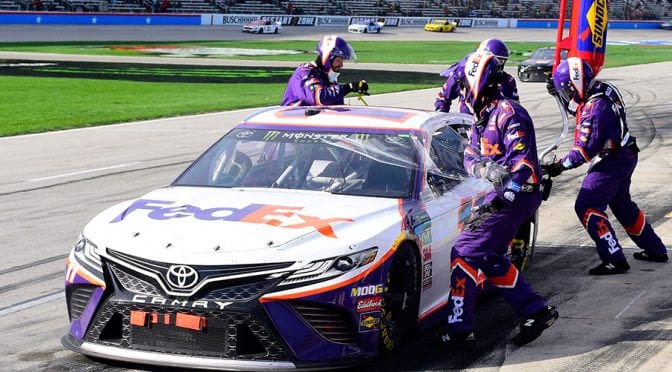
There are three certainties in life: Death, taxes and Denny Hamlin speeding on pit road.
Or so say the jokes on social media platforms following each of Hamlin’s transgressions. The driver of the No. 11 Toyota Camry, popped for speeding last Sunday on Lap 64, has become a popular subject for witty one-liners, but his prominence near the top of the list of frequent pit-road offenders has been exaggerated.
For one, he wasn’t the most frequent speeder among Joe Gibbs Racing drivers in 2017 or 2018. Matt Kenseth (seven) and Daniel Suárez (nine) led JGR in that category the last two seasons. Hamlin incurred 12 such penalties over the last three seasons, in line with current stablemate Kyle Busch’s 11. While JGR drivers aren’t pacing the field for yearlong totals — Michael McDowell earned 13 speeding penalties in 2018 alone — they are among the most penalized. But there’s good reason for it.
RELATED: See full Texas results
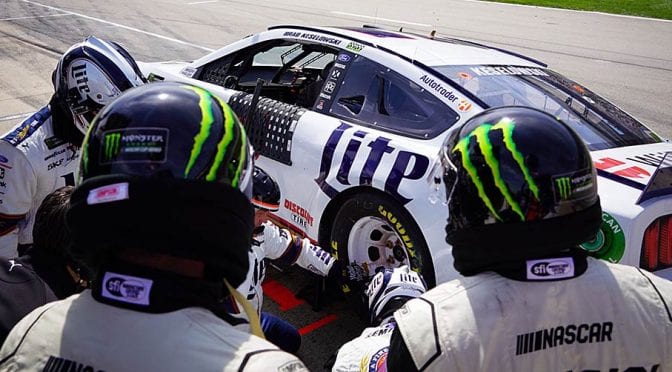
It’s an occupational hazard of a deliberate game plan — entering and exiting pit road to the very limit allowed by NASCAR — stemming from the organization’s never-ending quest for clean air and optimal track position.
Busch’s effectiveness in getting on and off pit road during the 2016 season was so much of an advantage, that it stands to reason why all JGR crew chiefs would want their drivers to emulate his effort. Hamlin’s most recent crew chiefs, Mike Wheeler and Chris Gabehart, have reputations for being aggressive on pit strategy. Wheeler proved a contrarian long-pitter early last season, while Gabehart is often credited for encouraging Busch’s knack for pushing the pit road pace while the two were paired together in the Xfinity Series.
As a whole, the four-car operation was caught speeding 48 times dating back to the beginning of the 2017 season, a strategic design apparently still in effect as of two days ago.
MORE: JGR makes history at Texas
Why the willingness to accept a penalty? Monster Energy Series race wins nowadays symbolize automatic berths into the playoffs, making every weekend a zero-sum game. They’re so valuable that the advantage of testing pit road’s speed limit comes with an opportunity cost for which JGR will happily pay. The organization’s resolve in the matter makes sense considering the speed of its cars — at least three of its cars ranked inside the fastest 11 in the series since the end of 2016, fast enough to reacquire most of the positions lost — and the notion that equal penalties have different ramifications.
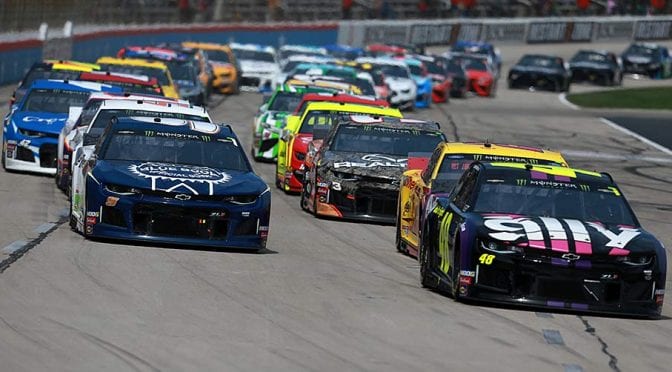
The timing of a penalty matters more than the maliciousness behind the act in question. A driver caught speeding on pit road under caution is banished to the tail end of the longest line on the ensuing restart with an immediate opportunity to win back the positions lost within a close-proximity pack. Hamlin wasn’t an elite restarter in years past, but he ranked among the top 15 for position retention on preferred groove restart attempts in each of the last two seasons. That’s possibly a good enough stature to green light the gamble.
A speeder under green-flag conditions must come back to pit road during the green-flag run, not only forfeiting track position but also valuable distance from cars higher in the running order, without the safety net provided by a restart.
While Hamlin’s speeding penalty at Texas occurred under green, it was just his fourth such penalty on non-drafting ovals in the last three years — pit-road speeding cost him 15 spots under green in the 2017 Coca-Cola 600, six spots in the first Las Vegas race last year and 15 positions in last year’s spring race at Texas — giant losses, to be sure, but rare instances among 120 total stops during green-flag runs.
It should be noted that during this span he did not receive such a penalty in a playoff race. Perhaps higher stakes prompt a more conservative approach?
Regardless, the impact of Hamlin’s pit-road speeding pales in comparison to its perception, even with the organization-wide modus operandi considered. It must not be a concern for Joe Gibbs Racing or else it would’ve been jettisoned from his team’s playbook. As long as his team’s speed remains consistently great, it shouldn’t be.
Hamlin and JGR likely will provide material to the social media comedians for years to come. The real joke, though, as long as Hamlin’s deliberate aggression helps game track position out of pit cycles, will be on his team’s surrounding competition.
David Smith is the founder of MotorsportsAnalytics.com and co-host of Positive Regression: A Motorsports Analytics Podcast. Follow him on Twitter at @DavidSmithMA.