MBM Motorsports announced Wednesday that Joey Gase will be its driver for the full NASCAR Xfinity Series in 2019. The team added an extra dash of newness with its car reveal.

Gase, 25, joined team owner Carl Long at the NASCAR Hall of Fame to take the wraps off a No. 35 Toyota Supra, the automaker’s long-anticipated model of choice for the Xfinity Series. The car, sporting sponsorship from Eternal Fan, was believed to be the first Supra shown in NASCAR race trim since the manufacturer’s official unveiling last summer at Daytona International Speedway.

“First time I saw it in person was this past weekend. I think it looks really cool and really different, not quite like a traditional stock car, for sure,” Gase said. “But I think it’s going to be really fast and I think we have a really awesome looking Eternal Fan car.”

RELATED: On the move: 2019 changes

Besides the Xfinity Series duties, Gase is scheduled for multiple races — as much as 90 percent of the schedule, Long said — in the Monster Energy NASCAR Cup Series with the No. 66 MBM team. That partial schedule will start with MBM’s attempt to qualify for the season-opening Daytona 500 (Feb. 17, 2:30 p.m. ET, FOX, MRN, SiriusXM NASCAR Radio).

“For the most part, I’m just happy to be on this side of it,” Long said, “and to have an experienced driver like Joey to get into this thing and start off the year running with performance, something that we feel like we’ve already achieved and we’re only going to get better.”

The organization also plans to field a No. 66 entry on the Xfinity side. Long indicated the crew chief hiring process was underway, with Gase’s involvement to help find the right fit.

Gase has made 30 Monster Energy Series starts over the past five seasons, running eight races last year for four different teams. He has been a full-time Xfinity Series competitor since 2014, driving last season for Go Green Racing and team owner Archie St. Hilaire.

Despite the switch, Gase will continue to fly the No. 35 he piloted last year — a car number that dates back to his days racing Late Models.

“The 35 number means a lot to Joey,” Long said. “The only thing I did was gave him a little design on the number, I thought. We’re all good.”

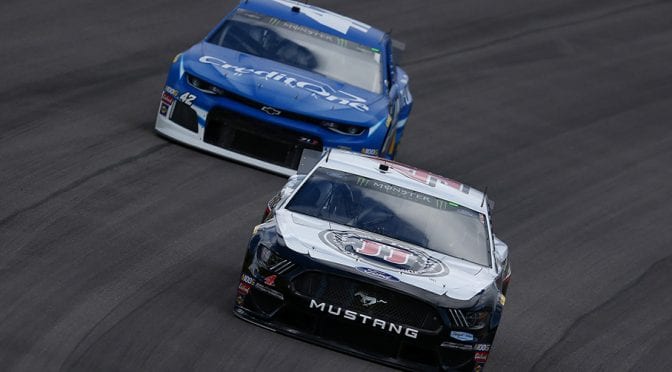
Kyle Larson’s got a slightly new look for his No. 42 Credit One Bank Chevrolet for the 2019 Monster Energy NASCAR Cup Series season.

The Chip Ganassi Racing driver’s car will sport a little more blue on the hood and in front of the grille. Another subtle difference is a white streak on the side of the car leading to the number. The splitter is also white instead of blue as it was in 2018.

RELATED: How did Larson fare in his Credit One Bank scheme in 2018?

Kyle Larson 2018 Credit One Paint Scheme
Kyle Larson’s 2018 Credit One Bank paint scheme. (Robert Laberge | Getty Images)

Credit One is in the midst of a multi-year association with Larson and CGR. The company sponsored 17 races of Larson’s in 2018.

The 26-year-old is entering his sixth season in the sport’s top series. The 2018 campaign saw Larson make the NASCAR Playoffs for the third straight year and finish ninth in the standings. He tallied 12 top fives, 19 top 10s and three poles on the year.

MORE: Recap Larson’s 2018 season | Career highlights for Larson

DAYTONA BEACH, Fla. — NASCAR has named industry veteran Jay Fabian as its Monster Energy NASCAR Cup Series Managing Director.

A respected leader within the garage area, Fabian previously served as the managing director of technical integration at NASCAR, where he oversaw post-race technical inspection at the NASCAR Research and Development Center in Concord, N.C. A consistent presence in all three NASCAR national series garages, Fabian’s versatile career has included roles as an over-the-wall crew member, a crew chief and, now, the managing director of NASCAR’s premier series.

“With his vast experience across the industry, Jay Fabian is uniquely suited for this position,” said Steve O’Donnell, NASCAR executive vice president and chief racing development officer. “Jay’s steady leadership and depth of knowledge are tremendous assets that will greatly benefit the series and all of NASCAR.”

Prior to joining NASCAR in April 2016, the Everett, Penn., native worked at Michael Waltrip Racing. During his 10-year tenure, MWR teams qualified for the NASCAR Playoffs in 2012, 2013 and 2015.

“This is a fast-paced sport that is constantly evolving, and I’m thankful for this opportunity and eager to take on the challenge,” Fabian said. “Racing has been my passion for as long as I can remember. There is growing anticipation for the 2019 season, and I’m looking forward to being a part of an outstanding team that will help build our sport.”

Fabian, with more than 25 years of motorsports experience, and NASCAR’s two other national series managing directors — Wayne Auton (NASCAR Xfinity Series) and Brad Moran (NASCAR Gander Outdoors Truck Series) — will report directly to Scott Miller, NASCAR senior vice president of competition.

Mooresville, N.C. – Ryan Truex will pilot the No. 71 Tommy Baldwin Racing Chevrolet in an attempt to make a start in the Monster Energy NASCAR Cup Series season opening Daytona 500 at Daytona International Speedway.

Taking after family history, Ryan Truex has ascended to the top of the motorsports ladder in just a few short years competing throughout the top tiers of the sport. Driving for several well-acclaimed teams such as Joe Gibbs Racing, Pastrana Waltrip Racing, BK Racing, Biagi DenBeste Racing and Hattori Racing Enterprises, Truex has made starts in all three top NASCAR series. This will mark Truex’s second attempt at qualifying for the Daytona 500.

MORE: On the Move: 2019 changes analyzed

“I am very thankful to TBR and Tommy Baldwin for this opportunity and can’t wait to get to Daytona and back in a Monster Energy NASCAR Cup Series car,” commented Ryan Truex. “The pressure is on to make it into the race, but Tommy is a true racer, and I know he will put everything into the car to give us a great shot.”

“I’m excited to have Ryan back in a Tommy Baldwin Racing car,” team owner Tommy Baldwin said. “We had success at Daytona in the NASCAR Xfinity Series in the past. I’ve known the Truex family a very long time, and it’s special that we’ll be able to compete in the Daytona 500 together, and hopefully more races as the year goes on. We are still in search of a primary sponsor that we’re hoping to put together in time to give TBR a great run this year.”

Mention the words “Chili Bowl” to a non-race fan and they’re likely to think you’re talking about what is on that day’s lunch menu. But for those within the racing community the Chili Bowl has nothing to do with food; instead it’s one of the most competitive races in all of motorsports. The event, which began Monday night and culminates with a 55-lap race on Saturday, brings together a diverse field featuring drivers across the motorsports spectrum — including some of NASCAR’s top talents — and represents a sort of “unofficial launch” of the 2019 racing season.

For those unfamiliar with the Chili Bowl, or for those seeking to better understand the buzz surrounding the annual event, here is a primer on what you need to know.

MORE: 2019 Chili Bowl Nationals preview

What exactly is the Chili Bowl?

The Chili Bowl Nationals is a multi-day event that sees drivers from around the world wheel Midget cars on a temporary quarter-mile dirt track constructed inside the River Spirit Expo Center in Tulsa, Okla.  This year, 360 drivers representing 33 states and five countries (Australia, Canada, New Zealand, United Kingdom and United States) are entered.

How does the format work?

Because of the volume of entries, multiple preliminary races are held Monday through Friday where each night two drivers lock themselves into the 24-car main event held on Saturday. That is the straightforward answer, though the actual procedure of how the field is whittled down each night to determine who advances out of each heat is far more complicated. Even the most ardent fan can be confused by the “alphabet soup” format that not only includes a driver’s finishing position but also has an element that takes into account how many passes they made in a specific heat. Honestly, if you would like a detailed breakdown the best thing to do is read this step-by-step process click this link.

How did the Chili Bowl did it get its now well-known name?

A race coined the “Chili Bowl” would seemingly have an interesting backstory on how its name came to be. In actuality, however, there is a pretty straightforward reason for how the Chili Bowl got its moniker when it was conceived by co-founders Emmett Hahn and Lanny Edwards: Sponsorship. When the first event was held in 1987, Bob Berryhill came on board to serve as the primary backer through his family-owned food company, The Original Chili Bowl. Berryhill continued sponsoring the race for the next three years and by that time the name stuck. And 33 years after its inception, the race continues to be called the Chili Bowl.

What is the difference between a stock car and the Midget cars used in this event?

As opposed to a NASCAR stock car, which is heavier and bulkier, a midget car is quite nimble with a high power-to-weight ratio. Midget cars also have open wheels, a feature that often results in drivers banging wheels during races causing cars to flip. During Chili Bowl week the number of cars that tumble are tallied with an official “flip count.”

What is Tony Stewart’s role?

A common sight at the Chili Bowl is Tony Stewart, himself a two-time race-winner, meticulously inspecting the racing surface. Not because he trying to glean advantage in pursuit of a third victory, but because the three-time Monster Energy NASCAR Cup Series champion is in charge of track preparation. It is a role the Stewart-Haas Racing co-owner takes quite seriously. Stewart begins grooming the track two weeks before the event, and during race week he devotes countless hours each day to maintaining the track with intent care.

What is the trophy that the winner receives?

The Golden Driller is a 76-foot tall statue of an oil worker stationed outside the River Spirit Expo Center, representing an industry synonymous with the Tulsa area. It is the sixth-tallest statue in the United States, and Oklahoma recognizes it as a state monument. Thus, when a trophy needed to be designed for the Chili Bowl it was natural that the winner receive a smaller version of The Golden Driller.

Who are some drivers entered with NASCAR connections?

There are several drivers with direct ties to NASCAR among the gaggle competing this week. Christopher Bell, who won a rookie-record seven Xfinity Series races in 2018, is the two-time defending champion and is a strong contender to score a third consecutive victory. Chip Ganassi Racing’s Kyle Larson is again entered and he has made it known how badly he wants to add a Chili Bowl win to his extensive résumé. Larson locked himself into Saturday’s main event with a dominant victory Tuesday night.

Other NASCAR drivers (past or present) entered include Rico Abreu, Justin Allgaier, Alex Bowman, Chase Briscoe, Landon Cassill, Kasey Kahne, Ricky Stenhouse Jr. and JJ Yeley.

Who are some of the other prominent drivers entered?

No driver has won more Golden Drillers than Sammy Swindell, who is back to pursue a sixth title this year. Bell (2017-2018), Abreu (2015-2016), Tracy Hines (2005), who previously competed full-time in the Gander Outdoors Truck Series, and Tim McCreadie (2006) are the other former winners entered.

Also worth noting is IndyCar driver Conor Daly; Karsyn Elledge, the niece of Dale Earnhardt Jr.; 2018 Knoxville Nationals winner Brad Sweet; and Toyota Racing Development prospect Logan Seavey, who’s drawn comparisons to Bell.

Front Row Motorsports revealed its crew chief lineup Wednesday for the 2019 Monster Energy NASCAR Cup Series, with two new faces added to its newly expanded three-team fleet.

Drew Blickensderfer will work with the No. 34 Ford team and driver Michael McDowell this season. Fellow veteran Mike Kelley joins the FRM fold atop the pit box for the No. 36 Ford and Sunoco Rookie of the Year candidate Matt Tifft. Seth Barbour returns to the No. 38 operation for a second season as crew chief for David Ragan.

RELATED: On the move: Tracking 2019’s changes

The team also announced that Derrick Finley has assumed the new role of technical director. Finley was McDowell’s crew chief last season with the No. 34 team and served in the same role for Ragan’s No. 38 in 2017. The team also indicated that Donnie Wingo will return to the Bob Jenkins-owned organization as competition director.

Blickensderfer previously worked with Richard Petty Motorsports, where he first teamed with Marcos Ambrose near the end of the 2012 season. He was paired with Bubba Wallace for his rookie season in RPM’s No. 43 last year. Blickensderfer has served as the crew chief for three wins in NASCAR’s top division: two with Matt Kenseth in 2009 and one with David Ragan during their time with Roush Fenway Racing in 2011.

RPM wished Blickensderfer well in a statement issued later Wednesday: “Drew Blickensderfer has been a great leader at Richard Petty Motorsports (RPM) over the past six seasons, including leading Bubba Wallace in his history-making rookie season. We wish him the best in his future endeavors. We will announce a new crew chief at the appropriate time. Director of Competition, Philippe Lopez, will continue to lead the competition business as we prepare for the 2019 season.”

Kelley heads back to the Monster Energy Series after a long tenure with Roush Fenway. He has 12 NASCAR Xfinity Series wins as a crew chief and led Ricky Stenhouse Jr. to back-to-back titles on that circuit in 2011-12. He spent last season with Roush Fenway’s No. 60 Xfinity team.

Barbour returns to Front Row Motorsports with Ragan. Like Blickensderfer and Kelley, he also has ties to Roush Fenway Racing, serving as a crew chief in the Xfinity Series from 2013-17 and a team engineer before that term. Ragan ranked 25th in the Monster Energy Series final standings in 2018, Barbour’s first full year as a crew chief in NASCAR’s top division.

‘Names are made here’ is the slogan of the NASCAR Xfinity Series and there are plenty of names looking to make their mark during the 2019 season. Tyler Reddick returns to defend his championship, albeit with a new team, while fellow Championship 4 participants Christopher Bell and Cole Custer return to their rides at Joe Gibbs Racing and Stewart-Haas Racing, respectively.

There are also several returning players in the mix like Justin Allgaier (No. 7 JR Motorsports Chevrolet), Austin Cindric (No. 22 Team Penske Ford) and Brandon Jones (No. 19 Joe Gibbs Racing Toyota). Noah Gragson (No. 1 JR Motorsports Chevrolet), John Hunter Nemechek (No. 23 GMS Racing Chevrolet) and Justin Haley (No. 11 Kaulig Racing Chevrolet) lead a host of fresh faces in full-time rides.

So just who is the favorite for the 2019 Xfinity Series crown? NASCAR.com’s Jessica Ruffin and RJ Kraft debate who will be the next driver to make their name in the Xfinity ranks.

RELATED: Drivers on the move for 2019 |  Xfinity Series schedule for 2019

RUFFIN: As a rookie in the Xfinity Series last season, Christopher Bell notched a series-best seven victories, including three in the playoffs. When he wasn’t visiting Victory Lane, Bell’s No. 20 Toyota was running consistently in the top pack; his season included 18 top-five results and 759 laps led, topping the series in both categories.

Beyond his finishes, though, Bell showed the ability to persevere when faced with a setback last season. He headed into the penultimate elimination race at ISM Raceway in a must-win situation and did just that, rallying from a 38th-place starting spot to clinch the victory and the Championship 4 spot. While the 24-year-old wasn’t able to clinch the title at Homestead-Miami Speedway — finishing fourth in the standings to champion Tyler Reddick — that’s only motivation for the sophomore driver, who won the 2017 Gander Outdoors Truck Series title. Couple his 2018 heartbreak with a full year of experience in the Xfinity Series and it just may pave the way for Bell to notch his second NASCAR championship.

KRAFT: Bell will be a factor and he certainly could put up the better overall season. For me, though, I am going with Cole Custer as the Xfinity Series title favorite in 2019. He showed significant growth in 2018 as he doubled his top fives (14 in ’18 after seven in ’17), tallied 26 top 10s in 33 races and racked up six pole positions. His 9.0 average finish is best among returning series regulars — Bell’s was 11.1 last year. While Custer only had one win in 2018, expect him to tack on a few more of those in 2019.

The real reason I like Custer as the title favorite: His runs at Miami — site of the Championship 4 race — over the past two years. The title comes down to a one-race shootout among four drivers and his stats there position him better than almost everyone at coming away with the championship. He won the race at the 1.5-mile track in 2017 as he led 182 of a possible 200 laps despite not being in the Championship 4. Last year, he led 95 laps and looked to be the dominant car before some questionable pit strategy left him scrambling to catch Reddick, the eventual winner and champion, and he finished second.

JOHNSON, MONAHAN & BOURGEOIS ALSO HONORED

THOMPSON, Conn. — Thompson Speedway Motorsports Park honored four NASCAR Whelen All American Series champions in 2018.

As Thompson‘s Division I NASCAR champion, Keith Rocco leads the list as he celebrated another crown behind the wheel of the No. 57 Sunoco Modified driving for the Pane family. The title was Rocco‘s seventh NASCAR title on the Connecticut high-banks, and his 16th in the history of track titles in the NASCAR Whelen All American Series across the country.

In seven events, Rocco won four races, including the opening race of the season with the 30-lap Icebreaker. In the finale, Rocco was swept up in a wreck under caution, but luckily for him, he didn‘t need to finish towards the front in order to seal the crown. His consistency through the first six races, which included six finishes inside the top five, was enough to give him a 20-point lead in the final tally. Todd Owen finished second, while Kyle James, who had just three top-fives, was able to finish third.

In his first championship run, Rehoboth, Massachusetts, driver Nick Johnson took the Late Model division by surprise in 2017. Johnson didn‘t visit Victory Lane throughout the seven-race schedule, but worked consistently inside the top five and entered the Sunoco World Series in prime position to clinch. But, with four drivers in striking distance entering the race, Johnson had to drive the car to its limits in the final 25-lap feature of the season.

He finished fifth, which was just enough, as he bested Tom Carey III by three points, and Mark Jension, who won the finale, by just 13 points. William Wall finished fourth, back by 15. Johnson‘s career includes racing just across the boarder in Massachusetts as well, where he won his first Pro Stock race at Seekonk Speedway last September. Johnson was honored inside the Clubhouse as Thompson‘s Late Model top contender, joining William Wall as the two most recent champions of the division.

THOMPSON SPEEDWAY: Final 2018 Point Standings | 2019 Schedule

“Not at all,” Johnson said at the World Series when asked if he thought winning the title at the beginning of the season was possible. “My immediate thought was I just wanted to come and win. We didn‘t even think we were going to run a full-time schedule, but one thing leads to another.”

For the second straight year, Shawn Monahan captured the Limited Sportsman title as part of the NASCAR Whelen All American Series. Monahan reversed his 2017 effort, where he didn‘t visit Victory Lane, and won four races in 2018 driving the No. 55 in a competitive class where 39 drivers took at least one green flag.

His second straight crown came with a 49-point gap in the standings.

“I couldn‘t be more proud of the team and more blessed to be where I am today,” Monahan said after clinching the crown. “If you had asked me at the beginning of the season, I would‘ve said that it‘s impossible because of the talent this division has. The difference between myself and the rest of the competitors is simply that I have been in the right place, at the right time.”

And finally, in the Mini Stock division, a veteran proved that he was ready to hang up his helmet in style. East Haddam, Connecticut, driver Eric Bourgeois found himself with a 27-point advantage in the standings, besting the 2017 champion Wayne Burroughs Jr. for the title. Bourgeois, who introduced his son Evan to the Mini Stock division on the track over the last few years, is retiring from full-time racing to focus his time on wrenching through the No. 78 Mini Stock for his son.

In fine fashion, Eric celebrated another Mini Stock title as he career running for points officially comes to a close.

With the banquet now in the rear-view mirror, Thompson has officially turned the calendar to the 2019 season as racing is just three months away from taking the green flag. A revamped schedule, which includes 10 races, begins with the Icebreaker weekend from April 5-7, headlined by the third race of the season for the NASCAR Whelen Modified Tour.

Dw96hovwwaeatx0

When it comes to a sure-bet NASCAR Hall of Fame inductee, Roger Penske undoubtedly sits high on that highly-revered list. 

The 81-year old owner and Team Penske namesake is perhaps the most legendary and renowned team principal in all of motorsports with two NASCAR premier series championships – including just last season with Joey Logano – and Daytona 500, Indy 500 victories and IndyCar titles, too. 

His team has 114 Monster Energy NASCAR Cup Series race victories – including the Daytona 500 and Brickyard 400 – spread out among nine drivers; four of them Cup champions at some point in their careers, and two of them Hall of Famers themselves poised to welcome him among NASCAR’s most celebrated elite.

RELATED: Meet the 2019 inducteesEvery Cup win for Team Penske

Penske is part of an illustrious list of 2019 NASCAR Hall of Fame inductees that includes the late Cup drivers Alan Kulwicki and Davey Allison, fellow team owner Jack Roush and four-time Cup champion Jeff Gordon, who will all officially enter the sport’s great Hall of Fame on Feb. 1.

For Penske’s recognition, it was always a matter of “when,” not “if.”

“He’s always growing, always learning, and no matter how successful he is, or how successful he is in his life, he’s always willing to take the time to learn technology, to learn about things in general,” said Team Penske driver Brad Keselowski, who earned Penske’s first NASCAR premier series championship in 2012.

“In motorsports and business, technology is always evolving and you’ve got to keep up with the times. His ability to do that and his self-motivation to do that is really unparalleled next to any other person I’ve ever seen in my life.

“He’s committed to always growing and always learning and that’s the number one thing I take from him.”

It certainly helps explain Penske’s staying power at the “top.”

While he is widely renowned for his work leading a race team, Penske actually began his racing career as a driver. After earning a degree from Pennsylvania’s Lehigh University, Penske immersed himself in the racing scene. He collected cars and raced cars, and in his mid-20s competed in events around the world, beating competitors – racing legends even – such as Bruce McLaren, Dan Gurney and A.J. Foyt.

When it comes to his NASCAR Hall of Fame honors, however, Penske will be best celebrated for his work as a leader outside the race car – a team owner, a driver Svengali, a mechanical marvel, an intense competitor always ahead of his time.

The legendary Mark Donohue scored Penske’s first NASCAR premier series team victory – a win in the 1973 season-opener on the Riverside, Calif. road course. At the time Penske dabbled in stock cars while running full force in IndyCar. NASCAR Hall of Famer Bobby Allison won four races for Penske in the mid-1970s and competed full time – 30 races – in a singular season (1976).

RELATED: Penske reacts to milestone win

But Penske didn’t fully establish a lasting full-time presence in NASCAR until 1991 when he hired the 1989 Cup champion Rusty Wallace to drive his No. 2 Pontiac. It didn’t take long for the pairing to sync up. Wallace won the sixth race of the 1991 season – from the pole position – at Bristol then won again at Pocono that summer. It was the beginning of a strong relationship and mighty competitive offering that claimed 37 trophies (most among Penske’s Cup drivers) before Wallace retired following the 2005 season. The two hoisted winner’s trophies in 12 of Wallace’s 15 seasons with the operation.

“One thing I’m so fond of, is his ability to understand and tackle things,” said Wallace, a NASCAR Hall of Famer (Class of 2013) himself. 

“Roger’s not just a smart CEO that runs a big company, he knows about engines, rear ends, brakes, tires and all the mechanical stuff about the car, and when you’re talking after practice he can talk all that smack with you. He knows it all instead of being an owner that doesn’t really know what’s going on.”

That’s become increasingly evident in NASCAR, where Penske is racking up statistics, accolades and big race trophies similar to what he does in open-wheel racing. Penske has three IndyCar championships and an unprecedented 17 wins in the Indianapolis 500 – the latest coming last May with driver Will Power.

In NASCAR, Penske has reached Cup Series Victory Lane with nine drivers – starting with Donohue, Allison, Wallace, add Jeremy Mayfield in 2000, the 2008 Daytona 500 winner Ryan Newman, former Cup champion Kurt Busch and Penske’s own Cup championship twosome of Keselowski and Logano. The team’s newcomer – 25-year old Ryan Blaney – won for Penske in his first year with the operation, claiming the 2018 Charlotte road course race.

And still, for each race trophy, for each championship, Penske remains humble and proud of a job well done by a hand-picked organization of high achievers and big dreamers.

“For me, 33 championships (across all racing genres) that gives us as Team Penske, and certainly to get the Indianapolis race, the Southern 500, and now to think that we’re the champion of 2018 for the Monster Energy NASCAR Cup Series is something that I never imagined at the beginning,’’ Penske said last November after Logano won the series championship at Homestead.

He added, “There’s really three things that are really ‑‑ I think ‑‑ every time I think about how we succeed and how we can be better, one is what’s your brand.

“And this kind of winning, not only on the racetrack but in business, drives a great Penske brand, which has been terrific. I think technology is so important when you think about what technology has done to us in business and think about the technology up and down pit lane. You’re got to be on top of it.

“But underlying that and the foundation of everything else is your people. If I can manage those three pillars, I think we’ll continue to have success.”

That success – from race trophies to the first-class buttoned-up operation that Penske brings to each race series – has absolutely resulted in the kind of victory and acclaim that has earned “The Captain” – as he is nicknamed – the well-deserved honor of NASCAR Hall of Famer.

“I think for Roger, who’s done everything there is to do in IndyCar and other forms of motorsports, to get into the world of NASCAR and be able to go in to the Hall of Fame with the driver who helped bring him into NASCAR, back in the early 90s – to have him win a Cup championship, go into the Hall of Fame. … I think it’s pretty special for him,” Wallace said. “When I talk to him, he’s pretty darn excited about it.

“He’s checked all the boxes on everything and rightfully so. He deserves this and he’s in.”

Joe Gibbs Racing announced Tuesday the creation of the J.D. Gibbs Legacy Fund in honor of its team co-founder and former president, who died Friday after a long battle with a neurological illness.

RELATED: J.D. Gibbs, 1969-2019

The team also announced that public memorial services will be held Friday morning, Jan. 25 at Belk Arena at Davidson College. The organization asks that in lieu of flowers for the memorial service to please consider a donation to the legacy fund.

The J.D. Gibbs Legacy Fund will benefit Young Life Ministry, a program that Gibbs actively participated in at the local and national level. The fund plans to reach youngsters of all socioeconomic backgrounds and provide financial support for facilities at Young Life’s Windy Gap Camp in Weaverville, North Carolina.

Gibbs, the eldest son of Coach Joe Gibbs, passed away at age 49 after fighting a chronic, degenerative neurological condition. His death was met with an outpouring of support and tributes from the NASCAR community for his role as a crew member, driver, and determined team executive.