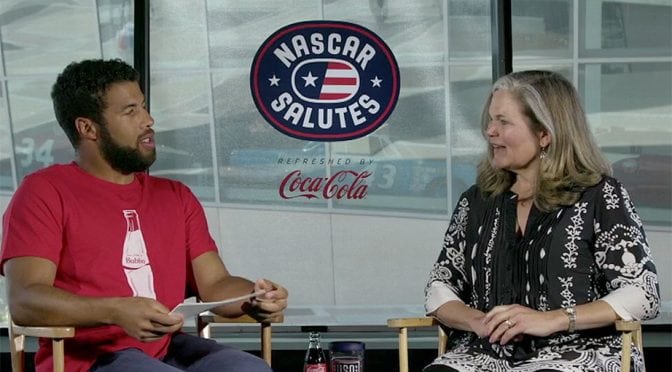
Bubba Wallace and fellow Monster Energy NASCAR Cup Series drivers are helping to honor military spouses as part of the NASCAR Salutes Refreshed by Coca-Cola program, and he recently interviewed Kristen Christy, the Armed Forces Insurance 2018 Air Force Military Spouse of the Year.
Christy’s entire life is intertwined with the Air Force and service. Her father served for 32 years and lived all over the world in joint assignments. Her first husband served for 18 years before his passing, and her new groom is an Air Force Reservist with 13 years of service.
Suicide prevention is important to Christy, whose first husband committed suicide following his service in Iraq. She sees prevention as an aspect of an overarching issue of helping people overcome obstacles and wants to use her own resiliency and lessons learned to help others transition from PTSD (Post-Traumatic Stress Disorder) to PTG (Post-Traumatic Growth).
“You know if you want to get something done you go to a military spouse,” Christy says. “We have to make lemonade out of lemons all the time.”
She says she draws strength and optimism from the NASCAR fan base and seeing all the appreciation at the track.
“That fan base is so patriotic! And to see those flags flying and the flyovers at those races … it just makes your heart soar,” said Christy of NASCAR’s special races honoring military service members and their families. “It kind of gives us more energy to be at our best and do what we do.”
On behalf of Kristen, NASCAR & Coca-Cola will donate to USO programming that supports and strengthens military spouses. Through the USO Unites pillar, the USO provides national and local programming that helps to nurture and maintain a strong bond between service members, their families and the community. Through programs focused on connection, strengthening, wellness and resiliency, the USO expresses America’s gratitude and commitment to service members and their families.
“Having Coca-Cola step in and donate to the special programs really means a lot and gives back to them,” Wallace said. “I feel like we should always do more. So it’s nice to be part of a sport and a company that’s willing to lay it all on the line just like they did for us.”
Through the Coke Zero 400 at Daytona, Coca-Cola Racing Family drivers will honor a military spouse each week in support of the USO’s Salute to Military Spouses. Stay tuned as Kyle Larson and Joey Logano each interview a military spouse to help share their respective stories. And click here to see Denny Hamlin, Austin Dillon and Ryan Newman’s interviews with servicemembers’ spouses.
The Nos. 2 and 11 teams in the Monster Energy NASCAR Cup Series incurred safety violations following the racing action last weekend at Chicagoland Speedway. Both cars were found to have one lug nut not properly installed in post-race inspection.
Crew chiefs Paul Wolfe (No. 2) and Mike Wheeler (No. 11) were each fined $10,000. Brad Keselowski drove the No. 2 Team Penske Ford to a ninth-place finish in the Overton’s 400 while Denny Hamlin was seventh in the No. 11 Joe Gibbs Racing Toyota.
In the NASCAR Xfinity Series, the No. 19 Toyota was found to have one lug nut not properly secured. Crew chief Chris Gabehart was fined $5,000. Brandon Jones finished 11th in that Joe Gibbs Racing car on Saturday.
DAYTONA BEACH, Fla. (July 3, 2018) – For the third year in a row, NASCAR Xfinity Series™ drivers will bear the names of active military units and installations on their race car windshields during Friday’s Coca-Cola Firecracker 250 at Daytona International Speedway (7:30 p.m. ET on NBCSN/NBC Sports App, MRN and SiriusXM NASCAR Radio), part of a continued effort to show appreciation for the United States Armed Forces through NASCAR Salutes Refreshed by Coca-Cola.
Military units and installations like the USS Arizona Ship-14, 701st Military Police Battalion and Nellis Air Force Base are among the groups from all five branches of the U.S. Armed Forces that will replace the Xfinity header on NASCAR Xfinity Series cars.
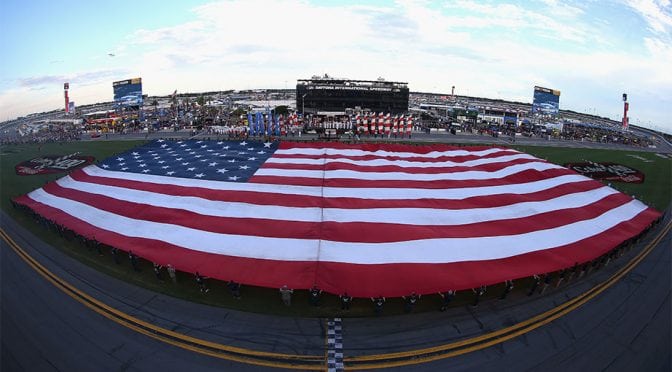
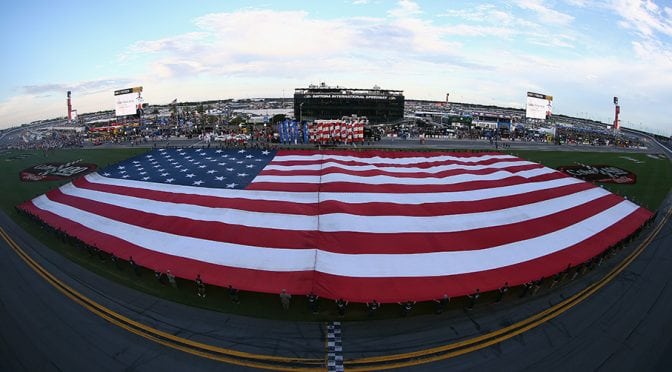
On Saturday, fans will once again join in a moment to “Rise to Honor” service members during the pace laps preceding the Coke Zero Sugar 400 (7 p.m. ET on NBC, MRN and SiriusXM NASCAR Radio).
“The tradition of honoring the U.S. Armed Forces on Independence Day Weekend is something our fans have always taken pride in,” said Jill Gregory, NASCAR executive vice president and chief marketing officer. “All across the world, U.S. military units and bases are working around the clock to protect our country’s freedom and this is the NASCAR industry’s way of showing appreciation for that commitment and sacrifice.”
Sean Gardner | Getty Images
NASCAR Xfinity Series teams were again given the opportunity to identify a unit or installation to honor for the Coca-Cola Firecracker 250, while NASCAR worked with Comcast’s Military and Veteran Affairs team to match units with remaining teams for the tribute.
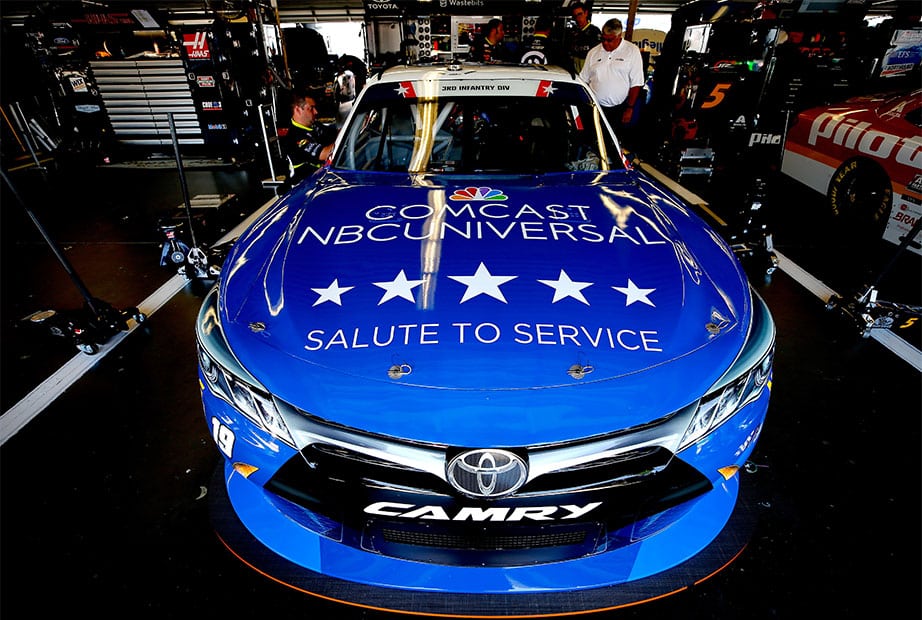
NASCAR Xfinity Series driver Brandon Jones will pilot the No. 19 Comcast NBCUniversal Salute to Service Toyota during the Coca-Cola Firecracker 250 and honor the United States Air Force Thunderbirds based in Las Vegas, Nevada.
“It’s such a privilege to pay tribute to those who serve our country each year at Daytona, and we’re thankful Comcast feels the same, providing a prominent place to honor military units on our windshields,” said Jones. “We get to race because of sacrifices men and women made and continue to make to protect our country, and this is just one way we can thank them for their service.”
Members from the military bases and installations honored on the NASCAR Xfinity Series race cars will be hosted throughout the race weekend. NASCAR Troops to the Track presented by Coca-Cola will welcome service members from U.S. Coast Guard Station Port Canaveral based in Cape Canaveral, Florida; U.S. Coast Guard Station Mayport based in Atlantic Beach, Florida; USS Georgia (SSGN 729) homeported in Kings Bay, Georgia; and USS Maryland (SSBN 738), also homeported in Kings Bay.
Additionally, Comcast will host 25 service members and their families from Fort Stewart USO, Central Florida USO and Jacksonville USO; while Coca-Cola plans to host USO guests from Joint Base Lewis-McChord, Tacoma, Washington and Peterson Air Force Base, Colorado Springs, Colorado as well.
Like last year (pictured), plenty of patriotic paint will be on display at Daytona. Sean Gardner | Getty Images
Multiple drivers and team members have connections to the installations being honored on their cars, such as driver Kaz Grala’s PR rep Jessica Trippy, whose father, Retired Colonel Joe Trippy, served as a U.S. Air Force C-130 pilot and the Vice Wing Commander for the 920th Rescue Wing from 2003 to 2007.
Others include Ross Chastain, whose team is honoring the 701st Military Police Battalion in honor of Chastain’s friend, Sergeant Major Jason VanKleeck; and Elliott Sadler, whose rear mechanic Jeffrey Schmidt is the brother-in law of Chad Daugherty, who serves in the 1st Squadron, 180th Cavalry Regiment, 45th Infantry Brigade Combat Team.
The weekend-long tribute at Daytona is the culmination of the seven-week NASCAR Salutes Refreshed by Coca-Cola program (#NASCARSalutes) – the industry’s collective expression of gratitude for those who bravely served and continue to defend the United States today. Several other activities have taken place around the program in recent weeks, including a special activation between Coca-Cola and the USO.
To shine a spotlight on the military spouse community, the USO launched a six-month Salute to Military Spouses in May and proudly partnered with Coca-Cola to specifically honor the Armed Forces Insurance Military Spouses of the Year at NASCAR races as part of NASCAR Salutes Refreshed by Coca-Cola. In addition, NASCAR and Coca-Cola made donations in each spouse’s name to USO programming supporting military spouses and families.
Coca-Cola Racing Family drivers were paired up with a Military Spouse of the Year branch winner and interviewed them to learn about their stories and the USO programs important to them. Coca-Cola Racing Family driver Denny Hamlin interviewed Marine spouse Jolynn Lee, Austin Dillon interviewed National Guard spouse Sheila Brookins, Ryan Newman interviewed Coast Guard spouse Stacy Bilodeau, Kyle Larson interviewed Navy spouse Brian Alvarado, Bubba Wallace interviewed Air Force spouse Kristen Christy, and Joey Logano interviewed Army spouse Krista Anderson.
These spouses’ stories continue to be shared on NASCAR.com and social media channels as the campaign concludes this weekend at Daytona International Speedway.
For the 10th consecutive year, Daytona International Speedway will honor three Medal of Honor recipients throughout the race weekend. Honorees include Sergeant First Class Gary Littrell of Henderson County, Kentucky; Master Sergeant Leroy Petry of Santa Fe, New Mexico and Staff Sergeant Don Jenkins of Quality, Kentucky.
In addition, all military members and their families will have access to a pair of Midway suites within the Daytona facility on Saturday where they can take a break from the busy day of activities to cool off and enjoy complimentary Coca-Cola products and snacks. The suites will be accessible from 3:30 p.m. through the end of Stage 1 of the Coke Zero Sugar 400. Throughout the day, various special guests will visit the suite and participate in Q&A sessions including Monster Energy NASCAR Cup Series driver and 2008 DAYTONA 500 champion Ryan Newman at 4:40 p.m.
Tickets to NASCAR national series events are available at NASCAR.com/tickets.
Daytona International Speedway President Chip Wile has been hard at work preparing for Saturday night’s Monster Energy NASCAR Cup Series Coke Zero Sugar 400 (7 p.m. ET on NBC/NBC Sports App, MRN, SiriusXM NASCAR Radio) and Friday night’s NASCAR Xfinity Series Coca-Cola Firecracker 250 (7:30 p.m. ET, NBCSN/NBC Sports App).
Involved in planning for an always unpredictable July event at the 2.5-mile Florida track includes taking a tour of the Sunshine State, as Wile has traveled from Jacksonville to Tampa and everywhere in between throughout June to spread the news of how seeing racing at Daytona in person is simply special.
“You need to see it live to really appreciate the sensation of speed and all the things that go along with the race,” Wile told NASCAR.com. “But, it’s not just a race. It’s an experience. From the time you set foot on the property until the time you leave, there’s so much to do and see.”
Wile has a huge task ahead of him each year to prepare for two of NASCAR’s biggest events — July’s patriotic celebration of speed at the World Center of Racing, along with the sport’s marquee event, the Daytona 500 in February.
Of course, there are major differences between the two events, including the warmer temperatures in July that make the Daytona high banks super slick for competitors.
“I say this to people all the time, there’s a difference between the Coke Zero Sugar 400 and the Daytona 500,” Wile said. “It’s a great opportunity for our local and regional fans to come out and enjoy the Daytona International Speedway and experience the $400 million renovations that we completed a couple years ago and see how coming to a race at Daytona is different.”
There will also be plenty of patriotism to go around Saturday night, especially with Daytona serving as the finale of the NASCAR Salutes Refreshed by Coca-Cola initiative. This race weekend caps off six weeks of honoring our nation’s heroes — another reason why the July classic stands out.
“This is a very different weekend for us,” Wile said. “The summer race is different than the 500 because we do love honoring our servicemen and women. NASCAR does a great job each and every week recognizing our military and making sure they know we appreciate them and the job that they do to keep us free.”
“We have one of the largest fireworks displays in the Southeast happening at the conclusion of the Coke Zero Sugar 400,” added Wile. “We’ll honor our military and celebrate our country’s independence this weekend with Medal of Honor recipients that will be part of our festivities.”
For Wile, having the ability to honor those who serve, both past and present, on NASCAR’s biggest stage is something he takes great pride in each year.
“It’s an incredible honor for everyone at the race track to host these true American heroes,” Wile said. “And certainly we’re going to honor our servicemen and women before the start of the Coke Zero Sugar 400 with the ‘ Stand and Salute.’ I think that’s a great way to recognize the servicemen and women who are on the property representing their branches of military. We’re going to have a couple other surprises for fans who are on site that will really tug at their heart strings.”
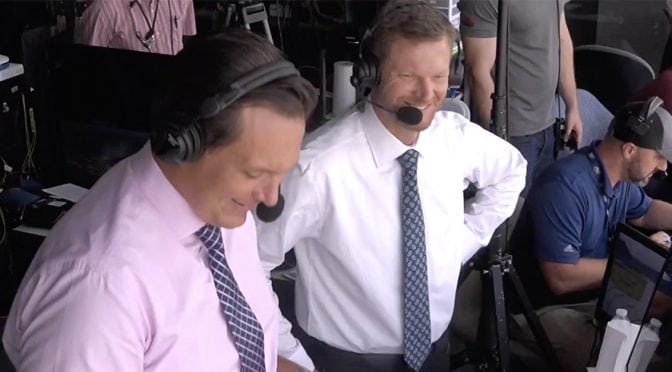
The deep appreciation Dale Earnhardt Jr. carries for NASCAR’s history includes him often re-watching races from decades before. It was fitting then that Sunday his debut Monster Energy NASCAR Cup Series broadcast as a full-time NBC analyst just happened to be a race harkening to the classics Earnhardt likes to view.
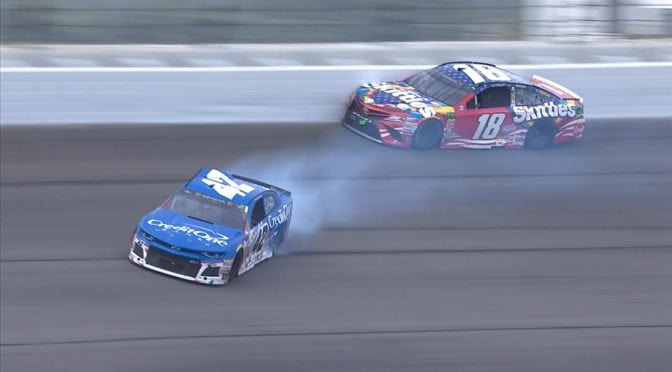
A thrilling last-lap duel featuring Kyle Busch and Kyle Larson saw them bump-and-bang off one another multiple times, culminating with Busch nudging Larson out of the lead in Turn 3, then maintaining control of his battered car to drive it across the finish line to win the Overton’s 400 at Chicagoland Speedway.
“That’s all Dale Jr. right there,” Busch said of the finish. “It’s 70s-, 80s- [esque].”
During the buildup to the stirring finish and on the final lap itself, Earnhardt shined in his new role, displaying an acumen for broadcasting that gives every indication he will be as successful in the broadcast booth as he was on the track.
As Larson chased down Busch to overcome a multi-second deficit, Earnhardt adroitly explained how Larson was able to make the high groove work to his advantage while Busch preferred the low section around the mile-and-a-half track. And when the Chip Ganassi Racing driver eventually caught Busch, Earnhardt highlighted how Busch had altered his corner entry to counteract Larson’s advantage and what Larson needed to do in response.
Then, as Larson went for the lead diving underneath Busch entering Turn 1 on the white flag lap, Earnhardt knew exactly what was coming, excitedly yelling “Slide job!” even before Larson made his brazen bid for the victory in a soundbite that in all likelihood will become part of NASCAR lore.
It was a sequence exemplifying Earnhardt at his best. Demonstrating his ability to mix his knowledge and perspective that allowed him to correctly anticipate what was to come with a folksy enthusiasm that made it sound as if he was sitting at the bar watching the race with buddies.
That Earnhardt’s debut was a smash is no surprise. During cameo TV appearances as a NASCAR analyst before retiring from full-time racing following the 2017 season, it was apparent Earnhardt possessed the ability to become his generation’s Benny Parsons — a star driver turned beloved broadcaster whose analyst skills actually superseded what had been a hall of fame career.
But there is more to becoming an ace analyst than a former driver simply exchanging their helmet for a headset, even if they have the charisma to connect with the audience. It takes work, something Earnhardt acknowledged he needed to put in if this career transition was going to be deemed a success.
With an eye on becoming a media personality once his racing career concluded, Earnhardt began in earnest preparing for this venture even before announcing his retirement.
Instead of just occasionally hosting a popular podcast that bared his name, Earnhardt became the full-time host prior to the 2017 NASCAR season, thus acclimating himself to the preparation, routine and production that goes into making a show. There were also stints this past February where he served as a roving reporter during NBC’s broadcast of the Super Bowl and Winter Olympics, where Earnhardt made sure to step outside his comfort zone and attempt things he previously would not have considered doing.
And in the lead-up to his debut Sunday, Earnhardt took part in several mock broadcasts where co-analysts Jeff Burton and Steve Letarte, and Rick Allen (play-by-play) would call a Cup race to gain familiarity and develop chemistry with one another.
Their strong rapport was on full display where the four enjoyed seamless banter in describing the action at Chicagoland — especially among Earnhardt and Letarte, his former crew chief, with the two respectfully disagreeing at times but also acting as a nice complement in their differing viewpoints on how things would unfold. When Busch crossed the finish line, Earnhardt and Letarte exchanged high-fives over the electric conclusion they had just witnessed.
“I knew that I was going to get along great with my teammates, so I’m not surprised I had a blast with them,” Earnhardt said post-race in a live video stream on Periscope. “We’re going to have a good time this year. I got a lot to learn and there is a lot more I can provide, and as I get better and understand some of the things that are going on [in the broadcast booth] I’m sure things will continue to get better.
“First broadcast was a big hit, I feel like.”
There is little question Earnhardt’s foray into full-time broadcasting exceeded expectations. Of course, being able to call a rousing finish that certainly gave him and his NBC colleagues plenty to discuss only helped.
Nonetheless, Earnhardt deserves credit for contributing to what was a memorable race Sunday. A fantastic ending featuring two of NASCAR’s best made all the better by an enthusiastic analyst who enhanced what was transpiring before him – while avoiding the cheesiness that can often overcome a broadcaster in that moment.
Q. How did you first become interested in NASCAR? “I come from a racing family, so as a family, as far back as I can remember, Saturday nights were spent at the dirt track, and Sunday afternoons were always spent watching the NASCAR race. I got a Dale Earnhardt car for Christmas when I was 8, and I have been a diehard Earnhardt fan since then. I got to go to my first race, Talladega, when I was 12 years old… that was 25 years ago, and I have been to Talladega EVERY year since then!!! There’s nothing like experiencing a NASCAR race in person!”
Q. What makes NASCAR special for you? “I like the non-stop action. I like the driver personalities, the pit strategies, the speed, and the skill.I like that NASCAR makes sure to keep the field competitive. I like that it’s a high intensity sport that is also family friendly. I like that NASCAR seems like a family community.”
Q. Do you have any favorite NASCAR memory? “My favorite NASCAR memory has to be the very first race I ever attended.It was Talladega Superspeedway back in 1993. I was 12 years old, and I will never forget the feeling of those cars coming by the first time at full speed. I was sitting with my family on the 2nd row and could feel the rumble in my chest as the field roared past. I was cheering on my driver, Dale Earnhardt, who led quite a bit that day.In the end, we watched as Rusty Wallace flipped violently in the grass crossing the finish line. I will never forget my first NASCAR race!”
Q: Do you have a favorite in any of the following categories? Drivers: “Jimmie Johnson and Clint Bowyer. Jimmie Johnson, because he is possibly the greatest driver ever, and I would like to go on a run with him. I am a runner myself and I think that would be cool. Clint Bowyer because he knows how to have a good time, and there’s no way that wouldn’t be fun!”
Track: “Talladega Superspeedway”
Sponsor: “My favorite NASCAR sponsor would have to be Chevrolet.I have always supported Chevy drivers and always driven Chevy trucks.They have supported NASCAR for so long and have a long history of winning!”
NASCAR Snack: “I love the Talla-mento Dogwitch at Talladega… with an ice cold beer of course!”
Q: What do you like to do in your free time? “I love spending time with my wife and daughter.My daughter is 5 and she loves Dale Jr and Jimmie Johnson!!!I am also a runner, and love to spend time running each day.”
FROM ALL OF US AT NASCAR, WE THANK NATHAN FOR HIS CONTINUED SUPPORT AND LOOK FORWARD TO HEARING FROM HIM IN 2018!
Two of the foundational pillars of NASCAR are hard-nosed racing and rivalries. Sunday’s finish between Kyle Busch and Kyle Larson at Chicagoland Speedway showed that those two principles don’t have to overlap.
Petty vs. Pearson, Yarborough vs. Allison(s), Earnhardt vs. Wallace. All brushed fenders in the spirit of fevered competition, often with an intensity that caused tempers to boil. Busch vs. Larson? The on-track fervor is there, as illustrated by their trade of multiple scrapes over the final lap, with Busch landing the final blow and the win. But any signs of personal fury or frayed emotion seemed to be awash in a more magnanimous sentiment.
Respect.
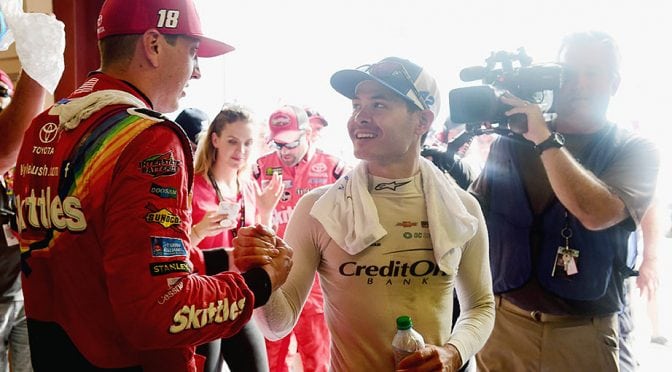
So it was that Larson pulled alongside Busch’s car on the cool-down lap for a knowing acknowledgement instead of a sideswipe. Larson’s signal from the driver’s-side window to his would-be rival was a thumbs-up instead of the finger just two digits over. And after the engines had silenced, Larson’s face-to-face meeting with Busch in Victory Lane was sealed by a handshake and not a right cross.
“I do appreciate him coming over and saying something about it and being receptive to what all went down,” Busch said after posting his fifth win of 2018. “If I was in his shoes, I don’t know what I would have done differently.”
Folks often clamor for competition with more of an edge, reinforcing the notion that stock-car racing is — and will forever be — a full-contact sport. Sunday’s fine finish brought that concept back to the forefront, providing a highlight-reel package of give and take — with a few more takes than gives sprinkled in over the final mile and a half.
But Larson remained matter of fact in sizing up the whole episode, saying simply that he bumped Busch, and Busch bumped back. Hard racing. No hard feelings.
“I just went down and talked to him and said that was a lot of fun,” Larson said of his post-race visit to Victory Lane. “I have a lot of respect for Kyle Busch. He has a lot of respect for me. Yeah, I mean, like I said, that was hard racing. I had a lot of fun.”
Busch persists as one of NASCAR’s most vibrant pot-stirrers, egging on the Chicagoland boo-birds after emerging from his battered, winning car. And Larson remains one of the sport’s brightest new talents, able to match the masterful Busch move for move down the stretch with a dash of dirt-track wisdom applied to the asphalt discipline.
All the ingredients were present on the chef’s table for a post-race blow-up. That recipe never quite blended, at least partly because of Busch’s and Larson’s mutual understanding of the last-lap rules of engagement — that, and a healthy dose of shared respect.
Good, hard racing without the rivalry? Two of the best showed us Sunday how that’s done.
At least that’s what Kyle Larson said after getting tangled up with Kyle Busch on the last lap of the Overton’s 400 at Chicagoland Speedway. Although the driver of the No. 42 ultimately finished runner-up to the ‘Candy Man’ for the eighth time in his career, Larson had some help racing down Busch in the final moments to give fans quite a show.
And he owes two specific drivers an extra ‘thank you’ in the garage next week.
“I felt like (Ricky) Stenhouse Jr. and (Ryan) Newman did a good job of holding him up for me and I was very thankful of that,” Larson said. “So, first off, thanks to those two. And yeah, it just broke his momentum up enough for the last three laps there for him to change up what he was doing and I was able to just keep committing to the wall and I got that run on him. The traffic really played in my favor there.”
Battling traffic is something Busch says is just part of racing, something you can’t control. However, he did notice that some drivers were ‘more gracious’ than others down the stretch at the 1.5-mile track.
Were those ‘others’ Stenhouse Jr. and Newman? Well, Busch did explain after the race that those two specific drivers didn’t make keeping the lead any easier.
“I don’t know what position they were racing for, but they were racing very hard for it,” Busch said. “They were just side‑by‑side. When that happens, there’s just nowhere for me to go. There’s no clean air. One was on the bottom. I think there was a middle lane kind of open, two on the top. I got by Newman, I got plugged up off of two, lost my momentum. Newman came to the bottom. We were three‑wide with lap cars in the backstretch. I couldn’t turn off 3 to the bottom like I would have if he wasn’t there. I don’t think Stenhouse knew that. Stenhouse kind of right reared me, got me steering up the race track towards the wall. That killed my rear tires for the next two laps. I was just sliding for dear life.”
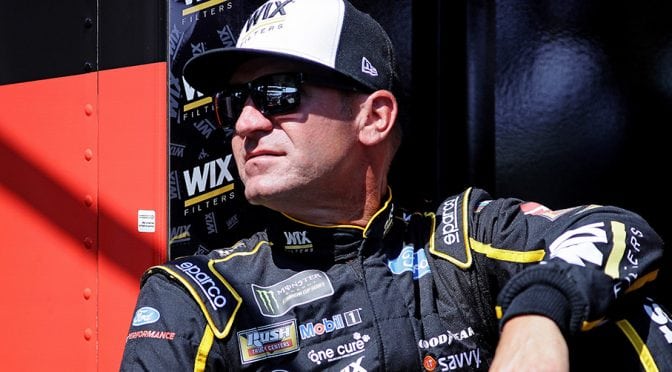
JOLIET, Ill. – Without doubt, Clint Bowyer will look at Sunday’s Overton’s 400 at Chicagoland Speedway as a race that got away.
Bowyer had driven from his fifth-place starting position to the front of the field before the first round of green-flag pit stops. But when he brought his No. 14 Stewart-Haas Racing Ford to pit road on Lap 39 of 267 and gave up the lead, Bowyer was too fast on exit.
That meant a pass-through penalty, and on his next trip down pit road, Bowyer sped again. The second infraction requires a stop-and-go, but Bowyer failed to stop on his third pass down pit road. So Bowyer returned to pit road for a fourth time, stopped in his pit stall and continued.
By then he was more than two laps down to the leader, but Bowyer fought back. Crew chief Mike Bugarewicz kept him on the track during a pit stop cycle in Stage 2 and was rewarded with a caution for debris in Turn 2.
That got Bowyer back on the lead circuit as the highest scored lapped car, and from there the two-time 2018 Monster Energy NASCAR Cup Series winner salvaged a fifth-place result.
Bowyer, however, was far from satisfied.
“Yeah, we were too fast (on pit road),” Bowyer acknowledged. “The guys work very hard on making sure that they are pushing the envelope, which you have to do in this world and against this competition. You have to push everything. Certainly, pit road is a big part of that. You’re splitting hairs out there on the race track down to the tenths of a second, and you can gain seconds on pit road.
“Obviously, our pit road speed was just a little too fast. We practiced it yesterday, and the guys even made some adjustments, but that tight section down there was just too fast. The first time you second-guess yourself. You come down the second time, and you’re cautious and speed again, so now you know you’ve got a problem. Then it was just confusion on my part. I wasn’t listening (to the stop-and-go instructions) and made a mistake and cost us a third time down.
“We got good at pitting today, unfortunately. The capability is there to run with these three guys (Kevin Harvick, Kyle Busch and Martin Truex Jr.). Our race team is young and making some mistakes, but we have time to gain on those and build on those. You hate to give away those stage points. I think we could have won both those stages and maybe be in contention for a win. … We have a lot of good mojo on this 14 car, we just have to put it all together to get another win.”
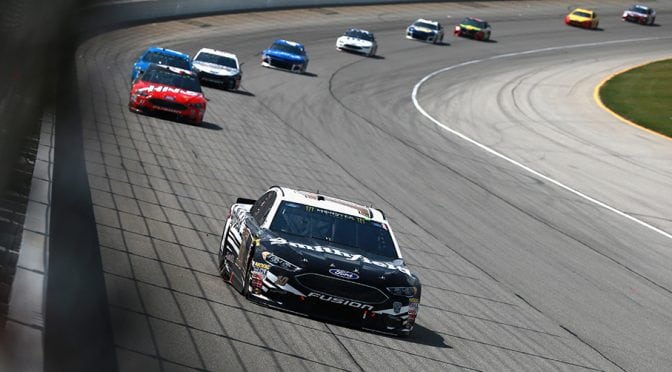
JOLIET, Ill. — For the first half of Sunday’s Overton’s 400 at Chicagoland Speedway, Aric Almirola looked every bit like a potential race winner.
The driver of the No. 10 Stewart-Haas Racing Ford Fusion took the lead near the end of the first 80-lap stage and held on for the stage win, the first of his career. On Laps 87 and 88, Almirola swapped the lead with Stewart-Haas Racing teammate Kevin Harvick, and he held it through a cycle of green-flag pit stops late in the stage.
But a pit stop under caution on Lap 129 proved Almirola’s undoing. After passing Ryan Blaney for the top spot on Lap 135, Almirola returned to pit road on Lap 142 when the vibration from a loose wheel got progressively worse.
The unplanned pit stop dropped Almirola to 26th, one lap down, and though he regained the lead lap as the beneficiary under caution at the end of Stage 2, a second loose wheel on Lap 220 doomed Almirola to a 25th-place finish.
“Our car was super-fast, especially out in clean air,” Almirola said. “It was incredibly fast. We just have to execute. We have to put a whole race together. That’s the difference between being good and being great. We are capable of winning. We showed it today. We have speed. We’re bringing incredible race cars to the race track and we just have to put a whole day together.
“We have to be flawless on pit road, and I have to do my part, too. Today we just had two loose wheels on two separate instances, and you can’t have that, especially in races like this that go green forever. I’m really frustrated, but the good news is that our cars are fast. We can build on that. We’re going to win a race. I guarantee you we are going to win a race. We have to be perfect to do it, though.”