Editor’s note: This is the third in a series of 14 team previews on NASCAR.com. Next up: JTG Daugherty Racing on Feb. 5. A list of team previews already published is at the bottom of this story.
Leavine Family Racing
Manufacturer: Chevrolet
Engine: ECR Engines, technical alliance with Richard Childress Racing
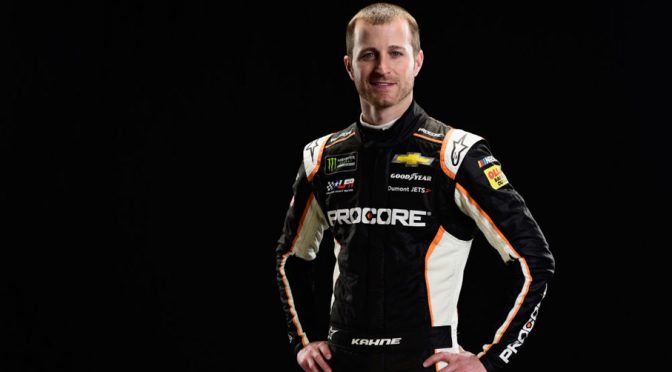
Driver: Kasey Kahne, No. 95
Crew chief: Travis Mack
2017 standings: Michael McDowell finished 26th in the No. 95 Chevrolet in 2017 before heading to Front Row Motorsports. Kahne, McDowell’s replacement, was 15th in the season’s final point standings driving the No. 5 Chevrolet for Hendrick Motorsports.
What’s new: Kahne comes over from Hendrick Motorsports after spending the past six seasons there. He went through a victory drought of 102 races before breaking through at Indianapolis last season and advancing to the NASCAR Playoffs. At Hendrick, Kahne compiled six of his 18 career wins in the Monster Energy Series and finished as high as fourth in the final standings (in 2012). He will pair with a new crew chief in Mack, who was the car chief for the No. 88 of Dale Earnhardt Jr. since 2015 and saw some action as an interim crew chief. Also, all Chevrolet teams will be adjusting to the new Camaro ZL1 introduced this season.
Chris Graythen | Getty Images
What to watch: Kahne’s competitiveness. He showed at Indy that he still has the skills to get to Victory Lane, but that was with Hendrick, where arguably he didn’t meet high expectations. Now he’s with an upstart team where a lot of new parts will need to come together quickly if he’s to pick up where he left off as a driver capable of making a run to the playoffs. A slow start might be inevitable, but how the team comes together after that could be a huge factor in whether Kahne is a legitimate playoff threat.
Key question(s): Can Kahne thrive now that the pressure is off at Hendrick? This might be one case where a change of scenery from a powerhouse team to a smaller team could work out well. Kahne arrived at media tour in Charlotte seemingly in a relaxed mood, and he gets a fresh start. Now if he nabs a top-10 finish it will be a good day instead of what was expected. Then, the challenge will be to build upon that.
DRIVER Kasey Kahne, No. 95 Procore Chevrolet: The Enumclaw, Washington, native joins his fifth Monster Energy Series team since making his debut in 2004 for Evernham Motorsports in the No. 9 Dodge previously driven by NASCAR Hall of Famer Bill Elliott. He posted a career-high six victories in 2006 for Evernham before moving to Richard Petty Motorsports in 2009. Kahne also had a stint with Red Bull Racing before moving to Hendrick Motorsports in 2012.
Kahne has 18 career victories, 92 top-five finishes, 175 top-10 finishes and 27 pole wins in 504 career races on the Monster Energy Series level. Kahne’s 18 wins tie him with Joey Logano and Ryan Newman for seventh place among active drivers. His 27 poles are tied with Kyle Busch for third among active drivers.
Some of Kahne’s career highlights include three victories in the Coca-Cola 600 at Charlotte Motor Speedway and the Brickyward win last year at Indianapolis. Kahne got his start driving sprint cars in Washington, and he currently owns a sprint car team, Kasey Kahne Racing in Mooresville, North Carolina.
Editor’s note: This is the second in a series of 14 team previews on NASCAR.com. Next up: Leavine Family Racing on Feb. 3. A list of team previews already published is at the bottom of this story.
Richard Petty Motorsports
Manufacturer: Chevrolet
Engine: ECR Engines
Drivers: Darrell “Bubba” Wallace Jr., No. 43
Crew chief: Drew Blickensderfer
2017 standings: Wallace competed in four Monster Energy NASCAR Cup Series races in 2017 (Pocono, Michigan, Daytona, Kentucky); full-time driver Aric Almirola finished 29th.
What’s new: Richard Petty Motorsport enters the 2018 Monster Energy NASCAR Cup Series season with Darrell Wallace Jr. at the helm of its one-car operation. It will be Wallace’s inaugural full-time Monster Energy Series campaign after subbing for an injured Almirola in four races during the 2017 season. After fielding Ford entries full time since 2010, RPM has made the switch to Chevrolet, part of a new alliance with Richard Childress Racing.
What to watch: In four starts for RPM in 2017, Wallace recorded a best result of 11th and finished no worse than 26th. That’s impressive considering it was his first opportunity to drive in the Monster Energy Series. Look for Bubba to keep building on what he was able to prove last year.
Key question(s): The obvious question is how will Bubba do in his first full-time season, but let’s dive deeper: How will Bubba handle the pressure of taking over the iconic No. 43 in his maiden Monster Energy Series voyage? How will he handle the pressure of being the first African-American to drive full time in NASCAR’s premier series in nearly 50 years? Also, how will RPM’s new alliance with RCR improve the Petty organization and shorten the learning curve of the new Chevy Camaro ZL1 simultaneously?
DRIVERS
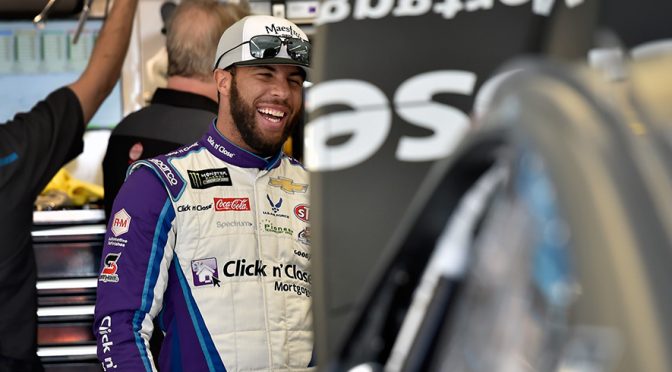
Darrell Wallace Jr., No. 43 Click n’ Close Chevrolet: Beginning at Pocono Raceway in June 2017, Wallace became the substitute driver for the No. 43 entry while Almirola recovered from back injury. In his four appearances in the Monster Energy Series during the summer, Bubba finished 26th, 19th, 15th and 11th, respectively.
Jared C. Tilton | Getty Images
Improving each weekend he strapped into King Richard’s car, the future looks bright for the 24-year-old in 2018. “Going into those four races last year, it was like, ‘OK, this isn’t my car, this isn’t my ride, no need to throw that extra little bit out there,” Wallace said. “Let’s just get through.’ And we ended up having some of the best races. We were on the cusp of fighting for a top 10 there at Kentucky. Just got edged out by my good friend (Ryan) Blaney there, so that was that.”
Now, he’s found his place. “I’m beyond excited,” said Wallace. “I might not show it, but, man, this is it. We’re here. We’re at the Cup level.”
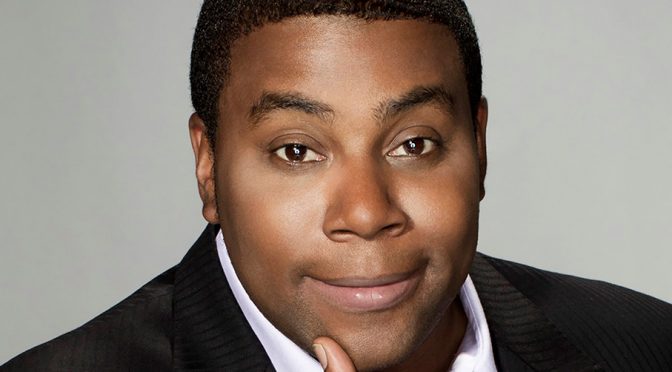
HAMPTON, Ga. – Atlanta native and comedy sketch actor Kenan Thompson of “Saturday Night Live” fame will return to his home city of Atlanta to serve as the grand marshal for the Folds of Honor QuikTrip 500 Monster Energy NASCAR Cup Series race at Atlanta Motor Speedway on Sunday, Feb. 25, 2018.
Born and raised in Atlanta, Thompson made his television debut as a 16-year-old on Nickelodeon’s wildly popular all-kid sketch comedy-variety show “All That” in 1994 before starring in the American teen sitcom “Kenan and Kel” alongside Kel Mitchell between 1996 and 1999. Thompson also appeared in several films early in his career, including “Good Burger,” “D2: The Mighty Ducks,” and “Heavyweights” among others.
Thompson will visit with race fans, attend the pre-race drivers’ meeting and give the drivers’ command as part of his grand marshal duties.
“Atlanta Motor Speedway is my home track, and being grand marshal at the Folds of Honor QuikTrip 500 is a great honor,” said Thompson. “I’ll make my city proud.”
Recently, Thompson has returned for his 15th season on “Saturday Night Live,” making him the show’s longest-running cast member. He has made numerous contributions to the show with his slew of hilarious impressions that include Rev. Al Sharpton, Charles Barkley, Steve Harvey and David Ortiz, and by playing memorable characters such as DJ Dynasty Handbag, the scathingly fierce co-host of “Deep House Dish,” boisterous second wife Virginiaca Hastings and “Weekend Update” correspondent Jean K. Jean.
Thompson has also showcased his voice talents as Greedy Smurf in the animated films “The Smurfs” and “The Smurfs 2.” Other past projects include starring opposite Samuel L. Jackson in “Snakes on a Plane,” Wieners” and “The Magic of Belle Isle” with Morgan Freeman.
The Atlanta NASCAR Weekend features Monster Energy NASCAR Cup Series qualifying on Friday, Feb. 23, the NASCAR XFINITY Series Rinnai 250 and NASCAR Camping World Truck Series Active Pest Control 200 Benefiting Children’s Healthcare of Atlanta doubleheader on Saturday, Feb. 24, and culminates with the Folds of Honor QuikTrip 500 Monster Energy NASCAR Cup Series race on Sunday, Feb. 25.
For more information or purchase tickets today, call the AMS ticket office at (770) 946-4211, (877) 9-AMS-TIX or visit www.atlantamotorspeedway.com.
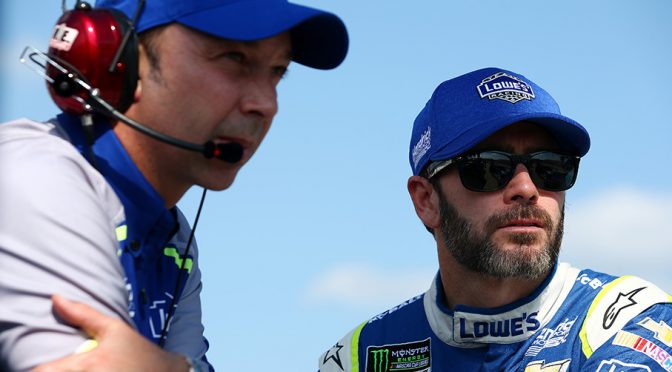
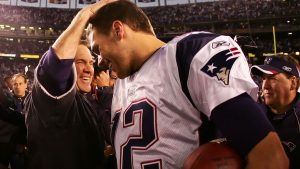
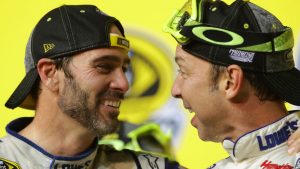
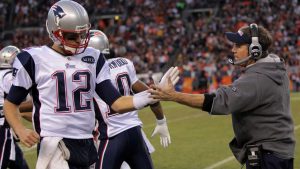
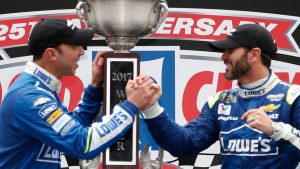
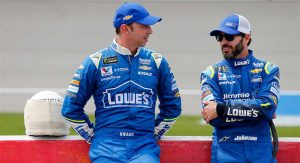
Two legendary duos look to extend their dynasties this month: Tom Brady and Bill Belichick go for Super Bowl win No. 6, and Chad Knaus and Jimmie Johnson launch their quest for a record eighth Monster Energy NASCAR Cup Series title.
Sure, the sports are different. The individuals are even different … to an extent. But what these men have done holds uncanny parallels to one another.
Jonathan Ferrey | Getty Images
Because the discipline, dedication and the capitalization of clutch moments that crowns an individual “the world’s greatest” never wavers — no matter the sport. Talent goes a long way, but to truly be one of the best, you have to give more than that.
You have to be Supermen.
• • •
In 2002, the Patriots entered Super Bowl XXXVI as an underdog to the St. Louis Rams. Brady was the team’s starting quarterback, but he only initially took over because starter Drew Bledsoe was sidelined with an injury. It was his first season as a starter in the NFL.
The Patriots weren’t expected to win. Brady wasn’t expected to propel the team to victory on the final drive. But they did — and he did.
Brady in 2002 Super Bowl (Ezra Shaw | Getty Images)
Thus was the beginning of a dynasty; Brady and Belichick led the team to another Super Bowl win in 2004, then again in 2005. It would take 10 years for the Patriots to hoist another Vince Lombardi Trophy.
During that lull, another dynasty was being formed as 30-year-old, fifth-year driver Johnson won his first championship for Hendrick Motorsports under the guidance of the scrupulous and ambitious Knaus.
The Johnson-Knaus dynasty would reign for five years, as the two dominated the Monster Energy Series, winning a record five consecutive championships from 2006-2010, then adding to the trophy case in 2013 and 2016.
Harry How | Getty Images
People began to tire of them winning and what was perhaps initial admiration began to turn into dislike for the No. 48 team — akin to the Patriots. But even the strongest haters can’t deny what the No. 48 team and the Patriots have done in their respective sports.
It’s hard to argue with five Super Bowl rings and seven Monster Energy Series championship trophies.
• • •
Tirelessly driven and always looking to beat anything and everyone (even sometimes their own records), Johnson and Knaus’ footprint in motorsports is large and historical.
Johnson, Knaus after winning the 2016 title (Sarah Crabill | Getty Images)
In 2016, many counted Johnson and the No. 48 team out after a 22-race winless streak heading into the playoffs. They speculated the dynasty was over, that NASCAR’s new playoff format (first put into place in 2015) was keeping Johnson from getting elusive title No.7.
But he did it thanks to a late restart when he pulled away from Kyle Larson for the win — just like Brady has done 42 times in his career when the Patriots were down in the fourth quarter. The only quarterback with more comebacks than that is Peyton Manning with 45 — and the distinctive difference between the two is that Brady isn’t done playing yet.
“I think there are some parallels there,” Johnson said of the Brady comparison. “… Being able to deliver when times are tough, those make-or-break moments, the experience, athletes over 40, really serve an athlete well.”
As athletes like 40-year-old Brady and 42-year-old Johnson cross the “over-the-hill” mark, critics begin to search for cracks in the foundation, speculating, “Are they finally done and washed up?” Part of what makes both of these athletes great is their longevity and ability to defy Mother Nature through dedication to their crafts. They take care of their bodies — both in their physical conditioning and diet — while pushing their own limits. Then, they work to improve what is already great.
“I think over each season of playing or driving, if you’re really committed to your sport, you just reflect and try to bring a better product to the field or the track every year,” Johnson said. “I’ve not met Tom, but we do have mutual friends. His commitment to getting better every year sounds very familiar. It’s something I’ve done through this offseason, just trying to figure out how I can be a better member of this 48 car, looking at everything and anything that I can do.”
Doug Pensinger | Getty Images
But if you give Brady and Johnson credit, you have to give just as much to their right-hand men; Belichick and Knaus.
If Belichick is Brady’s key to success, then Knaus is Johnson’s most powerful weapon — both implementing a culture of winning and the constant thirst for the next accomplishment.
Knaus runs his race team like the military; hard work, structure and dedication are valued among the walls of the No. 48 shop. His single-minded intensity and overwhelming drive to win are perhaps greater than any other crew chief. Belichick also has the same win-at-all-costs mentality; he recently held team workouts outdoors — and emphasized tardiness was still unacceptable — in the midst of Winter Storm Grayson.
Why? Because they had practice that day.
And a game to win.
• • •
Both Johnson and Brady will go down as some of the best athletes in their respective sports, while Belichick and Knaus’ names will forever be etched in history books next to John Wooden and Vince Lombardi.
But where would each athlete be without his coach or crew chief (and vice versa)?
Matt Sullivan | Getty Images
No one knows for sure, but it’s hard to imagine each individual having as much success as they did without the other. Johnson and Knaus — while they often bicker like an old married couple on the in-car radio — are so successful because they have each other to build on one another’s strengths and weaknesses. Same with Brady and Belichick.
There’s often one that will hang it up before another and that’s uncertain for the Patriots. For the No. 48 team that may be Knaus, as Johnson signed a three-year extension last season. Nothing is set yet.
“I feel like crew chiefs have always lived in dog years, and I’m not sure where (Knaus is) going to be,” Johnson said. “I think his contract is up at the end of this year. Of course I want him to push on.
“I keep telling him, ‘Man, I started this with you, I want to finish it with you.’ I’ll try to stretch him as long as I can. I guess I’m trying to subconsciously prepare that he’ll assume a different role at Hendrick, but I really don’t want to let that in.”
Getty Images
Right now, it’s about 2018; for Johnson & Knaus, it’s about obtaining their eighth Monster Energy Series championship when the checkered flag falls at Miami. For Brady-Belichick, it’s about beating the Philadelphia Eagles on Feb. 4 to win Super Bowl LII.
Because for both parties, it is (and always will be) about winning.
NASCAR.com spent a day at the Stewart-Haas Racing shop last month in Kannapolis, North Carolina, and here’s a list of the behind-the-scenes content that was produced:
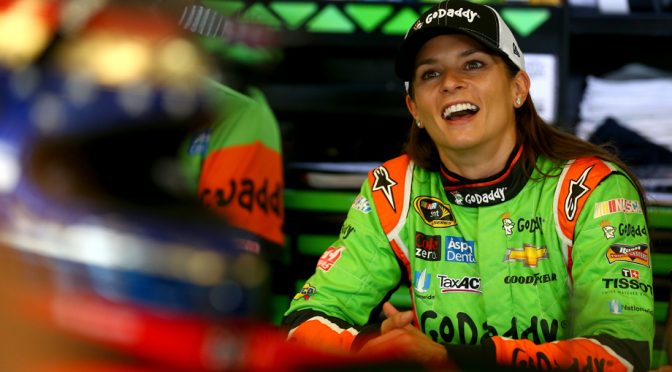
Danica Patrick took to Twitter to reveal the paint scheme for her Daytona 500 entry Friday morning, unveiling the Premium Motorsports No. 7 Chevrolet she’ll drive in what is scheduled to be her final NASCAR start.
The car is awash with plenty of signature green from longtime sponsor GoDaddy, which announced its backing for Patrick’s pair of farewell races on Jan. 18. Her car and fire suit will also include a “Danica Double” logo to commemorate her 2018 schedule of crown-jewel races — the Daytona 500 (Feb. 18, 2:30 p.m. ET, FOX, MRN, SiriusXM) and the Indianapolis 500 on May 27.
Other sponsorship locations on the car will be filled by Patrick’s other business endeavors. Her Warrior by Danica Patrick apparel line, Somnium Wine and her “Pretty Intense” health and fitness book are represented.
Patrick, 35, announced her retirement from full-time driving last November after five full seasons in the Monster Energy NASCAR Cup Series. In setting the stage for her departure, she also announced plans for Daytona and Indy, though the details for those rides were sparse.
Many of those plans have since come together. GoDaddy, which supported her in both NASCAR and IndyCar, signed on to support both efforts. Patrick’s agreement with Premium was announced the following week, reuniting her both with the No. 7 and crew chief Tony Eury Jr.
Premium Motorsports has a charter, which guarantees her a spot in the 40-car field for The Great American Race.
With the rumbling of engines and roaring of fans working together in sync like the force of a speed metal band every weekend, NASCAR has to be considered the most rock ‘n roll, man of all major American sports.
I mean, the literal description for speed metal is “extremely fast, abrasive and technically demanding.” Sound familiar?
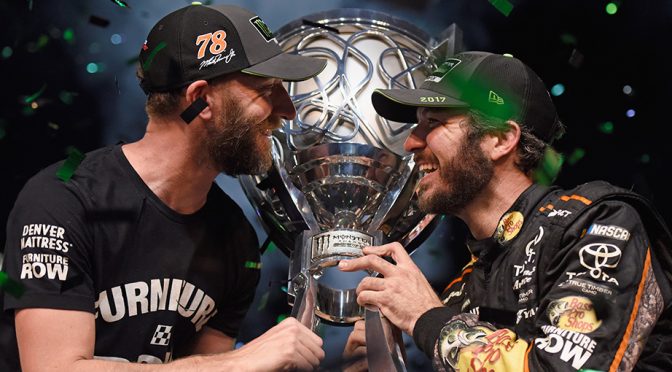
And Cole Pearn — the T-shirt-wearing, backcountry-skiing, hockey-playing Furniture Row Racing crew chief from Canada — might just be the embodiment of the perfect front man.
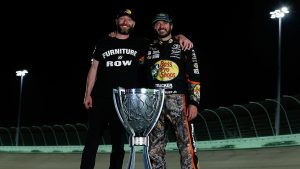
Reigning Monster Energy NASCAR Cup Series champion Martin Truex Jr. was asked at the NASCAR Media Tour presented by Charlotte Motor Speedway if his crew chief held “rock star status in his mind.”
Truex deadpanned, “To me, yes.”
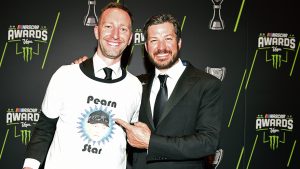
Heck, Pearn even has a T-shirt with his face on it and the nickname “Pearn Star” (that goes surprisingly well over a tuxedo), courtesy of our own @nascarcasm. If that isn’t as rawk as it gets, I don’t know what is.
Getty Images
He’s basically the next Neil Young or Geddy Lee, if they were ever to put on a headset atop a pit box.
“I don’t know about that (laughs),” Pearn told NASCAR.com. “You just do the best you can do and try as hard as you can and that’s really all you can do. I guess that’s for other people to decide on that.
“I think really our team as a whole is put together really well and we work well together. A lot of times I get the credit, but there’s a lot of people involved in that success, for sure.”
Alright, so maybe not the front man, but perhaps the mild-mannered bassist off to the side who secretly stays up at night writing all the songs and keeps everyone in time together on stage. Either way, he’s leading the charge and setting the tone.
“He’s relentless,” said Truex, who paired with Pearn for a series-high eight wins in 2017. “His work ethic and what he’s willing to do; he’ll do anything to win and to be competitive and get the job done. You know, him and all of our guys feed on that, whether it’s the shop guys or the road guys or even the pit crew. They feed off of that, and it’s been a big reason for our success.”
If the crew feeds off Pearn’s energy, then then the old saying is right — you are what you eat. Because the whole team is full of people that have that same drive.
“I think what’s fortunate about our group is there’s a lot of people that have that (machine-like work ethic) attitude,” Pearn said. “So you get a group of people with that similar never-give-up, relentless attitude then you all motivate each other and you all pick up each other and before long you’re way further ahead than any of you would be on your own.
Getty Images
“I’m really fortunate that, yeah, I’m like that, but we’ve got a lot of other people like that as well.”
That mentality sets quite the example for other teams across NASCAR, particularly the No. 78 Toyota’s competitors at the Monster Energy Series level.
Furniture Row was in a class of its own throughout all of 2017, with 19 stage wins paving the path to Truex’s first championship.
“I think the whole style is just trying to go faster than everybody else. I don’t know that there’s really any strategy,” said Pearn, a former NASCAR Pinty’s Series driver, himself. “ I think we were fortunate enough to qualify well most weeks and run up front which typically bodes well in the stages. … I don’t think anything changes from that standpoint.”
Either way, it’s apparent the old “underdog” title Furniture Row Racing seemed to be anointed with for so long is completely shed — championships tend to do that — and instead it’s now whatever the speed-metal equivalent of a Grammys-sweeping Bruno Mars is. Every other artist/driver/team is aiming to dethrone the champs.
Don’t expect anything to change in the FRR shop, however. Cole and the Pearn Stars never saw themselves in that dark horse light, anyway.
“I don’t think we ever really looked at ourselves as the underdogs. We always felt like we were as capable as anybody and in a great situation, especially since we were fortunate enough to get in with Toyota and be able to work with Joe Gibbs Racing. It really made it seem like running well on a weekly basis was definitely possible,” he said.
“I think we continue to have that confidence.”
And if there’s one thing all rock stars have in common, it’s confidence.
Kyle Larson scooted to the top of the leaderboard in the Thursday afternoon session as Monster Energy NASCAR Cup Series teams wrapped up a two-day organizational test at Las Vegas Motor Speedway.
Larson lapped the 1.5-mile track in the Chip Ganassi Racing No. 42 Chevrolet with an unofficial speed of 191.259 mph, the fastest of the two-day test. Speeds rose significantly in the closing session, with several teams deploying their cars in qualifying trim near the end of the day.
“I mean, I feel like it was a good test and nice to know that we have a lot of speed still in our cars with all the changes and the new Camaro ZL1,” Larson said, “so we will see how it goes when we get to Daytona and on into the season at the 1.5-miles and stuff.”
Thursday was a repeat of Wednesday’s opening day, with Larson fastest in the afternoon and rookie William Byron topping the morning session.
Ryan Newman was second-fastest in the Thursday afternoon closing session, posting a 190.027 mph lap in the Richard Childress Racing No. 31 Chevrolet. The result made for a 1-2 sweep for Camaro ZL1 models, which will make their competition debut later this month at Daytona International Speedway.
“It’s good to see a couple of Chevrolets, two or three Chevrolets up on the top,” Newman said. “It wasn’t a true test to when 40 cars come back so we will go through our notes and see how well we can do with our homework.”
Erik Jones notched the third-fastest lap (190.007 mph) in the Joe Gibbs Racing No. 20 Toyota. Ricky Stenhouse Jr. and Kasey Kahne completed the top five.
The two-day show in the desert marked one of the first times fans saw the Chevrolet Camaro ZL1 in action. It’s also the final opportunity for teams to gather data before heading to Daytona International Speedway for Speedweeks — and ultimately to Atlanta, the first intermediate track on the schedule, following the Daytona 500.
The test is comprised of one car per organization and one wheel force test car each for Chevrolet, Ford and Toyota.
Pole qualifying for the Daytona 500 and the Advance Auto Parts Clash race are set for Feb. 11 at Daytona with the season-opening Daytona 500 on Feb. 18 (2:30 p.m. ET, FOX, MRN, SiriusXM NASCAR Radio).
Rank
Driver
Team
Speed
1.
Kyle Larson
Chip Ganassi Racing
191.259
2.
Ryan Newman
Richard Childress Racing
190.027
3.
Erik Jones
Joe Gibbs Racing
190.007
4.
Ricky Stenhouse Jr.
Roush Fenway Racing
189.827
5.
Kasey Kahne
Leavine Family Racing
189.009
6.
William Byron
Hendrick Motorsports
187.689
7.
Chris Buescher
JTG Daugherty Racing
187.318
8.
Darrell Wallace Jr.
Richard Petty Motorsports
187.298
9.
Ty Dillon
Germain Racing
187.156
10.
Cole Custer
Go Fas Racing
186.761
11.
Brad Keselowski
Team Penske
185.656
12.
Kurt Busch
Stewart-Haas Racing
185.529
13.
Paul Menard
Wood Brothers Racing
185.077
14.
Drew Herring
Toyota Wheel Force
182.156
15.
Justin Allgaier
Chevrolet Wheel Force
181.099
16.
David Ragan
Ford Wheel Force
179.874
Byron sets pace in early Thursday session
William Byron continued his impressive display of speed in the Thursday morning session of a 16-driver organizational test at Las Vegas Motor Speedway.
The Hendrick Motorsports Sunoco Rookie of the Year candidate logged a lap at 189.281 mph on the 1.5-mile track, the fastest speed so far in the two-day test. Byron, the 2017 NASCAR Xfinity Series champion, drives the iconic No. 24 Chevrolet.
“It’s been awesome,” Byron said. “It’s been really a dream come true to get in one of these cars and have Hendrick Motorsports behind me, it’s really cool. It’s been a lot of fun; it’s been a blast.”
Fellow Chevrolet driver Kyle Larson of Chip Ganassi Racing was second on the speed charts at 189.129 mph, one day after posting the fastest overall speed.
Team Penske’s Brad Keselowski (188.745 mph), Richard Childress Racing’s Ryan Newman (188.686) and Stewart-Haas Racing veteran and defending Daytona 500 winner Kurt Busch (187.754 mph) completed the top five. Full results of the morning session can be found below.
In an odd note: there were two instances of two different drivers logging the exact same best-lap speed, a rarity. Paul Menard and Ty Dillon both ran a fast lap at 187.500 mph; Chris Buescher and Kasey Kahne each ran a best lap of 186.845 mph.
With a series of larger-scale enhancements in recent years — the additions of stage racing and major modifications to the postseason format — the theme to 2018’s rules update from the NASCAR Research & Development Center relies on a defter touch.
Advancements in inspection technology, a streamlined system for pit stops and standardized at-track personnel sizes and the introduction of the Chevrolet Camaro ZL1 for the Monster Energy NASCAR Cup Series are among the highlights in this year’s update. Other changes governing car specifications and improving safety are numerous but more subtle, an evolution of the updates that have preceded them.
“The past couple years, we’ve had quite a few changes, so in this year, we’re kind of heading more into a stabilization mode,” said Gene Stefanyshyn, NASCAR Senior Vice President for Innovation and Racing Development. “We’re pretty happy with the racing that we have on the track.”
In the Monster Energy NASCAR Cup Series, the most noticeable vehicle change will be the introduction of the Camaro ZLI, which replaces the outgoing Chevrolet SS model. The new Chevy made a splashy debut in Detroit last August and will get its first taste of competition later this month at Daytona.
For Stefanyshyn, it’s a project with personal roots that span back to his time as an executive with General Motors.
“It does pull a bit at my heartstrings because I was responsible for the 2010 Camaro, which had been in hiatus for five years,” he says. “I was fortunate enough to run that project and put it back on the street. It’s very good to see the evolution of it.”
The recent trend of reducing vehicle downforce will continue, but without altering spoiler heights. The aerodynamic shifts will be achieved through use of a common splitter and radiator oil cooler, which Stefanyshyn says will drop downforce by approximately 225 pounds (185 in the front, 40 rear) to a level of 1,650 pounds.
But the body changes have also extended to the realm of safety, with a superspeedway liftoff reduction to keep vehicles in all three national series from becoming airborne at NASCAR’s fastest tracks. The latest adjustments have added an estimated 30 mph to the liftoff threshold, Stefanyshyn says, in an effort to help reduce rollovers.
Other safety enhancements currently in development include a high-speed on-board camera designed to pair with Incident Data Recorders (IDR, or “black box”) to aid crash investigations. When the data recorder is tripped by a crash impact, the camera will also engage, capturing footage of the driver’s movement in the accident and providing another reference point for competition officials.
“This is going to be a very, very powerful tool,” Stefanyshyn says, indicating that the system is projected to be in place a third of the way through the season. “We have about 10 years of incident data recording. We have a very robust database that we use to continue to learn and improve. This will just be the next installment of analytical capability, which will allow us to be very precise and move very quickly.”
Changes are also in store for the NASCAR Xfinity Series, which will enter a transitional year for the new flange-fit composite bodies ahead of a full 2019 rollout. The series will also make improvements in the area of superspeedway bump-drafting, using a lower front fascia at Daytona and Talladega. The goal of mismatched front and rear bumper heights is to deter teams from locking on in the aerodynamic draft, a practice that’s currently officiated from race control.
The Xfinity tour will also expand the use of the aerodynamic package that debuted last year at Indianapolis Motor Speedway to largely positive reviews. That package — which utilized a taller rear spoiler, a restrictor plate and aero ducts to reduce the advantage of a leading car in ‘clean’ air — will also be used at Pocono Raceway and Michigan International Speedway this season.
For the Camping World Truck Series, the most impactful change is under the hood with the introduction of the optional NT1 engine. The Ilmor-produced powerplant, Stefanyshyn says, is intended to reduce engine development costs in the sport’s entry-level national series.
Other highlights of the 2018 NASCAR national series rules update, with some moves previously announced:
• NASCAR will move to a standardized team roster for at-track personnel, helping to more clearly define the roles of teams’ support staff.
•A new inspection station, developed in conjunction with Hawk-Eye innovations, will provide more comprehensive scans of vehicle bodies. The system will replace the former Laser Inspection System and several measurements previously done by templates.
• Common pit guns will be in use for the 2018 season, in an effort to reduce the performance premium on equipment and place the emphasis on the pit crews’ athletic performance.
• A new system for enforcing practice time penalties will be in effect for 2018. Instead of having car and driver sit idle on pit road, practice-time deductions will be enforced by covering the car in the garage. Practice holds will also be enforced at the end of practice sessions instead of the beginning.
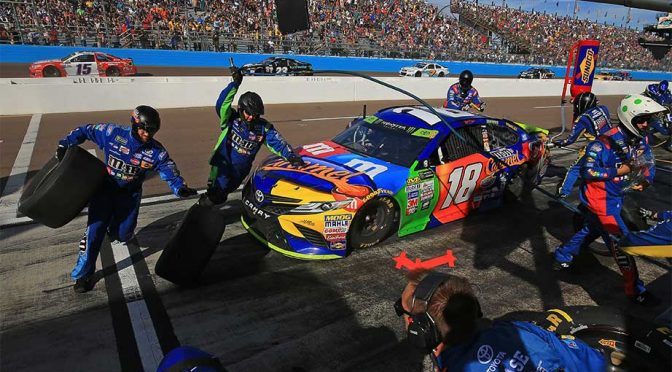
NASCAR pit crews received the equivalent of a summer reading list shortly after school let out last November at Homestead-Miami Speedway. That primary offseason assignment: Adjust to new rules that reduce the over-the-wall crew from six people to five.
The move has pushed teams to tap into their collective creativity in the offseason, devising and practicing new choreography for quickly swapping four tires and adding fuel. But NASCAR’s competition department has had to make its own adjustments, learning from the teams’ feedback to clarify the guidelines for the new world order in pit service.
“We’re always throwing ideas back and forth,” says Scott Miller, NASCAR Senior Vice President of Competition. “A lot of the things we ultimately come up with as the final rules were not done by us in a vacuum, but done with lots of input from the people that it affects most.”
Those regulations for pit crews and other team personnel were among the items unpacked Thursday at the NASCAR Research & Development Center in Concord, North Carolina, during what’s become an annual media briefing of the 2018 rules update. The related topic of standardized team rosters also was on the discussion docket, with at-track personnel numbers in place starting later this month at Daytona International Speedway.
The primary goals of the pit crew reduction were not only to reduce the number of team members on pit lane for safety reasons, but also to highlight the sports performance of over-the-wall crew members, some of whom will now be adapting to double-duty during stops.
“Not that there wasn’t a strong emphasis on the athlete in the old system, but we believe this even puts more emphasis on it,” Miller says. “One of the things that we’re really looking forward to is we’ve given them in the rules some flexibility with how they can use the men that are over the wall. So I think it’s going to be interesting to see how the teams develop the concept and who comes up with the best way to skin the cat, so to speak. We expect to see some varied strategies on that, which I think will be a very interesting story in the coming year.”
Tire carrying, tire changing and jacking up the car will now be handled by a group of four. One member of that quartet who performs double-duty will be allowed to stand on the ‘hot’ side of the pit wall, springing into action once the approaching car is one full pit box away from their stall. That move is intended to keep crew members from jumping off the top of the pit wall with both hands full, especially with a heavy tire.
A fifth person will serve as the fueler, who is prohibited from any other pit-stop duties. A light-duty extra person will be allowed over the wall only as a driver assist, with such responsibilities as providing food or drink to the driver and changing windshield tear-offs.
Pit-road officiating with a camera-based replay system went into effect before the 2015 season. This year, more monitoring will be in place to govern the use of standardized pit guns. Starting this year, NASCAR will issue standardized air wrenches, air hoses, regulators and control boxes to teams at each event, re-collecting them at the end of a race weekend.
The pit guns, made by Italian manufacturer Paoli, will feature a parity monitoring system to detect and deter any tampering. Competition officials indicated a similar system will eventually monitor and officiate lug-nut tightness, once the procedure passes through beta testing.
“That kind of goes along with the crew, back to emphasis on the athlete rather than emphasis on the equipment,” Miller says. “I think the athletes are certainly part of the show and part of the story, and the more emphasis that we can put on their performance as opposed to a fast jack or a fast pit gun, the better the level playing field and the better stories we have to tell.”
As announced last November, organizations will also need to comply with standardized sizes of at-track personnel once the season begins. The rules now delineate organizational staff (such as tech director, competition manager), road crew (engineers, crew/car chief, spotters) and pit crew.
Monster Energy NASCAR Cup Series teams will be allotted 12 road crew slots and five pit crew positions per vehicle. Three organizational staff will be allowed for one- or two-car teams; an additional organizational member will be permitted for larger teams. Positions such as team owners, public relations staff and the hauler driver are exempt from the cap.
“Several goals, but one of them is to just standardize the size of the team that’s at the race track. There was a lot of different things going on and we’re always trying to create a level playing field in every aspect of our sport, and I think just another element of that was … football teams have X amount of people on them and baseball teams have X amounts of people on them and now race teams have a defined number of team members.”
The new rules also allow for cross-over duties within an organization, such as a member of Hendrick Motorsports’ No. 24 team helping on the Hendrick No. 9 team. Roster spots can be shared outside of an organization — for instance, a Joe Gibbs Racing road crew member assisting with Furniture Row Racing, an allied team — but the crew member must be listed on both rosters.
Enforcement will be assisted by RFID chips embedded in credentials to monitor teams’ roster attendance. A roster cap infraction would result in the ejection of the offending individual from a race weekend, plus at least one other rostered crew member’s removal, to be chosen at NASCAR’s discretion.
NASCAR officials will also have visual cues regarding their proper roles, with crew members wearing two patches — one identifying their car number and a second, with an abbreviation denoting their duties. The patches will be affixed with Velcro, so that the car numbers and abbreviations can be switched when a crew member transfers to a different team or role.
“Ultimately, the fans will learn those designations and be able to relate to those crew members as say, the underneath guy on my favorite car,” Miller says. “… I think it will start to put faces to the people behind the scenes supporting the drivers, which I think ultimately will be a good thing for the sport.”