A young driver. A former champion. An innovative company. And a passion for racing. When you put them all together at the North Carolina Quarter Midget Association Speedway in Salisbury, North Carolina, it adds up to a very bright future for the youth movement in racing.
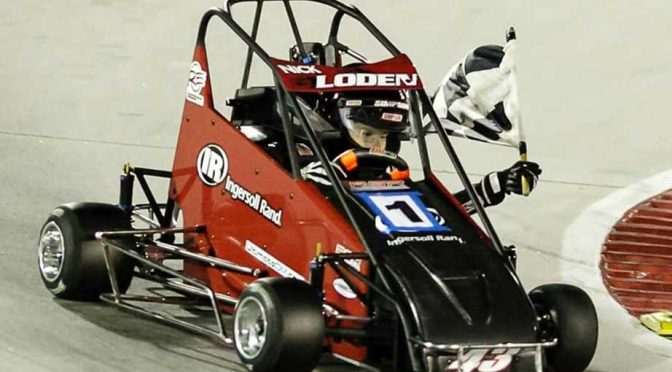
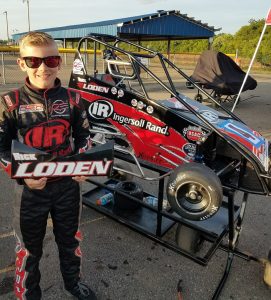
The young star is Nick Loden, a 12-year-old native of Stanley, North Carolina, and a product of Ingersoll Rand’s driver development program. The former champion is none other than track owner Bobby Labonte, a native of Corpus Christi, Texas, who won the 2000 NASCAR premier series title with Joe Gibbs Racing. The company is Ingersoll Rand, whose tools are mainstays at community tracks like these all across the country as well as in the highest levels of racing like today’s Monster Energy NASCAR Cup Series.
And the passion for racing? Well, if you know anything about this area of North Carolina, then you don’t even have to ask about that.
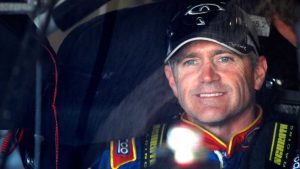
Jeff Zelevansky | Getty Images
But every story has to start somewhere, and for the former champion, his start came in a quarter-midget race car in Texas when he was just 5 years old. Back then the Labonte family’s hobby was racing, and weekends consisted of trips to places like San Antonio, Texas, and Tulsa, Oklahoma, just to name a few.
Sometimes the family drove for multiple hours to find a track. Sometimes, there wasn’t a track to be found, so Labonte’s dad and some friends would build one themselves.
“My dad and a few other guys, we traveled every weekend to go race,” Labonte said. “There was an old (airport) runway not being used, and I remember as a kid them putting fence posts up and making a circle track in the middle. They’d start putting hay bales up and they created an environment for youth to come race.
“What my dad provided for me and my brother and many other families was the opportunity to race.”
That sacrifice wasn’t lost on Labonte, so when he set out to build the track in Salisbury, he became a ground-breaker in more ways than one. The track was the first of its kind in North Carolina that was dedicated strictly to quarter-midget racing. Labonte tried to provide a proving ground for quarter-midget racers to enjoy, somewhere they could build memories and strike up relationships to help their racing careers.
One such racer is the young Loden, who has competed on Labonte’s track as he builds up experience. Loden has compiled 130 wins over the past two years on tracks all over the country and has raced in prestigious events such as the USAC Battle at the Brickyard, held each year at the famed Indianapolis Motor Speedway.
Photo courtesy of Loden family
Whatever track he is on, Loden can be seen flying past other drivers, a red-white-and-black blur in the familiar colors of Ingersoll Rand. Like Labonte, Loden is following in the footsteps of his dad, who was a successful racer in his own right.
Nick’s father Andy Loden started competing at the age of 17 in Williamson, New York. After moving to North Carolina, he was crowned the track champion at Hickory Motor Speedway in 2006, ’07, and ’08. He was also the track champion at Tri-County Motor Speedway in 2008 along with capturing the NASCAR Whelen All American Series North Carolina State Championship.
Loden’s father credits his successes in motorsports to his mechanical background as a service technician. And he feels those skills are exactly what his son Nick needs to be successful in motorsports.
Andy’s way of encouraging those skills is allowing Nick to build and repair his own cars, and at the track, Nick’s primary tool of choice is Ingersoll Rand’s W1120 ¼” 12-volt impact wrench to remove lug nuts when changing tires during practice.
When at the shop, Nick helps mount his own bodies with the D1130 12-volt 3/8″ drill. And in those untimely situations when Nick gets caught up in an on-track incident, he relies on one of Ingersoll Rand’s latest products, the G1811 12-volt cordless belt sander, when the focus turns to fabrication.
Loden’s level of participation and success align with Ingersoll Rand’s objective to be the best in class. In addition to being Loden’s tools of choice, Ingersoll Rand is the official Power Tool of NASCAR and provides products to teams at the highest levels. Within the Monster Energy Series garage, you will find teams using everything from the W5132 20-volt 3/8″ Impact for changing gears under race cars to the W5330 20-volt 3/8″ Right Angle Impact for making chassis adjustments.
Labonte knows what it takes to succeed on that higher level, and luckily for kids like Loden, there are people like Labonte who enjoy giving back to the racing community by building tracks where dedicated young racers can perfect their craft. But the young racers aren’t the only ones getting a kick out of what’s going on at places like the North Carolina Quarter Midget Association Speedway.
Todd Warshaw | Getty Images
“I’m really proud of the guys and girls that come through (Salisbury),” Labonte said. “There’s nothing more fun than seeing a 5-, 7-, 8-, 9-, 12-year-old kid with a smile on their face after they get done racing, no matter what happened. It’s awesome!”
At the Salisbury track, kids like Loden get to hone their skills and compete against drivers who someday might go on to the next levels in the sport. You never know what future stars might appear at tracks like this, in a fertile racing hotbed like North Carolina.
“When the track was built in Salisbury, it was an opportunity for Ryan Blaney, Harrison Burton and others to race there,” Labonte said. “Not everybody is going to be where Ryan Blaney is at today. But racing creates structure, it helps them develop skills.
“It impacted me, whether it was the main catalyst, I had no idea at 5 years old. But at the same time, it provides a catalyst for many things, and it is a great sport.
“It’s so many other things than just driving a car. This is the feeding ground for a lot of kids who get to start in something like this, and they might not have had that opportunity if we didn’t build a track.”
CHICAGO — Leading up to the Chicagoland race and the start of the playoffs, Aspen Dental — the official dentist of NASCAR — got fans into the race spirit a little early. And at the same time, reminded them in a fun way that it’s never too late to get started in breaking down the barriers that keep them from going to the dentist.
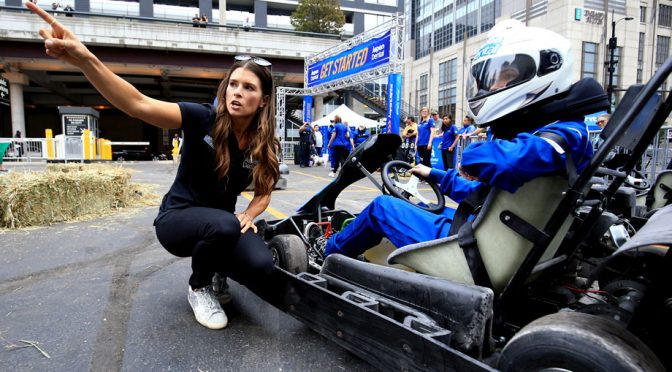
Aspen Dental built a pop-up go kart track in the heart of downtown Chicago so fans could fill their need for speed while knocking down symbolic obstacles to dental care like Judgment, Fear and Discomfort.
Danica Patrick was on hand offering tips to racers, giving a play-by-play of the action and talking to attendees about why a healthy mouth matters.
The event was the latest activity in Aspen Dental’s Get Started program, launched at the start of the 2017 season to encourage fans in unexpected ways to get started or restarted on their own personal road to better care, better smile sand better lives.
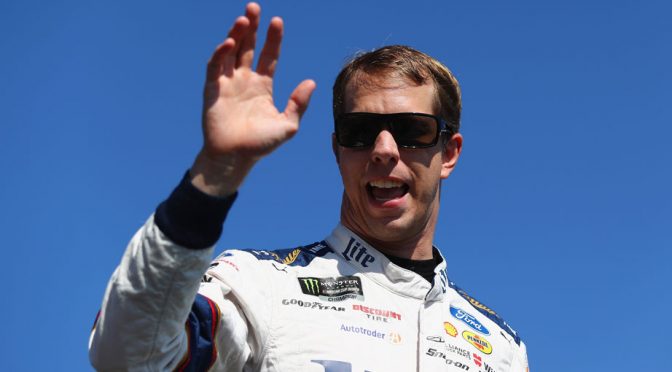
CHARLOTTE, N.C. – There was “rubbin’ ” that wasn’t intentional and “racin’” that was when officials with Charlotte Motor Speedway kicked off Bank of America 500 race week Tuesday with a parade through the city streets featuring 2012 Monster Energy NASCAR Cup Series champion Brad Keselowski.
“It is great to see people come out; I always like seeing the faces and seeing everybody getting excited and pumped up,” said the driver of Team Penske’s No. 2 Ford. “It’s a great way to promote the good things our sport does and build the excitement that makes motorsports so much fun for communities.”
Keselowski didn’t seem to mind the slower pace, putting a bumper to the pace car in front of him a half dozen times or more during the trek around the city.
Some folks were caught off-guard, many likely headed back from lunch when police on motorcycles, sirens blazing, led Keselowski and company through the city streets. Others were prepared, some even hanging out their car windows to snap photos and take videos with their smartphones.
“That. Just. Happened,” noted a surprised Keselowski.
CMS plays host to the opening race of the Round of 12 in this year’s NASCAR Playoffs, with the Bank of America 500 scheduled to get underway Sunday (2 p.m., NBC, PRN, SiriusXM NASCAR). It’s a race Keselowski has won once before, in 2013. A victory in the opening race of the second round would be most welcome.
He has less than 20 laps on the tri-oval under race conditions this season — a crash in the Coca-Cola 600 this past May put him out of commission after only 19 laps around the 1.5-mile track. He finished 39th and that’s been the only real blemish on his CMS record in recent years.
Charlotte, Talladega and Kansas make up the three stops for the Round of 12; eight drivers will advance while four others will see their title hopes end.
“I see those two mile-and-a-halves (tracks) which is mostly about the aerodynamics … and that’s important to get all that right,” Keselowski said of the Charlotte and Kansas stops. “And then Talladega which is just … I felt like before the stages it was a little easier to control your destiny there. You could run up front and kind of stay away from it all.
“Then with the stages, you could run up front, somebody would short pit and cycle you to the back. … That just mixes up the field; it means there’s no safe place to be.”
Keselowski is fourth in points after the round-ending reset. Martin Truex Jr. (Furniture Row Racing) and Kyle Busch (Joe Gibbs Racing) are 1-2 in the standings.
Busch won the final two races of the previous round and Charlotte is the only active track where he has yet to earn a points victory. Meanwhile, Toyota teammate Truex has scored four of his five wins this season on 1.5-mile tracks.
They’re two of the favorites to advance to Homestead-Miami Speedway for a shot at this year’s championship. Along with Keselowski, the remainder of the NASCAR Playoff field consists of Chip Ganassi Racing teammates Kyle Larson and Jamie McMurray, Kevin Harvick (Stewart-Haas Racing), seven-time series champion Jimmie Johnson and Hendrick Motorsports teammate Chase Elliott, Matt Kenseth and Denny Hamlin (JGR), Ryan Blaney (Wood Brothers Racing) and Ricky Stenhouse Jr. (Roush Fenway Racing).
Stage points, awarded to the top 10 drivers at the conclusion of each stage during a race, have been essential. That will continue to be the case, Keselowski said, as the playoffs continue.
“You can run fifth and not score any stage points and you’re not going to score the fifth-most points on the day, you’re going to score about the 10th-most points,” he said.
Keselowski won the opening stage at Dover and was eighth in the second stage. As a result, he finished with more total points than four drivers who finished ahead of him in the race.
“Those stages are (crucial), as they were meant to be,” he said. “They were meant to put an emphasis on running up front early in a race and not just riding around and cruising.”
Qualifying to set the 40-car field for Sunday’s Bank of America 500 is scheduled for Friday at 7:20 p.m. ET.
NASCAR announced penalties on Tuesday following last weekend’s events at Dover International Speedway and Las Vegas Motor Speedway. Among them were citations against two Monster Energy NASCAR Cup Series teams for unsecured lug nuts and suspensions for a NASCAR XFINITY Series team for loss of added ballast.
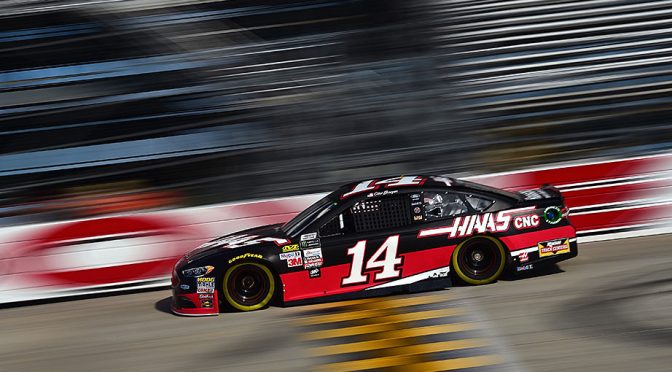
The Monster Energy Series teams hit for lug nuts were the No. 77 Furniture Row Racing Toyota driven by Erik Jones and the No. 14 Stewart-Haas Racing Ford piloted by Clint Bowyer. Each team had one lug nut unsecured following the race at Dover, so respective crew chiefs Chris Gayle and Mike Bugarewicz were each fined $10,000.
In the XFINITY Series, NASCAR penalized the No. 21 Richard Childress Racing team for loss of added ballast. Crew chief Danny Stockman Jr., car chief Clint Almquist and engineer Luke Mason were suspended through Nov. 14, a total of four points-paying races. Daniel Hemric, driver of the No. 21, is currently fifth in the playoff standings.
“No matter what gets handed down to us over the next couple days, we’re a strong group,” Hemric told NASCAR.com on Saturday after his fourth-place finish at Dover. “There’s so much depth at RCR. We’ll take whatever they give us in the next few days and take it in stride.”
NASCAR also penalized the No. 20 Joe Gibbs Racing Toyota (Erik Jones) and the No. 48 Chip Ganassi Racing Chevrolet (Brennan Poole) in the XFINITY Series for an unsecured lug nut. Respective crew chiefs Chris Gabehart and Chad Norris were each fined $5,000.
And in the NASCAR Camping World Truck Series, crew chief Carl Joiner was fined $2,500 as the No. 88 Toyota driven by Matt Crafton was found to have an unsecured lug nut post-race in Las Vegas.
And no, there’s no word on how Penelope is getting along with PomPom and Nutella, the ponies that Texas Motor Speedway president Eddie Gossage gifted to Gordon for his retirement in 2015.
When Monster Energy NASCAR Cup Series drivers get into autograph mode, there’s no telling what might happen. Sometimes, they even sign memorabilia featuring a different driver.
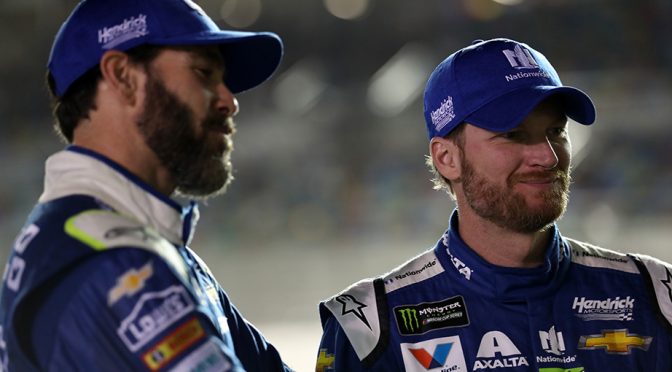
That’s exactly what happened to Dale Earnhardt Jr. recently, which allowed seven-time champion Jimmie Johnson to have some fun with his Hendrick Motorsports teammate.
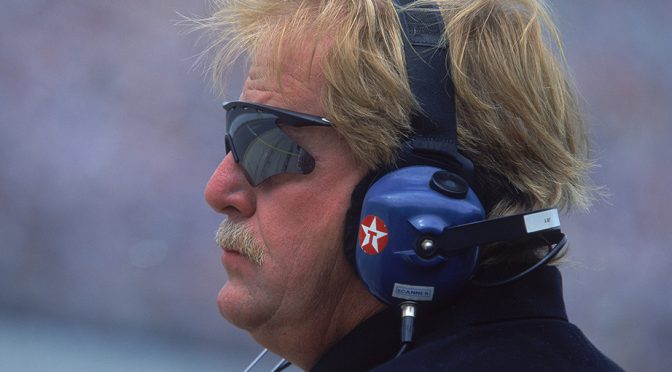
Robert Yates built the engines for the cars that won so many NASCAR races and sat on the pole for so many prestigious events, and his employees built and serviced the cars that won so many times. Through it all, Yates, the son of a preacher, was just as honest and humble as the day he started his career as an unknown, doing nothing more mentally challenging than sweeping the floors at Holman-Moody.
What must have been going on in that mind during those early days?
Yates finally found a foe he couldn’t outrun, liver cancer, and his passing Oct. 2 leaves a void in the NASCAR universe. He was 74.
He hadn’t really been around much since he handed the reins of Robert Yates Racing over to his son, Doug, at the end of 2007. But anytime the subject of horsepower came up during conversations at the track, Yates’ name was at the top of the list. That’s as true today as it was when he stepped away a decade ago.
The folks he worked with — and each and every time he gave them nothing less than 100 percent of his talent and ability and focus — good grief, where to start? David Pearson? Bobby Allison? Fireball Roberts and Fred Lorenzen and Richard Petty?
Pearson’s championships with Holman Moody in ’68 and ’69 were powered by Yates’ engines. Allison’s ’83 title got the Yates treatment, too. Petty’s final two victories in a 200-win career? Powered by Yates.
Daytona 500s? How many times did his engines, or his cars, sit on the front row? How many times did those same cars wind up in Victory Lane?
As an owner, well, he was pretty successful there, too. Five drivers won 57 races and one, Dale Jarrett, drove off with the championship in what is now the Monster Energy NASCAR Cup Series.
Ernie Irvan, Ricky Rudd and Elliott Sadler won with Yates and perhaps most memorable of all was Davey Allison, winning at Daytona and Talladega and Charlotte and elsewhere with Yates and crew chief Larry McReynolds and crew. The No. 28 Havoline Ford fielded by Yates remains one of NASCAR’s most memorable entries. Those were magical times.
Yates was successful, hard-working and talented, but more than that, he was honest and friendly and willing to help anyone who needed a hand. He was genuine and, yes, conversations with Yates could be lengthy and range across a wide field of subjects, but one never came away from an interview with the car owner feeling underserved.
There has been much change in NASCAR in recent years, but change has always been a part of NASCAR. From its very beginning, drivers, owners, teams, sponsors and even tracks had a limited shelf life. They come and they go in the sport and the sport continues on.
Yates was a special person who came along during a special time in the sport, one that’s cherished by many long-time fans and looked back on fondly by those who experienced the phenomenal growth.
In January of 2018, Yates will be one of five new members inducted into the NASCAR Hall of Fame.
“I picked the best 40 years for me,” Yates said of his career just moments after his name was announced in May.
“My family means so much to me because they allowed me to work night and day and never told me to come home at 3 in the morning. I always said I never outsmarted (the competition), I just outworked them.”
The Hall will gain yet another legend. The sport is much dimmer with his passing.
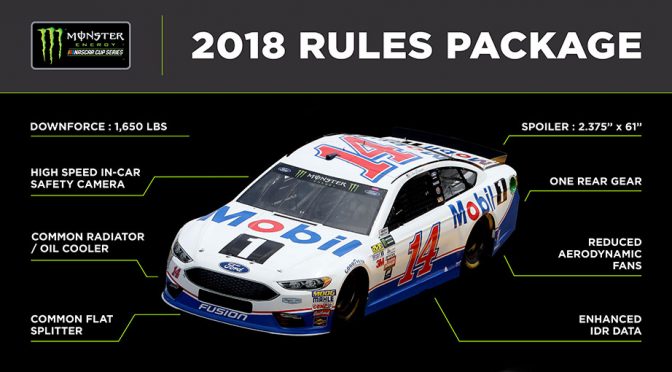
CONCORD, N.C. — After several seasons of reducing downforce and limiting horsepower, NASCAR’s 2018 rules package won’t take quite as big of a bite out of the aerodynamic platform currently employed by teams competing in the Monster Energy NASCAR Cup Series.
There are changes, but overall the 2018 package, delivered to teams Tuesday, is more about maintaining the positive momentum from years prior.
“We’ve got some things we would still like to try,” NASCAR Vice President of Innovation and Racing Development Gene Stefanyshyn told NASCAR.com. But 2018 will be about “just … hold things,” he said. “Let them settle down and then we can talk about what we will do for ’19.”
Chief among the handful of changes on the aerodynamic and technical front are the use of a common flat splitter and radiator/oil cooler for 2018.
The radiator/oil cooler move is something that is already in play at superspeedways. The common splitter, meanwhile, will be new for all venues.
“As we do that, some of the downforce will be removed from the car, so we will see a rearward shift in the balance of the car,” he said. “We estimate somewhere between two to two-and-a-half percentage points backward (approximately 100-120 pounds of downforce).
“So there will be an aerodynamic change. For that reason, we’ve decided to kind of leave things as they are because that will be something that teams will need to deal with. That’s basically the big thing on the non-superspeedway tracks as far as the aero package is concerned.”
New for superspeedways (Daytona and Talladega) next season will be the elimination of the current ride height rule, a move that should provide safety and perhaps competition benefits.
Tests conducted in the wind tunnel and on the track have verified what NASCAR officials were looking for prior to making the ride height move.
“In doing so we make a significant advancement in liftoff speed,” Stefanyshyn said. “Somewhere in the order of 30 mph; very, very significant.
“As we do that — we’ve had superspeedway specific shock absorbers and springs in the rear of the car. We can now do away with those and just use what we’ve got for the other tracks. It kind of brings all the packages together.”
Part of the reason for a limited number of rule changes can be linked to an evolution in the inspection process that will roll out next season.
The camera-based system which scans the car will replace current grid, module and Laser Inspection Station portions of the inspection process. Engine, chassis and safety inspection stations will remain in place.
“As we move to the next generation at-track inspection we’ve had engagement with the teams,” Stefanyshyn said. “What do we officiate, to what kind of tolerance? The teams and OEMs have given us a lot of input. They want us to bring that in tighter. As we do that there will be some more aerodynamics that will come off the car.”
In addition to the 100-120 pounds that will be gone with the common radiator and splitter changes, another 150 or so “is coming off due to the new officiating process and the tolerances we’ve agreed to,” he said.
“When you look at it you say you don’t see a lot physically different with the car, but those two element themselves are a fairly significant change, which was another reason we decided just to kind of hold where we are.”
Engine rule changes for ’18 were announced earlier this year. They include use of a sealed short-block engine for a minimum of 13 races; use of a long-block engine in the Clash and All-Star Race, the series’ two non-points events; and a single-engine rule for all races.
On the safety front, Stefanyshyn said incident data recorders will be powered by batteries from the vehicles, a move that will allow the IDRs to continuously record instead of recording only upon being triggered by an impact.
“When we run vehicle power, (the IDR) will be looping and we will be able to catch the frames or the information pre-crash which is very, very important as opposed to at-crash start,” he said. “We can actually go back in time and watch as that develops.
“Now we are actually going to have high speed video to be able to tie that exactly and it will give us a much higher understanding of a crash incident, and then being able to put in solutions to improve our situation in crashes. That’s a big step for us.”
The in-car camera will be located to the right of the driver.
The mandatory rollout of the enhanced vehicle chassis (EVC) originally slated for 2018 has been pushed to 2019. All new chassis are still required to certify with EVC beginning Nov. 20, 2017.
So what can fans expect to see in ’18?
“I suspect there will be somewhat of a difference,” Stefanyshyn said. “How each team handles it and figures it out will be interesting.”
“Robert Yates excelled in multiple NASCAR disciplines, earning the respect of an entire industry and an everlasting place in the hearts and minds of the NASCAR fanbase. His excellence spanned decades, from the 1983 championship powered by his engines and the 1999 title captured by the cars he owned, both of which helped earn him a deserved spot in the NASCAR Hall of Fame Class of 2018.
“And though he was a master at his craft, it was Robert’s passion and character that endeared him to every single person he encountered and will ensure that his memory will live on for generations. On behalf of my family and all of NASCAR, I extend heartfelt condolences to the family and friends of a NASCAR giant, whose legacy will impact an entire industry forever.”