BUY TICKETS: See the races at Bristol
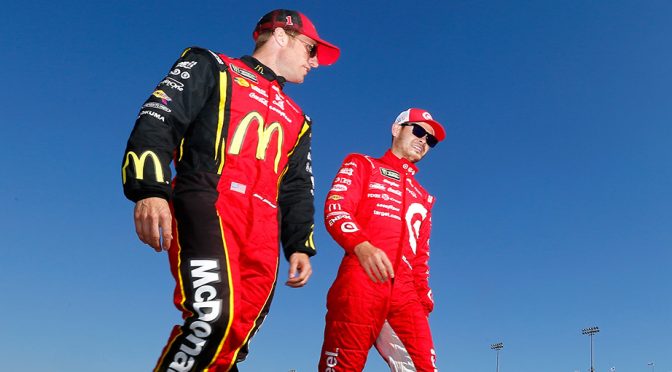
A strong finish to the 2016 season and an equally impressive start to 2017 has placed the two-team effort of Chip Ganassi Racing squarely in the Monster Energy NASCAR Cup Series spotlight.
These are heady days for drivers Jamie McMurray and Kyle Larson, crew chiefs Matt McCall and Chad Johnston, and the dozens upon dozens of support personnel surrounding the No. 1 and No. 42 teams.
Not that you would know it from speaking with the principals.
"No, I think that’s what we expected," Johnston said of the organization’s rise up the competitive ladder. Johnston’s driver, Larson, is the series’ points leader heading into Monday’s Food City 500 at Bristol Motor Speedway (1 p.m. ET, FOX, PRN, SiriusXM NASCAR). "I think it catches some people off guard and I think it’s gotten a lot of hype, but we felt like we were pretty good last year toward the end of the year; we weren’t as consistent as we wanted to be.
"But performance-wise we felt like we were pretty good. We also knew we needed to continue to work hard to keep gaining on it through the offseason. I think anything less than what we started off would have been a disappointment for all of us."
McCall said the resurgence is more than lip service. The results back up the attention being paid to the Ganassi organization this year.
"Because you know how it is, everyone always claims they’re working hard, working hard and that’s the case," he said. "But until you actually have something to show for it, you really don’t get to show the world that.
"It’s good for everyone that works here, a lot of long hours, to get a little recognition for all the work that’s been put in."
RELATED: Penske, Ganassi battle for early season supremacy
The explanations run the gamut, from the obvious to the intricate.
"I don’t know what the difference … is, but our race cars are just way faster," said Larson, who has banked one win and four runner-up finishes after seven races.
"I think after we struggled so bad through this point of the season last year, (Chad) got really aggressive on what changes he wanted done in the race shop and with the race cars, with the bodies. As soon as he got his bodies and chassis built, we had a great test at Pocono (in April 2016), then we went to Dover, almost won that race; came to Charlotte, won the Showdown, almost won the All-Star Race.
"Really since that point, we’ve had a lot of speed in our cars and we’ve just built on that and made them better and better."
There’s been no magic bullet, according to McMurray, who sits eighth in points and has four top-10 results this season. Instead, he said, it’s a combination of things that have, in some cases, taken years to develop and implement. Better cars, better personnel, better decisions. The organization has been a contender before, but it’s also had its share of expectations that failed to pan out.
"It’s been kind of years in the process of getting every department just a little bit better," McMurray, 40, said. "I think taking everybody’s ideas from engineering, from the guys on the shop floor that have grown up racing, taking all that and combining it and it’s all added up to a really good performance."
McMurray has been "on both sides" of the situation — those times when you show up at the track confident that you will contend and those times when you know there’s still plenty of work to be done just to survive.
"The frustrating part is that you know it’s not one little piece," he said. "It’s a lot of little, small things that are going to add up to getting you there.
"(From) 2010 being as high as you can get to, by 2012 it was horrible. It was super frustrating to go every week and know that if you did everything right you were maybe going to run 20th. Super frustrating weekends."
McMurray won the Daytona 500, the Brickyard 400 and the Charlotte fall race in ’10. He also won four poles. Two years later, he had only three top 10s and finished outside the top 20 in points.
"But right now we are back on top and it’s so much fun to show up every weekend and know that even if your car doesn’t drive great that you’re going to run really well and hopefully have a shot to win," he said.
Two Teams, Two Styles, One Goal
There’s a 16-year difference in ages between McMurray and Larson, and nearly as large of a gap in their approach to racing. Now in his fourth full season in the Monster Energy NASCAR Cup Series, Larson’s approach is simple: "I show up and drive," he said.
McMurray, however, is a product of his past, having arrived on the scene at a time when "guys that were big into setups and how do you make your car drive better," he said.
"I was raised with that mentality of kind of understanding the car and trying to make the right adjustments to it to make the car faster. Where Kyle really doesn’t know anything about cars. He doesn’t really give suggestions of what he thinks you need on the car to make it faster. He just searches around. A lot of times that works out well for him, so that’s opened my eyes up to maybe not trying to make the car perfect but maybe just search around and try to find something on the track."
Larson calls his teammate "a very underrated driver" with a ton of experience.
"He’s won every big race on our circuit," Larson said of McMurray. "I can go to him … and just pick his brain and get any bits of advice I could, look at his data and compare it to mine.
"I feel like we are very similar drivers and the way we use our hands and feet and how aggressive we are, so we mesh well together. I love working with Jamie; I hope he stays around for a long time and we can work together for a long time, as well, and have a lot of success together."
While the drivers come from different backgrounds and developed different approaches, the crew chiefs come from similar backgrounds. Both McCall and Johnston had driving careers and served at one point as engineers for other teams.
While experience behind the wheel has been helpful, understanding the methodology behind making a car go fast has been more crucial as the two made the move atop the pit box.
"I think the driving part, that sort of changes week to week," McCall said. "Especially every time you change a package and the tires change. …
"The other side (of that) is the managing skills, the people skills — there’s no experience for that so that’s definitely different on the crew chief side."
Johnston said the "other side of the steering wheel pays a lot better but it comes with a lot more hassles, too."
"The engineering side and just knowing all the nuances, the aerodynamics … things like that probably helped me more than anything," he said.
The two teams work as one, with key personnel working out of one trailer every week at the track. That promotes open dialogue, with both teams knowing what each is doing at any given time. The differences in the cars and their setups are minor, tweaked to suit each driver’s individual needs.
And their driving styles really aren’t that different. While some folks make much over Larson’s high-groove, sideways-here-I-come approach, Larson said it’s certainly not by design. Changes in the aero package and the loss of downforce, he said, have actually hurt him as much as anyone.
RELATED: Larson fast, atop the standings and having fun
"Everybody thinks that because I grew up dirt racing that I like the car sideways and all this and that," he said. "But I don’t. Stock car sideways is a way different feeling, a bad feeling, compared to Sprint cars. When you’re sideways in a Sprint car, you still have grip; you’re making more grip, to a certain point. Where with stock cars, you’ve got to worry about tire management so much and all that.
"If anything, I would honestly say less downforce is bad for me. In 2014, my first year in Cup, we had the most downforce we’ve had since I’ve been in NASCAR and I ran really well that year. That’s been my best season up until this year. I know last year we won a race and made the (playoffs) and all that, but consistently (2014) was our best up until this season.
"Lower downforce, the racing is better but I wouldn’t say it suits my driving style any better than it suits anybody else."
Having been in the spotlight before, McMurray isn’t fazed by the recent surge in attention paid to the Ganassi operation. He’s just happy to be a part of the process.
"I don’t know that when you’re on the inside that you view it that differently," he said. "When I think about our shop I know all the sacrifice and the work that’s gone into this and sometimes you don’t get rewarded for that. Sometimes you put all that time and effort in and it doesn’t translate to speed.
"But when you’re on the inside, you know everything that’s happened and why it is. I’m just thankful for it."