BUY TICKETS: See this event, races at Talladega


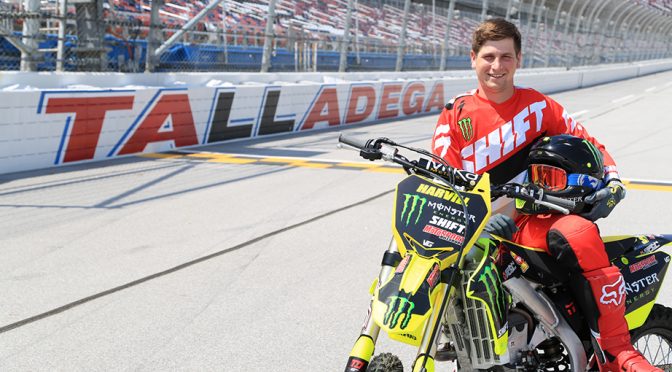
Alex Harvill is used to making the most of wide expanses. His pastime of jumping motorcycles great distances requires it, and the two leaps he’s made that stand as current world records have both taken place in the sweeping sand dunes of his home state of Washington.


But when Harvill wanted to bring his high-flying show to NASCAR, making the most of his Monster Energy backing and the energy drink maker’s sponsorship deal of stock-car racing’s top series, Talladega Superspeedway seemed likely to be a natural fit. Combine the 2.66-mile facility’s wide stretches of asphalt, its tendency for wild on-track action and its rabid fan base even more so make it an obvious choice.


Harvill will attempt to set a world record for the longest ramp-to-ramp motorcycle jump on May 7 before the start of the GEICO 500 (2 p.m. ET, FOX, MRN, SiriusXM NASCAR Radio), aiming to go 400 feet or farther. The jump will take place in the fan-frenzied zone called Talladega Boulevard, and the timing is even more audacious — the 24-year-old rider is scheduled to make his leap in the five-minute window between the national anthem and the command to start engines.


"I want to be under the most eyes as possible," Harvill told NASCAR.com, "make it on TV and kick off the NASCAR race with the biggest jump ever."


Until this week, Harvill had never been to Talladega, "but I have on NASCAR video games, so it’s like I’ve been here before because I’ve raced it many times. But this is my first time here, and it’s very impressive with how big it is."


Harvill currently holds two world records for motorcycle distance jumping — a 425-foot leap to set the bar for ramp-to-dirt jumps in 2012 and a 297.5-foot distance to establish the dirt-to-dirt benchmark a year later. The current ramp-to-ramp record is 351 feet, set in 2008 by Australian rider Robbie Maddison, but Harvill has designs on more than the target distance of 400 feet.


"I want to go for the furthest jump and then to keep going," says Harvill, who projects a target speed of 106 mph to achieve his Talladega goal. "My goal is to go 500 (feet), and I’m hoping Monster and NASCAR provide me platforms to keep going further and further."

To understand the psyche of someone who regularly vaults through the air on two wheels, it helps to know Harvill’s upbringing. By age 2 or 3, he was a motorcycle passenger in his father’s arms. His first dirt bike came at age 4. Winters were spent catching air with his father in the dunes not far from his Ephrata, Washington, home. Before long, young Alex was outjumping older kids on bigger bikes.


The fact that legendary daredevil Robert Craig Knievel Jr. — better known worldwide as Evel Knievel — made his first jump just 20 minutes from his hometown in nearby Moses Lake, Washington, only smoothed Harvill’s path to a lifetime of thrill-seeking. Back in 1965 when Knievel made his jumping debut, he was primarily a motorcycle dealer who dabbled in flat-track racing. "Everyone there knew him as Bob," Harvill says.


Knievel’s influence looms over Harvill, but their approaches to stunt riding differs. Instead of emulating Knievel’s devil-may-care style that resulted in multiple crashes and serious injuries, Harvill has taken a more calculating perspective to make his high-altitude endeavor as safe as can be.


World-record jumps before a NASCAR race have happened before, not surprisingly by Knievel, whose star rose through the 1970s. Knievel jumped 19 cars, covering a distance of 129 feet on Feb. 28, 1971 at the former Ontario (California) Motor Speedway.


Now it’s Harvill’s turn, and he already has a celebration in mind.


"I’m going to do some dance moves on the landing ramp, drink a few Monsters and watch the NASCAR race," Harvill said.

Editor’s note: Every Friday during the season, "Tweets You Might Have Missed" presents eight of the best NASCAR-related tweets from the week. 


1.

2.

3.

4.

5.

6.

7.

8.


DAYTONA BEACH, Fla. — To commemorate the holistic effort being made to help protect and preserve the environment, NASCARu00ae announced its fifth annual NASCAR Race to Greenu2122 initiative. Beginning today and culminating with Sunday’s TOYOTA OWNERS 400 at Richmond International Raceway, the initiative will build awareness around the programs NASCAR, the industry and multiple partners have developed to help reduce its carbon footprint.

A key pillar of NASCAR Race to Green is a call-to-action for fans and the industry to donate trees that will be planted across the country as well as in areas recently devastated by natural disasters. Fans can visit NASCAR.com/green to donate trees — $1 per tree for a 2-3 foot sapling — to be planted in those areas with the support of the Arbor Day Foundation. Fans are encouraged to share their own efforts around being green by using the hashtag #NASCARGreen.

“The Race To Green initiative allows us to highlight the foundational partners that help reduce our impact on the environment all year long,” said Brent Dewar, NASCAR Chief Operating Officer. “As an example of the wide range of initiatives taking place across the industry, American Ethanol has helped us eclipse 10 million miles on Sunoco Green E15, Safety-Kleen recycles all oil and lubricants at more than 200 race events a year, and collectively as an industry more than 400,000 trees have been planted to date. We are proud to continue those efforts under the Race to Green umbrella.”

As part of this year’s initiative, NASCAR fans visiting NASCAR.com/green will be treated to a newly designed digital destination, complete with easy-to-access information, news, an interactive carbon calculator and more. NASCAR Green will debut a new TV spot today as well, featuring a newly created NASCAR Green logo.


NASCAR Race To Green will highlight the sustainability efforts of its teams, tracks and NASCAR Official Partners, who work closely with NASCAR, year-round. While NASCAR Green initiatives span the entire year, the following additional activities will take place throughout this week-long effort:
• In partnership with the Arbor Day Foundation, NASCAR Official Partners have committed to donate trees to Tennessee residents affected by the Chimney Tops 2 Fire in November 2016. NASCAR will match the donations made by its Official Partners.

• As part of the 16th annual Comcast Cares Day, NASCAR XFINITY Series drivers will join Comcast volunteers for a Habitat for Humanity build in Johnson City, Tenn. NASCAR will donate trees for the newly built homes.

• Pocono Raceway will release a Sustainability Report that details the initiatives it has in place to be environmentally responsible, including its recycling program, solar farm and more.

• In partnership with Talladega Superspeedway, NASCAR XFINITY Series driver Elliot Sadler will visit Oak Mountain Elementary School in Birmingham, Ala. to donate 750 tree saplings provided by NASCAR and the Arbor Day Foundation.

• Today, Danica Patrick will help Mobil 1 spotlight its Mobil 1TM Annual Protection, allowing drivers to go one full year — or 20,000 miles — between oil changes, with a ceremonial pour at Bristol Motor Speedway.

NASCAR Green was launched because it was the right thing to do for the country, climate and fans. Since 2008, NASCAR has taken a holistic approach across its wide-ranging effort to reduce our impact on the environment, including:
• NASCAR and the industry have planted enough trees to completely offset carbon emissions for all three national series racing for the past six years, plus the next 40 years.
• NASCAR eclipsed more than 10 million competition miles on Sunoco Green E15, demonstrating that the ethanol blended biofuel stands up to high performance racing while significantly reducing emissions.
• Safety-Kleen delivers its oil recycling and re-refining services to the track each weekend, ensuring all cleaning solvents, oil, fluids and lubricants are recaptured and incorporated into useable products.
• NASCAR also features many teams and tracks using solar power as a renewable energy source, including: Daytona International Speedway, Indianapolis Motor Speedway, Michigan International Speedway, Pocono Raceway, Sonoma Raceway, Roush Fenway Racing and Kyle Busch Motorsports.
For more information about NASCAR Race to Green, visit NASCAR.com/Green.


The Monster Energy NASCAR Cup Series season will continue wit
h the Food City 500 at Bristol Motor Speedway on Sunday, April 23 at 2 p.m. ET on FOX, PRN and SiriusXM NASCAR Radio. 

BUY TICKETS: See the races at Bristol
RELATED: More on the Dash 4 Cash program

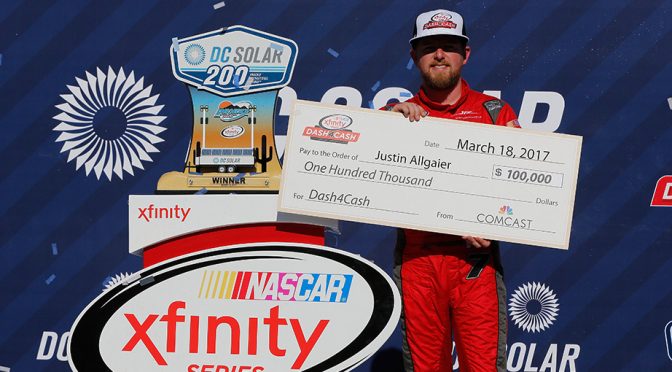
Justin Allgaier took home a $100,000 bonus by winning the first NASCAR XFINITY Series Dash 4 Cash race at Phoenix Raceway last month.


He’ll try to earn another $100,000 when the Dash 4 Cash competition returns in Saturday’s Fitzgerald Glider Kits 300 at Bristol Motor Speedway (1 p.m. ET on FS1, PRN, SiriusXM NASCAR Radio).


To take home the bonus, Allgaier doesn’t even need to win the race. He simply needs to beat the four Dash 4 Cash-eligible drivers to the finish line at the end of the race. The two top-finishing NASCAR XFINITY Series points earning drivers in each of the first two stages make up the four-driver Dash 4 Cash field for the final stage.


Allgaier has run well at Bristol throughout his career. In 12 starts at the Tennessee short track, he boasts one win (2010), five top fives and seven top 10s. He has finished in the top five in his last three Bristol races.


RELATED: Allgaier’s Bristol history


"Bristol has just been one of those places where the very first time I turned laps around the race track I felt comfortable," Allgaier said. "Last year we he had great finishes, so I’m ready to head back there and hopefully pick back up where we left off with our Cheney Brothers Chevrolet. Plus it’s a Dash 4 Cash race. How great would it be to get another $100,000 for JR Motorsports? We’ve won one already this year, so I’d like nothing more than to go out there and grab another one for this team."


The remaining Dash 4 Cash races are at Richmond International Raceway on April 29 and Dover International Speedway on June 3. 

RELATED: Full Bristol starting lineup
MORE: Bristol weather updates | Stay up-to-date with the schedule

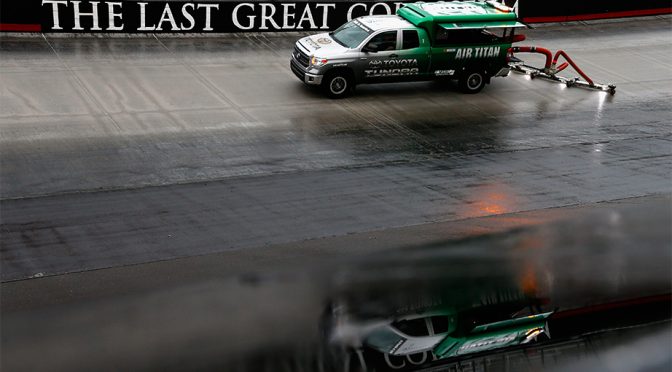
Rain has forced the cancellation of Coors Light Pole Qualifying for the Monster Energy NASCAR Cup Series at Bristol Motor Speedway, with NASCAR officials issuing a revised Friday schedule for on-track activity.


Instead, race officials have planned for a pair of 55-minute practices for the Monster Energy Series and the NASCAR XFINITY Series. The starting lineup for Monnday’s Food City 500 (1 p.m. ET Monday, FOX, PRN, SiriusXM NASCAR Radio) will be set according to the 2017 NASCAR Rule Book (owner points), meaning Monster Energy Series points leader Kyle Larson will start first. | See the lineup


The Monster Energy Series was set to take the track for an 85-minute practice at the 0.533-mile track at 11:30 a.m. ET. However, intermittent late-morning rain forced a schedule shift.

The revised Friday schedule shapes up as this:


— 1-1:55 p.m.: NASCAR K&N Pro Series practice
— 2-2:55 p.m.: NASCAR XFINITY Series practice (FS1)
— 3-3:55 p.m.: Monster Energy NASCAR Cup Series practice (FS1)

VOTE: Which rising star will win this weekend? More polls 

Saturday’s slate consists of two Monster Energy Series practices (8-30-9:25 a.m. and 11-11:55 a.m.), XFINITY Series qualifying (9:35 a.m.) and the XFINITY Series’ Fitzgerald Glider Kits 300 (1 p.m. ET on FS1, PRN, SiriusXM NASCAR Radio). The XFINITY Series race is the second of four Dash 4 Cash events in the series, in which the top qualifying XFINITY regular will win a $100,000 prize.

RELATED: Learn about the Dash 4 Cash program | Stage lengths for Bristol

Monday’s 500-lapper is the eighth of 36 points-paying races scheduled this year for the Monster Energy NASCAR Cup Series. Saturday’s 300 is the seventh of 33 events this year in the XFINITY Series.

NASCAR.com will keep you up to date on all the latest schedule changes, weather and on-track activity at Bristol this weekend.

BUY TICKETS: See the races at Bristol

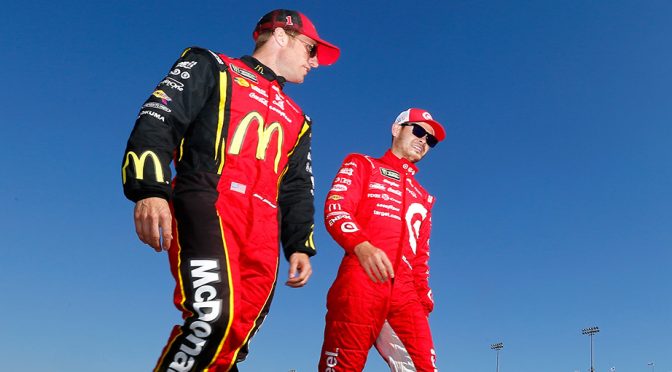
A strong finish to the 2016 season and an equally impressive start to 2017 has placed the two-team effort of Chip Ganassi Racing squarely in the Monster Energy NASCAR Cup Series spotlight.


These are heady days for drivers Jamie McMurray and Kyle Larson, crew chiefs Matt McCall and Chad Johnston, and the dozens upon dozens of support personnel surrounding the No. 1 and No. 42 teams.


Not that you would know it from speaking with the principals.


"No, I think that’s what we expected," Johnston said of the organization’s rise up the competitive ladder. Johnston’s driver, Larson, is the series’ points leader heading into Monday’s Food City 500 at Bristol Motor Speedway (1 p.m. ET, FOX, PRN, SiriusXM NASCAR). "I think it catches some people off guard and I think it’s gotten a lot of hype, but we felt like we were pretty good last year toward the end of the year; we weren’t as consistent as we wanted to be.


"But performance-wise we felt like we were pretty good. We also knew we needed to continue to work hard to keep gaining on it through the offseason. I think anything less than what we started off would have been a disappointment for all of us."


McCall said the resurgence is more than lip service. The results back up the attention being paid to the Ganassi organization this year.


"Because you know how it is, everyone always claims they’re working hard, working hard and that’s the case," he said. "But until you actually have something to show for it, you really don’t get to show the world that.


"It’s good for everyone that works here, a lot of long hours, to get a little recognition for all the work that’s been put in."


RELATED: Penske, Ganassi battle for early season supremacy


The explanations run the gamut, from the obvious to the intricate.


"I don’t know what the difference … is, but our race cars are just way faster," said Larson, who has banked one win and four runner-up finishes after seven races.


"I think after we struggled so bad through this point of the season last year, (Chad) got really aggressive on what changes he wanted done in the race shop and with the race cars, with the bodies. As soon as he got his bodies and chassis built, we had a great test at Pocono (in April 2016), then we went to Dover, almost won that race; came to Charlotte, won the Showdown, almost won the All-Star Race.


"Really since that point, we’ve had a lot of speed in our cars and we’ve just built on that and made them better and better."


There’s been no magic bullet, according to McMurray, who sits eighth in points and has four top-10 results this season. Instead, he said, it’s a combination of things that have, in some cases, taken years to develop and implement. Better cars, better personnel, better decisions. The organization has been a contender before, but it’s also had its share of expectations that failed to pan out.


"It’s been kind of years in the process of getting every department just a little bit better," McMurray, 40, said. "I think taking everybody’s ideas from engineering, from the guys on the shop floor that have grown up racing, taking all that and combining it and it’s all added up to a really good performance."


McMurray has been "on both sides" of the situation — those times when you show up at the track confident that you will contend and those times when you know there’s still plenty of work to be done just to survive.


"The frustrating part is that you know it’s not one little piece," he said. "It’s a lot of little, small things that are going to add up to getting you there.


"(From) 2010 being as high as you can get to, by 2012 it was horrible. It was super frustrating to go every week and know that if you did everything right you were maybe going to run 20th. Super frustrating weekends."


McMurray won the Daytona 500, the Brickyard 400 and the Charlotte fall race in ’10. He also won four poles. Two years later, he had only three top 10s and finished outside the top 20 in points.


"But right now we are back on top and it’s so much fun to show up every weekend and know that even if your car doesn’t drive great that you’re going to run really well and hopefully have a shot to win," he said.


Two Teams, Two Styles, One Goal


There’s a 16-year difference in ages between McMurray and Larson, and nearly as large of a gap in their approach to racing. Now in his fourth full season in the Monster Energy NASCAR Cup Series, Larson’s approach is simple: "I show up and drive," he said.


McMurray, however, is a product of his past, having arrived on the scene at a time when "guys that were big into setups and how do you make your car drive better," he said.


"I was raised with that mentality of kind of understanding the car and trying to make the right adjustments to it to make the car faster. Where Kyle really doesn’t know anything about cars. He doesn’t really give suggestions of what he thinks you need on the car to make it faster. He just searches around. A lot of times that works out well for him, so that’s opened my eyes up to maybe not trying to make the car perfect but maybe just search around and try to find something on the track."


Larson calls his teammate "a very underrated driver" with a ton of experience.


"He’s won every big race on our circuit," Larson said of McMurray. "I can go to him … and just pick his brain and get any bits of advice I could, look at his data and compare it to mine.


"I feel like we are very similar drivers and the way we use our hands and feet and how aggressive we are, so we mesh well together. I love working with Jamie; I hope he stays around for a long time and we can work together for a long time, as well, and have a lot of success together."


While the drivers come from different backgrounds and developed different approaches, the crew chiefs come from similar backgrounds. Both McCall and Johnston had driving careers and served at one point as engineers for other teams.


While experience behind the wheel has been helpful, understanding the methodology behind making a car go fast has been more crucial as the two made the move atop the pit box.


"I think the driving part, that sort of changes week to week," McCall said. "Especially every time you change a package and the tires change. …


"The other side (of that) is the managing skills, the people skills — there’s no experience for that so that’s definitely different on the crew chief side."


Johnston said the "other side of the steering wheel pays a lot better but it comes with a lot more hassles, too."


"The engineering side and just knowing all the nuances, the aerodynamics … things like that probably helped me more than anything," he said.


The two teams work as one, with key personnel working out of one trailer every week at the track. That promotes open dialogue, with both teams knowing what each is doing at any given time. The differences in the cars and their setups are minor, tweaked to suit each driver’s individual needs.


And their driving styles really aren’t that different. While some folks make much over Larson’s high-groove, sideways-here-I-come approach, Larson said it’s certainly not by design. Changes in the aero package and the loss of downforce, he said, have actually hurt him as much as anyone.


RELATED: Larson fast, atop the standings and having fun


"Everybody thinks that because I grew up dirt racing that I like the car sideways and all this and that," he said. "But I don’t. Stock car sideways is a way different feeling, a bad feeling, compared to Sprint cars. When you’re sideways in a Sprint car, you still have grip; you’re making more grip, to a certain point. Where with stock cars, you’ve got to worry about tire management so much and all that.


"If anything, I would honestly say less downforce is bad for me. In 2014, my first year in Cup, we had the most downforce we’ve had since I’ve been in NASCAR and I ran really well that year. That’s been my best season up until this year. I know last year we won a race and made the (playoffs) and all that, but consistently (2014) was our best up until this season.


"Lower downforce, the racing is better but I wouldn’t say it suits my driving style any better than it suits anybody else."


Having been in the spotlight before, McMurray isn’t fazed by the recent surge in attention paid to the Ganassi operation. He’s just happy to be a part of the process.


"I don’t know that when you’re on the inside that you view it that differently," he said. "When I think about our shop I know all the sacrifice and the work that’s gone into this and sometimes you don’t get rewarded for that. Sometimes you put all that time and effort in and it doesn’t translate to speed.


"But when you’re on the inside, you know everything that’s happened and why it is. I’m just thankful for it."
RELATED: Practice 1 results | Best 10-lap timesBuy tickets for Bristol


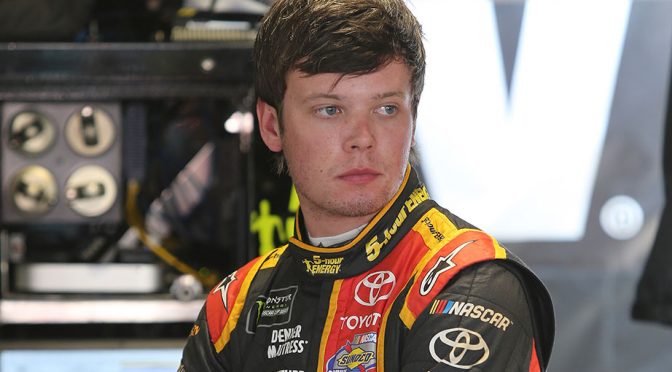
Rookie Erik Jones led the way in a rain-delayed opening practice for the Monster Energy NASCAR Cup Series on Friday afternoon at Bristol Motor Speedway.


Jones, a Sunoco Rookie of the Year candidate, powered the Furniture Row No. 77 Toyota to a best lap of 127.843 mph on the .533-mile track.


Kyle Busch, a five-time Bristol winner, was second-fastest in the Joe Gibbs Racing No. 18 Toyota, logging a top lap of 127.090 mph. Ryan Blaney, Martin Truex Jr. and Matt Kenseth completed the top five in the 55-minute session, the first tune-up ahead of Monday’s Food City 500 (1 p.m. ET Monday, FOX, PRN, SiriusXM NASCAR Radio).


Jones will start 14th in Monday’s 500-lapper after persistent early rain forced the cancellation of Coors Light Pole Qualifying in favor of practice time. Rain also postponed the race from Sunday to Monday. Series points leader Kyle Larson — seventh best in first practice — will start first Monday after the weather caused race officials to set the field according to the 2017 NASCAR Rule Book. | See the lineup


The inclement conditions forced a shake-up to the day’s schedule, scrubbing a planned 85-minute practice that was slated to begin Friday at 11:30 a.m. ET.


Chase Elliott brought out the only caution period in the session, losing control of his Hendrick Motorsports No. 24 Chevrolet off Turn 4 in a long slide on the track’s front straightaway. He managed to avoid contact, keeping his primary car intact, and was 11th on the practice speed chart (126.370 mph).


Kasey Kahne (13th, 126.121 mph), a teammate to Elliott at Hendrick Motorsports, slightly scraped the right side of his No. 5 Chevrolet late in the session. Joey Logano (ninth, 126.445 mph) also brushed the outside retaining wall with his Team Penske No. 22 Ford.


With uncertain weather forecasts placing a premium on practice time, NASCAR officials opted to defer any time penalties for infractions at the previous race (April 9, Texas). Those practice holds are set to be enforced next weekend at Richmond International Raceway.


BUY TICKETS: See the races at Bristol

BRISTOL, Tenn. — After his victory two weeks ago at Texas Motor Speedway, Jimmie Johnson was late for his post-race press conference – and with good reason.

Because of a malfunction with his fluid delivery system, Johnson was dehydrated by the end of the Monster Energy NASCAR Cup Series race. Consequently, a trip to the infield care center for IV fluids delayed his appearance in the media center.

During the NASCAR off week over Easter, Johnson took on very different sorts of fluids, in Mexico no less. After all, what good is a well-earned vacation if you can’t celebrate your most recent victory?


RELATED: Johnson taken to infield care center after Texas win


"Yeah, the three IV bags did wonders," Johnson said in a press conference Friday. "After leaving the media center, I started my off weekend quickly that night and proceeded to chase out the pain with as many margaritas and beers as I could down in Mexico.

"I recovered well, but unfortunately came back sick from Mexico, and I’m just on the tail end of that now. If you are going to play you are going to pay, I guess, at the end of the day."

What made the trip worth playing – and paying – was a victory that reversed a sluggish start to the season for the No. 48 team. Uncharacteristically, Johnson had posted just one top-10 finish in six races before the Texas win.

"We would have been drowning sorrows instead of celebrating and enjoying it (if the team hadn’t won)," Johnson said. "There’s no better way to go into an off weekend than with a win or a strong run, strong performance.


"We all sit inside of our heads and think about where we’re at, what’s going on. A tricky start to our season, to say the least, and to punch our ticket to the playoffs and get that win made for a great off weekend."