RELATED: Read more Inside Groove | Rainy Bristol photos
BUY TICKETS: See the races at Bristol
A strong finish to the 2016 season and an equally impressive start to 2017 has placed the two-team effort of Chip Ganassi Racing squarely in the Monster Energy NASCAR Cup Series spotlight.
These are heady days for drivers Jamie McMurray and Kyle Larson, crew chiefs Matt McCall and Chad Johnston, and the dozens upon dozens of support personnel surrounding the No. 1 and No. 42 teams.
Not that you would know it from speaking with the principals.
"No, I think that’s what we expected," Johnston said of the organization’s rise up the competitive ladder. Johnston’s driver, Larson, is the series’ points leader heading into Monday’s Food City 500 at Bristol Motor Speedway (1 p.m. ET, FOX, PRN, SiriusXM NASCAR). "I think it catches some people off guard and I think it’s gotten a lot of hype, but we felt like we were pretty good last year toward the end of the year; we weren’t as consistent as we wanted to be.
"But performance-wise we felt like we were pretty good. We also knew we needed to continue to work hard to keep gaining on it through the offseason. I think anything less than what we started off would have been a disappointment for all of us."
McCall said the resurgence is more than lip service. The results back up the attention being paid to the Ganassi organization this year.
"Because you know how it is, everyone always claims they’re working hard, working hard and that’s the case," he said. "But until you actually have something to show for it, you really don’t get to show the world that.
"It’s good for everyone that works here, a lot of long hours, to get a little recognition for all the work that’s been put in."
RELATED: Penske, Ganassi battle for early season supremacy
The explanations run the gamut, from the obvious to the intricate.
"I don’t know what the difference … is, but our race cars are just way faster," said Larson, who has banked one win and four runner-up finishes after seven races.
"I think after we struggled so bad through this point of the season last year, (Chad) got really aggressive on what changes he wanted done in the race shop and with the race cars, with the bodies. As soon as he got his bodies and chassis built, we had a great test at Pocono (in April 2016), then we went to Dover, almost won that race; came to Charlotte, won the Showdown, almost won the All-Star Race.
"Really since that point, we’ve had a lot of speed in our cars and we’ve just built on that and made them better and better."
There’s been no magic bullet, according to McMurray, who sits eighth in points and has four top-10 results this season. Instead, he said, it’s a combination of things that have, in some cases, taken years to develop and implement. Better cars, better personnel, better decisions. The organization has been a contender before, but it’s also had its share of expectations that failed to pan out.
"It’s been kind of years in the process of getting every department just a little bit better," McMurray, 40, said. "I think taking everybody’s ideas from engineering, from the guys on the shop floor that have grown up racing, taking all that and combining it and it’s all added up to a really good performance."
McMurray has been "on both sides" of the situation — those times when you show up at the track confident that you will contend and those times when you know there’s still plenty of work to be done just to survive.
"The frustrating part is that you know it’s not one little piece," he said. "It’s a lot of little, small things that are going to add up to getting you there.
"(From) 2010 being as high as you can get to, by 2012 it was horrible. It was super frustrating to go every week and know that if you did everything right you were maybe going to run 20th. Super frustrating weekends."
McMurray won the Daytona 500, the Brickyard 400 and the Charlotte fall race in ’10. He also won four poles. Two years later, he had only three top 10s and finished outside the top 20 in points.
"But right now we are back on top and it’s so much fun to show up every weekend and know that even if your car doesn’t drive great that you’re going to run really well and hopefully have a shot to win," he said.
Two Teams, Two Styles, One Goal
There’s a 16-year difference in ages between McMurray and Larson, and nearly as large of a gap in their approach to racing. Now in his fourth full season in the Monster Energy NASCAR Cup Series, Larson’s approach is simple: "I show up and drive," he said.
McMurray, however, is a product of his past, having arrived on the scene at a time when "guys that were big into setups and how do you make your car drive better," he said.
"I was raised with that mentality of kind of understanding the car and trying to make the right adjustments to it to make the car faster. Where Kyle really doesn’t know anything about cars. He doesn’t really give suggestions of what he thinks you need on the car to make it faster. He just searches around. A lot of times that works out well for him, so that’s opened my eyes up to maybe not trying to make the car perfect but maybe just search around and try to find something on the track."
Larson calls his teammate "a very underrated driver" with a ton of experience.
"He’s won every big race on our circuit," Larson said of McMurray. "I can go to him … and just pick his brain and get any bits of advice I could, look at his data and compare it to mine.
"I feel like we are very similar drivers and the way we use our hands and feet and how aggressive we are, so we mesh well together. I love working with Jamie; I hope he stays around for a long time and we can work together for a long time, as well, and have a lot of success together."
While the drivers come from different backgrounds and developed different approaches, the crew chiefs come from similar backgrounds. Both McCall and Johnston had driving careers and served at one point as engineers for other teams.
While experience behind the wheel has been helpful, understanding the methodology behind making a car go fast has been more crucial as the two made the move atop the pit box.
"I think the driving part, that sort of changes week to week," McCall said. "Especially every time you change a package and the tires change. …
"The other side (of that) is the managing skills, the people skills — there’s no experience for that so that’s definitely different on the crew chief side."
Johnston said the "other side of the steering wheel pays a lot better but it comes with a lot more hassles, too."
"The engineering side and just knowing all the nuances, the aerodynamics … things like that probably helped me more than anything," he said.
The two teams work as one, with key personnel working out of one trailer every week at the track. That promotes open dialogue, with both teams knowing what each is doing at any given time. The differences in the cars and their setups are minor, tweaked to suit each driver’s individual needs.
And their driving styles really aren’t that different. While some folks make much over Larson’s high-groove, sideways-here-I-come approach, Larson said it’s certainly not by design. Changes in the aero package and the loss of downforce, he said, have actually hurt him as much as anyone.
RELATED: Larson fast, atop the standings and having fun
"Everybody thinks that because I grew up dirt racing that I like the car sideways and all this and that," he said. "But I don’t. Stock car sideways is a way different feeling, a bad feeling, compared to Sprint cars. When you’re sideways in a Sprint car, you still have grip; you’re making more grip, to a certain point. Where with stock cars, you’ve got to worry about tire management so much and all that.
"If anything, I would honestly say less downforce is bad for me. In 2014, my first year in Cup, we had the most downforce we’ve had since I’ve been in NASCAR and I ran really well that year. That’s been my best season up until this year. I know last year we won a race and made the (playoffs) and all that, but consistently (2014) was our best up until this season.
"Lower downforce, the racing is better but I wouldn’t say it suits my driving style any better than it suits anybody else."
Having been in the spotlight before, McMurray isn’t fazed by the recent surge in attention paid to the Ganassi operation. He’s just happy to be a part of the process.
"I don’t know that when you’re on the inside that you view it that differently," he said. "When I think about our shop I know all the sacrifice and the work that’s gone into this and sometimes you don’t get rewarded for that. Sometimes you put all that time and effort in and it doesn’t translate to speed.
"But when you’re on the inside, you know everything that’s happened and why it is. I’m just thankful for it."
RELATED: Practice 1 results | Best 10-lap times | Buy tickets for Bristol
Rookie Erik Jones led the way in a rain-delayed opening practice for the Monster Energy NASCAR Cup Series on Friday afternoon at Bristol Motor Speedway.
Jones, a Sunoco Rookie of the Year candidate, powered the Furniture Row No. 77 Toyota to a best lap of 127.843 mph on the .533-mile track.
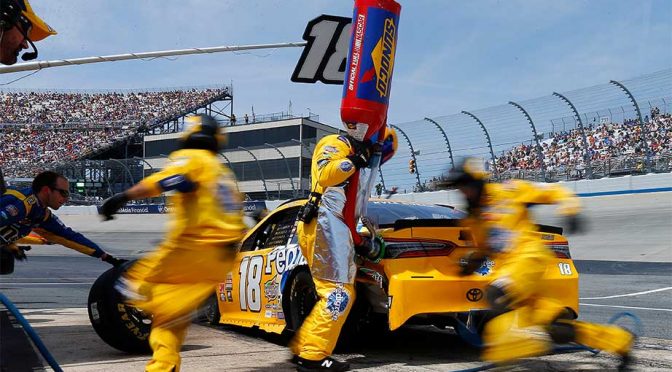
Kyle Busch, a five-time Bristol winner, was second-fastest in the Joe Gibbs Racing No. 18 Toyota, logging a top lap of 127.090 mph. Ryan Blaney, Martin Truex Jr. and Matt Kenseth completed the top five in the 55-minute session, the first tune-up ahead of Monday’s Food City 500 (1 p.m. ET Monday, FOX, PRN, SiriusXM NASCAR Radio).
Jones will start 14th in Monday’s 500-lapper after persistent early rain forced the cancellation of Coors Light Pole Qualifying in favor of practice time. Rain also postponed the race from Sunday to Monday. Series points leader Kyle Larson — seventh best in first practice — will start first Monday after the weather caused race officials to set the field according to the 2017 NASCAR Rule Book. | See the lineup
The inclement conditions forced a shake-up to the day’s schedule, scrubbing a planned 85-minute practice that was slated to begin Friday at 11:30 a.m. ET.
Chase Elliott brought out the only caution period in the session, losing control of his Hendrick Motorsports No. 24 Chevrolet off Turn 4 in a long slide on the track’s front straightaway. He managed to avoid contact, keeping his primary car intact, and was 11th on the practice speed chart (126.370 mph).
Kasey Kahne (13th, 126.121 mph), a teammate to Elliott at Hendrick Motorsports, slightly scraped the right side of his No. 5 Chevrolet late in the session. Joey Logano (ninth, 126.445 mph) also brushed the outside retaining wall with his Team Penske No. 22 Ford.
With uncertain weather forecasts placing a premium on practice time, NASCAR officials opted to defer any time penalties for infractions at the previous race (April 9, Texas). Those practice holds are set to be enforced next weekend at Richmond International Raceway.
BUY TICKETS: See the races at Bristol
BRISTOL, Tenn. — After his victory two weeks ago at Texas Motor Speedway, Jimmie Johnson was late for his post-race press conference – and with good reason.
Because of a malfunction with his fluid delivery system, Johnson was dehydrated by the end of the Monster Energy NASCAR Cup Series race. Consequently, a trip to the infield care center for IV fluids delayed his appearance in the media center.
During the NASCAR off week over Easter, Johnson took on very different sorts of fluids, in Mexico no less. After all, what good is a well-earned vacation if you can’t celebrate your most recent victory?
RELATED: Johnson taken to infield care center after Texas win
"Yeah, the three IV bags did wonders," Johnson said in a press conference Friday. "After leaving the media center, I started my off weekend quickly that night and proceeded to chase out the pain with as many margaritas and beers as I could down in Mexico.
"I recovered well, but unfortunately came back sick from Mexico, and I’m just on the tail end of that now. If you are going to play you are going to pay, I guess, at the end of the day."
What made the trip worth playing – and paying – was a victory that reversed a sluggish start to the season for the No. 48 team. Uncharacteristically, Johnson had posted just one top-10 finish in six races before the Texas win.
"We would have been drowning sorrows instead of celebrating and enjoying it (if the team hadn’t won)," Johnson said. "There’s no better way to go into an off weekend than with a win or a strong run, strong performance.
"We all sit inside of our heads and think about where we’re at, what’s going on. A tricky start to our season, to say the least, and to punch our ticket to the playoffs and get that win made for a great off weekend."
BUY TICKETS: See the races at Bristol
RELATED: Full weekend schedule for Bristol
The Monster Energy NASCAR Cup Series and NASCAR XFINITY Series are at Bristol Motor Speedway this weekend.
Below are the stage lengths for each race. Click here to bookmark stage lengths for every race this season.
Monster Energy NASCAR Cup Series (Race is Monday, 1 p.m. ET, FOX)
Stage 1: Ends on Lap 125
Stage 2: Ends on Lap 250
Final Stage: Scheduled to end on Lap 500
XFINITY Series (Race is Saturday, 1 p.m. ET, FS1)
Stage 1: Ends on Lap 85
Stage 2: Ends on Lap 170
Final Stage: Scheduled to end on Lap 300
BUY TICKETS: See the races at Charlotte
"Daylight Racing Time" is back for the Bank of America 500 as the race returns to a Sunday afternoon start time in 2017, Charlotte Motor Speedway announced on Thursday.
The fourth race of the Monster Energy NASCAR Cup Series playoffs and first race in the Round of 12 will now be held on Sunday, Oct. 8 at 2 p.m. ET with TV coverage on NBC — instead of the initial announced date of Saturday, Oct. 7 — in a move geared for on-track competition and a more family-friendly schedule over a three-day weekend.
"Charlotte’s so tricky, especially when the sun’s out," seven-time Monster Energy NASCAR Cup Series champion and defending Bank of America 500 winner Jimmie Johnson said in a track release. "And, the track’s finally aging and getting to a place with a lot of character (so) that a day race will allow us to run so many more lanes and, I think, create such an entertaining and compelling race … I’m really excited for a hot, slick, day race."
The past two years have seen the race moved from Saturday to Sunday due to inclement weather. The race has not been scheduled for the daytime since 2002. The fall race weekend schedule at Charlotte had been set up to be a Thursday-Friday-Saturday affair in recent years.
This year’s schedule will also include: Monster Energy NASCAR Cup Series qualifying held on Friday, Oct. 6 at 7 p.m. ET, and the XFINITY Series Drive for the Cure 300 presented by Blue Cross Blue Shield of North Carolina at 3 p.m. ET on Saturday, Oct. 7, televised on NBCSN. That race is an elimination race in the XFINITY Series playoffs as the postseason field will shrink from 12 drivers to eight following the event.
"We’ve heard from fans and from several drivers about how much fun it is to race during the daytime at Charlotte Motor Speedway," Marcus Smith, speedway president and general manager, said in the release. "A return to ‘Daylight Racing Time’ also builds on our commitment to being ‘FANS FIRST’ by providing families with affordable, world-class entertainment on a Sunday afternoon. Everyone should set their clocks for ‘Daylight Racing Time,’ because it’s going to be an unforgettable weekend of racing."
In other programming news: the fall race at Martinsville is now scheduled for a 3 p.m. ET start; and the fall Texas race will be broadcast on NBCSN.
Rankings below are based on a mixture of expected output and DraftKings’ NASCAR salaries for that day. The ordering is not based on highest projected fantasy totals, but rather by value of each driver.
(fppk = average fantasy points per $1,000 of salary. The typical median fppk for a 2016 race was in the 3s. Plate tracks tend to be lower and short tracks tend to run higher due to the amount of laps.)
BUY TICKETS: See the races at Bristol
Darrell Wallace Jr. unveiled his new Mello Yello paint scheme via Facebook Live on Thursday afternoon at the Roush Fenway Racing shop in Concord, North Carolina. The 23-year-old XFINITY Series driver will run the scheme on his No. 6 Ford at Richmond International Raceway on April 29 in the ToyotaCare 250 (1 p.m. ET, FS1, PRN, SiriusXM NASCAR Radio).
Here’s "MY" Mello Yello car for @RIRInsider! So sick!ud83eudd18 pic.twitter.com/OsrDRGjQQf
— Darrell Wallace Jr (@BubbaWallace) April 20, 2017
Kyle Petty, who piloted the No. 42 Mello Yello premier series ride in the early 1990s, was on hand for the unveil.
"Obviously I’m a big fan," Petty said to Wallace Jr. "I’m pulling for you to win in this thing. "… Some of my best years were in the Mello Yello car, some of my most fun."
Wallace is currently riding an ironic streak of five top-six finishes in his No. 6 Ford and is searching for his first win in the XFINITY Series. He is ranked fourth in the XFINITY Series standings.
Thanks to @kylepetty for helping us unveil @BubbaWallace‘s @MelloYello Mustang for Richmond! pic.twitter.com/G7l9afpdl1
— Roush Fenway Racing (@roushfenway) April 20, 2017
Editor’s note: This story originally ran April 20, 2017. We are re-publishing it following Ryan Blaney’s win at Pocono Raceway on June 11. Some of the information refers to races in April.
MOORESVILLE, N.C. — It used to be a thing.
When NASCAR rookies in bygone days graduated to their sophomore seasons, you came to expect the canned photos: A smiling driver at the rear of the car, clearing the bumper of the yellow tape that’s required of first-year talent.
Ryan Blaney — as best as we can tell — took no such staged photo, cheesing for the camera in mid-tape peel. Still, there’s been a noticeable change in the 23-year-old driver this season, his second in the Monster Energy NASCAR Cup Series, and it’s helped stir the early indications of a rejuvenation for Wood Brothers Racing, one of the sport’s most storied teams.
“I think when he pulled that rookie stripe off the car,” said team co-owner Len Wood, “it’s like last year he was, ‘I’m going to mind my P’s and Q’s, I’m going to pay attention and I’m going to be respectful of everybody, try to gain respect.’ This year, I think he’s stepped up his aggressiveness a little bit. I think that’s the main difference. So far, I haven’t seen recklessness with it, just aggressiveness.”
Blaney’s 2017 pivot may not have been the result of an overtly communicated directive from team to driver as much as a natural reflex for a relative newcomer growing more comfortable in his surroundings in stock-car racing’s major leagues.
Whatever the reason for the figurative loosening of the reins, the new vibe has clicked.
“I feel like that was a main goal, not only for myself but for our whole team, to be more aggressive this year whether it’s racing or pit calls,” Blaney says. “I think it’s definitely easier to make those decisions when you’re not a rookie and you try to gain respect that whole first year so that you can run them a little harder. That side had definitely amplified a lot and it’s benefited us so far.”
Stages of support
For an organization rich with tradition, owing to a family pedigree of 67 years of involvement with auto racing, the Wood Brothers have demonstrated a knack at adapting to modern-day NASCAR’s rules of the road. In particular, Len Wood says, the No. 21 Ford team has found opportunity in the incentive-based three-stage race format introduced this season.
In seven races through April 20, there were 14 intermissions. The Wood Brothers accumulated points in 11 of those, earning bonuses for running in the top 10. That stretch has included finishing in the points in nine of the last 10 stage breaks, and two convincing stage wins during Blaney’s rapid-paced run at Texas.
Many factors powered the Lone Star stage sweep, not the least of which was strategy. A late-breaking caution flag during the second stage put No. 21 crew chief Jeremy Bullins on the spot. Bullins ultimately made the call for Blaney to stay on the track to maintain position in the running order, bettering his chance for more stage points.
After collecting the green-checkered flag for Stage 2, Blaney fell back after a scheduled pit stop during the intermission, a jammed-up restart and a late pit-road gaffe that thwarted his comeback efforts. It would have been too easy to blame the late-stage decision for the team’s fade, but Len Wood pointed out that a similar strategy panned out for Jimmie Johnson, who eventually stormed to his first victory of the season.
If Bullins caught any undue scrutiny for the call, he doesn’t carry any regrets.
“Obviously you’re trying to win races, but through the first part of the season here, everybody’s seen what a big deal the stage points are,” Bullins said. “We felt like we could win that stage, and how do you give up 10 points? At the end of the day, we got a lot of points out of it, and did we get the win? No, but it was a good confidence boost for the team and certainly a decision we would make again in a heartbeat. I don’t second-guess it at all, and I think it was the right thing to do.
“I think the fact that we were able to win those stages shows how much our team has grown, and Ryan’s confidence in where our team is at this year.”
Team transition
The Wood Brothers made the jump back to full-time competition in NASCAR’s premier series last season, a transition aided by a strong technical affiliation with Team Penske, one of Ford’s flagship teams with drivers Joey Logano and Brad Keselowski. That relationship has grown since Aug. 14, 2014, when the Wood Brothers announced both the advent of the alliance and the addition of Blaney as the team’s driver, fresh from the Penske development system.
And though it’s hard to say that Ford’s commitment to the Wood Brothers — a fiercely loyal relationship spanning seven decades — has grown even stronger this year, the manufacturer has bolstered its efforts in both performance and sheer numbers by bringing Stewart-Haas Racing to the blue-oval side in 2017.
“I think it shows the support that they’re wanting to put into the sport in general, which is great,” Bullins said. “I think when you add a quality team like that, there’s more resources coming from both sides, right? I think it helps everybody.”
A prime asset helping to revitalize the Wood Brothers this season is a more measured Blaney. His patience in a wreck-filled season opener led to a runner-up finish in the Daytona 500; driving slightly less defensively in the races that followed helped to continue the upward trend.
But Blaney also adds off-track intangibles that have helped keep the shop’s mood light. It’s a team with plenty of tradition and old-school cred, but with a young driver known for his avid Star Wars fandom and his Snapchat antics — late-night death metal crooning anyone? — with partner-in-crime Bubba Wallace.
“He’s kind of a different kid,” Len Wood says. “He’s a kid off the track. Him and Bubba when they went last year and filmed each other acting like different drivers, that stuff was pretty funny. But I think when he puts the helmet on and sits down in that race car, I think the kid part’s gone and he’s turning into a very good driver.”
One without those pesky rookie stripes.