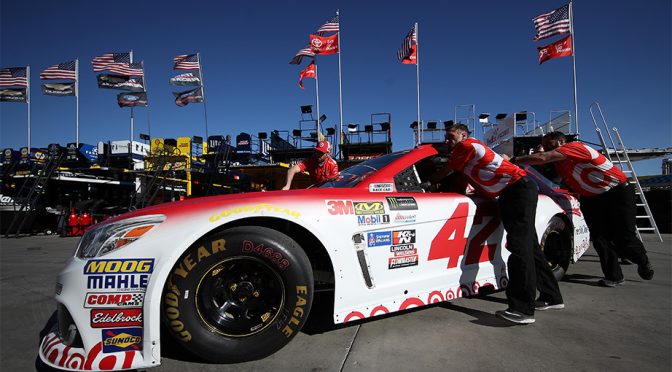
RWR’s return to the elite level of NASCAR will have Timmy Hill aboard the No. 51 Chevrolet for Speedweeks with a rotating list of drivers to follow throughout the season including longtime RWR drivers Stanton Barrett, Cody Ware and road course veteran Kevin O’Connell to name a few.
"We’ve been eyeing our return to the Monster Energy NASCAR Cup Series since the end of last year," said RWR team principal Rick Ware. "We knew with the competition level stronger than ever, we needed to take the steps to make sure we could come to the track and be as competitive as possible, while focused on building our organization as the season presses on.”
RWR also announced the team has acquired assets from Tommy Baldwin Racing (TBR) for use this season, including cars, pulldown rig and technology support.
Additionally, longtime industry veteran Joe Lax, also previously with TBR will serve as crew chief, while pro-motor engineering (PME) will supply the horsepower during the season.
Furthermore, Mike Hillman Sr., a longtime fixture in NASCAR joins RWR in a newly created role as team consultant.
"I feel like we’ve done a great job getting our stars aligned for this year," Ware added. "Between acquiring cars from Tommy Baldwin Racing and having a good open relationship with them, plus being able to bring key personnel aboard who have the desire and drive to make our team the best it’s ever been.
"One component I’m really proud about is our initiative to bring our body work in-house. We really have hired some talented and experienced personnel overall and I couldn’t be more excited to get our season underway."
Hill is hopeful to make his "World Center of Racing" debut in next month’s Super Bowl event. The 23-year-old hopes to make his 49th Cup race in his first ever Daytona 500.
Despite no Cup starts at Daytona, the Port Tobacco, Maryland native has four XFINITY starts at the 2.5-mile oval with two career top-10 finishes including back-to-back top-10 runs for Rick Ware Racing in 2012 with a career-best seventh in the season-opening race.
"I’m thankful to continue my relationship with Rick Ware Racing for the 2017 season," said Hill. "I’ve always wanted the chance to compete in the Daytona 500 and thanks to Rick and Lisa (Ware), I’ll have that opportunity. It won’t be easy, but as a team and Joe (Lax) leading the way, we’re focused and will give it all we have and hope we’ll be one of the 40 cars running in the Daytona 500!"
In addition to their effort in the Cup Series, Rick Ware Racing will also compete in the NASCAR Camping World Truck Series (NCWTS) this season with recently announced driver Spencer Boyd at the wheel.
Sponsorship for the team’s Cup entry will be announced at a later date.
The Nemecheks will even be running for the same team — family-owned NEMCO Motorsports — which will field John Hunter Nemechek full-time in the No. 8 Fire Alarm Services, Inc., Chevrolet for 2017, and will also field Joe Nemechek in the No. 87 Fleetwing Chevrolet in a select number of NASCAR Camping World Truck Series events.
Joe Nemechek and John Hunter Nemechek have competed against each other on the race track just three times before, twice in the Allison Legacy Race Series, and once in the ARCA Midwest Tour. The first time the duo competed against each other was in the Allison Legacy Race Series at the Concord Speedway in 2011 where the son finished first, and the father second. In a rematch at the Carolina Motorsports Park John Hunter Nemechek finished third, and Joe Nemechek finished fourth. The other was in an ARCA Midwest Tour event at the Milwaukee Mile in 2013, where neither driver won but experience outran youth.
John Hunter Nemechek, who posted two NASCAR Camping World Truck Series victories and captured his first pole award during the 2016 season, may be at a disadvantage in Daytona. Joe Nemechek has comprehensive experience at the “World Center of Racing,” having five pole awards and two victories (1998, 2002), four top-five and seven top-10 finishes in the NASCAR XFINITY Series. In addition, he has the all-time NASCAR XFINITY Series most starts record, including the most laps completed record, and number of pole awards record at the Daytona International Speedway. Across the top three NASCAR divisions Nemechek has 74 total starts at the Daytona Beach, Florida, facility.
This will be the second NASCAR season-opening event Joe Nemechek has competed against Nemechek lineage. In the 1997 NASCAR Camping World Truck Series season-opener at the Walt Disney World Speedway, Joe Nemechek in the No. 87 finished nine positions ahead of John Nemechek in the No. 8 — both as owner-driver entries.
Both father and son have collected victories, pole awards, and claimed the title of Most Popular Driver in their respective series, but only Joe Nemechek has claimed the series championship trophy. Without the dedication Joe Nemechek has had towards his son’s career, John Hunter Nemechek knows he might not have had the chance to show his talents, and have the opportunity to team up with his dad at the Daytona International Speedway.
Joe Nemechek and John Hunter Nemechek look to add their names to the short list of fathers and sons who have won races head-to-head in NASCAR’s premier series, and be listed alongside Lee and Richard Petty, Richard and Kyle Petty, Bobby and Davey Allison, Dale and Dale Earnhardt Jr., and Buck and Buddy Baker.
CHARLOTTE, N.C. — The enshrinement of three car owners of paramount importance to stock car racing, a driver who proved a prolific winner in NASCAR’s top-two series and a former Monster Energy NASCAR Cup Series champion who would become one of the most beloved storytellers in the history of the sport highlighted Friday night’s induction of the Class of 2017 into the NASCAR Hall of Fame.
Not only did the emotional proceedings usher one of NASCAR’s first car owners, Raymond Parks, into the Hall. Also recognized were the ongoing accomplishments of two owners — Richard Childress and Rick Hendrick — whose efforts have helped to produce a pair of seven-time champions.
Friday night also brought the induction of driver Mark Martin, who won 40 races in the Monster Energy NASCAR Cup Series, another 49 in the NASCAR XFINITY Series and who finished second in the championship standings at NASCAR’s highest level no less than five times.
Perhaps the most gripping moment of the night was the enshrinement of 1973 Cup champion Benny Parsons, a man of indefatigable good humor who flourished after his driving career as one of the most beloved broadcasters the sport has known.
Parsons lost his life on Jan. 16, 2007 after a courageous battle against lung cancer.
Appropriately, Parks was first to be enshrined. Introduced by Kevin Harvick and inducted posthumously by family friend Kyle Petty, Parks was a close friend of NASCAR founder Bill France Sr. and a pillar of the sport in its formative years.
Born in the mountains of north Georgia, Parks shares "moonshine" roots with such NASCAR pioneers as Junior Johnson. Parks later grew successful jukebox and vending machine businesses in Atlanta before venturing into NASCAR ownership.
Parks won NASCAR’s first two championships, in modifieds in 1948 and in Strictly Stock (NASCAR’s top division) with Red Byron behind the wheel and Red Vogt as crew chief.
"He put his money where his mouth was, investing in our great pastime as an owner," Harvick said. "The World War II veteran captured NASCAR’s first premier series championship in 1949 and nearly 70 years later has earned the highest honor from the sport he always believed in."
"Without Raymond Parks, there would be no Richard Petty — there’s nothing to build on," Kyle Petty said.
Introduced by fellow Michigander Brad Keselowski, Parsons won his only championship in 1973, an achievement that came during a string of nine straight years (1972-1980) in which Parsons finished in the top five in the final standings.
All told, Parsons won 21 races, including the 1975 Daytona 500, during a career whose hallmark was remarkable consistency. In 526 starts at NASCAR’s highest level, Parsons finished in the top 10 283 times, an enviable 54 percent.
"He’s from Detroit, and he came from being a Michigan taxi driver to a NASCAR champion," Keselowski said. "Think about that. That seems like the script from a Hollywood movie.
"But that is exactly what Benny Parsons accomplished in 1973."
Childress’ grandsons, Austin and Ty Dillon — both of whom are racing in the Monster Energy NASCAR Cup Series this year — introduced their "Pop Pop," the car owner with whom inaugural NASCAR Hall of Fame class member Dale Earnhardt won six of his seven championships.
"My brother and I are so proud and honored to introduce Pop Pop," Austin Dillon said. "There are countless family stories I could share of his true grit, persistence, determination, and love for others."
Including Earnhardt’s six with RCR, Childress has won 11 titles combined in NASCAR’s top three touring series, second only to fellow inductee Hendrick’s 15.
"I’m honored to go into the NASCAR Hall of Fame with my heroes," said Childress, who was inducted by his wife, Judy Childress. "Just look around this wall and look at the greats that we’ll be going in the Hall of Fame with. Unbelievable. And to go in the Class of 2017 with so many great inductees is quite an honor."
Seven-time champion Jimmie Johnson and four-time titleholder Jeff Gordon did the introduction honors for Hendrick, their car owner.
"The stats speak for themselves: 15 national series championship, 245 Cup wins, certainly impressive numbers, but more important than the wins and the championships is the person behind them," Gordon said. "He’s the most loyal man I know. He’ll take the shirt right off his back for you. His accomplishments are endless, and his character is unrivaled."
Hendrick accepted induction from his wife, Linda Hendrick.
"I humbly accept this tonight, and all the drivers that have been involved in our company, all the mechanics, everybody that’s ever been a part of it, I accept this on your behalf, past and present," Hendrick said. "I know my son (Ricky Hendrick, killed in a 2004 plane crash) is watching tonight, and he’s so proud. Congratulations to Jimmie for winning No. 7, dedicating it to him …
"But I can tell you that the feelings that I have for this sport and for all the people in it, all the sponsors — and I’ve got so many here tonight I can’t name them all, don’t want to do that — but it’s your faith, it’s your family and your friends that get you through life, and that’s the most important thing. When it’s all over, it’s the people that you touch and the lives you change that make a difference in this world."
Introduced by former Roush Fenway Racing teammate Matt Kenseth and inducted by team owner Jack Roush, Martin chronicled a career that began in 1981 and ended at Michael Waltrip Racing in 2013. In between, Martin finished second in the standings four times with Roush — the first in 1990 — and once with Hendrick, in 2009, during Johnson’s run of five straight titles.
Martin won 96 races across all three NASCAR national touring series, currently seventh all-time. He credited Roush with giving him a welcome opportunity to drive RFR Fords in 1988, after his career had stalled.
"He was hell-bent and determined as I was to make a name for himself winning races and competing for championships at NASCAR’s highest level," Martin said. "Jack Roush gave me that second chance."
During Friday night’s ceremony, Martinsville Speedway founder H. Clay Earles was recognized with the Landmark Award for Outstanding Contributions to NASCAR. Opened in 1947, Martinsville is the only track to have hosted races at NASCAR’s highest level since the sanctioning body’s formation in 1949.
The late Benny Phillips, former reporter and sports editor for the High Point (N.C.) Enterprise received the Squier-Hall Award for NASCAR Media Excellence. Overcoming polio to pursue his career as a journalist, Phillips also wrote for Stock Car Racing magazine for 27 years and spent 12 years covering racing with TBS.
Raymond Parks’ name will finally ring out in Friday night’s NASCAR Hall of Fame induction ceremony. His contributions to the sport will be recognized some 80 years after he first became involved in stock-car racing’s rough-edged formative years.
While his classmates have had their stories told to national audiences through advancements in modern video, very little exists about Parks but the stories themselves. Save for some fading, sepia-toned photographs and interviews conducted much later in Parks’ long life, the living, moving history of the sport before NASCAR’s formation was often left to the imagination.
A chance discovery nearly 20 years ago changed that.
“I’ve told some people it’s my great white whale,” said Ken Martin, video historian and archivist for NASCAR Productions. He says this as he scrolls through computer files, painstakingly restored and digitized from the original 16-millimeter film that Parks first commissioned in 1941, seven years before NASCAR’s founding.
For stock-car history buffs, the magnitude of the footage’s unearthing is difficult to comprehend. No other video footage of Parks’ pioneering star drivers — Georgia whiskey trippers Roy Hall, Lloyd Seay and yes, that Bill France Sr. — is known to exist. The staggering fact that it is brilliantly shot in color, a technology still in its infancy and not widely available before World War II, affirms the notion that Parks’ approach to running a top-shelf racing team was far ahead of its time.
Martin cuts out the lights in his fourth-floor office and the colors pop off his monitor. Parks’ cars — tri-toned and professionally painted in silver, black with red trim — spring to life. So do the candid shots of Seay and Hall in their heyday, hamming it up for the camera. There’s France, a towering figure in a bright red shirt. And at the center is Parks, seen in his proper businessman’s suit and hat, his military uniform before the United States’ entry into the second world war, and in casual settings away from the track.
Aside from the candids, the vintage racing action is gripping. The legend of “Lightning” Lloyd Seay has often been heralded, describing how he won three important races — at Daytona’s beach-road course, at High Point, North Carolina, and then the Labor Day classic at Lakewood Speedway in Atlanta — in a prolific span of eight days in the summer of 1941. The day after his Lakewood triumph, Seay was killed in a moonshiner’s dispute, cut down in his prime at age 21.
There is now color footage from those three races — although no sound — including part of Seay’s cool-down lap on his last day alive.
“I have to say I’m awestruck, and I don’t get awestruck by a lot of things,” said Winston Kelley, the NASCAR Hall of Fame’s executive director. Kelley watched the films for the first time this week, flanked by Hall historian Buz McKim, who compared the find to waking up on Christmas morning.
How NASCAR Productions obtained and restored the footage is a story in itself.
Martin, then a producer for ESPN’s racing coverage, visited Parks at his Atlanta office on October 21, 1997. Their hours-long interview was used in a five-volume box set to commemorate NASCAR’s 50th anniversary season the following year.
During the course of their conversation, Parks indicated that he frequently divided the prize money among his drivers while he kept the trophies. Asked about the trophies’ whereabouts, Parks guided Martin to a back room and pulled back a white drape. Underneath the cover sat several glistening loving cups, among them the priceless trophy from Red Byron’s 1949 championship in NASCAR’s Strictly Stock division, which has evolved into the modern-day Monster Energy NASCAR Cup Series.
Getty Images
The trophies were treasure enough for Martin to marvel at, but an old box that sat open behind them also snagged his eye. Inside were film reels — a baker’s dozen — some in their original metal canisters with white-tape labels reading Daytona, Spartanburg, Ft. Wayne and High Point. Martin knew he’d found a historian’s jackpot.
“It’s like a dream when you see these things,” Martin says. “I don’t know how you’d call it anything but like the Holy Grail of the sport. I can’t think of any other artifact that has the significance of these trophies and now of this footage.”
Martin didn’t know Parks that well, but made his best sales pitch to view the reels’ contents and hopefully preserve them. Parks, always protective of his business interests and possessions, declined, wary about how the footage might be circulated. The films stayed put.
Fast forward by nearly two decades, when Parks’ name was announced as part of the Hall’s Class of 2017 last May. Martin talked with Grady Rogers, a longtime Parks family friend, on Voting Day about potentially using the footage as a key piece of Parks’ induction video. The conversation then spread to Steve White, Parks’ stepson, and Violet Parks, Raymond’s widow, who ultimately agreed to donate the film with the only stipulation that there be no outside licensing of it without the family’s permission.
Once in NASCAR Productions’ possession, Martin had the film sent to Crawford Media Services in Atlanta for an exhaustive frame-by-frame restoration. After the six-week process, Martin returned the originals to the Parks family along with digitized copies on a hard drive. When that transfer occurred, White matter-of-factly handed Martin a booklet that he said might help him with the documentation. Martin’s eyes lit up. The soft-bound pamphlet with a cover reading “1941 Stock Car Racing Record” contained results and recaps of major and minor events from early in the sport’s inception, a stunning narrative from an era when record-keeping was spotty at best.
Martin called it “the skeleton key” to the film, helping him identify race dates, locations of long-lost tracks and drivers by car number, even beyond Parks’ familiar No. 7 for Seay, No. 14 for Hall and No. 21 for France. Neither the film nor the record book explain why Seay’s car was changed from No. 7 to unlucky No. 13 in the Lakewood race the day before he died. The unearthed footage eerily confirms that legend in striking color, but the reasons behind the number switch may be lost forever to NASCAR lore.
The approximately 80 minutes of film is now catalogued in fine detail. For perspective, the earliest documented color footage of stock-car racing before the Parks discovery was from the 1950s at Darlington Raceway.
“Any footage of pre-war auto racing in general, even the Indy 500, is very rare,” McKim says. “I don’t know of any other footage of stock-car racing pre-war, and if it exists, you can guarantee it’s not in color. Looking at it was like the best Christmas ever. I can’t even imagine what folks who have been fans of that era, if they ever get a chance to see this footage, how they’re going to react to it. It’s a tremendous revelation.”
Parks’ legacy in film
Though his official induction won’t come until Friday, Parks has always been part of the NASCAR Hall of Fame’s fabric. A statue of Parks and other founding fathers sits on the building’s top floor, not far from a reproduction garage meant to pay tribute to his famed mechanic, Red Vogt.
In many ways, Parks established the groundwork for modern-day team owners Richard Childress and Rick Hendrick, two of his 2017 Hall of Fame classmates. Parks fielded multiple professional drivers in top-notch equipment in an era when mere souped-up jalopies were commonplace. The film of Parks’ expertly prepared cars tearing up the primitive dirt tracks of the South offers definitive proof.
“It puts an exclamation point on some things that we already know about Raymond Parks, that he always did things first class,” Kelley said. “Didn’t matter whether it was his cars, his business, his attire, his drivers, his mechanics, his race teams, he had what appears to be the best cameraman of his time, and for it to be color footage which didn’t start until less than a decade before that. Raymond Parks did everything first class, and when you look at something from 1941 when he’s 27 years old, I think it puts an exclamation point on that.”
Parts of the footage, presented here for the first time, will be on display in Parks’ induction video and in his spire in the Hall of Honor. It augments the stories depicted in last year’s three-part series, “NASCAR: The Rise of American Speed,” which introduced Parks and his drivers to a new audience and helped fuel support of his Hall of Fame candidacy.
Now there are real-life corollaries to the re-enactments — Parks driving his Cadillac on the Daytona sand, France joking with bystanders in the makeshift pit area, all three drivers as trail-blazing daredevils with automotive feats of derring-do.
“This is a chance for a fresh look at some things. That’s what I love about it,” Martin says. “We’re opening a door to another chapter of our history that as documentarians, we have great stories to tell but if there’s no footage, it makes it kind of tough. Ken Burns told the story of the Civil War with no footage, but it’s a much different event with photographs and things. For us, we’re talking about moving cars and dynamic people, so when we can show them at their peak, that’s what I love.”
CONCORD, N.C. — There’s been plenty for Clint Bowyer to adjust to in the brief time that he’s officially been a member of Stewart-Haas Racing‘s driver roster.
He’s had to acclimate himself to the way that his new team operates. He’s also had to become more familiar with the personnel on the No. 14 Ford that Bowyer will drive in the Monster Energy NASCAR Cup Series in 2017. A helpful hand from his new crew chief, Mike Bugarewicz, has helped Bowyer adjust to both of those new concepts.
When Bowyer half-jokingly asked Bugarewicz if he had a team roster to keep him from addressing his crewmembers with, "Hey, buddy," or similar salutations, the second-year crew chief unexpectedly delivered.
"He’s such a dedicated person and so prepared, he literally went and took pictures of all the guys and e-mailed me the names of them," Bowyer said Wednesday during a preseason media event at the sprawling Ford Performance Technical Center. "I’m like, ‘Man, you didn’t have to do that. I could’ve come down.’ "
At which point Tony Stewart, his team owner and predecessor in the No. 14, interjected: "He says he didn’t need that. He needed that, trust me."
Laughing aside, Bowyer continued to underscore his point. "That’s the level of dedication that you have at Stewart-Haas," Bowyer said. "And it doesn’t just end with Mike, it’s all across the board. If you ask for something … you’ve got to be careful asking for something because it’s just done."
The next adjustment that Bowyer may have to make is getting accustomed to relevance, something in short supply even before he was announced Sept. 30, 2015 as the successor to three-time series champion Stewart for the organization’s flagship team. Bowyer drove in relative obscurity for Michael Waltrip Racing in its waning days, then languished through a throwaway season in 2016 with the former HScott Motorsports operation as he waited his turn to join SHR.
"If he could’ve clicked his heels three times and made it 2017, he’d have done it in a heartbeat," Stewart said. "But we were all just reminding him: ‘Be patient. You’ve got a lot to look forward to.’ And we were hoping that his season would turn around at some point, too, but it didn’t work out that way and it wasn’t for a lack of effort on their side.
"I think the nice thing, though, is — as odd as this sounds — I’ve seen him a lot calmer than I saw him all last year. I don’t know that he’s ever calm, but you can tell he’s excited about what’s coming up. He’s genuinely excited about getting in the 14 car and that makes us happy, too."
Bowyer’s authentic anticipation is attached to what he calls "the best opportunity I’ve ever had." Not only does the 37-year-old driver now have an avenue to potentially return to Victory Lane for the first time in more than four seasons, he also has the chance to place his name back among the sport’s top tier.
Bowyer has always been known as one of the most animated and energetic figures in the NASCAR garage. But performance — or a lack of it, in the case of Bowyer’s most recent body of work — has a way of shuffling even the most engaging figures to the shadows. Bowyer’s return to a high-profile ride likely changes both the prevailing perceptions and his exposure level, but the results will need to follow suit.
"Here’s what I hope — I sure hope you’re watching me," Bowyer said. "At the end of the day, relevancy in this sport is everything and I’ve lost that a little bit. Not a little bit, a lot. And I felt it and didn’t like it. It’s up to me to go out and become relevant again, have you watch me and talking about me.
"It makes everything better. This is a business. This is racing, but once you race at this level, it becomes a business and it trickles down to everything in your life. We’re race car drivers but we do this for a business. From my dirt program, everything, my (car) dealership, it just really trickles down. Every business thing that’s happened really feeds off of your success on that race track. I had a bad year and I want to become relevant again. You don’t work as hard and you have a hell of a lot more fun."
Before he embarks on that goal, Bowyer has had fun getting better acquainted with his new surroundings, no doubt aided by Bugarewicz’s handy chart. But the jollity has also extended to enjoying the luxuries of championship-level equipment for a change.
Bowyer marveled at the comfort and quality of his new carbon-fiber seat, remarking "I feel rich" with regards to the perfectly tailored fit. And in a further illustration of Stewart-Haas’ attention to precise details, Bowyer was asked last weekend about his preference for a gearshift handle. When the newest SHR driver reacted with indifference in saying that any handle would do, he was presented with eight possible choices.
"I think we have dialed in the right gearshift handle for myself and my success this year," Bowyer said with a wry smile. "If not, we have plenty of extras to go around."
The package, popular among millennial fans currently enrolled in college, offers a near industry-low price point for a NASCAR Cup Series race, a festive pre-race tailgate party, complimentary food and drink and a chance to interact with Chase Elliott, the 2016 Rookie of the Year in NASCAR’s top series.
Buyers of a Chase U ticket will enjoy a low $24 ticket for a seat in the Lower Winners Grandstand, free parking at the race and admission into the exclusive Chase U tailgate party taking place from 10 a.m. to noon on the day of the race.
The tailgate will include complimentary food and beverage for each ticketholder, live music, tailgate games, a Daytona USA racing simulator and a free-entry cornhole tournament with prizes and awards.
Elliott will make an appearance at the party for a special Q&A session with tailgate attendees and will take time afterwards to meet with fans.
"Atlanta is providing an awesome race-day experience for the students that come to Chase U," said Elliott. "I want fans to have a great time at the race, with their own party zone, live music, food, drinks, games and a grandstand ticket, all for $24. If I were able to go watch a race, this is a place that would be fun for me. Everyone there will have a great time, and hopefully we’ll make some lifetime NASCAR fans in the process."
The Chase U ticket package is available only to college students with a valid student ID and can be purchased today by contacting the Atlanta Motor Speedway ticket office at (770) 946-4211, (877) 9-AMS-TIX or by logging on to www.atlantamotorspeedway.com.
A full generation knows Benny Parsons best for his work behind the steering wheel, banging fenders and hoisting trophies competing alongside Richard Petty, Cale Yarborough and David Pearson in NASCAR’s early heyday.
Another generation appreciates "BP" for his work in front of the television camera, his easy and enlightening way of bringing NASCAR racing into our living rooms and enticing new fans to the sport.
He was supreme at both callings, a natural.
The 1973 premier series champion Parsons won 21 races yet only competed full time for 10 of his 21 years on the circuit. His "retirement" was also highly-decorated earning him an Emmy Award for his work on the other side of the camera.
His story is a righteous throwback to NASCAR’s formative days, the kind of shake-your-head tale of what can happen when great talent and the right opportunity fuse in unexpected ways.
This Friday, Parsons, who passed away in 2007 at the age of 65, will be inducted into the NASCAR Hall of Fame joining Raymond Parks, Richard Childress, Rick Hendrick and driver Mark Martin in the Hall’s Class of 2017 (8 p.m. ET on NBCSN).
"I’m not sure how he will be remembered most — for the racing or for the announcing," Phil Parsons said of his older brother.
"We’re all just so proud, and I know Benny will be smiling down."
Smiling was something the affable and well-liked Parsons did a lot. And with good reason.
Not only was he successful in racing’s highest levels, but his course to NASCAR’s big time reads more like a grand tale than the methodical, step-by-step path of drivers in today’s era. And for Parsons, it had the happiest of endings.
So the story goes. … Parsons had moved from his North Carolina birthplace to Michigan and was driving taxi cabs for his father’s business. He met a race team at a gas station, asked how he could get involved in the sport, followed through with an invitation to join in and the rest is history, as they say.
In this case, it is truly history. Parsons turned that local racing opportunity into a highly-decorated, nationally-acclaimed career.
Over his 21 years in the premier series, Parsons won the 1973 championship (in only his second full-time season), the 1975 Daytona 500, and the 1980 World 600 at Charlotte. Parsons won at 15 different venues and varied from the smallest of the small like the .357-mile South Boston Speedway to the vast of the vast in Daytona.
Perhaps as notable as his win total is an extraordinary statistic that speaks to Parsons’ ability to make the most out of an even limited opportunity. He finished among the top-10 a remarkable 283 times in 526 starts — more than half the races he entered — a phenomenal and talent-telling indicator.
From 1972 to 1980 Parsons never finished worse than fifth in the championship standings. And in 1982 he became the first driver to run a qualifying lap at Talladega Superspeedway over 200 mph.
Parsons, who won the ARCA Series championship in 1968 and 1969, also went on to earn an IROC race win on the Daytona high banks in 1976. He collected top-five showings in three of the four IROC races that year pitting NASCAR’s best against the elites of other racing genres.
His was such a robust racing career, people legitimately wondered how much more hardware Parsons could have collected if he’d competed full time more than half his career.
As it turned out, Parsons would hoist other trophies — specifically an Emmy Award.When it came to broadcasting races, Parsons was, simply, beloved.
He had all the knowledge of a champion driver, and made it his passion to stay informed — working the garage for insight and, as his brother Phil likes to joke, a good meal to boot.
Fans loved that about Parsons. He was homey, comfortable, and felt like one of them. But he was also one of the best drivers to ever suit up for a NASCAR race. He brought that all to television, delivering insight and excitement that earned him the 1996 Emmy Award for his work at ESPN.
"There wasn’t a person that Benny didn’t know and not a person that didn’t know him," Phil Parsons figures.
And that is indicative of how Parsons lived his life.
For as loved and respected as Parsons was by audiences, he was the ultimate big brother to Phil, who followed a similar path, racing (and winning at Talladega in 1988) in the sport’s top series an, now, broadcasting races for FOX Sports.
Benny was just about 16 years older than Phil, who recalls their relationship being based around the race track from the very beginning. His racing hero was also his big brother.
"I remember going with my father to see Benny race once I was old enough, maybe four or five years old," Phil Parsons said.
"That’s really my first memories of him. And I don’t have too many that didn’t involve racing somehow."
For Phil and the entire Parsons family, this week is the ultimate acknowledgement of Benny — a beloved role model in the family and a genuine success story all around.
"I know I will be emotional and not sure yet how it will manifest itself," Phil Parsons said, anticipating the moving Hall of Fame tributes to his brother to come.
"It’s just so special for my family, really a nice tribute."
DAYTONA BEACH, Fla. (Jan. 19, 2017) — Actor Owen Wilson, the voice of the animated character Lightning McQueen in Disney Pixar’s upcoming movie "Cars 3," will serve as Grand Marshal for the 59th annual DAYTONA 500 Monster Energy NASCAR Cup Series race on Feb. 26 at Daytona International Speedway.
The Daytona 500, the season-opening race for the Monster Energy NASCAR Cup Series, will begin at 2 p.m. (TV — FOX, FOX Deportes; Radio — MRN Radio, SiriusXM NASCAR Radio) following Wilson delivering the famous "Drivers, start your engines" command to the 40-car field. In addition to giving the command, Wilson will ride in one of the Grand Marshal cars during pace laps prior to the green flag of the 200-lap, 500-mile race and attend the drivers meeting.
"Cars 3" opens nationwide on June 16. Wilson, who voiced Lightning McQueen in "Cars" (2006) and "Cars 2" (2011), is also known for starring roles in a variety of hit comedy films including "Wedding Crashers," "Meet the Parents," "Zoolander" and "The Royal Tenenbaums." Wilson stars in the upcoming "Wonder" and the Woody Harrelson-directed live film "Lost in London."
"Owen Wilson is one of America’s most beloved comedic actors and his voice has brought Lightning McQueen to life for millions of movie-goers over the last 10 years," said Daytona International Speedway President Chip Wile. "His star-power, and of course his personality, are perfect fits for ‘The Great American Race.’ "
Wilson is the latest name on a long list of actors who have served as Daytona 500 Grand Marshals including Gerard Butler, Vince Vaughn, John Travolta, Ben Affleck, Nicolas Cage and Matthew McConaughey.
Following its expansion from two to four full-time teams to compete for the 2017 XFINITY Series championship, JR Motorsports deemed it necessary to increase its security presence on site at its Mooresville, North Carolina shop, as well.
NASCAR fans will get an inside look into Dale Earnhardt Jr.’s return to racing beginning next Tuesday thanks to a six-part series provided by Nationwide Insurance.
"Unfinished Business" documents the offseason preparation and work behind Earnhardt’s return to competition following last year’s injury-shortened season. NASCAR’s most popular driver missed the final 18 races of the year after suffering a concussion.
The series is scheduled to go live on the Nationwide 88 Facebook page each Tuesday between Jan. 24 and this year’s Feb. 26th running of the Daytona 500. Two episodes will air the week leading into the season-opening race.
A preview (trailer) of the series was posted to the Nationwide 88 Facebook page Thursday just before 6 p.m. ET.
"Based on everything that happened last year, we wanted to really capitalize on Dale getting back in the car and all the excitement and interest, just the fans’ general hunger for as much Dale Jr. content as we could provide," Jim McCoy, director of sports marketing for Nationwide, told NASCAR.com.
"Going into the offseason as we did our production shoot for 2017 as we normally do, we wanted to add on a new layer … a behind-the-scenes unique look around Dale. The offseason processes around production shoots, around designing the car, all the things that go into getting ready for Daytona. And having a real personal view from Dale conveying that."
Each segment of the six-part series is short, informative and entertaining.
For 2016, Nationwide produced a successful paint scheme unveil for Earnhardt’s No. 88 entry. But following his injury officials wanted to go a little deeper this year.
Portions of the series include Earnhardt’s wife, Amy, car owner Rick Hendrick and crew chief Greg Ives. "Just the people that are really close to everything … that fans don’t normally get," McCoy said.
Earnhardt’s prior medical condition didn’t hinder the process, but sensitivities surrounding the issue were addressed with the Hendrick organization. McCoy said it is "a very small part of this six-episode series."
"This is truly more about getting ready for Daytona; we absolutely touch on the subject of him being out of the car because you have to," he said. "But I would say the majority of it is around what goes into the offseason preparation, why he is even more excited for this year and all that."
Among the information provided to fans will be why there may be a different look to this year’s No. 88 Nationwide paint scheme. Earnhardt has always been actively involved in determining the appearance of his race cars and coming up with the look for this year’s car was no different.
"There was a unique little nugget that came out that we’d not heard on him growing up around his grandfather and his dad racing based on the car coming back from the race track," McCoy said. "The lighter cars you could always tell how the race went based on where the tire marks were, the dirt and everything else. On a white car you always had a better sense of that and we’ve really transitioned to a lighter paint scheme this year with more white mixed into it.
"He pulls in some of those personal stories that we hadn’t heard and I think the fans will get a really big kick out of learning a little bit more about why he likes lighter paint schemes."
Earnhardt has 26 career wins in NASCAR’s top series, and his final three — at Talladega, Daytona and Phoenix in 2015 — came with Nationwide on the car in a primary role. The company, which previously was the title sponsor for what is now the XFINITY Series, has been affiliated with Earnhardt and his family for many years.
McCoy said the series sponsorship, which ran from 2008-14, was crucial in helping to prepare Nationwide for its relationship with Earnhardt.
"We learned a lot and we would not have been ready and in position to be able to take over as majority primary (sponsor) of the No. 1 driver in the sport, for the fans’ demands and what they would want out of a sponsor," he said. "I think the Nationwide Series allowed us to really learn and do a lot of great things.
"But we’ve taken the program to new levels and heights in partnership with Dale. He’s our best customer and we can authentically connect with him and our products and services because it’s real. It’s been real since he was 16 years old. As we’re trying to expand the message of who Nationwide is and what we do, the many sides of our company."