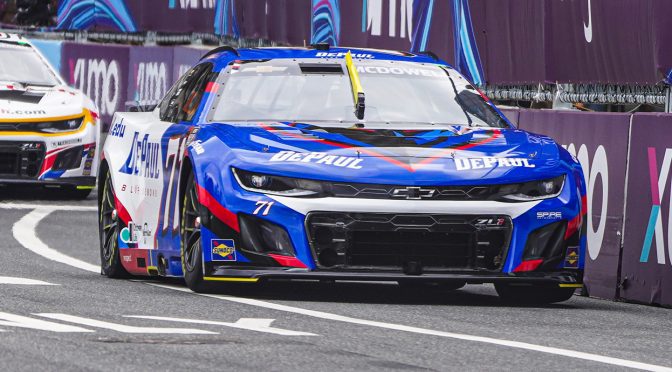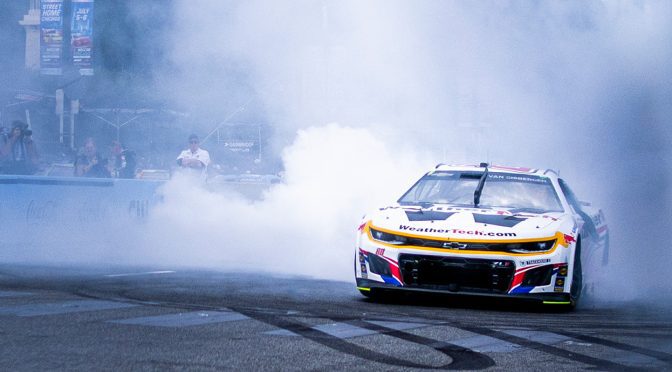
This weekend marks the return of NASCAR national series action to the famed Rockingham Speedway. Relive some of the most memorable moments in the track’s history by watching classic races in the NASCAR Classics Library.
The first Cup Series race at Rockingham was held on Halloween in 1965. The 43-car field was highlighted by 11 future NASCAR Hall of Famers, who also included legendary car owners and mechanics.
When the green flag waved for the first time, it was Richard Petty and his blue No. 43 leading the way. Junior Johnson, who qualified second, led 85 laps early on before engine issues forced his No. 26 machine into the garage area.
Curtis Turner, driving the No. 41 Ford for Wood Brothers Racing, proved to be the dominant car of the day. He led 239 of the race’s 500 laps on his way to Victory Lane.
It turned out to be the 17th and final victory of his career.
The 1989 season turned out to be the start of something big for the Mark Martin-Jack Roush duo. They finished 15th in points during their first season together in 1988 and aimed to build on that in 1989. They accomplished just that.
Everything seemed to click throughout the season as he remained in the top five in points for most of the season.
It was almost unbelievable that Martin had not yet visited Victory Lane after the season’s first 26 races, during which he secured 10 top-three finishes.
The October 1989 race at Rockingham proved to be the turning point as Martin led 101 laps on his way to the first victory of his eventual NASCAR Hall of Fame career. His victory also kept him in contention for the championship as he was in third place in the standings, just 128 points behind Rusty Wallace, with two races remaining.
There was just something about Rockingham that clicked with Kyle Petty after he teamed up with Felix Sabates.
Petty, who previously found success in the Cup Series at the track with his family-owned team, as well as Wood Brothers Racing, was virtually automatic in the No. 42 Pontiac for Sabates at the track.
He finished 10th at the track in 1989 and truly ramped up his performance during one of the most dominant stretches at a track in NASCAR history. Petty started on the pole at the track in 1990, led 433 of the race’s 492 laps and emerged victorious.
The following season saw Petty replicate the same feat from the pole, this time leading 380 laps. His most dominant performance came in 1992, winning both the pole position and the race while leading 484 of 492 laps.
This all came amid winning the pole four consecutive times, including a total of five.
You can watch the 1990 and 1991 GM Goodwrench 500 from Rockingham in the NASCAR Classics Library.
The battle for the 1994 NASCAR Cup Series championship took a tragic turn in August 1994 when Ernie Irvan suffered critical injuries in a practice crash at Michigan International Speedway.
At the time of the incident, Dale Earnhardt and Irvan had pulled ahead in the points battle. Earnhardt led Irvan by 27 points after the first 20 races of the 31-race schedule.
Irvan’s injuries left Earnhardt more than 300 points ahead of Rusty Wallace, Mark Martin and Ken Schrader with only 11 races remaining on the schedule. The three drivers would need to be nearly perfect for the rest of the season.
The only problem was that Earnhardt needed to slow down, but he simply kept mashing the gas.
He entered the race at Rockingham with a chance to clinch the title as there were two races remaining on the schedule. This opportunity stemmed in part from six of his last seven finishes being third or better.
The race featured 10 cautions, which allowed Earnhardt to advance through the field after starting in 20th.
As the checkered flag waved, it was Earnhardt holding off an incredible last-ditch effort from Rick Mast to secure victory, and by doing so, Earnhardt clinched his seventh NASCAR Cup Series championship, tying Richard Petty for the most in series history.
The most recent Cup Series event at Rockingham took place in February 2004. Young stars Matt Kenseth and Kasey Kahne ensured that the track was sent off into the sunset with a thrilling finish.
The two drivers and Jamie McMurray crossed the white flag bumper to bumper. Kahne searched for a new lane into the second turn, riding high on the backstretch as he chased down Kenseth.
McMurray nearly clipped the wall on the backstretch, turning it into a two-horse race for the checkered flag between Kenseth and Kahne, the latter of whom was only making his second career start.
Kahne dipped low out of the fourth turn and attempted to drive under Kenseth for the win, but it wasn’t enough as Kenseth held on by 0.10 seconds. It was the eighth victory of his Cup Series career.
The race featured 18 of NASCAR’s 75 Greatest Drivers. The contest is additionally one of the closest finishes in Cup Series history, currently tied for the 12th closest.
WINSTON-SALEM, N.C. — Bowman Gray Stadium welcomes fans back to The Madhouse this weekend for the Hayes Jewelers 200.
Action kicks off Friday, April 18th, with practice from noon to 5 p.m. ET. Qualifying for The Brad’s Golf Cars Modified and The Law Offices of John Barrow Sportsman Series runs from 5-7 p.m. ET.
Fans can watch practice and qualifying for free.
Then, on Saturday, April 19th, Bowman Gray Stadium’s 2025 racing season kicks off with a 40-lap Sportsman Series race, followed by the Hayes Jewelers 200 Modified Series Race, and action from the QRC Street Stock and Q104.1 Stadium Stock Series to close the evening.
Gates open at 6 p.m. ET on Saturday, and racing starts at 8 p.m. ET.
Adult tickets for The Hayes Jewelers 200 are $12, kids ages 6-11 get in for $2, and the stadium offers free parking.
Fans can visit bowmangrayracing.com or call (336) 723-1819 for directions, parking, seating, and concession information.
THOMPSON, Conn. – A dominant performance from Ron Silk in Wednesday’s NASCAR Whelen Modified Tour Icebreaker 150 at Thompson Speedway Motorsports Park was nearly derailed during the final pit sequence of the evening.
While attempting to exit pit road, Silk made contact with his long-time Modified Tour rival Justin Bonsignore and spun. The contact resulted in damage to the front of Bonsignore’s Modified while Silk continued without losing any track position.
Silk was unfazed by the pit road incident as he quickly worked his way around Patrick Emerling during the closing laps to reclaim the lead. With Emerling playing defense against the rest of the pack, Silk cruised to his 27th career Modified Tour win and his eighth overall at Thompson.
“I was pretty confident if I got a good restart and got to the lead, I would be able to hold them off,” Silk said. “My car drove great. The first 40 laps or so we were a little bit free, but we fixed that on the pit stop. The car was just spot-on after that.”
Thompson has always been a significant track in Silk’s career on the Modified Tour, as his first three triumphs in the series came at the facility.
Joining Haydt Yannone Racing in 2022 proved to be a catalyst in Silk recapturing the efficiency he enjoyed at Thompson. Aside from his first campaign with Haydt Yannone, Silk has now won at least one race at Thompson each year piloting the silver No. 16.
Finding his way to Victory Lane on Saturday evening required Silk and crew chief Phil Moran to be sharp with pit strategy. An early caution provided Silk and Moran the opportunity they needed to shift momentum in their favor, as Silk utilized fresh tires and adjustments to charge toward the front of the field.
Silk was untouched at the front of the pack until a spin by Craig Lutz with 27 laps remaining brought most of the field back into the pits. Once Silk shook off the contact from Bonsignore, he had to quickly dispatch both Emerling and Jake Johnson to regain the lead.
He comfortably did just that.
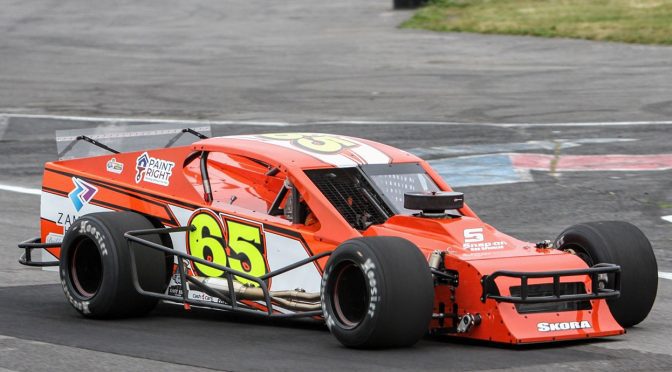
Ron Silk streaks past the grandstands at Thompson Speedway Motorsports Park on his way to victory in Wednesday’s Icebreaker 150. (Photo: Rob Branning/NASCAR)
Emerling, who was piloting a Geoff Bodine tribute scheme, endured an eventful evening of his own. After losing control of his Modified on Lap 64, problems in the pit lane for Emerling resulted in his falling a lap behind the leaders, which he quickly regained on an ensuing yellow flag.
Going off-sequence from the leaders enabled Emerling to salvage a runner-up finish. Emerling was pleasantly surprised by the outcome, one that could prove to be beneficial in his quest for a Modified Tour title.
“That was an absolutely insane run by the team,” Emerling said. “We got stuck a lap down, but luckily there was quick caution there. We got our lap back and we passed a ton of cars. Our car was feeling good on those old tires, but that was an insane run.”
Following Silk and Emerling home in the third was Trevor Catalano, with Austin Beers and Bonsignore completing the top five. The rest of the top 10 consisted of Chase Dowling, Stephen Kopcik, polesitter Jon McKennedy, Tommy Catalano and Matt Swanson.
The next event on the NASCAR Whelen Modified Tour schedule is the Cheshire County Clash 200 at Monadnock Speedway on May 3, which also marks the start of the Whelen Short Track Cup. FloRacing will have coverage of the on-track action starting at 6 p.m. ET.
The story of the 2024 NASCAR Cup Series Playoffs will unfold like you’ve never seen before in Full Speed Season 2 coming to Netflix on May 7.
Go behind the scenes and into the lives of NASCAR’s top stars such as Joey Logano, Ryan Blaney, William Byron, Christopher Bell and Daniel Suárez as they journey through the pressure-packed playoffs, culminating in the championship battle at Phoenix Raceway.
Hear not only from the drivers themselves but also from the people closest to them, including wives and girlfriends Brittany Logano, Gianna Blaney, Morgan Bell, Julia Piquet and others. Contributors to the series include Dale Earnhardt Jr., Marty Smith, Steve Letarte, Bob Pockrass and Kim Coon.
The trailer is just a sneak peek of the drama you’ll see next month when the five-episode series drops.
Ingenuity has long been a trademark of Rodrigo Sanchez’s career in motorsports. After all, the marketing, media and PR whiz long ago put his stamp on Formula 1’s annual grand prix in Mexico, elevating the fan experience with a festival atmosphere that draws on the country’s colorful culture.
So it’s of little surprise that Sánchez’s entry into the behind-the-curtain side of the motorsports industry arrived courtesy of that same spirit of innovation.
“I basically made a fake copy of a hot pass. We used to use hot passes back in the day, and I used PowerPoint and I sort of replicated it,” Sanchez says now, confessing to his youthful indiscretion. “I think I still have it. Honestly, I don’t even know how that worked. It was terrible.”
It worked well enough that a teenager equipped with Microsoft Office software, an old official-looking lanyard and a laminator made his way deep into the paddock for the Championship Auto Racing Teams (CART) Gran Premio de Mexico in 2002. His goal wasn’t to meet childhood hero Adrián Fernández, though he went far enough to see his green-on-red Tecate and Quaker State-sponsored Champ Car up close. Instead, Sanchez was there to make connections, to explore how his passion for racing might become his calling.
In a roundabout way, it worked. Sanchez says his makeshift credential drew the attention of Billy Kamphausen, one of CART’s earliest hires and its longtime VP of logistics, who stopped him. “Where did that come from?” Sanchez recalls Kamphausen saying. Perhaps it was the text that read “Worker Pass” that gave it away, or that his name wasn’t exactly centered on the paper.
Sanchez tried to explain that his uncle, who had a history of working as a medical liaison for Mexico City races, had given him the pass, but later confessed that he was there to pursue a career in motorsports. Kamphausen brought him to his at-track office and replaced his slapdash pass with a real one, telling him: “Well, you’re a minor, I cannot properly hire you,” Sanchez recalled, “but if you come back tomorrow, for sure, we can use some extra hands.”
The work was entry-level – delivering equipment, transporting pop-off valves and other go-fer tasks – but that November weekend made an impression on CART’s staff, who appreciated Sanchez’s energetic approach. It led to more volunteer opportunities and a chance to travel with a major motorsports circuit for the first time.
“I think from there,” he says, “I sort of just knew that’s what I wanted to do.”
Courtesy Rodrigo Sanchez
Twenty-plus years later, Rodrigo Sanchez has delivered on the aspirations of his youth as the Chief Marketing Officer of the Formula 1 Mexico City Grand Prix and NASCAR Mexico Weekend. Along with OCESA, the leading live entertainment company in Mexico and Colombia, Sanchez will help bring the NASCAR Cup Series to Mexico City for the first time June 13-15. It’s the latest in a series of monumental milestones for the 40-year-old, who was once part of the NASCAR internship program before taking on crucial roles to bring racing to Austin, Texas at Circuit of The Americas and ushering in a revival of Formula 1 events in Mexico.
Sanchez’s garage access is legit now, but he still keeps his homemade pass as a totem to the hustle.
“That shows the passion that he had, what it really took for him to get where he is,” says Adrián Fernández, a Mexico City native who drove to 11 wins across CART and IndyCar competition in his career and also made 10 Xfinity Series starts with Hendrick Motorsports and JR Motorsports. “Like I always tell him, I give Rodrigo a lot of advice through my experience and everything, and basically, he just did exactly what I did myself, too. You just take it to another level.” Fernández would know, having once stowed away on a truck, crossing the border from England to the Netherlands without money or a visa to further his racing dream.
“I mean, he was just trying to do the same, just keep trying to get by, get into the races and try to get the opportunity to be close to the racing world,” Fernández said. “And obviously, when you have such a passion, I always tell my kids, you will always succeed. If you have that much passion for something, you eventually will succeed if you have the discipline, the love of what you do, and the willingness to sacrifice, you will get there. And that’s something that he definitely did.”
* * *
Sanchez’s sister was a student at the University of Texas-Austin when she spotted a career-minded pamphlet. The brochure was a notice for NASCAR’s internship program, and she urged Rodrigo to apply.
“A lot of names rise to the top, and his did,” says NASCAR VP Brandon Thompson, who headed up the internship initiative, then in its infancy. Back then, the vetting process for potential candidates was not quite as robust, but even on an Excel file that put college majors, GPAs and other vital information into columns, Sanchez says he knew his experience and still-developing skills made a difference.
So did his references. Track promoters in Mexico reached the upper floors of the Daytona Beach offices to tout Sanchez’s proficiency, and those raves found an audience in NASCAR executives Jim France and Mike Helton. France prompted Thompson to consider Sanchez’s application for the summer job, one that would help to establish his trajectory into the motorsports orbit.
“I mean, to be honest, I owe my career to NASCAR,” Sanchez said. “That’s where really, things started getting serious outside of volunteering work and just jobs freelancing here and there.”
It was a crossroads moment, but one that Sanchez had been building toward for much of his early life. His uncle, Juan Manuel Sanchez, was an anesthesiologist who routinely worked on the medical safety response team for Formula 1’s events in Mexico. “He was basically the doctor that started the race in the medical car, behind the grid, so I got exposed to Formula 1 since I was a couple years old,” Rodrigo said. “I have many stories of him bringing us over to the race track, and have pictures with some of the guys from that era, and I think that sort of kick-started my love for racing, because I was just so exposed to it for a number of years. So I think that’s sort of where it started.”
Courtesy Rodrigo Sanchez
In 2002, the same year that he finagled access to the CART garage, Sanchez acted on his natural instinct to get behind the wheel, competing in a go-kart event in Mexico City. The pursuit of a driving career was met with some resistance from his family. “In my house, they were very traditional in terms of, no, you go to school and once you finish college, you’ll figure it out,” Sanchez says, “and unfortunately that doesn’t work in motorsports, so I had to start finding my way through things on my own.”
As CART morphed into Champ Car, which would a few years later merge with IndyCar, Sanchez’s involvement in racing promotions was briefly in limbo. He sought sponsorship for a potential ride in the USF2000 series and its Road to Indy ladder program, juggling his school workload with a side gig as a brisket cutter at a Rudy’s Bar-B-Q in Austin.
The NASCAR internship rekindled those aspirations. Sanchez was flown in to Charlotte, attended the Coca-Cola 600, and made connections during his tenure that would supercharge his marketing thirst.
“Credit Rodrigo for his work ethic, his knack for it, but his talent, right? So, not just knack — talent. All of those things have to come together,” Thompson says. “I also think it does shine a light as well on the experience that he was able to gain through his internship, and all that credit goes to the hosts that we’ve had in the program over the years. Being a part of the program myself, one of the things I remember about the program was how hands-on it was. I got to experience just how hands-on it was, but I think when you see the success that Rodrigo has had, and again, the fact that his talent has been able to carry him forward, you see that talent is honed.”
The internship led to a placement with JMI Sports and its sweeping, worldwide reach into a variety of motorsports disciplines. “That was possible because of NASCAR,” Sanchez says now, noting that what he’d learned from the sponsorship side of the industry had spurred him into a marketing and commercial direction for the agency that hired him.
Sanchez’s connection to the stock-car world never really left, and it’s getting a full-circle repeat with NASCAR’s visit to Mexico City now less than two months away. That synergy isn’t lost on Sanchez, the one-time intern who now has an active hand in shaping a historic motorsports event.
“What it reminded me was just how important it is to plant those seeds, and how a program like the NASCAR Next internship program, how those the fruits — to kind of keep with that analogy — may not bear themselves for years to come,” Thompson said. “… Obviously, he’s gone on to do wonderful things.”
Courtesy Rodrigo Sanchez
* * *
Rodrigo Sanchez guesstimates he was “Employee No. 5” at the Circuit of The Americas. He was brought in early as the marketing manager for what would eventually become a world-class motorsports facility and a staple on the Grand Prix schedule.
In those earliest days until construction began on New Year’s Eve in 2010, there wasn’t much to market.
“We would go to the piece of land in Austin where the track was being built, and it was just a bunch of bushes and pigs,” Sanchez recalls, “and at that point, they were like, ‘We’re building a Formula 1 track here,’ and a lot of people were like, ‘Yeah, you guys are crazy.’ But we kept on pushing.”
Those 1,500 acres just southeast of Austin’s downtown are nearly unrecognizable today. The path to get there required diligence and collaboration with city leaders and the community, all while navigating the uncertainty of the project’s fits and starts.
“There were days that we didn’t know if we were going to have a job the next day,” Sanchez says. “We really went through a lot, and when the race started in November of 2012, I remember from the grid, we ran out to the service road and went up into the main grandstand, and when we actually saw the cars start, we were all crying. We couldn’t believe it, what we had accomplished.”
Courtesy Rodrigo Sanchez
The work to build the Texas capital city into a motorsports destination established Sanchez as both a hometown prodigy and a rising star in the racing promotions biz. His ties to the Formula 1 world, one of his first loves, grew stronger.
When the opportunity arose to revive the Mexican Grand Prix, an event that had been dormant since Nigel Mansell’s win there in 1992, Sanchez jumped.
“If you see first how he grew up in the racing world, and how his involvement with the Austin Grand Prix and the track when he was working there and all that, he was always very smart on learning, and he was smart of knowing how to promote, learning how the real promotion of an event really worked,” Fernández says. “Obviously, with his Latin side, when he went to Mexico, obviously all that experience applied to the Mexican way of thinking. It basically was a super, super-successful combination.”
In many respects, the blueprint for luring F1 back to the Mexican capital was similar to the start-from-scratch business model for bringing the COTA venue to life. The key difference was that his immersion in the motorsports realm was unique in his new role; the Mexico City staff that surrounded him were all relative newbies.
That inexperience turned out to be a blessing. Instead of working with a team fueled by preconceived or dated notions of how a global-scale sporting event should look, Sanchez says he felt empowered to shape the race weekend in his own creative view – all from the ground up.
“When I came, there was nothing but an idea,” Sanchez said. “So really just working to make that idea a reality and just go through all the stuff you need to go through, I think that’s one of the most rewarding aspects of what I do, because when you see this on TV or live at the event, and there’s 300,000 fans just going nuts at something that was written on a napkin one day and you sort of made it into a reality, I would say that’s the most gratifying aspect of it.”
Local flavor was a driving force behind Sanchez’s vision. Though the Formula 1 circuit crisscrosses the world to a variety of international locales, he said going to the race track could sometimes be a rinse-and-repeat experience with little time for sightseeing.
The answer was to bring the local culture to the track, instead of making visiting fans venture off in search of it. Sanchez introduced Día de Los Muertos promotions to seasonal events, added mariachi bands and homegrown-style professional wrestling in prominent trackside locations, and welcomed food stands that celebrated the country’s culinary heritage.
“Even if they didn’t have time to just go visit the city, I wanted to bring a little bit of the colors, the flavors and the atmosphere of the city into the garage area, and that’s really how it all started,” Sanchez says. “Just bringing whether it was Lucha Libre wrestling into the middle of the garage and all the food stands. That’s obviously something I’m looking to do for NASCAR and just seeing what the reaction is with another motorsports championship. … But if they can take just a little bit of good from Mexico back home, I think that’s mission accomplished.”
Fernández has watched the growth of the Mexican Grand Prix in his home country with vested interest. The rest of the F1 world took notice as well; the event won the circuit’s Race Promoters’ Trophy five years running from 2015-19.
Courtesy Rodrigo Sanchez
“It’s not just the event in terms of the drivers, the cars. I mean, it’s the whole thing,” Fernández says, drawing a comparison with IndyCar’s Long Beach Grand Prix. “It’s the whole fiesta weekend, right? It’s a celebration.”
In another one of those full-circle moments that have seemed to follow Sanchez’s life, his relationship with Fernández has grown. The homespun driver whom Sanchez once rooted for growing up is now one of his closest friends.
“For me, he’s like one of my kids. He’s part of the family,” Fernández says. “He’s very close with my kids, and he’s spent most Christmas and New Year’s, a lot of them, he spends with us. We have had a very, very good relationship now for a few years, so he has become very close to the whole family. So really, he’s not just a friend. I consider him almost like a part of my family.”
Beyond friendship, Fernández has become part confidante and a trusted advisor.
“I speak with him, I would say, at least once a week if I am ever in trouble or if I ever need a bit of guidance, or if I ever need anything, that’s the first person I call,” Sanchez says. “It’s obviously someone I really care for, but he’s such a strong figure in terms of what he achieved with his career and with motorsport, and with obviously a similar background to mine, where you know you just have to move on to another country and learn new things and adapt to new things and just start climbing the ladder. For me, he’s such a strong figure in that aspect, in his work ethic and just the way he does things.
“Absolutely, I think it’s one of the incredible stories that I’ve been able to live throughout my career. That guy I used to see on television, and as I said, your childhood hero, now is one of my closest friends, like family.”
Courtesy Rodrigo Sanchez
The next time Sanchez comes calling, his latest promotional challenge may be top of mind. NASCAR’s first Cup Series race in Mexico comes 20 years after the Xfinity Series started a four-season run at the Autódromo Hermanos Rodríguez circuit. The logistics of bringing the premier NASCAR Cup Series operations to another country are a wide-scope production, and the planning for the fiesta weekend that Fernández mentions reaches a similarly grand scale.
That tall task might seem daunting, but it hasn’t dimmed any of the anticipation.
“I have known Rodrigo for a while now, and all I can tell you is that we are very lucky to have him,” says Trackhouse Racing’s Daniel Suárez, NASCAR’s first Cup Series winner from Mexico. “This event that is going to happen in Mexico, without Rodrigo it wouldn’t be the same. He’s a very, very talented guy. He knows his stuff extremely, extremely well. He’s a huge motorsports fan, so it’s just a perfect combination. When you have somebody talented in what he does, in marketing and putting events together, and then it happens that he loves motorsports? I mean, what else can you ask for? And then, obviously he speaks the language extremely well, and he understands the Mexican market better than anyone I know. So I think we’re very lucky to have him, and he’s going to make sure that this event is a success, not just for a couple of years but for a very long time.”
When that goal is realized come June, Sanchez says he plans to take a cue from his experience at the Circuit of The Americas’ inaugural race weekend, finding a vantage point among the crowd for the green flag. This time, his credential will officially get him there.
“Definitely. That’s something I normally do, just right after the opening ceremony, the national anthem, just run to whatever grandstand you can and just enjoy the moment,” Sanchez says. “Because that’s, I think, what really makes it special. That’s where you just really see what you were able to do.”
Expanded practice and qualifying procedure is in effect, meaning cars have separate practice and qualifying sessions; in this case, on different days as well. (Practice is at 3:05 p.m. ET on Friday on The CW App.) Qualifying is one lap, one round.
The qualifying order below is determined via metric that combines the previous race finish by owner (70%) and current owner points position (30%).
The race itself is at 4 p.m. ET on Saturday, April 19. Watch the race on The CW or listen on MRN Radio or SiriusXM NASCAR Radio.
# denotes series rookie
(i) denotes ineligible for driver points