Editor’s note: Projections have been updated after Saturday practice and qualifying:
Shane van Gisbergen flipped the NASCAR Cup Series playoff picture last Sunday with his dominant win in Mexico City. However, don’t count on another first-time winner this weekend when the circuit shifts to Pocono Raceway on Sunday (2 p.m. ET, Prime Video, MRN Radio, SiriusXM NASCAR Radio).
According to Racing Insights, the last 11 races in Long Pond, Pennsylvania have been won by drivers ranked sixth or better in the playoff standings, so let’s take a deeper look at who will be in the mix at the “Tricky Triangle.”
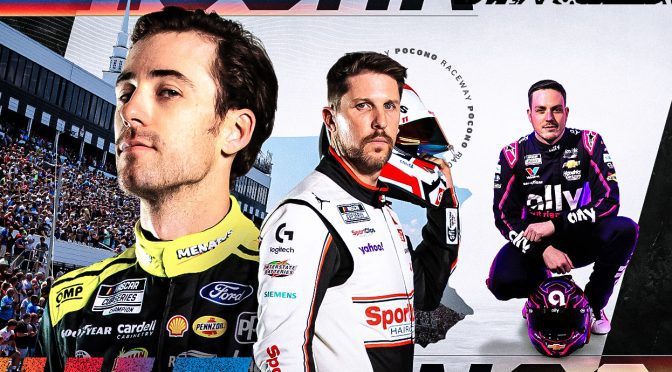
The winningest Cup driver in Pocono’s history, Denny Hamlin, is set to return after missing the Cup Series’ inaugural event at Autódromo Hermanos Rodríguez following the birth of his son.
He’ll restart his consecutive starts streak when he takes the green flag Sunday and will be one of the favorites to do so in grand fashion. Since 2022 at Pocono, Hamlin ranks first in speed, long runs and restarts. He’s also finished inside the top 15 in every race at Pocono dating back to 2018, except for the 2022 race, where he and former Joe Gibbs Racing teammate Kyle Busch were disqualified after post-race inspection.
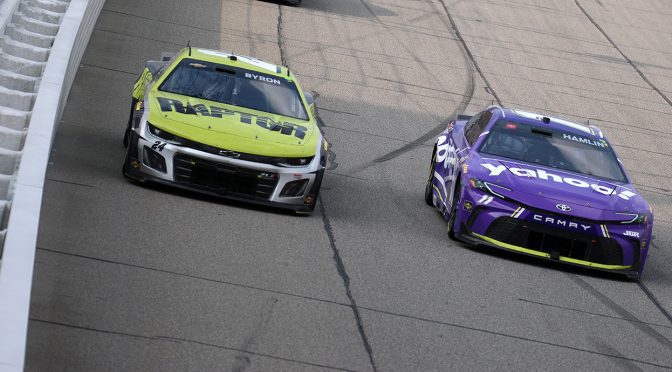
Still looking to add a second victory this season is William Byron. The two-time Daytona 500 winner holds a 67-point lead in the regular-season standings ahead of Hendrick Motorsports teammate Kyle Larson. What’s going to make Byron a threat on Sunday is how the No. 24 driver has been able to earn and maintain track position all season long.
Byron has been the best of all Cup drivers this season in average start (9.3), average finish (10.4) and average running position (9.2). Pocono has been tricky for Byron, though, as he has just one top-10 finish in the last four races at the 2.5-mile track.
TYLER REDDICK: Still looking for his first win of 2025, the No. 45 23XI Racing driver could be in a spot to turn his season around. He’s finished runner-up in two of the last three Pocono races and has been top 10 in the last four.
CHASE ELLIOTT: The pride of Dawsonville, Georgia will be doing double duty this weekend as he dips into Xfinity Series action on Saturday. Elliott was awarded the Pocono win in 2022 after the previously mentioned DQs of Hamlin and Busch that year and owns consecutive top 10s in the last three races at the “Tricky Triangle.”
ERIK JONES: Legacy Motor Club has picked up the pace as summer kicks off this weekend, and the No. 43 Toyota driver has an underrated history at Pocono. Jones has finished top 10 in eight of his 13 Pocono starts, and his five top fives in Long Pond are tied for his most at any other track on the calendar (Darlington).
BUBBA WALLACE: Coming off top 10s at Nashville and Michigan, followed up by a gritty 12th-place result in Mexico, the No. 23 23XI team is heading in the right direction ahead of Pocono. Wallace has been impressively consistent at the 2.5-mile circuit with no finish worse than 11th in the last four events in Long Pond.
RACING INSIGHTS’ PROJECTIONS FOR THE GREAT AMERICAN GETAWAY 400
Racing Insights’ advanced statistical formula incorporates current track, track type, recent performance, team data and pit-crew data to predict a projected winner and provide full race results. Updated on race day with practice and qualifying factored in.
LONG POND, Pa. — One week ago, Shane van Gisbergen’s victory in Mexico City vaulted him into the NASCAR Cup Series Playoffs.
In some ways, certainly, the victory was an upset for the driver who sits 30th in the points standings. But the reality is that the New Zealander affectionately known as SVG seemed destined to win at least one of the five road-course races on the regular-season schedule to propel him into the postseason.
Provisionally, that means 10 different drivers have locked themselves into the playoffs by virtue of their wins this year. Ten races remain in the hunt for one of the final spots in the 16-driver grid to determine this year’s championship contenders.
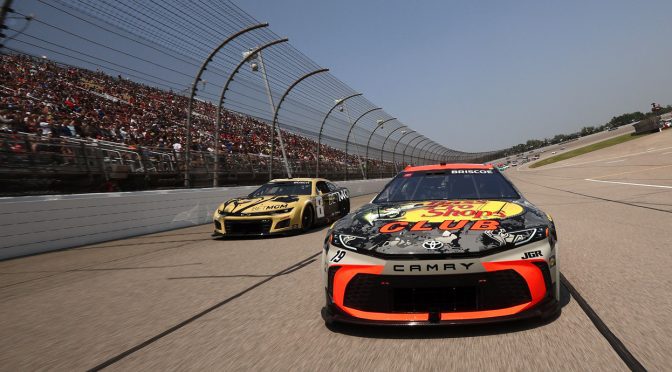
Entering The Great American Getaway 400 at Pocono Raceway on Sunday (2 p.m. ET, Prime Video, MRN Radio, SiriusXM NASCAR Radio), Joe Gibbs Racing’s Chase Briscoe sits 14th in the projecred playoff standings, 39 points above the elimination line following van Gisbergen’s historic win. And now that van Gisbergen has claimed victory, Briscoe will be rooting for him at Chicago, Sonoma and Watkins Glen if Briscoe can’t win those himself, since multiple SVG wins wouldn’t eliminate another spot available to make the postseason on points.
“You knew that SVG was probably going to win one and (knock out) somebody that was going to get in on points,” Briscoe told NASCAR.com Saturday. “So that part was unfortunate, but I was actually talking to my dad about it where, out of everybody to win, if I couldn’t win, I kind of wanted SVG just because odds are he’s probably going to win one of the other ones. So I would rather him win it than somebody else, right? Because now, if I don’t win the other road courses, I hope SVG wins them all just because of how it would work out.”
Bubba Wallace of 23XI Racing is 10th in the regular-season standings but 13th in the provisional postseason picture, 57 points above the current dividing line. Plenty of racing lies ahead with roughly two months until the playoffs begin, but with only 10 races to go, drivers like Wallace know their window of opportunity is closing one week at a time.
“I mean, obviously, look, we wanted to be locked in on a win and whatnot,” Wallace said. “We’re getting to 10 races left and still get to that. So that mindset hasn’t changed since post-Kansas 2022 (when Wallace won). We want to (lock in) by going back to Victory Lane. For some, it’s easier than others, but for someone like myself, I need to work very hard and put in twice the effort to get the same result. Sleeves are rolled up tight, excited for the task at hand. We’re getting it all figured out. But momentum’s on our side.”
Two-time NASCAR Cup Series champion Kyle Busch is currently 20th in the playoff grid, four spots and 50 spots outside the picture entering Pocono. His eyes are set on snapping a career-long 73-race winless streak to lock into the postseason, but he knows points could still get him there — for now.
“I think there’s even a few more winners that could possibly win a race and continue to move that (elimination line higher),” Busch said. “The whole win-and-you’re-in is certainly alive and well and is the best positive thing for you, so we’ll try to get a win. …
“I mean, you could do it on points with where you’re at right now. But if there’s two more winners that are behind you that get in and that puts you to a negative-100 deficit, then obviously that’s not going to be doable.”
The NASCAR Cup Series is at the “Tricky Triangle” this week for The Great American Getaway 400 at Pocono Raceway (2 p.m. ET, Prime Video).
Pocono is a 2.5-mile, triangle-shaped track with three different radius corners, each with varying degrees of (relatively flat) banking, and three different straightaway lengths. In geometry class, we called that a scalene triangle, and with three differently priced manufacturers for this race, I’ll be scaling that scalene definition to the betting world.
When we examine track history and practice times, one manufacturer stands out with a few undervalued drivers, so I’ll take the lot of them for the win.
As I do every race, I take a close look at my practice FLAGS metric to identify which drivers stand out and if there are any trends in the FLAGS data.
As it turns out, there was a pretty clear trend right off the bat.
Each of the top-four drivers in my group-adjusted FLAGS was piloting a Ford, with Ryan Blaney leading Chris Buescher, Austin Cindric, and Brad Keselowski until we reached the first non-Ford, William Byron.
The Blue Ovals also boast a relatively strong recent track history, with Blaney winning this race a year ago and setting the most fastest laps, while Buescher and Keselowski racked up the second- and fifth-most fastest laps.
Ford as a whole took home 71 of the 117 (60.7%) fastest laps, including four of the top five drivers, with Josh Berry grabbing 13 fastest laps. In addition, Cindric claimed four fastest laps, so it shouldn’t come as too much of a surprise that he ended up in the top four in FLAGS.
Berry is also undervalued in my model, because there’s no way to account for a car not completing any representative at-speed laps, with Berry having a diffuser issue costing him pace in practice and forcing him to miss qualifying.
Even with Berry undervalued in my model, it still shows Ford having a 32.6% chance of winning this race, which translates to implied odds of +207.
If we bump Berry up a bit, this wager likely shows value at close to 2-to-1. However, as always, I like to leave some wiggle room for model error, so I’m comfortable with this down to around +220.
FanDuel is offering this at +260, which is a healthy deviation from my model’s number.
Ford looked fantastic on the long run, so if you’re tailing me on this, we’re probably rooting for a healthy green flag run to end this race, rather than some late-race restarts where Chevy showed plenty of speed on the short run.
The Bet: Ford Winning Manufacturer (+260, FanDuel | Bet to +220)
LONG POND, Pa. — Dale Earnhardt Jr. has a 100% win rate as a NASCAR crew chief.
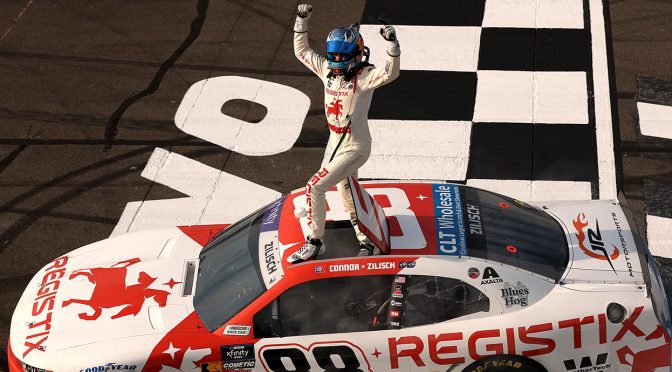
The Hall-of-Fame driver, two-time Xfinity Series champion and current JR Motorsports team co-owner helped guide rookie Connor Zilisch and the No. 88 JRM Chevrolet to the win in Saturday’s NASCAR Xfinity Series at Pocono Raceway.
Earnhardt found himself atop the pit box subbing for Mardy Lindley, suspended one race after two loose lug nuts were found on the No. 88 car at Nashville. With him to help was his former crew chief and Prime Video broadcast partner, Steve Letarte, as well as Mike Bumgarner and Patrick Martin. But from making the ultimate strategy calls to assisting the pit crew from behind the wall during stops, Earnhardt got exactly what he was looking for out of the weekend: contributing to the outcome in a meaningful way, this time ending in Victory Lane.
“I felt like I really did have a role today that was probably even more than I anticipated,” Earnhardt said. “But I did get a big assist from out of the gate. Mardy, Pat and all the guys on this team, we all sat down at meetings early in the week, understood what we needed to accomplish, had an idea in a game plan, right? We’d come off the trailer fast, car’s comfortable. That was helpful. So we were ready for the race.”
Letarte was more than just a friendly face sitting on the box. A Cup Series crew chief for Earnhardt from 2011-2014 with two wins together at Pocono in 2014, Letarte offered his own input to help Earnhardt navigate the strategy game from pit road to best position Zilisch for success on the track.
“As the race is playing out, Letarte’s sitting up there with us and he’s like, ‘Here’s an opportunity to kind of do what we didn’t do back in 2014,'” Earnhardt said. “So we went for it, made the gamble. I’m glad Steve was up here to kind of help us understand what possibilities were on the table. We’ll have to have him come to the beer toast.”
Victory Lane at Pocono Raceway is tucked neatly into a corner near the Cup Series garage, directly in the paddock area where fans can gather and partake in the celebration from not-so-far. The crowd huddled around the barriers to shower Earnhardt, Zilisch and Co. with cheers, chanting each of their names while they went through the “hat dance” of sponsor photos in celebration, a reminder that Earnhardt hasn’t lost any of his popularity since his days of winning 15 consecutive Most Popular Driver Awards.
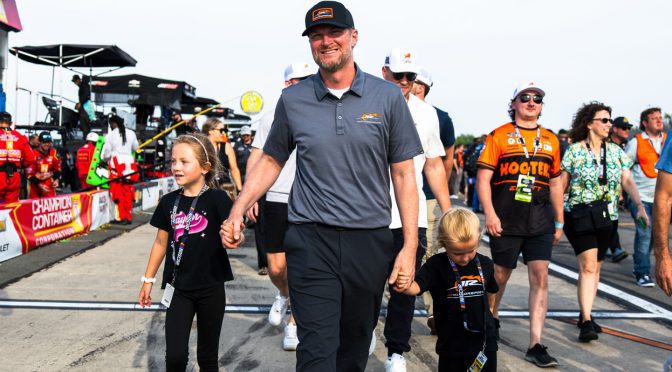
Also there to soak in the celebration were his wife Amy and their two girls Isla and Nicole. That perhaps meant more to Earnhardt than anything on Saturday.
“I don’t think I’ll ever get to take them to Victory Lane as a driver, so I love that they get to experience just things about NASCAR,” said Earnhardt, son of seven-time Cup champion Dale Earnhardt Sr. “I had such a great time growing up as a kid in this sport just running around here and and I want them to have that opportunity and understand that this is a place where they could create opportunities for themselves down the road. I’ll let them do what they want to do with their lives, and steer themselves where they want to go and support everything they want to do. But I certainly want them to want them to know that NASCAR is an option and exists and there’s so many possibilities.
“And if they’re enjoying being around it, they can find ways to make a living at it. So we’ll see. These are core memories, that they make, I believe, walking down pit road and going to Victory Lane.”
Going into the weekend, Earnhardt never imagined he and Zilisch would walk away as winners. Zilisch had yet to win on a track that wasn’t a road course and Earnhardt had never served as a crew chief in his storied career. But with help from Letarte, Earnhardt’s decision to leave Zilisch out at the conclusion of Stage 2 rather than pitting him and forfeiting the 10 regular-season points and one playoff point that come with a stage victory ultimately paid dividends late on Saturday evening.
“Steve was definitely all about that strategy,” Earnhardt said. “That’s really right up his alley. But I was nervous because I don’t have Mardy there to really tell me confidently, ‘This is the fuel mileage we’re getting.’ We were in traffic when we were measuring our fuel all day, and then when we get to the lead, the fuel mileage changes a little bit. So you’ve got to adhere to those changes and understand you really can’t push the car and run him out of gas. That’s really one of the last things I wanted to do today.
“So there’s a lot of conversation up there to figure it out and finally land on something we can feel confident about. And so I felt it felt good to have some input and decision-making power, if you will.”
He also offered advice to Zilisch about restarts and techniques, continuing conversations between the two that began midweek.
“He was asking some questions about what he should do,” Earnhardt said, “and I was thankful that he wanted to know those answers because I definitely didn’t want him doing what he thought he should do. But I know he’s the kind of guy that’s like, ‘Hey, tell me everything. There’s not enough information.'”
That information worked, on the final restart of Saturday’s race, Zilisch charged to the left of Jesse Love exiting Turn 3 to pounce for the lead with four laps to go.
The end result? A perfect success rate for Earnhardt as a crew chief.
Track: Pocono Raceway Location: Long Pond, Pa. Track length: 2.5 miles When: Sunday, 2 p.m. ET Where to tune in: Prime Video, MRN Radio, SiriusXM NASCAR Radio Race purse: $11,055,250 Race distance: 160 laps | 400 miles Stages: 30 | 95 | 160 Defending winner: Ryan Blaney, July 2024 Starting lineup:Denny Hamlin wins pole
Pocono poses several tricky challenges as regular season winds down
After Shane van Gisbergen snared a playoff spot last week at Mexico City, 10 tests remain to finalize the mighty grid of 16 title hopefuls.
Postseason urgency kicks off at the “Tricky Triangle,” where winless drivers face long odds to muscle their way upfront. Each of the last 11 winners in Long Pond ranked sixth or higher in the playoff standings and a few past Pocono winners will be tough to beat on Sunday.
Among them is seven-time Pocono winner Denny Hamlin. Admittedly, he may be “rusty” after a week off for the birth of his son, but he should slot back in seamlessly as he leads the field to green.
“It’s a track that no matter the car that we drive or the tires we have on or the aero package, none of that really matters — you still make speed at this race track the same way, no matter what car you’re driving,” Hamlin said. “It’s been one of the few tracks that I haven’t had to change my approach to it depending on the car I’m driving. I think that’s why the success has been sustained.”
That familiarity has helped veterans at times, but the nature of Pocono’s layout leaves room for mayhem. Joey Logano and his crew chief, Paul Wolfe, who always seems to pull a rabbit out of the hat when there’s a slew of different race strategies on the table, shine at tracks like this.
“You’ve got to have the strategy piece worked out and the execution of the race, and restarts in general are chaotic here as well,” Logano said. “This track definitely presents a lot of opportunities to do things. With the stages, the way they fall, being able to pit and not go a lap down, there’s a lot of opportunity to do some crazy stuff.”
The restart zones and pit cycles can reshuffle the deck and possibly produce a new victor. Contenders such as Chase Elliott, Tyler Reddick and Bubba Wallace — all with strong runs in past Pocono events — are among those eyeing a breakthrough as time ticks down and not wanting to chance their season on points.
“We would like to take some positive things that we had a year ago to this weekend. That would be great,” Elliott said. “We will just keep chipping away, and I thought we were doing some good things, so we just have to do some of the things we are doing well and add some more to it.”
Then, there’s the track’s mismatched corners and Ryan Blaney — who scored his first Cup win here — relishes the challenge of trying to tackle each end to be the best again.
“I like the challenge of three completely different corners,” Blaney said. “Every race track is different, no matter if it’s an oval. Like both ends are very different everywhere we go. But this is very, very different at all three ends. How do you pick and choose where you want to be good?
“Your driving style is completely different from [turns] one to two to three, so I’ve always liked that change-up. I think it really shows how diverse you are as a race car driver that you can switch it up three times a lap.”
Whether you’re in it to stack more points or punch a postseason ticket, there’s no room left to wait. The time to gamble is now — especially at a track that rewards bold strategy and punishes indecision.
What do crew chiefs have in focus to win Sunday’s race?
Pocono Raceway’s unique layout has always provided a challenge to crew chiefs. How do you give a driver the right balance in a car setup across three completely differently shaped and banked corners?
Jonathan Hassler, crew chief for the No. 12 Team Penske Ford, mastered that one year ago, aiding Blaney and Co. to Victory Lane at the “Tricky Triangle.” But it wasn’t because every corner was perfect; it’s that the right sacrifices were made to achieve speed.
“I’ve always tried to pick two corners to be good in and just kind of deal with the other one,” Blaney said Saturday. “And my mindset has always been trying to prioritize [Turns] 1 and 3 and just live over the “Tunnel [Turn].” It’s kind of how we were last year. Like I was great in 1 and 3 and I gave up a little bit of time in the tunnel, but I was still a net positive in those two corners.”
For Hassler, that balance can be, well, tricky.
“It’s tough,” he told NASCAR.com. “Like, Turn 2 is really rough and heights are super important. Sometimes, having the car lower, especially in Turn 3, tends to give overall grip and performance, but you start to maybe take away from Turn 2. So that’s kind of what you’re playing with.”
Cole Custer and the No. 41 Haas Factory Team qualified fifth for their best start of 2025, a performance that comes one week after their best finish of the season at Mexico City where Custer finished eighth. Crew chief Aaron Kramer is careful not to get too far ahead of himself but carries optimism into the 2.5-mile Pocono.
“We’ve had a couple good weeks. I won’t call this a good week yet. It’s a good start,” Kramer told NASCAR.com. “We obviously need to capitalize on our opportunity to make it a good week.”
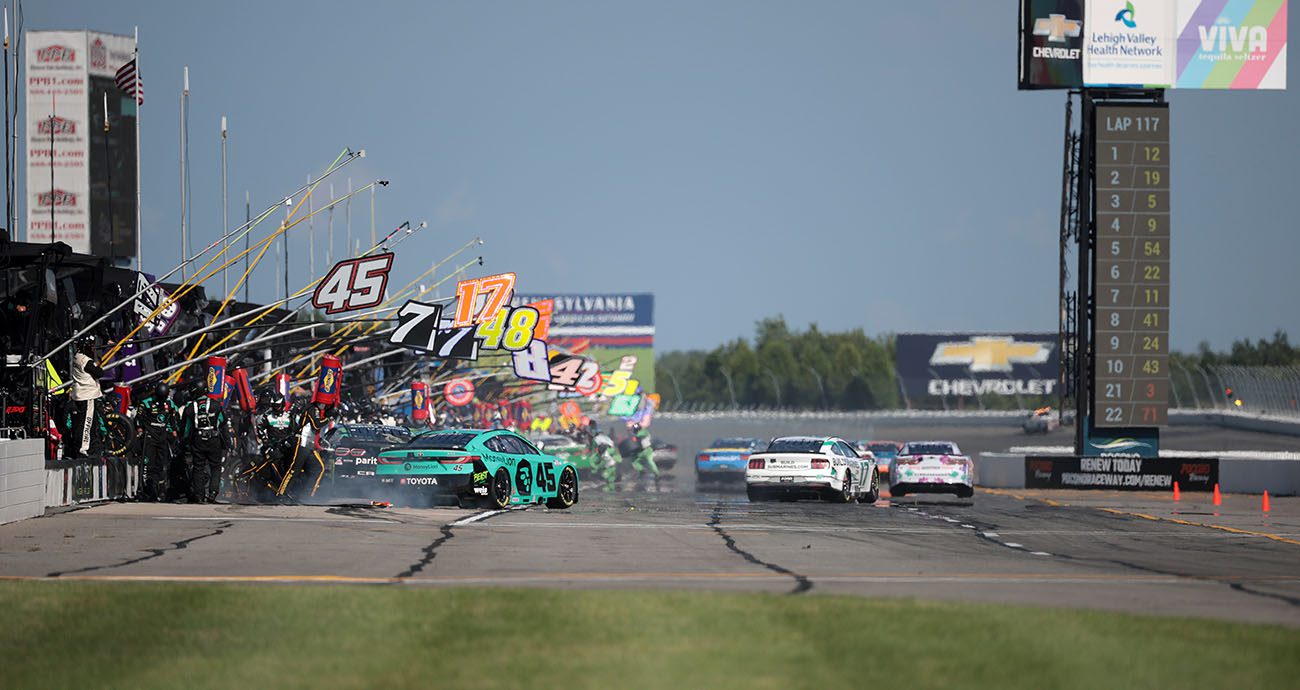
Part of that will come from fuel mileage. Pocono is renowned for putting a premium on strategy. This year, the fuel component will be coupled with a new, softer Goodyear tire package. The left sides have been used at intermediates like Las Vegas, Darlington and Michigan this year while the right sides are the same as last year’s rights at Indianapolis.
“The tire and the fuel strategy stuff kind of go hand-in-hand,” Kramer said. “The fuel strategy stuff doesn’t work if the tires won’t live as long as you need to make them live to do some of those options. So it’ll be interesting. This tire is a little bit softer than what we ran here in the past.
“Tire wear typically isn’t an issue here, which opens up these different strategy options, but because the tire is a little softer, it may come into play where it forces your hand on some decisions.”
Call it a pattern: Toyota trends well at the triangle. Toyota has won six of the last 10 races in Long Pond. In particular, Hamlin is responsible for half of those six wins and it doesn’t hurt that the No. 11 driver ranks first in speed, long-run speed and restarts at Pocono in the Next Gen car, according to NASCAR Insights. Plus, he’s finished first or second in five of the last eight Pocono races.
He may not be the favorite to win, but watch out for …
TY GIBBS. The No. 54 Joe Gibbs Racing driver has been in play for the win the last two weekends. Gibbs has found some speed to kick off the summer stretch with eight of his last nine qualifying efforts starting in the top 10. At Pocono, he has one run of finishing in the top five in three starts and should it come down to it, the No. 54 crew ranks fourth-best on pit road this season, per NASCAR Insights. Plus, Gibbs would cause a major upset if he can notch his first career win 77 points below the elimination line.
Fantasy update
NASCAR Fantasy Live expert Dustin Albino provides insight for your Sunday lineup.
Eventful practice and qualifying sessions at Pocono mixed up my lineup from earlier this week. One thing is for certain, a returning Denny Hamlin should be included in your lineup, despite not being keen of his No. 11 Toyota in practice. William Byron had the fastest car on five- and 10-lap averages but wrecked during his qualifying attempt. Hendrick Motorsports has a best starting spot of 18th with Chase Elliott. Chris Buescher, who enters Pocono on the playoff bubble, will take the green flag from the front row and has a top-five car in five-lap averages. Strategy will be aplenty over 400 miles, making it an uphill battle to choose the best lineup.
Lineup: Denny Hamlin, Chris Buescher, Ty Gibbs, Ryan Blaney, Carson Hocevar
Our biggest pieces of the week — get covered for race day from all angles. • NASCAR at Pocono: Key information, links, results through the weekend | Read more
• In-Season Challenge: $1 million tournament begins to take shape | Read more
• Racing Insights: Full finishing order projections for Sunday’s 400-miler | Read more
• Field of 16: Valuable stage points up for grabs as regular season winds down | Read more • Turning Point to Pocono: Is Chase Elliott the sleeping giant of 2025? | Read more
• At-track photos: Scenes, sights from the Pocono Mountains | View gallery
• NASCAR Classics: Unlock the vault of the best races held in Long Pond | Watch races
• Paint Scheme Preview: Fresh designs slated for the “Tricky Triangle” | View gallery
• Power Rankings: How the Cup Series field stacks up before Pocono | Read more
In a day of varying strategies and dramatic restarts among the frontrunners, JR Motorsports rookie Connor Zilisch prevailed in a late-race sprint to the checkered flag in Saturday’s NASCAR Xfinity Series’ Explore the Pocono Mountains 250 at Pocono Raceway — the first oval win of this young talent’s career.
Late-race restarts determined the day and ultimately it came down to a duel between Zilisch and his best friend, last year’s Rookie of the Year, Jesse Love. Zilisch pulled his No. 88 JR Motorsports Chevrolet alongside Love’s car as they crossed the start/finish line with four laps to go and then he took the lead for good with three laps remaining – .437-seconds ahead of the field.
It was that kind of resolute day for the 18-year-old Zilisch, who had some key help in his headset from a first-time crew chief. His team owner, NASCAR Hall of Famer Dale Earnhardt Jr., filled in for the team’s full-time leader, Mardy Lindley, who was serving a one-race suspension.
The two-time Daytona 500 winner Earnhardt, an icon in the sport, not only called the race from atop Zilisch’s pit box, but climbed down and helped out on pit stops too. He was absolutely ecstatic after the race in his debut, calling the shots. He’s the fifth crew chief this season to earn his first Xfinity Series victory.
“Just a great job putting us in position to succeed, we had a lot of things go our way, a lot of good luck, good race strategy, had a little help from [his former NASCAR Cup Series crew chief Steve] Letarte,” a grinning Earnhardt said, applauding Lindley’s preparation for the weekend.
“Hats off to everybody on this team,” he continued. “It’s been amazing all weekend long. Great race car driver. Connor Zilisch is going to be a big deal in this sport for a long time. A lot of fun for me today.”
Zilisch was similarly exuberant, having to really work hard for this win, his second of the season. Ten caution flags on the afternoon created varying strategies and a real test of restart skills.
“I’ve been dying for this one for a while now, I’ve been so close on the ovals lately,” Zilisch said. “I finished second at Charlotte, second at Nashville.
“And Dale Jr., not too bad on the box,” he said smiling, saying he appreciated Earnhardt’s advice throughout the race. “Pretty cool to have him up there. Thank you so much to the entire JR Motorsports team. … this one is definitely special. I’ve been chasing an oval win for a while now.”
For much of the day, Zilisch’s greatest challenge up front came from former Cup Series champion Chase Elliott, who is competing in both the Xfinity and Cup Series races this weekend. Elliott led the most laps — 38 of the 100 compared to Zilisch’s 34 out front.
Elliott and the series’ current championship leader, JR Motorsports’ Justin Allgaier, were up front on a restart with 13 laps remaining. While contending for the lead, they nearly came together and had to take evasive action up the track not to collide.
Love took advantage of the situation and came through from the second row to stake claim to the race lead in the No. 2 Richard Childress Racing Chevrolet. A caution came out almost immediately after Love moved to the front and that allowed Zilisch to start directly behind him on that final restart — leaving the trophy up to the two friends to decide.
“That’s the most focused I’ve ever been inside a race car, I did not want Connor to beat me because I’ll have to hear about it for a long time,” said Love, with a smile. “Hats off to him. He ran a good race. Once I was able to get a draft I was able to get back to him. But that bums me out, I’m not going to lie, but I’m still trying to be grateful we have fast race cars and are in position to win. Hats off to Connor.”
Another rookie rounded out the top three with Kaulig Racing’s Christian Eckes claiming a career best third-place finish in the No. 16 Chevrolet. Elliott rallied to finish fourth and Ryan Sieg was fifth in his family-owned Ford.
Carson Kvapil, Sam Mayer, Sammy Smith, rookie Taylor Gray, and Justin Allgaier rounded out the top 10.
The reigning series champion Allgaier now holds an 82-point championship advantage on RCR’s Austin Hill, who was collected in an early-race accident and finished 35th.
The NASCAR Xfinity Series moves to Atlanta for Friday night’s Focused Health 250 at EchoPark Speedway (7:30 p.m. ET, The CW, PRN Radio, SiriusXM NASCAR Radio). Hill has won the last three Atlanta races – the most recent this February.
NOTE: Post-race inspection was completed without issue in the Xfinity Series garage, confirming Zilisch as the winner. The Nos. 16 and 17 will go to the Research & Development Center in Concord, N.C. on Monday for further inspection.
LONG POND, Pa. — One race remains to set the seeds for the inaugural In-Season Challenge in the NASCAR Cup Series.
The 32 drivers locked into this year’s five-race, bracket-style tournament will be seeded according to their best finishes over the course of three races — Michigan International Speedway, Mexico City’s Autódromo Hermanos Rodríguez and finally Pocono Raceway on Sunday afternoon (2 p.m. ET, Prime Video, MRN Radio, SiriusXM NASCAR Radio).
Tyler Reddick, the 2024 regular-season champion, wasn’t quite sure where he sat in the provisional seedings but knew “we’re not currently seeded very well at all.” He’s right, sitting in the No. 21 seed after two races. Chase Briscoe, on the other hand, is the No. 12 seed and knew exactly who he’d be matched against if the tournament started today.
“For sure. Right now, I’d go up against Tyler if it started this weekend,” Briscoe said. “I’m hoping that changes just because Tyler, I think he’s, like, seeded (21st) or something right now, and he’s one of the top five guys in the sport. So it’d be a tough round one.”
Mexico City marked the second of three seeding races for the 2025 In-Season Tournament.
Here are the updated seeding positions following Mexico City, with one race remaining: pic.twitter.com/urQ0xsSbQn
The challenge begins next week at EchoPark Speedway (formerly Atlanta). Ryan Blaney, the 2023 Cup champion, is currently listed as a No. 23 seed and would be matched against No. 10 Ross Chastain in the opening round.
“I wasn’t crazy-hyper-focused on like the seeding,” Blaney said, “but then I saw a chart of the seeding as of right now after Mexico City, and I was like, ‘Oh man, I need to get my seeding up.’ But Atlanta being the first race, it doesn’t really make a huge difference. I think you’re going to see a lot of upsets at Atlanta just because the way the track is, but I think when you get in the tournament starts next week, you’re definitely going to be aware of who you’re racing and who you’re matched up against.
“You’re not going to completely jumble your race up just for that, but you might have a hell of a battle for like 20th. You’re like, ‘Why are these guys racing so hard?’ Well, it’s part of the In-Season [Challenge]. These guys are racing their asses off for 20th to move on.”
Bubba Wallace is currently the No. 6 seed and would be matched against No. 27 Joey Logano, the defending and three-time NASCAR Cup Series champion. The $1-million prize is tantalizing, but Wallace shares the same mindset as Blaney: don’t let those battles ruin your race.
“I’ve been paying attention to the seeding, but you can’t let that be a distraction,” Wallace said. “It’s something that is cool I think more so for the fans to be more invested into their favorite drivers and see how it stacks up than the drivers themselves. So I’ve just got to do our part and not get caught up in the madness.”
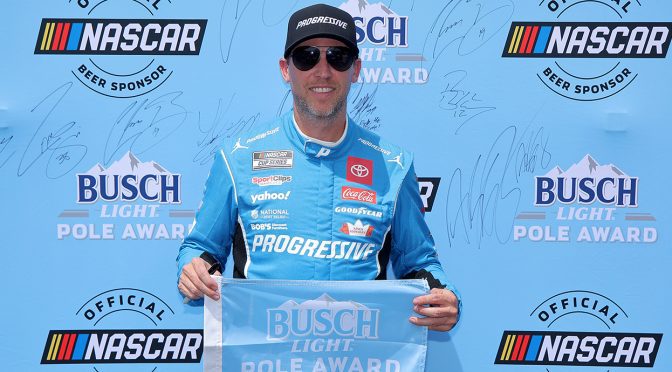
Perhaps not too surprisingly, Pocono Raceway’s all-time winningest driver, Denny Hamlin, was fastest on Saturday to earn pole position for Sunday’s The Great American Getaway 400 (2 p.m. ET, Prime Video, MRN Radio, SiriusXM NASCAR Radio).
Hamlin’s No. 11 Joe Gibbs Racing Toyota will take the green flag to start the NASCAR Cup Series race, and historically speaking, no one has led the field to more checkered flags; his seven wins at Pocono are the most in history. And he’s finished first or second in five of the last eight races on the 2.5-mile, unique three-turn track.
Hamlin’s lap of 172.599 mph was .083-second faster than RFK Racing’s Chris Buescher in the No. 17 Ford. Spire Motorsports’ Carson Hocevar (Chevrolet), Legacy Motor Club’s John Hunter Nemechek (Toyota) and Haas Factory Team’s Cole Custer (Ford) rounded out the top five in qualifying.
It marks a big return for the season’s three-time race winner Hamlin, who is back on the grid after receiving a waiver from NASCAR, missing last weekend’s inaugural race in Mexico City to be home for the birth of his son.
“We typically can step up from practice,” said Hamlin, who was not even among the top-10 fastest drivers in the afternoon’s practice session. “We had good adjustments, so never really panicked too much.
“And obviously because I was a little more rested than the rest of the field right there, I was able to show a little more speed,” he added with a smile and nod to missing last week’s race.
“Every week we have a good shot to win and this team just knows what I need out of the car. The cars and tires have changed over time, but you still make speed at this track the same way. I was able to execute there in qualifying and that’s a good start for us.”
Of note, the current Cup Series championship leader, Hendrick Motorsports’ William Byron, crashed his No. 24 Chevrolet late in the qualifying session.
Hamlin’s JGR teammates, Chase Briscoe and Ty Gibbs, will start sixth and seventh and Tyler Reddick, who drives the 23XI Racing Toyota co-owned by Hamlin, was eighth fastest. JRG’s Christopher Bell will line up ninth on the grid, and Trackhouse Racing’s Daniel Suarez will roll off 10th. Six of the top-10 cars were Toyotas.
Defending race winner, Ryan Blaney, was 20th quickest in the No. 12 Team Penske Ford.
Four drivers did not make qualifying runs, including Reddick’s 23XI teammate Bubba Wallace, whose team rolled his car off the line just before his run. Wood Brothers’ Josh Berry, Rick Ware Racing’s Cody Ware and NY Racing’s Brennan Poole also did not make qualifying laps.
PRACTICE
Before crashing on his qualifying lap, Byron put down the fastest single lap in Saturday’s practice session at 170.758 mph. Bubba Wallace (170.032 mph), Chase Elliott (169.885 mph), Tyler Reddick (169.766 mph) and Chris Buescher (169.667 mph) rounded out the top five.
The No. 24 Hendrick Motorsports driver also topped the board in five- and 10-lap averages at the 2.5-mile Pennsylvania circuit.
Christopher Bell’s No. 20 Joe Gibbs Racing Toyota suffered a mechanical issue before hitting the track in Group B’s 25-minute session and only put down three laps, landing 13th on the practice board.
Joe Gibbs Racing driver Denny Hamlin, a three-race winner this season, missed last week’s race in Mexico City so he could be home with his family for the birth of his first son, Jameson Drew. Hamlin revealed that it was a tough labor for his fiancée, Jordan, and was glad he could be there for her and their two daughters.
His son’s name was thoughtful and purposeful – Jameson is “James’ son” and James is Hamlin’s first name. And Drew gives him “JD” initials — a nod to both the late JD Gibbs, a cherished friend of Hamlin and the person credited with hiring him at JGR and also the initials of James Dean, the car owner earlier in Hamlin’s career providing his big opportunity to be seen — and eventually hired — to a major NASCAR operation.
“He’s been great, slept through the night the last three nights in a row. … he’s behaving good early,” Hamlin said of his son, with a smile.
Hamlin said he watched the Mexico City race from home last weekend and was very impressed with the Amazon Prime broadcast and the extended time the network uses. But he’s ready to race at Pocono — where his seven wins are the most all-time. He finished runner-up (2024) and scored that seventh win (2023) in the last two visits.
“Just a track that no matter what the car we drive or the tires we have on or the aero package, none of that really matters,” said Hamlin, who earned his first career NASCAR Cup Series victory at Pocono, sweeping both races — from pole position no less — in his 2006 rookie season.
“You still make speed at this race track the same way, no matter what car you’re driving.
“It’s been one of the few tracks that I haven’t had to change my approach to it, depending on the car I’m driving. So, I think that’s why the success has been sustained.”
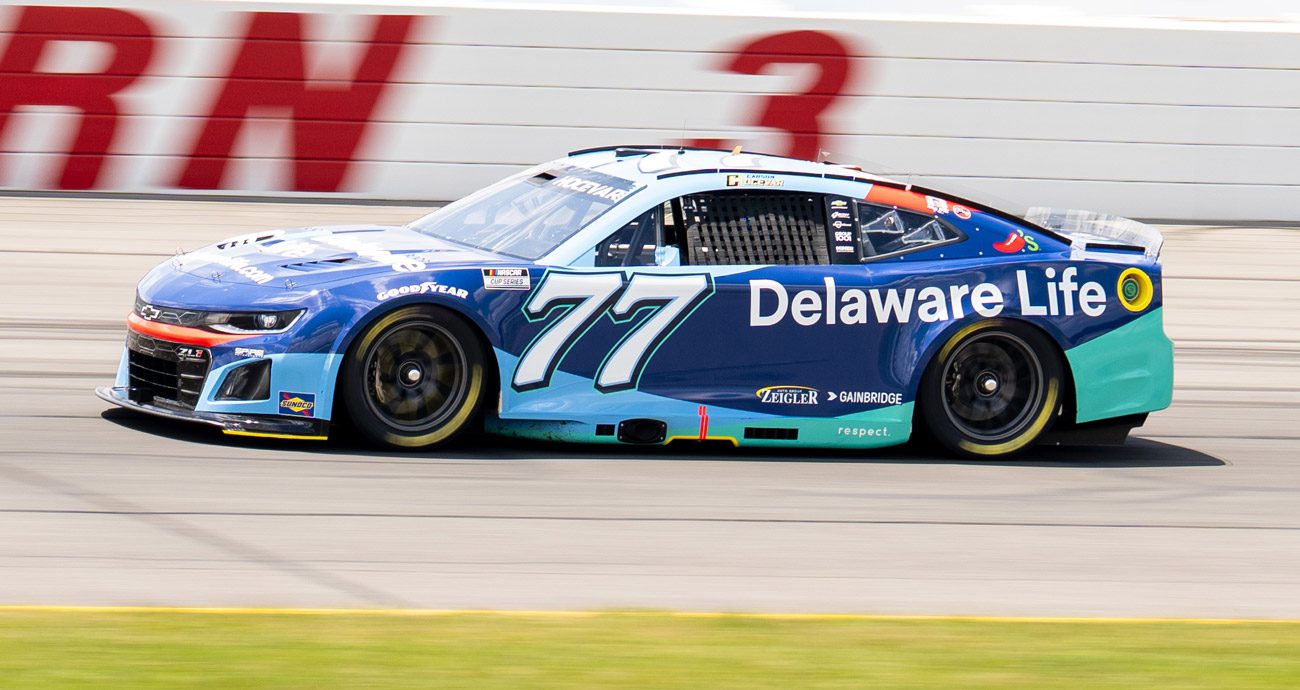
LONG POND, Pa. — Carson Hocevar entered Pocono Raceway Saturday as a hot topic of conversation all over again.
The 22-year-old sophomore racer for Spire Motorsports reignited a feud with Ricky Stenhouse Jr. in Mexico City — only one week after their tensions cooled. He was also fined $50,000 by Spire Motorsports for derogatory comments Hocevar made about Mexico City on a livestream before the weekend began.
Before shifting his attention back to the race track, Hocevar reflected on his comments, which disparaged Mexico City before he ventured south of the United States border.
“The issue wasn’t the team having their frustrations that I’m giving my opinion and putting it out there,” Hocevar said. “It’s the fact that my opinion wasn’t my opinion. It was just based off everything else that I’ve heard or seen, right? I didn’t go do my own homework and voice my own opinion. I didn’t give it a shot. I didn’t give it a chance. I didn’t go walk around. I didn’t go see it. When I did, then hindsight’s 20/20, then I have my own opinion. But I’ve already put it out there. So I think that was the biggest thing was like — I wasn’t doing what I pride myself of doing, (which is) just having my own opinion, putting it out there and being me. I just didn’t give it a fair shot, so I think that’s where it all stems from.”
Hocevar, who finished 13th in Friday’s NASCAR Craftsman Truck Series, is also expecting Stenhouse to claim some sort of retribution after contact at Autódromo Hermanos Rodríguez from the lapped car of Hocevar spun lead-lap-racer Stenhouse out of position, their second run-in in three weeks.
“The scorecard has it that I’m getting something from the 47 at some point, right?” Hocevar said. “And I think my team and everybody kind of knows that. But at the same time, it’s ideally just the 47, right? It’s not an open hunting season on the 77 because of these incidents. It’s kind of oscillated to when the 47 has a moment that he wants to take at us or take a shot, it’s just like — OK, that’s probably fair. But with everybody else, my team has reassured me that this isn’t open hunting season. We are going to race like we’ve raced; let’s just not create more enemies that we start getting shots back at us.
“But we’re still just going to go race, be aggressive and defend ourselves when we need to. But this is, unfortunately, now a 2-0 scorecard. I’ve been a fan of the sport for a long time. You know the game; you’ve seen it and everything. But we just go race.”
Alex Daus | NASCAR Digital Media
Hocevar is no stranger to controversy, even in just his second year inside the NASCAR Cup Series. On-track run-ins have overshadowed his consistent and impressive speed dating back to his years competing as a full-time Truck Series driver from 2021-23. He knows his reputation precedes him, even with Cup veterans who have watched Hocevar come up through the ranks.
“I already have that image, right? Like it’ll never go away,” Hocevar said. “I could go three years from now and it’s just like oh, I’m back, per se. I think I’ve already made that image before I got in this garage, and I think it’s just trying to balance one thing of owning it and trying to change the narrative while still being like, yeah, I get it. Like I’m aware of this and knowing that.”
The same overaggression that has cost Hocevar has also rewarded him. In addition to five career Truck wins, Hocevar has earned two top fives, three top 10s and his first Busch Light Pole Award in the Cup Series this season. But he has also finished 24th or worse in five of the last six races, the lone exception a runner-up finish at Nashville Superspeedway, the same night he first turned Stenhouse.
“I’ve just been a fan forever, right? And you always saw the rookie get pushed around and kind of have to pay their dues,” Hocevar said. “And I was just like, man, if I’m ever in that spot, I’m never going to get pushed around. That’s how you lose opportunities of races. You never know how long you’re going to be in the garage, for one. None of us have a shot clock waiting on us. You never know.
“So, for me, I want to take advantage of every opportunity I have out there and have no regrets of the effort I’ve put in. And maybe at times, instead of just not letting myself get pushed over, I’m trying to push other people over, and that was the wrong mindset or wrong decision at times.”
Those mistakes have weighed on him mentally, he said. Still, he knows he can’t sacrifice speed for the sake of making friends on the track.
“Just because I do something in the heat of the moment or maybe do it two or three times, doesn’t mean I’m not hard on myself for those mistakes because they are mistakes,” Hocevar said. “It’s just trying not to make that a pattern. But when you’re constantly making aggressive moves like we’re doing, it’s balancing that fine line of, you make a thousand moves a day. Just unfortunately, what people remember isn’t always the good ones. You always remember the negative ones. So that’s just trying to limit the negative ones a lot more.”