From garage workers to athletes, the pit stop has changed dramatically over the years

RELATED: Evolution of the pit stop through the years in photos

How far has technology progressed when it comes to pit stops in NASCAR racing? Ask walking encyclopedia Buz McKim, the NASCAR Hall of Fame resident historian, and he knows just the picture to drive the point home.

The classic black-and-white photo from the 1968 season depicts Junior Johnson‘s master mechanic Herb Nab over the pit wall and awaiting his driver, LeeRoy Yarbrough. Nab stands poised with his primitive air gun ready, but a closer inspection shows the early innovator’s preferred method of changing tires — the lug nuts are lodged in his teeth for quicker access.

Compared to today’s state-of-the-art pit stops in which the exchange of four fresh tires and the addition of 18 gallons of gas takes place in 12 seconds or sometimes less, the contrast almost makes NASCAR’s earliest crewmembers seem like cavemen before the invention of fire.

"It’s escalated now to where it’s unbelievable," said Waddell Wilson, who turned the wrenches for three Daytona 500 victories and saw decades of advances first-hand. "If you were to take these boys now, put ’em back in the early ’60s at the race track, it would blow their minds. They could not believe how far it’s come in really not that many years, in a way. … It’ll keep escalating. Technology is unreal in this day and time."

The art of performing a pit stop in NASCAR racing has grown from a rudimentary exercise with little emphasis in the sport’s infancy to the current-day orchestration with blazing speed, replete with all the pressures of big-time motorsports. NASCAR.com conducted extensive research, including interviews and the review of hours of footage to determine the turning points in the evolution of pit stops and the innovations that have stood the test of time.

UPS

Herb Nab waits to change tires, with lug nuts at the ready in his teeth. (Photo: ISC Archives via Getty Images)

The early years

Teams rarely needed pit stops in the formative years of the sport, primarily because most races were short, 100-mile affairs. The only race where pit stops truly factored in the 1950s was the ahead-of-its-time Southern 500 at Darlington Raceway.

When drivers did need to stop — usually because of tire issues or crash-related damage — their crew raised the car with old-fashioned bumper jacks and four-way tire wrenches until the mid-1950s and the advent of pneumatic air guns. Grainy footage of NASCAR Hall of Famer Herb Thomas pulling in with a flat tire at Lakewood Speedway shows that early stops to change just one tire took nearly a minute to complete.

Midway through the decade, floor jacks replaced bumper jacks with mechanical whiz Smokey Yunick believed to be the pioneer of that technology.

"Before that, they just didn’t know any better," McKim said. "Smokey had a truck repair shop in Daytona and he was used to those big floor jacks, and he thought, ‘well heck, we can just use one of them.’ It’s the old ‘necessity is the mother of invention’, more or less."

Speed on pit road didn’t take another quantum leap forward until the Wood Brothers made the earliest forays into choreographing their service. Their handiwork was showcased in the 1965 Indy 500 when they were hired to pit Jim Clark’s Lotus-Ford. Their speed assisted Clark in notching his only win in the fabled race and raised eyebrows up and down the Brickyard’s pit road, revolutionizing that series’ approach to pit stops.

The emphasis on timing and position shaved precious seconds from the time stopped in the pits, but it was still a laborious process. In the 1960s and into the 1970s — when speedways got bigger and races became longer — it wasn’t uncommon during caution periods to see teams change left-side tires, return to the track ahead of the pace car, then return to the pits to change right-side tires to avoid losing a lap.

Wilson recalled how the Mario Rossi-owned team for legendary driver Bobby Allison debuted another major time-saver in 1970 at the annual pit crew competition at Rockingham Speedway, gluing lug nuts directly to the wheel and making Nab’s iconic teeth-grinding methods obsolete.

"I thought we had it won with Pearson’s car because we were the quickest until they beat us out," said Wilson, who was with the famed Holman-Moody team at the time. "We worked on that, and that made a big difference." That practice continues today as teams participate in an every-weekend ritual of affixing lug nuts with high-tech rubber cement.

In terms of refueling, cars in NASCAR’s top series still used a gas cap attached by a lanyard until the rise of time-saving capless filler nozzles in 1974. That development, combined with advancements in ventilation and faster flow in gas cans pushed pit times even lower, down to the 30-second neighborhood. But major gains that dropped pit-stop times into the teens were just around the corner.

Moving toward modern

Andy Petree likes to tell the story about how one of his first big breaks in NASCAR came about. Junior Johnson hired him in 1981 to be a tire-changer in addition to other duties for the No. 11 driven by Darrell Waltrip, based solely on the recommendation of longtime family friend Ned Jarrett, now a NASCAR Hall of Famer.

What Jarrett was unclear of was that the extent of Petree’s training was his former employment at a tire store. Furthermore, the extent of his racing was of the weekend warrior variety in Limited Sportsman division races that were usually 25 laps with no pit stops required. The next thing Petree knew, he was riding in the team hauler to the series’ next race, all the way from North Carolina to Riverside, California.

"So the very first pit stop I ever made in NASCAR was when we were leading the race and Junior Johnson calls for four tires," said Petree, now an analyst for ESPN. "So you can’t imagine — there was no pit practice, none of that, nothing. Just show up and do it. So you talk about pressure. I mean I can’t tell you how much pressure. I had family just getting started, my wife was pregnant, and here I am with all this pressure to make this deal work. Anyway, we end up winning the race and it worked out for me … but I tell you, I was about to throw up."

Petree’s story underscores the growing emphasis on pit stops through the 1980s, but the work was still performed by mechanics and engineers whose primary duty was prepping the car for race day. Developments with lighter jacks, faster wrenches and improved fuel flow continued to offer help, but it wasn’t until the late ’80s and early ’90s that teams began to institute over-the-wall practice during the week to hone the craft.

To identify strong suits and pinpoint areas for improvement, NASCAR teams needed to review game film of their pit stops much in the way other sports teams did. Petree, who worked by then with Richard Childress Racing and the No. 3 team for Dale Earnhardt, originally began collecting footage with a cameraman standing behind pit wall but the deficiencies in showing every aspect of the team’s stops were evident. He next tried placing a cameraman in the grandstands with a long lens, but that also failed to give a complete picture.

Parallel to this, Petree had been introduced to the idea of small cameras that were the size of a lipstick or cigarette pack, mounting them on the car to gauge suspension travel and other data. When the first one arrived via courier, something clicked.

"I opened that thing up and a light bulb went off in my head and I said, ‘Uh oh, I think I got it.’ So I was the first one to put a camera on a pole above the pit stall," Petree said. "That was 1993. For the longest time, I think it was almost the entire season before anybody figured out what that thing was. We were able to record that pit stop from above, and you can’t believe the things that we could identify and work on and get better, watching the process. We would review these stops every week, so it was a huge emphasis that we’d put on pit stops. And I think that’s when it really started."

Game-changer

For all the advances in equipment, practice and timing, four-tire stops didn’t regularly dip down below 20 seconds until the revolutionary notion of shaping pit crews in the mold of a professional sports team, with each over-the-wall crewmember having their own specialty role. The pioneer was Ray Evernham, a former Modified racer who was just beginning to make his mark in the NASCAR garage.

When Evernham was paired with young phenom Jeff Gordon in the 1993 season, he formed the Rainbow Warriors, a purpose-built crew of professional athletes for the No. 24 Hendrick Motorsports team. With the "Refuse to Lose" motto on their T-shirts becoming the team’s calling card, the concept ushered in a new attitude and new era on pit road.

"I think every great crew chief sort of revolutionizes things," Gordon said of Evernham. "They’re always looking at what area can you find the most significant gain, and I think Ray really started focusing and understanding that races could be won or lost on pit road by just gaining a couple tenths of a second and being consistent with that and seeing how it was getting harder and harder to gain those positions on the race track because of aerodynamics and track position.

"Yeah, I think that pit crews evolved so much during that period of time where they were crew members or guys that worked in the shop during the week and then went to the track and were your best guys that could pit the car, where Ray said, you know what, we need to start bringing athletes in here and guys that were specialized and trained at changing tires, carrying tires, jacking the car, and I think it did revolutionize things."

Other teams eventually followed suit, and over time the practice has helped numerous athletes from more traditional stick-and-ball sports enjoy a second career in NASCAR, whether they have a stock-car racing background or not.

But all athletes require coaches, and NASCAR teams have adapted to fulfill that need. It’s what prompted Team Penske to hire Jim Beichner, the wrestling coach for 18 seasons at the University at Buffalo, to help improve conditioning and fine-tune the powerhouse operation’s crew.

"We’re looking more at ex-athletes from different sports that are very talented," Team Penske No. 2 crew chief Paul Wolfe told SiriusXM NASCAR Radio. "We just kind of get them in the door and see what aspects they’re good at and where we think they could fit in. And then you just kind of train them to do the jobs we want. Those guys that are jumping over the wall are athletes today, and that’s all they focus on. There’s no concern to them about working on the race cars. That’s what it takes to be able to be successful on pit road these days."

Better equipment has done its part as well, shaving more precious tenths of a second from stops. Jacks now require just one pump to lift the car, impact wrenches are now purpose-built tools manufactured for racing teams only, and the invention and progression of the "war wagon" pit box as a one-stop shop for race-day needs have all made crewmembers’ jobs more efficient.

But for all the advances in tools of the trade, the specialization of the men behind the wrenches has made the biggest difference.

"Now look at it," Gordon said. "We have whole training facilities and recruitment and everything else to get the best athletes we can to do that."

Safety and the future

The emphasis on speed hasn’t come without nods to safety. NASCAR officials instituted pit-road speed limits after the death of crewman Mike Rich in a pit-road accident in the 1990 season finale. Beforehand, drivers barely slowed as they pulled off the track to pit lane.

"I never thought about it, all the years I went across the wall," Waddell Wilson said. "The cars would go by you so fast especially at Daytona and Talladega, the speed of them would just about turn you around. They’d come down pit road about as fast as they were running down the race track. That’s how they’d make up time."

A pit crew’s attire has also come a long way. In the earliest days, crewmembers went over the wall with no helmets, dressed in only mechanic’s work shirts and pants. Not until later in the 1980s did teams begin using kneepads to help ease the pain in kneeling on the pavement to change tires. Now pit crews are outfitted in fireproof uniforms with full-face helmets, some with lights underneath the visors to improve visibility during night races.

Thanks to specialized pit crews and equipment, the threshold for a successful stop these days puts teams in the 12-second bracket for four tires and two cans of gas. But for all the advancements made in other racing series that have no limits on how many crewmembers can service the car, the nod to an old-school approach in stock-car racing still makes teams work for it.

"Really in NASCAR, it’s still just two air wrenches, six guys basically across the wall — that’s it. So with technology, it hasn’t really changed that much," Petree said. "It’s really these athletes and coaches and everything that have gotten this process down. That’s what makes it amazing that they can do a 12-second stop with the basic same equipment when I started and was doing 24-second pit stops."

But how much faster can pit stops go? Ten seconds? Eight? Chris Rice, competition manager for RAB Racing and a NASCAR.com analyst, said that only radical changes would push four-tire stops into the single digits on the stopwatch.

"We’re to our limit. I don’t think NASCAR wants us to be much faster," Rice said. "You know, 11, 12 seconds is all they want to see. The only way to get faster is go to one lug nut, and I don’t ever see that coming because we’re running a stock car. A stock car, you can go in the Hall of Fame and the cars have five lug nuts — some even have six. Obviously people are going to get stronger and faster, but you’re at a point now that you can’t get the gas in fast enough to be any faster."

Petree agreed, acknowledging the restrictions posed by fuel flow. But he hinted that the evolutionary nature of finding speed on pit road may still have room to grow.

"But what is the limit on a stop that doesn’t take a full load of fuel? We haven’t seen it yet," Petree said. "I would like to say it would be 11 seconds, but I know it’s not because I’ve been there when I thought a 20-second pit stop was unheard of."
First K&N Pro Series East victory for NASCAR Next driver comes in front of influential eyes

RELATED: Play NASCAR Fantasy Live | Sign up for RaceView today

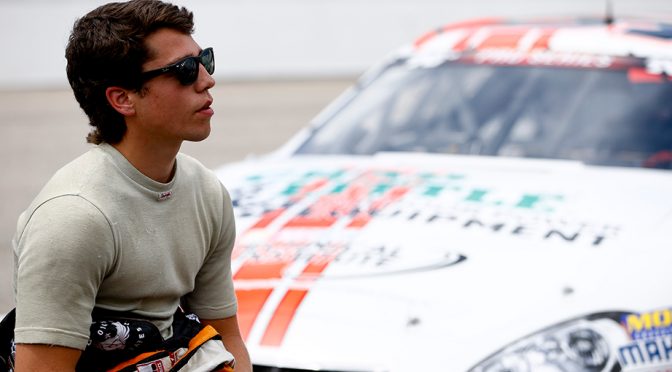
Jesse Little led only one lap in the July 11 Granite State 100 at New Hampshire Motor Speedway.

Fortunately for the NASCAR Next driver, his move to the front came on the last lap.

Little, 17, earned his first NASCAR K&N Pro Series East victory by darting from third to first when race leader Nick Drake and second-place Brandon Jones tangled in Turn 3 at NHMS.

The victory came in Little’s 31st start in the series.

Little said he didn’t have a car capable of getting around the leaders, but based on what he saw taking place in front of him, knew he might have a chance.

“And when I saw them wreck, I had a big sense of relief … once I (took) the checkered flag, I felt like all the pressure was lifted off my shoulders,” he said.

FULL SERIES COVERAGE

• Latest news
• Standings
• Schedule

“It was a really special feeling pulling into Victory Lane and finally getting everybody that supports me and sticks behind me their first win.”

Little is the son of former NASCAR Sprint Cup Series driver Chad Little and has been around racing his entire life. He is one of 12 NASCAR Next drivers and is competing in his second full season in the K&N Series.

“I grew up in the racing world, and that’s really all I know,” Little said. “I don’t really know that many people outside of it … just people that have been close to my dad and have helped him through his career, that he’s stayed close with and now I’m beginning to build relationships with.”

The K&N Series travels to Columbus (Ohio) Motor Speedway this week for the July 19 Jegs 150. Three different winners have emerged in the three previous K&N stops at Columbus — Darrell Wallace Jr. (2011), Cale Conley (‘12) and Daniel Suarez (‘13). Little, now fourth in points, has one career start at the 0.333-mile oval, finishing 12th a year ago.

The New Hampshire win was Little’s third consecutive top-10 finish and his fifth in this year’s 10 races.

“It was a huge win for us, being at New Hampshire and being with the Sprint Cup guys,” Little said. “I put it … New Hampshire as one of our biggest races of the year, and to get the win there, I think it couldn’t have come at a better place.

“It was right in our mid‑season where we had just started to build back and had some good top-10 finishes, and to go out and get the win, it definitely gave my guys a ton of confidence, including myself, and it was really gratifying the way we did it.

“We ran up front all day, and the teams know how hard we work, and even though we’re under-sourced and under-funded, it’s just really gratifying that we can go out at a track like that and prove ourselves and I can prove to other people that myself as a driver, I’m there to contend and I want to win.”

Ben Rhodes, a winner of four consecutive races heading into NHMS and five overall this season, remains the series points leader.

MORE:

READ: Latest
NASCAR news

WATCH: Latest
NASCAR video

PLAY: NASCAR
Fantasy Live

FOLLOW LIVE: Get
RaceView

See the full list of participants for Eldora

Entry # Driver Owner Crew chief Manufacturer Sponsor

1

0

Ryan Ellis(i)

Kenneth Grimes

Jeremy Nowak

12 RAM

Koma Unwind Relaxation Drink

2

00

Ken Schrader

Gene Haas

Donald Richeson

13 Toyota

Federated Auto Parts

3

02

Tyler Young

Randy Young

Bryan Berry

14 Chevrolet

Randco/Young’s Building Systems

4

2

Austin Dillon(i)

Richard Childress

Nick Harrison

12 Chevrolet

AMERICAN ETHANOL

5

3

Ty Dillon(i)

Richard Childress

Danny Stockman Jr

13 Chevrolet

TBD

6

05

John Wes Townley

Tony Townley

Mike Beam

14 Toyota

Zaxby’s

7

6

Norm Benning

Norm Benning

Kevin Dargie

14 Chevrolet

TBA

8

07

Ray Black Jr

Ken Smith

Tam Topham

13 Chevrolet

TBA

9

08

Jimmy Weller

Bobby Dotter

Jason Miller

13 Chevrolet

TBA

10

8

John Hunter Nemechek

Sidney Mauldin

Jerry Babb

14 Toyota

TBD

11

9

Chase Pistone

Joe Denette

Ryan McKinney

14 Chevrolet

NTS Motorsports

12

10

Jennifer Jo Cobb

Jennifer Jo Cobb

Steve Kuykendall

12 RAM

Koma Unwind Relaxation Drink

13

13

Jeb Burton

Duke Thorson

Jeriod Prince

14 Toyota

Estes-Carolina Nut Company

14

14

Michael Annett(i)

Bob Newberry

John Monsam

13 Chevrolet

TMC Transports

15

17

Timothy Peters

Tom Deloach

Marcus Richmond II

14 Toyota

Red Horse Racing

16

19

Tyler Reddick

Brad Keselowski

Doug Randolph

14 Ford

Broken Bow Records

17

20

Gray Gaulding

Bob Newberry

Jeff Hensley

14 Chevrolet

Gemini Southern

18

21

Joey Coulter

Maurice Gallagher Jr

Jeff Stankiewicz

14 Chevrolet

TBA

19

29

Ryan Blaney

Brad Keselowski

Chad Kendrick

14 Ford

Cooper Standard

20

30

Ron Hornaday Jr

Steve Turner

Doug George

14 Chevrolet

Exide

21

31

Ben Kennedy

Steve Turner

Michael Shelton

14 Chevrolet

heater.com

22

32

Kyle Larson(i)

Harry Scott Jr

Mike Hillman Jr

14 Chevrolet

Glad

23

35

Mason Mingus

Kevin Cywinski

Mark Rette

14 Toyota

Call 811

24

50

T J Bell

Mark Beaver

Ken Evans

14 Chevrolet

American Linemen

25

51

Erik Jones

Kyle Busch

Eric Phillips

14 Toyota

ToyotaCare

26

54

Darrell Wallace Jr

Kyle Busch

Jerry Baxter

14 Toyota

ToyotaCare

27

63

Jr Heffner

Michael Mittler

Michael Mittler

13 Chevrolet

TBA

28

77

German Quiroga

Tom Deloach

Butch Hylton

14 Toyota

NET10 Wireless

29

180

Jody Knowles

Tracy Wallace

Wayne Hansard

13 Ford

Clayton Signs

30

182

TBA

John Corr

Michael Cheek

13 Chevrolet

Performance Auto

31

88

Matt Crafton

Rhonda Thorson

Carl Joiner

14 Toyota

Ideal Door-Menards

32

98

Johnny Sauter

Mike Curb

Dennis Connor

14 Toyota

Smokey Mountain-Curb Records

33

99

Bryan Silas

Chris Baluch

Cal Boprey

14 Chevrolet

TBA

MORE:

READ: Latest
NASCAR news

WATCH: Latest
NASCAR video

PLAY: NASCAR
Fantasy Live

FOLLOW LIVE: Get
RaceView

New color schemes celebrate members of the Chase Grid

MORE: Current Chase standings
RELATED: Full coverage of the Chase for the NASCAR Sprint Cup format changes | Official news release | Changes explained | Chase Facts and FAQ

DAYTONA BEACH, Fla. (July 15, 2014) — Celebrating the accomplishments of those drivers who will contend for the 2014 NASCAR Sprint Cup Series championship, NASCAR has released several new elements to the paint schemes of race cars making the 16-driver Chase Grid.

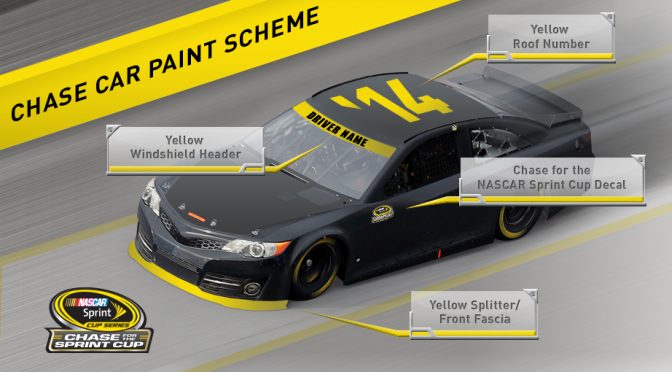
Chase for the NASCAR Sprint Cup-eligible cars will have the roof number, the front splitter / front fascia and the windshield header colored yellow, as well as have a Chase for the NASCAR Sprint Cup logo affixed to the front-quarter panel of their race car.

As part of NASCAR’s emphasis on winning races all season long, this celebratory paint scheme will be placed on a driver’s car to begin the Chase for the NASCAR Sprint Cup, at Chicagoland Speedway on Sept. 14. Once a driver is eliminated after one of the Chase’s first three rounds, the paint scheme will be removed from the car. Please refer to the graphic for a visual representation of these changes.

These changes serve as a visible symbol of the new Chase format. In addition, the paint scheme elements will ensure that fans are able to easily identify each championship contender as NASCAR’s playoffs progress.

Announced by NASCAR Chairman and CEO Brian France in January, the new championship format expands the Chase field to 16 drivers, up from 12 in previous years, and implements a new round-by-round advancement format that ultimately will reward a battle-tested, worthy champion.

A victory in the first 26 races all but guarantees a berth in the 10-race Chase, which will air exclusively on the ESPN family of networks. The number of championship drivers in contention for the championship decreases after every three Chase races with four drivers racing for the title at Homestead-Miami Speedway in the NASCAR Sprint Cup Championship, scheduled for November 16.

MORE:

READ: Latest
NASCAR news

WATCH: Latest
NASCAR video

PLAY: NASCAR
Fantasy Live

FOLLOW LIVE: Get
RaceView

Cain: Junior’s mindset a sure sign of his determination to be champion

RELATED: Play NASCAR Fantasy Live | Sign up for RaceView today

As the television camera slowly focused on Dale Earnhardt Jr.‘s face Sunday while he sat on the New Hampshire Motor Speedway pit wall after the Camping World RV Sales 301, he looked physically beat and mentally frustrated.

And yet that should be oddly comforting for Junior Nation. It was a good hurt. Earnhardt finished 10th in his No. 88 National Guard Chevrolet, although by looking at him you’d think he’d crashed out or blown up or hobbled home in 40th.

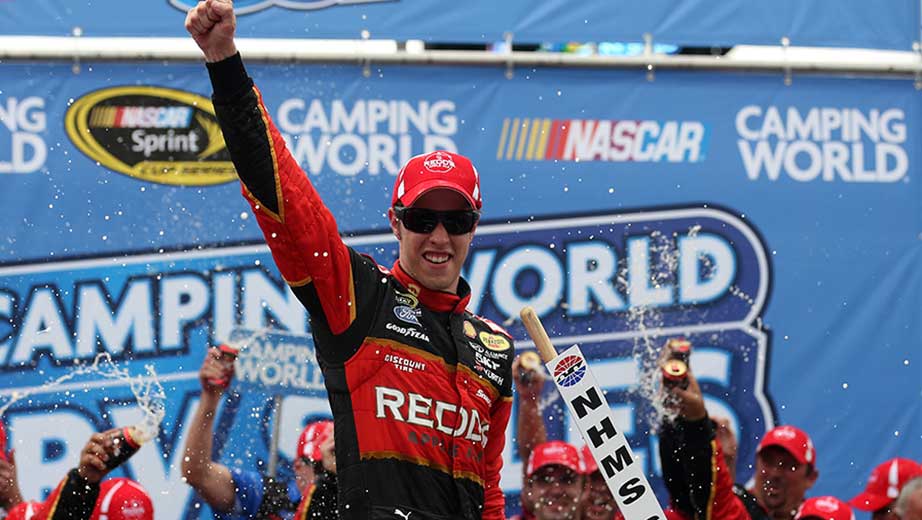
The effort was good enough to officially join Sunday’s race winner Brad Keselowski as the only two drivers to clinch a 2014 Chase for the NASCAR Sprint Cup berth, with multiple wins and a place in the top 30 of the standings secure. And yet Earnhardt was not satisfied.

His obvious disappointment on the day despite the big picture accomplishment is a telling sign of how highly motivated the sport’s perennial Most Popular Driver is to also become its champion.

FULL SERIES COVERAGE

• Latest news
• Standings
• Schedule

There was a time not too long ago when Earnhardt would have considered a top-10 finish a reason to smile, if not celebrate. But not Sunday. Not this season.

"That was frustrating," Earnhardt said grimacing. "That was the hardest I’ve ever worked for a 10th-place finish. … I had to drive so perfect every lap.  That was really frustrating. I had a good race with the No. 42 Kyle (Larson) at the end there. He was real loose, I was way too tight, so that was a mixture for us just to get stuck together and not be able to work around each other.  But I had fun racing him.

"We are going to have to come back here and run better than that to have a shot in the Chase. We will keep working. Tenth place I’m really disappointed, but I remember when we used to like these."

It was still stinging when he discussed on The Dale Jr. Download on Dirty Mo Radio.

"We need a little bit better race car when we go back, and I know that I didn’t enjoy seeing how fast some of them other guys were, particularly Brad Keselowski," Earnhardt Jr. "I don’t like to get outrun like that.

"That was just an ass-whuppin’. So I’m sure that’s going to fire up all the guys at Hendrick, and when we go back to New Hampshire, I feel pretty damn confident we’re not going to run like we did."

It’s the attitude of a legit late-season contender. It is the difference in mindset between a championship team and one OK with just making the Chase. And there have been years when the latter was the case for Earnhardt.

However, being troubled over a mostly good race is something Earnhardt could get used to.

With two wins this season, including his second Daytona 500 victory, plus a firm place among the top five in the season standings all year and a spot in the 10-race playoff already locked up, Earnhardt is delivering an answer to those critics who have long — and at times unfairly — questioned his ability and challenged his commitment.

The upside of his Earnhardt pedigree has been a loud and loyal fan base. The downside of being the son of the sport’s greatest driver is bearing the burden of proving himself over and over and over again.

Yet as Earnhardt closes in on his 40th birthday this October he is long over the need to "prove" himself. His quest for this first title is uniquely both personal and expansive. It would be affirming for himself — payoff for the work, commitment and self-belief he has maintained. And yet, he knows what a championship would mean to the millions of fans who have supported, encouraged and lived vicariously through his race days and seasons for more than a decade.

He’s in his best championship position — and form — in years.

"You could say it (clinching a spot in the Chase) was an afterthought, but we worked hard to get to where we are to be able to run as well as we have and win some races," Earnhardt said.

"It feels great. It’s an accomplishment. I’m proud of our team for that.  Hopefully we can improve though before we come back here. This is an important race track so we need to run better than this and I know we will work hard to figure that out."

He felt just strongly Tuesday.

"I’ve always believed that if you work hard, the results will come," Earnhardt Jr. said. "And I don’t know, you can’t get too damn bent out of shape about it, but you’ve just got to keep working dammit so that’s what we’re going to do.

MORE:

READ: Latest
NASCAR news

WATCH: Latest
NASCAR video

PLAY: NASCAR
Fantasy Live

FOLLOW LIVE: Get
RaceView

No. 51 truck was found to be too low in post-race inspection

MORE: Kyle Busch Motorsports penalized post-Iowa

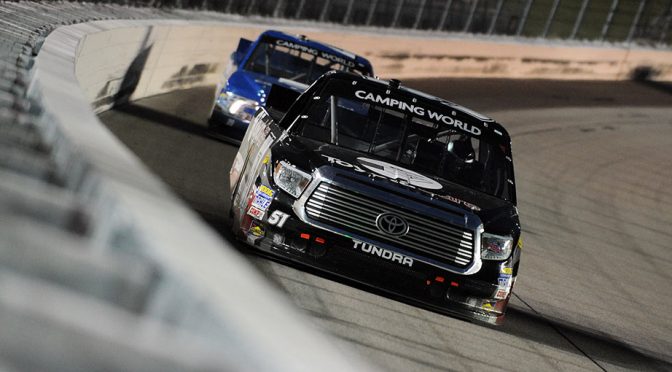
Daytona Beach, Fla. — The No. 51 team that competes in the NASCAR Camping World Truck Series has been penalized for a rules infraction discovered in post-race inspection July 11 at Iowa Speedway.

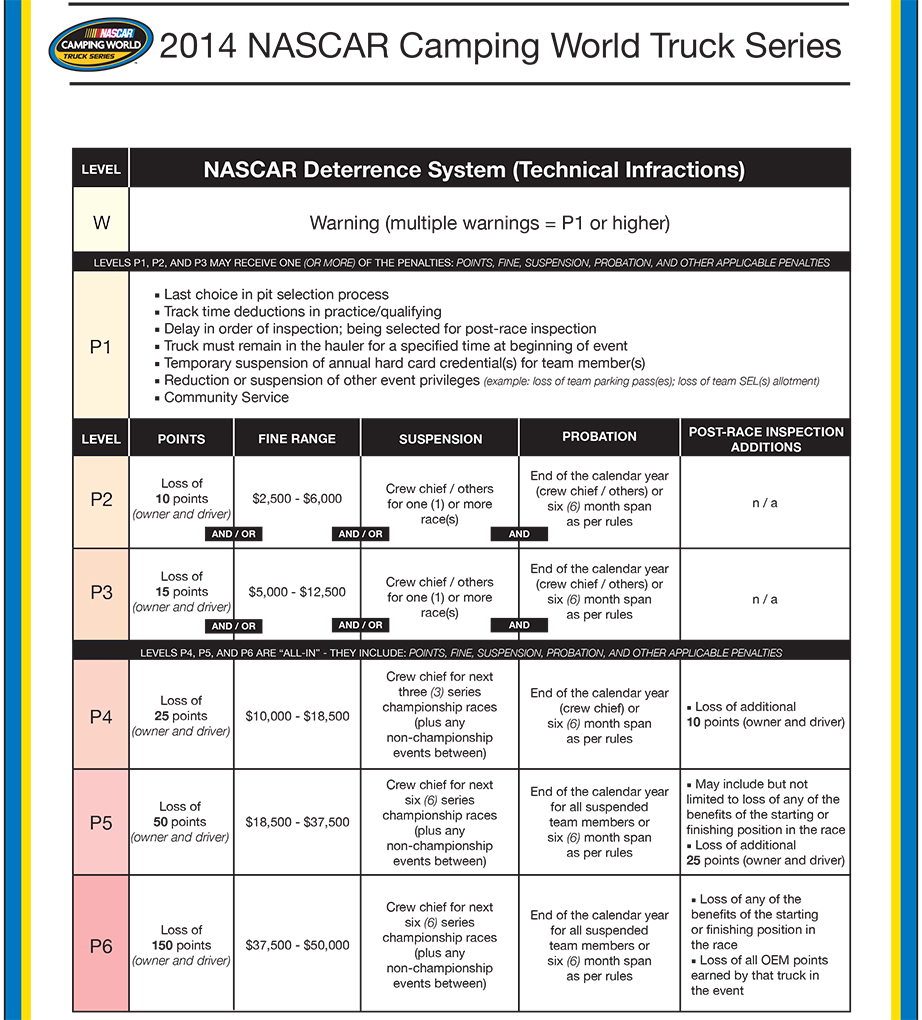
The infraction is a P2 level penalty and violates Sections 12-1 (actions detrimental to stock car racing) and 20B-12.8.1 (truck failed to meet post-race height requirements) of the 2014 NASCAR rule book.

As a result of this infraction, crew chief Eric Phillips has been fined $6,000 and placed on NASCAR probation until Dec. 31. In addition, driver Erik Jones has lost 10 championship drivers points and owner Kyle Busch has lost 10 championship owner points.

MORE:

READ: Latest
NASCAR news

WATCH: Latest
NASCAR video

PLAY: NASCAR
Fantasy Live

FOLLOW LIVE: Get
RaceView

No. 51 truck ruled too low in the rear after Erik Jones’ victory

MORE: Official NASCAR release

NASCAR on Tuesday issued penalties to the Kyle Busch Motorsports No. 51 team for failing a post-race inspection after its victory in the NASCAR Camping World Truck Series‘ most recent race at Iowa Speedway.

NASCAR stripped the team of 10 points in the series’ truck owner championship standings and docked driver Erik Jones 10 points in the drivers’ standings. The team also fined crew chief Eric Phillips $6,000 and placed him on probation until Dec. 31.

FULL SERIES COVERAGE

• Latest news
• Standings
• Schedule

The most recent penalty falls under the heading of a P2-class infraction, according to the new NASCAR deterrence system implemented during the offseason. Penalties are weighted according to a scale from P1 (least severe) to P6.

Jones drove to his second career win in the series last Friday night after leading 131 of 200 laps, but his No. 51 Toyota measured too low in the rear after the American Ethanol 200. It was the second straight week that the truck failed a ride-height requirement; the No. 51 driven to victory by owner/driver Kyle Busch at Kentucky Speedway on June 26 measured too low in the front. The most recent penalty included a steeper fine than the initial $5,000 fee and added probation for Phillips presumably because of a repeat offense.

While NASCAR Sprint Cup Series teams transitioned to a rules package without a minimum ride height in 2014, rules governing ride heights remain in place for NASCAR Nationwide and Camping World Truck Series teams.

Friday night after the race, Phillips said that there was little connection between the two technical violations.

"The Kentucky deal is completely a different thing," Phillips said. "We were probably pushing tolerances there, but that’s our job to do, but here it wasn’t that, by no means. We’ll just have to figure it out Monday and see what happens."

Busch addressed the problem after Saturday’s NASCAR Nationwide Series race at New Hampshire Motor Speedway, saying that the issue was similar to the JR Motorsports No. 9 team for driver Chase Elliott in the Nationwide Series in terms of experiencing difficulty in maintaining post-race heights within the rules. That team was hit with a P2-level penalty for being too low in the front after finishing fifth at Las Vegas Motor Speedway in March.

"There’s a tolerance or a window of I think a quarter inch that you’re allowed in green," Busch said. "Well, we start at the low side of that because that’s the way our setup is. So it doesn’t really give us that much space to go through the yellow, which I think is three-eighths of an inch or so. The Nationwide cars, I think that tolerance is a half-inch. They widened it and guys are not having issues now because the tolerance is bigger.

"Our trucks still seem to be having that issue just because the tolerance window wasn’t opened up as what Nationwide is, so we’re trying to get it the best we can. It’s our front end setup stuff. People know what we’re running. They know what we’re doing. It’s just a matter of trying to get it fine-tuned a little bit more, where we can start higher and maybe maintain a little bit better height if they don’t change the rule."

Jones, 18, is not running a full schedule in the Camping World Truck Series, splitting time with Busch this season in the No. 51 truck. Busch remains atop the truck owner standings despite the penalty, but his lead over ThorSport Racing’s Rhonda Thorson and the No. 88 team of defending series champion Matt Crafton shrank from 38 to 28 points.

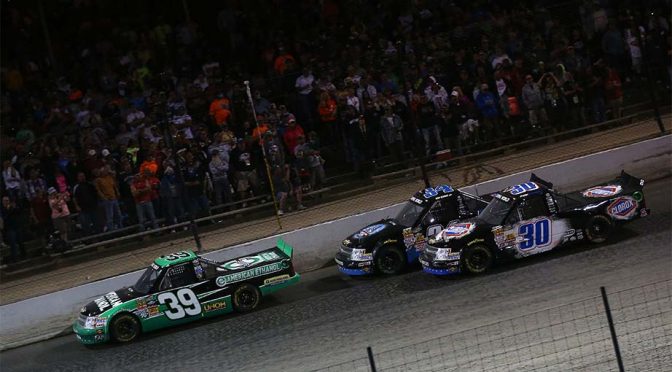
The series returns to the dirt of Eldora Speedway in Rossburg, Ohio, for its next race, the second annual 1-800-CarCash Mudsummer Classic on July 23.

MORE:

READ: Latest
NASCAR news

WATCH: Latest
NASCAR video

PLAY: NASCAR
Fantasy Live

FOLLOW LIVE: Get
RaceView

Two wins in three races push Team Penske driver atop balloting; cast your vote

RELATED: Photo gallery: Memorable moments from New Hampshire

MORE:

READ: Latest
NASCAR news

WATCH: Latest
NASCAR video

PLAY: NASCAR
Fantasy Live

FOLLOW LIVE: Get
RaceView

Nationwide Series rookie to make Sprint Cup debut in No. 33 car

RELATED: Play NASCAR Fantasy Live | Sign up for RaceView today

NASCAR Nationwide Series driver Ty Dillon is scheduled to make his Sprint Cup Series debut next month at Atlanta Motor Speedway in the Circle Sport Racing No. 33 Chevrolet.
 
Dillon, 22, is the younger brother of Sprint Cup driver Austin Dillon and the grandson of Richard Childress, owner of Richard Childress Racing. He is currently fourth in the Nationwide Series points standings, with 11 top-10 finishes in 17 starts.

"I am excited to hopefully be making my Sprint Cup debut," Dillon told MRN’s NASCAR Live. "I am looking forward to the opportunity."

FULL SERIES COVERAGE

• Latest news
• Standings
• Schedule

According to Circle Sport owner Joe Falk, who confirmed the move Tuesday, the decision to put Dillon in the car for Atlanta is part of the arrangement between the two organizations.
 
"Richard and I work together on who we put in the car 90 percent of the time," he said. "It’s all part of what we do with RCR."
 
While there may be an additional start with Circle Sport in 2014 for Dillon, Falk said the Atlanta event is the only one confirmed at this time.
 
Dillon trails points leader Regan Smith by 34 as the Nationwide Series prepares to head to Chicagoland Speedway for the July 19 EnjoyIllinois.com300 (ESPN2, 8:30 p.m. ET).
 
Dillon told MRN’s NASCAR Live that he did a test for Furniture Row Racing earlier in the year (RCR has a technical alliance with Furniture Row). Ty also got some seat time in a Cup car when he filled-in for his brother, Austin, during a practice session at Texas in April. Austin was battling an illness at the time so Ty took the car out in qualifying trim.

Dillon finished second in the Camping World Truck Series standings in 2013 before making the move into Nationwide competition this season.
 
"We run (Earnhardt Childress Racing engines) in all the restrictor-plate races," Falk said, "and of course with Ty in the car, and when (RCR driver) Brian Scott is in the car. We buy all our cars from RCR an get the full engineering package when the driver is one of theirs."
 
Timmy Hill (3), Bobby Labonte (1), Alex Kennedy (2), David Stremme (6), Scott (5) and Morgan Shepherd (1) have all made one or more starts with the No. 33 team this season. Scott won the pole earlier this year at Talladega.
 
“It’s a good deal for us,” Falk said of his organization, adding that the goal is to obtain enough primary sponsorship to allow the team to continue to increase its alliance with RCR.

MORE:

READ: Latest
NASCAR news

WATCH: Latest
NASCAR video

PLAY: NASCAR
Fantasy Live

FOLLOW LIVE: Get
RaceView

Two-time Truck Series winner will make first Nationwide start with Joe Gibbs Racing

RELATED: Play NASCAR Fantasy Live

The first five times he climbed behind the wheel of a NASCAR Camping World Truck Series entry, Erik Jones climbed out with a top-10 finish, including one trip to Victory Lane.
 
Few folks in the stock-car racing world have enjoyed such an impressive beginning, including his truck team owner Kyle Busch.
 
The 18-year-old from Byron, Michigan, will be hoping for similar results this weekend, when Jones makes his NASCAR Nationwide Series debut for Joe Gibbs Racing at Chicagoland Speedway.
 
Jones, who earned his second Truck Series win this past week at Iowa Speedway, will take over the reins of the No. 20 JGR Toyota for the EnjoyIllinois.com 300 (Saturday at 8:30 p.m. ET, ESPN2)

FULL SERIES COVERAGE

He currently shares the seat of the No. 51 Kyle Busch Motorsports Toyota in the Truck Series with Busch. Saturday’s race will be his first of three scheduled Nationwide Series starts; Bristol and Phoenix are also on this year’s schedule for Jones.
 
While not as successful as the Truck Series team, which has been in the winner’s circle six times this year, the No. 20 Nationwide outfit carries legitimate credentials. Sprint Cup driver Matt Kenseth has made 11 starts this year for the team, with nine top-10 finishes; Sam Hornish Jr. scored a runner-up in the car at Michigan; Darrell Wallace Jr. was seventh at Daytona earlier this month.
 
Jones will be the team’s seventh different driver this year.
 
"There’s definitely an expectation every time you step into a race car that’s successful … especially with the 51 truck this year," Jones said Tuesday. "Kyle has been extremely dominant, and every time I get into it, it makes me feel more confident just knowing that the truck can win and we have a shot to win every weekend."
 
Likewise, he said, there are expectations that come with the opportunity in the No. 20 entry — a little different because it’s his first start in the series, but there just the same.
 
"At the same time, I’m wanting to go out and show them that I can do it and run well in the … series and hopefully show that we an go out and be competitive," he said.
 
Logging laps is job one, and "hopefully running in the top 10 by the end of the race,” he said.
 
"We’re all race car drivers and we all want to go for the win. I think we’ll be challenging hard to do all we can to run up front and contend, and at the end of the day, I hope we’ll be up there. I know we’ve got great equipment and a great team. I’m pretty excited to see what it’s all going to bring."
 
A recent test with the team at Memphis was as much about getting acquainted with the team as it was getting comfortable in the car. For more track specific information, he expects to bend the ears of teammates Elliott Sadler and Hornish Jr.
 
"Definitely going to lean on them a lot and hopefully get a lot of information out of them as to what they do on these tracks and how they race and just try to learn from them," Jones said. "They’ve obviously done it a lot longer than I have, and just hopefully I can learn a lot from them and go into the race and learn a lot and come out a better driver than I was."

MORE:

READ: Latest
NASCAR news

WATCH: Latest
NASCAR video

PLAY: NASCAR
Fantasy Live

FOLLOW LIVE: Get
RaceView