AUSTIN, Texas – NASCAR’s show-and-tell took center stage Friday afternoon at Circuit of The Americas, revealing more details about the penalties that led to crew chief ejections for the Nos. 34 and 51 teams at the 2025 Daytona 500 and a loss of 10 driver and owner points.
In pre-race inspection, NASCAR officials found that lead weights were added to the hydration packs and in various cord covers that were not secured in both vehicles, which is a safety infraction. Per the NASCAR Rule Book, both teams violated Section 14.11.2.1, A, which notes that “any and all ballast added to the vehicle must be secured in a ballast container(s).”
“They probably weren’t planning on racing with this, but what they were doing is having this on for right side weight in the inspection,” Cup Series managing director Brad Moran said during the demonstration Friday. “The ballast was to the right side where the driver hydration is, which we take seriously. Our drivers, we want to make sure they get proper hydration. So this was on the right side of the car. That (part) would have been exchanged during the approved adjustments prior to racing.”
There also were parts of the driver cooling system and a power cord with additional lead weight that was not hooked up and sitting on the driver’s side during the inspection.
“You add that up and we could be anywhere from 10 to 14 pounds [heavier] … we don’t need to get that technical, but we know a power cord doesn’t weigh what this weighs,” Moran said. “Most teams don’t go in this direction because the price is too big — again, 10 points doesn’t sound like much, but it is if you’re trying to win a championship.”
Both crew chiefs – Chris Lawson (No. 34 Front Row Motorsports Ford) and Billy Plourde (No. 51 Rick Ware Racing Ford) – returned for the Cup Series race at Atlanta Motor Speedway.
Drivers Todd Gilliland (No. 34) and Cody Ware (No. 51) are both outside the top 20 in the points standings entering this weekend’s race at Circuit of The Americas.
AUSTIN, Texas — The NASCAR Cup Series race at the Circuit of The Americas brings a new day on a “new” track.
For Trackhouse Racing driver Shane van Gisbergen, it brings a new and welcome opportunity.
After less than satisfying finishes in drafting track races at Daytona International Speedway and Atlanta Motor Speedway (33rd and 23rd, respectively), the road-course ace from New Zealand comes to COTA as the betting favorite for Sunday’s EchoPark Automotive Grand Prix (3:30 p.m. ET, FOX, PRN Radio, SiriusXM NASCAR Radio).
Van Gisbergen surprised drivers and spectators alike when he triumphed in the 2023 Chicago Street Race, his series debut. Now, the three-time Australian Supercars champion is a known quantity.
“I miss that — going there and no one knows who I am; I could kind of fly under the radar and do my own thing,” van Gisbergen said. “Obviously, there are expectations now, but I’m pretty good at keeping that under control myself and focusing on my own thing.”
The Cup Series will race on a shorter COTA circuit this season, with the section from Turn 7 through the Turn 11 hairpin eliminated. That reduces the course from 3.41 miles (the Formula One circuit) to 2.40 miles.
Accordingly, the race will feature 95 laps instead of 68, meaning more trips beyond the main grandstand and more adventures in treacherous Turn 1.
SVG understands the reasoning behind shortening the course and shouldn’t have difficulty adapting to the new layout.
“I did like the long track, but I see why they shortened it,” he said. “More time past the stands and more action. And the cut-through that’s done (from Turn 6), we don’t lose any passing spots. That extra bit (Turns 7 through 11), there’s only one real passing spot, and they’re kept one with the cut-through.
“More laps, too. I think it’s probably a good thing, a shorter track.”
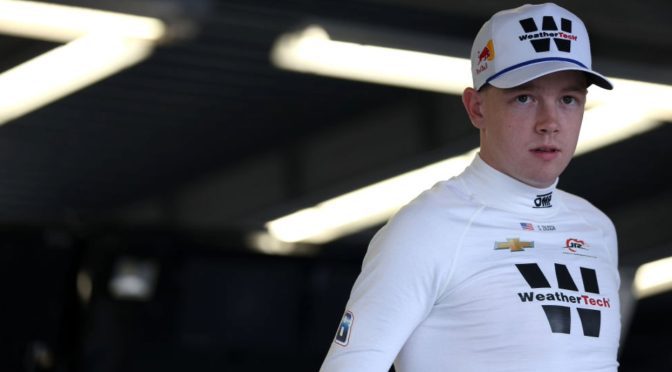
Sunday’s race also is noteworthy as the Cup debut of Connor Zilisch, who won at Watkins Glen International last year in his first Xfinity Series race. Doing double duty this weekend, Zilisch will drive a fourth entry for Trackhouse Racing, the No. 87 Red Bull Chevrolet, in Sunday’s Cup race.
“Going into my first Cup race at COTA, it’s going to be a big challenge for me,” Zilisch said. “A lot of question marks, but I just want to go in and enjoy it and have fun. You only get to make your debut in the Cup Series once.
“I feel like it’s going to be a good experience for me to go learn and run all the laps. I think that’s what I’m honestly looking forward to the most, just running all the laps and making the most of the experience.”
It’s not as though the road course aficionados won’t have stout competition from the rest of the Cup Series stars. William Byron and Christopher Bell, who won at Daytona and Atlanta, respectively, to start the 2025 season, finished 1-2 at COTA last year.
Byron will also run the Xfinity Series race on Saturday in Hendrick Motorsports’ No. 17 Chevrolet.
“I’m more than ready to get to COTA,” said Byron, who escaped a last-lap crash to win the Daytona 500 on Feb. 16. “We’ve always been fast there, and last year really showed what this team is capable of.
“The course will be shorter this time, but that’s where the extra laps in the Xfinity car should help. After the last two weekends of drafting, I’m happy to be going to a road course that takes such technique.”
Generally speaking, the NASCAR Cup Series is no place for the young and inexperienced.
Statistics show that Cup drivers are generally at their best in their 30s — perhaps even their late 30s. That stands in stark contrast to other sports, such as football, basketball or baseball, where players tend to peak in their mid-to-late 20s. One explanation is that the benefit of experience is greater, and lasts a longer time, relative to age-related reductions in physical abilities (such as reaction time and eyesight) in NASCAR than in stick-and-ball sports.
So when a driver still manages to excel at an early age, breaking through to the sport’s highest level before they’re even legally old enough to drink, it means something special. This is why all eyes will be on young phenom Connor Zilisch at the Circuit of The Americas this week, as the North Carolina native will compete in his first Cup race at 18 years and 223 days old in Sunday’s EchoPark Automotive Grand Prix (3:30 p.m. ET, FOX, PRN Radio, SiriusXM NASCAR Radio).
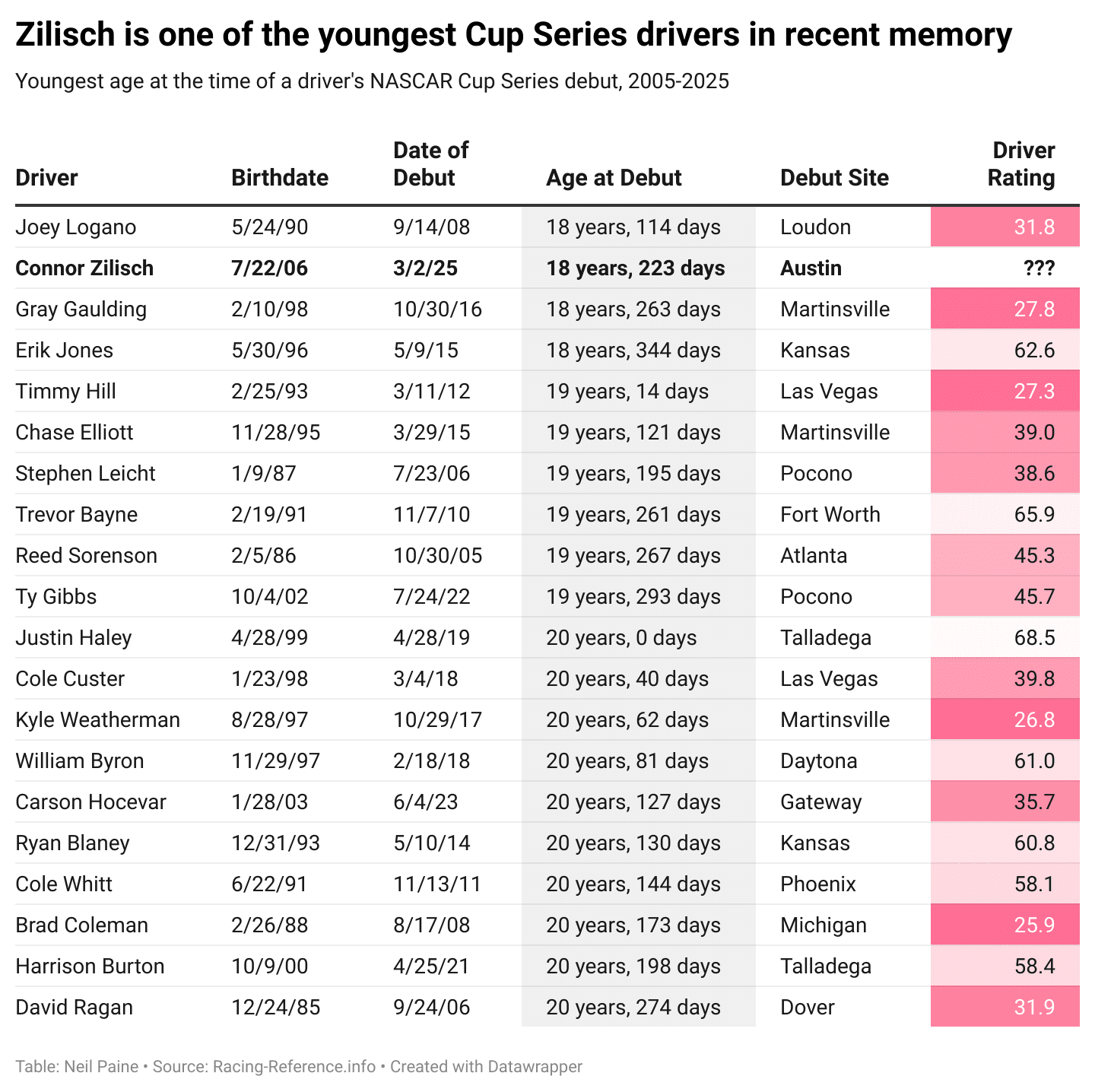
Zilisch will become the youngest driver to make a Cup Series debut since Joey Logano at the 2008 Sylvania 300 in New Hampshire, at the tender age of 18 years and 114 days old:
Logano represents some lofty company for Zilisch because his rise as a young prodigy was practically like no one else’s we’ve ever seen in history. When Logano was just 15, legendary driver Mark Martin raved about his talent — “I am absolutely, 100-percent positive, without a doubt that he can be one of the greatest that ever raced in NASCAR,” Martin said, “There’s no doubt in my mind.” — and Randy LaJoie nicknamed him “sliced bread” when he was running around the Nationwide (now Xfinity) Series at age 18. Logano was such a special prospect that Joe Gibbs immediately handed him the keys to the iconic No. 20 Home Depot Toyota after Tony Stewart left to create Stewart-Haas Racing.
Zilisch has experienced a similarly meteoric ascent. He became the first American to win the FIA Karting Academy Trophy at age 14 in 2020 — joining a roster of winners that includes Formula One driver Charles Leclerc — and he had a 2024 season for the ages, in terms of accomplishments as a young driver: He won 15 total races across seven different series, including two endurance races in the LMP2 class and the very first Xfinity Series race he entered, the Mission 200 at Watkins Glen, driving for Dale Earnhardt Jr. and JR Motorsports.
Now, he will sit behind the wheel of the Trackhouse Racing No. 87 Chevrolet at COTA, a place where he already has a top-five finish from the Truck Series a year ago. But before we get too gassed up on Zilisch’s potential to excel right away, we do need to note that most young drivers take a little while to find their footing at the Cup level. The average non-Zilisch driver in our list above posted a Driver Rating of just 44.8 in their debut race, and only a few (Justin Haley, Trevor Bayne, Erik Jones) even came close to approaching the Cup Series average Driver Rating of 70.0. Most struggled a lot; even Logano posted a Driver Rating of just 31.8 in his maiden voyage, which remains to this day his fifth-worst performance ever in a single race.
Zilisch may have a unique advantage on Sunday, however. If you scan our list of young debuts, you’ll notice that none of the others drove their first race at a road course like COTA. To find the next youngest driver to make his Cup debut at a road course since 2005, we have to go all the way down to Alex Kennedy, who was 21 years and 142 days old when he debuted in the 2013 Toyota/Save Mart 350 at Sonoma.
Kennedy was something of a road-course ringer, but he was nowhere near the level of prospect that Zilisch is, and his Cup career lasted just 22 races. Zilisch, by contrast, has a lot of experience (for his age) at many different track types, even though his most impressive performances have come at road courses. It’s also worth mentioning that the only driver to win in his Cup debut in the past 62 years did it at a road course — of sorts — when Shane van Gisbergen won the 2023 Grant Park 220 in Chicago. Granted, van Gisbergen was 34 years old then and had accrued far more experience and success driving touring cars than Zilisch has at this early phase of his career.
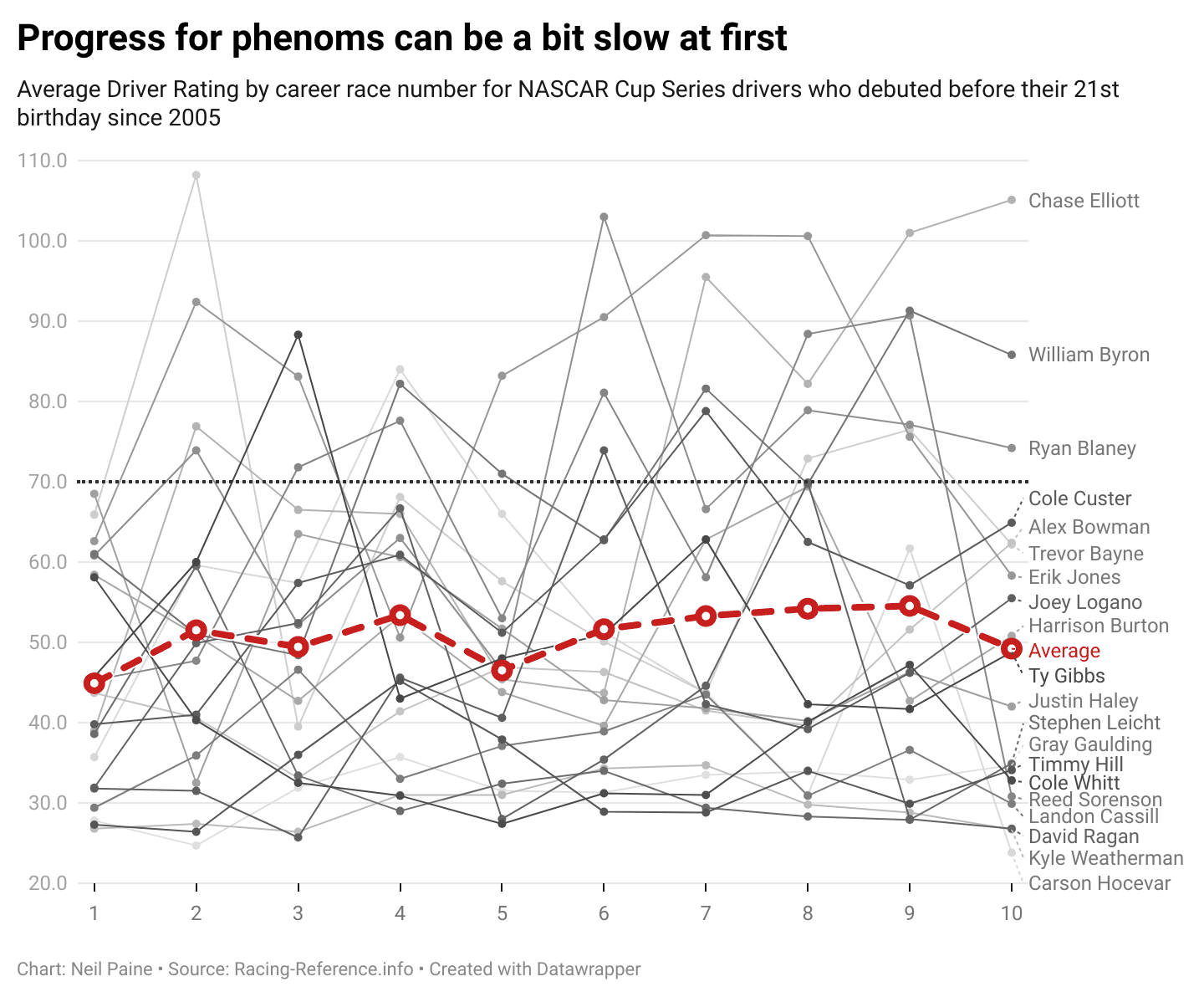
But even if Zilisch does struggle in the same manner as other young debut drivers, how long might it take for him to get rolling? Here’s a plot of Driver Ratings over the first 10 career starts for every Cup Series driver who debuted before turning 21 since 2005:
For many drivers in this category, early progress was a bit slow to arrive. The average Driver Rating of the group improves some between race Nos. 1-4, then stalls some in race No. 5 before leveling out a bit. Then, the average drops again at race No. 10. Some of the names on our list were able to rise above, however: Trevor Bayne, Erik Jones, Chase Elliott and Ryan Blaney (the latter a couple of second-generation Cup phenoms) were above average by race No. 2 of their careers, Ty Gibbs and Reed Sorenson broke through by race No. 3, Carson Hocevar and William Byron did it by race No. 4, and Logano got there by race No. 6. By 10 races in, Elliott, Byron and Blaney was consistently running above-average performances, in a sign of greatness to come.
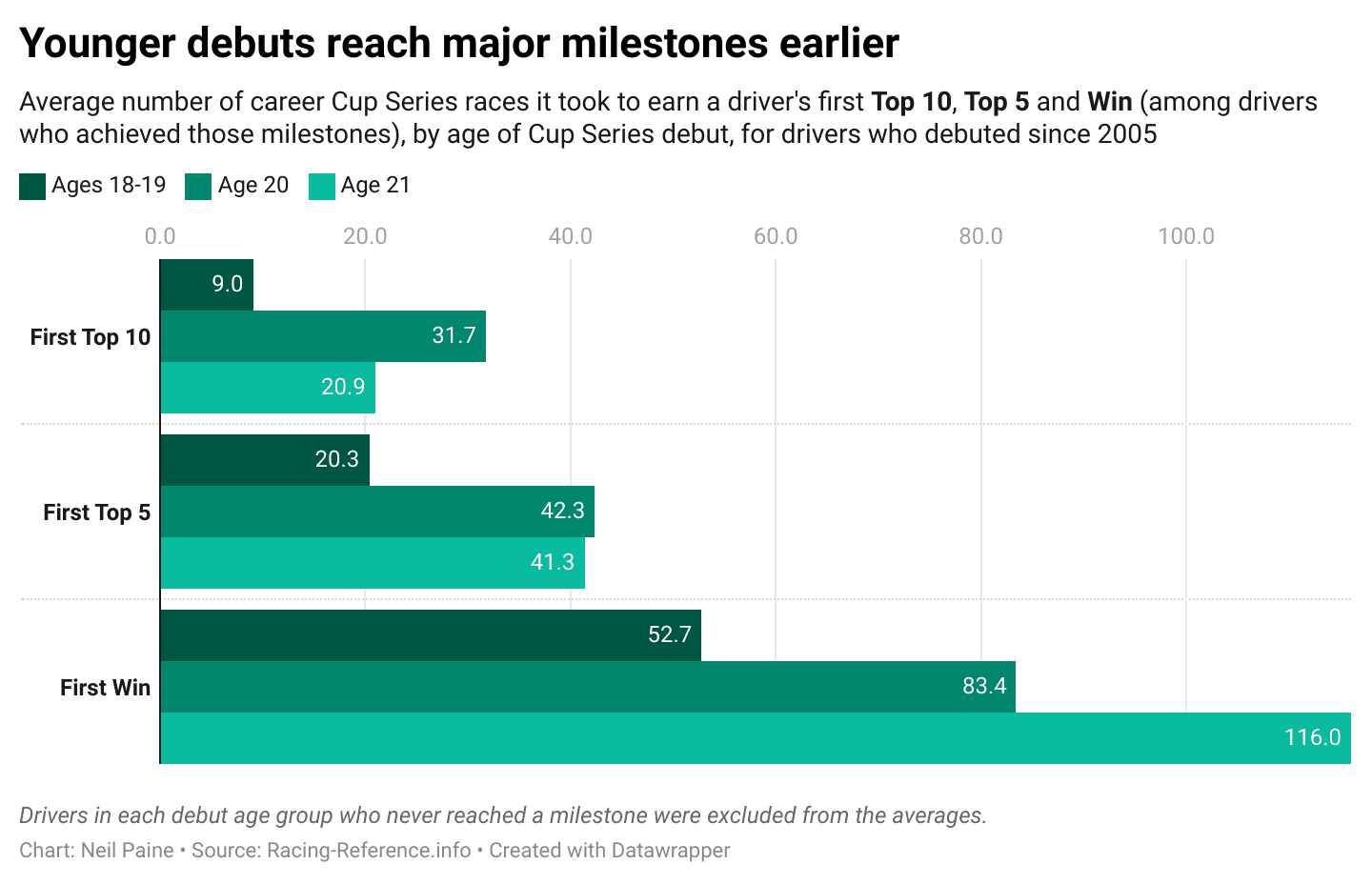
In general, young, hotshot drivers do have to wait less time before reaching major milestones. If we break down our sample of drivers who debuted since 2005 by their age at the time of their first race, we find that drivers (like Zilisch) who entered the Cup Series at 18 or 19 and eventually scored a top 10 did it within their first nine career races on average — significantly sooner than drivers who debuted at ages 20 or 21:
That same pattern holds for the average number of races it takes to achieve a top five or a win for the first time. It’s not necessarily surprising that phenoms would achieve success earlier than drivers who debuted at an older age — prospects like Logano and Zilisch are fast-tracked to the top level for a reason. But that’s another reason why the hype and expectations tend to be so high for these types of young drivers.
What will Zilisch do from here? We can only watch and wait. It’s worth remembering that even Logano hit plenty of growing pains after his early “sliced bread” days: He beefed with what felt like every driver in the garage and lost his ride at Joe Gibbs Racing before finding redemption with Team Penske — where he improved his reputation over time (just don’t ask Matt Kenseth about that) and eventually became a three-time Cup Series champion, living up to Martin’s prophetic words about being one of the greatest ever. Similar patience will probably be required for Zilisch. But for now, his journey is just beginning — and it’s right to be excited for what his future might hold.
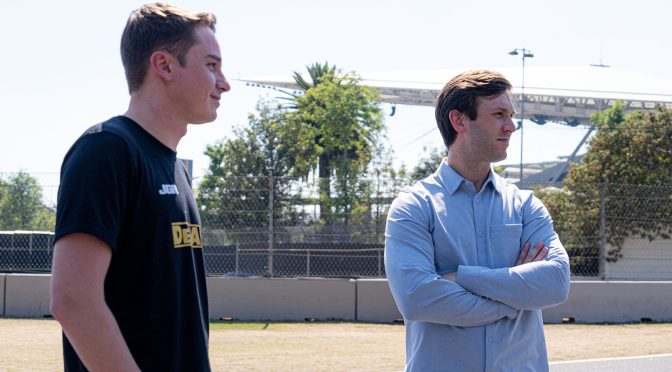
MEXICO CITY — More than 200 Mexican journalists packed into a media event Wednesday morning in Mexico City to hear from local race organizers, NASCAR executives and a quartet of the sport’s biggest stars sharing updates on the June 13-15 NASCAR race weekend in Mexico. Tickets for the event go on sale this week.
NASCAR Vice President Steve O’Donnell welcomed the crowd in Spanish. After a brief question-and-answer session on stage with drivers Ryan Blaney, Daniel Suárez, Christopher Bell and Chase Elliott, the drivers conducted one-on-one interviews with an enthusiastic Mexican media contingent.
“I would say today was awesome,” O’Donnell said afterward. “You always think about all the work that goes into prepping for events, and to see it come to fruition, to see the enthusiasm today from the drivers — obviously they’ve been here taking in the culture, learning about things they aren’t normally exposed to — I think they’ll take that excitement back to the U.S. and talk to the other drivers and people in the industry, and that will get them more excited for the event too.
“When you come to a new venue, particularly in a new country, seeing people who may not understand the sport but want to learn, and seeing their enthusiasm for NASCAR, is awesome. And it kind of refreshes you. This is what the sport’s all about, and we’re lucky we get to do what we do.”
The program included a preview of the upcoming Netflix docuseries NASCAR: Full Speed. A featured clip highlighted Suárez, the first Mexican-born driver to win in NASCAR’s top series, who emotionally shared that he did not come from a wealthy family and relied on talent and perseverance to reach the highest level of the sport.
“I have done some things that seemed impossible by following my dreams,” Suárez said in the film.
On stage, Suárez recalled an emotional moment early in his career when he sought advice from 10 close confidants about whether he should move from Mexico to the United States to pursue a NASCAR career. Eight of them told him no. But he listened to the other two, moving to North Carolina, where he learned English and survived on very little money.
In 2016, the Monterrey, Mexico, native won the Xfinity Series championship. Since then, he has earned two Cup Series victories and made two playoff appearances with the latest coming last year.
“All the complications actually made the journey,” the Trackhouse Racing driver said. “This is a dream, and I’m trying to enjoy every single minute of it.”
That passion is what draws fans to the sport — both die-hard and new. For Suárez, the opportunity to return to Mexico as a top-tier driver for a top-tier team is something he doesn’t take for granted. His inspiring journey wasn’t lost on his fellow NASCAR Cup Series stars sitting beside him on stage.
Chase Elliott, the 2020 NASCAR Cup Series champion and the sport’s perpetually voted Most Popular Driver, called his time in Mexico City this week — and the chance to return for the race — “a great honor for all of us involved.” He thanked the community for greeting them with “open arms.”
“All we ask for is the opportunity, and you have given that to us,” said Elliott, driver of the No. 9 Hendrick Motorsports Chevrolet.
Bell, last week’s winner at Atlanta Motor Speedway, also noted the warm reception they have received—from touring the track at the famous Autódromo Hermanos Rodríguez to sampling authentic tacos and attending a Lucha Libre wrestling match Tuesday night.
Not only is NASCAR experiencing a new culture, but the sport is also bringing a new experience to the Mexican people and the large international crowd expected to attend the three-day event in downtown Mexico City.
“I love, love the fact of diversifying the schedule and going to new venues,” said Bell, a driver for Joe Gibbs Racing and the most recent Cup Series winner, while speaking with a group of Mexican media members.
“You just want the crowd to turn out, and you want crowd engagement. Based on what we’ve experienced this week and what we know is to come, I think that’s going to happen here in Mexico,” he added. “I think it’s going to be a banner weekend, and the crowd seems like it’s going to be very engaged and show up in a big way.”
“I’m a big advocate of going to different venues, and coming here — this is a world-class facility. It’s a place we should be coming to. It’s going to be fun seeing it all unfold.”
As event executive Federico Alamán González said with a smile and in perfect English:
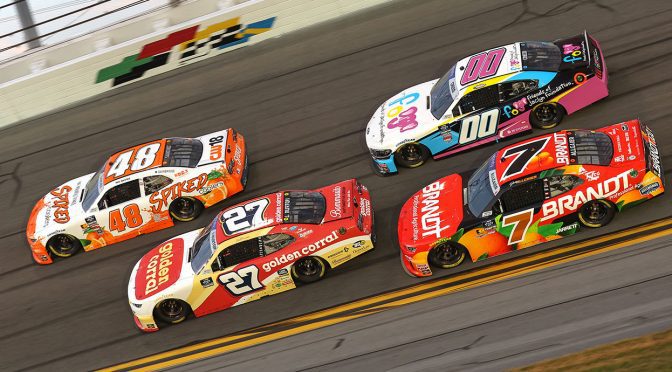
The Haas Factory Team No. 00 and Big Machine Racing No. 48 teams were penalized following Saturday’s race at Atlanta Motor Speedway.
Both cars were found to have at least one lug nut not properly installed, which is a safety violation noted in Section 8.8.10.4a in the NASCAR Rule Book. The teams were each fined $5,000.
Nick Sanchez, driver of the No. 48 Chevrolet, scored his first Xfinity top-five result last weekend, while Sheldon Creed, driver of the No. 00 Ford, finished 14th.
The Xfinity Series heads to Circuit of The Americas on Saturday for the Focused Health 250 (2:30 p.m. ET, The CW, PRN Radio, SiriusXM NASCAR Radio).
Trying to draw a bead on who has the early hot hand in the 2025 Cup Series? Good luck, with a pair of superspeedways and a road course as the first three races potentially skewing those trends.
Conventional wisdom used to be that the first five races of the NASCAR Cup Series season would provide a good gauge of how the circuit’s balance of power might tilt. In years past, that span of the schedule typically served up a mix of intermediate tracks, one-milers and perhaps a short track — all kicked off by Daytona’s superspeedway test.
This year, however, pundits may have to let the calendar breathe a bit before drawing definitive conclusions about which teams made the best offseason performance strides, who jumped out to a competitive edge and who the rest of the field might be chasing for the bulk of the 2025 campaign.
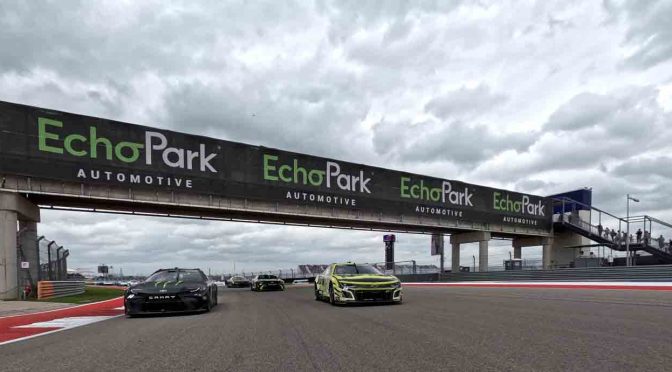
For the second straight season, the Cup Series has competed on drafting-style tracks in the first two races of the year, making the turn from Daytona to Atlanta. This year, the chaser that rounds out the opening three-race trifecta is Sunday’s EchoPark Automotive Grand Prix (3:30 p.m. ET, FOX, PRN Radio, SiriusXM NASCAR Radio) at the Circuit of The Americas, the deliciously complex road course in Austin, Texas.
It’s a schedule that has all the look and feel of a triple play of wild-card events, with 1-mile Phoenix Raceway and 1.5-mile tracks at Las Vegas Motor Speedway and Homestead-Miami Speedway up next. That five-race stretch, though, still holds the possibility of providing a baseline for how the Cup Series field stacks up.
“You know, it used to be like — let’s get like a month in or something. That will probably still be true,” said former Cup Series champ Chase Elliott, the winner of COTA’s inaugural NASCAR race in 2021. “Really, I think by the time you get through — where do we go … from COTA to Phoenix to Las Vegas? I think by the time you get through Vegas, you’ll have a pretty good idea of what’s going on, truthfully, at that point. So you’ve delayed it a week, basically, with the second speedway and the road course thing.”
Road racing, Elliott acknowledged, isn’t the rarity or write-off that it used to be — not with six of that track type on the 36-race schedule.
“In the past, I would agree that it was kind of an outlier. Well, now, we have 15 of them, it seems like, so they kind of matter, too,” Elliott said, noting the days when Sonoma Raceway and Watkins Glen International were the Cup Series’ only two road courses. “It used to be that you could get away with just not being a road racer for two weeks a year, and it didn’t really matter because it was in the summer. If you ran good, great. And if you didn’t, no big deal, right? Where now, you have so many of them so you kind of have to embrace. I would argue that that one matters, as well.”
So far, the first two races haven’t produced the striking number of anomalies in the Cup Series standings that the small sample size tends to create. A quick glance at the top of the Cup Series heap isn’t all that wild of a card, with points leader Ryan Blaney just ahead of William Byron and Tyler Reddick in the top three — a trio that ended up in last year’s Championship 4 field.
On the flip side, John Hunter Nemechek and Ricky Stenhouse Jr. — both outside the top 20 in last year’s final standings — are in a three-way tie for sixth place with Kyle Larson. Further down, it’s a deep points deficit for three drivers who made last year’s Cup Series Playoffs, with Ty Gibbs 29th, Brad Keselowski 33rd and Chase Briscoe last. Both Gibbs and Keselowski crashed out of last Sunday’s Atlanta race, and Briscoe’s No. 19 Joe Gibbs Racing team is in the cellar after a post-Daytona penalty.
This year’s winners haven’t been left-field surprises, either, with Daytona 500 champ Byron joining Atlanta winner Christopher Bell in that group. Both Byron and Bell have won multiple races in each of the last three seasons, and while Bell didn’t have Atlanta on the list of venues where he figured his No. 20 Joe Gibbs Racing team would necessarily thrive, he was bullish on putting his name among the early season front-runners in the first five races and beyond.
“Honestly we’re just getting into the bread and butter of what the 20 car likes,” Bell said post-race at Atlanta. “COTA should be a strong track. Phoenix, Vegas, Darlington, Homestead. All of these tracks coming up in the early part of the season is where we think we can compete for wins and do good, score a lot of points. Atlanta was not one of those race tracks we had circled. It’s very refreshing to be able to get one early in the season, especially one where we didn’t expect to win at. Hopefully, we can keep the ball rolling.”
Jonathan Bachman | Getty Images
2. Keep Austin New
Weird? Maybe. But a host of changes will greet the Cup Series this weekend, with a shorter course configuration, new pavement and new Goodyear rubber at COTA.
Circuit of The Americas still qualifies as one of NASCAR’s newer stops on the schedule. Significant changes, however, are ahead for this weekend’s event, which marks just the Cup Series’ fifth trip to the Lone Star State capital.
The city’s motto of “Keep Austin Weird” will describe not only its reputation as a home for eclectic music and culture but will also sum up a new-look course configuration for this weekend’s NASCAR events. Race promoters announced that change last November, shifting from a 3.41-mile full layout to a shorter 2.3-mile “national” circuit for both the Cup Series and Xfinity Series this weekend.
The new shape of the course eliminates the section from Turn 7 through the Turn 11 hairpin on the full layout. The scheduled race distances won’t change as much, with last year’s event going 231.88 miles vs. this year’s 228, but the lap count goes up from 68 to 95. That shift means that the field will rumble past fans’ vantage points more often over the course of the event.
“I think shortening the track definitely changes quite a few things,” Team Penske’s Austin Cindric said. “The lap count, from a fan standpoint, I think that is more than anything else. How much do you prioritize the other corners that still exist on the race track? Past that, there are still plenty of elements to take away. It is a very unique circuit.”
The adjustments will put a premium on Saturday morning’s extended practice, when the drivers will get a chance to validate their computer simulation testing with real-world track time.
“It’s kind of one of those things where it’s tough because the only thing you can do is simulator work, right, until you can get some eyes on it,” Elliott said. “The good news is that we’ve got some practice next week to understand the reconfiguration. I do not have my head wrapped around it completely at this point. I mean, I know what it’s supposed to look like, but I think until you really get out there and feel it — for me, it’s always hard to kind of understand exactly how things are going to be. And I kind of hate guessing because I don’t want to guess wrong in that situation, so I just kind of look forward to practice, honestly, more than anything. I would have to imagine it will change the racing a little, I would think, just based off the way it’s shaped. So hopefully, it gives more opportunities to get crafty, have some more options, opportunities to pass or just be different. If it does, great. And if it doesn’t, it’ll look like it has for the last few years out there.”
If that’s not enough new, Sunday’s race will be the first on the Circuit of The Americas’ fresh asphalt, the fruit of a repaving project that was completed last September. The resurfacing was the second in a roughly 2 1/2-year span as track officials sought to address the track’s bumpy nature.
That new begets more new, with Goodyear bringing a new tire that’s making its Cup Series debut this weekend. Goodyear officials indicated that the new tire features an updated construction, plus a new compound that emphasizes wear and lap-time falloff.
Experts Steve Letarte and Jeff Burton break down Sunday’s Atlanta result, noting how Christopher Bell has heaps of motivation driving him to success.
4. Last year’s road-course review
Hendrick Motorsports won four of the five road-course races last season, led by Kyle Larson’s pair of triumphs (Sonoma, Charlotte Roval). RFK Racing’s Chris Buescher was the only non-Hendrick road-race winner (Watkins Glen) in 2024. See how the field’s finest stacked up in terms of laps led on road courses last season. (Credit: Racing Insights)
Driver
Road course laps led, 2024
Kyle Larson
81
Ross Chastain
61
Chris Buescher
51
William Byron
42
Tyler Reddick
42
Shane van Gisbergen
31
Christopher Bell
24
Joey Logano
22
Ty Gibbs
18
AJ Allmendinger
17
Alex Bowman
14
5. Catch the pack — news and notes from around the garage
Only two races into the 2025 Cup Series season and tensions are beginning to rise.
Carson Hocevar was the biggest topic of discussion on-track with his run-ins and conversations with multiple drivers at Atlanta Motor Speedway last Sunday, but the late-race incident between Austin Cindric and Kyle Larson for the lead flew under the radar as Ross Chastain spoke to Hocevar on the infield grass.
On Monday, Cindric and Larson spoke over the phone and hashed out their perspectives on the contact off Turn 2 that sent the No. 2 Team Penske Ford spinning along with Daytona 500 winner William Byron.
“I thought we had a good talk,” Cindric said during a Zoom teleconference Wednesday. “Kyle took responsibility on the end of the race there, which obviously ended our race. Talking about it doesn’t really un-wreck my race car, but I think we’re on the same page as to what the expectations are moving forward racing together.”
To schedule the call with Larson, Cindric didn’t have Larson’s number and said he doesn’t find the purpose in having his competitors’ phone numbers.
Instead, shortly after the race, Cindric handed a business card to Hendrick Motorsports President and General Manager Jeff Andrews.
“When the race is over, you know, I was helping my guys load the car and as you’re standing there, we’re the first hauler, and I can’t say I was really in a very good head space to want to talk to anybody,” Cindric said. “But at the same time, knowing that this is something I definitely wanted to discuss with Kyle, I was like ‘if somebody comes up to me, I’m just going to give them my phone number and be done with it. I do have a stack of business cards that I brought around with me, like going to the Rolex [24], like as a teenager, handing them out to team owners and team managers. So I still had all of them in my backpack, and I saw Jeff Andrews and Chad Knaus standing over by the 24 hauler, so I figured that was a good way of ensuring that I would get my conversation that would be a lot healthier than just showing up at the race track.”
With Cindric’s prowess on drafting tracks, there’s an argument to be made he could have two wins already stashed away and a guaranteed bid into the 2025 NASCAR Playoffs.
The fourth-year driver finished eighth in the Daytona 500 and 28th at Atlanta but the results don’t show what Cindric was able to do in those events. He led the most laps in the ‘Great American Race’ and followed it up by leading 47 circuits around the 1.5-mile Georgia track.
Looking deeper into the numbers, Cindric also scored 20 combined stage points in the first two races of the season, and according to Racing Insights’ loop data, Cindric ran inside the top 15 for all but 17 laps, including the nine he missed after exiting the race following the wreck. He leads the Cup Series with an average running position of 5.4, more than four positions better than teammate Ryan Blaney (9.5) in second.
“I felt like I could have said a lot more than I did,” Cindric said. “I like to honestly keep that behind closed doors, so maybe if you felt like I spoke up and I felt like I was holding back, that tells you how upset I was with the situation. It’s still something I’m relatively upset about and gets the blood pressure going a little bit. But that’s racing. I mean, I’m not the only one that’s been in those positions and felt like they haven’t been able to capitalize on an opportunity to win a race or had somebody else be the cause of that. It doubles down with it being two weeks in a row. At this level, race wins don’t fall out of the sky.”
While it’s still way too early in the season to discuss postseason outlooks, Cindric’s early-season heartbreaks already harken to a playoff-contending driver who had multiple win opportunities taken from him last season — Chris Buescher.
Cindric is nowhere close to any sort of panic button as he sits a healthy fourth in the points standings, but with two golden opportunities out of the mix for the No. 2 driver, he will have to battle Larson again and other stars of the sport to get that coveted checkered-flag sticker on his Ford Mustang.
“I know if I want to win in this series, I’m certainly going to have to race against him [Larson] a lot more,” Cindric said. “I certainly expect us to be at that level throughout the year and I just expect it to be better than what we had on Sunday.”
The 75th season of racing at Hickory Motor Speedway is poised to be one of the most notable in the track’s long history.
Along with more improvements to the facility’s infrastructure, Hickory is also introducing the Grand Slam for Late Model Stock competitors. This four-race championship encompasses Hickory’s three marquee events in the Jack Ingram Memorial, Bobby Isaac Memorial and the Fall Brawl, as well as one qualifying event.
Kevin Piercy, who is entering his 17th year as Hickory’s promoter, has witnessed the historic track undergo plenty of changes during his tenure. The diamond anniversary at Hickory creates both pressure and opportunity for Piercy, who is eager to see another year of weekly competition commence Saturday evening.
“Anytime you open up for another season, there’s a lot of work, time and effort that goes into preparing for opening night,” Piercy said. “I haven’t had a whole lot of time to think about what’s next, but we’re excited to host the 75th year of Hickory Motor Speedway, America’s most famous short track.”
Since 1951, Spectators have flocked to Hickory Motor Speedway to cheer on the local heroes and watch the next generation of NASCAR stars.
Long before he started overseeing the day-to-day operations of Hickory, Piercy was familiar with how the track got its nickname as the “Birthplace of the NASCAR Stars.”
Since Hickory opened its doors to the public in 1951, many NASCAR legends have honed their skills around the half-mile oval. The list of track champions features many NASCAR pioneers like Junior Johnson, Ned Jarrett and Ralph Earnhardt, along with other accomplished competitors such as Jack Ingram, Harry Gant, Tommy Houston and Josh Berry.
Hickory also hosted several NASCAR Cup Series races from 1953-71 before later becoming a staple on the NASCAR Xfinity Series schedule. Despite the last major NASCAR event at Hickory taking place in 1998, the track continues to attract both fans and competitors through its weekly racing program.
Piercy has strived to keep the proud tradition of racing at Hickory flourishing, though that often involves keeping a balance between being frugal and innovative. Full-time competitors at Hickory are becoming less common due to financial restraints, which is why Piercy said programs like the Grand Slam are essential to sustainability.
“You’re constantly trying to be creative and find new ideas,” Piercy said. “Our Limited [Late Model] division has a challenge with 10 events inside the season that make up a second crown. For people who are on a budget, that allows them to race without committing to the whole season.
“That’s the same direction we’re going with the Grand Slam this year.”
Hickory’s Grand Slam technically begins July 19 with the Jack Ingram Memorial, but a driver who wishes to compete for the in-season title can earn eligibility by competing in one weekly event between Saturday’s opener and Aug. 23. A total of 50 points toward the Grand Slam will be designated to a driver for making a weekly race start before the deadline.
Hickory’s Grand Slam consists of the track’s three Crown Jewels: the Jack Ingram Memorial, the Bobby Isaac Memorial and the Fall Brawl. (Photo: Gardner Street Photography/Hickory Motor Speedway)
The Grand Slam is not the only change Piercy has made ahead of the 2025 season, as he and his staff completed the installation of a new scoreboard in Turns 1-2 that doubles as a video board. With the updated technology, Piercy believes spectators will have a more optimal experience when it comes to keeping track of the leaders.
Infrastructure has been a top priority for Piercy since Hickory received more than $500,000 in North Carolina state grants following the COVID-19 pandemic. The renovated scoreboard was a continuation in a long line of improvements at Hickory over the past few years, but Piercy still has many plans outlined for the track, including a repave.
“We went as far as we could with the grant money with renovating the bathrooms, the suites and paving the infield,” Piercy said. “We have some money left, but not enough to get started on the track. We’d love to pave the track at some point, but that’s going to be a future project. The video board is a tremendous asset and an opportunity for sponsors, too.”
Piercy possesses optimism over Hickory’s future in an evolving world, but his focus is centered on ensuring everything is ready before opening night. He expects plenty of exciting moments throughout the 2025 season, one he hopes will end with a thrilling conclusion to the inaugural Grand Slam during the Fall Brawl in November.
Sustaining Hickory’s proud racing heritage is strenuous-but-rewarding work for Piercy. Having served as promoter for just under a quarter of Hickory’s lifespan, Piercy said the job remains arduous, but he’s proud of everything he and his staff continue to accomplish with one of NASCAR’s most cherished short tracks.
“When I took over, we were in a recession,” Piercy said. “I had multiple competitors come to me [back then] who felt the timing was disastrous. The first two or three years were sketchy, but we’ve evolved. It’s a rollercoaster with up and down years, but we try to be sensitive to the needs of the competitors, the fans and the sponsors.
“We try to underpromise but overdeliver on the way we do things at Hickory Motor Speedway.”
Hickory Motor Speedway’s 75th season gets underway Saturday with a full docket of racing that includes twin 40-lap features for Late Model Stocks along with Limited Late Model, Street Stock, Super Truck and Renegade races. The first green flag waves at 6 p.m. ET with FloRacing providing coverage of all the on-track action.
The latest episode of the “Hauler Talk” podcast provided a glimpse into the NASCAR playoff committee that held its first meeting two weeks ago at Daytona International Speedway.
The panel of more than two dozen members included active and Hall of Fame drivers, series executives and representatives from manufacturers and the media industry.
NASCAR managing director of racing communications Mike Forde said Joe Gibbs Racing’s Christopher Bell was among the active drivers on the committee weighing changes to the NASCAR playoffs beginning with the 2026 season.
“NASCAR has really turned to him as a leader in the garage,” Forde said. “I think how he handled the disappointment of Martinsville (missing the championship round after his last-lap move was deemed illegal), we took notice of that. He was vocal and super candid, and I think a lot of people would probably assume that we didn’t care for that, but it’s the opposite. We met with him in January to talk about where we were with the playoffs and to invite him as part of this committee.
“He did speak up in the committee and gave some ideas that we should maybe think about. Rotation of the championship, for instance, was a big one on his mind.”
Forde said there was no agenda for the opening discussions and described the tenor of the room as civil, educational and wide-ranging.
“You’re looking at about 25 people on the panel from all walks of life, and I was kind of interested to see how it would start,” Forde said. “The first to speak was a retired NASCAR Hall of Famer who had a bunch of very well prepared research, and his idea or pitch was to go back to the 36-race season championship. Others went the opposite direction and said, ‘Well, I like the playoffs. I think that it is important to have eliminations but how will we do it a little bit differently? Is it a seven-race lead-in to a three-race championship?’ That was one idea that was kicked off. And do we reduce the field from 16 drivers to 12 or 10, as we did in prior iterations of the Chase and playoffs?
“So there was a lot discussed. Step one of the meeting was to really just throw ideas out there good or bad. The goal is a playoff system, whether it’s keeping it or changing it, that crowns a deserving champion but also maintains or elevates fan engagement, whether from a digital or social perspective, or butts in the seats and eyeballs on the television. We want the competition for sure, but we want fans to be really engaged as well.”
Forde and senior director of racing communications Amanda Ellis also explained why NASCAR changed course Sunday in ending the Cup race at Atlanta Motor Speedway under caution after allowing Saturday’s Xfinity race to finish under green despite a last-lap wreck.
The Daytona 500 ended under a green flag despite a massive crash coming to the checkered flag. Ellis noted that Daytona International Speedway has more than twice as many cutouts as Atlanta to allow safety vehicles to access the track, “and that alone makes calling those two races exactly the same, in my opinion, very challenging.”
With many calls for a consistent policy in how NASCAR handles last-lap wrecks, Forde said the varying dimensions of race tracks would make consistency difficult and noted the calls could be different this weekend at the Circuit of The Americas road course.
RELATED: COTA weekend schedule
“There are more run-off areas, so if there is a wreck at the front of the field between two leaders, it might not be a caution because you’ll have to see if the trailing cars are in a precarious position,” Forde said. “At road courses because it’s so spread out, we might be able to keep it green.”
The episode also features an interview with Speedway Motorsports senior vice president of operations and development Steve Swift who reviewed the positive reaction to the reconfiguration of Atlanta Motor Speedway and what might be ahead as the track’s asphalt quickly ages.
Swift also discussed this weekend’s overhaul to the NASCAR course layout at COTA, which will be about a mile shorter in distance and nearly 30 laps longer in race length.
Other topics covered during the third episode of “Hauler Talk,” which explores competition issues in NASCAR:
• Dissecting the disqualification of Parker Kligerman’s Daytona victory being upheld on appeal.
• Fan questions about the length of cautions, why series use different race directors and how track limits will be enforced at COTA.
Click on the embed above to listen or search for “Hauler Talk” wherever you download podcasts to hear it on your phone, tablet or mobile device.
Nate Ryan has written about NASCAR since 1996 while working at the San Bernardino Sun, Richmond Times-Dispatch, USA TODAY and for the past 10 years at NBC Sports Digital. He is a contributor to the new “Hauler Talk” show on the NASCAR Podcast Network. He also has covered various other motorsports, including the IndyCar and IMSA series.
*1st place monies includes the $3,500 Special Award Whelen Engineering “Winner of the Race” award paid to winning driver.
Total: $82,450
1st-$12,585
2nd-$4,792
3rd-$3,744
4th-$2,881
5th-$2,776
6th-$2,671
7th-$2,567
8th-$2,562
9th-$2,557
10th-$2,552
11th-$2,348
12th-$2,343
13th-$2,338
14th-$2,333
15th-$2,329
16th-$2,224
17th-$2,219
18th-$2,214
19th-$2,210
20th-$2,205
21st-$2,000
22nd-$2,000
23rd-$2,000
24th-$2,000
25th-$2,000
26th-$2,000
27th-$2,000
28th-$2,000
29th-$2,000
30th-$2,000
($10,000 of the above purse is contributed by FloRacing.com)
QUALIFYING AND SPECIAL AWARDS
$1,150 Hoosier Tire “Pole Award” per event award to the eligible driver with the fastest qualifying time eligible to participate under the Manufacturers’ Prize Money Conditions.
$1,000 Hoosier Tire “Hard Charger” per event award to the highest finishing eligible driver who advances the most positions from the start of the race to the end of the race. In the case of a tie, the highest finishing driver will receive the award.
$550 Sunoco Spec Fuel per race award divided: 1st-$300 5th-$150 10th-$100
$400 Phil Kurze “Halfway Leader” Award presented by Josten’s per event award to the race leader at the halfway point of the event, regardless if the race is running under green or yellow.
One set of Hoosier Racing Tires – Product Award valued at $1,000 to be awarded as follows: At the conclusion of the event, the race winner will draw a pill to randomly select which finishing position of 10th through 25th will win this award.
One set of Hoosier Racing Tires – Product Award valued at $1,000 to be awarded to the highest finishing new team participating in the race. New team is defined as a new Car Owner to the NASCAR Whelen Modified Tour or a Car Owner who has not participated during the past three (3) seasons of the NASCAR Whelen Modified Tour. If there are no new teams that qualify for this award, a second pill will be drawn, by the race winner, and the tires will be awarded to a team that finishes between 10th and 25th positions.