Nationwide Series champ knows the transition to the Sprint Cup Series will be tough

WELCOME, N.C. — Team owner Richard Childress has been inexplicably coy about the presumed upcoming announcement that Austin Dillon will drive the No. 3 Chevrolet in the NASCAR Sprint Cup Series next year, but that hasn’t stopped people from talking about it — people including Austin Dillon.
 
As he accepted his NASCAR Nationwide Series championship trophy last Monday night in Miami Beach, Dillon, Childress’ grandson, offered an emotional good-bye from the stage to the team members who helped propel him to his second title at the NASCAR national series level.
 
Earlier in the day, over lunch with reporters, Dillon talked about the difficulties the transition to the NASCAR Sprint Cup Series might bring.

"It’s going to be tougher, obviously," Dillon said. "I’d like to go out there and win every race and set the world on fire, but you have to set realistic goals. I think what we’ve gone through for four years (in the NASCAR Camping World Truck Series and NASCAR Nationwide Series) is really going to prepare me for that. We’re going to fight hard for anything we can do, and we’ll take little victories as we go.
 
"I’m excited. The Sprint Cup Series is going to be tough, but you’ve just got to hit it head-on and jump in there. The good thing is I have those rookie stripes next year. I am focused on finishing races, so I do have some mulligans with the yellow stripes. I need to go out there and get to the edge, to the limit of those cars — try and find it. I can’t just go out there and run every lap and not be trying to make things happen. You’ve got to go after it and find the edge of those cars somehow."
 
Dillon drove the No. 3 to a championship in the truck series two years ago, and this year he won the NNS title in a No. 3 Chevrolet Camaro. He understands that driving the No. 3 in the NASCAR Sprint Cup Series wouldn’t be without controversy.
 
Dale Earnhardt won six of his seven championships in the No. 3 RCR Chevy. If Dillon is in the No. 3 next year, will fans gravitate to him the way they did to Dale Earnhardt Jr. after his father’s death at Daytona in 2001?
 
"I’m a huge Junior fan myself," Dillon asserted. "I think Junior not only has fans because of what he’s done, [but] I think it’s because of the person he is, too. I was jumping up and down pulling for him the other night (in the season finale at Homestead, during an intense late-race battle for second against Matt Kenseth). I thought he was going to win that race. They were racing so hard. I wish he would have got clear, because I think he would have got to the lead. He fights hard, and he wants it just as bad for his fans as they want it for him.
 
"As far as them gravitating to me, I think there’s going to be some lovers, some haters… there’s going to be a little bit of everything. I really enjoy the support from our fans. It’ll be interesting to see. Every time we got the lead in that 3 car [in the NASCAR Nationwide Series], people were standing up in the stands, especially when you go to Talladega or Daytona and take the lead."
 
If Dillon drives the No. 3 in NASCAR Sprint Cup, brother Ty Dillon, who ran the No. 3 in the truck series this year, will have to choose another number when he graduates to the NASCAR Sprint Cup Series, likely two years from now. Ty has a clear preference.
 
"I love the number 41," Ty Dillon said after accepting his truck series runner-up trophy Monday night. "It’s very sentimental to me. So if nobody snags it by the time I get there, I might have the opportunity to run it…
 
"That number just means a lot to me, because my grandfather started this whole thing at Bowman Gray Stadium, and that was the number he ran there. If I could choose, that’s what I’d want."
 
Kurt Busch will drive the No. 41 Chevrolet for Stewart-Haas Racing next season, but two years down the road, who knows? He may be open to negotiations.

MORE:

READ: Johnson wins
2013 Sprint Cup Series title

READ: HOF-worthy career
in the books, Martin bows out

READ: Finale represents
end of a chapter for some

READ: Kenseth won’t dwell
on coming up short

Single-car entry latches on with Richard Childress Racing for 2014

Already with a new driver in the fold for 2014, JTG Daugherty Racing team officials have a new alliance in place for next year as well.
 
Team officials announced Monday a technical alliance with Richard Childress Racing that includes receiving Earnhardt-Childress Racing engines and engineering services for the NASCAR Sprint Cup Series — ECR engines are built for Chevrolets.

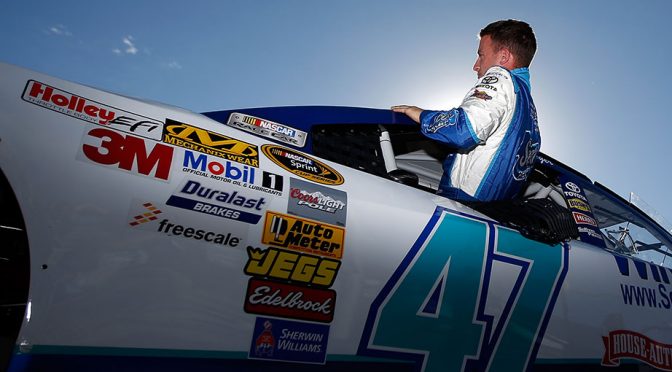
AJ Allmendinger, who drove seven races in the team’s No. 47 Toyota in 2013, will man the car full time next year.

"We certainly appreciate all the support that (Toyota Racing Development) has provided to JTG Daugherty Racing for five years and we are great fans of their business model,” JTG Daugherty Racing co-owner Tad Geschickter said in the release. "As a single-car team, we feel that aligning directly with a successful multicar organization like Richard Childress Racing is what will work best for us in 2014."

JTG Daugherty began as a satellite operation to Michael Waltrip Racing, even competing out of the MWR shop until the team decided to split off into its own entity beginning with the 2012 campaign. After a minor improvement to 23rd in points that first season as a standalone organization, the team slid backward in the standings the past two years.
 
Bobby Labonte was the full-time driver from 2011 through this season. The veteran and former Sprint Cup Series champion had one top-five during that time, a fourth-place run in the 2011 Daytona 500.
 
Earlier in 2013, JTG Daugherty Racing announced a plan to put Allmendinger in the seat of the 47 for five races, a number that swelled to nine after Labonte broke his ribs in a bicycle accident.
 
Allmendinger performed well enough to earn the company’s full-time ride in 2014. The team’s best finish this year was Allmendinger’s 10th-place finish at Watkins Glen.
 
"With our RCR alliance and AJ behind the wheel, we are looking forward to a fresh start in 2014," Geschickter said.

MORE:

READ: Johnson wins
2013 Sprint Cup Series title

READ: HOF-worthy career
in the books, Martin bows out

READ: Finale represents
end of a chapter for some

READ: Kenseth won’t dwell
on coming up short

Popular outdoor retailer to serve as primary sponsor for 11 races

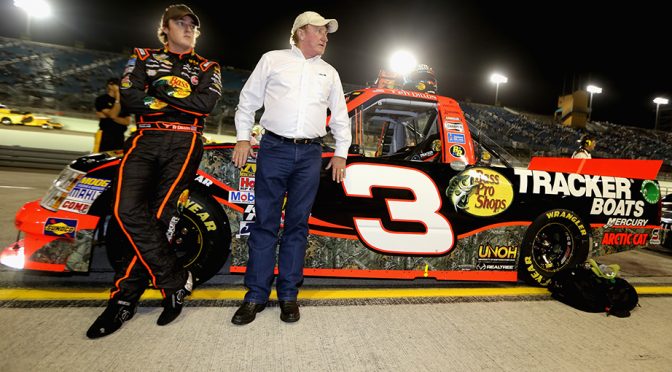
Bass Pro Shops will continue its partnership with Richard Childress Racing in 2014, serving as a primary sponsor on Ty Dillon‘s No. 3 Chevrolet Camaro in the NASCAR Nationwide Series. Bass Pro Shops/Tracker Boats will be a primary sponsor for 11 races on the No. 3 Camaro during Dillon’s first full season in the series, beginning with the DRIVE4COPD 300 season opener at Daytona International Speedway. Yuengling Light Lager was previously announced as a primary sponsor for eight Nationwide races for Dillon.

"All of us here at Bass Pro Shops couldn’t be more pleased to continue our friendship and business relationship with our long-time friend Richard Childress and his family," said Johnny Morris, founder of Bass Pro Shops. "We’re happy to continue our sponsorship with Ty Dillon as he advances to the Nationwide Series next year."

The RCR/Bass Pro Shops partnership began in 1998 as an associate sponsor of RCR’s No. 3 GM Goodwrench Chevrolet Monte Carlo with NASCAR Hall of Fame driver Dale Earnhardt. The relationship continued with Kevin Harvick in the No. 29 Chevrolet and in 2004 with Kerry Earnhardt, Earnhardt’s eldest son, who drove RCR’s No. 33 Bass Pro Shops Chevrolet Monte Carlo in six NASCAR Sprint Cup Series races. Austin Dillon carried on the tradition in 2010 earning two victories and the Camping World Truck Series Rookie of the Year honors, before capturing the championship in just his second season in the series. Bass Pro Shops/Tracker Boats was also a sponsor for Ty Dillon’s ARCA Series presented by Menards championship season in 2011.

"I’m a hunter and a fisherman and share Johnny Morris’ passion for the outdoors, so it’s special to have the support of Bass Pro Shops and Tracker Boats," Ty Dillon said. "It means a lot to me that Johnny and everyone at Bass Pro Shops are going to follow me to the NASCAR Nationwide Series. We’ve accomplished a lot together in the past couple of years. We won some races for them, a championship in the ARCA Racing Series presented by Menards, and the Sunoco Rookie of the Year honors in the NASCAR Camping World Truck Series.

"I hope we can continue that success in the Nationwide Series next year. I love being able to spend time in the outdoors with my family and the Bass Pro relationship allows me to share those stories with their customers and fans."

The Dillon/Bass Pro Shops duo has earned three victories, four pole awards, 16 top-five and 29 top-10 finishes in two seasons in the Camping World Truck Series in RCR equipment.

"Johnny Morris is a great friend and we’re all very proud to be associated with him and Bass Pro Shops," said Childress, president and CEO of Richard Childress Racing. "He’s done so much for both Ty and Austin early on in their careers, and we hope he’ll be with us for years to come now. To have Bass Pro Shops with Ty next year in the Nationwide Series is an honor for all of us. Ty and his brother (Austin) are both talented drivers with bright futures ahead. They are also tremendous ambassadors for the outdoors, hunting and fishing, conservation and the Bass Pro Shops brand — so it’s a perfect fit."

MORE:

READ: Johnson wins
2013 Sprint Cup Series title

READ: HOF-worthy career
in the books, Martin bows out

READ: Finale represents
end of a chapter for some

READ: Kenseth won’t dwell
on coming up short

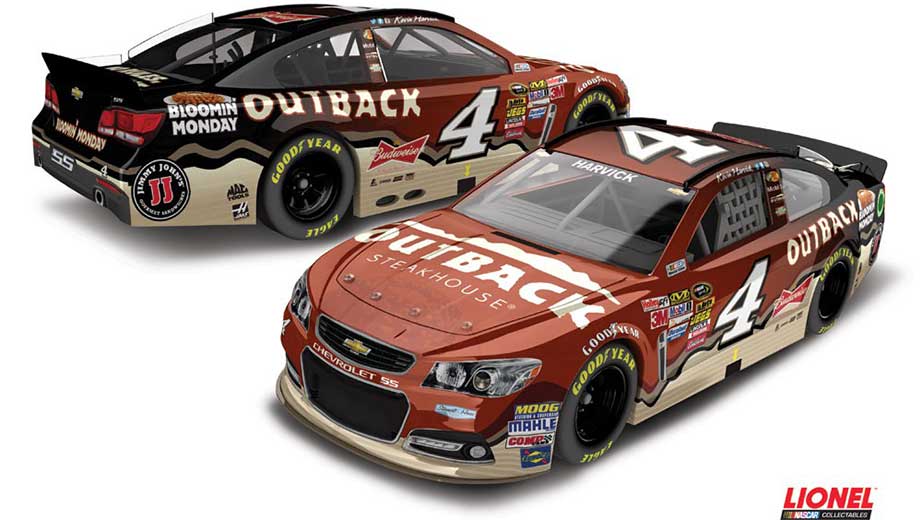
See Harvick’s new paint schemes in the No. 4 car for Stewart-Haas Racing

SHOP: Kevin Harvick diecasts through the years

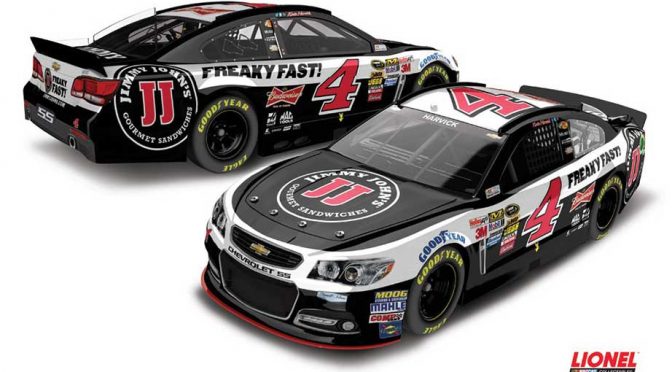
Kevin Harvick shed light on what his new car number would be for the 2014 NASCAR Sprint Cup Series season four months ago. Now, details of what the No. 4 Chevrolet will look like are coming into view.

Three new looks for three primary sponsors have debuted for one of Stewart-Haas Racing’s newest drivers. Budweiser and Jimmy John’s will follow Harvick from Richard Childress Racing to SHR next season, and Outback Steakhouse will stay with the Stewart-Haas team. All three are available in the diecast section of the NASCAR.com Superstore.

SHOP: Kevin Harvick No. 4 Stewart-Haas Racing diecasts

Harvick has driven car No. 29 in all 466 Sprint Cup starts in his 13-year career. Team owner Richard Childress changed the 3 to 29 after Dale Earnhardt’s death in the 2001 Daytona 500, and Harvick drove to victory with the new number three races later at Atlanta Motor Speedway.

Harvick explained the choice of his new number at New Hampshire Motor Speedway in July, when Stewart-Haas introduced him as the replacement for Ryan Newman in the former No. 39 team.

"The number was something that … I don’t want to say didn’t really matter to me, but it’s something that you want to see consistent with the team and the things that they have going on," Harvick said. "That was a number that was available and seemed like it was a pretty common tie to the 14."

SHOP: Kevin Harvick No. 4 Stewart-Haas Racing diecasts

The No. 4 was last used by Kasey Kahne during 2011, the final season of operation for Red Bull Racing. Before Kahne, Ward Burton (in 2007) was the last driver to use the number regularly on the Sprint Cup level.

Three drivers are most commonly linked to success in the No. 4. Sterling Marlin drove the No. 4 Morgan-McClure Motorsports Chevrolet to back-to-back Daytona 500 wins in 1994 and ’95, and Ernie Irvan gave the team its first win in The Great American Race in 1991. Rex White, added this year to the ballot as a NASCAR Hall of Fame nominee, drove the No. 4 to 26 of his 28 career victories at NASCAR’s highest level and primarily used it during his run to the 1960 series title.

MORE:

READ: Johnson wins
2013 Sprint Cup Series title

READ: HOF-worthy career
in the books, Martin bows out

READ: Finale represents
end of a chapter for some

READ: Kenseth won’t dwell
on coming up short

Chevrolet, Ford, Toyota all look forward to 2014 tweaks

Editor’s note: This story is the first of a weekly series about the Gen-6 debut.

Officials with the three automakers entrenched in NASCAR say their companies have been pleased with the move to the Generation-6 car, and none expect major changes to their entries as development of a 2014 rules package continues during the offseason.

The return of manufacturer identity was one of the key elements of the Gen-6 car, which debuted in 2013, with Chevrolet, Ford and Toyota groups given more leeway in addressing the appearance of their respective vehicles.

General Motors teams introduced the new Chevrolet SS for NASCAR Sprint Cup Series competition in 2013 and will continue to field the model next season. Ford teams will once again field the Fusion while Toyota teams continue to compete with the Camry model.

"The biggest thing … that we were able to accomplish was that it really stays true to the look of the production car," Pat Suhy, NASCAR group manager for General Motors, said of the new look for the cars on the track. "Now the focus has shifted from being about the common elements of the car — how do they fit my design — … to ‘OK, we’re testing new packages for 2014; here’s what we think we need to look at.’

"It’s evolved from creating a car to evolving a car."

Part of that evolution involves working with NASCAR to develop a rules package that will provide close, competitive racing. The 2013 package might have been a step in the right direction, but it was just a step.

"I think … we’ve fixed some problems that were inherent in the Gen-5 car, but at the same time some new problems have cropped up," said Andy Graves, vice president of chassis engineering for Toyota Racing Development and Toyota NASCAR program manager. "All the manufacturers and teams are working with NASCAR to try and solve those problems and make it better racing yet. We think there is still some work to do. It’s not a major overhaul, just fine-tuning."

Graves said the response to the look of the Gen-6 car has been "overwhelming."

"We were able to put a ton of character in the cars and get the looks of the vehicles that, if all the cars were painted in gray primer, you could easily spot what cars are the Camrys," he said. "And at the end of the day, that’s the goal. We’re really happy right now in that balance of performance versus character.

"When you look back at photos of all the cars in 2012 versus what we have today, it’s unbelievable the amount of character that we’re able to put in cars and still keep a level playing field amongst the three manufacturers."

From a competitive standpoint, 17 drivers won one or more races this past season. Chevrolet teams won 16 of 36, the Toyota camp won 14 times while Ford teams registered six victories.

Track qualifying records took a beating, with 19 of 32 qualifying sessions (four qualifying sessions were canceled due to weather) resulting in new records.

"Performance wise … we’re not that far off," said Pat DiMarco, Ford Racing NASCAR program manager. "We’re not the top of the heap right now, but I don’t think we’re that far off. With all the due diligence that we as OEMs did with NASCAR … I think there is enough in the engine and in the aero and the underbody and the setups and tires … that any little gain in any one of those areas will put you at the top at this point.

"I think (the Gen-6 car) did what it needed to do as far as the look; I think we have a good process in place with NASCAR."

DiMarco said he expects the 2014 season to be "a game-changer" with the rules package undergoing alterations in an effort to improve competition on the series’ 1.5-mile venues.


"It’s not … going to be a body change that will be different … everybody won’t be focusing on that one thing," he said. "There were a lot of things that did change from 2012 to this year with different camber rules, changes in weight, things like that. What really is the difference between the teams as well as the manufacturers out there? I think all in all we could be better every weekend. And I think every other team out there that doesn’t win would say the same thing."

MORE:

READ: Drivers excited
for Gen-6 evolution

READ: Manufacturers give
Gen-6 debut high marks

WATCH: Gen-6 Top 10:
Nos. 9-10

WATCH: Gen-6 Top 10:
Nos. 7-8

10-race playoff has seen some tweaks and changes in its 10-year history

The Chase for the NASCAR Sprint Cup is now officially 10 years old. Yet a decade later, fans and competitors alike seem divided on its merits.
 
While some still believe that determining a champion based only on a 10-race stretch lessens the accomplishment, it’s worth noting that a driver and team have to be reasonably successful leading up to the Chase to qualify for a shot at the title. The first 26 races of a season are no less important today than they were before the new format was implemented.
 
It’s also notable that in seven of the past 10 years, the eventual champion has been seeded no lower than third once the field has been determined, an indication that the better-performing teams were simply able to continue to run well down the stretch.
 
The Chase format, which debuted in 2004, has undergone several changes through the years. Officials have tweaked the size of the field from 10 to 12 (excluding this year’s 13-team field, which was expanded due to issues arising in the Richmond, Va., event) and adjusted how the qualified teams are seeded (with the addition of bonus points for wins). Even some of the venues have changed, although those moves were not necessarily made with the Chase in mind.
 
NASCAR officials say they are pleased with the format and what it has provided, allowing more drivers the opportunity to compete for the title during the closing 10 weeks of the season. And that has led to more competitors still being in contention heading into the final race.

Six of the 10 drivers in the inaugural 2004 Chase field were in the title hunt before the start of the final race. Other occasions have seen three, four and five drivers still in contention heading into the final stop.
 
That wasn’t always the case before the arrival of the Chase. The championship was already decided six times with at least one race to be run in the 10 years prior to 2004.
 
The Chase has provided the opportunity for memorable moments – from Kurt Busch bouncing back in 2004 to win the title in the final race after losing a wheel, to Tony Stewart‘s and Carl Edwards‘ back-and-forth battle for the title in 2011.
 
"I would tell you that, from NASCAR’s perspective, the Chase has delivered what we had hoped it would do," NASCAR president Mike Helton said Nov. 15 at Homestead-Miami Speedway. It has created "extraordinary moments," he said, adding that "… I think we could sustain an argument that it’s one of the most challenging championships in all of sports."
 
More drivers have had the opportunity to win the championship under the Chase format, although fewer have actually succeeded. Only four drivers have won at least one title since ’04. In the decade preceding the change, seven different drivers wore the crown.
 
However, the fewer Chase title winners are primarily a result of the success of one driver and team: Jimmie Johnson and the No. 48 Hendrick Motorsports organization.
 
Johnson’s accomplishments — six titles in an eight-year span — is reason enough to dislike the format, joked Matt Kenseth, who won the last pre-Chase championship and finished second to Johnson this season.
 
"The one thing that I don’t like is there’s one guy that thinks he has to win every single one of them," Kenseth said, ribbing his fellow competitor. "Doesn’t leave much for the rest of us.
 
Kenseth (Joe Gibbs Racing) has come to terms with the format, saying it does have its merits. A bad race during the regular season won’t erase what a team has been able to otherwise accomplish, he said.
 
"I guess if you’re running well and you feel like you have a solid team, a solid year going … you can have some bad races, have things go wrong, (then) kind of get reset when you get to the Chase."
 
While Johnson has been the most prolific winner in the Chase, it’s unrealistic to try and credit his success to the format. The El Cajon, Calif., native was racing in NASCAR’s Sprint Cup Series full time before the ’04 season, scoring six wins and finishes of fifth and second under the season-long title-determining system.
 
That it is somewhat similar to how other professional sports determine champions isn’t necessarily a bad thing, he said.
 
"I think it’s great to have our sport relevant to others in the fact that we have a playoff system," Johnson said. "I think that’s one key component."
 
Kevin Harvick, the former Richard Childress Racing driver who will be plying his trade for Stewart-Haas Racing in 2014, said he’s comfortable with the format but would like to see a change in Chase scenery.
 
It is, he said, "the same race tracks year after year."
 
"I think it would help our schedule, it would help … build some excitement around some different race tracks," Harvick, third in points this past season, said.
 
Specifically, he said, "I think there needs to be a road course in it.
 
"I think there definitely needs to be some things mixed up in it. I think the format is great, but … the tracks need to change on a yearly basis."
 
A schedule change greeted teams in the inaugural Chase season, with Darlington Raceway‘s Southern 500, a Labor Day weekend staple, moving to November and replacing one of North Carolina Motor Speedway’s (Rockingham) two annual dates.
 
The following year, Texas Motor Speedway added a second date, and it slid into the Darlington slot when the South Carolina track began hosting only one Cup race annually, in May.
 
The schedule was altered twice more: In 2009 when Auto Club Speedway‘s second race was moved into the Chase (swapping dates with Atlanta Motor Speedway); and in ’11 when ACS dropped its Chase spot and Chicagoland Speedway began hosting the opening Chase race.
 
Helton didn’t say changes in the tracks hosting Chase races were likely, but he didn’t discount the possibility either.
 
"When we first started the Chase, we said that we weren’t going to change the schedule to fit the Chase," he said, "but that was 10 years ago.
 
"Things change, and you never know what may or may not happen."
 
The 2014 NASCAR Sprint Cup Series schedule has already been announced, meaning any possible moves, should they occur, wouldn’t take place before the 2015 season.

MORE:

READ: Johnson wins
2013 title

READ: Martin bows out after HOF-worthy career

READ: Finale represents
end of a chapter

READ: Kenseth ready to
move past 2013

Pastrana hopes to one day race in the Daytona 500

His days as a full-time NASCAR driver may be now behind him, but Travis Pastrana loves the sport too much to walk away from it completely. His focus is turning back toward off-road trucks and rally cars, but he would still like to run a Camping World Truck Series race from time to time. He wouldn’t mind starting a K&N Pro Series event every now and then. And one NASCAR race in particular still calls out to him.

The biggest one.

"I’d love to race the Daytona 500 one day," Pastrana said last weekend at Homestead-Miami Speedway, before his final full-time Nationwide Series start. "That’s a huge bucket list thing. I’ve met enough people and gotten decent enough results that hopefully we could get a sponsor and go in."

Hey, leave it to the world’s preeminent motorsports daredevil to dare to dream that big. For now, though, Pastrana is stepping away from NASCAR after a full season in the No. 60 Nationwide Series car of Roush Fenway Racing. Pastrana finished 14th in final points and managed four top-10 finishes, but his highlights were buried by a struggle that too often left his blue, pink, and yellow race car in a crumpled heap.

Pastrana, who announced his decision in a Facebook message Nov. 11, said his results this year simply weren’t good enough to attract the funding he needed to pursue another season.

"It sucks," he said at Homestead. "It was a decision made over a long term. And still, over the last couple of weeks, I was still asking around, and just seeing what can we piece together. It came down to, OK, you’ve basically got to go back two levels and we’ll try to piece together something. And instead of being paid to do your day job, if you will, it was — hey, we’re going to put a lot of money into this and basically take up all of our kid’s college fund. Or, we can try to keep piecing together small stuff, go back to that, and just have fun with NASCAR. And for me, 30 isn’t super old, but I’m not 20. We’ve got to kind of look a little further."

Pastrana harbored no illusions that NASCAR would be easy, and entered the Nationwide Series prepared to face the steepest learning curve of his professional life. And while he very often showed speed, Pastrana struggled mightily with the nuances of racing stock cars on pavement, to the point where he didn’t see the progression over time he had hoped for. At midseason, he sat down with Jack Roush and team competition director Robbie Reiser, who hoped to see Pastrana improve and crash fewer cars as he began to return to tracks a second time.

Aside from a few glimmers, it never happened. "My best races that I should have been top-10 in for sure were the ones where I crashed out," Pastrana said. "If I was running bad, I didn’t tend to push it that hard. If I was running good, I was like — ‘I’m ninth! I want to be running sixth!’

"It’s slaying dragons, as Greg Biffle says in the car. On an average race week, I’ll be full to the lock slide probably three to four times. That’s not good. … I’m just trying to find that limit, and a big problem for me is, I’m used to cars that I’m very comfortable sliding. These cars are not those types of vehicles, and you’re going really, really fast. Even if it’s just a little slide, I’m not worried about it, and all of the sudden it hooks up and goes. I need to be more concerned."

It’s all a stark contrast to the all-wheel rally cars Pastrana was more accustomed to, which weren’t as powerful but were easier to control.

"It’s just a matter of trying to find out how to go fast," he said of those vehicles. "Here, I’m trying to not to crash. Every corner, it’s like a train crash. My mom’s like, ‘You’re that close to crashing?’ I’m like, you have to be. You have to be on the edge. In a rally car, I can get it completely sideways. Maybe that’s because I have more experience in it, but I’m not worried about it. I can get it back under me. Here, if I’m completely sideways, I’m clenched."

And Pastrana was completely sideways too often in a season that featured a number of hard crashes, not all of them his doing, but some which ruined promising runs nonetheless. Looking back, much of what Pastrana learned driving other types of race cars simply didn’t translate as well as he had hoped. And the talent level among regular NASCAR drivers was everything it was built up to be — something reinforced in Pastrana’s mind when Scott Speed, who often struggled in NASCAR, moved to rally cars and won an X Games gold medal this year.

"To get within a half-second is one thing, to get every hundredths of a second after that — these guys are just really specific to what they do," Pastrana said. "Even the road courses, I thought I was going to do really well on, we struggled. These cars are a lot different than what I was used to. And we knew that. It was kind of, jump in the deep end. As long as you’re still making progress, I don’t care if we start out 40th, as long as at the end of the year we’re running 25th. As long as I feel like we’re making progress. And this year, I feel like I understood a lot of the stuff I needed to get better at, and a lot of that stuff was not progressing. I was working on it, I knew what I had to do, but pavement has always, even on motorcycles, kind of driven me crazy."

In everything else Pastrana has ever raced, he’d always been able to find speed. As difficult as he expected NASCAR to be, and as much as he expected to struggle initially, "I never thought I’d not be successful," he admitted. The faster he tried to go, the slower he went.

Pastrana said other drivers like Jimmie Johnson and Matt Crafton tried to warn him that he needed more time, that plunging into a full Nationwide season with just 10 national-level starts to his name would be asking a lot.

"I’ve always jumped in the deep end. I knew that they were all probably right," Pastrana said. If he had to do it all over again, maybe he’d have competed more in ARCA or the K&N Pro Series rather than leap straight into Nationwide, though that approach would have presented hurdles of a different kind.

"The problem was, I couldn’t do that full-time, because I’d have to fund it through my other endeavors," Pastrana said. "I might have raced a few more years of rally and tried to slowly work up to that. It’s just never been my style, though."

No, his style is to go big, just like when he’s hitting the ramp on his motorbike during the X Games. Yet through the entirety of this rough season, there’s still something about NASCAR that appeals to him, that stokes his internal fire like nothing else. He had a conversation about it with Nelson Piquet Jr. as they traveled to Phoenix from a rally race.

"Man, I don’t have the same adrenaline in rally that I do in NASCAR," Piquet told him. And Pastrana feels the same way, which is why even though his full-time career is ending, last week at Homestead might not have been his last NASCAR event.

"I love driving," he said. "I love the sport, I love the people. I love the challenge."

MORE:

READ: Johnson wins
2013 Sprint Cup Series title

READ: HOF-worthy career
in the books, Martin bows out

READ: Finale represents
end of a chapter for some

READ: Kenseth won’t dwell
on coming up short

In her first full Sprint Cup Series season, Patrick finished 27th in the standings

While Jimmie Johnson was lost in confetti and champagne celebrating his sixth NASCAR Sprint Cup Series championship last weekend at Homestead-Miami Speedway, Danica Patrick was happily marking a much more low-key and personal milestone nearby – ripping off the yellow tape on her No. 10 GoDaddy Chevrolet bumper.


The bright yellow tape is a traditional branding for rookie drivers – and after a debut season of well-documented, highly-scrutinized, headline-making ups and downs, when the checkered flag flew at Homestead, Patrick, 31, was at last just another driver.


As much as she can ever be, that is.


And even if ripping off the yellow tape is symbolic, the former IndyCar star now considers her transition to stock cars official. What that means is still to be determined.


Will she be a top-10 car every week now? Will other drivers still cut her some slack? Is she on the verge of victory in 2014 or will her success be a less exact standard?


"After the first year is done, you’re on a more level playing field," Patrick concedes. "But honestly from an outsider’s perspective, I feel like three years in is where you kind of go, ‘all right, you’re seasoned. If we give you a good car you should be fast in this car.’

"If I were to look at any rookie. Obviously there are circumstances like your car, your team and your crew chief. That has big effect. But as far a driver, it’s fair after about three years."

With her 20th place finish at Homestead, Patrick finished 27th in the championship points standings. Her lone top-10 finish was an eighth-place run in the Daytona 500 – a stunning, pressure be-damned historic performance after becoming the first woman to win the pole position for NASCAR’s greatest race.


To simply look at the statistics may not be a fair representation of her effort.

And while most people might think the Daytona 500 was the highlight of her year, Patrick considers her 12th place finish at the notoriously tough Martinsville, Va. half-miler this spring to be the biggest accomplishment of the season since she came back from being two laps down to gain that result and actually paced the entire Stewart-Haas Racing team that day.


In the end, Patrick finished second in the Sunoco Rookie of the Year standings to former two-time NASCAR Nationwide Series champion Ricky Stenhouse Jr., who is her boyfriend of nearly a year. And as is the joke in NASCAR circles, she’ll go to the annual Sprint Cup Awards banquet anyway — as Stenhouse’s date.


Her second full season, however, will mean different expectations.

SHR’s Vice President of Competition, Greg Zipadelli, doesn’t hesitate when asked the ultimate question. Can Patrick win at the Cup level?


"Yes," Zipadelli said. "Yes, she will."

Having been in this sport for decades and led their team owner Tony Stewart through his own transition from open-wheel cars to a Cup championship, Zipadelli is realistic and measured in his approach. And he won’t get mired in predicting when or where Patrick will first visit victory lane.


"You’ve got to be able to make speed and learn to go fast then you have to learn how to close the deal and take the next step," Zipadelli said. "And it seems like they’re working on that and as a group working better together, have a better understanding of each other compared to early in the year when just trying to figure it out and thinking it was magic.


"The magic is patience. Patience in making sure we give her what she needs and allowing her to grow. There’s a lot of guys in this garage that it took a few years to get going."


Stewart, who suffered a season-ending broken leg injury in a sprint car race this summer, has had the unexpected, silver-lined opportunity to really observe Patrick both when he was racing alongside her and now on television or from the pit box.

His similar background gives him a unique perspective and he also is adamant that she will win in Sprint Cup competition.

"I wouldn’t have hired her if I didn’t believe that," Stewart has answered unflinchingly whenever the question comes up.


While fans may simply gauge Patrick’s success by her race results, Stewart is looking at incremental progress from week to week.
 He points to the fall race at Charlotte as a perfect example of the subtle, not necessarily quantifiable progress he sees.


"The damage was done once she got one lap down, then the second lap down," Stewart said. "But after that she ran with the leaders – when second, third and fourth place came around her she was running right with them.

"It’s like ‘you’ve got to let them go,’ but at the same time, she was faster than them for a lap. It’s fun to watch her racing with the guys that were second, third and fourth place in the race and she was right in the middle of it there for a while, even though she was two laps down.


"If we can ever get her through the first couple of stints of the race, she can run with speed, it’s just getting it at the beginning of the race."


Patrick appreciates the encouragement, support and insight Stewart has given her and has never been afraid to seek out advice from other drivers.

Far from being insular, Patrick is down-to-earth and very self-aware. For every family that waits two hours in an autograph line so their 10-year old Danica look-a-like can pose for a photo with Patrick, there is someone willing to criticize her every move and motive. And she knows it.


Asked if she still feels like a polarizing figure, Patrick didn’t hesitate.

"That exists," Patrick said very matter-of-factly, before smiling. "I still read about it on Twitter. I try not to read too much. Things like, ‘when are you going to come out and admit you can’t drive these cars.’


"But it’s fine. Whatever. It exists before and exists now, hopefully now it’s just a bigger base. .. more fans and more haters."


Perhaps hardest to figure out, was an unexpected source of midseason controversy: former Cup driver-turned television analyst Kyle Petty, who took equally large swipes at Patrick’s ability and credibility.

He questioned whether her success is judged on marketing appeal instead of racing results and, has steadfastly stood by his remarks even as he received pushback and criticism over them.

"Danica has been the perfect example of somebody who can qualify better than what she runs, she can go fast, but she can’t race," Petty said in June. "I think she’s come a long way, but she’s still not a race car driver. And I don’t think she’s ever going to be a race car driver. Because I think it’s too late to learn."

Having time and a broader perspective now to reflect on the situation, Patrick is philosophic and not bitter or defensive. Contrary to what you might think, she choses to view it as mostly a positive experience.

"He was so polarizing with his comments, they were so one-sided, it forced the other side to come out," Patrick explained. "His opinion was the one out there so it forced other fans or journalists to show the other side as a contrast.


"A lot of good stuff came from that, a lot of people came to defend me so there was some positive."


A few weeks ago, dressed casually in a blouse and shorts, Patrick sat in her motor coach at Talladega Superspeedway trying to make a dent in what must seem like an infinite stack of memorabilia, photos, and hero cards awaiting her autograph. That evening, Patrick had some time to kill while waiting for Stenhouse Jr. so the couple could have dinner.


Relaxed and candid as ever, Patrick thoughtfully reflected on her season while looking forward to the next. And she readily concedes it’s been an interesting year both on and off track. After revealing that she and Stenhouse were a couple before the season, the hub-bub surrounding racing’s highest profile driver romance has subsided. They were besieged by reporters during the Daytona 500 Media Day and questioned about everything from how they expected to race another on-track to the kind of Valentine Day gifts they would exchange.


Other than sitting next to one another in drivers meetings and sneaking the occasional kiss on pit road, Patrick hopes it now falls into the "keep moving, nothing to see here folks" kind of normalcy.


"I feel like we’re very honest and comfortable about it all and so it makes everybody else very comfortable it all," Patrick said. "You ask a question, we’ll give you an answer, I’m not trying to hide anything. And we’re very comfortable in front of people.


"It’s kind of crazy, but sorry to let everyone down, it’s just kind of normal."


They park their motor coaches facing one another at most tracks. She stays in his allowing family and friends to stay in hers instead of getting a hotel.

"It’s like having four bedrooms so you can pack a lot of people in," Patrick says motioning around her comfy mobile living room. "Everyone hangs out, no one has to go hotels or drive and we can just hang out.


"Plenty of big dinners get cooked and big breakfasts too which are a lot of fun. Just cook up a big mess of bacon, and then toast eggs too and I get a huge bowl of fruit and some yogurt and granola and put it all out on the table. Sometimes we’ve had as many as 12 people there. It’s kind of like a party compound. It’s great when we open the awnings up and make it more communal."


Her relationship with Stenhouse has been easy contentment. At the track, Patrick said he is a big source of moral support not to mention a racing resource.

The Mississippi native has introduced her to the rodeo and convinced the wine connoisseur that beer is all right too. He’s also gotten her hooked on golfing, a sport she figures she attempted maybe one time in her life previously.


"We’ve sure played on some nice courses," Patrick said. "That’s really all Ricky, I don’t deserve to play on some of those courses yet."

"But," she laughed. "I’ve finally gotten comfortable enough to play with other people."


Of course Patrick knows that with golf — as she has learned with racing — experience and tempered expectation are necessities. She has a big asset in that corner, her veteran crew chief Tony Gibson.


"The one thing I’ve learned here especially late in the season is her desire to run good and be fast and be competitive has gotten stronger not weaker," Gibson said. 

"She hasn’t gotten dejected or said, ‘I can’t do this.’ She keeps pushing forward. ‘Let’s make it happen.’ She has that kind of attitude, not the ‘I’m never going to get it.’"

One thing we know about Patrick, she sure knows how to make an entrance and has a knack for stepping up when the spotlight shines brightest on the biggest races on the planet – the Daytona 500 and Indy 500. Now it’s about sustaining the highs and implementing the lessons through a whole season.

After winning the Daytona 500 pole position, leading the race and putting herself in position to win as the final laps clicked off, Patrick joked that she couldn’t have written a better start to her first full season.

Then she grinned and corrected herself.

"Except the way you end is, I won."

MORE:
READ: Johnson wins
2013 Sprint Cup Series title

READ: HOF-worthy career
in the books, Martin bows out

READ: Finale represents
end of a chapter for some

READ: Kenseth won’t dwell
on coming up short

From Chicagoland to Homestead, lasting impressions abound

It came to an end in familiar fashion, with the most dominant driver of his era standing on a stage in South Florida, receiving a giant silver trophy as confetti and fireworks were shot into the air. But Jimmie Johnson‘s road to his sixth championship was hardly as straightforward as the oval at Homestead-Miami Speedway. This Chase for the NASCAR Sprint Cup had all the twists and turns of a road course.

There were contenders who rose and fell, others who fell and rose, whole races and individual moments that played large roles in determining who would eventually wear the crown. Through it all, the focus returned again and again to two men — Johnson and Matt Kenseth — who would ultimately wage an individual duel, owning the top two positions in the standings for the final eight weeks of the playoff.

Others tried to insert themselves into the mix, but Kyle Busch, Jeff Gordon and Kevin Harvick couldn’t sustain momentum, and Dale Earnhardt Jr. never recovered from an early stumble. If any one of several circumstances had broken differently — a tire that didn’t cut down, an engine that didn’t fail, a setup that didn’t go awry — the entire face of the Chase may have changed, and someone other than Johnson may have been standing on that stage in the subtropical night.

But they didn’t, and he was. No question Johnson earned it, using strong performances at Texas and Phoenix to set the stage for title No. 6, and then securing it on a relatively smooth night outside Miami. But no question others had their opportunities, combining with the eventual champion to create the top 10 moments in this year’s Chase.

10. Stated like a champ

Brad Keselowski‘s season was rife with issues, from penalties incurred due to technical violations, mechanical failures and a summertime skid that left him outside the Chase and unable to defend his 2012 championship. The Oct. 12 race at Charlotte seemed more of the same after he dragged a jack out of his pit box following an early stop. But the Penske Racing driver rallied, passing Kasey Kahne with nine laps remaining to snap a 37-race winless skid and crash the championship race for his lone victory of the season. There was no oversized beer glass this time, but the celebration was still a robust one. "We’ve had what we need to be a championship team. We just haven’t put them all together," Keselowski said. For one night, they did.

9. ‘Ol Texas back-step

Jeff Gordon wasn’t even supposed to be in the Chase after missing by a single point the final spot awarded on standings. But NASCAR gave him new life by placing him in the playoff as a 13th driver in the wake of a race manipulation scandal that rocked the regular-season finale, and the four-time champion took advantage by winning at Martinsville to emerge as an outside title threat. But that opportunity was effectively ended one week later, when Gordon cut a left-front tire and crashed hard Nov. 3 at Texas, damaging much more than just his No. 24 car. "It’s devastating," Gordon said. In a Chase that left little room for error, Gordon plummeted to sixth in the standings, and his quest for a fifth title would have to wait another year.

8. Kansas strikes again

It may be difficult to remember now, but this season saw Kyle Busch get off to the best Chase start of his career. He was runner-up to Kenseth in the first two playoff races, and was third in the standings three weeks in. Then came the Oct. 6 race at Kansas, a track which is definitely no place like home for the younger Busch brother. His long list of career mishaps at the 1.5-mile facility was extended by a series of on-track incidents, the last one being contact with Carl Edwards and Brian Vickers that left the No. 18 car dangling from a wrecker. It was the third straight Kansas race where Busch had wrecked, and this one was perhaps the most costly — he left Kansas City fifth in points, his strong start suddenly but a memory. "We’re in Kansas, right?" he asked. "Just run over the 18 car and get what you need."

7. The longest day

It was supposed to be a day race, but Mother Nature had other ideas. Persistent rain pushed the Sept. 15 Chase opener at Chicagoland deep into the evening, extending a long week dominated by the race manipulation scandal that knocked Martin Truex Jr. out of the playoff in favor of Ryan Newman, and then saw Jeff Gordon added as a 13th driver. But in the end, normalcy returned in the form of steady Matt Kenseth, whose prowess on intermediate tracks shined through even on a soggy day into night. The No. 1 Chase seed got a push from Kevin Harvick and passed Kyle Busch on a restart with 23 laps remaining, rolling into Victory Lane in the wee hours of Monday morning. After a week of uncertainty and upheaval, the focus was finally back on the competition.

6. Junior goes boom

In that very same Chicagoland race, something occurred that at the time seemed relatively unremarkable — Dale Earnhardt Jr. blew an engine. He had entered the Chase ninth in the standings, and after a strong start to the playoff opener had fallen back in part due to front-end damage suffered in a pit-road collision with Kasey Kahne. But on Lap 277, smoke began emanating from the No. 88 car, and the ensuing 35th-place finish knocked NASCAR’s most popular driver back to 13th in points. "It’s tough," Earnhardt said. "It’s going to be really hard to win a championship this far behind." His words would prove prophetic, given that Earnhardt went on a tear in the final nine races, recording an average finish of 5.6 over that span and finishing fifth in final points. If not for the blown engine at Chicago? Who knows.

5. Two for two

It was one thing to see Matt Kenseth win at Chicagoland, given that he was the class of the season to that point on intermediate tracks. But flat, technical, one-mile New Hampshire? A place where Kenseth had never won, and hadn’t cracked the top five in eight years? Continuing a theme that saw the first-year Joe Gibbs Racing driver excel even at venues that had once been a weakness, the Chase leader led the final 53 laps and became the third driver to sweep the opening two playoff races (Greg Biffle did it in 2008, Tony Stewart in 2011). If there was a high mark of Kenseth’s season, Sept. 22 in Loudon — in his 500th career start, no less — was it. "More than a stretch, more than a dream," he said of the victory, which would prove his career high seventh and final race triumph of the year.

4. Masters of Martinsville

It was supposed to be the weekend when Jimmie Johnson silenced all doubts. He had taken a four-point lead over Matt Kenseth the previous week at Talladega, where neither contender could make much headway in the draft at the end. But Oct. 27 at Martinsville, a track where Johnson had won eight times, shaped up as something else altogether. But a funny thing happened — Kenseth, who had never enjoyed much success on the flat 0.526-mile track, outscored Johnson on arguably the latter’s best track, finishing second while his rival for the championship came home fifth. After another pivotal day in south Virginia, Kenseth and Johnson were tied atop the standings. And in another twist, the Hendrick Motorsports driver who made the loudest statement was Jeff Gordon, whose victory moved him up to third.

3. The hat fits

For the first seven weeks of the Chase, it seemed to be Matt Kenseth who had the momentum. The tide turned Nov. 3 at Texas, where Jimmie Johnson gave everyone a glimpse of the way things used to be — and what was still to come. It looked like the heyday of the old, untouchable Jimmie, a dominating effort where the No. 48 car led 255 laps and its driver wrested control of the playoffs. Kenseth finished a respectable fourth, but his cars were suddenly a work in progress, and Johnson suddenly led the standings by seven points. Standing in Victory Lane with his new black cowboy hat, he looked big and bad indeed.

2. Hello, Six-Time

By the time the circuit reached Homestead and the season finale Nov. 17, Matt Kenseth was in dire straits. An uncharacteristically poor effort the previous weekend had sunk him to 28 points behind Jimmie Johnson, and barely ahead of third-place Kevin Harvick. Amid those swaying palm trees, Kenseth did about all he could do — won the Coors Light Pole, led the most laps and battled eventual winner Denny Hamlin for the victory before finishing second. But it wasn’t enough. After a scrape on a restart, Johnson put it on cruise control and easily wrapped up his sixth title at NASCAR’s top level. He needed to finish only 23rd — and came home ninth, clinching the crown by 19 points. "You’re the best out there, buddy," crew chief Chad Knaus told him over the radio. No one was inclined to disagree.

1. Drama in the desert

The real dramatics that had shaped the Chase endgame had come seven days earlier, in a Nov. 10 race at Phoenix that blew the playoff open. Still riding high after his Texas victory, Jimmie Johnson entered seven points ahead of Matt Kenseth, who lagged behind the championship leader throughout qualifying and practice. Once the race began, it was clear why — Kenseth had a car that was a beast to drive, didn’t respond well to changes and at one point had him two laps down. Johnson battled his issues as well, most notably a run-in with Carl Edwards that nearly sent the No. 48 car into the wall, and still cost it track position as its driver struggled to keep it pointed forward.

Kenseth, though, was in no position to take advantage. The most consistent team of the 2013 season whiffed on the setup at the worst possible time, on an afternoon where Johnson rallied to finish third and Kevin Harvick won to give himself a mathematical chance in the finale. What had been among the tightest title races ever was suddenly a 28-point lead in Johnson’s favor. "We haven’t had a day like this all year," Kenseth lamented after finishing 23rd. His run almost overshadowed a gutty effort from Johnson, who would own the spotlight the following week. "We’re heading into Homestead in the position we want to be in," he said then. Seven days later, he held a sixth silver trophy in his hands.

MORE:

READ: Johnson wins
2013 Sprint Cup Series title

READ: HOF-worthy career
in the books, Martin bows out

READ: Finale represents
end of a chapter for some

READ: Kenseth won’t dwell
on coming up short

Veteran comes on board as crew chief, competition director

For Steve Addington, the move to Phoenix Racing is like shifting over to a different branch of the same family tree.

The veteran crew chief will still work with chassis and engines built by Hendrick Motorsports, the same organization that provided equipment to the Stewart-Haas Racing team where he worked the previous two seasons. And Addington knows that whenever his No. 51 car tests, that information is likely to make its way through the Hendrick pipeline back to his old mates at SHR.

"For us to be successful is to work things under the Hendrick mentality of, the more information you have, the better off you’ll be," Addington said Thursday, when he was named Phoenix Racing competition director and crew chief of the team’s No. 51 car. "There are going to be times where (Phoenix and SHR) probably are leaning on each other, and that’s something I’m fine with."

It would be understandable if he felt differently, given that Addington on Tuesday was replaced as crew chief of Tony Stewart‘s No. 14 car by Chad Johnston, who most recently oversaw Martin Truex Jr.’s No. 56 at Michael Waltrip Racing. Addington and Stewart won four races together, the last coming this past spring in Dover before the three-time NASCAR champion suffered a broken leg in a sprint car accident that sidelined him for the final 15 events of the year.

"I’m kind of scratching my head, and I told Stewart the same thing," Addington said. "He knows that, and he knows I’m a little frustrated on that end of it. If they make a decision to make a change, if they feel like that’s what they need to do, I’ve just got to move on. I don’t want to dwell on that. I know everybody wants a lot of answers, and there are some answers where I would still like to have the full story, but it is what it is. I’ve got friends there who will remain friends, and that’s just part of this business. When you win (12) races in 18 months or whatever it was with the 18 (car) and lose your job, nothing ever surprises you anymore."

That’s a reference to the end of Addington’s stint at Joe Gibbs Racing, where he and Kyle Busch won 12 races together over a two-year span that included the eight-victory campaign of 2008. This past season, he worked primarily with Mark Martin after Stewart suffered his injury, but nothing seemed to click. It’s easy to wonder what might have been, given that Stewart had reeled off seven top-10s in 10 weeks, and at 11th in points had moved into Chase for the NASCAR Sprint Cup contention at the time of his injury.

"It is, and that’s the frustrating part," Addington said. "I think, in the back of my mind — where we were sitting in points, the Charlotte race, the runs that we had, the win at Dover … there’s like a gap there you wish you could fill in. But I felt like we were on the right track. I felt like we were in great position to make the Chase. We were running well enough to make the Chase. It makes you scratch your head a little bit. It is what it is. To me, things happen for a reason, and this brought me and Harry together to build something, and that’s exciting to me."

That would be Harry Scott Jr., who in August completed the purchase of Spartanburg, S.C.-based Phoenix from longtime former owner James Finch, and then began the process of remaking an organization that’s won just once at the Sprint Cup level — with Brad Keselowski at Talladega in 2009. Addington has 20 career Sprint Cup victories, and now with the additional role of competition director will be able to shape the organization as well as the team he brings to the track each weekend.

Addington sees some parallels between Phoenix and Furniture Row Racing, another single-car entity located outside of Charlotte, N.C. — in this case, Denver — but has an alliance with a more established organization and this past season made the Chase for the first time. Addington is familiar with Hendrick personnel and equipment from his time at SHR, something he believes can strengthen the relationship between the two entities.

"I’ve had a lot of conversations with Harry, and met with him a lot at the race track at night and things like that, and asking questions of his goals and everything," Addington said. "Both of us want to look at this in two or three years and be able to sit back and look at what we’ve built. He’s in it to be successful, aligning himself with Hendrick Motorsports, and Rick (Hendrick) is excited I’m coming here to be able to feed this race team like it should be. … They want to see Harry succeed at the Cup level, and we’ve got a lot of great things going working hand-in-hand with Hendrick Motorsports, and potentially with Stewart-Haas."

Although Phoenix has not yet named a driver for next year, Addington said the team is in talks with Justin Allgaier, one of 12 different drivers the organization used this past season. For the past three years Allgaier has driven in the NASCAR Nationwide Series for Turner Scott Motorsports, a team that fields entries on the Nationwide and NASCAR Camping World Truck circuits which Scott co-owns with partner Steve Turner.

"In the back of our minds, we all hope that everything works out and we’ll bring Justin into the fold, but that stuff can change at any time," Addington said. "They’re working on that end of. If it is Justin, I’m excited about that, to try and help him further his career at this level and help him be successful. We’ve had conversations, and there are concerns in Justin’s mind about the direction, and I’ve tried to give him all the confidence that if he comes here, we’re going to work out butts off to make sure he has good race cars at the race track week in and week out to be successful. Whoever gets in the car, we’re going to give them 100 percent effort, and I think Harry is working hard to give us the resources to do that."

Although Addington will continue to live in the Charlotte area, the move to Phoenix is something of a homecoming for the native of Boiling Springs, S.C. His first job at NASCAR’s national level was working for Jason Keller’s family-owned Nationwide team in nearby Greenville, S.C., and Addington says his mother lives about five minutes from the Phoenix shop in Spartanburg.

And the daily commute shouldn’t be too much of a problem for the team’s new crew chief, who is well familiar with the area. "I know all the back roads," Addington said with a laugh.

MORE:

READ: Johnson wins
2013 Sprint Cup Series title

READ: HOF-worthy career
in the books, Martin bows out

READ: Finale represents
end of a chapter for some

READ: Kenseth won’t dwell
on coming up short