NASCAR Chairman and CEO marks 10th anniversary at Northwestern’s renowned school of management

EVANSTON, Ill. — Some people celebrate anniversaries with parties, but Brian France celebrated his 10th anniversary as NASCAR’s Chairman and CEO by doing what he does best, talking business.

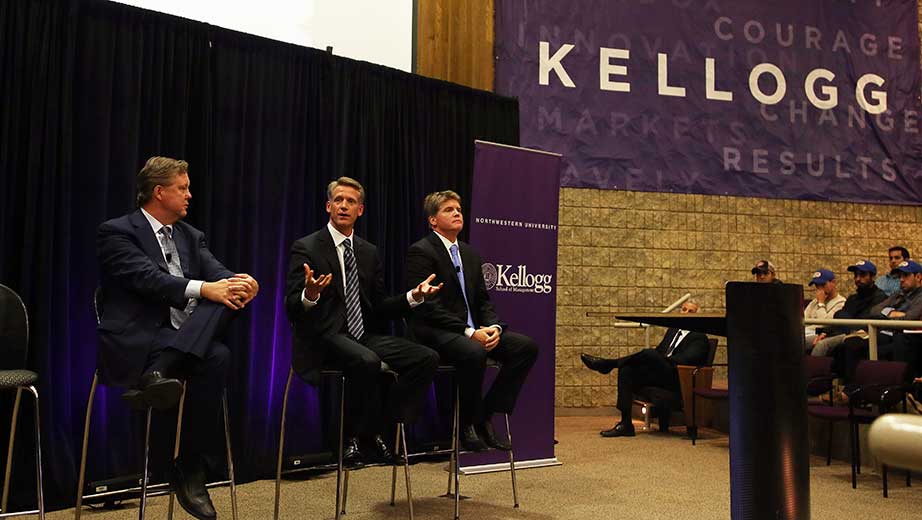
But what made Friday’s anniversary unique is France talked business with nearly 600 of the world’s brightest minds and future business and corporate leaders at Northwestern University’s renowned Kellogg School of Management.

For the first time in his decade-long tenure, France spoke at length publicly and candidly about some of the initiatives that not only have seen NASCAR grow under his leadership, but also how the sanctioning body has managed to weather some rough storms, most notably the economic downturn with which the sport is still dealing.
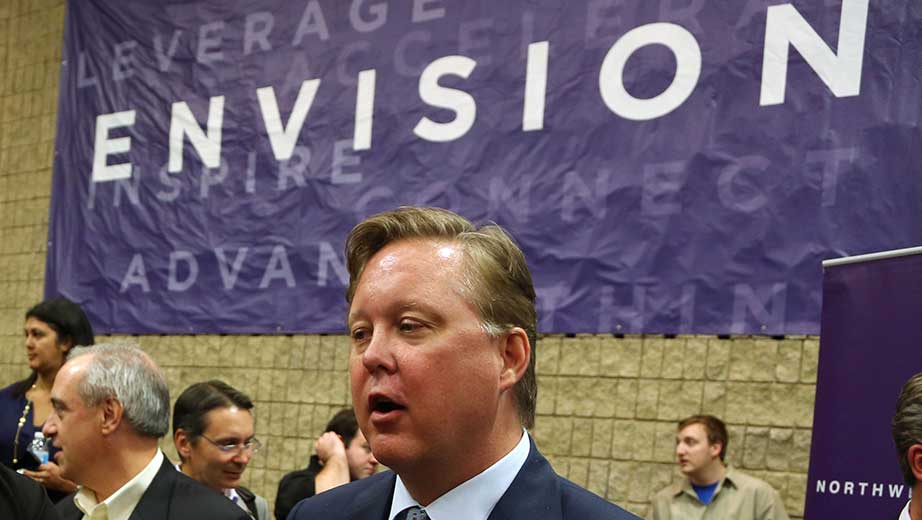
(Tasos Katopodis/Getty Images for NASCAR)

"Every part of our business where we thought we were not relevant or not going in the right direction, we worked very hard and did this when … there was tremendous uncertainty, but we needed to do it," France said. "We’re now much better off than we ever have been and it takes a real assertive plan to pull it off."

Northwestern’s business school is traditionally ranked among the top five in the U.S. for much of the same elements that France embodies, namely passion and vision. Plus, its geographic proximity to Sunday’s opening event of the 10-race NASCAR Chase for the Sprint Cup in Joliet, Ill., about 60 miles away, made for a natural tie-in, France said.

France downplayed the plaudits for which he’s credited, choosing instead to focus in on how NASCAR as an organization –and its hundreds of employees — have come together to form a stronger and tighter operational platform.

By doing so, and competing in an extremely competitive professional sports marketplace in the U.S., NASCAR has managed to reduce much of the damage that potentially could have been done by the global recession.

"In our case, clearly the economy disproportionately hurt our sport more than it did any other sport," France said. "I think a lot of people just said it’s the economy. We just didn’t buy that. It’s a big issue and remains a big issue. But the good news was since things were difficult, people were looking for something to believe in in our industry. … We used all that instability to be decisive, and that’s most important."
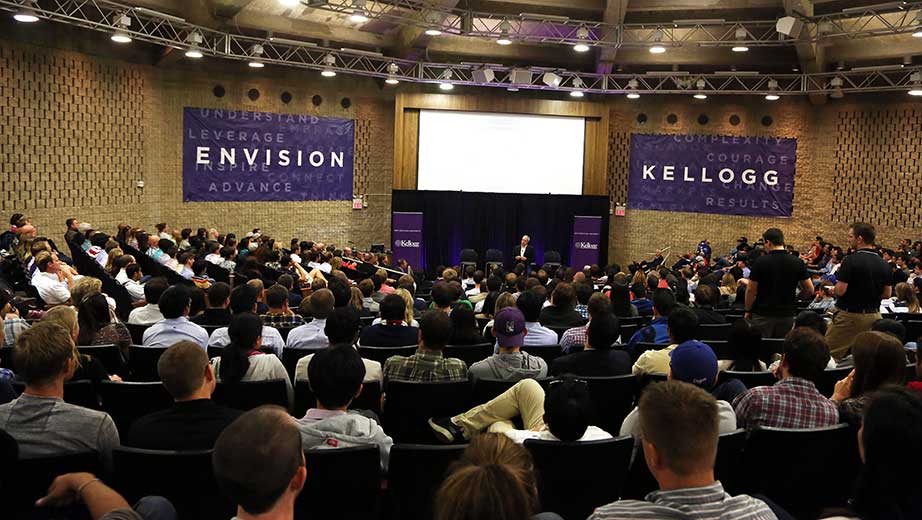
(Tasos Katopodis/Getty Images for NASCAR)

Among innovations that NASCAR has undergone during France’s leadership are:

— Started NASCAR Green, the largest environmental platform in sports, which is centered around renewable energy, recycling programs and tree planting. "We’re a (for) profit organization and we have to resource things," France said. "We had to create an intellectual property around green space and convince people that we’re about technologies, new fuels, new energy sources, that we could be an unbelievable partner in recycling … and we’ve done that."

— With the burgeoning interest in the sport, as well as exploding consumption of platforms such as Facebook, Twitter, Instagram and Pinterest, recognized the need to bring all digital and social media initiatives in-house to increase engagement with fans. In so doing, NASCAR bought back all digital and social media rights to its top platform, NASCAR.com, from the former licensee two years early to serve as the linchpin for the sanctioning body’s unprecedented growth in outreach to its fans.

— Implementation of two cycles of state-of-the-art race cars, with the revolutionary Car of Tomorrow in 2007 and the innovative "Gen-6" car that debuted this season.

— Recently announced 10-year agreements with both NewsCorp and NBCUniversal worth $8.2 billion in broadcast rights fees, as reported by multiple media outlets.

— A complete overhaul of the sanctioning body’s marketing and communication divisions, opening up unprecedented access and engagement with the media and fans.

— A far-reaching diversity program to improve opportunities for minorities and females to advance in the sport as drivers, crew chiefs, officials and in business operations of teams, as well as the sanctioning body. "It was a challenge," he said. "We didn’t like what we saw and we’re going to figure out how to change that for obvious reasons."

— NASCAR counts nearly 25 percent of Fortune 500 companies as sponsors and partners, the greatest number of any professional sports league.

— Implemented the largest scale research, consumer studies and fan feedback programs that the sport has ever had in efforts to learn what things needed to be changed.
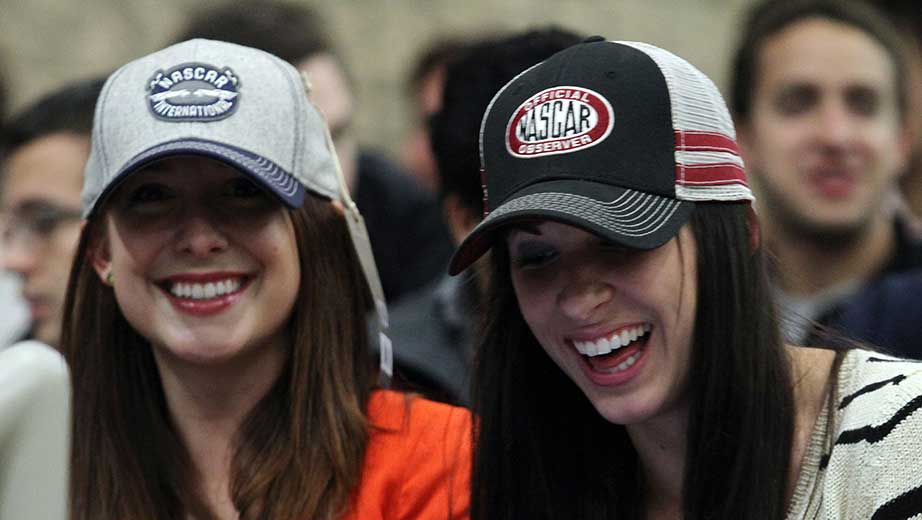
(Tasos Katopodis/Getty Images for NASCAR)

Even before Brian France succeeded his father, Bill France Jr., as NASCAR Chairman and CEO in 2003, he played a pivotal part in moving the sport forward, particularly in the area of safety.

When NASCAR’s biggest star, Dale Earnhardt, was killed in the season-opening Daytona 500 in 2001, the younger France oversaw NASCAR’s development of the most far-reaching safety enhancement program in the sport’s history.

Included in that were mandating head-and-neck restraint devices for drivers, SAFER barriers (so-called "soft walls" that both absorbed significant more amounts of impact, as well as helped protect drivers), data collection recorders in race cars (which gather information to help further enhance the safety of vehicles), different positioning of drivers behind the wheel to maximize protection and more.

When Brian France formally took over for his father, he set in motion a series of changes to both modernize and enhance much of the sport’s policies and procedures. Those included the innovative Chase for the NASCAR Sprint Cup playoff system and the afore-mentioned Car of Tomorrow/Generation 6 style vehicles.

France also pointed to the sanctioning body’s efforts to increase its reach in Canada and, in particular, Mexico. To the latter, France said viewership of NASCAR races among Hispanics tuning into English-language telecasts is up 30 percent this season through the first 25 races.
(Tasos Katopodis/Getty Images for NASCAR)

Steve Phelps, NASCAR’s Chief Marketing Officer, spoke of the significance of the sanctioning body’s Industry Action Plan drawn up during France’s tenure, a long-range plan that not only sets the direction for the sanctioning body, but which is designed to also make changes on the fly when necessary.

"Not surprisingly, it focused on our next-generation fans, focuses on digital and social (media), our drivers’ star power, our fan engagement and that fan experience on race day, and is our product on the race track, the format, is it going to be engaging for the existing fans as we move to the future and will it excite and engage the new fan," Phelps said. "We spent a lot of time working on it."

To accomplish that basically called for rewriting much of NASCAR’s marketing playbook.

"We had to do a better job of marketing ourselves," Phelps said. "This was an industry that was thirsty for us to lead and for Brian’s leadership to say, ‘Yes, we’re going to go in a different direction.’ … If we want this sport to grow, we have to make it grow."

Speaking of growth, France and NASCAR are not sitting on their laurels.

"In the last four, five years under Brian’s leadership and the amount of change we’re engaging, Brian has not let up on the throttle and we’re feeling it," NASCAR Vice President of Strategic Development Eric Nyquist said. "It’s exhilarating but at times a little bit terrifying because we have this large-scale commitment.

"But we also know that if we don’t make meaningful change, we’re not going to get to the next places we need to be."

MORE:

READ: Driver previews:
The Chase

READ: Fantasy preview:
The Chase

READ: Race breakdowns:
The Chase

READ: Top 10 Chase moments

Following week-long review of race at Richmond International Raceway

NASCAR has announced a set of officiating revisions to further reinforce its in-race rules and regulations following a week-long review of events that transpired during last Saturday’s NASCAR Sprint Cup Series race at Richmond International Raceway.

NASCAR officials met with drivers, owners and crew chiefs this afternoon at Chicagoland Speedway to address these revisions that will take effect beginning with Sunday’s opening race of the Chase for the NASCAR Sprint Cup. The revisions focus on assisting the competitors to understand what is acceptable and what is not acceptable in NASCAR’s sole determination when it comes to officiating teams’ racing during an event. NASCAR will issue a technical bulletin to the teams later this afternoon that outlines these revisions.

“Today’s technical bulletin addresses the subject of team(s) artificially altering the outcome of a race and the level of reaction that this will receive from NASCAR,” said Robin Pemberton, NASCAR Vice President of Competition. “We reinforced this issue to the teams in our meeting earlier today and conveyed what is considered unacceptable in our officiating of the event.”

Initial officiating revisions that were announced and will take effect Sunday are:

·Spotters only on spotters’ stand (one per team)

·Spotters’ stand limits: Two analog radios, scanners, Fan Views

·Video camera will be installed on spotters’ stand

MORE:

READ: Driver previews:
The Chase

READ: Fantasy preview:
The Chase

READ: Race breakdowns:
The Chase

READ: Top 10 Chase moments

As the season dwindles, Hornish and Dillon seem to be each other’s biggest competitor

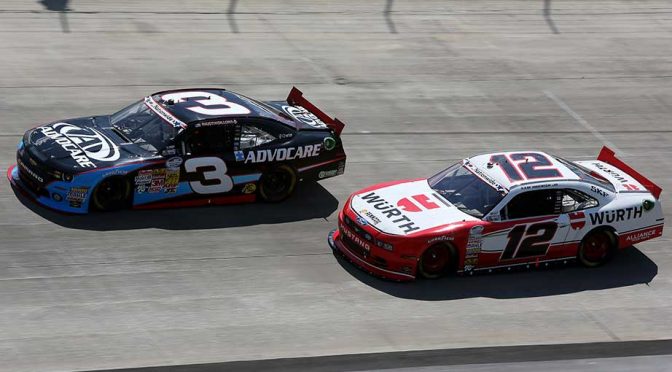
JOLIET, Ill. — Following Saturday’s race at Chicagoland Speedway, Austin Dillon pulled onto pit road and parked his car right behind the vehicle of Sam Hornish Jr. The championship in the Nationwide Series may be coming down to the exact same arrangement.

Top-five runs by Hornish and Dillon, combined with more misfortune on the part of other title hopefuls, continued to distill the season-long Nationwide championship hunt down to a two-man race between a former Indianapolis 500 champion and the driver in the cowboy hat.

Although Kyle Busch dominated Saturday — he led 195 of 200 laps, most ever for the series on 1.5-mile track, breaking the record of 194 set by Dale Earnhardt at Charlotte in 1986 — Hornish came home third and Dillon fourth, continuing what’s quickly becoming a head-to-head battle both on the race track and in the standings. Hornish now leads by 17 points over Dillon, with their next-closest pursuer 19 points further behind.

“I think so,” Dillon said when asked if the title race was coming down to him and Hornish. “It’s going to take a mistake from one of us to switch it up. If he makes a mistake, we’ll be there.”

Hornish isn’t so sure. “There is still a long time to go. What, seven races? A lot can happen,” he said. “We have to be smart about how we run it, and all those things. One flat tire can lose you a bunch of points.”

The splintering of what was once a close five-man race for the title continued Saturday due to incidents that kept any other drivers from making up ground on the lead. Regan Smith entered Saturday in third, 26 points back, but Justin Allgaier bounced off the wall and into the No. 7 car, sending it spinning through the grass. The resulting 13th-place finish left Smith 36 behind Hornish.

Elliott Sadler fared worse — he came in 28 points behind Hornish in fourth place, but after getting hit from behind by Brett Butler suffered a 19th-place result that left him 44 points back. Brian Vickers finished sixth Saturday and jumped a spot in the standings to fifth, but remains 56 points behind.

For the moment, it’s Hornish and Dillon and everyone else.

“Definitely, I feel that way,” said Dillon’s crew chief, Danny Stockman Jr. “It’s about consistency theses days, right? You can’t be tearing race cars up. You have to be working on a steady program every week, and when you get to the race track, knowing what you’ve got. The 20 (car of Brian Vickers), the 11 (car of Sadler), the 7 (car of Smith), those guys are fast. They’ve had a lot of bad luck this year. I never look back, I’m always looking forward. Right now, I feel like the guy we have to beat is (Hornish), and we’re going to go after him next week at Kentucky.”

While other contenders stumbled Saturday, Hornish and Dillon kept up the pace at the front. Hornish ran second behind Busch for a long stretch, but low tire pressure had the splitter of the No. 12 car nearly dragging the ground. Buy the time the Penske Racing crew corrected it, teammate Joey Logano had overtaken Hornish for second place.

Dillon was in the mix as well, and at one point tried to muscle past Busch on the high side, but to no avail. Still he showed plenty of speed, particularly at one point where he swooped low on track to pass Hornish and Logano for second. But his No. 3 car got tight as the race neared its end, and Dillon settled for fourth.

“Man, it’s just tough,” Stockman said. “It’s as simple as a quarter-inch of track bar or a round of wedge. That’s how close you’ve got to be in these races to beat these guys. We just need to be a little bit better at adjusting our cars at the end, and that’s where we’re getting beat, is making our car for that last stint. We just were too tight there. Am I happy with running fourth? I’m feeling a lot better than last week. But we need to be better as a team for the last stint.”

Trying to catch Busch, en route to his 10th Nationwide victory this season, only made it that much more difficult. “I don’t know what the 54’s got,” Dillon said, referring to Busch’s car number. “It’s unbelievable. He’s so fast. Just drives away. I mean, clean air is big, but I don’t understand. He can pull me 10 car lengths after that. It’s pretty impressive, and he’s a great driver, ands it was fun being up there racing with him at the end.”

As it was with Hornish, evident by the fact that Dillon walked over to the No. 12 car and stuck his head inside after the event was over. “Good race,” he told Hornish. He could have been talking about the championship battle at large, which the two drivers have waged while maintaining a mutual respect for one another.

“Austin and I continue to try to race each other clean, and I feel like we have a great battle going. At the same time, it is extremely clean. If he asks me a question about what I am doing, especially at a place like Watkins Glen where he asked me a couple questions about how to help him, I didn’t have any problem helping him out a little, and I probably still wouldn’t at this point in time,” Hornish said.

“The way we have raced each other is a good thing. I would like it to be settled as much by who is the fastest and most consistent, as opposed to one of us having their way with the other one. The way he has treated me in the past, we should be able to do that. We should race it out and see who wins this thing.”

MORE:

READ: Driver previews:
The Chase

READ: Fantasy preview:
The Chase

READ: Race breakdowns:
The Chase

READ: Top 10 Chase moments

Burton: Digital-radio ban is ‘a big deal,’ impacts crew chief, spotter communication

JOLIET, Ill. — When crew chief Brian Pattie and spotter Brett Griffin needed to discuss fuel strategy in the waning laps of a race at Charlotte last year, they didn’t do it over the open analog radio everyone could hear. They used a secondary digital channel, in part to keep high-strung driver Clint Bowyer from receiving too much information and potentially becoming agitated in the car.

Use of digital radio has become common on the No. 15 camp, as it has for many teams. But beginning Sunday at Chicagoland Speedway, it’s outlawed — one of many rule changes NASCAR announced Saturday in the wake of a race manipulation scandal that unfolded in last weekend’s regular-season finale.

“It’s a good thing it’s not our first year together,” Pattie said. Bowyer’s team is at the center of a controversy that’s twice changed the makeup of the Chase for the NASCAR Sprint Cup, and Saturday led NASCAR to call a mandatory meeting of all Sprint Cup Series drivers, owners and crew chiefs at the 1.5-mile track.

There, teams were informed of new rules that included the banishment of digital radios, a limit of one spotter per team on the spotter’s stand, a camera placed on the spotter’s stand, a yet unannounced tweak to restart procedures and potentially severe penalties for anyone involved with attempting to alter a race artificially. In a media briefing afterward, NASCAR President Mike Helton and NASCAR Chairman and CEO Brian France repeated one common theme — just give 100 percent.

“I think they want it to be like it’s always meant to be, and really always is,” said Matt Kenseth, the top seed in the Chase. “I think last weekend was a really — this whole week has been really weird. I honestly feel when they drop the green, it’s one against 42, and that’s what they want, and that’s what they should get, and that’s what the fans should get. That was the basis of the meeting.”

“There’s a lot of debate about this week and what went on and whether it’s right or wrong, but I think at the end of the day, the fans want to know and want to see that every team out there is racing the best they can,” added Jeff Burton. “I know I have to say that I’m an F1 fan, and when a guy leads the race and lets another guy win, that always bothered me a great deal. I don’t think it’s rampant as some appear to think it is, but I think it’s good for our sport just to sit everybody down and say, ‘Hey, look, we have to be credible. We have to put on great races and be credible in doing it.’”

In his final season with Richard Childress Racing, the veteran driver Burton added the usual practice of teammates helping one another on the race track would continue as it always has.

“What we have to be careful not to do as a sport and a group of fans — and I’m a fan, too — is, look at every situation and try to analyze it and say, ‘Oh my God, he didn’t try.’ You know what I mean? What this is is a general overview,” he said. “You’re here for you, your team and your sponsor, let’s try to keep it that way. We’re always going to help our teammates, that’s not going away. But the deal is, if you’re doing something to adjust the race, the way the finishing order of the race would change, don’t do that. So I think you have to be careful to not start nitpicking every little incident on the race track.”

On Monday, NASCAR levied some of the harshest penalties in its history against a Michael Waltrip Racing team it determined had manipulated the Richmond race to help MWR driver Martin Truex Jr. earn the final Wild Card in the Chase. A point deduction knocked Truex out in favor of Ryan Newman, who appeared poised to win the event and claim the final playoff spot until a suspicious spin by Bowyer and a surprise decision to pit by Brian Vickers helped change the course of the race.

That incident, as well as radio communication NASCAR later reviewed involving the Penske Racing team of Joey Logano and the Front Row Motorsports team of David Gilliland — which both field Fords — led France on Friday to take the unprecedented step of adding Jeff Gordon as the 13th driver in the Chase. Gordon lost out to Logano by one point for the final playoff spot determined by the standings, in part because the actions of the MWR drivers allowed Logano to pass two cars on the final lap.

The rule changes announced Saturday were an attempt to prevent a similar scenario from happening again. Although the prohibition on race manipulation gets the most attention — Helton cited as potential examples offering a position in exchange for favor or material benefit, directing a driver to give up a position to the benefit of another driver, intentionally causing a caution, intentionally wrecking a competitor, or intentionally pitting to gain advantage for another competitor — the ban on digital radios may have the most immediate impact on teams.

“We use digital a lot,” Burton said. “The spotter’s role has evolved throughout the years, and the spotter is in constant contact with the crew chief, giving a lot of information to the team that they otherwise did not have. It’s too much chatter on the analog for the driver to be hearing all the time. So it’s a big deal. Taking that away from us will affect us, although we raced for years without it. We can do it. I don’t think it’s a safety issue. But it certainly will change the way we pit. The notice given will be a little bit different, things like that. But we’ll adjust to that.”

NASCAR also discussed changes to its restart procedures that vice president for competition Robin Pemberton said would be detailed in the driver’s meeting prior to Sunday’s race. Questions about race winners potentially jumping final restarts lingered after both the Nationwide and Sprint Cup events last weekend at Richmond.

“It’s time to do something different. There’s too much in question,” Burton said. “We saw the restart last week, which looked like some other restarts we have seen — one restart was a penalty, the other restart wasn’t. They’re right, it’s balls and strikes. The more we can take the officials out of it, the better it’s going to be for everybody. That’s not a slam against anybody, that’s just the way it is. I’m a sports fan, and the least amount the refs are involved, the better it is. The rule they’ll announce Sunday will be, I think, a whole lot easier to watch without them having to get involved.”

The meeting early Saturday afternoon between NASCAR executives and teams afternoon lasted about 20 minutes, and security kept media well away from where it was taking place. Many competitors declined comment, and by all accounts, the tone was firm. “I think it got everyone’s attention,” said Paul Wolfe, crew chief for reigning Sprint Cup champion Brad Keselowski. Brad Daugherty, co-owner of JTG Daugherty Racing, said on the ESPN broadcast of Saturday’s Nationwide event that France was “clearly agitated” and “very stern.”

Understandable, given that France saw it as part of protecting the integrity of the sport.

“Anytime your sport’s credibility is put in question, it’s a hard thing,” Burton said. “I have a lifetime invested in this thing, and it’s been a difficult week for everybody. When people look at what we do and think it’s not fair or it’s not just, that’s a bad thing. And we can’t have that.”

MORE:

READ: Driver previews:
The Chase

READ: Fantasy preview:
The Chase

READ: Race breakdowns:
The Chase

READ: Top 10 Chase moments

Kenseth, Busch combine to give JGR legitimate title hopes

Related: Full coverage of the Chase for the NASCAR Sprint Cup

JOLIET, Ill. — The lobby at the Joe Gibbs Racing facility in North Carolina is a testament to the success of its owner. There are mementos from Gibbs’ three Super Bowl triumphs as head coach of the Washington Redskins, and a trio of NASCAR championship trophies won by former drivers Bobby Labonte and Tony Stewart. The man they call “Coach” has won a lot, and won across two very disparate pursuits, and visitors are reminded of that the instant they walk through the glass doors.

There are few things, though, you don’t see encased next to all those rings and awards.

Like the suspension piece that came unhooked and ended Kyle Busch’s pursuit of the 2008 NASCAR title.

Or the electrical part that failed last season, taking Denny Hamlin’s championship hopes along with it.

More than anything else, those two items — the first a heim joint that busted at New Hampshire, the second a master control switch that fell off at Martinsville — have come to define JGR’s recent history in the Chase for the NASCAR Sprint Cup, which for one of the sport’s elite organizations has too often become a frustrating effort in crisis management. Each fall the team’s success on the race track gives way to questions about quality control, with memories of Busch’s star-crossed 2008 campaign — where he won eight races only to have three consecutive weeks of mechanical issues sideline him in the Chase — still fresh in the mind.

The fate last year of Hamlin, in the thick of the title hunt until his master control switch shook loose in the 33rd of 36 points events, only serves to reinforce it all. But this year JGR enters the Chase as strong as it’s been since Stewart’s glory days with the organization, with Matt Kenseth and Busch occupying the first and third seeds, respectively, as the playoff opens Sunday at 1.5-mile Chicagoland Speedway — just the kind of intermediate track on which Gibbs has enjoyed so much success already this season.

It all shapes up as a golden opportunity for JGR to rewrite its recent history in the Chase, which hasn’t produced a championship for the organization since Stewart’s last title there in 2005. That is, if one of those nagging failures doesn’t get in the way first.

“I hope we’ve learned some things from our past,” said Jimmy Makar, JRG’s vice president for racing operations. “We’ve figured out a couple of different ways to lose a championship, but we know how to win them, too. We’ve won with Bobby and Tony both. So I think we’re as strong as ever leading into this one. Our cars are competitive. We struggled on some of the big 2-mile tracks, and we don’t have any more of those to worry about. The mile-and-a-halfs are where we seem to have a little bit of a handle on what’s going on. So I’m excited. We keep ourselves in contention, we have a really good shot.”

On paper, it certainly seems that way. In his first year with the organization, Kenseth has enjoyed perhaps his best season ever to this point, leading the NASCAR Sprint Cup Series ranks with five victories. One year after missing the Chase, Busch has rebounded with a vengeance, winning four times and posting 11 top-fives. The only omission is Hamlin, whose year was sidetracked after he broke a back vertebra in a final-lap crash at Fontana in March, forcing him to sit out most of five races and miss the Chase for the first time in his career.

From a reliability standpoint, the biggest question surrounding the Gibbs organization for much of this year has concerned its engines, which are made by Toyota Racing Development. After a spate of failures earlier this season — including notable ones by Kenseth and Busch in the Daytona 500 — TRD cut back on horsepower in favor of reliability, gradually balancing the two. Prior to last weekend’s controversial regular-season finale at Richmond International Raceway, Kenseth and Busch had combined to win three times in four weeks, although that span did see failures by Hamlin and another Toyota driver, Clint Bowyer, at Atlanta.

In total, though, the JGR teams enter the Chase in the wake of one of their stronger stretches of the season, which buoys its drivers’ confidence in the organization’s quality control.

“I feel comfortable with it,” Busch said. “We’ve certainly had some issues. Last year, I went through a lot of quality control issues on my team, and the other teams didn’t for whatever reason. So, I guess I put that on God’s fate. Whatever he’s going to have in store for us this year. Truthfully, there’s nothing I can put my hands on and touch that’s going to make a difference. It’s going to be about what happens. We’ll play it out as it comes to us. Why I say all of that is because we’ve had really, really good races. Our worst finish of us running at the end of a race is 11th or 12th. Throw away Richmond — that don’t count. But the other races have been 30th or worse, and that’s been (when) things that have happened to us. I feel like our cars are really good.”

“I think you go out and try to do the best you can at all the things that you can control, and there’s a lot of things you just can’t control,” Kenseth added. “There’s a lot of parts and pieces that I can’t control. I think you go out and everything that you can do something about, you try to do to the very best of your ability. I know everybody else on the team is doing that as well. There’s certain things you just can’t control, and to worry about those things and stress about those things really isn’t productive, and really takes your time away from trying to be the best you can at the things you can control.”

The rest falls to people like Makar, who has implemented a system that analyzes potential failures and ranks them in terms of importance, from something relatively innocuous to larger problems capable of knocking a driver out of a race. Although the TRD engines have experienced their ups and downs this year, JGR hasn’t suffered anything catastrophic like Busch’s brake rotor failure last year at Pocono, or Hamlin’s master switch breakdown a year ago at Martinsville. While anything can still happen over 10 races, Makar feels positive about where the organization stands in terms of part reliability.

“I feel real comfortable with that,” he said. “We’ve put a lot of procedures and things in place to try and eliminate failures and bigger problems and things of that nature. You’re still dealing with human beings, and everybody’s got to go out and do their jobs, but I feel like there should be no reason for a part failure. We don’t have anything going on that would make me believe that would potentially be a problem.”

Which would certainly remove a potential hurdle in front of Busch or Kenseth, who along with five-time champion and No. 2 Chase seed Jimmie Johnson have emerged as the favorites to win this championship. At 41 and with a title to his credit from his days at Roush Fenway Racing, Kenseth brings a large degree of leadership and experience to a team that’s had a youthful lineup since Stewart left to form his own team in 2009. Makar likes the combination of two drivers from two different generations who go about things in two different ways, which has produced nine race wins between them at this point.

“Both of them are just doing really well,” he said. “They’re on their game, they’re doing the things it takes. We just need to keep the cars in contention, not have any problems. Our engine issues we’ve had come and go during the year, it sounds like TRD has their hands around it. But the engine deal is something you always worry about no matter where you are, because we push the things to such limits. But I think we’re in pretty good shape. Beating ourselves, that’s the thing I worry about more than us not being able to compete and be there.”

Which, in the end, may very well be what determines JGR’s fate over the course of this Chase, as it has in seasons past. While the first 26 races certainly offer promise, any mistakes are magnified in the final 10. And those mistakes will have to be minimized if a Gibbs driver is to break through and deliver the organization’s first premier-series championship in eight years.

“That’s to be seen,” Busch said. “We’ve got to prove ourselves first.”

MORE:

READ: Driver previews:
The Chase

READ: Fantasy preview:
The Chase

READ: Race breakdowns:
The Chase

READ: Top 10 Chase moments

Many drivers confused over decision to add 13th car to Chase

JOLIET, Ill. — Martin Truex Jr. could only shake his head.

“I’m not even sure what to say at this point, to be honest with you,” the Michael Waltrip Racing driver said after qualifying Friday at Chicagoland Speedway. “I’m kind of at a loss for words. They kick me out to make a spot for somebody, and they don’t do the same for the other guys. It’s just unfair. Nothing I can do about it.”

Last Saturday night in Richmond, Truex was one of the 12 drivers who qualified for the Chase for the Sprint Cup. Monday, he was ousted in favor of Ryan Newman because of penalties NASCAR levied against MWR for attempting to manipulate the outcome of the race. Friday, he could only watch as chairman Brian France took the unprecedented step of adding Jeff Gordon to the playoff as a 13th driver.

The move sent shock waves through the garage area, producing a range of emotions — from Truex’s downhearted disbelief, to happiness for Gordon, to surprise and perplexity over another contender being suddenly added to the championship mix.

“It doesn’t really make a lot of sense to me,” said Roush Fenway driver Greg Biffle, the seventh seed in the playoff. “I understand the fact that the outcome was changed because of circumstances during the event, and I agree that there should be some compensation made for that, but I still haven’t quite had enough time to digest how we got an extra one.”

The road to that development began when Clint Bowyer spun suspiciously on his own with seven laps remaining at Richmond in a race Newman seemed en route to winning. Bowyer’s spin, along with a surprise decision by Brian Vickers to pit on the final restart, allowed Carl Edwards to win the race and Truex to secure the final Wild Card in a tiebreaker over Newman — who would have taken that spot himself with a victory.

In addition, the moves by Bowyer and Vickers also helped Joey Logano make up two positions on the final lap and edge Gordon by two points for the final playoff spot determined by the standings. Two days later NASCAR ruled MWR had manipulated the outcome, and subsequent penalties knocked Truex out and put Newman in. After suspicious radio communications emerged this week involving Logano’s Penske Racing team and Ford stable mate David Gilliland of Front Row Motorsports, France took the extraordinary step of overruling the rule book and adding Gordon as a 13th driver to the Chase.

“Of course, I’m very happy that Jeff is in the Chase. In my opinion, though, I think there should be 12 cars,” said five-time champion Jimmie Johnson, Gordon’s teammate at Hendrick Motorsports. “One in, one out should be the deal. It’s not. But there are a lot of things to consider and look at. It’s been an interesting week, to say the least — the conversations I’ve had, the things I’ve seen, read, speculation, truth. Truth lies somewhere in the middle of all this we keep talking about. But very happy for the 24 (car) to be in the Chase now.”

Another Hendrick driver, Kasey Kahne, seemed nonplussed. “I don’t know,” he said. “I think NASCAR ended it. I don’t even want to talk about this anymore, because I’ve been kind of confused all week.”

Reigning Sprint Cup champion Brad Keselowski, who didn’t qualify for the playoff, just chuckled at the news. “I am not shocked,” the Penske Racing driver said. “I don’t know if that is good or bad that I am not shocked, but at some point you expect the unexpected.”

Johnson said some could argue the apparent disparity in penalties between MWR and Penske for their actions at Richmond — the former had each of its drivers docked 50 points and was hit with a record $300,000 fine, while the latter was put on probation — but from a competitive standpoint, he’s more concerned about having 13 drivers in the Chase.

“Through all this, we’re all just looking for consistency. And I think there’s probably more argument in that than 13 cars in the Chase. But as a competitor, and one of the 12 in the Chase — that was in the Chase — you just changed the odds and the ratio tremendously by adding that 13th car,” said Johnson, the second seed in the playoff.

“I feel like Jeff should be in, so I guess the 22 (car of Logano) would be on the outside looking in if they removed one. But that’s a good team. They won the championship last year with (Keselowski). And Joey’s doing a great job and earning a lot of points. So it changes the dynamic of the Chase quite a bit to have 13 cars in there.”

Logano, the sixth seed, said his focus was on his own car — and that he’d have to race Gordon on the track anyway, regardless of whether or not the four-time champion was in the Chase.

“It makes it one more person harder to win, yeah. It is what it is,” Logano said. “We have to worry about our own cars. We race against 43 of them every week. Just because there is one more in the Chase doesn’t change who we race against. We have to beat them all anyway. We need to win races to win the championship. Jeff is going to be in the race either way, so it doesn’t change our plan.”

It does change his Saturday schedule, given that NASCAR has called a mandatory meeting of all drivers, owners and crew chiefs to discuss teamwork tactics in the wake of the Richmond race. But Friday, the garage area was still reeling from an unprecedented move in Chase history, and the title contenders were coming to grips with the idea of an additional driver being made eligible for the title.

“Hopefully,” said fifth Chase seed Carl Edwards, “it’s one more disappointed guy at Homestead.”

MORE:

READ: Driver previews:
The Chase

READ: Fantasy preview:
The Chase

READ: Race breakdowns:
The Chase

READ: Top 10 Chase moments

Tripleheader sweep a possibility entering Sunday

Related: Full results | Updated standings

JOLIET, Ill. — Chalk up another win from the Coors Light Pole for Kyle Busch. And give the driver of the No. 54 Joe Gibbs Racing Toyota two legs up on a weekend sweep at Chicagoland Speedway.

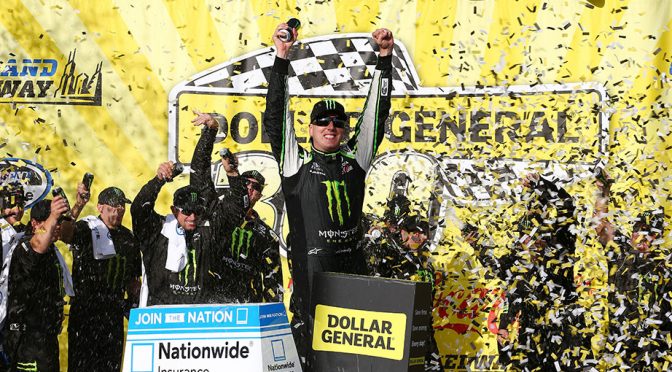
In Saturday’s Dollar General 300 powered by Coca-Cola, Busch won his 10th NASCAR Nationwide Series race in 20 starts this season, leading 195 of 200 laps in claiming the record 61st victory of his career.

Busch became the first driver to win from the pole in NNS competition at Chicagoland, though he’s certainly no stranger to winning from the top starting spot. In Saturday morning’s time trials, Busch won his eighth pole of the season. He has converted seven of those into victories.

FULL SERIES COVERAGE

View all articles
View all videos
View all photos

Joey Logano ran second, but no other driver proved a threat to Busch’s dominance. Sam Hornish Jr. finished third and extended his lead in the series standings to 17 points over Austin Dillon, who came home fourth.

Dale Earnhardt Jr. finished fifth, followed by Brian Vickers, Matt Kenseth, Parker Kligerman, Kevin Harvick and rookie Nelson Piquet Jr.

Having won Friday night’s NASCAR Camping World Truck Series race at Chicagoland, Busch will go for the second three-series weekend sweep of his career in Sunday’s GEICO 400 Sprint Cup race at the 1.5-mile track.

That won’t be an easy task. During Saturday’s practice, the handling on Busch’s Cup car wasn’t optimal.

“We tried a lot of stuff (Saturday) in the Cup garage and couldn’t really find the feel I was looking for, couldn’t really find the grip I was hoping to have that would produce fast lap times and be comfortable for me,” Busch said. “It’s going to be a bit of a challenge (Sunday).

“I think we’re a top-10 car right now. That’s a little further off than where I’d like to start going into (Sunday), but we’ll just have to work through 400 miles and push hard and see if we can’t achieve the trifecta.”

Penkse Racing teammates Logano and Hornish agreed that they needed to find a little additional speed to compete with Busch on a regular basis, but they also defended their own records. Four Penske drivers have combined for 10 NNS victories this season.

“We’re not far behind — we’ve won quite a few races this year,” Logano said. “But the 54 car is obviously our main competition every weekend. Where it’s at is hard to pinpoint. It’s probably a little bit of body, it could be some motor, it could be some of our chassis setups.

“We have to look in every little area to find a little bit of speed. It’s not like he’s a half-second quicker than us. He’s a tenth better, all day. It’s hard to pinpoint exactly where it’s at — because he drives away so fast you can’t figure it out quick enough.”

Having led 153 of the first 158 laps, Busch held a lead of more than three seconds when Brett Butler plowed into the back of title contender Elliott Sadler‘s No. 11 Toyota as Sadler was slowing to enter pit road.

Lead-lap cars came to the pits on Lap 160 for tires and fuel, leaving them with enough gas to finish the race comfortably. Busch was first off pit road for a restart on Lap 164, but one circuit later, a caution for debris slowed the field for the fourth time.

Busch pulled away after a Lap 170 restart and stretched his lead until Kyle Larson blew a left rear tire and smacked the outside wall in Turn 2, spewing debris throughout the corner.

That wasn’t the last yellow. One lap after a restart on Lap 182, Justin Allgaier‘s Chevrolet clipped the outside wall, bounced into Regan Smith‘s Chevy and sent it spinning down the backstretch. Smith, who entered the race third in the series standings, stayed on the lead lap but restarted 18th when Busch led the field to green on Lap 187.

Smith worked his way up to 13th by the finish but lost ground to Hornish, as did Sadler, who ran 19th, one lap down.

Notes: Busch led the largest number of laps ever in a Nationwide Series at an intermediate speedway, eclipsing the 194 of 200 led by Dale Earnhardt at Charlotte in 1986… Busch posted his 20th perfect Driver Rating in the series… Kenny Wallace started his 543rd NNS race, bring his total NASCAR starts across all three national touring series to 900.

MORE:

READ: Driver previews:
The Chase

READ: Fantasy preview:
The Chase

READ: Race breakdowns:
The Chase

READ: Top 10 Chase moments

Kyle Busch won Camping World Truck Series event on Friday; Dillon to start second

Related: Qualifying results

JOLIET, Ill. — Kyle Busch, seeking a rare weekend tripleheader sweep, won the pole position for Saturday’s NASCAR Nationwide Series race, clocking a 178.968 mph lap in qualifying at Chicagoland Speedway.

The Coors Light Pole Award was Busch’s eighth of the season, 34th of his Nationwide career and first on the 1.5-mile track. His Joe Gibbs Racing No. 54 Toyota will lead the 40-car field to the green flag in the Dollar General 300 powered by Coca-Cola (3:30 p.m. ET, ESPN2), the 26th of 33 races for the series this season.

Busch, a nine-time winner in the Nationwide tour this season and a two-time Chicagoland winner in the series, prevailed in Friday night’s NASCAR Camping World Truck Series event and has a chance to achieve a 3-for-3 weekend sweep. Since NASCAR expanded to three national series in 1995, Busch is the only driver to win in each series in a weekend, having accomplished the feat at Bristol Motor Speedway in August 2010.

Austin Dillon was a close second in qualifying, clocking a 178.867 mph lap in the No. 3 Richard Childress Racing Chevrolet. He was followed by a pair of Penske Racing Fords that will share the second row at the green flag, Joey Logano (178.595) in third with series points leader Sam Hornish Jr. (177.328) in fourth.

Parker Kligerman, driving the No. 77 Toyota for Kyle Busch Motorsports, completed the top five. Dale Earnhardt Jr., making just his fourth Nationwide start of the season and his first since April, was sixth.

Rookie Kyle Larson, fastest in Friday’s opening practice, spun out of the Turn 2 exit during his qualifying attempt. He avoided contact with the wall, but his No. 32 Turner Scott Motorsports Chevrolet was towed back to the garage. He’ll start 39th in Saturday’s 200-lap, 300-mile event.

Josh Wise, Carl Long and Morgan Shepherd were the only drivers who failed to qualify.

Jeff Green’s qualifying time was disallowed, and he will start last in the 40-car field on a past champion’s provisional berth.

MORE:

READ: Driver previews:
The Chase

READ: Fantasy preview:
The Chase

READ: Race breakdowns:
The Chase

READ: Top 10 Chase moments

Chevrolet has strong showing in both practices

Related: Full practice results

JOLIET, Ill. — Kasey Kahne set the pace in final NASCAR Sprint Cup Series practice Saturday afternoon at Chicagoland Speedway, turning a 181.068 mph lap in final prep for the opening event of the Chase for the NASCAR Sprint Cup postseason.

Kahne, driving the No. 5 Hendrick Motorsports Chevrolet, ran 52 laps in the final 50-minute session — the most of any driver — but logged his chart-topping lap on his first circuit around the 1.5-mile track. His lap was slower than the 182.383 mph lap that Martin Truex Jr. established to lead Saturday’s first Sprint Cup practice.
 
Juan Pablo Montoya was second-fastest in final practice at 181.056 mph for Earnhardt Ganassi Racing, making Chevrolets 1-2 atop the leaderboard. Joey Logano, who scored the Coors Light Pole Award in Friday qualifying, was third-fastest in final practice after logging the eighth-fastest lap in the earlier session.
 
Five-time Sprint Cup champion Jimmie Johnson, Kahne’s Hendrick teammate, was fourth in final practice with Greg Biffle completing the top five in preparation for Sunday’s Geico 400 (2 p.m. ET, ESPN).

Jeff Gordon, newly eligible for title contention, clocked the second-fastest lap in the opening session at 182.328 mph in the No. 24 Hendrick Motorsports Chevrolet. NASCAR officials added the four-time champion to the Chase as the 13th and final seed Friday after a review of last weekend’s regular-season finale at Richmond International Raceway.

Gordon was followed on the early speed chart by two Hendrick teammates — Kahne and Dale Earnhardt Jr. — with Montoya in fifth.
 
Matt Kenseth, the Sprint Cup points leader heading into the Chase opener, was 11th-best in Saturday’s opening session and ninth-best in final practice.


MORE:

READ: Driver previews:
The Chase

READ: Fantasy preview:
The Chase

READ: Race breakdowns:
The Chase

READ: Top 10 Chase moments

Phoenix Racing rises with Turner Scott veteran doing double duty

JOLIET, Ill. — Justin Allgaier’s life at the track and away from it has been a month’s worth of dream sequences, each of them bringing change, opportunity and fulfillment. Such is life when you’re a new dad with a shot at stock-car racing’s big leagues.

Allgaier will make his NASCAR Sprint Cup Series debut in Sunday’s Geico 400 (2 p.m. ET, ESPN), the first race under new management for the Phoenix Racing No. 51 Chevrolet. To make the maiden voyage even more memorable, Allgaier — an Illinois native — will break into NASCAR’s top series at Chicagoland Speedway, a home track of sorts for the 27-year-old driver.

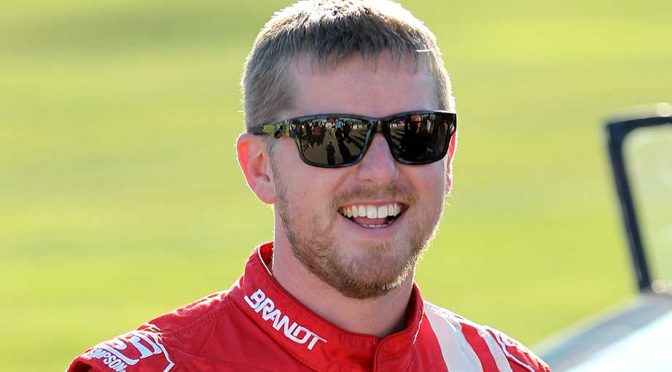
“If you would’ve told me a year ago that I would make my Cup debut at Chicagoland with Brandt on the car, I’d have probably told you that you were crazy,” Allgaier said before Coors Light Pole Qualifying for Saturday’s Nationwide Series Dollar General 300 powered by Coca-Cola. “But everything’s worked out so perfectly, and I can’t thank everybody that’s involved in this deal enough. This really is a dream come true, and it’s been a fun go at it so far this weekend. It’s only going to get better.”

Allgaier’s rise up the stock-car ladder is a story of both opportunity and paid dues. When Turner Scott Motorsports principle Harry Scott Jr. purchased Phoenix from longtime independent team owner James Finch, Allgaier — among Turner Scott’s longest-tenured drivers — was tapped to drive in the No. 51 Chevrolet SS’s first race under new ownership.

The announcement, made in conjunction with the completion of the purchase, was the byproduct of Allgaier’s five consistent seasons in NASCAR Nationwide Series competition and his third with the Turner Scott team. Even though he’s just one weekend in to making his Sprint Cup vision a reality, Phoenix’s newest driver already sees a difference in the scrappy single-car team.

“The one thing that I’ve kind of noticed is that Harry Scott is an awful lot like James Finch, 20 years, 15 years ago,” Allgaier said. “Harry has that ambition, that drive, that want to go out and do good, and that’s how James started his race team, when he started Phoenix Racing. So, the perfect guy to carry the banner.

“And I really do feel like with the resources that we’ve grown over on the Nationwide side and the knowledge and the people that we have, I think that the steady progression of the Cup program can be a team that, maybe we’re not going to win races right away, but I think it’s a team that we can get up there and contend for top-fives and top-10s at some point. I think everybody knows it’s going to take time and effort, and everybody is committed to doing that.”

For Nick Harrison, who remains as Phoenix Racing’s crew chief through the transition, the change has brought peace of mind and a newfound focus.

“The uncertainty there for all the guys on the team is secure now, and we can worry about what we need to and that’s making the race car go fast for Justin,” Harrison said. “We’ve probably fought wondering what our future holds instead of worrying about race cars in the past few weeks, which is natural, guys worrying about their livelihoods, but now everything looks solid. Harry’s brought that, and I think he’s got a lot of good ideas and a lot of good stuff coming in the future, but that’s probably the biggest thing.”

In the meantime, Harrison and Allgaier have worked on building a rapport with the common goal of finding speed at Chicagoland. The early reviews from both sides have been positive, with Harrison commending his driver’s ability to offer constructive feedback and communicating his car’s needs.

It’s all helped Allgaier find a degree in comfort in closing what he calls a “huge, huge gap” in handling, performance and feel of the Sprint Cup car compared to his Nationwide ride.

“I definitely have a learning curve to go through there,” Allgaier said, mentioning his miscalculation in qualifying that relegated him to the 36th starting spot in Sunday’s main event. “Today, I got to practice quite a bit more and got way more comfortable, felt like I was in my own element. It’s not going to be easy, I know that, but at the same time I feel like we have a good shot at going and having a good opening weekend.”

Allgaier has two more Sprint Cup races with Phoenix on his 2013 schedule, at Charlotte and Talladega on consecutive weekends in October. But unfinished business still exists for his season-long goal, a Nationwide Series championship with Turner Scott.

While pulling double duty has presented some logistical challenges, Allgaier says the benefit of extra track time has been a boon to his efforts in both series.

“I feel way more comfortable in the car, and I feel like I can give the Nationwide guys a better go at it,” Allgaier said. “In that regard, it helps. The other part of it is just the confidence of being able to get that start and coming back over here and knowing that we still have a championship that we’re working toward. We’re learning a lot, we’re working a lot and I’m looking toward the last few races, for sure.”

Though Phoenix Racing’s ownership is now a certainty, Allgaier said both he and the team are still seeking sponsorship to make a full-time Sprint Cup campaign next season feasible.

“Just trying to figure out what the best options are and what the best directions are,” he said. “Trying to get through the rest of this year, see if we can run well on the Cup side and finish out the Nationwide season strong. Hopefully all the pieces of the puzzle come together and we can put something together for next year.”

Regardless of what his Sprint Cup debut holds or what his 2014 outlook may be, Allgaier has plenty to savor at home. His wife, Ashley, gave birth to daughter Harper Grace on Aug. 13, creating a whole different sort of transition and dreams.

“It’s been a challenge, but it’s a challenge that I absolutely love,” Allgaier said. “It’s been awesome. My daughter, Harper, is just the sweetest thing ever. It’s funny because I don’t remember life before we had a baby, but definitely it’s fun to see her grow and change.

“Every day, something new. It’s really been cool.”

MORE:

READ: Driver previews:
The Chase

READ: Fantasy preview:
The Chase

READ: Race breakdowns:
The Chase

READ: Top 10 Chase moments