Truex looking for a road course sweep after winning Sonoma

Related: Full practice results | Complete coverage from Watkins Glen

FULL SERIES COVERAGE

View all articles
View all videos
View all photos

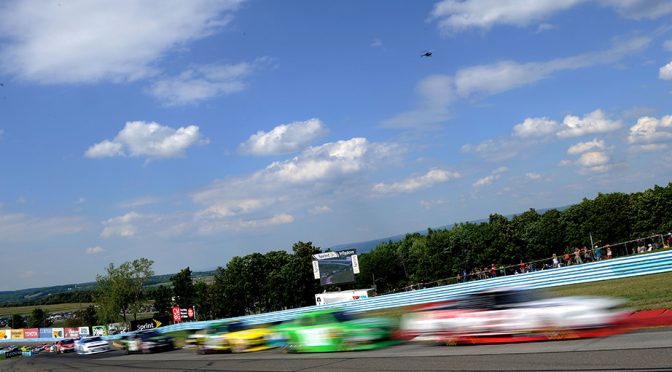
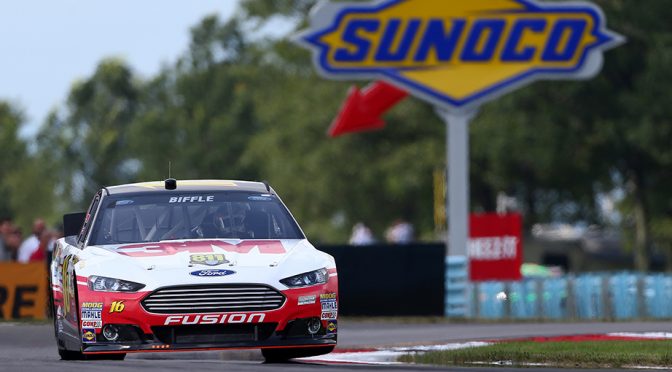
WATKINS GLEN, N.Y. — In the Sprint Cup Series‘ second practice of the day at Watkins Glen International, Carl Edwards topped what would be a track record set by Martin Truex Jr. in the earlier session with a best lap of 68.693 seconds and at 128.397 mph. Edwards was third-fastest in the first practice; Truex was 19th-fastest after running 13 laps in the later session.

Edwards’ practice time would be fast enough to break the track record, which was set last August by Juan Pablo Montoya (69.438 seconds/127.020 mph). Times don’t become official until qualifying.

Michael McDowell, filling in the No. 35 of Josh Wise, took the second spot on the leader board with a best lap of 69.284 seconds at 127.302 mph. Clint Bowyer drove his No. 15 Peak "Duck Dynasty" Toyota to a best speed of 127.232 mph and the final spot in the top three.

Montoya repeated his top-five performance earlier in the day, running fourth-fastest. Brad Keselowski rounded out the top five.

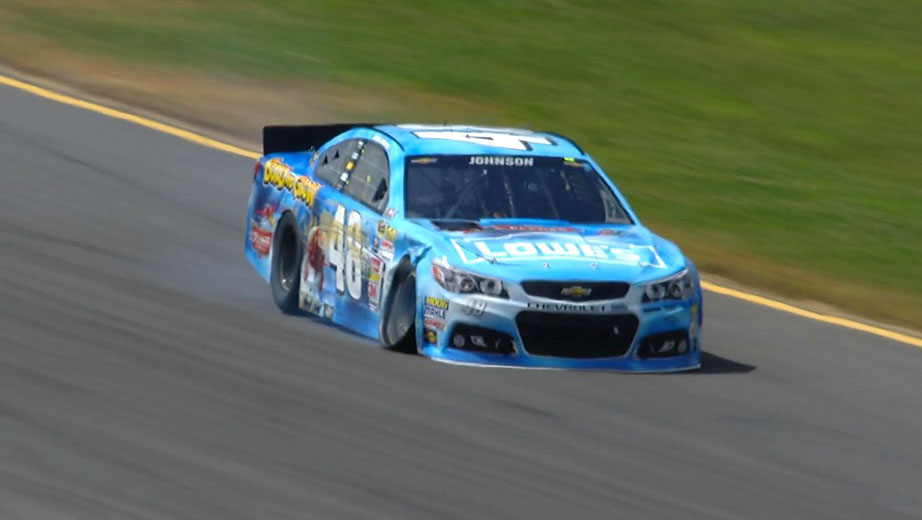
Points leader Jimmie Johnson improved on his 16th-fastest run in the first session, ending the day at sixth on the leaderboard.

Johnson, Jamie McMurray and Joey Logano ran the most laps at 18, with the latter two falling at 25th and 31st on the speed chart, respectively.

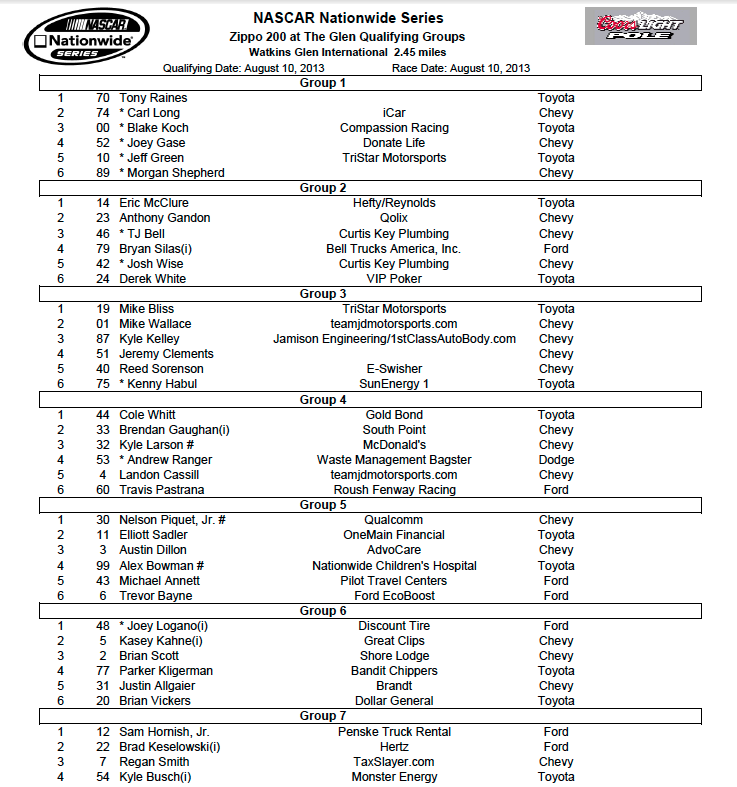
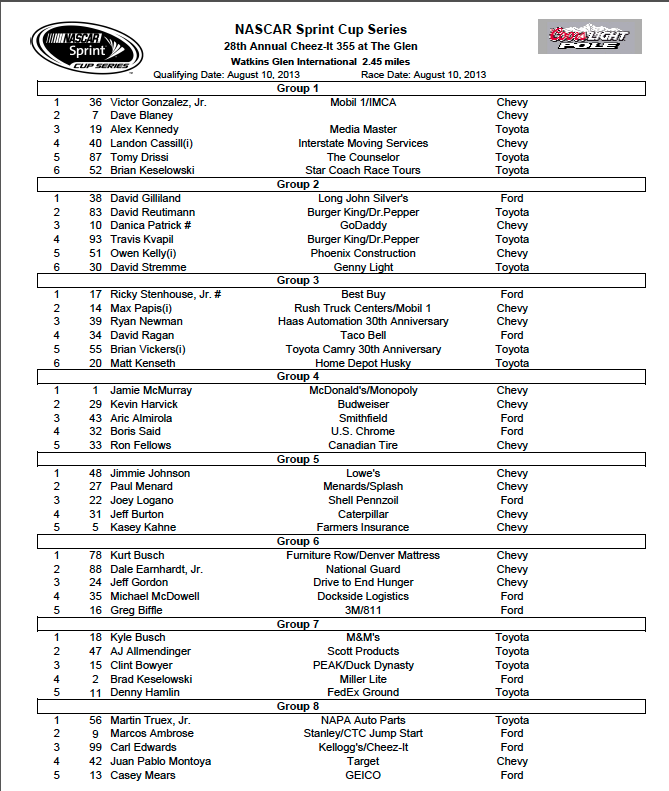
The practice was pushed back after heavy rain fell on the track as Nationwide practice was soon to begin. Groups for qualifying, which begins Saturday at 11:40 a.m. ET, will be set from the practice times in the earlier session.


MORE:

WATCH: Tony Stewart
breaks right leg

WATCH: Preview Show:
Watkins Glen

WATCH: This week’s
Fantasy Showdown

WATCH: What Drives
the 5?

Cars roll out to qualify at 9:35 a.m. ET | Group qualifying explained

MORE:

WATCH: Tony Stewart
breaks right leg

WATCH: Preview Show:
Watkins Glen

WATCH: This week’s
Fantasy Showdown

WATCH: What Drives
the 5?

Cars roll out to qualify at 11:40 a.m. ET | Group qualifying explained


MORE:

WATCH: Tony Stewart
breaks right leg

WATCH: Preview Show:
Watkins Glen

WATCH: This week’s
Fantasy Showdown

WATCH: What Drives
the 5?


Follow Nationwide practice from Watkins Glen, Friday, Aug. 9

MORE:

WATCH: Tony Stewart
breaks right leg

WATCH: Preview Show:
Watkins Glen

WATCH: This week’s
Fantasy Showdown

WATCH: What Drives
the 5?


Watch GarageCam from Watkins Glen, Friday, Aug. 9

MORE:

WATCH: Tony Stewart
breaks right leg

WATCH: Preview Show:
Watkins Glen

WATCH: This week’s
Fantasy Showdown

WATCH: What Drives
the 5?


Watch live press conferences from Watkins Glen, Friday, Aug. 9

MORE:

WATCH: Tony Stewart
breaks right leg

WATCH: Preview Show:
Watkins Glen

WATCH: This week’s
Fantasy Showdown

WATCH: What Drives
the 5?

Seeking sponsorship, driver wants to compete for championships

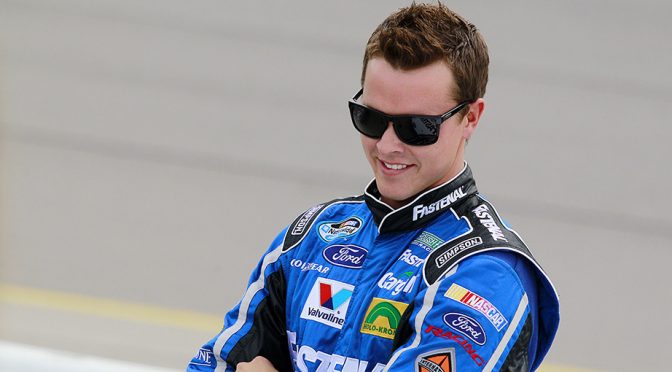
CONCORD, N.C. — In a sport built on speed, Trevor Bayne is a study in patience.

The Roush Fenway Racing driver had to wait on sponsorship to fall into place before he could return to full-time NASCAR Nationwide Series competition with the organization this season. He had to sit out five weeks waiting for the effects of Lyme disease to subside shortly after winning the Daytona 500 for the Wood Brothers in 2011. And now he’s waiting for the moment when he can finally join NASCAR’s premier circuit on a permanent basis.

“That’s our hope,” Bayne said during a fan event at Charlotte Motor Speedway. “We’d love to be full-time in Sprint Cup. Even a partial schedule, if I run full-time in Nationwide again. I think we want to win a championship, and if that’s not this year, maybe next year. But for me, I’m ready to go Cup racing, and I want to to do that as soon as possible, but I’m on their timing right now.”

FULL SERIES COVERAGE

View all articles
View all videos
View all photos

The appeal of Bayne as a fixture at NASCAR’s top level was obvious Wednesday, as fans packed the track’s ticket office to receive autographs from the smiling and affable 22-year-old. Yet despite his status as the youngest ever winner of the Daytona 500, progress has been slow. He competed in only a handful of Nationwide races last year, and has run a partial Sprint Cup schedule for the Woods each season since 2011.

The move of two-time Nationwide champion Ricky Stenhouse Jr. to the Sprint Cup ranks for this season cleared a spot for Bayne to return to full-time competition at Roush. In January, team co-owner Jack Roush said his hope was to move Bayne up to Sprint Cup full-time for 2014, if an accompanying sponsorship package could be put together. More than halfway through the 2013 campaign, it’s unclear if there’s any movement toward that goal.

“Next year, we have not really gotten to a point on that one yet,” Bayne said. “Me, I want to run for championships, whether that’s in Nationwide or Sprint Cup. I would love to run in the Sprint Cup Series full-time, but it just depends on sponsorship and where things head with that right now.”

Perhaps it hasn’t helped that Bayne has had a rather uneven season with the team that’s claimed the last two Nationwide titles. Although he won earlier this year at Iowa Speedway, Bayne has five top-fives and 11 top-10s in 20 starts and ranks ninth in the standings, 71 points behind leader Austin Dillon. The speed has been there, Bayne said, but it’s taken time for he and his new team to coalesce.

“Unfortunately, there have been more ups and downs than you’d want to see in a season where you run for a championship. … I think we’ve had the raw speed. Even at Indy a couple of weeks ago, I thought we had something for (winner) Kyle Busch, and then at the end I made a mistake on a restart, messed up the thing, and at the end ended up crashed. So you take out some of those, I think we’ve had a really solid season, but unfortunately you can’t take those out,” he said.

“We’ve had parts failures, I’ve had brain failures, and then we’ve had times when we weren’t as fast as we wanted to be. But I think over the last two months, we’ve gained as many points as anybody except the No. 3 car with Austin. So I think we’re on a progression to get better. It’s just anytime you start with a new team, it takes some learning and molding. And now it’s happening, and I just hope it’s not too late. With 13 races left, I think we can make up the 70 points we’re behind right now.”

In fairness, even Stenhouse went through a bumpy season before he and crew chief Mike Kelley found a rhythm that netted eight race victories and a pair of titles over the next two seasons. And Bayne has finished inside the top 10 in four of his last five starts to narrow the gap somewhat on the series leaders. He hopes to continue that momentum Saturday at Watkins Glen, where he finished third in a K&N Pro Series East race in 2008, and finished ninth in the Nationwide car his last time there in 2011.

“Of all the road courses, that’s the place I’m most comfortable,” he said. “The kind of road course it is, faster, sweeping, more technical — for an oval guy, that’s always a good thing.”

MORE:

WATCH: Tony Stewart
breaks right leg

WATCH: Preview Show:
Watkins Glen

WATCH: This week’s
Fantasy Showdown

WATCH: What Drives
the 5?

Drivers comment on dangers of returning to roots to race on off-days

Related: Full Stewart coverage

Two days after the Sprint Cup Series race at Watkins Glen International, David Ragan will venture to Carolina Speedway and strap into his super late model for an event on the Gastonia, N.C., dirt track that pays $3,000 to win. These days, he wonders if some NASCAR team owners and sponsors might view his hobby in a less than favorable light.

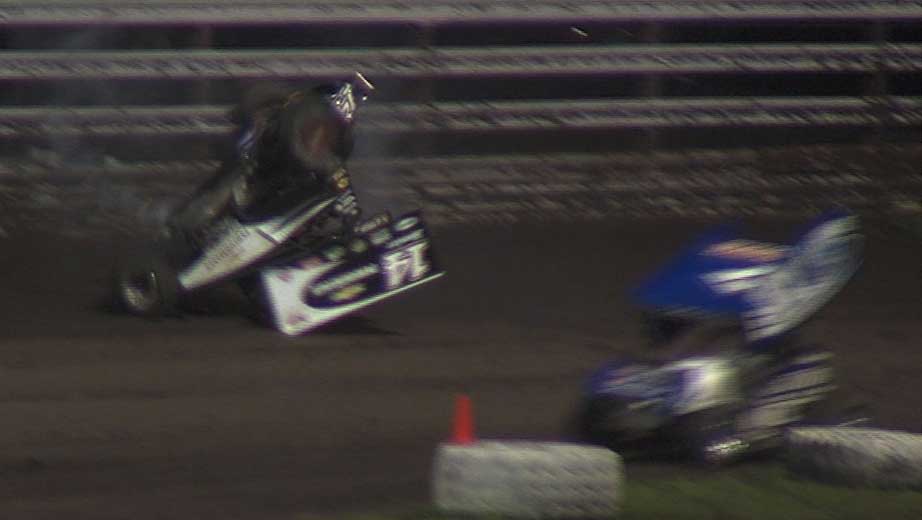
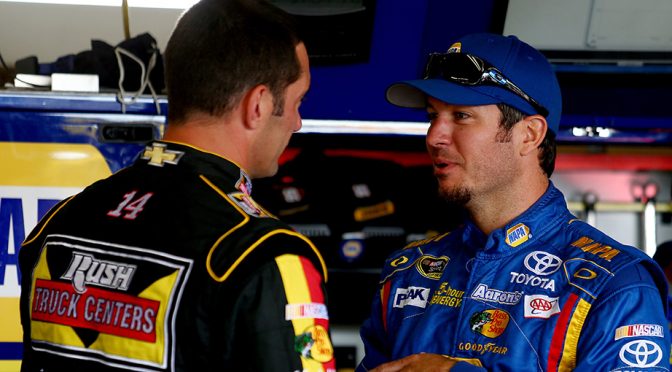
Extracurricular competition among established NASCAR drivers has always required a delicate balance, but it’s come under greater scrutiny in the wake of Tony Stewart‘s crash Monday night in a winged sprint car race on an Iowa dirt track. The three-time Sprint Cup champion will miss the event at Watkins Glen, and likely several races beyond that, as he recovers from a pair of broken bones in his lower right leg. Max Papis will drive his No. 14 car Sunday.

FULL SERIES COVERAGE

View all articles
View all videos
View all photos

Stewart is far from the only national-series NASCAR driver who dabbles in lower-level circuits in his free time. But he’s certainly among the most prominent, and an injury suffered outside of a NASCAR race that will end his Chase for the Sprint Cup hopes has some wondering how car owners and sponsors will react.

"It’ll definitely make some of the car owners have second thoughts about some of their drivers," said Ragan, who won earlier this season at Talladega. "I think it will make the sponsors think when they’re rewriting their contracts for the upcoming season, setting two- and three-year deals. They’ll think about the risk that some of their drivers may take. And not only in other types of racing, but going skiing, jumping out of airplanes. Maybe Travis Pastrana can get by with some of that stuff, because that’s his life. But we do a lot of fun things outside of the sport, and we just have to be smart."

As the owner of Stewart-Haas Racing, Stewart enjoys a degree of latitude that not all drivers have. Some organizations do try to limit how much their drivers compete outside of NASCAR — as was the case for Stewart himself when he drove for Joe Gibbs Racing. But the high profile of a perennial title contender may open more eyes to the gap that exists between some short tracks and the sport’s highest levels, just as Dale Earnhardt’s fatal crash in 2001 brought the safety crisis in NASCAR’s national divisions to light.

"When an injury happens to a driver of Tony’s magnitude — one of the sport’s most visible superstars — such as when Dale Earnhardt’s death spawned safety innovations, everyone takes a closer look," said three-time NASCAR champion and Hall of Fame member Darrell Waltrip, now an analyst for Fox television. "We already were questioning the wisdom of racing in other series, especially sprint cars. But I think Tony’s injury probably is the straw that broke the camel’s back. Some owners and drivers now might decide it’s too risky and curtail this."

Not that NASCAR drivers have always been able to race anywhere and everywhere they want. Ragan said when he was at Roush Fenway Racing — where he won the summer Sprint Cup event at Daytona in 2011 — team co-owner Jack Roush preferred that his drivers run any planned outside activity by him first.

"Back when I drove for Roush Fenway Racing, it’s something that Jack was very open with — hey, if you want you go do anything else, come talk to me," Ragan, now with Front Row Motorsports, said Wednesday at a Charlotte Motor Speedway event promoting the facility’s fall races. "If you’re driving a good car, and you’re racing in a good race with good competitors, then it’s OK. But something like if you’re at a Saturday night short track, you don’t have a suit and a helmet, and want to just jump in someone’s car to make a few laps to race — that’s probably not a smart idea."

Roush may be a little more open in his thinking these days thanks to the arrival of Pastrana, an extreme sports legend who competes in rally cars in addition to his full Nationwide Series schedule. "With Travis Pastrana being my teammate, it kind of loosens the reins a little bit, said Trevor Bayne, a Nationwide driver and former Daytona 500 champion who also competes for Roush.

"We’re not stupid. We know it’s a risk," Bayne added at Charlotte Motor Speedway. "You’ve just got to be smart about those risks that you take."

Although winged sprint cars have been a primary focus of attention — due to both Stewart’s injury and the fatal crash of former NASCAR driver Jason Leffler at a New Jersey dirt track in June — many national-series drivers regularly return to their roots by competing in late models, dirt cars, modifieds, or other types of vehicles. Any potential crackdown on extracurricular racing would require a culture change within the motorsports community, given how many drivers who do it.

"Will owners and drivers re-read their contracts? Maybe. If I’m an owner with a driver and 300-plus employees that depend on that driver getting in the car each weekend because the sponsor pays me, then I not only have to protect myself, I have to protect my business and employees. That’s how I look at it as an owner," said Kyle Petty, an eight-time winner on NASCAR’s top circuit, and now a television analyst for Speed.

"As a driver, I’m going to say, ‘This is what I do. I don’t live in a bubble. I can’t let life live me. I have to live it, and can’t just sit on my rear end and do just this one thing. I want to drive everything I can.’ Therein lies what will be the compromise between the owners and drivers. Some drivers won’t ever get in another type of car. Many of them are Cup drivers only. Then there are others — Kasey Kahne, Tony, Kyle Busch and others — who will run anything with four wheels and a steering wheel. It’s not a game-changer, but Tony’s accident shines a light on an issue that certainly will be addressed by drivers and owners."

Will it be addressed at Stewart-Haas? On a conference call Tuesday with reporters, team competition director Greg Zipadelli certainly sounded as if a conversation was in order.

"I think it makes him better at what he does here, but it obviously leaves the door open for a situation that we’re in now," Zipadelli said of Stewart. "I think that as many races as he’s run in the past, we’re probably lucky that this is the first time we’re dealing with this, to be perfectly honest with you. We’ll do our best at Stewart-Haas to put pieces together and sit down and evaluate it, and I think it would be a lot easier to look at and talk about things right now because we’re in the situation that we’re in moving forward. That doesn’t mean anything other than we will talk about it, we’ll discuss it and we’ll try and do what’s best for Stewart-Haas and our partners in the future."

Ragan and Bayne offer opposite ends of the spectrum. Ragan competes when he can in late models and Legends cars, but chooses his events carefully and even brings his own seat belts to the track. "You try to do the best you can," he said. "You never know what may happen, but you can’t live life scared to death of what risk lay in front of you, either."

And then there’s Bayne, who doesn’t compete much outside of NASCAR. He was out five races due to Lyme disease in 2011, and even though that absence wasn’t due to an on-track issue, it was enough for him to realize he didn’t want to risk missing any more time behind the wheel.

"You’ve got to be smart," he said. "You can’t be out here doing stuff when you’re running for championships and get yourself hurt. I’ve kind of had my mulligan of being out of the race car … in 2011 for five weeks, and it wasn’t (because of) something I did. But you don’t want to have many of those. I try to be as safe as possible. You can’t put yourself in a bubble, but you can make good decisions."

MORE:
WATCH: Final Laps:
Kahne edges Gordon

WATCH: Victory Lane:
Kahne celebrates

WATCH: Johnson hits
wall at Pocono

WATCH: Danica involved in
four-car wreck

Three-time Sprint Cup champ remains hospitalized for observation

Three-time NASCAR Sprint Cup Series champion Tony Stewart underwent a successful second surgery on his broken right leg Thursday, three days after a sprint car crash in Oskaloosa, Iowa.

FULL SERIES COVERAGE

View all articles
View all videos
View all photos

A specialist in North Carolina placed a stabilizing metal rod inside the fractured tibia Thursday, according to a statement from the Stewart-Haas Racing team. The operation was a follow-up to a preliminary surgery Tuesday that stabilized and cleaned the Grade 2 injury, the team said.

Stewart remains hospitalized for observation.

Stewart was leading a 30-lap main event for the American Sprint Car Series at Southern Iowa Speedway on Monday night when a slow car spun into his path. Stewart’s car struck the stopped car, breaking his tibia and fibula in the accident.

The wreck has sidelined the driver of the No. 14 Chevrolet that he co-owns with Gene Haas indefinitely. Road-racing ace Max Papis will drive the car this weekend at Watkins Glen International in Sunday’s Cheez-It 355 at the Glen (1 p.m. ET, ESPN). Interim drivers for future races have not been determined, team officials said.

Stewart currently ranks 11th in the Sprint Cup standings, leading the Wild-Card race for one of two spots in the Chase for the NASCAR Sprint Cup postseason. His five career Watkins Glen victories lead the all-time list at the 2.45-mile road course.

MORE:

WATCH: Tony Stewart
breaks right leg

WATCH: Preview Show:
Watkins Glen

WATCH: This week’s
Fantasy Showdown

WATCH: What Drives
the 5?

NASCAR president talks industry action plan, economic growth, NASCAR ‘characters’

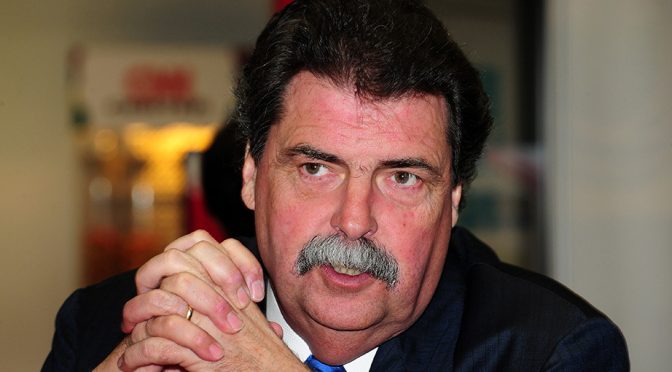
NASCAR President Mike Helton says the sanctioning body, its teams and tracks all learned valuable lessons in the wake of the economic downturn, lessons that have made each stronger over time.

Speaking to business leaders during the Aug. 6 Charlotte Business Journal’s Motorsports 2.0 program at The Ritz-Carlton in Charlotte, Helton addressed several topics during an hour-long question and answer session with 1999 NASCAR Cup champion Dale Jarrett, including the continued importance of sponsorship in the sport and how it has evolved in recent years.

“Like any other business, we have our ups and downs and our cycles,” said Helton, who noted that one in four Fortune 500 companies are involved in NASCAR today. “And while the whole world felt the shift in ’08, so did motorsports in general. Certainly NASCAR realized that it and all the stakeholders in the sport were going to have to review their models. And we had some lean times.”

Sponsors — which today include companies such as 3M, Walt Disney Co., UPS and Wal-Mart — “didn’t want to leave,” Helton said. “They just had to figure out how to justify staying and how to make their investment make sense to them. And everybody (including) the race tracks and race teams and NASCAR were willing to figure that out.”

FULL SERIES COVERAGE

View all articles
View all videos
View all photos

Helton said the sport is beginning to “see more engagement and conversations,” but that growth must continue in order to meet the needs of all parties.

“It’s not where we want it to be and never will be,” he said. “It never was. We’re always wanting … to continue to grow. So we’ll keep doing the things that we feel like are right and correct; the race tracks will (and) the race teams will, to continue to build good, solid relationships.”

Helton said the company’s industry action plan was a result of the downturn, spurring officials to take a closer look at how they conducted business.

“And it was an eye-opener, I’ve got to tell you. It was tough to sit in some of the conversations and be told by a third group what your dirty clothes looked like. But it was the way we felt like we had to do it in order to make the next decisions.”

From that study came the realization that more needed to be done to help promote growth among a younger audience as well as a more multicultural audience.

“There had to be an initiative around not just cleaning up the perception of those barriers but an active pursuit of a multicultural audience,” he said. “Certainly we want NASCAR to fit in that environment and be all-inclusive and not exclusive.”

The plan wasn’t built solely to help NASCAR determine what it needed to do, but what the sport needed in order to move forward and continue to be successful.

“We were the group that said ‘here’s what we know. Let’s work together to figure out how to do this,’ ” he said. “It’s not a NASCAR action plan, it’s an industry action plan. And it’s for the health and the future of the sport.”

Star power continues to help drive the sport and can help it stand out in a sea of opportunities available to today’s consumer. While noting that the NASCAR Hall of Fame is “full of characters that drew fans to our sport,” Helton said the need for such “characters” is still very real today.

“We’ve got to have modern characters that compete against other (entities) — it can be an animated movie or it could be a …  football player that makes the Panthers stand out and makes you want to go to watch a football game,” he said.

“We’ve got to do the same thing in our world. We’ve got to have more Tony Stewarts and Jeff Gordons, Dale Earnhardt Jrs. who have been around for a while and are still tremendous characters. But we need an influx of making some of the folks that may not be getting the right attention more attention and we need to be thinking about where that next group of characters come from.”

Helton said the recent TV packages with FOX and NBC will benefit the sport from more than just a financial standpoint. The effort and energy put into launching new entities such as FOX Sports 1 and NBC Sports Network will be tremendous, he said, “because they have their network at stake so they are going to present our content at their level.”

“Between FOX launching FOX Sports 1 and building that to a quality level and NBC wanting to build their entire sports program along with Olympics and NFL — that’s a pretty good closet to share space with.”

The process of approval for track entitlement sponsorships will be reviewed by the sanctioning body, although Helton said NASCAR wants to continue “to be as open as we can be.

“We want to allow the teams and the tracks to pursue their own relationships as much as we can allow them to,” he said.

“There are those at times though that we have to say, ‘wait a minute. That may not be well accepted for the good of the sport.’ We’ve had that in the past and will continue to have look at that more closely whether it’s race teams or race tracks because it seems like in today’s world with the advent of social media and the digital world … controversy can be fired up a whole lot quicker than it might have been (in the past).”

With initiatives involving youths, star power and the multicultural environment in play, he said, “we have to be sensitive and careful to anything that someone might interpret against those issues and topics. We get criticized sometimes for being too authoritative but at the end of the day it’s all for the good of the sport.”

Helton said that while legendary team owners such as Rick Hendrick, Jack Roush, Roger Penske and Richard Childress are entering the twilight of their careers, “I suspect the names … will be on those organizations for decades to come.”

The decision-making that goes on at those organizations has already shifted in some cases, he said, while the process seems to be under way with others.

“J.D. (Gibbs) certainly now is making the decisions for Joe Gibbs Racing,” he said. “Same thing with Jack Roush (Roush Fenway Racing); Rick Hendrick (Hendrick Motorsports) has already got Marshall (Carlson) and Doug Duchardt; Richard Childress (Richard Childress Racing) has generations of operators (in place).

“Michael Waltrip Racing is a relatively new player in our world but has a very strong program that should sustain itself well past Michael’s … days, and Michael’s got a bunch of them left.

“So our hope and desire is … because it is critical for us to have successful organizations that have the race teams just as it is for the race tracks, that those organizations continue to be a part of the sport and then along the way others decide to enter the sport as Michael … did. As his days of a driver (began to wind down), he figured out how to stay in it.”

MORE:

WATCH: Final Laps:
Kahne edges Gordon

WATCH: Victory Lane:
Kahne celebrates

WATCH: Johnson hits
wall at Pocono

WATCH: Danica involved in
four-car wrec