Driver plays at "Go Ape" outdoor experience leading up to Richmond race

NASCAR Sprint Cup Series driver Kyle Busch spends a majority of his weekends practically “flying” around a race track in his No. 18 M&Ms Toyota Camry, a setting the driver is more than comfortable doing for a living.
 
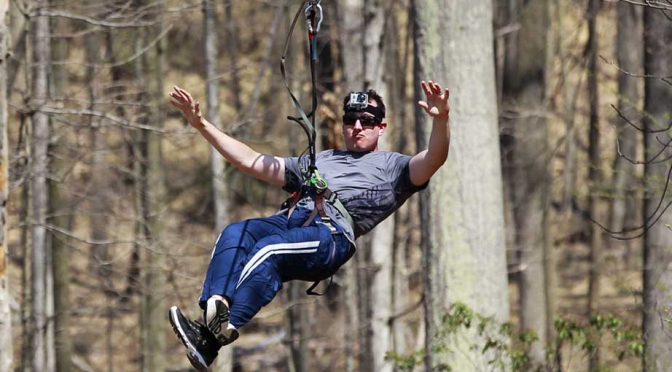
But, what about when Busch is put in an entirely new environment, say the jungle? Well, whether in or out of his comfort zone, the Joe Gibbs Racing driver gives it his all and has fun doing it. Such was the case Wednesday, when Busch’s aerial skills were put to the test, flying through treetops, braving a Tarzan-like swing and riding a skateboard 50 feet in the air.
 
His participation in the event, which was held at “Go Ape,” an outdoor experience in Rockville, Md., was part of an appearance on behalf of Richmond International Raceway (RIR) to help promote its NSCS primetime race — the Toyota Owners 400 — on April 27. The 27-year-old, who has captured four consecutive spring race wins at RIR, was accompanied on the course by RIR President Dennis Bickmeier. And for one day, Busch was king of this jungle.
 
“It was fun to do something different and get out to ride some ropes, enjoy the outdoors and do something that isn’t your typical experience,” Busch said. “I loved the Tarzan swing. You hook up to the rope, fall off a platform and drop right off. It takes your stomach away from you for a second, but it’s fun.”
 
Busch, who is currently fourth in the points standings through six races, will make his 300th career Sprint Cup Series start Saturday (April 13) under the lights at Texas Motor Speedway  (FOX, 7:30 p.m. ET).

___________________________________________________________________________________________

Comments are currently unavailable. We’re working on the development of a NASCAR fan forum – please stay tuned.
Five-Time, Knaus excel at adapting, finding creative solutions

The most impressive run turned in by Jimmie Johnson this season might not have been Sunday’s dominant victory at Martinsville Speedway, where he led more than half the event and took home his eighth grandfather clock. It might not have been the Daytona 500, where he held on over a final restart to record his second victory in the Great American Race.

No, Johnson’s most notable run might have been one that was completely overlooked amid a scuffle on pit road and a driver being carried off on a backboard. The odds-on favorite to win at Auto Club Speedway on March 24 was absolute junk for most of the event — the car didn’t draft very well, it didn’t seem to have enough speed, it got mired in traffic. It all began to feel reminiscent of a complete whiff at Las Vegas in 2008, which owner Rick Hendrick has called the worst race in the history of the No. 48 team.

It never got as bad as that two-laps-down slog, but it wasn’t going well, either, especially with Johnson running 25th and his frustration growing as the event wore on. “What’s Jimmie doing back here?” a surprised Dale Earnhardt Jr. asked over his radio after losing track position due to a four-tire stop. Truth was, his more decorated teammate had been back there for much of the race.

"I think change is good for the 48 (team). … And we like new challenges."

Jimmie Johnson

All of which made his eventual 12th-place finish that day something of a shock, even if no one noticed given all the shenanigans going on elsewhere. Crew chief Chad Knaus took a big swing on a late pit stop, Johnson milked all he could out of a car that had no business being in the front half of the field, and the positions gained over those final green-flag runs helped the five-time champion retake the points lead following his victory this past Sunday at Martinsville.

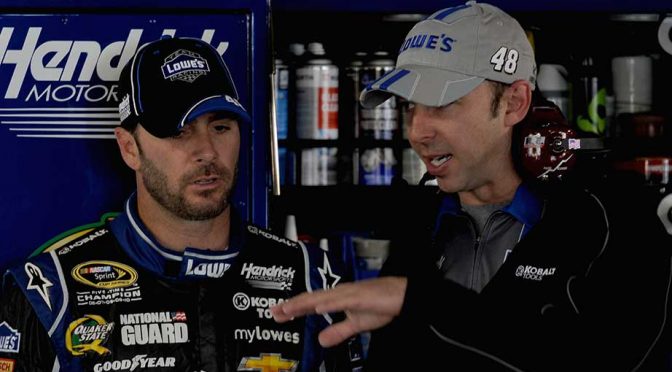
Johnson gets a lot of credit for being one of the best of his (or any) generation, and rightly so, given his ability to find perfect lines and wheel a car with such smooth, clinical efficiency. But he admittedly isn’t the most technical-minded guy in the garage area — “Work on it? Come on, are you crazy?” Johnson said at Martinsville when asked if he performs maintenance on the 1949 Chevrolet pickup he often drives around town — which only emphasizes the role his crew chief plays in setting up the car.

And yet, those individual attributes mask what is perhaps the No. 48 team’s greatest strength — its ability to adapt over the course of a race weekend, or a race distance, or even a season, rarely letting the lows get so low that they threaten to spiral out of control. That miserable event at Las Vegas five years ago stands out precisely because it’s such an aberration, the kind of run that happens to other outfits with a shallower pool of tactics and talent to draw upon. The No. 48 team succeeds, year after year and weekend after weekend, because of the superior way it adjusts to the ever-changing conditions that define NASCAR.

That much is evident, on scales both large and small, again and again. This year at Las Vegas, on a track where a cool test day and a warm race day left crew chiefs scrambling to fix an epidemic of loose race cars, Johnson led 66 laps and cruised home in sixth. At Fontana, late adjustments allowed Johnson and Knaus to salvage 12th after going backward all day. At Martinsville, where Johnson’s traditional advantages seemed mitigated by a new car and tire, that near-perfect weekend was the result of research over the Easter break — what, you thought Knaus would be hiding pastel-colored eggs? — and a highly educated guess.

“I was actually talking to my father last week when we were coming to the race track, and he said, ‘Man, you guys have got a really good setup for Martinsville, you ought to be in pretty good shape.’ And I said, ‘Well, we did until they changed all the rules,’ ” Knaus, whose father John was an accomplished short-track driver, said after race.

“With the new car and everything that we had coming in here with the new tire, we really had to dig in deep. And the off weekend gave us an opportunity to really look back over some past history and draw some conclusions that we were hoping were going to work out. So my father, he’s like, ‘Well, how do you know where you’re going to start?’ I said, ‘Well, I guess we’re just going to guess.’ Fortunately enough, we guessed right.”

In fairness, a guess from somebody like Chad Knaus isn’t really a guess at all. And other teams also adjust well, although they don’t often maintain such a high level of performance in the process. It all goes to show why Johnson relished the idea of the Generation-6 race car, which leveled the scales in terms of setups and preparation. No question, the vehicle’s more brand-identifiable characteristics have the greater interest of the sport in mind. But given that Johnson earned most of his race wins and four of his five titles in the previous vehicle, you’d think he’d hate to see it go.

Hardly. “I like change,” he said last year before the Car of Tomorrow was put out to pasture. “I think change is good for the 48 (team). … And we like new challenges.”

No wonder he’s led the points after four of six races in this season where adaptability is as important as it’s ever been. Drop spike strips on the track or stick a cougar in the back seat, and they’d still find a way. Now it’s on to Texas Motor Speedway, where teams will test Thursday ahead of the race weekend, and where the No. 48 team’s penchant for situational creativity has shown brightly in things like the mid-race pit crew switch and the on-the-fly rebuild of a car wrecked in a collision with Sam Hornish Jr.

The United States Marine Corps has long had an unofficial slogan — improvise, adapt and overcome. Granted, Johnson and his No. 48 team aren’t exactly storming the halls of Montezuma or taking the shores of Tripoli. But they also never assume what worked once will work again. They’re experts at making something out of nothing. Through seven years of historic success, they’ve never grown content. And whether it’s a late adjustment at Fontana or preparation for Martinsville, they improvise, adapt and overcome, over and over, better than anyone else.

___________________________________________________________________________________________

Comments are currently unavailable. We’re working on the development of a NASCAR fan forum – please stay tuned.
Official tire recycler of NASCAR Green to recycle approximately 120,000 Goodyear tires annually

DAYTONA BEACH, Fla. — As part of NASCAR Race to Green®, a month-long, industry-wide effort to reduce the sport’s carbon footprint, NASCAR and Liberty Tire Recycling announced today a new partnership that designates the tire recycling services provider as the Official Tire Recycler of NASCAR Green.

NASCAR has the largest recycling program in sports, including a comprehensive effort that accounts for approximately 120,000 Goodyear tires recycled across NASCAR’s top three national series each year. Liberty Tire Recycling will join other Official NASCAR Green partners, which comprise a comprehensive recycling program, including Coca-Cola, MillerCoors, Creative Recycling, Goodyear, Safety-Kleen, and Sprint.

FULL SERIES COVERAGE

View all articles
View all videos
View all photos

“By recycling more than 140 million tires annually, we reclaim nearly 1.5 billion pounds of rubber for innovative, eco-friendly products,” said Thomas Carter, Liberty Tire Recycling vice president of alternative fuels. “We look forward to enhancing NASCAR Green’s best-in-class recycling program by keeping its discarded tires out of landfills and transforming them into smart, sustainable products that improve people’s lives."

In conjunction with the NASCAR Green Clean Air Tree Planting Program Delivered by UPS, an initiative that will neutralize the carbon emissions of all of the racing in NASCAR’s three national series, Liberty Tire Recycling will provide GroundSmart Mulch that will enhance the landscaping of trees that are donated to areas of need throughout the country. The rubber mulch lasts longer than its wood mulch counterpart and prevents soil from washing away. Additionally, Liberty Tire Recycling products, such as rubberized asphalt will be used to repave racetracks and parking lots at NASCAR Home Track racetracks across the country.

“Adding the nation’s premier tire recycling company to our group of Official NASCAR Green Partners will further enhance NASCAR’s position of leadership in sustainability across all sports,” said Jim O’Connell, NASCAR chief sales officer. “Liberty Tire Recycling has positioned itself as a leader in tire recycling innovation and we are pleased to work towards a common goal of reducing the environmental impact of our sport.”

Liberty Tire Recycling will join the NASCAR Fuel for Business Council®, which brings together an exclusive group of more than 55 Official NASCAR Partners to get more out of their sponsorships, specifically bringing together partners four times a year to buy and sell products and services. This environment offers the unique opportunity for many Fortune 500 companies to bypass the time and layers of corporate coordination that may exist and construct customized deals to help address specific business needs.   

About NASCAR
The National Association for Stock Car Auto Racing, Inc. (NASCAR) is the sanctioning body for the No. 1 form of motorsports in the United States. NASCAR consists of three national series (the NASCAR Sprint Cup Series, NASCAR Nationwide Series, and NASCAR Camping World Truck Series), four regional series, one local grassroots series, three international series and GRAND-AM Road Racing and the American Le Mans Series, both known for competition on road courses. Based in Daytona Beach, Fla., with offices in eight cities across North America, NASCAR sanctions more than 1,200 races in more than 30 U.S. states, Canada, Mexico and Europe. For more information, visit www.nascar.com and follow NASCAR at www.facebook.com/NASCAR and Twitter: @NASCAR.

About Liberty Tire Recycling
Liberty Tire Recycling is the premier provider of tire recycling services in North America. By recycling more than 140 million tires annually, Liberty Tire reclaims about 1.5 billion pounds of rubber for innovative, eco-friendly products. The recycled rubber produced by Liberty Tire is used as crumb rubber and industrial feedstock for molded products; as tire-derived fuel for industrial kilns, mills and power plants; and as rubber mulch for landscaping and playgrounds. The company maintains a network of processing plants and comprehensive door-to-door collection services. For more information visit www.LibertyTire.com.
___________________________________________________________________________________________

Comments are currently unavailable. We’re working on the development of a NASCAR fan forum – please stay tuned.

Famed engine builder Petty, short track star Phillips among 25 eligible

Related: Kenny Bruce on the new nominees

DAYTONA BEACH, Fla. — Larger than life figures who built NASCAR lap by lap and bolt by bolt from the post-World War II era into the 21st century comprise the 25 nominees for the NASCAR Hall of Fame Class of 2014. 

NASCAR today announced those 25 nominees for the NASCAR Hall of Fame’s fifth induction class, and included among the diverse group are five newcomers whose achievements are cornerstones of the sport’s origins and continue to fuel its growth in contemporary times.

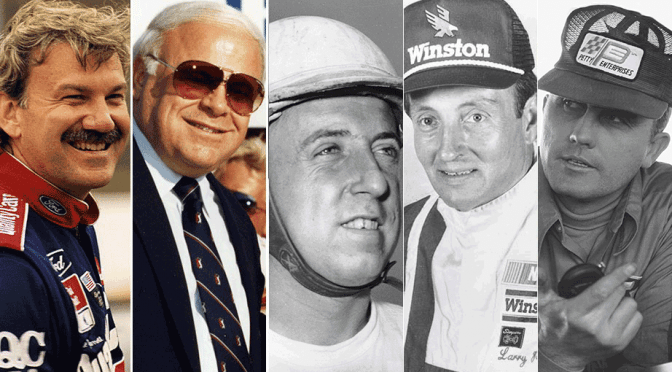
Of the 25 nominees, 20 return from last year’s group. Five are first-timers with varying backgrounds in the sport: second generation NASCAR premier (now Sprint Cup) series champion Dale Jarrett; Maurice Petty, the chief engine builder for Petty Enterprises for more than three decades; five-time NASCAR weekly series national champion Larry Phillips; race track builder and owner Bruton Smith; and 1960 NASCAR premier series champion Rex White.

From that list, five inductees will be elected by the NASCAR Hall of Fame Voting Panel, which includes a nationwide fan vote on NASCAR.COM. Voting Day for the 2014 class will be May 22. Fans can attend the announcement at the NASCAR Hall of Fame in Charlotte, N.C. 

This round of nominees was selected by a 21-person nominating committee consisting of representatives from NASCAR, the NASCAR Hall of Fame and track owners from both major facilities and historic short tracks. The committee’s votes were tabulated by accounting firm Ernst & Young.

The NASCAR Hall of Fame’s 2014 inductees will be determined by a 54-member Voting Panel, which includes the entire Nominating Committee, media members, manufacturer representatives, retired competitors (drivers, owners and crew chiefs) and recognized industry leaders. In addition, the fan vote will result in the Voting Panel’s final ballot. Fan voting on NASCAR.COM opens today, April 10 and closes May 21 at noon.

Following are the 25 nominees, listed alphabetically: 

Red Byron, first NASCAR premier (now Sprint Cup) series champion, in 1949

Richard Childress, 11-time car owner champion in NASCAR’s three national series

Jerry Cook, six-time NASCAR Modified champion

H. Clay Earles, founder of Martinsville Speedway

Tim Flock, two-time NASCAR premier (now Sprint Cup) series champion

Ray Fox, legendary engine builder and owner of cars driven by Buck Baker, Junior Johnson and others

Anne Bledsoe France, helped build the sport with husband Bill France Sr. Affectionately known as "Annie B.," she is the first woman to be nominated for induction into the NASCAR Hall of Fame.

Rick Hendrick, 13-time car owner champion in NASCAR’s three national series

Jack Ingram, two-time NASCAR Busch (now Nationwide) Series champion and three-time Late Model Sportsman champion

Bobby Isaac, 1970 NASCAR premier (now Sprint Cup) series champion

Dale Jarrett, 1999 NASCAR premier (now Sprint Cup) series champion and three-time Daytona 500 winner

Fred Lorenzen, 26 wins and winner of the Daytona 500 and World 600

Raymond Parks, NASCAR’s first champion car owner

Benny Parsons, 1973 NASCAR premier (now Sprint Cup) series champion

Maurice Petty, chief engine builder for Petty Enterprises

Larry Phillips, only five-time NASCAR Whelen All-American Series national champion

Les Richter, former NASCAR executive; former president of Riverside International Raceway

Fireball Roberts, 33 NASCAR premier (now Sprint Cup) series wins, including the 1962 Daytona 500

T. Wayne Robertson, helped raise NASCAR popularity as R.J. Reynolds Tobacco Company senior VP

Wendell Scott, NASCAR trailblazer was the first African-American NASCAR premier (now Sprint Cup) series race winner, and first to be nominated for induction into the NASCAR Hall of Fame.

Ralph Seagraves, formed groundbreaking Winston-NASCAR partnership as executive with R.J. Reynolds Tobacco Company

O. Bruton Smith, builder of Charlotte Motor Speedway and architect of Speedway Motorsports Inc.

Curtis Turner, early personality, called the "Babe Ruth of stock car racing"

Joe Weatherly, two-time NASCAR premier (now Sprint Cup) series champion

Rex White, 1960 NASCAR premier (now Sprint Cup) series champion

Detailed information about the 25 nominees is available at NASCAR.COM  and NASCARMedia.com, NASCAR’s media-only website.

The 21-person Nominating Committee follows…

NOMINATING COMMITTEE 

NASCAR Hall of Fame: Executive Director Winston Kelley; Historian Buz McKim.

NASCAR Officials: Chairman/CEO Brian France; Vice Chairman Jim France; President Mike Helton; Vice President of Competition Robin Pemberton; Senior Vice President of Racing Operations Steve O’Donnell; Competition Administrator Jerry Cook; former Senior Vice President Paul Brooks; former Vice President Ken Clapp.

Track Owners/Operators: International Speedway Corporation CEO Lesa Kennedy; Martinsville Speedway President Clay Campbell; Texas Motor Speedway President Eddie Gossage; Atlanta Motor Speedway President Ed Clark; former Indianapolis Motor Speedway President Tony George; Dover Motorsports CEO Denis McGlynn; Pocono Raceway board of director member Looie McNally; Bowman Gray Stadium operator Dale Pinilis; Riverhead Raceway operators Jim and Barbara Cromarty (1 vote); Rockford Speedway owner Jody Deery; Kingsport Speedway Operator Robert Pressley.


___________________________________________________________________________________________

Comments are currently unavailable. We’re working on the development of a NASCAR fan forum – please stay tuned.
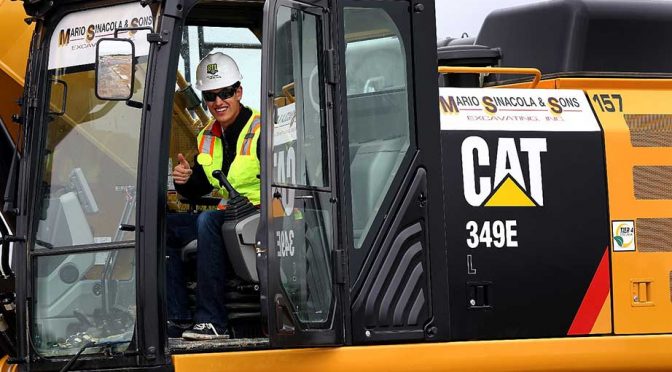
Driver helps promote 811 “Call Before You Dig” national hotline, progress of highway 114 construction project

Video: Logano operates a hydraulic excavator

The Highway 114 Construction Project continued its progress Wednesday with the help of NASCAR Sprint Cup Series driver Joey Logano as part of his kickoff of National Safe Digging Month.

Logano took a break from his 3,300-pound stock car and jumped behind the wheel of a 125,000-pound CAT hydraulic excavator along a stretch of the Highway 114 Project to demonstrate the importance of safe digging.

“That’s cool to be able to use a big earth mover like that to pick up a bunch of dirt,” Logano said. “I really didn’t know what I was doing, but I was playing around like a kid in a candy store. I can do that all day. It was pretty fun.”

FULL SERIES COVERAGE

View all articles
View all videos
View all photos

Logano’s ceremonial dig will be the only work that will be done on the Highway 114 Project during this weekend’s NRA 500 NASCAR doubleheader at Texas Motor Speedway. The Texas Department of Transportation and contractor Mario Sinacola & Sons Excavating have halted construction, leaving all lanes along the key stretch of Highway 114 running past TMS fully open to fans during the race week.

The Highway 114 construction project targets the stretch of highway west of I-35W and covers the road east of FM 156, including a key segment in front of TMS. The project, aimed at expanding a two-lane road to a four-lane frontage road, will help improve traffic flow with increased capacity. The $15.3 million project will make the commute easier for both race fans and residents around TMS.

The Highway 114 Project will not be the only construction on hold this weekend to ensure a smooth commute for race fans. The DFW Connector Project also will halt construction ensuring there will be no lane closures this weekend.

The Highway 114 Project is part of a transformation that will ultimately improve traffic year-round around TMS.

“The people are going to notice a smoother flow of traffic for race week,” Texas Department of Transportation Public Information Officer Michelle Releford said about completion of the project. “This area has grown like crazy all over 114. We’ve got several projects going on right now just for 114 widening. There are tons of new subdivisions out here and businesses. Everybody else is going to know that their rush hour commute is more consistent as far as getting to work on time.”

The project is slated to be completed by late next year, but fans and residents should be seeing a noticeable difference throughout the year.

“The project is going along really well,” Releford said. “Later this year more lanes will be opened up and next year we will have traffic on all the new lanes.”

Logano’s effort to help celebrate National Safe Digging Month is part of Shell’s partnership with Common Ground Alliance to raise awareness for 811, the national “Call Before You Dig” hotline. With one easy phone call to 811, the process begins of getting underground utility lines marked. Local One Call Center personnel will then notify affected utility companies, who will send crews to mark underground lines for free. The move saves time and eliminates the risk of damaging utility lines.

“You don’t want to be that guy,” Logano said. “It’s easy, it’s simple. They do it for you. Just so you don’t make all your neighbors mad at you. It’s a simple thing to do. It’s kind of a no-brainer in my eyes to do it.”

Tickets for the NASCAR doubleheader featuring Friday evening’s Nationwide Series O’Reilly Auto Parts 300 and Saturday night’s NRA 500 are available by calling (817) 215-8500 or by visiting www.texasmotorspeedway.com


___________________________________________________________________________________________

Comments are currently unavailable. We’re working on the development of a NASCAR fan forum – please stay tuned.
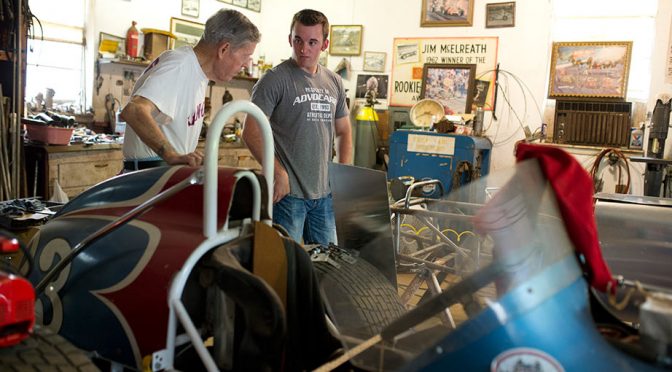
RCR driver gets taste of history in Meals on Wheels program

Austin Dillon‘s rank near the top of the NASCAR Nationwide Series standings this season hasn’t been a stunning development. But the 22-year-old driver had surprises of his own in store for Fort Worth-area residents Tuesday.

Dillon made unannounced stops to Tarrant County, Texas, residents through the Meals on Wheels program using Texas Motor Speedway‘s Chevrolet Camaro pace car for Friday night’s O’Reilly Auto Parts 300. After providing home-delivered meals to two families, his third delivery stop was at the home of Jim McElreath, a former USAC and driver who opened his garage of vintage cars and memorabilia.

FULL SERIES COVERAGE

View all articles
View all videos
View all photos

"Any time you meet a guy that has so much history of racing, it’s awesome," Dillon said. "I’m a big fan of the history and how it’s progressed over time, but still the same core values are there."

McElreath, the 1962 Indianapolis 500 Rookie of the Year, also savored the experience.

"It was great to talk racing with Austin because he has a bright future," said McElreath, 85. "Any time I get to share my love of racing with a fellow driver, it’s a good day."

The rest of Dillon’s day involved deliveries to Dick and Marian Atkins, the former a retired Air Force colonel, and Rick Atkins, a former sprint car driver. The county chapter of Meals on Wheels, which began in 1973, helps more than 4,000 elderly and disabled homebound residents each year.

Dillon, the 2011 NASCAR Camping World Truck Series champion, will be doing double duty at the 1.5-mile Fort Worth track this weekend. He’ll campaign his usual ride, the No. 3 Chevrolet from Richard Childress Racing, in Friday’s Nationwide event, then will jump to James Finch’s No. 51 Phoenix Racing entry for Saturday’s Sprint Cup Series race.

The underdog No. 51 team has used three drivers in six Sprint Cup races this season with admirable results; Phoenix Racing sits 11th in the series’ car owner points after last weekend’s event at Martinsville Speedway.

"The No. 51 team and James Finch have put a lot of effort into it this year, and they do every year," said Dillon, whose fifth career Sprint Cup start Saturday night will be his second effort for Finch. "I think the best thing about this year is that they’ve been rewarded with some great finishes. I think we can get in there this weekend at a track that I run pretty good at and have a good finish."

___________________________________________________________________________________________

Comments are currently unavailable. We’re working on the development of a NASCAR fan forum – please stay tuned.
Take a look back at the race and track history with some noteworthy numbers

0.028    seconds, the margin of victory when Elliott Sadler beat Kasey Kahne to the checkered flag (April 4, 2004), the closest since the advent of electronic scoring.

1    Cup driver has won with two different manufacturers (Jeff Burton — 1997 with Ford, 2007 with Chevrolet).

1.5    miles, the track length.

3    is the starting position to produce the most wins (four).

4    drivers have made all 24 starts in the history of the race (Jeff Gordon, Bobby Labonte, Burton and Mark Martin).

5   degrees of banking on the frontstretch and backstretch.

8.842    best average starting position, Jimmie Johnson (only active driver with an average starting position in the top 10).

9    drivers from Texas have won at least one race in NASCAR’s three national series (Terry Labonte, Bobby Labonte, A.J. Foyt, Billy Wade, Bobby Hillin Jr., Johnny Rutherford, James Buescher, David Starr and Colin Braun).

9.4    is the best average running position (Matt Kenseth).

16    is the number of races Jeff Gordon participated in before winning (Spring 2009), the longest span of any of the 14 active Cup winners.

17    drivers have poles at Texas (Dale Earnhardt Jr., Gordon, Bobby Labonte, Ryan Newman and Martin Truex Jr. all have two).

20    races have been run without Kevin Harvick posting a DNF.

23    is the age of the youngest pole winner (Brian Vickers at 23 years, 0 months, 12 days on Nov. 5, 2006).

24    degrees of banking in the turns.

25    is the age of the youngest winner (Newman, at 25 years, 3 months, 22 days on March 30, 2003).

31    is the deepest in the field that a race-winner has started (Kenseth in 2002).

FULL SERIES COVERAGE

View all articles
View all videos
View all photos

33    Cup races have been held in Texas (Texas Motor Speedway; Meyer Speedway; Texas World Speedway).

44    is the age of the oldest winner (Dale Jarrett at 44 years, 4 months, 6 days on April 1, 2001).

46    is the age of the oldest pole winner (Bill Elliott at 46 years, 6 months, 0 days on April 8, 2002).

79    drivers have called Texas home.

99    is the only car number to produce three or more wins (Burton — 1997; Carl Edwards — 2005 sweep, 2008 sweep).

106.6    Matt Kenseth’s driver rating at Texas, a series best.

129    drivers have competed in at least one Cup race.

196.235    miles per hour is the track qualifying record set by Vickers on Nov. 3, 2006 (27.518 seconds).

334    laps (500 miles) is the length of the race.

455    is the number of fastest laps run by Greg Biffle, a series high.

677    is the highest number of quality passes, held by Earnhardt Jr.

772    laps have been led by Kenseth, the most by any driver (21 starts).

1,330    feet is the length of the backstretch.

1995    construction began on Texas Motor Speedway.

1997    the year the first races were held (April 5 — Nationwide, winner: Martin; April 6 — Cup, winner: Burton).

2011    was the first night race when the Sunday race was moved to Saturday night.

2,250    feet is the length of the frontstretch.

___________________________________________________________________________________________

Comments are currently unavailable. We’re working on the development of a NASCAR fan forum – please stay tuned.
How are you watching the races at Texas Motor Speedway and Rockingham Speedway? Find out how to get the latest from wherever you are.

WATCHING AT HOME?

GOING TO THE RACE?
GOING MOBILE?
PLAYING FANTASY?

Even if you’re not at the track, you can keep up with all the live action on TV and at NASCAR.com. (All times Eastern, unless noted.)

Watch practices and races on TV:

SPRINT CUP SERIES:

Friday, April 12:

Practice on SPEED, 12:30 p.m.

Final practice on SPEED, 3 p.m.

Coors Light Pole qualifying on SPEED, 6:30 p.m.

Saturday, April 13:

NRA 500 on FOX, 7 p.m.

NATIONWIDE SERIES:

Friday, April 12:

Coors Light Pole qualifying on ESPN2, 5 p.m.

O’Reilly Auto Parts 300 on ESPN2, 8:30 p.m.

CAMPING WORLD TRUCK SERIES:

Sunday, April 14:

North Carolina Education 200 on SPEED, 2 p.m.

Get inside the garage:

GarageCam will be streaming live from Texas Motor Speedway on Friday, April 12 from the Nationwide garage at 10:30 a.m. ET and from the Sprint Cup garage at noon ET.

Keep an eye on the media center:

Press Pass will have live news conferences throughout race weekends. All times Eastern.

Thursday, April 11:

Greg Biffle, Paul Menard and Martin Truex Jr. | 4:10 p.m.

Robin Pemberton | 4:30 p.m.

Friday, April 12:

Carl Edwards | 2:15 p.m.

Brian Vickers | 2:30 p.m.
Sprint Cup Series Coors Light Pole qualifying | 7:45 p.m.
Nationwide Series post-race | 10:30 p.m.

Saturday, April 13:
Sprint Cup Series post-race | 10:45 p.m.

Want more?

Get lap-by-lap updates on NASCAR.com during practice laps, qualifying and races.

Re-live the race:

Watch race highlights from your favorite driver and top moments shortly after the race using Race RePlay.

Want to attend the races this weekend? Buy tickets to the Texas races here and the Rockingham race here.

Know the track:

Check out our Texas Motor Speedway track page and Rockingham Speedway track page to learn the history of the tracks and explore the best fan views.

Want to meet a driver?

Here is a list of appearances. (List subject to change, all times local.)

Friday, April 12 (Texas):

Johanna Long | 1:30 p.m. at the Chevy Stage.

Kyle Larson | 1:45 p.m. at the Chevy Stage.

Justin Allgaier | 1:45 p.m. at the Chevy Stage.

Neslon Piquet Jr. | 1:45 p.m. at the Chevy Stage.

Saturday, April 13 (Texas):

Austin Dillon | 2:45 p.m. at the Chevy Stage.

Ricky Stenhouse Jr. | 3 p.m. at the Port-A-Cool trailer.

Paul Menard | 3 p.m. at the Chevy Stage.

Tony Stewart | 3:35 p.m. at the Chevy Stage.

No. 42 car pit crew | 4 p.m. at the Chevy Stage.

Saturday, April 13 (Rockingham):

Driver autograph session | 10:15 a.m. at the rocks by the main entrance.

Get packing:

The weather in Rockingham is:

Click for Rockingham, North Carolina Forecast

The weather in Fort Worth is:

Click for Fort Worth, Texas Forecast

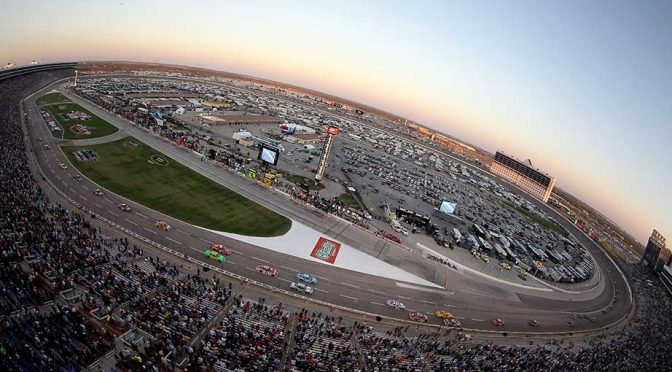
Texas Motor Speedway hosts the first night-race of the NASCAR Sprint Cup Series season on its mile-and-a-half asphalt track.

Keep all eyes on the race:

With RaceView Premium and NASCAR RaceView Mobile ’13, formerly RaceView 360, you can watch live, virtual 3-D video with in-car audio as well as national radio broadcasts, telemetry data and real-time stats.

Follow from anywhere:

NASCAR Mobile ’13: This new app is free to download with an upcoming in-app subscription for premium content including live driver audio, live advanced leaderboards and live alternate camera angles (when available).

Buddy system:

Watch live enhanced coverage with 10 HD cameras, a live chat and live standings for this week’s Nationwide series races with RaceBuddy.

Play NASCAR FANTASY LIVE:

Don’t forget to do your research and set your lineup.

Expert tip of the week:

Texas is one of the fastest tracks on the circuit — faster than Daytona and Talladega — so this week’s roster should be comprised of marquee teams with solid engine programs. Get more tips from Dan Beaver’s fantasy blog.

Keep up with the latest:

Use our weekly Driver Reports for a quick breakdown of how each driver is looking. Also each week, our writers vote on which drivers are making moves. Read the resulting driver Power Rankings to help power up your lineup.

Last year’s top three finishers at Texas:

1. Jimmie Johnson

2. Brad Keselowski

3. Kyle Busch

See the complete results from last year’s event here.

___________________________________________________________________________________________

Comments are currently unavailable. We’re working on the development of a NASCAR fan forum – please stay tuned.
The son of a legendary race car driver, Chase Elliott is making a name for himself

The post-race staging area after Saturday’s NASCAR Camping World Truck Series event at Martinsville Speedway was a smoldering mess of race trucks, almost a receiving line of vehicles with crumpled fenders and used-up brakes. In other words, typical Martinsville.

The No. 94 Chevrolet near the front of the line was no different, mostly straight but with a handful of apparent battle scars. But the driver of the sixth-place truck was far from typical for a rookie.

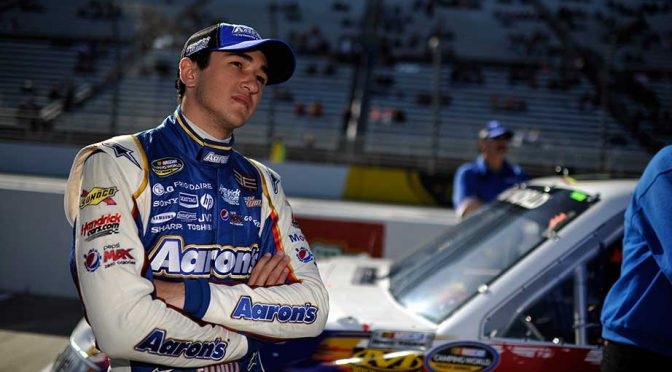
Chase Elliott, 17, hadn’t made a truck series start in his young, budding racing career. Yet here he was after his debut on the fringes of a top-five, fresh-faced and pleased after 250 laps of learning the ropes at one of NASCAR’s most difficult tracks.

"He fell way back, kept his head together and did what he needed to do, and we came out of here with a good finish," said Bill Elliott, his father, team owner and the 1988 champion in NASCAR’s premier series. "That’s where we just need to keep building this program. It’s hard enough as-is. Every place he goes is going to be kind of a learning curve."

The younger Elliott’s maturation process continues this weekend at Rockingham Speedway, site of Sunday’s North Carolina Education Lottery 200 at the Rock presented by Cheerwine — the series’ third race of the season. It’s a track he’s raced and won on before in other stock-car series, but never in a truck from NASCAR’s national circuits.

Even with the boyish expression of a teenager, Elliott still speaks as a driver with bounds of experience. Credit that to a number of seasons driving late model cars up through the ranks and the expert tutelage of his father, a 44-time winner in NASCAR’s top tour.

"Same old Rocking-ham. If it hasn’t changed in the past 10 years, it’s not going to change before next weekend."

— Chase Elliott

"I’ve learned a lot from him," Chase Elliott said. "We’ve done a lot of racing these last four years and we’ve gone to a lot of different race tracks. I think that’s helped more than anything. We’ve gone to places, I’ve burned up brakes, we’ve gotten super-tight, gotten loose, blown right-fronts, blown right-rears. It seems like we’ve seen a lot of stuff, and I think all that’s going to do is help better prepare you for races like this in the truck series.

"This is a very, very competitive series, and I learned a lot about that today. I especially think going into next week at Rockingham, you’re going to see some fast times, some fast trucks and good racing, too."

Elliott was a bright spot in a considerably strong youth movement for the series at Martinsville, with two Rookie of the Year candidates — Jeb Burton and Darrell Wallace Jr. — leading laps and notching convincing finishes in the top five. Elliott was one of two drivers without rookie candidacy making their first truck start; Erik Jones, 16 — like Elliott — took advantage of a new rule allowing drivers younger than 18 to race on tracks the size of Rockingham or smaller, claiming a ninth-place finish.

Bill Elliott scored four victories at Rockingham over the course of his decorated Sprint Cup career, but he acknowledged that there’s a limit to the wisdom he can impart on his son.

"I’m in a position now that I’ve tried to help him and teach him and take him as far as I can," he said. "The rest is going to be circumstances — getting with the right group of guys and meshing and taking it to the next level. I know he can drive. I know he can do the job, but it’s just if everything comes together. The farther you go up the ladder, obviously the harder it gets. That’s going to be the next step. … I look at it if we can be competitive, that’s the key. We race against a lot of guys that race hard at this deal and if we can keep nibbling at it and keep going and doing what we need to do, that’s what we’ve got to do."

The next steps continue in the North Carolina sandhills, where the mile-long layout of the Rock places a premium on tire management and handling. But the younger Elliott, standing beside his still-warm truck in the Martinsville garage, spoke about the challenge ahead with the perspective of a would-be veteran.

"Same old Rockingham," he said. "If it hasn’t changed in the past 10 years, it’s not going to change before next weekend."


___________________________________________________________________________________________

Comments are currently unavailable. We’re working on the development of a NASCAR fan forum – please stay tuned.
Engine builder Maurice, Jarrett, Phillips, Smith, White added to list

He began building engines in a tiny room off to the side of a tiny shop in the tiny, sleepy little township of Level Cross, N.C.
 
But by the time the last bolt had been tightened and the last seal checked, the man known simply as “Chief” was a giant in the engine-building business.

"There is no one that comes even close to accomplishing what Maurice did."

Richard Petty

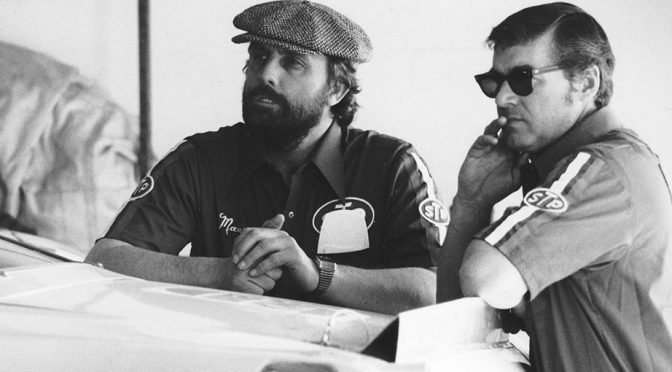
Maurice Petty, 74, built the engines for more than 200 NASCAR race-winning entries, and helped power his brother Richard to seven Cup championships and seven Daytona 500 titles.
 
Petty is one of five new nominees on this year’s list of 25 that will be considered for induction into the NASCAR Hall of Fame for 2014.
 
He is the fourth member of the highly successful Petty Enterprises organization to be nominated. Patriarch Lee Petty, son Richard and cousin Dale Inman are already members of the hall.
 
Other first-time nominees are 1999 NASCAR Sprint Cup champion Dale Jarrett, 1960 champ Rex White, Speedway Motorsports Inc., founder O. Bruton Smith and Larry Phillips, the only driver to win five NASCAR Weekly Series national titles.
 
Richard Petty said it was only fitting that his younger brother be among those nominated.
 
“There is no one that comes even close to accomplishing what Maurice did,” Petty said.“Just like Dale was so far out there as a crew chief, Maurice was just as far ahead of the rest of them when it came to building engines.”
 
Inman won eight championships as a crew chief, seven with Petty.
 
“Leonard (Wood), he was in that same class as Dale,” Petty said of the Wood Brothers’ crew chief who joined the Hall last year. “But to me, there’s not anyone in the same ballpark with Maurice.”
 
Marvin Panch, Pete Hamilton and Buddy Baker also earned Cup wins with engines built by Petty.
 
Jarrett is the son of two-time champion Ned Jarrett, who was inducted into the Hall of Fame in 2011. In addition to his ’99 title, the younger Jarrett, now a NASCAR commentator for ABC and ESPN, won 32 Cup races, including the Daytona 500 on three occasions. He is also a two-time winner of the Brickyard 400 at Indianapolis Motor Speedway and won 11 races in the NASCAR Busch (now Nationwide) Series.
 
White won six races and scored an amazing 35 top-10 finishes in 40 starts en route to the 1960 championship. His ability to come away with solid finishes is apparent — in nearly one-half of his 233 career starts, White placed inside the top five. During a nine-year campaign at the top level, he finished in the top 10 in points six times, including a runner-up effort in 1961 and retired with 28 career victories.
 
A racer turned promoter, Smith was one of the original partners of Charlotte Motor Speedway. The 1.5-mile track became the base for Smith’s Speedway Motorsports empire, an organization that today owns eight tracks hosting 12 NASCAR Sprint Cup events. CMS is also the home of the series’ annual all-star race. SMI became the first motorsports organization to be traded on the New York Stock Exchange, as Smith took the company public in 1995. In addition to CMS, the company also owns Bristol, Texas, Atlanta, Las Vegas and New Hampshire Motor Speedways, Kentucky Speedway and Sonoma Raceway.
 
There are no accurate records of Phillips’ total number of wins, but the racer who dominated the competition across the Midwest is said to have captured more than 1,000 short-track victories during his amazing driving career.
 
He was a standout in the NASCAR Weekly Racing Series, where he trounced the competition while winning five titles between 1989 and 1996. He boasts a winning percentage of 76 percent with victories in 220 of 289 NASCAR-sanctioned starts and in 2006 he was named one of the top 25 drivers in the NASCAR Whelen All-American Series.
 
In addition to this year’s five new faces, this year’s list also includes nine nominees that have been on the ballot since the inaugural vote in 2010: car owners Rick Hendrick, Richard Childress and Raymond Parks; two-time Cup champions Joe Weatherly and Tim Flock; Red Byron and Benny Parsons, each with one championship to their credit; and early stars Curtis Turner and Glen “Fireball” Roberts.
 
Others on the list are: Jerry Cook, H. Clay Earles, Anne B. France, Ray Fox, Jack Ingram, Bobby Isaac, Fred Lorenzen, Les Richter, T. Wayne Robertson, Ralph Seagraves and Wendell Scott.
 
The 21 members of the Hall of Fame nominating committee, along with a 31-member panel of former drivers, crew chiefs, owners, manufacturer representatives and members of the media will meet May 22 to consider this year’s nominees and cast votes for the 2014 class. One vote is also provided through a nationwide fan vote initiative.
 
The names of the five inductees will also be announced May 22, after the votes have been tallied and verified.

___________________________________________________________________________________________

Comments are currently unavailable. We’re working on the development of a NASCAR fan forum – please stay tuned.