Underweight connecting rod a mistake that harmed more than helped, company says

Related: NASCAR news release | Top NASCAR penalties | Video | Inside engines | Fantasy take

David Wilson of Toyota Racing Development was on the telephone with Joe Gibbs until late Tuesday night, reassuring the team owner of one thing: there was no intent.

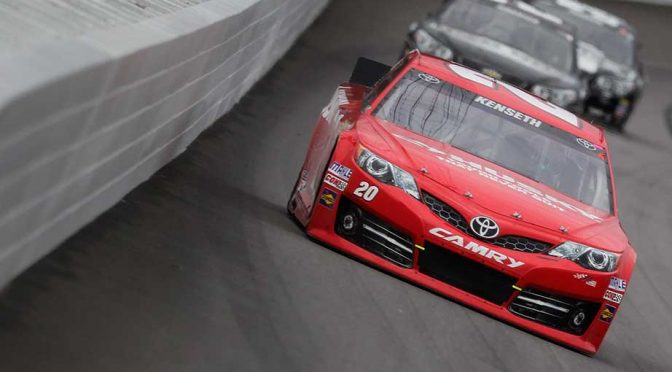
Joe Gibbs Racing driver Matt Kenseth was saddled Wednesday with one of the more severe penalties in recent memory, due to a connecting rod in the engine of his No. 20 car that was found to be lighter than allowed during tear-down at the NASCAR Research and Development Center. NASCAR has historically treated engine offenses very harshly, and this was no different — Kenseth was docked 50 points, his pole at Kansas Speedway was vacated and his race victory last weekend cannot be used toward Chase for the Sprint Cup eligibility.

Crew chief Jason Ratcliff was also fined $200,000 and suspended six weeks; Gibbs lost 50 owner points and won’t be allowed to accumulate any more from the No. 20 for six weeks; and Toyota was docked five points in the manufacturers’ standings. JGR plans to appeal the penalties, while TRD is zeroing in on what caused the infraction in the first place. But the company says it is sure of one thing — this was not an attempt to gain a competitive advantage.

FULL SERIES COVERAGE

• View all articles
 • View all videos
 • View all photos

“There obviously was no intent,” said Wilson, senior vice president at TRD, which manufacturers engines for Toyota teams in NASCAR’s premier series. “… It was an oversight. Now, how can this happen? Obviously that’s our biggest concern and what we’re principally focused on today.”

According to the Sprint Cup Series Rule Book, connecting rods must be composed of solid magnetic steel with a minimum weight of 525 grams. Wilson said only one of the vehicle’s eight connecting rods was in question, and it measured 2.7 grams under the minimum weight. Its neighboring rod, he added was more than 4 grams over the minimum.

Wilson said NASCAR mandates the material and minimum weight of a connecting rod, because otherwise engine builders would try to construct them out of a lighter substance such as titanium. If there was an intent to gain a competitive advantage, he added, all the connecting rods would have been lighter, and not just one. Making one rod lighter than the others only unbalances the load on the bearings, and carries a higher risk of failure.

“The notion that you would reduce the weight of one rod, and by 2.3 grams, as an opportunity to enhance your performance is patently absurd. Because what you actually risk is placing an uneven bearing load on the crank shaft. What you strive for is every connecting rod to weigh the same … At 10,000 RPM, if you don’t have a balanced bearing load, you’re going to fail,” Wilson said.

“You’d never do that. If we were going to undertake this, it would absolutely be across all eight cylinders, or you’re running the risk of damaging a main bearing and failing an engine. … There’s zero motivation, zero incentive” to have one rod lighter than the others, he added.

So how did it happen? Like many engine builders, TRD outsources some components from vendors — including connecting rods. TRD has been using the same supplier for connecting rods since the fall of last year, and Wilson said the company is certified at the highest level by the International Organization for Standardization.

Since TRD can’t measure every part that comes to its facility from a vendor, it leans on that ISO certification as a safeguard. “We place a lot of the burden of that qualify control on them,” Wilson said. “Because that’s by definition what they do. What doesn’t correlate here is, how could that supplier have made that mistake? And what is our exposure level?”

Wilson said TRD checked the paperwork for all the engines in Toyota vehicles bound for this weekend’s event at Richmond International Raceway, to ensure none of the connecting rods were suspect. They weren’t. “So at that point we’re characterizing it as a fluke,” he added. “At this point, we’re not making any excuses. And whether it’s a fluke or not, it’s on us.”

How much of a role that might play in Gibbs’ planned appeal to the National Stock Car Racing Appeals Panel is yet to be seen. “We are going to support them in whatever manner we can,” Wilson said. “Certainly we think we have a responsibility therein. They’re running the show, though. It’s their appeal. We’re there to hopefully support them, and achieve a good result.”

It’s been a stressful season for TRD, which, despite its success on the race track, has endured some rough weeks early in the year due to valve problems. But Wilson said NASCAR has torn down 10 Toyota engines this season, and did the same to roughly 26 last year, and none of them revealed similar issues with connecting rods. At the end of their long telephone conversation into the wee hours Wednesday morning, Gibbs ensured Wilson there was no plan to change engine manufacturers.

“The last thing he left me with last night was, ‘Hey, we signed up for this partnership, and we are going to get through this together as partners. We have no intention of laying you guys away. We take the good with the bad,’” Wilson said. “You remember last year through the crises with Kyle (Busch), that arguably could have stressed this partnership. But we stood firm behind the team just as we expect they’re going to stand firm behind us. We’ll get through this.”


___________________________________________________________________________________________

Comments are currently unavailable. We’re working on the development of a NASCAR fan forum – please stay tuned.
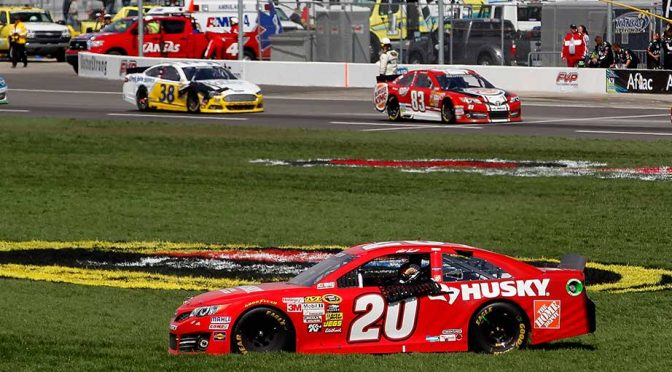
Crew chief, driver, owner all penalized over illegal connecting rod

Related: Toyota reaction | Top NASCAR penalties | Video | Inside engines | Fantasy take

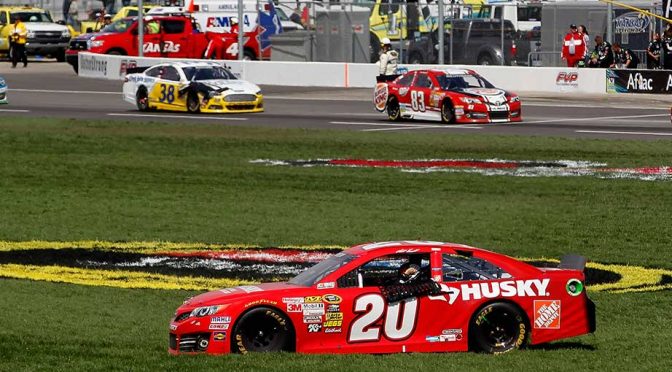
Matt Kenseth’s race team was hit with a severe penalty from NASCAR on Wednesday, one the Joe Gibbs Racing driver will feel the sting of all the way into the Chase for the Sprint Cup.

Kenseth was docked 50 points, and lost the three Chase bonus points he would have received for winning last weekend’s event at Kansas Speedway, after a connecting rod in the engine of his No. 20 car failed to meet minimum weight. The violation was discovered Tuesday in post-race engine inspection at the NASCAR Research and Development Center in Concord, N.C.

In addition, crew chief Jason Ratcliff has been fined $200,000, suspended for the next six Sprint Cup events, including the non-points Sprint All-Star Race. Car owner Joe Gibbs was docked 50 owners’ points and had his license suspended for six races, during which he will be ineligible to receive owners’ points. Kenseth’s pole at Kansas will not be allowed for eligibility into the 2014 Sprint Unlimited at Daytona, and in a rare step Toyota was docked five points in the manufacturer standings.

FULL SERIES COVERAGE

• View all articles
 • View all videos
 • View all photos

Kenseth’s victory at Kansas was his second of the season. As is customary, the race-winning engine was taken to the NASCAR R&D Center for inspection. Although Joe Gibbs Racing engines are provided by Toyota Racing Development, the team is ultimately held responsible for what it brings to the race track. Gibbs Racing said it plans to appeal through the National Stock Car Racing Appeals Panel.

According to NASCAR, the No. 20 team’s Kansas engine violated the sections of the 2013 Sprint Cup Series Rule Book that stipulate connecting rods must be made of solid magnetic steel and have a minimum weight of 525 grams. Each of the eight rods in a Sprint Cup engine is weighed with its connecting rod cap and cap fastener.

Joe Gibbs Racing said in a statement that one of the engine’s connecting rods was ruled too light. “We are working with our partners at TRD on this issue,” the team said. “In the meantime, we will plan to appeal the penalty.”

Toyota said in a statement that the connecting rod in question was three grams under the legal minimum weight, and none of the other seven were found to be at fault.

"We take full responsibility for this issue with the engine used by the No. 20 Joe Gibbs Racing (JGR) team this past Sunday in Kansas — JGR is not involved in the process of selecting parts or assembling the Cup Series engines," TRD president Lee White said. "It was a simple oversight on TRD’s  part and there was no intent to deceive, or to gain any type of competitive advantage. Toyota is a company that was built on integrity, and that remains one of the guiding principles of the company. The goal of TRD has always been — and will continue to be — to build high-performance engines that are reliable, durable and powerful, and within the guidelines established by NASCAR."

Kenseth stood eighth in the Sprint Cup standings following his victory at Kansas, but the loss of 50 points would drop him to 14th. His Kansas win will also not be credited toward Chase Wild Card eligibility.

NASCAR traditionally takes a very hard line on engines, which by rule cannot exceed 358 cubic inch displacement. One of the most severe penalties ever levied by the sanctioning body involved the engine of driver Carl Long, which was found to be too large during Sprint All-Star Race weekend in 2009. Long’s team was fined $200,000 while the driver was docked 200 points and suspended for 12 weeks, although that number was reduced to eight upon appeal.

Not even potential NASCAR Hall of Fame members are immune from the sport’s stringent engine guidelines. Maurice Petty, engine builder for brother Richard Petty and a nominee for next year’s Hall of Fame class, was fined $35,000 for an engine in the No. 43 car that was found to be too large following the 1983 fall race at Charlotte Motor Speedway. His brother was also docked 104 points.

NASCAR has nullified Chase bonus points before — in 2008, Carl Edwards lost the 10 bonus points he would have garnered under the old scoring system after the cover of his vehicle’s oil reservoir tank was found to be missing in inspection following a victory at Las Vegas. Crew chief Bob Osborne was suspended six races, and the 10 bonus points Edwards would have carried into the Chase were withdrawn.

The penalty to Kenseth’s team comes in the wake of sanctions levied last week against Penske Racing. Brad Keselowski and Joey Logano each lost 25 points, while their respective crew chiefs, car chiefs and race engineers were all suspended six weeks for rear-end housing parts that were confiscated prior to the April 13 race at Texas. Penske is appealing the penalties, and the suspended crewmen have been allowed to work until that appeal is heard Wednesday morning.


___________________________________________________________________________________________

Comments are currently unavailable. We’re working on the development of a NASCAR fan forum – please stay tuned.
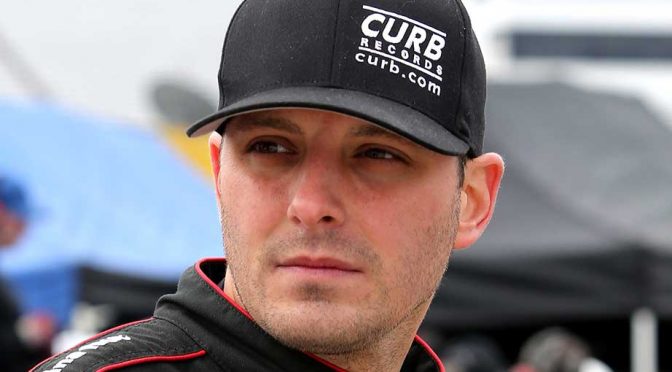
Driver loses 50 championship points; crew chief fined $200,000, suspended six races

Related: Reaction | Top NASCAR penalties | Video | Inside engines | Fantasy take 

DAYTONA BEACH, Fla. — Penalties have been handed down to the No. 20 NASCAR Sprint Cup Series team as a result of rule violations discovered in the post-race engine inspection April 23 at the NASCAR Research and Development Center.

FULL SERIES COVERAGE

• View all articles
• View all videos
• View all photos

The No. 20 car was found to have violated Sections 12-1 (actions detrimental to stock car racing); 12-4J (any determination by NASCAR officials that the race equipment used in the event does not conform to NASCAR rules); and 20-5.5.3 (E) (Only magnetic steel connecting rods with a minimum weight of 525.0 grams will be permitted; connecting rod failed to meet the minimum connecting rod weight) of the 2013 rule book.

As a result of this violation, NASCAR has assessed the following penalties:

•    Crew chief Jason Ratcliff has been fined $200,000 and suspended from NASCAR until the completion of the next six NASCAR Sprint Cup Series championship points events (a period of time that also includes the non-points NASCAR Sprint All-Star Race).

•    Car owner Joe Gibbs has lost 50 championship car owner points; the first-place finish from April 21 at Kansas Speedway will not earn bonus points toward the accumulated aggregate car owner points total after the completion of the first 26 events of the current season and will not be credited toward the eligibility for a car owner Wild Card position; has had the owner’s license for the No. 20 NASCAR Sprint Cup Series car suspended until the completion of the next six championship points events, therefore being ineligible to receive championship car owner points during that period of time.

•    Driver Matt Kenseth has lost 50 championship driver points; the Coors Light Pole award from April 19 at Kansas Speedway will not be allowed for eligibility into the 2014 Sprint Unlimited; the first-place finish from April 21 at Kansas Speedway will not earn bonus points toward the accumulated aggregate driver points total after the completion of the first 26 events of the current season and will not be credited toward the eligibility for a driver Wild Card position.

•    The loss of five NASCAR Sprint Cup Series Manufacturer Championship points.

Crew chief fined and suspended, team docked owner and driver points

DAYTONA BEACH, Fla. — NASCAR announced today penalties and fines to the No. 98 team that competes in the NASCAR Camping World Truck Series, as a result of rule infractions at Kansas Speedway.

FULL SERIES COVERAGE

• View all articles
 • View all videos
 • View all photos


The No. 98 truck was found to have violated Sections 12-1 (actions detrimental to stock car racing); 12-4K (if in the judgment of NASCAR Officials, race equipment that has been previously verified or previously approved and/or sealed by NASCAR for use in an event, pursuant to sub-section 8-6 and/or 8-12, has been altered, modified, repaired, or changed in any manner); 20B-16 (once a fuel cell or fuel cell components have been certified, modifications of any kind will not be permitted to the fuel cell or fuel cell components); and 20B-16.1B (standard black, safety foam with minimum free-standing height of eight (8) inches, acceptable to NASCAR Officials, and used as provided by an approved fuel cell manufacturer, must be used: Fuel cell safety foam modification.) of the 2013 rule book.

As a result of this violation, crew chief Joel Shear has been fined $10,000 and suspended from NASCAR competition until the completion of the next four (4) NASCAR Camping World Truck Series events. He has been placed on NASCAR probation until December 31. The team has also been docked 25 championship driver (Johnny Sauter) and 25 championship owner (Mike Curb) points.

The violations involving the No. 98 truck occurred in opening day inspection.


___________________________________________________________________________________________

Comments are currently unavailable. We’re working on the development of a NASCAR fan forum – please stay tuned.

Driver remains hopeful of returning this weekend at Richmond

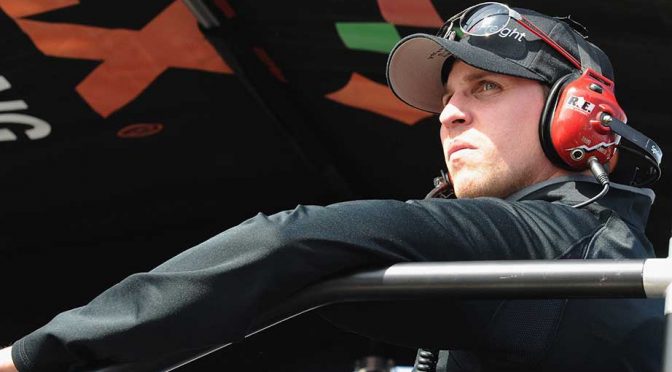
WASHINGTON — Denny Hamlin‘s latest scan is done.
 
Now he’s waiting for doctors to read the results and arrive at a consensus of opinion as to whether he can race this weekend at Richmond International Raceway.
 
"A doctor has seen a scan yesterday, but, obviously, there’s a large team of doctors who have to have a consensus," Hamlin said Wednesday morning during a visit to the Grooming Lounge in downtown Washington. "Until all of them get the images, we’re still waiting on that. They should have them this morning.
 
"Hopefully, by the end of the day, everyone will have consensus and have time to review what’s the safe thing to do."
 
Hamlin, sidelined with a compression fracture of his first lumbar vertebra during a last-lap wreck March 24 at Fontana, Calif., said he has been preparing to get back into his Joe Gibbs Racing No. 11 Toyota Friday at Richmond if he has medical approval. Charlotte neurosurgeon Dr. Jerry Petty has the final say and getting input from the group.

"Hopefully, by the end of the day, everyone will have consensus and have time to review what’s the safe thing to do."

—Denny Hamlin

Whether he’s approved to race at Richmond or not, Hamlin plans to start the race the following week at Talladega and then give way to a relief driver. He’ll exit the car at Talladega at the first opportunity after riding in the back.
 
"We do have an agreement, I believe, on starting next week and getting out, so at least we’ll get some points starting next week," Hamlin said. "After that, I don’t know. It just depends on what the doctors, the results of this (the scan) are and when they want to re-scan and check progression again …
 
"Physically, I’m not much different than I am every day with my mobility. … We obviously have to be smart about this, because it is just one season. Hopefully, there’s many more to come. I’m just trying to do the right thing for my team and sponsors, because I feel like they need me."
 
Hamlin is leaning toward back surgery during the offseason — or perhaps sooner if his prospects of making the Chase for the NASCAR Sprint Cup evaporate — because the compression fracture exacerbated a problem with bulging disks that existed before the crash. The bulging disks are far more painful to the 32-year-old-driver than the compression fracture was.
 
"(The accident) really screwed ’em up," Hamlin said. "I’m at the point now where, if they don’t let me back in the car in a timely fashion, where I’m going to be racing for nothing for the rest of the year, I’d just as soon do it now and get it over with and come back next year strong and ready to go."
 
Hamlin visited Washington in advance of America’s Small Business Summit, where FedEx (the primary sponsor of Hamlin’s No. 11 Toyota), the Red Cross and the U.S. Chamber of Commerce together will offer disaster preparedness tips to small businesses.
 
Earlier on Wednesday, Hamlin toured the American Red Cross Disaster Operations Center, the primary point of contact for all disaster services, before driving a street-legal version of his No. 11 Camry to the Grooming Lounge to participate in a preparedness review.
 
"The last couple of years we’ve informed some kids on what to do when a disaster strikes, to prepare themselves, their families and all that," Hamlin said. "What we’re doing now is trying to get these small businesses to be informed, because, ultimately, our economy works around small businesses.
 
"Forty percent of small businesses that are affected by natural disasters never reopen. That’s a very disturbing stat. It affects a lot of families, because everyone that works here has two or three family members that live in their household, and they get fed off them being open. So we have to get them informed and very educated on what they can do in case a disaster strikes, to make sure their business is stronger on the way out."
___________________________________________________________________________________________

Comments are currently unavailable. We’re working on the development of a NASCAR fan forum – please stay tuned.
Changes at Daytona, Talladega in response to crash in Nationwide season-opener

DAYTONA BEACH, Fla. — Both Daytona International Speedway and Talladega (Ala.) Superspeedway will undergo reinforcements to the crossover gate fencing in response to a February accident in the NASCAR Nationwide Series season-opening race at Daytona.

In the midst of a multi-car accident near the end of the event, a car driven by rookie Kyle Larson impacted a crossover gate located in the frontstretch fencing and parts of the car penetrated the fencing with debris scattering into the grandstands. Fourteen fans were treated at the track and 14 more were transported to local hospitals with injuries reportedly ranging from a broken bone to cuts and scrapes.

Both track presidents joined NASCAR Vice President Steve O’Donnell for Wednesday’s progress announcement.

They revealed that two structural engineering firms were hired to review data from the car and the scene of the accident. The engineering firms — experts at track design with more than 175 years of combined experience — agreed on recommendations to reinforce all the current crossover gates.

FULL SERIES COVERAGE

• View all articles
• View all videos
• View all photos

A crossover gate opens before and after the race to allow fans and officials to move across the track between the infield and the grandstands. There are eight at Daytona and seven at Talladega.

“These changes include the installations of cable to create a redundant system to enhance continuity to the gate area," Daytona International Speedway President Joie Chitwood explained. “The additional cables are the same size as the existing cables both at Daytona and Talladega as well as installing supplemental tethering between the gate frame and post."

The work is already completed on the 2.67-mile Talladega track — NASCAR’s largest venue — where the Sprint Cup and Nationwide series race next week.

Chitwood did confirm that the engineers did not see a need to change the other fencing — which has stabilizing cables — saying all indications are that it was doing the “appropriate job."

No seating sections will be moved and both track presidents said they had not received any request from a fan to get a different seat assignment for upcoming races. Chitwood said the track is still in touch with the fans injured in February.

“NASCAR and the tracks where we race always want to ensure the fans have a safe and enjoyable experience, and we believe we do everything we can to make the sport as safe as possible for our fans and again, believe our history speaks to that fact," O’Donnell said.

He also provided insight into the investigation from NASCAR’s perspective, which included a strong focus on Larson’s No. 32 Toyota by using photographs and video of the accident plus the Incident Data Recorder (IDR) files.

“The information we provided included the 32-car’s impact speed, its acceleration, the impact angle, the impact time (duration) and change in vehicle speed during the incident," O’Donnell said of the review conducted at NASCAR’s Research and Development Center in Concord, N.C.

“So even as we wrap up this specific investigation as it relates to Daytona, our work will continue.

“This was phase one to get ready for Talladega and Daytona. We’re looking closely at all tracks where NASCAR races."

But, O’Donnell cautioned, each race track has its own unique characteristics in terms of banking and car speeds so there may not be a uniform need to change every track. That research and consultation is part of the ongoing work.

And, he added, that while NASCAR is still examining the structural integrity of the cars, he did not foresee changes to the engine restrictor plates next week at Talladega.

“Obviously we’ll see with practices, see where we land, but we’re confident with the safety measures in place for this event," O’Donell said.
 ___________________________________________________________________________________________

Comments are currently unavailable. We’re working on the development of a NASCAR fan forum – please stay tuned.

Johnson a unanimous top-spot choice, while Stenhouse Jr. sees signifcant gains and Smoke falls

— 1/3 5th

Driver                    Change            High/Low            Last race


1. Jimmie Johnson        —                        1/3                       3rd

Outlook: It may have been an uncomfortable week for Johnson, but it certainly didn’t show on the race track. Despite a late charge by Kasey Kahne, nobody was catching Matt Kenseth at Kansas. His third-place finish might as well count as a win, especially considering his points lead increased by 19.
Standings:
1st, 311 points

2. Brad Keselowski    

Outlook: Possibly due to his meeting with the man in charge, or perhaps that other thing hanging over his head, but regardless, Keselowski drove an inspired race on Sunday. Don’t expect that chip on his shoulder to dissolve anytime soon.
Standings:
 3rd, 273 points

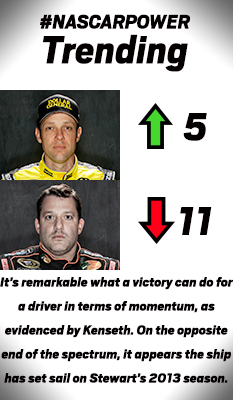
3. Matt Kenseth           

Outlook: Back-to-back Kansas victories have Kenseth feeling pretty good. Richmond isn’t historically one of his best tracks, but he does have a win there, and he’s been running so well when he’s able to finish a race that another trip to Victory Lane may be imminent.
Standings: 8th, 252 points

4. Kasey Kahne           

Outlook: Along with Truex Jr., Kahne enjoyed the biggest leap in the points standings, moving up five spots to second overall. Kahne’s stock is trending up and his second victory of the season could be right around the corner.
Standings:
2nd, 274 points

5. Kyle Busch              

Outlook: Luckily it didn’t end in fisticuffs, but a wreck between Busch and Joey Logano ended the day for the two drivers, both of whom took huge hits in the points and ranks.
Standings:
 7th, 257 points

Related Links:

Toyota Owners 400 entry list

Group qualifying for Sprint Cup road courses

Post-race reactions

Final Laps: Kenseth holds off Kahne

All Access: Danica Patrick

NASCAR Tech Series: CNC Machine

Sights and Sounds

Mobil 1 Driver of the Race

Weekend Top Five

Race Rewind


6. Dale Earnhardt Jr.

Outlook: Earnhardt had his chance at a top-five finish at Kansas spoiled thanks to an untimely caution, but Junior was still pleased with his team’s progress in the race. That being said, his brief reign at the top of the standings seems a distant memory.
Standings:
5th, 263 points

7. Clint Bowyer             

Outlook: Having a killer personality is one thing, but that doesn’t get a driver very far in NASCAR. Luckily there’s another side to Bowyer — a side that can drive the heck out of a race car. His runner-up finish last year was no fluke.
Standings:
9th, 247 points

8. Greg Biffle               

Outlook: Inspired by his team’s Boston Marathon relief efforts, Biffle was prepared to donate to a worthy cause and give $100 for each lap he led at Kansas. Noble, yes. Unfortunately the Roush Fenway Racing driver led zero laps on his way to a 19th-place finish.
Standings: 4th, 264 points

9. Carl Edwards           

Outlook: Edwards looked fantastic all weekend heading into Sunday’s race. He took the opening practice, and nearly grabbed the pole, finishing second in qualifying. And then he took 17th in the STP 400. Not exactly the textbook definition of “following-through”.
Standings:
6th, 262 points

10. Jeff Gordon            

Outlook: Gordon got behind the eight ball after crashing during qualifying and certainly wasn’t as confident as he could have been ahead of the race. Regardless, that didn’t stop the veteran from moving up from his starting position of 43rd to a 13th-place finish.
Standings:
15th, 202 points

11. Kevin Harvick       

Outlook: Harvick started the STP 400 17th, and finished 12th. Good, but not great. The Richard Childress Racing driver will need to improve if he intends on holding onto his 12th and final Chase spot. He has but one top-10 finish in 2013.
Standings:
 12th, 224 points

12. Martin Truex Jr.    

Outlook: Time to prove everyone wrong for good, Martin Truex Jr. Consecutive top-fives have you just on the outside of a Chase spot, but Richmond has been your worst track, with an average finish of 24.1. Show us what you got.
Standings:
14th, 204 points

13. Paul Menard          

Outlook: Another race, another top-10 for Menard. It’s almost a foregone conclusion that someone from the Menard, Truex Jr., Jamie McMurray, and Aric Almirola bunch will sneak into the Chase. There are 12 top-10 finishes split between them and four belong to Menard.
Standings:
10th, 240 points

14. Jamie McMurray        

Outlook: Richmond hasn’t been friendly to McMurray in the past. He currently sits in the 11th spot in the standings, so it’s safe to assume that despite an excellent 7th-place finish at Kansas, the Earnhardt Ganassi Racing driver might be on the outside looking in after the weekend.
Standings:
 11th, 227 points

15. Joey Logano             

Outlook: Yikes. Just three weeks after sitting pretty in ninth place with his stock on the rise, Logano now finds himself 37 points and eight spots out of a Chase spot with no wins under his belt. Much could change with the result of his penalty appeal decision, but above all else he needs a victory.
Standings: 20th, 187 points

16. Aric Almirola         

Outlook: What’s a guy gotta do to get some respect around here? An eighth-place finish has him 13th in the standings, but Almirola isn’t getting much recognition. His average finish of 26th in two career Richmond races doesn’t bode well for heads to turn.
Standings: 13th, 222 points

17. Ricky Stenhouse Jr.

Outlook: Sitting in the second row at the start of the STP 400, Stenhouse Jr. had plenty to be confident about heading into the race. The rookie made sure not to squander his opportunity, finishing a more-than-respectable 11th.
Standings:
18th, 196 points

18. Ryan Newman          

Outlook: Newman (along with the rest of his Stewart-Haas Racing gang) has been mediocre at best in 2013. Richmond might be his shining moment of the season, as he averages a finish of 11.6, with one win, five top-fives, and 13 top-10s in 22 races.
Standings: 17th, 200 points

19. Kurt Busch         

Outlook: The season certainly isn’t a wash for Busch, as he’s shown promise in spurts. Right now, it’s hard to picture him gaining much traction, but it definitely isn’t out of the question.
Standings: 22nd, 180 points

20. Jeff Burton          

Outlook: With 37 Richmond starts under his belt, there was a time when one could look at his 16 top-10 finishes at the track and feel confident that he could add another one. Tough to feel that way these days, but Burton could certainly be looked at as a dark horse.
Standings: 23rd, 178 points

In the rearview

Note: These rankings have been determined by a poll that included writers Kenny Bruce, Holly Cain, David Caraviello and Zack Albert, and video host Alan Cavanna. Tell us what you think about the Power Rankings. Use the hashtag #NASCARPOWER.

___________________________________________________________________________________________

Comments are currently unavailable. We’re working on the development of a NASCAR fan forum – please stay tuned.
Kyle Busch, Johnson, Earnhardt know how to make the most of this .75-mile track

.051  seconds remains the closest margin of victory at Richmond since the advent of electronic scoring, won by Jeff Burton in September 1998.

2  drivers have posted their first Coors Light Pole wins at Richmond: Bobby Labonte (September 1993) and Brian Vickers (May 2004). Tony Stewart (September 1999) and Kasey Kahne (May 2005) posted their first NASCAR Sprint Cup wins at Richmond.

3  active drivers have a NASCAR Sprint Cup Series average finish in the top 10 at Richmond: Kyle Busch, Denny Hamlin and Clint Bowyer.

4  of the 113 races at Richmond International Raceway have been shortened due to weather conditions: spring of 1962, spring of 1977, spring of 1982 and spring of 2003.

5.438  is the average finish position of Kyle Busch, who leads all active drivers in the NASCAR Sprint Cup Series at Richmond International Raceway.

7  drivers have won consecutive Coors Light poles at Richmond. Bobby Allison holds the record for most consecutive poles at Richmond with five (1972-1974).

7.925  is the best average starting position among active Sprint Cup Series drivers at Richmond International Raceway, a number earned by Jeff Gordon.

8  drivers in the NASCAR Sprint Cup Series have posted consecutive wins at Richmond International Raceway. Richard Petty leads the series in consecutive wins at Richmond after posting seven consecutive wins from the fall of 1970-1973. Terry Labonte (1994-1995) and Jimmie Johnson (2007 sweep) are the only two active drivers with consecutive wins at Richmond.

FULL SERIES COVERAGE

• View all articles
 • View all videos
 • View all photos

9  is the record for runner-up finishes, a tie between Bobby Allison and Richard Petty. Jeff Gordon leads all active drivers with six.

11  of the 113 Sprint Cup races at Richmond International Raceway have been won from a starting position outside the top 20.

15  Cup Series wins at Richmond have been claimed by Petty Enterprises, the most wins at the track, followed by Hendrick Motorsports with 10 and Joe Gibbs Racing with nine.

20  years, 6 months, 21 days is the age of the youngest Richmond pole winner: Brian Vickers on May 15, 2004. The oldest Richmond pole winner is Mark Martin, who won in April 2012 at 53 years, 3 months, 19 days.

16  active NASCAR Sprint Cup drivers have won at Richmond International Raceway, and each participated in at least one or more races before visiting Victory Lane. Dale Earnhardt Jr. and Tony Stewart won at Richmond in their second appearance.

22  of the 113 NASCAR Sprint Cup races at Richmond International Raceway have been won from the Coors Light pole. Only three active drivers have been able to accomplish the feat: Kasey Kahne (2005), Jimmie Johnson (2007) and Kyle Busch (2010). Thirteen races have been won from second-place.

31  is the deepest in the field that a race winner has started at Richmond International Raceway, by Clint Bowyer in the spring of 2008.

32  races after his Cup Series debut at Richmond, Terry Labonte made his first trip to Victory Lane there in 1994, the longest span of any of the 16 active NASCAR Sprint Cup Series winners. Bobby Labonte leads the series among active drivers with the most NASCAR Sprint Cup starts at Richmond without visiting Victory Lane at 40.

35  wins have come from Chevrolet, while Ford has 28.

44  is the record for top-10 finishes, held by Richard Petty. Mark Martin leads all active drivers with 30; followed by Terry Labonte with 28.

47  different drivers have won at Richmond International Raceway, led by Richard Petty with 13. Kyle Busch leads all active drivers with four.

51  drivers have won Coors Light poles at Richmond, led by Richard Petty and Bobby Allison with eight each. Jeff Gordon and Mark Martin lead all active drivers with five each.

63  starts at Richmond is currently the series record, held by NASCAR Hall of Famer Richard Petty. Terry Labonte leads all active drivers with 55 starts; followed by Mark Martin with 54.

90  of the 113 Cup races at Richmond International Raceway have been won from a top-10 starting position.

113  Sprint Cup races have been held at at Richmond International Raceway, one NSCS event from 1953-1958 and two races per year since 1959.

467  drivers have competed in at least one NASCAR Sprint Cup race at Richmond; 304 in more than one.

1,415  laps led in 40 starts gives Jeff Gordon the record at Richmond among all active drivers.

1953  was the inaugural Coors Light Pole at Richmond, taken by Buck Baker with a speed of 48.465 mph.

___________________________________________________________________________________________

Comments are currently unavailable. We’re working on the development of a NASCAR fan forum – please stay tuned.

ThorSport teammate Crafton takes over top spot

Johnny Sauter has fallen out of the Camping World Truck Series lead after incurring a 25-point penalty from NASCAR for fuel cell violations discovered in opening inspection this past weekend at Kansas Speedway.

FULL SERIES COVERAGE

• View all articles
 • View all videos
 • View all photos

Sauter’s No. 98 truck was found to have violated several sections of the 2013 Rule Book in relation to the fuel cell, which cannot be modified after receiving NASCAR approval and must include standard black safety foam with a minimum free-standing height of 8 inches. As a result, crew chief Joel Shear has been fined $10,000 and suspended the next four Truck Series events. He has also been placed on probation through Dec. 31.

Owner Mike Curb and Sauter were also docked 25 owner and driver points, respectively. Sauter won the season’s first two races and finished fifth at Kansas, after which he led ThorSport Racing teammate Matt Crafton by 12 points in the series standings. With the penalty, Crafton assumes the lead, while Sauter falls to second.


___________________________________________________________________________________________

Comments are currently unavailable. We’re working on the development of a NASCAR fan forum – please stay tuned.

Compare the No. 20 penalty with the biggest penalties in Sprint Cup Series’ history

Related: Reaction | NASCAR news release | Video | Inside engines | Fantasy take

After NASCAR officials discovered an illegal connecting rod in the Kansas-winning car of Matt Kenseth, the No. 20 team is facing hefty penalties. The penalties include a $200,000 fine and a suspension for crew chief Jason Ratcliff; 50 owner points plus forfeited points from Kenseth’s win at Kansas and a suspended owner’s license for the No. 20 car for Joe Gibbs; and 50 driver points as well as the STP 400 Coors Light Pole award toward eligibility for the Sprint Unlimited for the driver himself. Here is a list of the toughest penalties NASCAR has handed out in the Sprint Cup Series to compare just how much trouble Kenseth is in.

FULL SERIES COVERAGE

• View all articles
• View all videos
• View all photos

Carl Long, No. 146 | Lowe’s Motor Speedway, May 2009

Violation: Section 12-1: Actions detrimental to stock car racing. Section 12-4-I: Any determination by NASCAR Officials that the Race Equipment used in the Event does not conform to NASCAR rules: Section 20-5.4A: Engine exceeded the maximum engine size of 358.000 cubic inch displacement.

Penalty: Loss of 200 Cup Driver Points.

Matt Kenseth, No. 20 | Kansas Speedway, April 2013

Violation: Section 12-1: Actions detrimental to stock car racing. Section 12-4J: Any determination by NASCAR Officials that Race Equipment used in the Event does not conform to the NASCAR Rules detailed in Section 20 of the NASCAR Rule Book, or has not been approved by NASCAR prior to the Event. Section 20-5.5.3E.: Only solid magnetic steel connecting rods with a minimum weight of 525.0 grams will be permitted. Connecting rod failed to meet the minimum connecting rod weight.

Penalty: Loss of 50 Cup Driver Points.*


Jeremy Mayfield, No. 12 | Talladega Superspeedway, April 2000

Violation: Section 12-4-A: Actions detrimental to stock car racing. Section 8-8: Fuel used by a Competitor that does not meet NASCAR specifications. Section 12-4-AA: Use of altered fuel or fuel other than the official fuel at the Event.

Penalty: Loss of 151 Cup Driver points.


Johnny Sauter, No. 70 | Lowe’s Motor Speedway, May 2008

Violation: Section 20-3.1.3A: Wing mounting locations were not as specified by the NASCAR Sprint Cup Series Rule Book.

Penalty: Loss of 150 Cup Driver points.

Appealed: NASCAR Penalty upheld.

 

Scott Riggs, No. 66 | Lowe’s Motor Speedway, May 2008

Violation: Section 20-3.1.3A: Wing mounting locations were not as specified by the NASCAR Sprint Cup Series Rule Book.

Penalty: Loss of 150 Cup Owner points.

Appealed: NASCAR Penalty upheld.


Brian Vickers, No. 83 | Martinsville Speedway, October 2008

Violation: Section 12-4-Q: Section 20-2.1D: Exterior sheet metal body parts did not meet the specified minimum thickness.

Penalty: Loss of 150 Cup Driver points.


Martin Truex Jr., No. 1 | Daytona International Speedway, July 2008

Violation: Section 12-4-Q: Section 20-3.8A: Roof of the car does not conform to the specifications of the NASCAR Rule Book.

Penalty: Loss of 150 Cup Driver points.


Travis Kvapil, No. 43 | Pocono Raceway, June 2010

Violation: Section 12-1: Section 12-4-J: Section 20-10.7J: Unapproved modification to valve stem hardware.

Penalty: 150 Cup Driver Points


Clint Bowyer, No. 15 | September 2010, New Hampshire Motor Speedway

Violation: Section 12-1: Actions detrimental to stock car racing. Section 12-4-J: Any determination by NASCAR Officials that the Race Equipment used in the Event does not conform to NASCAR Rules: Section 20-3: The car body location specifications in reference to the certified chassis, does not meet the NASCAR-approved specifications.

Penalty: 150 Cup Driver Points

*These penalties are ranked according to their severity in proportion to the points system used at that time. NASCAR moved to a one-point-per-position format in 2011.