Find out where your favorite drivers will start in Thursday’s Duels at 2 p.m. ET on SPEED at Daytona International Speedway. 

Daytona Duel #1 Lineup

Pos Car Driver Team
1 10 Danica Patrick # GoDaddy Chevrolet
2 21 Trevor Bayne(i) Motorcraft/Quick Lane Tire & Auto Center Ford
3 14 Tony Stewart Bass Pro Shops/Mobil 1 Chevrolet
4 11 Denny Hamlin FedEx Express Toyota
5 22 Joey Logano Shell Pennzoil Ford
6 88 Dale Earnhardt, Jr. National Guard Chevrolet
7 42 Juan Pablo Montoya Target Chevrolet
8 13 Casey Mears GEICO Ford
9 99 Carl Edwards Fastenal Ford
10 56 Martin Truex, Jr. NAPA Auto Parts Toyota
11 48 Jimmie Johnson Lowe’s Chevrolet
12 2 Brad Keselowski Miller Lite Ford
13 29 Kevin Harvick Budweiser Chevrolet
14 16 Greg Biffle 3M Ford
15 38 David Gilliland Love’s Travel Stops Ford
16 26 Michael Waltrip Sandy Hook School Support Fund Toyota
17 78 Kurt Busch Furniture Row Chevrolet
18 95 Scott Speed Leavine Family Racing Ford
19 51 Regan Smith(i) Guy Roofing Chevrolet
20 47 Bobby Labonte Kroger Toyota
21 83 David Reutimann Burger King/Dr. Pepper Toyota
22 87 Joe Nemechek(i) Florida DOT/D.A.B. Constructors Toyota
22 52 Brian Keselowski TruckerFan.com Toyota

Daytona Duel #2 Lineup

Pos Car Driver Team
1 24 Jeff Gordon Drive to End Hunger Chevrolet
2 39 Ryan Newman Quicken Loans Chevrolet
3 5 Kasey Kahne Farmers Insurance Chevrolet
4 18 Kyle Busch M&M’s Toyota
5 20 Matt Kenseth Dollar General Toyota
6 17 Ricky Stenhouse, Jr. # Best Buy Ford
7 27 Paul Menard Menards/Peak Chevrolet
8 33 Austin Dillon(i) Honey Nut Cheerios Chevrolet
9 15 Clint Bowyer 5-hour Energy Toyota
10 31 Jeff Burton Caterpillar Chevrolet
11 1 Jamie McMurray McDonald’s Chevrolet
12 9 Marcos Ambrose Stanley Ford
13 43 Aric Almirola Smithfield Ford
14 55 Mark Martin Aaron’s Dream Machine Toyota
15 34 David Ragan Detail Doctor Ford
16 35 Josh Wise MDS Transport Ford
17 98 Michael McDowell K-Love/Curb Records Ford
18 32 Terry Labonte C&J Energy Services Ford
19 7 Dave Blaney Florida Lottery Chevrolet
20 36 JJ Yeley Golden Corral Chevrolet
21 93 Travis Kvapil Burger King/Dr. Pepper Toyota
22 19 Mike Bliss(i) G-Oil/Plinker Tactical Toyota

Qualifying races present both opportunity and peril ahead of 500

DAYTONA BEACH, Fla. — Danica Patrick and Jeff Gordon locked up the top two spots for the Daytona 500 after Sunday’s pole qualifying, but even though the rest of the field is an uncertainty, two other starting lineups came into much clearer focus.

FULL SERIES COVERAGE

View all articles
View all videos
View all photos

The qualifying speed chart determined the grid for Thursday’s Budweiser Duel, the pair of 150-mile qualifying races that will set the starting order for the Feb. 24 Great American Race. Patrick will set the pace from the pole position in the first race and fellow front-row starter Jeff Gordon will start first in the second event of the twin bill.

The top 15 finishers in each Duel race — excluding Patrick and Gordon — will clinch a Daytona 500 berth, filling in spots 3-32 in the field. The rest of the 43-car field will be set by a mix of qualifying time (positions 33-36) and provisional berths (positions 37-43), with just two cars on the entry list failing to make the main event.

While teams will be eager to make the most of their track time to gain positions on the starting grid and learn more about their Daytona 500 vehicles, drivers also enter the two races with some anxiety over protecting their primary cars.

"That is our fastest car that we have. We want to keep it clean but we still have to learn what we need to do with it to have the best setup for the Daytona 500 when it comes on Sunday," said Ricky Stenhouse Jr., who will start sixth Thursday in the second Duel. "We will be out there trying to work on it each time we have pit stops and in practice. We will try to get it driving good. By the end of the 500 you want a car that is driving good, not just on speed.”

Results of the qualifying races can often cast a preliminary winner as a Daytona 500 favorite. Matt Kenseth prevailed in the second Duel event last year before winning his second 500 crown, but he was the first driver to sweep both races since 2004, when Dale Earnhardt Jr. accomplished the feat.

The lineups:

Race 1
Race 2
Pos.
No.
Driver
Pos.
No.
Driver
1
10
Danica Patrick
1
24
Jeff Gordon
2
21
Trevor Bayne
2
39
Ryan Newman
3
14
Tony Stewart
3
5
Kasey Kahne
4
11
Denny Hamlin
4
18
Kyle Busch
5
22
Joey Logano
5
20
Matt Kenseth
6
88
Dale Earnhardt Jr.
6
17
Ricky Stenhouse Jr.
7
42
Juan Pablo Montoya
7
27
Paul Menard
8
13
Casey Mears
8
33
Austin Dillon
9
99
Carl Edwards
9
15
Clint Bowyer
10
56
Martin Truex Jr.
10
31
Jeff Burton
11
48
Jimmie Johnson
11
1
Jamie McMurray
12
2
Brad Keselowski
12
9
Marcos Ambrose
13
29
Kevin Harvick
13
43
Aric Almirola
14
16
Greg Biffle
14
55
Mark Martin
15
38
David Gilliland
15
34
David Ragan
16
26
Michael Waltrip
16
35
Josh Wise
17
78
Kurt Busch
17
98
Michael McDowell
18
95
Scott Speed
18
32
Terry Labonte
19
51
Regan Smith
19
7
Dave Blaney
20
47
Bobby Labonte
20
36
JJ Yeley
21
83
David Reutimann
21
93
Travis Kvapil
22
87
Joe Nemechek
22
19
Mike Bliss
23
52
Brian Keselowski


Get the Coors Light Pole Qualifying results for all 45 drivers for the Daytona 500

Pos Car Driver Team Time Speed -Fastest
1 10 Danica Patrick # GoDaddy Chevrolet 45.817 196.434 0.000
2 24 Jeff Gordon Drive to End Hunger Chevrolet 45.850 196.292 0.033
3 21 Trevor Bayne(i) Motorcraft/Quick Lane Tire & Auto Center Ford 45.924 195.976 0.107
4 39 Ryan Newman Quicken Loans Chevrolet 45.931 195.946 0.114
5 14 Tony Stewart Bass Pro Shops/Mobil 1 Chevrolet 45.936 195.925 0.119
6 5 Kasey Kahne Farmers Insurance Chevrolet 45.953 195.852 0.136
7 11 Denny Hamlin FedEx Express Toyota 45.972 195.771 0.155
8 18 Kyle Busch M&M’s Toyota 45.973 195.767 0.156
9 22 Joey Logano Shell Pennzoil Ford 45.973 195.767 0.156
10 20 Matt Kenseth Dollar General Toyota 45.983 195.725 0.166
11 88 Dale Earnhardt, Jr. National Guard Chevrolet 46.016 195.584 0.199
12 17 Ricky Stenhouse, Jr. # Best Buy Ford 46.027 195.537 0.210
13 42 Juan Pablo Montoya Target Chevrolet 46.034 195.508 0.217
14 27 Paul Menard Menards/Peak Chevrolet 46.035 195.503 0.218
15 13 Casey Mears GEICO Ford 46.037 195.495 0.220
16 33 Austin Dillon(i) Honey Nut Cheerios Chevrolet 46.063 195.385 0.246
17 99 Carl Edwards Fastenal Ford 46.097 195.240 0.280
18 15 Clint Bowyer 5-hour Energy Toyota 46.100 195.228 0.283
19 56 Martin Truex, Jr. NAPA Auto Parts Toyota 46.105 195.207 0.288
20 31 Jeff Burton Caterpillar Chevrolet 46.117 195.156 0.300
21 48 Jimmie Johnson Lowe’s Chevrolet 46.134 195.084 0.317
22 1 Jamie McMurray McDonald’s Chevrolet 46.144 195.042 0.327
23 2 Brad Keselowski Miller Lite Ford 46.163 194.961 0.346
24 9 Marcos Ambrose Stanley Ford 46.203 194.793 0.386
25 29 Kevin Harvick Budweiser Chevrolet 46.215 194.742 0.398
26 43 Aric Almirola Smithfield Ford 46.215 194.742 0.398
27 16 Greg Biffle 3M Ford 46.218 194.729 0.401
28 55 Mark Martin Aaron’s Dream Machine Toyota 46.229 194.683 0.412
29 38 David Gilliland Love’s Travel Stops Ford 46.236 194.654 0.419
30 34 David Ragan Detail Doctor Ford 46.245 194.616 0.428
31 26 Michael Waltrip Sandy Hook School Support Fund Toyota 46.317 194.313 0.500
32 35 Josh Wise MDS Transport Ford 46.331 194.254 0.514
33 78 Kurt Busch Furniture Row Chevrolet 46.474 193.657 0.657
34 98 Michael McDowell K-Love/Curb Records Ford 46.501 193.544 0.684
35 95 Scott Speed Leavine Family Racing Ford 46.502 193.540 0.685
36 32 Terry Labonte C&J Energy Services Ford 46.508 193.515 0.691
37 51 Regan Smith(i) Guy Roofing Chevrolet 46.609 193.096 0.792
38 7 Dave Blaney Florida Lottery Chevrolet 46.633 192.996 0.816
39 47 Bobby Labonte Kroger Toyota 46.738 192.563 0.921
40 36 JJ Yeley Golden Corral Chevrolet 46.852 192.094 1.035
41 83 David Reutimann Burger King/Dr.Pepper Toyota 47.284 190.339 1.467
42 93 Travis Kvapil Burger King/Dr.Pepper Toyota 47.333 190.142 1.516
43 87 Joe Nemechek(i) Florida DOT/D.A.B. Constructors Toyota 47.357 190.046 1.540
44 19 Mike Bliss(i) G-Oil/Plinker Tactical Toyota 47.509 189.438 1.692
45 52 Brian Keselowski TruckerFan.com Toyota 48.946 183.876 3.129

We are actively working on a fan community solution and hope to have it up and running soon. As we work through this enhancement, we are temporarily disabling the comments function. We appreciate your patience and apologize for the inconvenience.

Full Results: Patrick’s record-setting speed has her in prime Daytona position

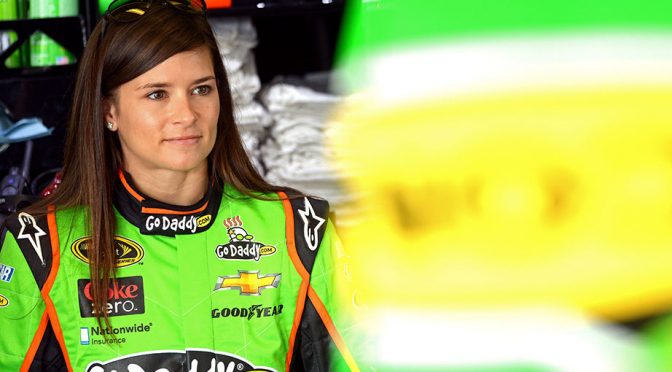
Danica Patrick’s hot start to 2013 is no fluke.

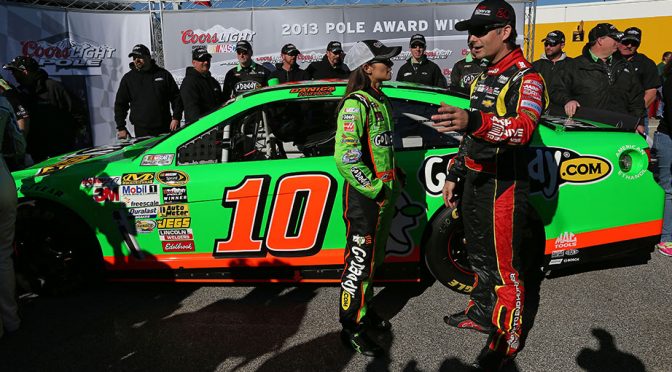
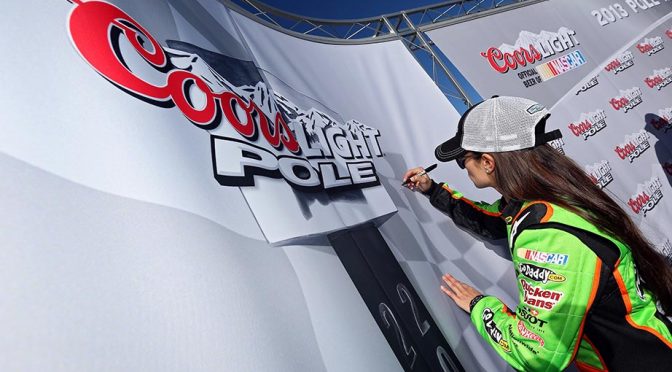
The Stewart-Haas driver showed she’s more than capable of running with the rest of the pack on Sunday, notching the first Coors Light Pole by a woman in Sprint Cup Series history during qualifying for the Daytona 500 at Daytona International Speedway in just her 11th career start. For the 11th consecutive year, there is a different pole sitter for the Daytona 500.

Patrick’s qualifying time of 45.817 seconds positioned her atop the leaderboard early in the day and her top speed of 196.434 mph is the fastest Daytona 500 qualifying speed since Ken Schrader’s Chevrolet topped out at 196.515 in 1990. The driver of the No. 10 GoDaddy Chevrolet also becomes the first Sunoco Rookie of the Year candidate to win the Daytona 500 pole since Jimmie Johnson in 2002 and the first woman to qualify for The Sprint Unlimited.

WATCH DANICA’S RECORD-BREAKING LAP

Prior to Sunday, there had been just two Coors Light Poles earned by a woman, Patrick last year at Daytona and Shawna Robinson in Atlanta in 1994, both of which came in NASCAR Nationwide Series competition. This will be the best starting position for a female in Sprint Cup history, eclipsing Janet Guthrie’s starting position of ninth at Talladega and Bristol, both in 1977. In 1980, Guthrie started 18th in the Daytona 500, formerly the best start for a woman in Daytona 500 history. She finished 11th in that race.

"This is very much a team pole."

Danica Patrick, on winning the Daytona 500 Coors Light Pole

Jeff Gordon was second on the leaderboard in the No. 24 Drive to End Hunger Chevrolet with a time of 45.85 and a top speed of 196.292, followed by Trevor Bayne’s 45.924 (195.976).

QUALIFYING EXPLAINED

Patrick’s SHR teammates Ryan Newman and Tony Stewart rounded out the top-five, with the 2008 Daytona 500 winner Newman coming in at 45.931 (195.946) and the three-time Sprint Cup Series champion Stewart finishing in 45.936 with a top speed of 195.925.

Matt Kenseth, winner of the 2012 Daytona 500, placed 10th on Sunday with a time of 45.983 (195.725) in the No. 20 Dollar General Toyota for his new home, Joe Gibbs Racing.

“I think that says a lot about the team, a lot about Stewart-Haas Racing, a lot about how much work was done over the winter and how they’ve adapted to the new car,” said Patrick. “This is very much a team pole.”

The Generation-6 cars continue to impress, as 22 drivers topped 195 mph. Before Sunday, the last driver to hit that mark in Daytona 500 qualifying was Jeff Gordon (195.067) in 1999. Before that, you have to go back to Davey Allison (195.955) in 1991.

We are actively working on a fan community solution and hope to have it up and running soon. As we work through this enhancement, we are temporarily disabling the comments function. We appreciate your patience and apologize for the inconvenience.

Drivers such as Mark Martin and Kurt Busch are off to a rough start because of early wrecks, putting a dent in their superspeedway inventory.

DAYTONA BEACH, Fla. — Mark Martin surveyed the scene and summed it up succinctly.
 
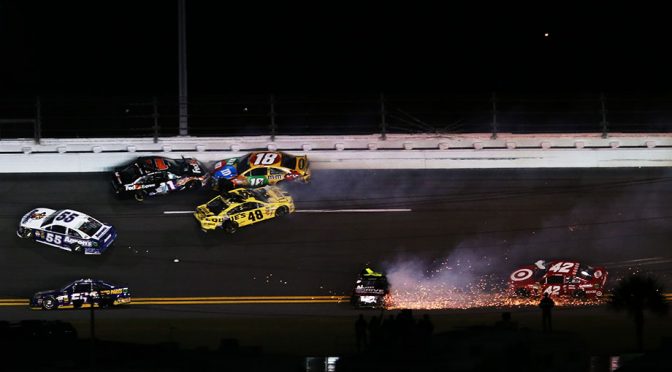
“We didn’t get very far, did we?” the Michael Waltrip Racing driver said after getting caught up in a nine-car crash during The Sprint Unlimited at Daytona International Speedway.
 
Not very far at all, just 14 laps complete and then the typical chaos that so often ensues when NASCAR’s Sprint Cup Series attacks the high banks of Daytona or Talladega superspeedways.
 
For Martin, 54, it was the second time in as many days that his blue on white Toyota Camry had come off the track the worse for wear and tear.
 
“That one’s finished,” crew chief Rodney Childers said of the team’s entry in the Saturday night event, adding that team officials would have another car brought down for the remainder of the Speedweeks activities.

FULL SERIES COVERAGE

View all articles
View all videos
View all photos

And there’s plenty left. Plenty of time on the 2.5-mile track means plenty of opportunities for teams to dial the cars in and miscues to dial them right back out. Three more days of practice remain, as well as the Budweiser Duel qualifying races scheduled for Thursday.
 
Those damaged were event-specific cars, built to run in the 75-lap non-points race, then eventually cycled back into the teams’ speedway programs for use at a later date. They aren’t earmarked specifically for this week’s Daytona 500.
 
Still, with all the remaining track time, one incident could leave a team wondering “what if?”
 
“We’ve seen in these practices, if something happens, then we’d have to get out a backup car,” Doug Duchardt, vice president of development for Hendrick Motorsports, said. “You need something in case, because Thursday you have the 150s to race and you have Friday and Saturday practice.”
 
Hendrick teams underwent varying degrees of demolition Saturday night as Jimmie Johnson and Jeff Gordon were caught up in the initial incident while Dale Earnhardt Jr. suffered minor damage due to contact late in the race.
 
Those three cars were sent back to the shop to be repaired if possible, to be replaced if not.
 
“We repair those cars as an insurance policy,” Duchardt said. “If we don’t end up using them, then we have those available for Talladega and then you can decide how to manage your fleet of three speedway cars through the rest of the year.”
 
Much like Martin, former Cup champion Kurt Busch was tallying up his losses after two days of on-track activities that cost his Furniture Row Racing team two cars.
 
“Two days, two wrecked cars and only a few laps completed,” Busch said. “It’s been a disappointing start to say the least. But the good news is that we’ve had fast cars.”
 
Team owner Richard Childress, whose RCR organization has a technical alliance with Furniture Row, said his group would “help them in any way we can” and that it was likely one of the two damaged FRR cars would be repaired and returned by the start of the new week.

We are actively working on a fan community solution and hope to have it up and running soon. As we work through this enhancement, we are temporarily disabling the comments function. We appreciate your patience and apologize for the inconvenience.


We apologize.  We are having technical issues with our comment sections and fan community and it is temporarily unavailable.  We are actively working on these issues and hope to have it up and running soon. We are also working on enhancements to provide a better forum for our fans. We appreciate your patience and apologize for the inconvenience.


We are actively working on a fan community solution and hope to have it up and running soon. As we work through this enhancement, we are temporarily disabling the comments function. We appreciate your patience and apologize for the inconvenience.


Drivers develop new strategies for new cars

DAYTONA BEACH, Fla. — Passing on the left? It may be the understanding on interstate highways, but it wasn’t the case Saturday night at Daytona International Speedway.

Matt Kenseth certainly tried, pulling his yellow Toyota to the bottom of the 2.5-mile race track again and again over the course of the season-opening Sprint Unlimited exhibition race. And although the vehicle seemed as strong as any in the 19-car field, the Joe Gibbs Racing driver couldn’t generate enough momentum to challenge Kevin Harvick for the victory.

LEADERBOARD: See the final results

Kenseth finished fifth, but as the focus now turns to the Daytona 500, he took solace in the fact that his Sprint Unlimited car was speedy enough to mix it up at the front and lead 26 laps. And with the Great American Race now a week away, he knows it will take more than a few cars in the low lane to try and outrun those charging along the top.

“I just needed to get a couple more guys on my bumper,” Kenseth said. “One time, we had a good enough line to do it and they got three-wide behind me, stalled the line out and we just couldn’t go anywhere after that. But we had to try.”

"Lot of different things happening out there, and everyone’s just going to have to learn what works and what doesn’t."
— Dale Earnhardt Jr.

He certainly did, often without a whole lot of help. “I need more people with me here!” he barked at one point over the radio, as he tried to outmuscle the majority of the field plastered to the top. Saturday night’s non-points event was the first featuring the more brand-identifiable Generation-6 NASCAR Sprint Cup Series cars, which from the drivers’ perspectives carried with them plenty of unknowns — particularly in the draft on one of NASCAR’s wildest tracks.

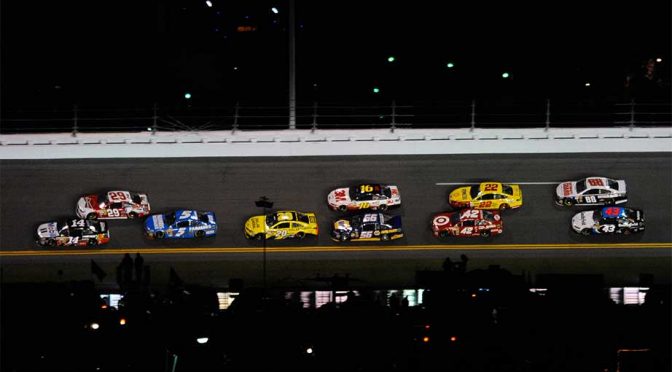
The checkered flag brought a degree of clarity, even in an event that had been whittled down to 12 cars by a pileup on the 15th lap. The side-draft is more a factor now than ever. And a few cars by themselves found it very difficult in the low line, even if those vehicles were as strong as Kenseth’s or that of fourth-place finisher Tony Stewart. Harvick may have swooped across the track from the low side to put a block on Greg Biffle on the final lap, but in such a limited field, the road to victory was clearly through the high line.

“Everybody figured out you could really side-draft and slow down that bottom lane,” Harvick said. “The 20 (car of Kenseth) definitely probably had the fastest car. He couldn’t make it all the way by himself and through the corner and get on the straightaway, because of the side-draft.”

Kenseth certainly did all he could, nosing up on Harvick again and again. “We had three or four shots to almost get cleared on Kevin, but he had a strong car and we just couldn’t make it happen,” he said. That may have had less to do with the vehicles’ power than their positioning relative to the rest of the field.

“There were just few enough cars that when about eight or 10 of them started controlling the top line, they basically controlled the fate of everyone else,” said Dale Earnhardt Jr., who finished eighth. “You really had to have more cars moving around and going for the lead to get a little more racing, a little more action. But I thought what I saw the first segment and the second segment, even with just a few cars out there, it was pretty dicey.”

But from beginning to end, cars had a hard time overtaking the leaders from the bottom. Kenseth was often simply outnumbered, with too few other competitors willing to switch down to the low line.

“It looked like everybody lined up on the top, and then if everybody commits to one line, you don’t want to be the lone guy out there trying to make something happen,” said Carl Edwards, who finished 12th. “Right now, it seems that this race — the 500 — it could turn into anything. Anything could develop because as the race went on tonight, we learned different things the whole event. There’s no telling what’s going to happen. I don’t know if it’ll be the top or the bottom, middle, who knows?”

It’s a new challenge, one Earnhardt seems to enjoy.

“You’ve got to really think about what you’re doing up there, what you do, the decisions you make, what line you’re in,” he said. “We haven’t had to worry about what line you get in for years, so that’s kind of neat, wondering whether the top or the bottom is going to move. Lot of different things happening out there, and everyone’s just going to have to learn what works and what doesn’t.”

Joey Logano said it’s not unusual for the high line at Daytona to be faster, because cars up there have an easier time staying close together, and therefore encounter less resistance from the air. Cars on the bottom, meanwhile, are more apt to be pulled apart, which makes it more difficult for them to overtake the vehicles on their outside.

“The outside lane, you come off the corners, it’s got a head of steam, and it tightens everybody up,” the third-place finisher said. “And when the cars tighten up, it takes a lot of drag off everybody’s cars, and that whole lane will accelerate. When you’re pulling those guys apart on the bottom, they’re getting further and further apart, and it just slows your lane down. If they can’t quite get there and stay tight, the top guys will just keep dragging them down, dragging them down. That’s why the top prevails, for the most part, unless you have some really stout cars on the bottom.”

But will that still be the case later in Speedweeks, with more cars on the race track? Earnhardt believes the Daytona 500 will be different — there will be enough cars in that event, he said, for both high and low lanes to storm to the finish.

“Absolutely, with more cars on the track it will be way more racier,” he said. “When you’ve got 12 cars on the track and eight or 10 of them decide to run the top like that, it really controls the rest of the field. You can’t get two cars together and make enough speed that eight or 10 can do at the same time. They just outnumbered everybody on the top, so that’s what you kind of had to run out there. That just kind of forced everybody’s hand out there. That was smart. Sometimes you use your brain to win races.”


We apologize.  We are having technical issues with our comment sections and fan community and it is temporarily unavailable.  We are actively working on these issues and hope to have it up and running soon. We are also working on enhancements to provide a better forum for our fans. We appreciate your patience and apologize for the inconvenience.
Automaker’s push for brand identity kick-started car transformation

DAYTONA BEACH, Fla. — When Mark Reuss took over as president of General Motors North America more than three years ago, he brought with him the belief that Chevrolet needed to be more relevant in NASCAR. It was the first step down a road that led to Saturday in Daytona Beach, where the manufacturer unveiled a production car to match the model it is fielding in the Sprint Cup Series.

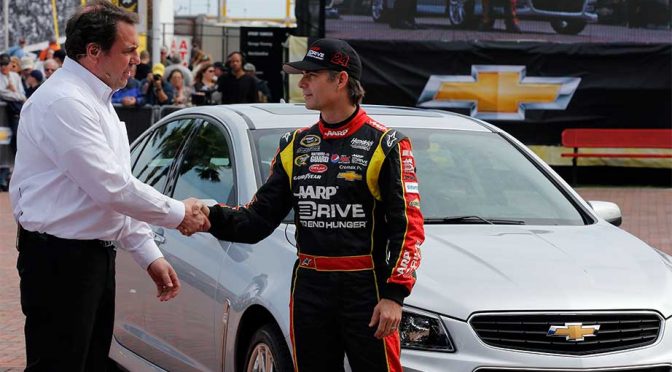
The gleaming 2014 SS that Jeff Gordon wheeled into Daytona International Speedway’s FanZone was significant for more than just Chevrolet, which has won 10 straight manufacturer titles in the circuit’s top division. According to NASCAR President Mike Helton, it was Chevrolet who spurred the movement that eventually produced the Generation-6 race car — without which, the tour’s most famous carmaker might have pulled out of the sport.

“Mark Reuss said, ‘If we can’t be relevant, we’re not going to race,’” said 10-time NASCAR championship car owner Rick Hendrick, whose team fields Chevrolets. “We had a lot riding on that.”

FULL SERIES COVERAGE

View all articles
View all videos
View all photos

Those concerns seemed far away Saturday, when Chevy introduced its first rear-wheel sport sedan in 17 years, a car bearing many similarities to the manufacturer’s new Sprint Cup car. The unveil followed similar reveals by Ford and Toyota, but evidently it was Chevrolet that started the drive toward the more brand-identifiable race cars competing for the first time during these Speedweeks.

“This was a great collaborative effort, and we can’t thank Chevrolet enough for leading the charge on that,” Helton said during the announcement. “They backed us into a corner and said, ‘Here’s what you guys need to think about doing,’ and causing us to maybe react a little bit ahead of our own schedule. But it worked. It worked well, and we’re grateful for their participation.”

Chevrolet unveiled the race car version of the SS this past November during Champions Week festivities in Las Vegas. The production model is manufactured in Elizabeth, Australia, in conjunction with Holden, GM’s Australian division. With a V8 engine and 415 horsepower, the vehicle is what Reuss called a “relatively low-volume play” for Chevrolet. “It’s really a link to our biggest race series here.”

Although Reuss wasn’t sure how many of the cars Chevrolet would sell given the vehicle’s price point — it’s designed as a “premium” model — the intent is to make that connection between the race track and showroom, and pique interest in the process. “What we need is traffic,” said Hendrick, who operates over 80 car dealerships across 13 states.

Like the Ford and Toyota, the Chevy model features physical characteristics that are common to both the race and production cars. The Generation-6 vehicles replace a “Car of Tomorrow” in which brand identity was sacrificed in an effort to improve driver safety. Those safety features have been carried over, and even enhanced, in the new models that provide carmakers with a greater degree of individuality at the same time.

“Fans grew up with, I grew up going to the track with, let’s outrun the Fords and outrun the Pontiacs and all those guys,” Hendrick said. “I think we missed that. The COT, we had a lot of success with it, we won championships with it. But it was time to get back to our roots and have a production car we could race, and would be different from the other cars.”

Reuss said that effort started with Chevrolet, which has the influence of 702 Cup victories and 36 manufacturers titles behind it.

“We went in hard with this car and said, ‘This is the car we want to race here,’” Reuss said of the SS. “It’s rear-wheel drive, it’s credible. We need to look at the angles of the backlight and the front windshield. We need to look at the profile of the car. Here’s the math of what the car is, of what we’re doing and what we’re bringing into Chevrolet. If we don’t race it here, then I’m not sure we want to bring it over here from Holden. So it was that and some guts and some chances that we took, and we kept working it.”

Ultimately, NASCAR and the other manufacturers jumped on board. Had that not happened, would Chevy have pulled out of the sport?

“I think it would have been a good chance,” Hendrick said. “I think it could have been. As a matter of fact, I’m fairly sure they might have. I think once they made their point that if they were going to be in the sport, it had to be relevant to what they sell … they were bold enough to say, ‘For us to support it like we have in the past, it needs to be a Chevrolet.’”

Now that movement transcends a single manufacturer, as seen in each manufacturer’s more brand-identifiable race cars. Hendrick can fondly recall the days when the success of the Monte Carlo on the race track drove people to dealerships, and believes the sport is on the cusp of such an era once again.

“We had the drivers as stars, and we used to have the cars as stars,” he said. “Now I think we’ve got them both again, and that’s the neatest part about this deal.”


We apologize.  We are having technical issues with our comment sections and fan community and it is temporarily unavailable.  We are actively working on these issues and hope to have it up and running soon. We are also working on enhancements to provide a better forum for our fans. We appreciate your patience and apologize for the inconvenience.
Kahne leads packs of NASCAR drivers participating in Daytona Beach Half Marathon

DAYTONA BEACH, Fla. — Before the sun even rose Sunday, Jimmie Johnson’s race day had already begun. More than six hours before cars begin front-row qualifying for the Daytona 500, the five-time NASCAR champion was among a handful of drivers participating in a very different kind of event — a half marathon that began on pit road at Daytona International Speedway and ended 13.1 miles later in Victory Lane.

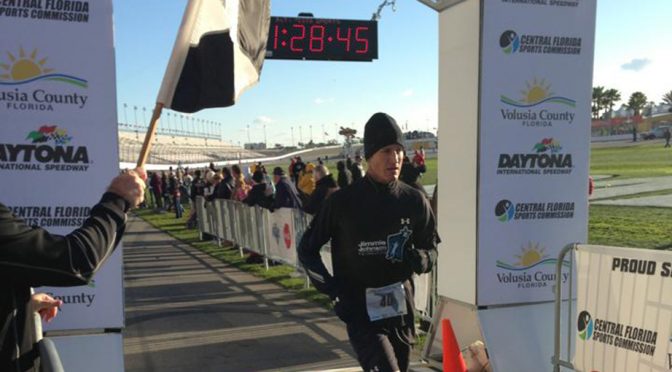
Kasey Kahne was the first NASCAR driver to cross the finish line, clocking in at 1:28:45, just over 12 minutes behind the overall winner’s time of 1:16.03. Johnson trailed Kahne by a little more than a minute, finishing the race in 1:29.48.

It’s nothing new for Johnson, an early riser who has used physical fitness as a cornerstone of his NASCAR success. But it’s also another indication of changing times in a sport once better known for moonshine and cigarettes, where some drivers are now less apt to stumble in at dawn than they are to try and squeeze in a run before it. Kasey Kahne, Aric Almirola and Michael Waltrip are also signed up for Sunday’s run, which meanders from the speedway to the oceanfront and back again.

The 6:30 a.m. start makes for an early wake-up call for competitors who participated in The Sprint Unlimited the previous night, and will be back in their cars for pole qualifying in the afternoon. It’s just another morning for Johnson, who on weekdays is often swimming laps or running before daybreak, and sneaks in a bike ride in the afternoon. The Hendrick Motorsports standard-bearer has competed in several triathlons — which combine swimming, bicycling and running — and maintains a rigorous workout regimen, so training for a half-marathon fits right in.

“I enjoy it, and if I’m away from my house too long and we’re traveling and I can’t get in my routine, it’s amazing how it effects my temperament,” Johnson said. “I’m frustrated and feel like I’m not getting things done. So for me, it’s all good. Yes, it’s physically helping me. But there are a lot of mental aspects to it that are helpful as well.”

"There are a lot of mental aspects to it that are helpful as well."

— Jimmie Johnson

This is nothing new in NASCAR — ageless wonder Mark Martin has been a gym rat for decades, and even wrote a book on how strength training can aid high-performance driving. Many top drivers have unquestionably become more athletic, even as the debate continues over whether a workout routine like Johnson’s actually aids a driver behind the wheel.

“I believe that physical conditioning makes you better at any single thing you do, whether it’s going to the grocery store or what,” Martin said. “Physical conditioning can make you better. It can make you better physically, it can make you better mentally. It can. Does it? I don’t know. It can, though. … I don’t know the science behind that, but I just believe it can make a difference. It certainly can make a difference in other facets of your life, so why wouldn’t make a difference if you’re driving a race car?”

Martin began strength training in 1988, and at age 54 still works out four to five days a week. Many younger competitors have followed suit — Almirola regularly bikes for two to three hours, Waltrip has completed full marathons and Kahne hopes to complete Sunday’s half marathon in an hour and 35 minutes, which would mean a 6:35-per-mile pace.

“There’s no way it hurts, to do this other stuff and to be in really good shape and take care of yourself and to run a half marathon as fast as you can,” Kahne said. “ … There’s no way that stuff hurts you when you’re in the race car. Does it help? I don’t know (how) much that stuff helps. ‘Smoke’ is about as good as it gets, and he doesn’t do that stuff. But for me personally, it helps me.”

No, Tony Stewart doesn’t do that stuff, and it hasn’t stopped him from winning three championships in NASCAR’s top division.

“I don’t think it matters. Unless you got to get out and push the car, it’s a different deal,” he said. “Nobody is having to get out and push these things. … Running a marathon or not running a marathon doesn’t make an ounce of difference. That’s all I got on it.”

Clint Bowyer would wholeheartedly agree.

“I’ve never been tired in a car. I’ve certainly been tired running. As a matter of fact, I was tired at Phoenix — that was a hell of a run,” he said, referring to his anger-fueled dash toward Jeff Gordon after the two wrecked at Phoenix International Raceway last year. “I could not keep that pace up for 13 miles. I don’t have trouble turning the steering wheel, it’s not that heavy. It’s power assist. Working out and stuff like that, there will be a time. When I get that age, I will workout. I’m going to enjoy myself now.”

If anything, drivers like Stewart and Bowyer seem to harken back to an earlier age, when the most exercise drivers got was climbing in and out of their cars. Some puffed away on cigarettes while behind the wheel. “I’m not sure anyone would have admitted training back in the Allison-Alabama Gang era, or even in the Earnhardt era,” Johnson said.

And that was before the implementation of power steering, headrests and other elements that made the cars easier to drive.

“I think their cars were far worse, with no power steering and things like that,” David Reutimann said. “… I do feel like being as good at the end of the race as you were at the beginning is a huge deal, but I think those guys just had the stamina. And I don’t know how they could do it, because obviously not many of them were working out. You look at the biceps on Junior Johnson back in the day, the guy had some arms on him. So a lot of those guys were pretty stout. They may not have worked out or ran marathons, but a lot of those guys were very strong in their own respect.”

They were also able to turn late nights into early mornings. NASCAR’s history is filled with larger-than-life personalities who played as hard as they worked, but somehow didn’t allow it to affect them behind the wheel.

“I think the mentality was different in those days,” added Reutimann, whose father Buzzie was also a driver. “You heard stories about guys staying up half the night and drinking and then running 500 miles. Evidently, they were a lot tougher than we are right now. Because they seemed to be able to pull it off. I could never pull it off, for sure.”

Kahne said some of that still lingered when he broke into the sport in 2004, before the fitness craze and the baby boom combined to make the Sprint Cup motorhome lot a much more sedate place. The likes of Curtis Turner and Joe Weatherly might not be able to relate to getting up before dawn to run 13 miles, but they’d certainly understand the reasoning behind it — using another method to try and be the best.

“Everything’s changed so much,” Kahne said. “… I like where’s it at now, with some of the training and things I’ve been able to do. Doing this half marathon, and a (triathlon) last year, it’s pretty fun. And it keeps your focus where it needs to be if you want to try to beat Jimmie Johnson or Brad Keselowski in the points throughout the whole season.”

We apologize.  We are having technical issues with our comment sections and fan community and it is temporarily unavailable.  We are actively working on these issues and hope to have it up and running soon. We are also working on enhancements to provide a better forum for our fans. We appreciate your patience and apologize for the inconvenience.