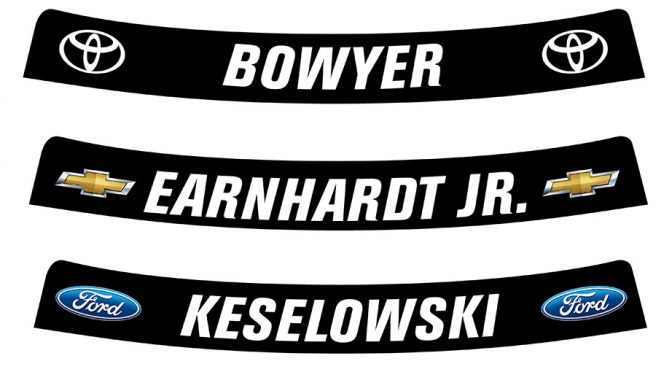
Manufacturer brand badges get higher placement, NASCAR announces
DETROIT — NASCAR used the birthplace of America’s auto industry as the kick-off point in the latest phase of the Gen-6 race car’s introduction.
During Tuesday’s Autoweek Racing Conference — the first stop on the NASCAR #Gen6 Road to Daytona Fueled by Sunoco — NASCAR President Mike Helton continued the rollout of the Gen-6 platform, the sport’s first revision since 2007.
"We’ve found that four of five of our fans have an affinity for the brand of car," he said. "A lot of those relationships are even older than the relationship with their favorite driver."
"We’ll see what happens when they’re door-to-door."
— Robin Pemberton, NASCAR vice president of competition
During Tuesday morning’s panel, Helton announced that the manufacturer’s brand badge will now flank the drivers’ names atop their windshields.
"We believe this will help build the identity of the driver with the race car and their relationship with the manufacturer," Helton said.
To that end, NASCAR worked closely with Chevrolet, Ford and Toyota to develop new cars that match the profiles of stock models sold in showrooms. This sixth generation of car will more closely resemble the cars fans can purchase.
The new cars feature body panels unique to the Ford Fusion, Toyota Camry and Chevrolet SS, and Kim Brink, NASCAR’s vice president of brand, consumer and series marketing, said it’s part of an aim to strengthen the way fans view the cars on the track vis-a-vis the cars sold in showrooms.
"The new car is a game-changer for us in marketing," she said.
Manufacturers usually adapt a race car’s design after a production car hits showrooms, but Chevrolet will turn the tables in Daytona when it introduces the 2014 SS. The NASCAR model will race later that evening in The Sprint Unlimited at Daytona, and Jim Campbell of Chevrolet Performance Racing said the automaker will debut the production car in the fan midway at the speedway.
Tuesday’s roundtable took place less than two miles from General Motors Corp.’s downtown headquarters.
Robin Pemberton, NASCAR’s vice president of competition, said the Gen-6 cars also will feature new safety enhancements in the roll cages and are about 150 pounds lighter than last year’s models. Feedback from drivers, he added, has been good so far but everyone is waiting to see what happens when the first green flag drops.
"We’ll see what happens when they’re door-to-door," he said. "Right now it’s just been individual tests and guys driving by themselves."
Also in attendance at the panel session held at the College for Creative Studies were Jamie Allison, director of Ford Racing, and David Wilson, senior vice president of Toyota Racing Development.
The media blitz continues tomorrow at ESPN’s Bristol, Conn., headquarters and also will make stops in New York and Jacksonville, Fla., before arriving in Daytona Beach for the start of Speedweeks. The 55th running of the Daytona 500 is Feb. 24.
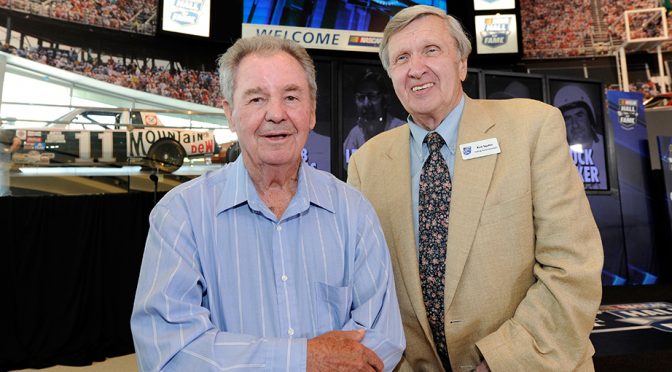
New award created to recognize contributions of NASCAR media, named after initial recipients
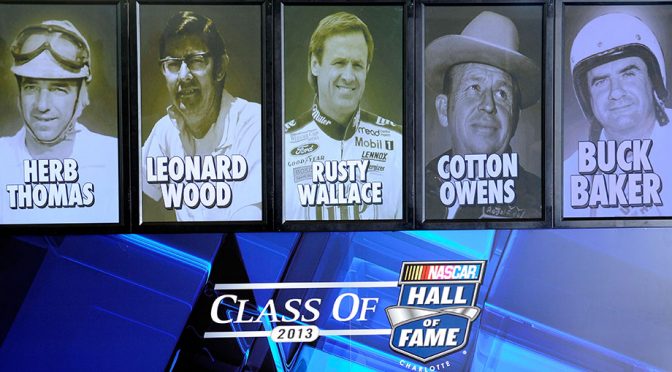
The five 2013 inductees to the NASCAR Hall of Fame — Buck Baker, Cotton Owens, Herb Thomas, Rusty Wallace and Leonard Wood — will headline the show during the induction ceremonies Friday night in Charlotte.
But that doesn’t diminish the importance of a new award created to recognize indelible contributions to the tapestry of NASCAR racing or to the first two recipients, for whom the award is named.
At dinner preceding the induction ceremony, broadcasters Ken Squier and Barney Hall will be recognized as the first two recipients of the Squier-Hall Award for NASCAR Media Excellence. Earlier that afternoon, the NASCAR Hall of Fame will unveil an exhibit created in their honor.
"You cannot think of the ’79 Daytona 500 without Ken Squier’s voice popping into your head."
—Brett Jewkes, NASCAR vice president and chief communications officer
NASCAR chairman and CEO Brian France, vice chairman and executive vice president Jim France, NASCAR vice chairwoman and executive vice president and International Speedway Corporation CEO Lesa France Kennedy and NASCAR president Mike Helton all embraced the idea of recognizing the contributions of motorsports journalists and broadcasters.
"As the initial idea was presented to Mike, Brian, Jim and Lesa, there was no hesitation," said Brett Jewkes, NASCAR vice president and chief communications officer. "It was like, ‘Yep. Do it.’"
Jewkes and NASCAR’s Integrated Marketing Communications department drove the implementation of the award after the executives signed off.
"I think that honoring the media in the NASCAR Hall of Fame is very important, because I think the role they’ve played in promoting the sport, building the sport, telling the stories of the drivers and great events and personalities is central to the growth of NASCAR," Jewkes said.
"I think it’s important that it has this permanent place to be honored within the Hall of Fame. I think it will be very popular. I think the fans are going to really enjoy seeing some of the artifacts that the honorees have over time, and I think it’s going to be a nice addition to the ceremonies as well."
Squier got his start in NASCAR broadcasting in 1970 as a co-founder of the Motorsports Radio Network (MRN), but he’s perhaps best known for his call for CBS Sports of the 1979 Daytona 500 — and the fight between Bobby and Donnie Allison and Cale Yarborough that followed the race.
Hall was the first track announcer at Bristol Motor Speedway. After a decade-long career in local radio, he joined MRN as a turn announcer and by the late 1970s was a fixture in the booth. To many fans, Hall is the voice of NASCAR racing.
"If you look at two people that have all the things that Hall of Fame announcers have in the other sports — they have longevity, they are a clear part of the soundtrack of the history of the sport," Jewkes said. "You cannot think of the ’79 Daytona 500 without Ken Squier’s voice popping into your head.
"Broadcasters and media and good writing — they become part of the fabric and the culture of the sport, and we would be very hard-pressed to find anyone who’s more the embodiment of that than Ken and Barney."
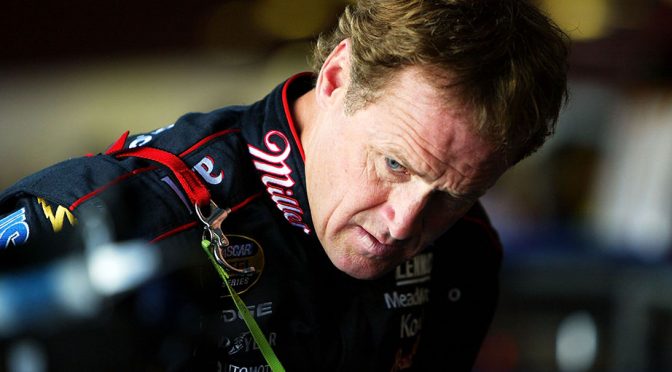
Charismatic competitor left his mark on the sport
(Note: This release is part of a series in advance of the 2013 NASCAR Hall of Fame Induction Ceremony in Charlotte, N.C., on Feb. 8, broadcast live at 7:30 p.m. ET on SPEED, Motor Racing Network Radio and SiriusXM Satellite Radio. Buck Baker, Cotton Owens, Herb Thomas, Rusty Wallace and Leonard Wood are the five 2013 inductees. This installment spotlights 1989 premier series champion driver Rusty Wallace. Click here to download and listen to a special NASCAR Hall of Fame podcast on Rusty Wallace with historian Buz McKim.)
Rusty Wallace’s ability as a driver is unquestioned.
He won 55 times — ninth most in NASCAR premier series history — during two decades against rivals named Bodine, Earnhardt, Elliott, Gordon, Jarrett, Labonte, Martin, Richmond and Waltrip.
But Russell William Wallace Jr., the 1989 series champion, did more than just drive the 900 horsepower stock car. His mechanical intuition was equally responsible for career achievements that will be capped Feb. 8 with Wallace’s induction into the NASCAR Hall of Fame along with champions Buck Baker and Herb Thomas; championship car owner Cotton Owens and innovative crew chief, mechanic and engine builder Leonard Wood.
“It was like having on-board telemetry,” said Barry Dodson, Wallace’s championship crew chief at Raymond Beadle’s Blue Max Racing, of his driver’s phenomenal ability to judge — and correct — a vehicle’s handling.
PROFILES OF INDUCTEES
Ceremony set for Feb. 8
• Buck Baker
• Cotton Owens
• Herb Thomas
• Rusty Wallace
• Leonard Wood
Dodson labeled Wallace a high-strung thoroughbred. “You had to keep the bridle on,” he said. “I knew I always had (all) 100% in that seat.
“You didn’t have to be a cheer leader for Rusty. I never have seen a more determined guy.”
Robin Pemberton, crew chief for 15 of Wallace’s 37 victories at Penske Racing, likens Wallace to NASCAR Hall of Famer Bobby Allison, another hands-on driver/mechanic.
“He was looking for feel; what he needed. He just knew what he had to have,” said Pemberton, now NASCAR vice president of competition. “He trained a lot of us how to think.”
Fellow NASCAR premier series champion Dale Jarrett concurs with both crew chiefs.
“He was probably if not the best, certainly one of the best of all time knowing his car, being totally involved in it from the chassis all the way to the aerodynamics of it,” said Jarrett, a fellow ESPN analyst. “He was probably as much of a hands-on driver in making changes to his car as anyone else that I can remember.
“He was a fair but hard-nosed racer.”
Wallace, 56, grew up in St. Louis, the eldest of three racing sons of short track champion Russ Wallace. He made his competitive debut at age 16 in 1972 at Lake Hill Speedway near Valley Park, Mo. After winning several area racing championships, Wallace moved to United States Auto Club stock cars where he was the 1979 rookie of the year and third in points to champion A.J. Foyt. He won the 1983 American Speed Association title.
Wallace made his NASCAR premier series debut in the 1980 Atlanta 500 driving a Chevrolet owned by Roger Penske to a second-place finish. His first full season, in Cliff Stewart’s Pontiac, saw Wallace claim rookie of the year honors. Victory No. 1 came in the April 6, 1986 Valleydale 500 at Bristol Motor Speedway with Wallace in the seat of Beadle’s Pontiac.
With the Blue Max organization from 1986 through 1990, Wallace won 18 times. He lost the 1988 championship to Bill Elliott by 24 points despite a late-season charge in which Wallace won five of the final six races. Motivated by the near miss, Wallace out-dueled Dale Earnhardt to capture the 1989 title. Wallace won six races; Earnhardt five.
Wallace joined Penske Racing in 1991, and remained with the organization for the remainder of his career. He finished second in points in 1993, won 37 times and extended to 16 the number of consecutive seasons with a victory. From 1986 through 2002 Wallace finished outside the top 10 in points just once.
“Rusty had so many memorable races with our team and he was a big part of our development with Penske Racing and how we were able to grow our NASCAR program,” said Roger Penske, the 2012 championship team owner. “Not only was Rusty a great driver but he has continued to excel after his racing career with his work as a team owner, an announcer and in his development of Iowa Speedway.
“He has meant so much to this sport and we are very proud of all he has accomplished.”
Wallace won 25 short track races and on all three road course — Riverside, Sonoma and Watkins Glen — contested during his career. He scored victories with six different crew chiefs: Dodson, Pemberton, Larry Carter, Eddie Dickerson, Buddy Parrott and Jimmy Makar. His last victory came at Martinsville Speedway on April 14, 2004.
Wallace retired after the 2005 season to pursue a multi-faceted post-racing career as broadcaster, track designer and promoter, motivational speaker and businessman. Both brothers, Mike and Kenny, remain active NASCAR competitors as does his son, Steve.
Induction ceremonies will take place at 7:30 p.m. ET in the Crown Ball Room at the Charlotte Convention Center which is directly connected to the NASCAR Hall of Fame. The event is the first half of NASCAR Acceleration Weekend followed on Saturday, Feb. 9 by NASCAR Preview 2013. Tickets for the ceremonies start at $45 (available at www.nascaracceleration.com) and the NASCAR Hall of Fame box office. In addition, a $20 ticket will gain fans all-day access into NASCAR Preview 2013 and the NASCAR Hall of Fame on Saturday, Feb. 9.
Half marathon beckons on day of Daytona 500 qualifying
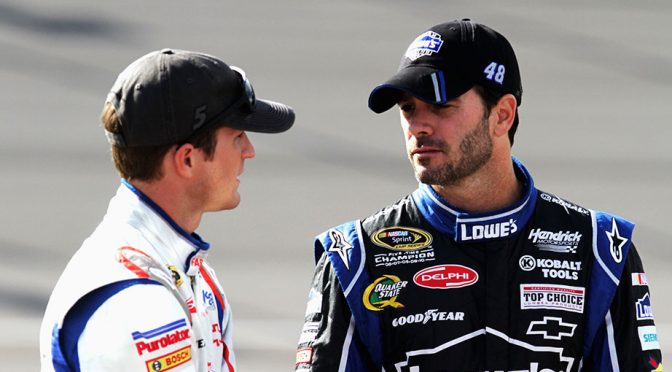
Jimmie Johnson and Kasey Kahne would like nothing more than to be the quickest driver during qualifying for the Daytona 500. But first, the Hendrick Motorsports teammates hope to be quick in a different kind of race.
Johnson and Kahne, along with Aric Almirola and Michael Waltrip, will all run in the fifth annual Daytona Beach Half Marathon (13.1 miles), which starts at 6:30 a.m. on Feb. 17 — the Sunday of qualifying for The Great American Race. It’s the first time the race has been held during Speedweeks.

Perhaps the foursome can get one final scouting report on Daytona International Speedway. The race starts on pit road, before the runners eventually exit the track, run over a bridge and onto the beach before eventually ending up in Victory Lane at the finish.
“We all decided this was a perfect run to do,” Almirola said. “It’s during Speedweeks, it’s going to get the race fans involved and it just seems like a lot of fun. We are looking forward to it.”
Of the four NASCAR drivers, Waltrip and Johnson have at least one Daytona 500 win on their respective resumes. Johnson won the 2006 race, and also has a Daytona 500 pole to his credit. His best finish in the past six 500s, though, is 27th (2011, 2008). Waltrip won in 2001 and 2003, and one of his other two NASCAR Sprint Cup Series wins came during the summer race at Daytona.
Kahne has a pair of seventh-place finishes (2007, 2008) in the Daytona 500 while Almirola has two starts to his credit.
Hall of Fame Induction Ceremony acknowledges five stars of the sport
The 2013 NASCAR Hall of Fame inductees were enshrined into the Hall of Fame on Friday, an event that signaled the beginning of NASCAR Acceleration Weekend 2013. As part of the weekend, the NASCAR Preview 2013 Presented by Sprint — scheduled for Saturday — gives fans an all-day experience that includes driver Q&As, autograph sessions, display booths from tracks, other industry-related sponsors and more.
SCHEDULE OF EVENTS
Friday, Feb. 8, 2013
Hall of Famer Autograph Session: Junior Johnson, David Pearson, Bud Moore, Bobby Allison, Ned Jarrett, Dale Inman, Darrell Waltrip and Glen Wood
Time: 4 p.m.
Location: Hall of Honor
Induction Ceremony: 7:30 p.m. ET (live on SPEED)
Saturday, Feb. 9, 2013
NASCAR Preview 2013 Presented by Sprint
Location: NASCAR Hall of Fame and the Charlotte Convention Center
Event Schedule
Doors open: 7 a.m.
Preview begins: 9 a.m.
Autographs begin: 9:30 a.m.
Preview ends: 5 p.m.
Junior Johnson Midnight Moon Moonshine and Sign:
Location: NASCAR Hall of Fame
Time: 4-8 p.m.
Sunday, Feb. 10, 2013
Granite Marker Unveiling: 9 a.m.
Class of 2013 Autograph Session: 10 a.m.
Location: NASCAR Hall of Fame
 Buck Baker: Baker had 46 wins in a career that spanned 26 years. He was the first NASCAR driver to claim back-to-back championships (1956 and 1957) and had 45 poles, 246 top fives and 372 top 10s. | Hall of Fame induction video
 Cotton Owens: While Owens had only nine wins as a driver, he was known for being a team owner for a group that included David Pearson and Junior Johnson. Owens died just days after he was announced as a member of the 2013 class. | Hall of Fame induction video
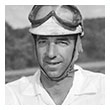 Herb Thomas: Thomas’ stats are impressive. In just 10 years (228 starts), he earned 48 wins, 122 top fives, 156 top 10s and 39 poles. But more importantly, Thomas was the champion in 1951 and 1953 and runner-up in 1952, 1954 and 1956. | Hall of Fame induction video
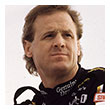 Rusty Wallace: While Wallace is most known for driving the No. 2 for Penske Racing, his 1989 championship came with Blue Max Racing. He had 55 wins over his 25-year career and continues in the sport as a car owner and broadcaster. | Hall of Fame induction video
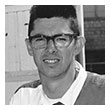 Leonard Wood: Leonard is second member of the Wood family to make the Hall of Fame — his brother Glen was inducted in 2012. With 96 wins as a crew chief, Leonard is known as the innovator of the modern pit stop. Wood can still be seen at the No. 21 Wood Brothers pit box during a race. | Hall of Fame induction video
Drivers expect new cars to break track records
DARLINGTON, S.C. — Martin Truex Jr. said he was asking himself how fast he could get around Darlington long before the Sprint Cup driver arrived at the legendary 1.366-mile track Feb. 5 for the Goodyear tire test.
The answer? Pretty doggone fast.
Truex Jr. (Michael Waltrip Racing), Carl Edwards (Roush Fenway Racing), Paul Menard (Richard Childress Racing), Denny Hamlin (Joe Gibbs Racing) and Juan Pablo Montoya (Earnhardt Ganassi Racing) participated in a day-long Goodyear tire test as the tire supplier attempted to get a bead on the right compound and construction for NASCAR’s new Generation-6 car, which debuts this year.
"It’s going to be the typical Darlington line when we come back. We’ll just be doing it a little quicker."
— Martin Truex Jr.
“It’s definitely faster than what we ran last year,” Truex Jr. said during a lunch break. “I actually ran faster this morning in race trim than I qualified here last year when we qualified like sixth. So the cars are fast, and driving great.
“Today is all about getting the tire right, helping Goodyear get the right tire back here so we can put on a great race.”
Speeds have been higher than in the past at nearly every test thus far, and Truex Jr. says much of that is due to the superior handling of the new car.
“They’re a little bit lighter, there’s more left side weight, more downforce, and that allows you to keep the car lower until you get to the center of the corner,” he said. “Another thing is the track (today) really doesn’t have any rubber in it yet. As we ran today … just the few hours of running with five cars, the groove was moving up. It’s going to be the typical Darlington line when we come back. We’ll just be doing it a little quicker.”
Kasey Kahne holds the Darlington track qualifying record of 181.254 mph (27.131 seconds), set in 2011. That mark is one of several likely to fall once the 2013 season gets under way, according to Edwards.
“We just ran what, 27.50s?” asked Edwards. “I think we’ll be a lot faster than that track record. I think you’ll see that a lot as long as this aero package is the way it is. The cars are stuck so well, and the tires are so good, everybody’s engines get better, the cars are lighter. …
“They’re fast in the corner; you can really lay the throttle to them in the middle of the corner.”
Unlike race weekends, testing allows teams to use telemetry to take detailed measurements inside the cars. That can be both good and bad for a driver, according to Edwards.
“At the test you have … a digital speedometer and it’s right there on the dash,” he said. “We’re curious guys, we’re competitive, so each time you get down in the corner you want to watch and see how fast you’re going. But the fastest point is the point on the track that needs the most attention and your attention’s not supposed to be on that monitor.
“I’ve seen 193 or something but I can’t look at it any longer before I have to look in the corner.”
Brett Bodine, NASCAR’s director of competition for research and development, said the factors mentioned by the drivers — additional downforce, less left-side weight and more mechanical grip — combine to make the car easier to drive. And that, he said, should provide better competition when the field is on the track under race conditions.
“When the car drivers better, the drivers are more comfortable in (race) traffic,” he said. “And certainly that was our goal. We feel like we’ve definitely raised the bar, moved the needle in a positive direction in respect to racing in traffic.”
There were no incidents during the morning session, although Edwards said his car made slight contact with the wall.
“It’s neat to wake up in the morning and go run down into these corners at 190-something miles an hour,” Edwards said. “It’s a big way to start your day.”
Drivers will return to Darlington for The Bojangles’ Southern 500, scheduled for May 11.
Driver excited to work with Keselowski’s championship team
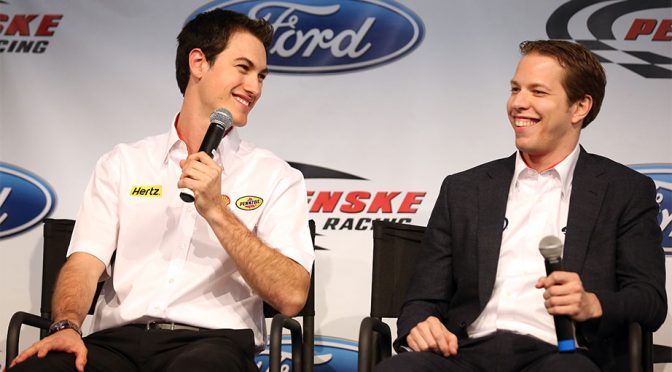
Joey Logano’s eyes light up when he tells the story. It’s a funny story, a true story and a story about the first time he and Brad Keselowski, now teammates at Penske Racing, had any interaction on the race track.
“My first Nationwide race at Dover; I’m as green as can be, right?” Logano says, grinning. “I don’t know what the heck I’m doing. I pull up on the race track for practice … and I pulled right out in front of him.
“I get to the back straightaway and (Keselowski) comes blowing by me and he’s flipping me off and I’m still in third gear. I didn’t even get into fourth gear and I’m getting flipped off by Brad.
“I’m like, ‘Holy cow, what did I get myself into?’ So that was my first Nationwide start and the first time I got near Brad.”
"I think both of us like the same thing in a race car and that’s important to have in a teammate."
— Joey Logano on Brad Keselowski
Since that day in 2008, their paths have crossed many times — even though Logano was tossed headfirst into NASCAR’s Sprint Cup Series the following season, while Keselowski wasn’t fully immersed until 2010.
Now they’re teammates. Partners. Co-conspirators of a sort, hoping to keep the flames lit on the Penske Racing rocket that carried Keselowski to the Sprint Cup championship barely three months ago.
Logano calls it a fresh start for himself, but speaks no ill of a seven-year career (dating back to a Pro Cup effort) spent with Joe Gibbs Racing. “When you’re 15 years old (when you start with a team), that’s a … majority of your life,” he said. “It was bittersweet leaving there, but I’m looking forward to coming to Penske.”
When Tony Stewart, who won two Cup titles and 33 races at JGR, departed at the end of ’08, Logano suddenly held the keys to one of the most sought after Cup rides in the garage.
He was 18.
“I wasn’t even close to being ready,” Logano admitted. “I wish I’d been older when they booted me up so quick. It might have made my life a little easier. …But it’s not an experience I’d ever want to change.”
Logano, now 22, has two career wins in the Cup series and a best points finish of 16th. At various times he’s been called everything from one of the most talented young drivers in the sport to an underachiever.
That he has now landed at Penske Racing would seem to lend credence to the former.
Keselowski has nine career Cup wins and a championship. Logano said he believes he can help his teammate become an even better driver. “And I know he’s going to help me,” Logano said.
“There’s more than one way to skin a cat. We’ve raced against each other for a long time. It was exciting to get to Charlotte the first time (to test) and look at his data and compare it to my data, see what it was like and what we do different. I think both of us like the same thing in a race car and that’s important to have in a teammate.
“(The way) he presents himself around his team, around the media, there’s a lot to learn there for me.”
Keselowski, crew chief Paul Wolfe and others within the organization must deal with a shift in manufacturer support (fielding Fords now that Dodge has departed) and attempt to decipher the new Generation-6 car.
Logano has that on his plate, and also finds himself surrounded by a host of unfamiliar faces — new crew chief Todd Gordon, spotter Tab Boyd, new crewmen going over the wall as well as new ones back at the shop. The getting-to-know-you period likely won’t be complete by the time the No. 22 team loads up and heads south for the season-opening Daytona 500 later this month.
“I think we know all the new things … will come with a learning curve,” Logano said. “But I think we can get through that pretty quick. It’s a pretty tight-knit group.
“Working with a new group of guys that just so happened to win the championship last year, that’s pretty awesome to be a part of. I couldn’t have picked a better place.”
Gordon believes the key for the team is to build chemistry and move forward. He and Logano have so much in common, he said, “it has been almost eerie.”
“Our personalities are very close,” Gordon said of his new driver, who led a career-best 190 laps last season and won at Pocono, but ended the year 17th in points.
“What he’s done (previously) gives you his resume and gives him credibility,” Gordon said. “… I think he’s been a refreshing, much deeper person than what I anticipated when he came in. He’s been a racer his whole life.
“I got to work with Brad in 2011 on the Nationwide side and that’s part of what our program can really benefit from. Paul and myself have good relationship with Brad; Joey has good relationship with Brad. Our core group is one (unit). It’s not two. I think in the long run that can make our whole program better.”
In a bit of a twist, Logano will be the first Penske driver competing in 2013 when he and his team take part in The Sprint Unlimited at Daytona, a non-points race for 2012 pole winners. Logano won two poles a year ago while Keselowski managed a best starting spot of third in 36 attempts.
It’s a major bonus, Logano said, since it will allow his team to work together in race conditions for the first time without the pressure of a points race.
“To be able to have that one race of experience, it’s like a preseason game,” he said. “Still, we want to go out there and win. It pays a lot of money and winning anything at Daytona — I’ve said it before, winning a tricycle race at Daytona would be awesome.”
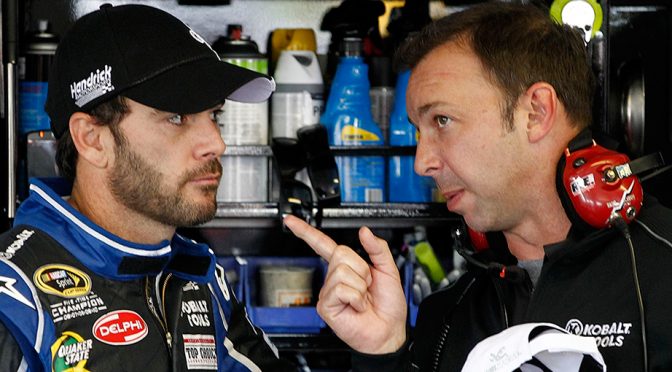
Johnson, Knaus only looking at positives from titleless 2012
They would have won the race.
To a man, they’re convinced of it. The car was fast, and under the lights of Homestead-Miami Speedway, the No. 48 team had that old championship mojo working again. Pit strategies had played out to the point where Brad Keselowski was going to have to stop one more time, and they could go the rest of the way. Jimmie Johnson and Chad Knaus had the path to a sixth NASCAR Sprint Cup Series title laid out before them.
“We had them,” car owner Rick Hendrick remembered. “There was no way. They were going to have to stop, and we didn’t. We were sitting there saying, ‘We’ve got them.’ All we’ve got to do is finish the race.”
"Last year was, I think, our best year as a whole. Which is I guess why I didn’t really think of the bad stuff."
— Chad Knaus, crew chief
They were on the way to doing just that — until a fractured oil cooler brought an abrupt end to Johnson’s run in the 2012 season finale, removing the final obstacle in Keselowski’s title quest. The Penske driver won the championship by 39 points, finishing high enough to clinch the crown without any help, but there was some lingering curiosity in the Hendrick camp over what might have happened had Johnson been able to push Keselowski to the finish.
“They never really had to make anything happen,” Knaus recalled. “And if they had to, you don’t know what the situation would have been. But I don’t reflect on that too much.”
Even now, he still doesn’t. No question, Johnson and Knaus have both endured offseasons where they’ve struggled to leave the previous campaign behind — the driver in 2011, when he was frustrated by the lack of speed in his car; the crew chief in 2004, when he was beaten down by an unrelenting testing schedule — but in that regard, this one does not qualify. When Johnson and Knaus look back on 2012, they don’t dredge up frustration over letting a potential championship get away. Instead, there’s satisfaction over what they believe is the best year they’ve had together.
That seems downright odd, given the expectations placed on the best team of NASCAR’s modern era. Even Hendrick refers to the 2012 finish, which saw Johnson go behind the wall in each of the last two events of the year — a blown tire at Phoenix International Raceway preceding the problem at Homestead — as fumbling the ball in the final minutes of a football game. But when Knaus looks backs on a campaign that saw Johnson tie for the series lead in victories, and record more top fives, top 10s, and laps led than anyone else, all he sees are positives.
“Last year was, I think, our best year as a whole,” Knaus said. “Which is I guess why I didn’t really think of the bad stuff. It was a great year, we had a lot of fun, we won a bunch of races, we led a ton of laps. … It was a great year. We had a great time last year; we really did. It was a lot of fun. I wasn’t even really tired at the end of the season. I could have kept on going a few more. So that’s why I think I’m looking forward to this year.”
The driver agreed. “We had a kick-ass year, and it just didn’t turn out,” Johnson said.
There was no stewing over shortcomings as there had been a year earlier, when Johnson’s car simply wasn’t fast enough to keep up with the title contenders, and he was out of the championship picture before the season finale. Compare that to Homestead this past November, when he felt hardly any emotion at all once his damaged car was listed as out of the race.
“I was just flat-lined,” Johnson said. “I don’t know why. I actually went out that night and had a big time and celebrated and had fun. I guess looking back on it now, we had a year we were very proud of. I know the things I’m responsible for; I think I did the best job in my history as a driver in my career. So I think I just stopped. Things happen. This is a team sport, things go wrong. I just reflected back on the incredible year we had as a team, and certainly what I was able to accomplish as a driver.”
Granted, the circumstances surrounding the final knockout were rare — in 30 years of racing, Hendrick said he can’t remember another one of his cars suffering a broken rear-end oil cooler, the failure that befell Johnson in the 2012 finale. Even though the No. 48 team dropped to third in final points behind Clint Bowyer, the emotions in the aftermath were far from negative.
“We wanted to go back and race again,” Hendrick said.
No wonder, given the performance Johnson showed for much of the season.
“We did a very good job last year,” Knaus said. “Did we win the championship? No. Could we have? Yes. Were we in position to do it? Yes. But we didn’t pull it off. I am very proud of Jimmie, I am very proud of this team, I am very proud of the way they reacted throughout the course of the season. Man, everybody said we were out of it at Kansas. … But I felt great about last season, I really did. I had no heartburn at the end of the season, there were no weird actions taken, nothing like that. We had a great year last year.”
No question, it helps to have a perspective shaped by success, and those five championship banners hanging from the rafters of the Hendrick Motorsports team center can make a single near-miss easier to digest. Still, it’s been two years now since Johnson last won a title, and given the increased competition that sixth — not to mention record-tying seventh — crown isn’t nearly as guaranteed as it once appeared.
But Johnson and Knaus show no signs of breaking up. The No. 48 team thrives on adaptation, which will be key with the Generation-6 cars ready to make their debut. Unlike some other owners, Hendrick isn’t wringing his hands over the distribution of certain car parts for the new vehicle. And for the five-time champions, the focus is on what’s possible rather than what might haven gotten away.
“We can’t sit back and reflect on the bad things or the negatives and look too far in advance saying, ‘Oh man, we’re never going to win again,’ or ‘We’re never going to do that again.’ You just can’t do that,” Knaus said. “If you do that, you’re just going to beat yourself to death. And that’s not how we roll. We don’t do it like that. We look forward. We feel like we’re a comfortable team, we’re confident, we’ve got great players, got great equipment — we just keep moving, man.”