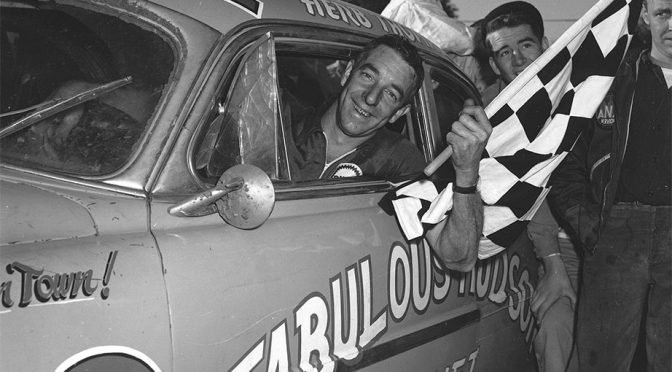
Record winning percentage forged NASCAR Hall of Fame credentials

Editor’s note: This release is part of a series in advance of the 2013 NASCAR Hall of Fame Induction Ceremony in Charlotte, N.C. on Feb. 8, broadcast live at 7:30 p.m. ET on SPEED, Motor Racing Network Radio and SiriusXM Satellite Radio. Buck Baker, Cotton Owens, Herb Thomas, Rusty Wallace and Leonard Wood are the five 2013 inductees. This installment spotlights two-time premier series champion driver Herb Thomas. Click here to download and listen to a special NASCAR Hall of Fame podcast on Herb Thomas with historian Buz McKim.

DAYTONA BEACH, Fla. — Take it from the King. Herb Thomas stood tall in an era when the stock in stock car truly defined what NASCAR’s pioneers raced.

“He was as good as they come,” said Richard Petty. “There have been very few guys who had more confidence in what he could do than Herb. He was so strong-minded that he willed his wins and what he was doing on the track.

“He was going to beat the guys on the track no matter what was going on. That was his mind-set.”

High praise indeed from a driver whose father, Lee, battled door to door with Thomas and traded NASCAR championships with him. Both Pettys, father and son, are members of the NASCAR Hall of Fame. Thomas is due to be inducted into the hall on Friday, Feb. 8, along with fellow NASCAR premier series champions Buck Baker and Rusty Wallace; championship owner Cotton Owens; and innovative crew chief, mechanic and engine builder Leonard Wood.

Thomas, born into a farming family in Olivia, N.C., not far from where North Carolina Motor Speedway would be built, was NASCAR’s first two-time champion. He captured premier series titles in 1951 and 1953 and finished second in two other seasons including 1954, Lee Petty’s first of three championship years.

PROFILES OF INDUCTEES
Ceremony set for Feb. 8

• Buck Baker
• Cotton Owens
• Herb Thomas
• Rusty Wallace
• Leonard Wood

Thomas, who died in 2000 at the age of 77, won 48 races between 1951 and 1956, establishing a record winning percentage of 21.05 percent over a 228-race career. He ranks 13th among all-time NASCAR premier series winners. Thomas won three of the first six Southern 500s at Darlington Raceway.

“It’s win or bust,” Thomas once said. “Second place is never good enough.”

Thomas caught the racing bug in 1947 when he attended a modified race in Greensboro, N.C., with a group of friends. He bought one shortly thereafter but never had much success with the car. Thomas’ son, Victor Herbert Thomas, guessed that his father honed his driving skills behind the wheel of a dump truck hauling dirt over winding back roads to Ft. Bragg, N.C., during World War II.

“Daddy came from farming; he never was associated with the moonshine bunch,” he said of his father, who cut timber and operated a saw mill.

Although he won in a variety of cars, Thomas forever will be remembered as the driver of the No. 92 Fabulous Hudson Hornet powered by engines built by Smokey Yunick, owner of the self-proclaimed “Best Damn Garage” in Daytona Beach, Fla.

Thomas, who had won races earlier in the season driving a Plymouth and an Oldsmobile, switched to a factory-supported Hudson Motor Car Co. effort in mid-1951. The Hornet featured a high-torque inline six cylinder engine and — according to Thomas — a low center of gravity which gave the car a performance edge.

The biggest edge, however, appeared to be the driver himself.

“The tracks were rough, dusty and weren’t hard-packed (clay). You had to learn to drive around the holes,” said Hershel McGriff, who competed against Thomas in 1954 and won five races driving an Oldsmobile for Frank Christian. “He was real competitive."

Baker frequently was quoted as saying, “The one guy you have to beat is Herb Thomas.”

Thomas won seven times in 1951 — five of the victories in his Hudson — and won the championship by a comfortable margin over Fonty Flock and became NASCAR’s first driver/owner title holder. He posted eight wins a year later, but finished second to Tim Flock, who also drove a Hudson.

Thomas won 12 times in both 1953 and 1954 as he and Lee Petty swapped championships. By 1955, Hudson’s factory presence was gone and Thomas switched to Chevrolets and Buicks. He crashed in May’s race at Charlotte Speedway, a 0.750-mile dirt track suffering injuries that sidelined Thomas through most of the summer. Yet Thomas returned to win the Southern 500 for the third time and finished fifth in points despite missing 19 races.

The 1956 season was Thomas’ last as a full-time competitor. He won five times including three consecutive victories in Portland, Ore., Eureka, Calif., and Merced, Calif., at the wheel of Carl Kiekhafer’s No. 300B Chrysler 300. His crew chief was current NASCAR Hall of Fame nominee Ray Fox.

Thomas raced three more times in 1957 and 1962 before retiring for good.

"I used to pass everyone in the turns. Now they pass me in the turns. It’s time to hang it up,” he said. “There’s no use running if you can’t be first.”

Thomas’ son, Victor, recalls his father his father as being quiet and never one to brag about his accomplishments.

“He always respected others and wasn’t a talker but if he said something, it would be the truth,” he said. “He never thought of himself as being a NASCAR champion. He was just a regular guy; a humble man.”

Induction ceremonies will take place at 7:30 p.m. ET in the Crown Ball Room at the Charlotte Convention Center which is directly connected to the NASCAR Hall of Fame. The event is the first half of NASCAR Acceleration Weekend followed on Saturday, Feb. 9 by NASCAR Preview 2013. Tickets for the ceremonies start at $45 (available at www.nascaracceleration.com) and the NASCAR Hall of Fame box office. In addition, a $20 ticket will gain fans all-day access into NASCAR Preview 2013 and the NASCAR Hall of Fame on Saturday, Feb. 9.

Length of segments has been deicded, but pit stop and car elimination among aspects fans can still decide for The Sprint Unlimited at Daytona

This story originally ran on NASCAR.com on Jan. 21, 2013.

DAYTONA BEACH, Fla. — NASCAR and Sprint confirmed today that fans will have a direct impact on several competition elements of the newly titled The Sprint Unlimited At Daytona, the 75-lap non-points race that opens the NASCAR Sprint Cup Series season.

Fans will play an integral part in how the fan-favorite race unfolds on Saturday, Feb. 16 (8 p.m. ET, FOX, FOX Deportes, Motor Racing Network Radio and SiriusXM Satellite Radio) at Daytona International Speedway. By casting their vote, fans are invited to design several competition aspects of the preseason event, including:

–        The number of laps in each segment

–        The type of pit stop a team makes after the first segment

–        How many cars will be eliminated after the second segment 

SPRINT UNLIMITED   
Sprint Cup Series kick-off

Fans decide: Vote on format

Mobile experience
New innovations for 2013

Sprint Unlimited content
Event gets an overhaul
New name, same setting

Video: Kyle Busch’s 2012 save

Votes can be cast on NASCAR’s new official mobile app — NASCAR Mobile ’13 — or at NASCAR.com/SprintUnlimited. All votes made through the NASCAR Mobile ’13 app will count twice.

“We are excited to provide our fan base this first-of-its-kind opportunity to directly be involved in determining the race’s format and in-race decisions,” said Robin Pemberton, NASCAR vice president of competition. “By allowing our fans this type of interaction, it is our hope that more fans will be tuned in to the event than ever before.”  

The voting window for the race format will close on Wednesday, Feb. 13 at 11:59 p.m. ET. The voting windows for the pit stop and elimination will close at various times throughout the race broadcast. Vote results will be relayed to teams during each segment and announced live on the FOX race broadcast.

“Giving fans such a strong voice in the design of the race is a fitting way to launch our 10th season in the sport,” said Steve Gaffney, Sprint vice president of corporate marketing. “We are giving them the ultimate access to the sport, the decision-making power to sculpt the type of race they want to see. With today’s technology, they can make these decisions in real time as the race is happening.”

“Sprint has been a great partner for the sport and I applaud them for developing new and innovative ways to give the race fans an unprecedented role in The Sprint Unlimited,” said Joie Chitwood III, Daytona International Speedway president. “We have some of the most passionate and knowledgeable fans in sports and I’m looking forward to seeing the choices they make and how it will impact this exciting star-studded event.”

Fan voting categories include:

Length of each of the three race segments:

Choice A: 40 laps, 20 laps, 15 laps

Choice B: 35 laps, 30 laps, 10 laps

Choice C: 30 laps, 25 laps, 20 laps

*Race format voting ends at 11:59 p.m. EST on Wednesday, Feb. 13.


Team pit stop after the first segment:

Choice A: No pit stop

Choice B: Two (2) tire change

Choice C: Four (4) tire change

*Pit stop voting concludes at the green flag of the first segment.

How many cars will be eliminated after the second segment:

Choice A: None (0)

Choice B: Two (2) cars eliminated

Choice C: Four (4) cars eliminated

Choice D: Six (6) cars eliminated

*Elimination voting concludes at the green flag of the first segment.

Fans are encouraged to follow @NASCAR and @MissSprintCup on Twitter to engage in the #SprintUnlimited conversation throughout the voting window.

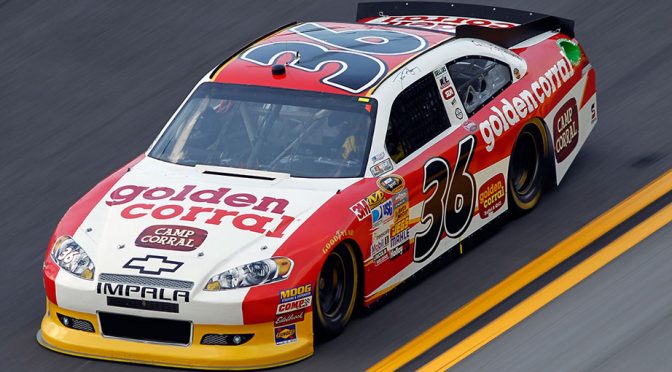
J.J. Yeley will pilot Tommy Baldwin Racing’s No. 36 full time in 2013

Longtime NASCAR Sprint Cup Series driver J.J. Yeley will drive the No. 36 Chevrolet SS for Tommy Baldwin Racing full time this season. Yeley drove for the team three times in 2012 at Indianapolis, Watkins Glen and Dover.

FULL SERIES COVERAGE

• View all articles
• View all videos
• View all photos

TBR announced Monday that Golden Corral would return to the team in 2013 as a primary sponsor for the No. 36 at the four superspeedway races. On Tuesday, the team announced an additional primary sponsor for three races. United Mining Equipment (UME) will be on Yeley’s car at Kentucky Speedway and both races at Bristol.

Yeley has a diverse background in racing, driving in all three of NASCAR’s premier series, the ARCA racing series, IndyCar and IROC and has participated in Tony Stewart’s annual Prelude to the Dream several times, coming in second in 2011.

Golden Corral will also bring back its “Top 10 Kids Eat Free” promotion. Only it will be called “J.J.’s Mondays” on the Monday following the race if Yeley finishes in the top 10.

The No. 01 BMW/Riley of Chip Ganassi Racing with Felix Sabates captured the 51st Rolex 24 Hours at Daytona International Speedway

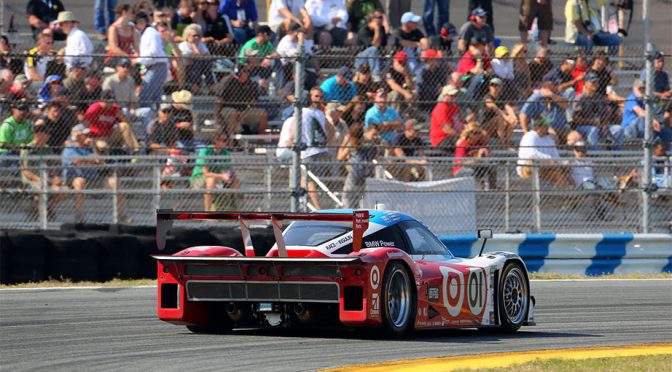
DAYTONA BEACH, Fla. — With the swagger of inevitably, given a decisive power advantage, the No. 01 BMW/Riley of Chip Ganassi Racing with Felix Sabates captured the 51st Rolex 24 Hours at Daytona International Speedway. (See full results here.)

Juan Pablo Montoya finished first in the crown jewel of GRAND-AM sports car racing, crossing the finish line of the grueling 24-hour race 21.92 seconds ahead of Max Angelelli in the No. 10 Chevrolet of Wayne Taylor. Defending champion AJ Allmendinger ran third in Michael Shank’s No. 60 Ford.

Filipe Albuquerque won the GT classification, finishing ninth overall with Audi R8 teammates Oliver Jarvis, Edoardo Mortara and Dion von Moltke. David Donohue captured first in the new GX division, winning the class in a Porsche Cayman with teammates Shane Lewis, Nelson Canache and Jim Norman. 

Montoya’s closing drive made a five-time overall winner of teammate Scott Pruett, who tied Hurley Haywood for the record in that category. Pruett extended his own record to 10 class wins in the Rolex 24, six of those coming in Daytona Prototypes.

"They did their homework and they played the game the best."

— AJ Allmendinger

Haywood, the race’s grand marshal, was one of the first to congratulate Pruett in Victory Lane.

“It’s just an incredible day all the way around, winning with these guys, winning with Chip, with (sponsor) TELMEX, with BMW,” Pruett said. “And then at the end of it, having gotten to know Hurley real well over the years by racing with him and just as a friend, and to have him there at the end was pretty special, a very special thing.”

Memo Rojas and Charlie Kimball teamed with Pruett and Montoya for the victory, which was owner Chip Ganassi’s record fifth in 10 tries. Montoya and Rojas each claimed their third victories in the Rolex 24. Kimball, who races despite being diagnosed with type 1 diabetes, recorded his first.

The defending-champion No. 60 Ford/Riley found trouble almost immediately. Allmendinger, who took the checkered flag last year, started off in the car, but 40 minutes into the race, he returned to pit road with a broken tie rod in the left front.

Allmendinger lost seven laps while the crew repaired the suspension damage. After regaining three laps under subsequent cautions, the No. 60 again was seven laps down after a fueling issue forced the car back to the garage.

Throughout the night, however, the team rallied, regaining lost laps under a spate of cautions. A caution for debris at 10:20 a.m. put the No. 60 back on the lead lap, and superb drives by Justin Wilson and Marcos Ambrose brought the car to the second position, where it was running when Allmendinger took over for the final stint under green at 1:45 p.m.

Two minutes earlier, Montoya had replaced Pruett, in pain from an old ankle injury, as the No. 01 readied for its stretch run. Pruett made the call to take himself out of the car.

“It’s no secret that I’ve gotten pretty beat up over the years, especially in IndyCar,” Pruett said. “I don’t know, for some reason my left ankle was bothering me a lot. It was really painful, and sometimes that happens. I knew I could go out and run a fast pace, but I wasn’t confident that if I had to go head to head, some real hard, close racing, that I’d have enough strength in my ankle to be able to get it done.

“I told (team manager) Timmy (Keane), ‘I don’t want to do this, but for the good of the team, we need to do it because we don’t know how this thing is going to unfold, we don’t know who’s going to be there at the end.’ And I got in and ran a couple stints right there at the end and put us in a solid position. Juan got in and just did a tremendous job.”

Though the stakes for Pruett multiplied the pressure of the situation, Montoya made the most of his BMW power and opened a lead of 26 seconds before a caution at 2 p.m. for debris at the start/finish line slowed the race.

“It was a lot of pressure,” Montoya acknowledged. “I thought, ‘We have a decent lead, we’re just going to go out there and ride for two and a half hours or whatever is left,’ and then you realize there’s a caution and another caution and another caution…

“We were kind of concerned about the (60) car, what they were going to do with fuel, because they told me they could make it until the end and that we were going to have to push, and we pushed like crazy and opened up a hell of a gap. It was fun.”

Nevertheless, Allmendinger grabbed the lead during the exchange of pit stops, restarted with 70 minutes left and held the top spot for six minutes of scintillating racing before Montoya powered to the outside approaching the exit from the banking and cleared the No. 60 as the cars entered the infield.

Caution for debris at 2:30 p.m. — with one hour, two minutes left in the race — bunched the field again, but Montoya soon passed Max Angelelli for the lead. Both drivers stopped for fuel in the final six minutes, leaving Montoya with his decisive advantage.

The race was not without controversy. In a general sense, the Ganassi cars had a clear power advantage over their Chevrolet and Ford rivals. In fact, GRAND-AM officials mandated a horsepower restriction for the Chevrolets before the weekend — based in part on dynamometer comparisons — and relaxed it only slightly after Pruett and Dixon spanked the rest of the field in qualifying.

Angelelli said he couldn’t feel the post-qualifying change.

"Did they change?" he asked facetiously after his first stint in the No. 10 Corvette. "No feeling at all. If the change is .000001 millimeter, it is not a change. They need to be released (from the horsepower restriction). Just look at the top speed. It is very simple."

Ganassi credited aerodynamics, specifically the ability to run his cars with minimum wing, for their dominant speed at the end of the straightaway. After the race, Angelelli scoffed at that explanation.

“Montoya was in his own league,” Angelelli said. “He was ‘A’ class. We were ‘B’ class… it was like driving with handcuffs.” 

Despite holding off Montoya for four laps after a restart with 70 minutes left, Allmendinger echoed those sentiments.

“They had the cars to beat, for sure,” Allmendinger said. “They did their homework, and it’s no secret that with the way testing works, everybody is kind of hiding some stuff and trying to keep it in reserve for the race. Last year we were able to capitalize on that, and we got our turn and won the race.

“You know, it was their turn. They did their homework and they played the game the best. When it’s your year, you’ve got to capitalize on it. We did that last year; they did that this year.”

The fastest car in the field — Ganassi’s No. 02 driven by Dixon, Dario Franchitti, Joey Hand and Jamie McMurray — fell out after sunrise. McMurray’s collision with the pit road wall at 5:47 a.m. cost the team seven laps for repairs.

"It didn’t seem like the pit road speed monitor was working, and I got panicked," McMurray said. "I was speeding, just reading the dash. When I got to the end of pit road, I was too hot trying to exit the pits on cold tires.

"It’s crazy how slick it is. I just made a mistake. I feel like an idiot, because we have the best cars, and it’s really about making it to the end. I didn’t do anything out of the ordinary — I just messed up."

The No. 02 team regained all but two of the laps lost before Franchitti stopped on the track at 11:48 a.m., causing a caution that gave his teammates the opportunity for a much-needed brake change. Rival owners Shank and Taylor took umbrage at the coincidence.

But Franchitti bristled at the suggestion that he had caused the caution deliberately, believing instead that he still had a chance to win the race.

"We were two laps down, so it was very doable," Franchitti said. I think, if we got back on the lead lap, we could have created some hassle for the other guys. … It just lost drive. I could go up through all the gears, but it wouldn’t go anywhere. No warning at all."

Other notes:

Pruett extended his career Rolex Series victory record to 40. Rojas, his full-time teammate, is second with 26 wins… The race was run under caution for one hour, 45 minutes Sunday morning because of heavy fog. That’s the second time in three years the Rolex 24 has experienced a significant fog delay… The event featured a record 74 changes of the overall lead… The top three finishers all completed 709 laps over the 3.56-mile road course.

Several drivers from NASCAR’s national series take GRAND-AM teams to the finish line

DAYTONA BEACH, Fla. — After 23 hours, the 51st Rolex 24 at Daytona came down to the final few minutes, and it was NASCAR’s own Juan Pablo Montoya who delivered on the 3.56-mile Daytona International Speedway road course Sunday, collecting his third Rolex win and assuring his Chip Ganassi Racing teammate Scott Pruett a record-tying fifth.

It was the second straight year a NASCAR driver was not only on the winning team, but was the driver who brought the car to one of racing’s most prestigious checkered flags.

And as it turned out, Montoya’s biggest threat in the end came from last year’s winner and fellow Sprint Cup Driver AJ Allmendinger, who co-drove with NASCAR’s road racing superstar Marcos Ambrose.

In the final hour, Montoya and Allmendinger raced through the tricky infield portion of the course as if they were tangling on a NASCAR short track.

“I knew he was going to get by, I was just going to make him work for it, I wasn’t going to make it easy on him,’’ explained a smiling Allmendinger, who ended up third.

“Obviously, with his background in racing in general, it’s fun to compete against him,’’ Allmendinger added. “But I don’t look at it just as NASCAR and NASCAR. Obviously, we both have diverse backgrounds, so it’s just fun to compete with somebody like that for the win.’’

Montoya said he was trying to be patient and ultimately it came down to a fuel mileage situation anyway.

“With the speed we had on the car, it felt like we didn’t have to take any risk,’’ Montoya said. “I think we’ve both been doing NASCAR for a while and you learn the give and take and you learn to share the race track, and that’s something here other people don’t do.’’

While Montoya, Allmendinger and Ambrose represented NASCAR on the podium, their fellow stock car competitors left the track exhausted, but also mostly satisfied.

Last season’s Camping World Truck Series’ "Most Popular Driver" Nelson Piquet Jr. finished eighth overall, tweeting afterward what a great time he had in the race and that he will "soon be announcing my NASCAR plans." 

Two-time Daytona 500 winner Michael Waltrip and his co-driver, 2012 Sprint Cup championship runner-up Clint Bowyer, looked as if they could race another few hours.

They finished 16th overall in a Ferrari 458 — eighth in the production-based GT class — and for a fair portion of the event kept themselves in contention for a podium finish.

"With the speed we had on the car, it felt like we didn’t have to take any risk."

— Juan Pablo Montoya

“We were always just close enough to getting on the podium that it kept us engaged every moment,’’ Waltrip said. “I think Clint (Bowyer) said it best when he said that car was ‘one tough son-of-a-gun.’ It felt and drove the same in the last hour as it did in the first.

“I love being a part of this (race). Just being at Daytona and of course, what this place means to me. It’s all good when you’re driving a Ferrari on a Sunday afternoon in Daytona.’’

Bowyer, who was making his Rolex debut, seemed as happy as he could be without taking home any winning hardware. He had stints driving in the sunset, in the middle of the night, in the morning as fog brought out a caution period and then finally in the race’s closing hours.

“It took me ’til daylight to have a little fun,’’ Bowyer said with a smile. “That stint was probably my best and I enjoyed it the best. The fog was kinda boring. But we got back on the lead lap. … And that’s what’s neat, just seeing the rejuvenation in everyone’s faces. But it’s no different than what we do every week in NASCAR.’’

And, he added, “I’m not tired at all.’’

It was an early day for Montoya’s Ganassi teammate, 2010 Daytona 500 winner Jamie McMurray. He co-drove on Ganassi’s second car, which retired from the race because of mechanical problems with three hours remaining.

That wasn’t to say McMurray didn’t have an eventful event first, however.

His car hit an air hose exiting the pits Saturday night and after serving a penalty, McMurray went back on track and turned some of the fastest laps of the race, putting the car out front for a good portion of the early going.

Early Sunday morning, a problem with the speed limiter on the dashboard distracted McMurray as he was leaving the pits and he glanced off the wall.

“This is different than crashing in a regular event,’’ McMurray said. “When it’s just you it’s not the same as having three other teammates and the amount of people we’ve had down here for testing. It is very embarrassing, very humbling, just heartbreaking to be the guy that does that. … I’m normally overly cautious. It really is frustrating because I feel like I don’t do that too often.’’

Standing alongside team owner Chip Ganassi as they watched Montoya complete the final lap, McMurray broke into a wide grin and celebrated the bigger picture.  

“Even though it’s two separate teams, you want to see your teammates win.”

NASCAR Sprint Cup Series runner-up brings Midwest flavor to international event

DAYTONA BEACH, Fla. — Clint Bowyer had plenty of first impressions from his first 90-minute stint in his Rolex 24 at Daytona debut Saturday — from inside the car and out. And instead of worrying about staying awake for the twice-around-the-clock race, NASCAR’s famously amped-up Sprint Cup Series championship runner-up was more concerned about how or when he’d ever grab some sleep.

“The guys on the pit box don’t sleep,” Bowyer said. “I was asking them, what stint they sleep, and they don’t.

“They have an espresso machine and I have a case of 5-Hour (Energy drink), so we’ll charge on.”

“What time is it anyway?”

“Seven-thirty?” he repeated when given the answer, “We’re almost to halfway right?”

"Of course it’s their biggest race of the year. Our Daytona 500 is exactly like that with the excitement in the air like that, especially down on the starting grid."

—Clint Bowyer

As the pressroom erupted in laughter it was clear NASCAR’s Bowyer had won over the wine-and-cheese sports car types just as his aw-shucks Midwest charm has made him popular with NASCAR fans. But he professed again Saturday that he felt very much out of his element; i.e. not in Kansas anymore.

“I was going to wear cowboy boots to this deal, but there’s no rednecks in this,” Bowyer said jokingly Friday during final practice. “Looks like a lot of rich guys to me.”

Bowyer figured he had 10 good laps — or about 20 minutes — around the 3.56-mile Daytona road course before the green flag fell Saturday afternoon for his 24-hour debut.

“But it is a big track so those were long laps,” he said, only half-joking.

Standing with fellow NASCAR stars, 2010 Daytona 500 winner Jamie McMurray and Juan Pablo Montoya, who later became a three-time winner at Rolex 24, during a photo opportunity on Friday, Bowyer explained that he had knocked two seconds off his lap times simply by the team hiring a spotter.

Because he was driving a slower GT-class production based Ferrari, Bowyer was slower than the race’s marquee Daytona Prototypes that began lapping the GT cars 15 minutes into the race. And it was an adjustment.

“I still don’t have any answers on where I’m supposed to be when these lunatics in the faster (Daytona Prototype) cars come blowing by me 50-mph faster,” Bowyer said to McMurray and Montoya.

“There is no answer because no one drives the same place twice,” Montoya said, genuinely trying to reassure him.

What was McMurray’s advice?

“What you need to do is drive your own line.”

But Bowyer wasn’t convinced.

“If I do that, the driver will be cussing me in some other language while I’m trying to get out of his way,” Bowyer said while laughing. “All I can see is headlights, and they get real big in the window.”

The language barrier at this international event of racing’s Who’s Who came up again during Bowyer’s first stint.

“The guys that talk to you, I can’t understand them, other than when they say to pit,” Bowyer said with a smile. “I understand ‘pit.’ ”

Despite earning his first Sprint Cup Series road course victory at Sonoma, Calif., last season, Bowyer was unyieldingly humble about what he brought to the 24-hour effort: fun. And what he hoped to get out of it: bonding time with his Sprint Cup Series co-owners, Rob Kauffman and Michael Waltrip, whom he was co-driving with this weekend.

The two-time Daytona 500 winner Waltrip said he was impressed with how quickly Bowyer got up to speed in the Ferrari during this limited practice.

Even after accidentally hitting the engine “kill” switch while climbing into the No. 56 Ferrari 458 for his first stint Saturday evening, Bowyer was able to win back several positions he lost on pit road. The car was 26th overall, 13th in the GT class at midnight. It finished eighth in the class and 16th overall on Sunday.

“Obviously, because of that we couldn’t get going and lost a lot of track position, and I’m super bummed out about that,” Bowyer said. “The biggest thing is getting used to the car. Man, it’s hard to be consistent out there. You can’t ever get a clean lap. About the time you do, you’ll go in the chicane and there will be dirt everywhere and you revisit your dirt racing experience.”

But he was also quick to stress, “The cars are a lot of fun to drive. They’re lightweight and pretty loose. But with the paddle shifting you can downshift too (quickly) and get yourself in trouble.

“I’ve gotten myself in trouble a couple times, had to shoot through the chicane then have a conversation with myself to calm down a little bit; then I was slow, so had to have another conversation with myself to pick it back up.”

Judging by his demeanor after his time behind the wheel the conversation went well. He was taking in the experience — all it had to offer.

“Really, really cool there the atmosphere before the race,” said Bowyer, before jokingly suggesting that “the starting grid is definitely in my opinion some room to improve in our sport after what I saw.

“Of course it’s their biggest race of the year. Our Daytona 500 is exactly like that with the excitement in the air like that, especially down on the starting grid.

“But there was body paint. I saw body paint and I thought that was a great addition to the day. And some of them had umbrellas. That would be one area that could be worked on.”

And then after the last reporter’s question, Bowyer turned the tables.

“Raise your hands, how many of you are going to stay up 24 hours?” Bowyer asked, acknowledging the few who raised their hands.

“Well, have fun with that,” he said, standing up and smiling and heading out of the media center to take some more in.

JGR driver gains new perspective with birth of first child

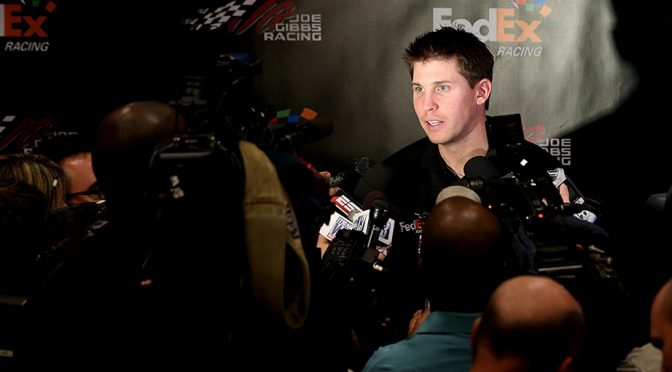
HUNTERSVILLE, N.C. — Denny Hamlin has this fatherhood thing down.

Five days of it, at least.

“It actually hasn’t been too bad,” said the Joe Gibbs Racing driver, whose daughter Taylor James Hamlin was born Sunday. “She’s sleeping most all the time now in between feedings. So it’s been relatively easy. So far.”

Surely that will eventually change, as Hamlin juggles his new daddy duties along with his role as one of the top drivers in the Sprint Cup Series. But to this point, it’s all gone smoothly — the baby is healthy, Hamlin said his girlfriend Jordan Fish came though the birth without a hitch, both sets of parents have arrived in town to help, and even the dogs seem to get along with the new arrival.

“The experience is great,” Hamlin said Thursday, when the Gibbs shop was visited by the NASCAR Sprint Media Tour hosted by Charlotte Motor Speedway. “Your outlook changes, on when you have to leave home, when you have to get home, things like that. How excited you are to pull into the driveway knowing you get to see your daughter. So that part of it is cool.”

Soon enough, it will be time for Hamlin to say goodbye to mother and daughter — the baby is too young to venture to Speedweeks — and work on bringing home another new addition: the Sprint Cup championship that eluded him again last season. He still shakes his head over how it ended for him last year, when he opened the Chase for the NASCAR Sprint Cup running as well as anyone, and ended it out of contention because of a mechanical problem.

This time, it was an electrical switch that went awry at Martinsville, one of Hamlin’s best tracks. He still won five times in 2012, but believes he should have doubled that number, and the way last year ended made it clear in his mind what the offseason priority needed to be.

“You can’t have any DNFs. We’ve seen that,” Hamlin said. “There are no more mulligans in the Chase … It’s just too hard nowadays. You’ve got to average a finish in the top five. That’s extremely hard to do, but we can do it. We’ve been in championship hunts and something mechanical has taken that away every single time. … Our key in the offseason has been reliability, coming up with a system to make sure our cars are bulletproof when they hit the race track.”

These are not new issues at JGR, where Kyle Busch’s dominant 2008 season came unglued in the Chase opener because a rear suspension piece simply wasn’t hooked up correctly. Jimmy Makar, vice president for racing operations at Gibbs, says the team is working on it. Last year, JGR implemented a system that analyzes potential failures and ranks them in terms of importance, from something relatively innocuous to something that can knock a car out of a race.

“We’re real good at fixing failures once they happen,” Makar said. “That’s something we’ve always been good at. We’re trying to get to the point where we recognize a potential failure before it ever happens, and be proactive instead of reactive.”

Hamlin feels the team is heading in the right direction. “Things that went wrong with our cars, or things that fell off or got loose or whatever, it was human error, and you need to take that kind of out of the equation,” he said. “To do that, you have to have more than one set of eyes working on your cars. We’re hopefully working on some things to make sure that our cars are reliable as the planes you fly in the air.”

Right now, though, Hamlin still has a few weeks to bask in his newfound fatherhood before the season begins. “Leaving the house for sure will be hard. I have solace in knowing in just a few months I’ll get to see her all the time every day,” he said. And there are plenty around him willing to offer advice, team president J.D. Gibbs included.

“I asked Jordan, ‘How was he?’ I went and saw the baby a couple of days after and said, ‘How’s he been?’ She said he’s been really good,” said Gibbs, who has four children. “My wife would not say that about me. So it was good to hear that. I said, ‘Hey, this ain’t easy, so hang in there.’ ”

Hamlin’s crew chief Darian Grubb has two kids, and they might offer a preview of what the driver is in for. “My 4-year-old son’s got strep, and my 6-month-old is sick and has goo running out of every orifice she has. So it’s one of those things,” Grubb said, laughing.

“It’s a tough time, but it’s also one of the most gratifying times you’ll ever have. I sent him a text and said, ‘Let me know when you get to take that first nap with her sleeping on your chest, and you’ll know what it’s all about to be a father then.’ He sent me back a one-word text that just said, ‘Awesome.’ ”