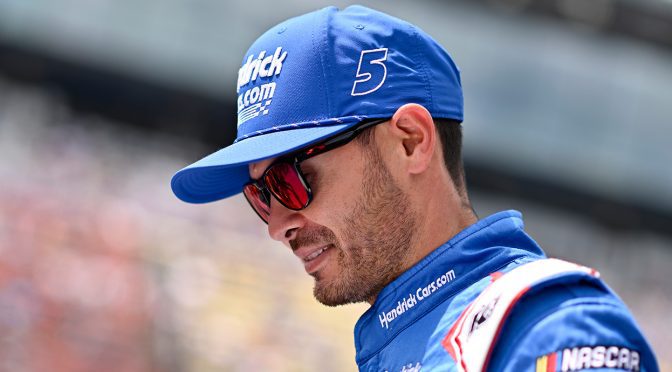
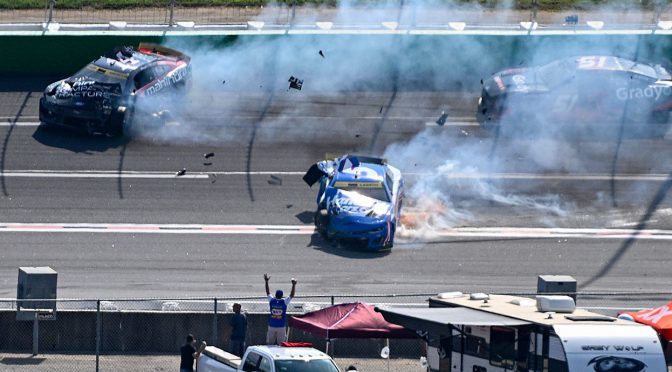
CONCORD, N.C. — Kyle Larson said his crash in Sunday’s race at Atlanta Motor Speedway was a matter of briefly losing control, the result of a mounting set of circumstances through the high-banked first and second turns. The impact — compounded by the arrival and involvement of Chase Briscoe’s No. 14 Ford — has made his circumstance in the NASCAR Cup Series Playoffs a tighter one.
Larson will attempt to regain control of his postseason footing in Sunday’s Go Bowling at The Glen (3 p.m. ET, USA, NBC Sports App, MRN, SiriusXM) at Watkins Glen International. He’s won there twice in the last three years, and his Hendrick Motorsports team currently rides a five-race win streak at the New York road circuit.
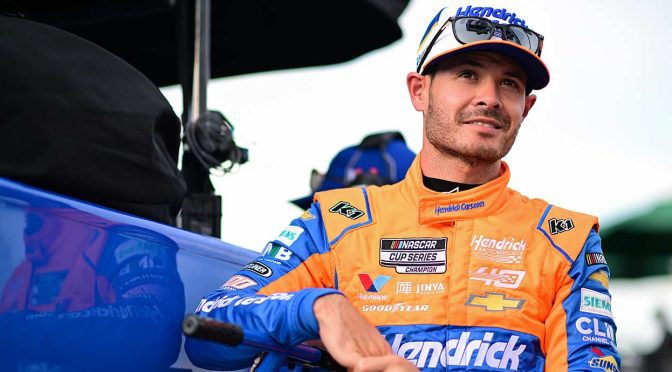
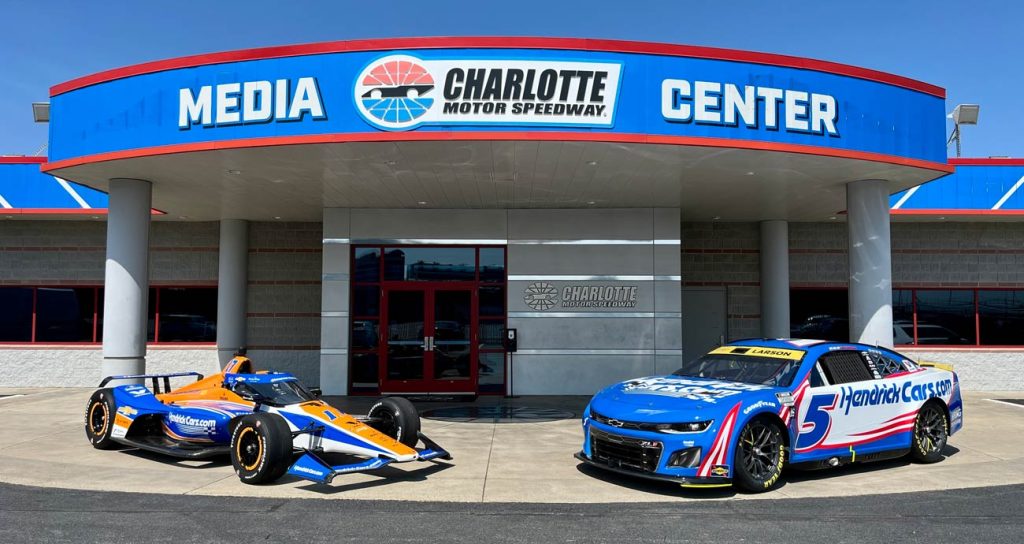
Larson spoke Tuesday from Charlotte Motor Speedway, where Hendrick and Arrow McLaren announced a second attempt at running the Indianapolis 500 and Coca-Cola 600 in the same day in 2025. He said that the harsh nature of the wreck at Atlanta left him with some soreness, in addition to his 37th-place finish and fifth crash-related DNF of the season.
“I felt fine, and I was just a little bit stiff (Monday) and less (Tuesday), but I just got loose,” Larson said. “The cars, when you get off-set halfway of the guy in front of you, you lose a lot of downforce, and I was just kind of living in that pocket, and I felt fine, and then it just started stepping out. I think the tires are so stiff for speedways, the car setups are stiff, it just makes reactions harder. You saw Chris Buescher do pretty much the same thing as me. I was going to crash that corner. I was either going to hit driver’s side or nose it in, and unfortunately nosed in.”
The Stage 1 exit in Sunday’s postseason opener chipped away at Larson’s cushion in the Cup Series standings. The 32-year-old driver entered Atlanta as the points leader but dropped to 10th in the playoff pecking order, just 15 points above the provisional elimination line with two races left in the Round of 16 — Sunday at The Glen and the following weekend at Bristol Motor Speedway.
Larson noted how Watkins Glen has been a favorable venue for the No. 5 team to potentially rebound, but acknowledged that projections of significant tire wear at the 2.45-mile road course are expected to affect the race’s complexion.
“I mean, I think always that points are going to be on your mind a little bit, so I can’t deny that,” Larson said, “but I’m happy that we’re going to a style of track that we’re competitive at, but there’s still the unknown of the tire wear and the hype behind the fall-off, which I do believe there’s going to be a lot of fall-off. So yeah, we’ll see, but I think as long as you can have a solid day, and hopefully we can gain 10 to 15 points on the cut line and I would feel much better about things going into Bristol.”
Larson just missed on having an extra buffer for the balance of the Cup Series Playoffs, having come up short by a single point to Tyler Reddick in the hunt for the Regular Season Championship. Instead of collecting a 15-playoff-point bonus, Larson was awarded 10 playoff points as the regular season’s runner-up.
Larson competed in 25 of the 26 regular-season races, missing out on the Coca-Cola 600 when rain delayed his Indy 500 efforts. Even a last-place finish in the Charlotte 600-miler could have made the difference in the regular-season title chase, but Larson said other missed opportunities in the season’s first seven months also factored in.
“I think it’s really easy for everybody to just look at one race and forget about all the races that I’ve crashed in or whatever that have also contributed to me … all I needed was one more point,” Larson said. “It could have been in any race that could have got me (one point), so I don’t view it as if I would have skipped the Indy 500 and come here and run, that’s the one thing that’s going to change my season.”
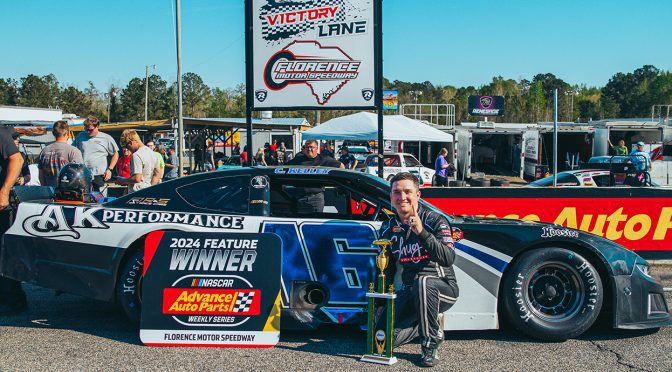
Casey Kelley has been attending races at Florence Motor Speedway in Timmonsville, South Carolina, for as long as he can remember. His dad raced at the 4/10-mile paved oval for many years and took home several track titles. In one championship-winning season in the mid-1990s, the elder Kelley won 10 of 12 races at Florence.
The family history would make Casey Kelley winning a Late Model championship at the track this season that much sweeter.
“It’ll mean the world to me,” Kelley said. “I love Florence Motor Speedway. [Owner] Steve Zacharias and his whole family, they do a lot of work there, and they try really hard, so I like supporting them. They’ve done an awesome job making it better over the last couple of years, and it’s just an honor to race there. I’m very thankful.”
With one points race remaining, Kelley nearly has the track title locked up. With five wins, he’s finished in the top five in all 14 races, giving him a 28 point lead at the top of the standings.
Casey Kelley (Photo: Leann Zacharias/Florence Motor Speedway)
Kelley has been racing Late Models at Florence for several seasons, but he credits his turnaround this summer to joining AK Performance and Kendall Sellers. Kelley and his twin brother Cody both race with Sellers, and Cody is second in the Florence Late Model standings.
“It’s been nothing but success, really, whenever we race with him,” Casey Kelley said. “He brings a lot of nice equipment and good cars to the track, and it’s shown this year with five wins. I mean, I couldn’t ask for much more.
“Just the consistency and AK Performance, the way they work, they prepare the cars very well. They work every day in the shop, and we go over there and we practice a lot. … They’re as nice as anybody out there, and they’ve got the best equipment of anybody, so it makes it a lot easier on me.”
The Kelley family has always been involved in racing; they owned a dirt track in Hartsville, S.C., for many years. After watching his dad race when he was growing up, Kelley said he and his brother knew it was a sport of which they wanted to be a part.
“We’re just following our dad’s footsteps,” he said.
The 28-year-old Kelley has been racing at Florence now for 16 years. He began when he was around 12 in the track’s Young Guns division. He eventually moved up to the Charger class in a car owned by his uncle until the Kelleys bought their own limited late model.
This is the first full season the Kelley brothers have raced against one another. In the past, they would have one brother driving while the other worked on the car, and trade off week-to-week. Eventually, when Casey moved up to Late Models, Cody would race a Super Truck on the same night.
The brothers jumped at the chance to both race a Late Model this season, but racing against his brother – who is also his biggest competition – isn’t easy for Casey Kelley. The good thing about the duo is, while they’re competitors on the track, they’re also each other’s biggest fans.
“We race hard against each other,” Kelley said. “To be one and two, it means a lot. It wouldn’t matter if he was ahead of me, if I was second. He’s a really good race car driver, so to be next to him or ahead of him in points is awesome.
“I like racing against him, but it’s so hard to race against your brother, you know? But it is fun.”
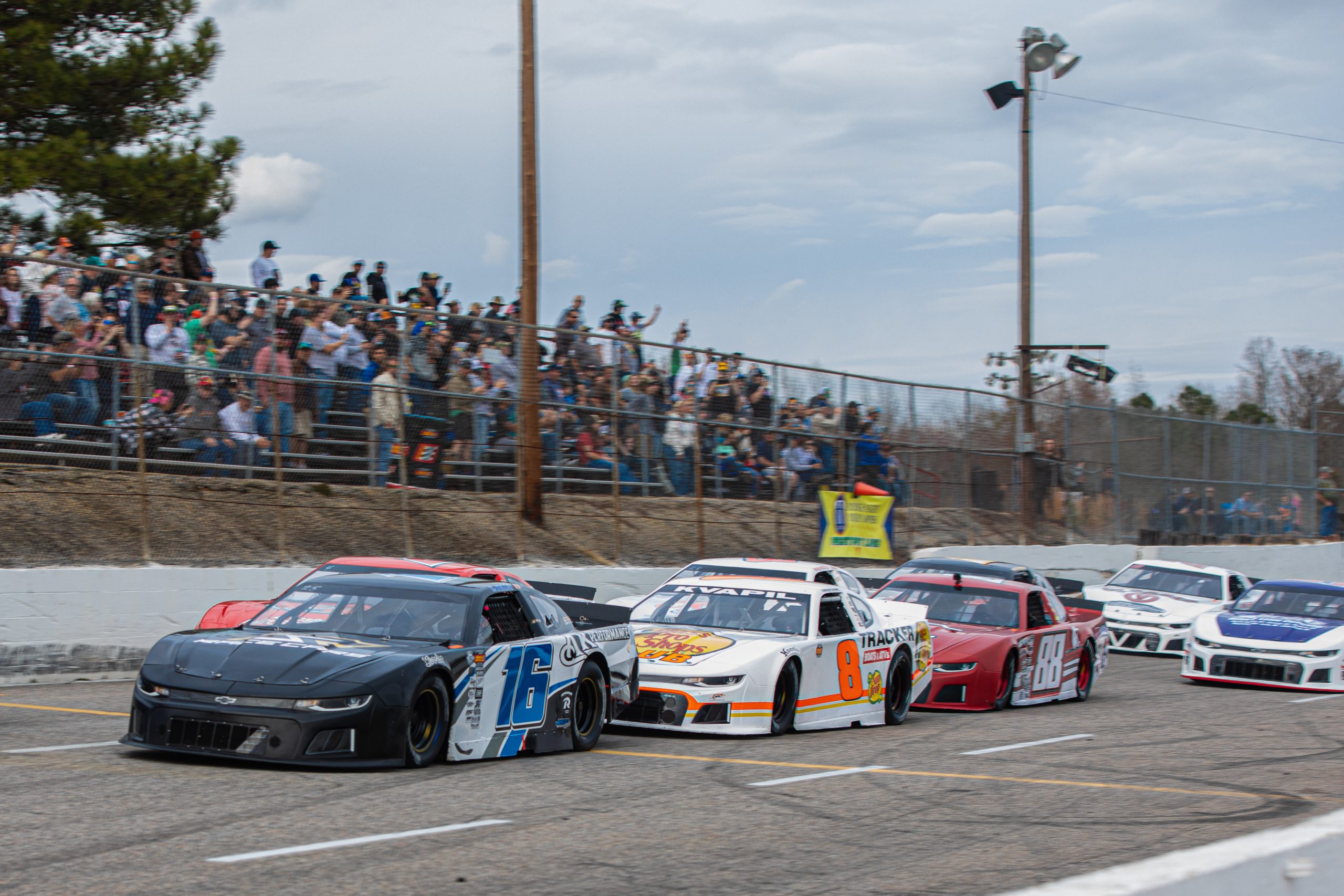
Casey Kelley leads the ninth annual IceBreaker at Florence Motor Speedway on Feb. 10, 2024. (Photo: Ted Malinowski/NASCAR)
With one points race left, Kelley’s points lead is just about big enough to where he doesn’t have to worry about what happens on championship night, as long as he starts the race.
But he isn’t resting, and he doesn’t want to leave anything to chance.
“I’m just trying to stay consistent and not have any trouble,” he said. “I think the points lead is big enough. I don’t know for a fact, but I think if I start the race, I think I might have it locked up, but I don’t know for sure… Just try to have a good consistent run and try to finish in the top five will be my goal.”
Winning a championship would complete Kelley’s goal, not only for this season, but for all the years he and his family have been racing around Florence Motor Speedway.
“It’ll be awesome,” he said. “It has been a goal of mine to win a championship at Florence. Whenever we started out this year, Kendall, that was what he wanted to do. He said, ‘Let’s go win the championship at Florence,’ and that’s been our goal, so I’m very happy to be able to do it, and I wouldn’t want to do it with anybody else.
‘It’s just been a good year. Kendall Sellers at AK Performance, they just just bring really, really good equipment, and it just makes the job easier on me.”
Florence will host Night 2 of its Night of Champions on Saturday beginning at 7 p.m. ET. Champions will be crowned in the track’s SC Vintage, Bandoleros, Legend Cars, Street Stocks, Late Models and Chargers divisions.
Editor’s note: This story was updated following Saturday’s NASCAR Cup Series practice and qualifying session.
A new tire compound courtesy of Goodyear is expected to change the look of Sunday’s NASCAR Cup Series Playoffs race at Watkins Glen International.
The Go Bowling at The Glen event set for 3 p.m. ET Sunday (USA, MRN Radio, SiriusXM NASCAR Radio, NBC Sports App) will feature a tire tread expected to create approximately three seconds worth of lap-time fall-off from the start of a run through its conclusion. If tire degradation is indeed that severe, drivers will be forced to change how they attack the historically fast, sweeping 2.45-mile road course in upstate New York.
Team Penske’s Austin Cindric, Trackhouse Racing’s Daniel Suárez and 23XI Racing’s Regular Season Champion Tyler Reddick — all drivers competing in the postseason — participated in a three-team, two-day tire test at the road course on June 26-27. Goodyear provided six different compounds to teams that day, four of which were developmental compounds. Reddick and Suárez each spun during testing while determining the limits of the new rubber, with Reddick spinning multiple times on Day 1 of testing. On Cup Series Playoffs Media Day ahead of the playoffs, drivers mentioned information they received indicated tires lost anywhere from two to five seconds worth of lap time over the tires’ life.
Following the tire test, Ford, Chevrolet and Toyota each brought vehicles to perform a wheel-force test, in which the manufacturers could collect data via sensors and provide teams information to prepare for the upcoming race.
“In our ongoing efforts to introduce more fall-off, we tested at Watkins Glen in June and came out with a new tire that will accomplish that goal,” said Greg Stucker, Goodyear’s director of racing. “Based on our test and a subsequent WFT (wheelforce test) with the manufacturers, we should see around three seconds of fall-off per lap over a run. That, of course, can mean more passing throughout the race. It’s always tricky on road courses as drivers take advantage of a limited number of ‘passing zones,’ so the increased fall-off should lead to more comers and goers as some drivers manage their tires and gain on the field as the runs go on.”
Indeed, the dramatic levels of fall-off are intentional as Goodyear and NASCAR work hand-in-hand to create better passing opportunities for drivers.
“The evolution of where we want to go with tires starting back at our short tracks and road courses, as we’ve said for the last couple of years, we want to get really aggressive on [tire wear],” Elton Sawyer, NASCAR’s senior vice president of competition, told SiriusXM NASCAR Radio on Tuesday. “And Goodyear has been a tremendous partner in this effort. I mean they’ve worked really hard. We’ve done a lot of testing. Some things that have come out of this include the option tire that we ran at Richmond a couple weeks ago.
“So that technology and that innovation, if you will, and evolution of where the tire is today is a credit to them. And we will continue to push the boundaries there. Ultimately, our goal is to have great racing, but what gives us that is tire fall-off. So, continuing to work on it, but we’re excited to see exactly what we’ll have up there this weekend.”
Martin Truex Jr. is a past winner at Watkins Glen and the 2017 NASCAR Cup Series champion. Adding tire wear to the mix, he believes, will play into his strengths in the No. 19 Joe Gibbs Racing Toyota.
“I think it’ll be a good thing for me, personally,” Truex said at NASCAR Playoffs Media Day. “I think it’ll be a good thing for passing. Watkins Glen is so fast that when we were there the last few years with no tire fall-off, you can’t get close enough to a guy to make a pass. It’s simple physics, right? You go up through the esses and lose five-to-six car lengths, it’s over. So, it’s going to help us be able to make passes, especially if your car is good and that’s what we need at those kinds of places.”
Perhaps the most significant unknown heading into Sunday’s 90-lap contest is whether the tire wear will be so significant that it discourages teams from “flipping” stages. At Watkins Glen, Stage 1 will conclude at Lap 20 and Stage 2 at Lap 40, with pit road closed after the leader crosses the start/finish line to signal two laps remaining in the stage. Since stages were introduced in 2017, teams have typically opted for one of two strategies at road courses: pit before the stage end and restart at the front of the field to retain track position or stay out to collect stage points, sacrificing track position and restarting toward the tail of the field.
Game-planning for Sunday’s race at Watkins Glen could be flipped on its lid if tire degradation is so severe that two green-flag laps result in significant fall-off.
“I certainly think that it could definitely play a role in strategy,” Denny Hamlin, last year’s Watkins Glen pole-sitter, said during Media Day. “It’s been so straightforward in the past that you just want to get to those stage points, and then you go ahead and pit. But certainly, if tires are going to matter like it seems like they might, it throws a whole new element in it — and it’s not a huge gimmicky element because you have to strategize around tire wear. The driver plays a huge role in that, so certainly I’ve got my fingers crossed that it’s a race that’s going to be unlike any road course we’ve seen.”
Sean Gardner | Getty Images
Defending Cup Series champion Ryan Blaney echoed that sentiment but noted the points standings after Atlanta may also influence a need to collect stage points or chase a victory instead.
“If you can grab some stage points, you’re probably gonna do that, and it depends where you’re running,” said Blaney, who earned 53 points at Atlanta and is currently first in the standings. “If you’re top five and you feel like you’ve got winning pace, maybe if the leader pits you have to make a big decision of, do you go grab nine or 10 stage points and restart in the back? You have to see how big the fall-off there is. Like, ‘Hey, is two laps gonna be three-quarters of a second of fall-off if you have two-lap older stuff?’ I don’t know. Is that gonna overcome the track position? That’s all in-game decisions that crew chiefs and drivers have to kind of assess and make.”
Teams will receive an additional 20 minutes of practice on Saturday afternoon. The 38-car field will be split into two practice groups, with each scheduled for two 20-minute sessions. Joey Logano, winner at Atlanta and locked into the Round of 12, believes those 40 minutes will be imperative toward strategizing for Sunday.
“It just really depends on what it is when we get there, right?” Logano said. “I mean, you’ve got to assume that somebody in practice will go for a long run, and you’ll get to see what that is, right? Maybe it’s you who does it, but we’ll see, and you’ll see what the tire (degradation) is. But I think until then, you know, we’re all speculating a little bit, right? … Is it going from five seconds of fall-off to three seconds? Or one second? We don’t know that for sure, right? We can speculate as much as we want, but we don’t know that till we get there, and that’ll adjust your strategy from there.”
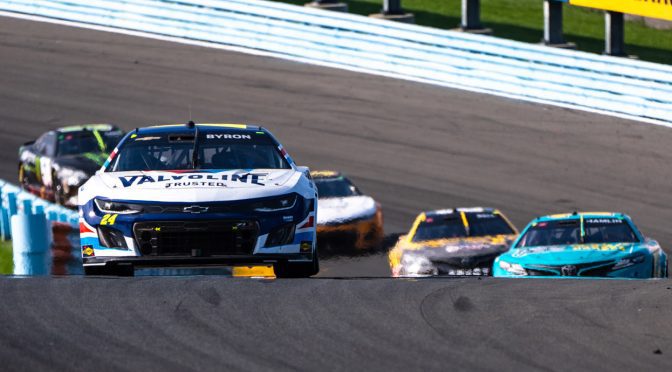
Hendrick Motorsports has gone undefeated at Watkins Glen since Chase Elliott’s win in 2018, with Elliott winning again in 2019, Kyle Larson going back-to-back in 2021 and 2022 and William Byron victorious in 2023.
“They’ve been really good there. Hopefully, the new tire kind of changes some of that,” Team Penske’s Blaney said. “I feel like when it’s that big of a change (in tire), you really have to switch up your rear cambers, your front cambers, your toes. All that stuff that (is) really important on road courses, so we’ll see. I think maybe that tire change is the best thing for us trying to get Hendrick off the top there at The Glen, where they’ve been dominant. We’ll see. That will be an interesting race for sure.”
Following practice and a 28th-place qualifying effort, RFK Racing playoff driver and co-owner Brad Keselowski noted a significant difference behind the wheel of his No. 6 Ford.
“It’s really interesting. A lot of progress. I give Goodyear a lot of credit for going to work,” Keselowski said. “Last year, I felt like this was one of the tracks with the least amount of tire fall off and it hindered the ability of great action. Like with anything in this sport, when we change, it’s never a little bit, it’s like whoa, the other end of the spectrum. The knob got cranked and it will be interesting to see how it affects the race.”
John Patalak’s phone began blowing up with texts before post-race inspection ended last year at Watkins Glen International.
By Monday morning, NASCAR’s vice president of safety engineering had messages from several Cup Series drivers who had worn mouthpieces to measure head motion and impacts during the race at The Glen.
They all wanted the data recorded by those mouthpieces during 90 laps around the 2.45-mile road course.
“Which was unusual,” Patalak said, “because none of those drivers had crashed.”
In fact, the Aug. 20, 2023, race at Watkins Glen had no wrecks — but a plethora of Cup Series stars felt as if they crashed. Among those was Kyle Larson, who typically requested his mouthpiece data after superspeedway crashes but never for a race in which he avoided the wall.
“For Watkins Glen, I really wanted to see it, because it felt like I was crashing multiple times a lap,” Larson said. “So yeah, the data was very eye-opening and good to show NASCAR.”
The numbers bore out his concerns. The Watkins Glen mouthpiece data took longer to download because it was so voluminous, showing nearly 1,000 impact events were recorded in the “Bus Stop” — a jarring revelation given there were about 3,400 total events recorded during the entire 2023 season at all tracks.
“By Tuesday, we were pretty blown away,” Patalak said. “Over a quarter of our season’s mouthpiece sensor events were coming from one location on one track. So that started the Bus Stop reconfiguration. We pulled a lot of video and talked to a lot of drivers in the following days.”
Planning to modify that section of the track for 2024 started within days. After being tested in June, a new configuration (which removed elevated rumble strips and added smoother curbing transitions) will be in place as the Cup Series returns this weekend.
It’s among the best examples of how the mouthpiece sensor, which was developed by a Wake Forest University School of Medicine Biomedical Engineering research team and has been worn by at least 10 drivers in every race since the 2023 season, is making an impact in NASCAR safety enhancements.
Though it’s literally invisible when compared with high-profile safety technology such as the SAFER barrier, the HANS device and the now ubiquitous cockpit cocoons that keep drivers secure in crashes, Patalak believes the mouthpiece sensor could be just as prominent in reducing potential injuries by helping chart a path forward for future R&D.
“The more data we can get, the better informed our analyses and decisions and the tools we use become,” Patalak said. “The mouthpiece sensor in and of itself makes the driver no safer at all in the race car at that moment. But we’ve got to decide each year on our priorities in making things safer. It dictates all of that.”
Initially resistant to the concept of a foreign object in his mouth while racing 500 miles, defending Cup Series champion Ryan Blaney now has worn the device for more than a year.
“I was against it, but if it’s going to help us learn what the drivers go through in these wrecks, I’ll put this thing in,” he said. “I don’t like being the crash test dummy, but it’s good to have that data.”
Chris Graythen | Getty Images
How the mouthpiece sensor has taken hold
Similar to the Incident Data Recorder or “black box” that monitors what happens to a car during a wreck, the mouthpiece sensors are designed to measure what happens to a driver’s head. Both grew out of the safety revolution after Dale Earnhardt’s fatal wreck in 2001, but while black boxes became mandatory by 2002, technology took longer for accurately measuring forces sustained by a driver.
NASCAR initially considered earpiece sensors 20 years ago but preferred monitoring head motion through a mouthpiece on the upper dentition because of the upper jaw’s direct attachment to the skull.
As advancements in miniaturization led to more precise measurements of impact, Wake Forest University School of Medicine researchers engineered custom mouthpiece systems with a focus on youth sports (soccer, hockey, youth and high school football) as well as college women’s soccer (and also has dabbled in bull riding).
The School of Medicine team began designing the custom driver mouthpiece in 2018 in a partnership that started with Patalak attending the school in 2015 to earn his doctorate. He studied with Dr. Joel Stitzel, a biomedical engineering professor who would oversee the NASCAR project.
“NASCAR and NASA had done some work with the NASCAR crash database, and one of the academic groups doing research on behalf of NASA was Wake Forest,” Patalak said. “That was one of the first times I realized there is a group an hour up the road from Concord (N.C.) doing high-level simulation work on head injuries.”
The NASCAR mouthpiece is made at Hurst Dental Labs in Winston-Salem, North Carolina, and resembles a nightguard worn to prevent teeth grinding. But the mouthpiece is more flexible and thinner, though still stiff enough to optimize data collection.
Because drivers don’t have as many breaks to pop out their mouthpieces and relay information (as an NFL quarterback might do to call an audible at the line of scrimmage), a primary concern was ensuring clear radio communication without compromising the sensors.
During the first five years of mouthpiece development (which was delayed by the pandemic), Stitzel said the team went through several iterations for NASCAR before landing last year on a minimalist model with exterior instrumentation for a tighter fit.
Drivers who wear the mouthpiece take a 5-minute scan in the preseason, but a makeshift mobile dental lab also has been used to help customize comfort and fit. Mike Hurst, the owner of the dental lab that manufactures the mouthpiece, was praised by Stitzel for often being on call at the track to make miniscule adjustments.
“A millimeter or two inside the mouth is very perceptible, and sometimes the drivers will want that change,” Stitzel said. “And Mike will shave off just a tiny bit, and it’s much better. It’s really an art.”
The mouthpiece has a battery that can run for six or more hours. During practices, data is continuously recorded to evaluate how the head reacts during laps without impacts and to measure bumps, areas where a car bottoms out and the G forces under cornering.
During a race, the recordings are triggered when a threshold of 4Gs is exceeded. “We have the threshold set quite low because we want to record a lot of data to make meaningful analyses,” Patalak said.
Said Stitzel: “We are concerned not just with concussions and injury-causing events but cumulative exposure to low-level impacts that the head experiences, and 99.9 % of those are not concussive.”
As many as a dozen researchers and students at Wake Forest have supported the NASCAR project, which is spearheaded by Stitzel and Dr. Jill Urban. There’s a representative from the university at every Cup event to distribute prior and collect and download the mouthpieces after each practice and race (or at the care center after a crash).
At least two drivers have said they preferred wearing the mouthpiece because their jaws ached less after races from no longer clenching their teeth. Patalak could tell the initiative had caught on when mouthpieces sometimes had to be tracked down because drivers “literally forgot it was in their mouth. For the core group that wear it week in and week out, it just became part of their weekly routine and didn’t bother them throughout the race.”
Alejandro Alvarez | NASCAR Digital Media
Drivers are driving the data collection, too
Blaney has been wearing a mouthpiece since the Aug. 26, 2023, race at Daytona International Speedway, where his device recorded his head acceleration during a severe crash. The Team Penske star laments being without the mouthpiece when he suffered a hard hit two months earlier at Nashville Superspeedway.
“They get the black box for the car, but the driver is a whole different thing,” Blaney said. “We’re the softest thing in the race car. We were still tweaking on the car between Nashville and Daytona, they had cut some gussets in the clip to try to crush it more, so I wish we could have got the data from Nashville. I was like, ‘Man, I’ve got to wear this just to give them some data on where to go with this car and continue to make it (safer).’ ”
Blaney removes his mouthpiece during every other caution “just to reset” but has encountered no issues with communicating. “It’s fairly thin, but there’s still wires running through it on the molar side,” he said. “I don’t speak too differently with it in, but I just didn’t want to have anything in my mouth for 500 miles. That was my only concern, but I just kind of got used to it after a while.”
Larson jokes he sometimes relays feedback with a lisp but doesn’t mind the mouthpiece because he already was accustomed to wearing a device to align his teeth, and “this is just a little bulkier.”
Joey Logano also became a regular user of the mouthpiece after initial awkwardness. “It kind of messed up my speech a little bit because it’s like you put your retainer in when you go to sleep,” the two-time Cup champion said. “They got it to where it’s pretty comfortable now. I was always nervous if you wreck and what if it fell out or you choke on it, but it’s fine.”
As a perk for participating, drivers have full access to their mouthpiece data that is kept in a cloud-based system. By the Monday afternoon after a race, they receive an automated notification via an app that a detailed race weekend summary is available with all recorded events (and highlighting the highest). For further review, drivers can reply directly to Patalak and Wake Forest researchers to set up meetings in person or via videoconferencing.
Unlike black box data (which can be requested by teams), only drivers have access to the mouthpiece data that is treated “as private health information,” Patalak said. “When the data is used for research, it’s anonymous and untraceable to a driver.”
In April, Larson used his data to provide context when a passionate discussion of the Watkins Glen changes erupted on social media. The 2021 Cup champion’s mouthpiece recorded 145 impact events through the Bus Stop, with Larson noting, “Something needed to be done. What was there before was not safe for the brain.”
Stitzel, who entered the biomedical engineering field because he wanted to protect people from injuries, said Larson’s post caused an enthusiastic stir in the team’s research lab.
“Most of the time, we’re writing papers and hoping people cite them and trying to get students through graduation. And to see him say, ‘Oh, this data mattered to me’ as something we’re doing to help NASCAR make the sport safe, that’s very rewarding to me. That’s the whole reason we’re doing this. It created some excitement throughout the lab.”
Courtesy NASCAR Communications
Zeroing in on the Bus Stop at Watkins Glen
During at least one and sometimes two of the apexes in the Bus Stop at Watkins Glen last year, Cup drivers were experiencing high G forces to both sides of the head in “a third of the time it takes to blink your eye,” Stitzel said.
During a June 26, 2024, test with Tyler Reddick, Daniel Suárez and Austin Cindric at Watkins Glen, Patalak said there were fewer events, and those recorded were of decreased severity. “I’m comfortable we will see an improvement in the (Sept. 15) race with the Bus Stop updates,” Patalak said.
Reddick also is confident of the improvements while “the nature of the Bus Stop remains intact. I appreciate them putting our safety first. It’s great they’re collecting this data. The more data they have, the more they can identify trends.”
Said Blaney: “It’s a good indication on just what your head goes through. It was interesting to me to look through it after Daytona with the NASCAR and Wake Forest folks and understand what it all means. That has definitely helped on changes with the car.”
After mouthpiece data showed drivers were experiencing cumulative impacts from successive front and rear collisions in restart stack-ups, NASCAR was spurred to develop new rear impact head surround foam that could reduce head impact forces by up to 50 percent.
“It made a really big difference in reducing head accelerations in those type of impacts,” Patalak said. “We had mouthpiece sensor drivers reach out and say, ‘Hey, didn’t feel good.’ They never went to the infield care center. So, we’re seeing sometimes the driver’s experience doesn’t match the eyeball test of a car with just a tire mark. So then we can look at the data and say, ‘This is unusual.’
“Then we can look at human body computer modeling data and design a drop test to improve the head foam because we know exactly how fast the driver’s head impacted the foam. That would have taken us way longer to understand without the mouthpiece sensor data.”
Using the device is voluntary, and up to 16 drivers currently wear the mouthpiece in races. Though a heavier lift logistically, Patalak said NASCAR could handle equipping the entire field weekly, and it’s his goal to have the mouthpiece participation rate at 100%.
“Having the data really helps us decide where we can get the most safety improvements the fastest,” he said. “It gives a glimpse into exactly what happens in a crash, and that makes it actionable. You can go to all the stakeholders and say, ‘This is what we’re pursuing, and this is the data behind it.’ It puts the wheels in motion quickly.”
Nate Ryan has written about NASCAR since 1996 while working at the San Bernardino Sun, Richmond Times-Dispatch, USA TODAY and for the past 10 years at NBC Sports Digital. He is the host of the NASCAR on NBC Podcast and also has covered various other motorsports, including the IndyCar and IMSA series.
CONCORD, N.C. — Hendrick Motorsports and the Arrow McLaren IndyCar team announced Tuesday that Kyle Larson will make a second attempt at a Memorial Day Weekend double in 2025, charting a course for the former NASCAR Cup Series champion to compete again in the Indianapolis 500 and Coca-Cola 600 in the same day.
The two racing organizations that will field Larson’s entries announced the plan at a joint news conference Tuesday at Charlotte Motor Speedway, home of NASCAR’s longest race and the second leg of Larson’s 1,100-mile goal on May 25, 2025.
Larson, who secured Indy 500 Rookie of the Year honors this season, will team with Arrow McLaren full-time drivers Pato O’Ward, Nolan Siegel and Christian Lundgaard for next year’s race.
The bid will serve as an attempt at redemption from this season’s try, dubbed the “Hendrick 1,100” by organizers. Larson impressed as an Indy 500 rookie, but his effort to complete the full distance in the two events was marred by rain May 26 at both venues.
Zack Albert | NASCAR Digital Media
Larson started fifth and finished 18th after storms delayed the green flag at Indianapolis, then flew to the 1.5-mile Charlotte track to try to join the Coca-Cola 600 in progress. Rain halted the 600-miler short of its scheduled end, and Larson never replaced fill-in driver Justin Allgaier in the No. 5 Hendrick Motorsports Chevrolet.
Representatives from both teams used the phrase “unfinished business” in launching a second attempt at the double, stressing that Larson’s emphasis next year would be to arrive in Charlotte in time for the 600-miler’s green flag. Team owner Rick Hendrick deflected a number of hypotheticals about which circumstances might prompt Larson to exit the Indianapolis event, and team officials said that Tony Kanaan — Arrow McLaren’s sporting director and the 2013 Indy 500 winner — would be on standby if needed.
“I think this year went the way it did, and I couldn’t be in two places one time, although I would have loved to,” Larson said, “but I think I owe it to my NASCAR team as well, to get here in time to try and win one of the biggest races of the season, and a race that has the most implication to this season as well. So, yeah, right now I’m OK with that.”
Nine days after this year’s 600, NASCAR officials granted Larson a waiver to retain his eligibility for the Cup Series Playoffs. Hendrick said that the uncertainty about the star driver’s postseason fate was a determining factor in aligning the team’s priorities next year.
“I think they were in a box,” Hendrick said. “You had so many people bitching about it that we shouldn’t get a waiver, should get a waiver, comparing what happened with him to someone getting hurt, and I don’t want to go through that again. So that’s part of the decision. Hey, if we’re going to do this, we’re not going to put them in a box, and we’re not going to be late. We’re going to be here and run this race. That’s priority. But no, I mean, they were damned if they do, damned if they don’t, so I think they saw the benefit.”
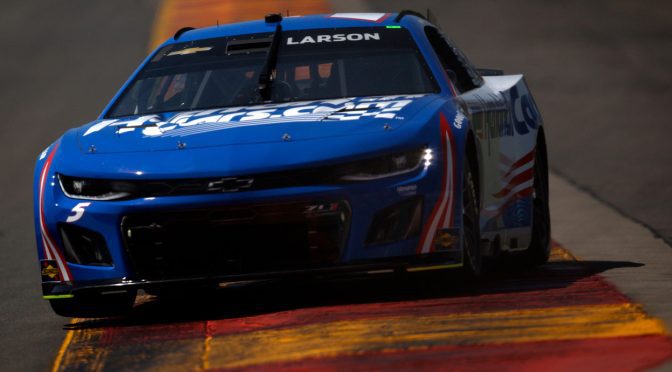
Larson gained a measure of solace at Indianapolis Motor Speedway in July, winning the Cup Series’ Brickyard 400 in a blue-and-orange No. 5 Chevy bearing the same design as his Memorial Day rides. After that victory, Larson expressed a desire to attempt the double again. “I think everybody knows that I would love to do it because, in my mind, I did not get to do it this year,” he said.
Kanaan indicated that both he and Larson would need to pass a refresher course to participate, and that Larson made his life easier in his role as a driver coach and consultant last May. In terms of expectations for the second go-round, both teams are already carrying high hopes.
“Don’t give Kyle Larson a second shot at something that he already did well at,” said Jeff Gordon, Hendrick Motorsports’ vice chairman and a five-time Brickyard 400 winner. “I mean, I think he’s going to knock it out of the park. He already did, but I know what a perfectionist he is and the few things that he learned or couple of things that didn’t go well, I know he wants that second chance to clean that up. I was so impressed with what he did, but I was also impressed with what Arrow McLaren did, so obviously that does raise expectations.”
Larson is chasing his second Cup Series championship as part of this year’s playoffs. He opened the postseason with a Stage 1 crash in Sunday’s race at Atlanta Motor Speedway, leaving him 37th in the 38-car field. That mishap dropped him from the top of the Cup Series Playoffs standings to 10th place, just 15 points above the elimination line. Larson will attempt to rebound in the second Round of 16 contest at Watkins Glen International on Sunday (3 p.m. ET, USA, MRN Radio, SiriusXM NASCAR Radio, NBC Sports App).
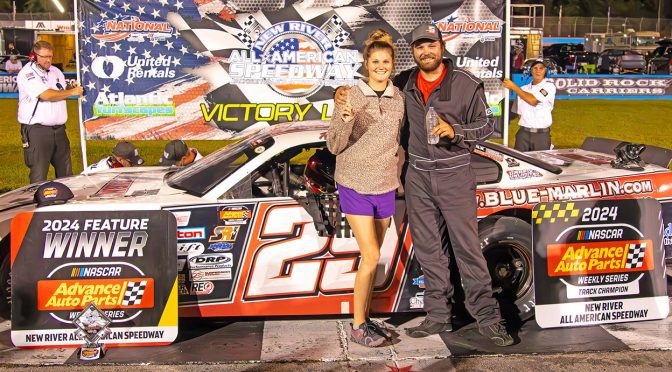
JACKSONVILLE, N.C. – Paul Williamson was faced with a must-win scenario on Saturday night at New River All American Speedway, and for the second consecutive season, the Kenansville, North Carolina, driver delivered under pressure.
Rusty Daniels won in the first of two races for the Late Model Stock Car division in controversial fashion, forcing the title race to come down to a winner-take-all showdown in the second act. After a full field invert, Williamson quickly raced his way to the lead but had Daniels in hot pursuit for most of the 40-lap race.
Williamson, however, saved his best for last – driving away from Daniels in the closing laps to clinch his second straight track championship.
“I seem to think we work under pressure the best,” Williamson said in victory lane. “The good Lord was looking out for us, and we were able to win it. Everybody worked hard and I appreciate it. My dad, Wendell [Davis], my fiancé Haley [Brown], my grandparents, everybody. There’s just so many people to thank and to be able to bring it home for everybody, this is for everybody else. This isn’t for me. It’s for everybody else.”
The victory in the second race was also a bit of redemption for Williamson.
In the first act of the doubleheader, he had led over Daniels for much of the race. However, in the apex of turns three and four on the race’s final lap, Williamson would spin off Daniels’s front bumper. Daniels would go on to win while Williamson would recover for a third-place finish.
“That was just hard racing,” Daniels said after the first race. “I believe he got on the binders a little bit for a couple laps there in front of me. I didn’t try to dump him.”
The on-track incident led to an off-track incident between the Williamson camp, the Daniels camp, and NASCAR officials. After the kerfuffle, Williamson said he had to shift his focus.
“To say the least, I was pretty ill, but me and my dad went in the trailer and did the math,” Williamson remarked. “We knew what we had to do. I took all that energy and put it in my right foot on the skinny pedal.”
For Daniels, it’s the third straight season he has been in contention for a championship but not been able to clinch.
“It’s frustrating,” Daniels commented. “The best man won tonight though. Congratulations to those guys, they did a good job.”
The championship showdown between Williamson and Daniels overshadowed a career-best performance for Gerald Benton, who scored a runner-up finish in the first race and a third-place result in the second.
New River All American Speedway roars back into action on Saturday, Sept. 21 with championships on the line in Charger and Mini Stock. The racing program also features the Allison Legacy Series, Bombers, Legends, Bandoleros and Champ Karts.
Five races remain in the 2024 NASCAR Whelen Modified Tour season, and the battle for the championship is as close as ever.
The championship fight, which includes Justin Bonsignore, Ron Silk and the surging Patrick Emerling, continues Saturday with the third running of the Eddie Partridge 256 at New York’s Riverhead Raceway (8 p.m. ET on FloRacing).
Saturday’s race marks the 74th visit to Riverhead for the Modified Tour dating back to 1985. No driver has won more races at the quarter-mile bullring than Mike Ewanitsko and Justin Bonsignore, who are tied with 11 career Riverhead wins, five more than the next closest driver.
Other notable winners include Mike Stefanik, Donny Lia, Ryan Preece, Doug Coby, Ted Christopher, Reggie Ruggiero and the most recent winner, Ron Silk.
Tickets to Saturday’s Eddie Partridge 256 are available trackside. Below is everything you need to know about Saturday’s race.
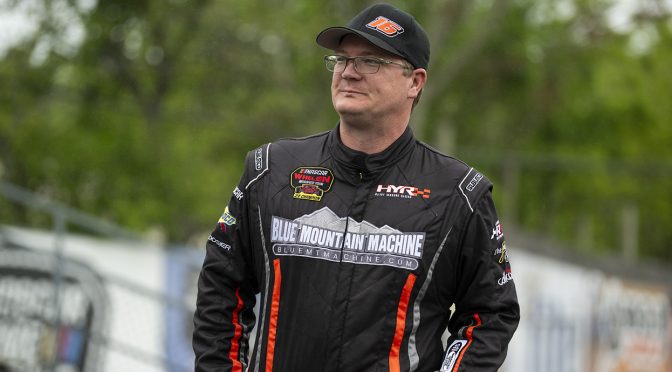
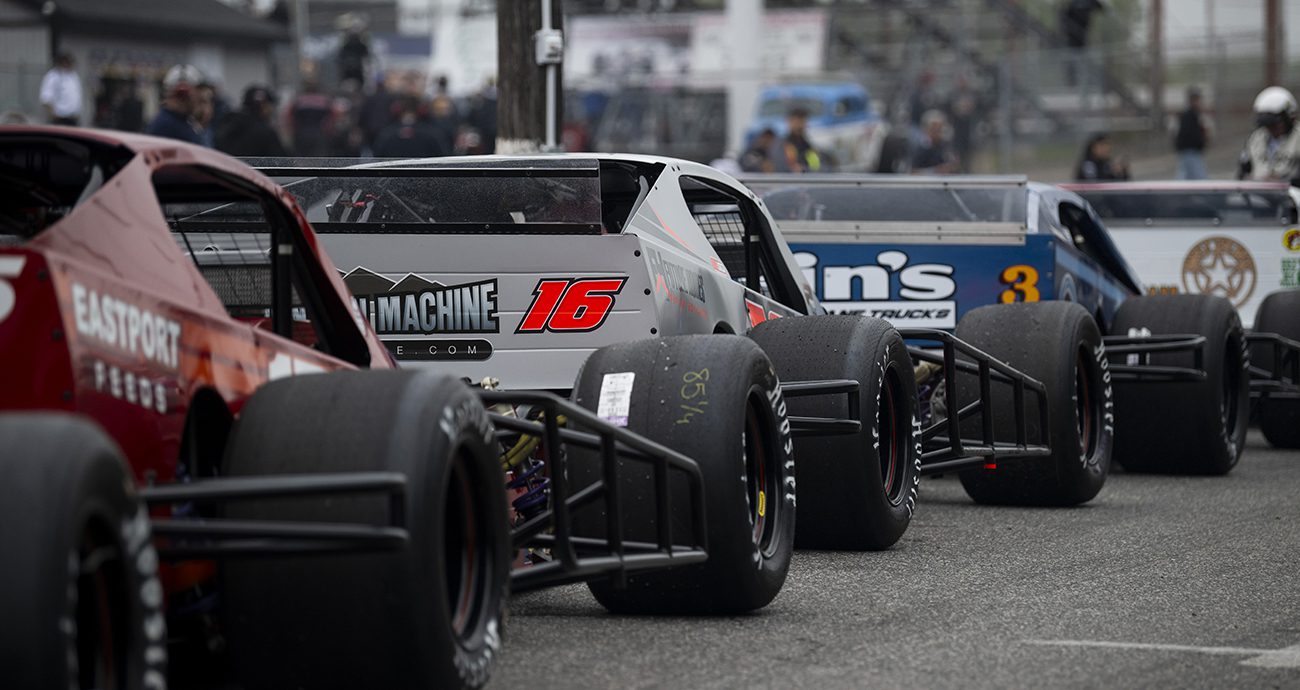
Ron Silk, driver of the No. 16 Blue Mountain Machine; Future Homes Modified, sits on the grid ready to practice during the Miller Lite Salutes Wayne Anderson 200 for the Whelen Modified Tour at Riverhead Raceway on May 18, 2024 in Riverhead, New York. (Photo: Kostas Lymperopoulos/NASCAR)
Eddie Partridge 256 at Riverhead Raceway
If you’re going to win a NASCAR Whelen Modified Tour race at Riverhead Raceway, odds are you’re going to have to beat Ron Silk and Justin Bonsignore.
The pair that’s in the midst of another championship battle has won the last five Modified Tour events at Riverhead dating back to September of 2022. Bonsignore has won three times, and Silk has won twice, making them the obvious favorites ahead of Saturday’s 256-lap adventure.
Hot on their heels, however, is the surging Patrick Emerling. The winner of the last two Modified Tour events, at Thompson Speedway Motorsports Park and Oswego Speedway, Emerling is also a Riverhead winner. He captured his lone Riverhead win in 2021 and could very well play the role of spoiler Saturday night.
Not to be counted out are the local contenders at Riverhead. Among the contingent to file entries is Timmy Solomito, a three-time winner in NASCAR Advance Auto Parts Weekly Series competition this year at Riverhead who also happens to be a nine-time Whelen Modified Tour winner.
Other local entrants include J.R. Bertuccio and Jack Handley Jr., all of whom have won Weekly Series events at Riverhead this season. Also entered is Mark Stewart, who was runner-up in the Eddie Partridge 256 one season ago, as well as his uncle, Roger Turbush.
Another notable entry comes in the form of Boehler Racing Enterprises and the Ole Blue No. 3, which will have Tyler Rypkema behind the wheel for the first time.
The full entry list for Saturday’s Eddie Partridge 256 is available here.
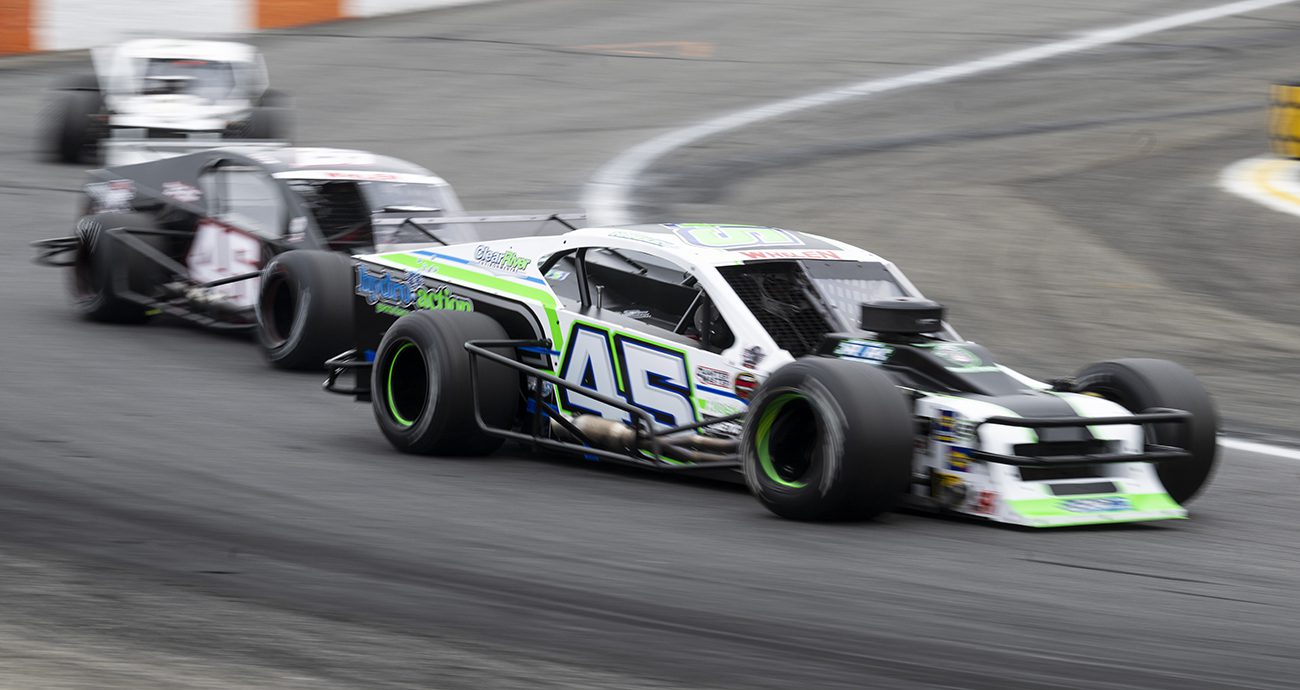
Jack Handley Jr, driver of the No. 45 Hydro-Action/Suffolk Precast Modified, during the Miller Lite Salutes Wayne Anderson 200 for the NASCAR Whelen Modified Tour at Riverhead Raceway on May 18, 2024 in Riverhead, New York. (Photo: Kostas Lymperopoulos/NASCAR)
Schedule: Saturday, September 14… Final practice from 3:30 to 4:15 p.m. ET … Qualifying at 6 p.m. ET … Eddie Partridge 256 at 8 p.m. ET (FloRacing).
Qualifying: Two consecutive qualifying laps. Faster lap determines qualifying position. Adjustments or repairs may not be made on the vehicle after the vehicle has taken the green flag at the start/finish line. NASCAR reserves the right to have more than one vehicle engage in qualifying runs at the same time. Starting field for the Eddie Partridge 256 is limited to 28 starters including Provisional Positions.
Tire allotment: The maximum tire allotment available for this event is nine (9) tires per team. All tires used for qualifying, and the race must be purchased at the track and scanned by Hoosier, unless otherwise approved in advance by the Series Director. Four (4) tires must be used for qualifying and to begin the race. All qualifying tires must remain in impound until released by NASCAR Officials. The remaining tire allotment may be used for practice and/or change tires during the event. The tire change rule is two (2) tires per caution period.
Perhaps the worst thing for any playoff driver is to wreck early and finish in the back of the field, watching helplessly as rivals battle for the win and rack up crucial points in the standings.
Unfortunately for Kyle Larson and Chase Briscoe, that’s exactly what happened 56 laps into Sunday’s playoff opener at Atlanta Motor Speedway. Larson got loose in Turn 2 and went hard into the outside wall, and Briscoe was unable to avoid hitting the back of Larson’s car as he skidded down the banking. In an instant, two of the 16 active championship hopefuls doomed themselves to be scored 37th and 38th out of the 38 cars that ran the race.
After assessing the physical damage of the wreck, both teams also need to survey the metaphorical damage — just how much does this hurt Briscoe’s and Larson’s chances of advancing to the next round of the playoffs (and beyond)? To help with that task, let’s turn once again to our playoff simulator, which uses each driver’s recent performance at each track type to simulate the rest of the playoffs 10,000 times and project everyone’s probability of success going forward.
Briscoe was the biggest loser of the day as his odds of escaping the Round of 16 dropped by 43.9 percentage points with the last-place finish, the largest decline in advancement odds for any driver after Sunday’s race.
We noted last week that Briscoe’s skills didn’t necessarily match up well with any of the first-round sites, but Atlanta was nonetheless a place where avoiding catastrophe would be paramount, just because of the track’s chaotic tendencies since being reconfigured and running like a superspeedway starting in 2022. By being caught up in the worst-case scenario so early, Briscoe now stares at a 21-point deficit versus the elimination line, and with it, just a 16% chance to advance.
It’s still not impossible to dig out of Briscoe’s hole in the standings. In the simulations, a top-10 finish at Bristol Motor Speedway — where he has run at an above-average clip –boosts Briscoe’s odds of advancing to 41%, and a top 10 at Watkins Glen International would see his odds rise to 46%. That’s still not great … but if he finishes in the top 10 in both races, he would have an 88% chance to advance. So Briscoe still has a chance, but his margin for error is nonexistent at this point.
An interesting thing about Sunday’s wreck was that the fallout was asymmetrical. Larson started the chain of events that knocked both Briscoe and himself out, but Larson’s odds to advance only dipped by 10.3 percentage points — damage that was less severe than the race exacted on Martin Truex Jr. (minus-35.9), Harrison Burton (minus-33.1), Denny Hamlin (minus-13.8) or Brad Keselowski (minus-13.0).
Some of this is due to Larson’s status as a high-ranking driver — he had more breathing room to work with — and, indeed, he remains 15 points over the elimination line despite the near-last-place finish. (Before the playoffs, we wrote that he really just needed to avoid disasters at all three first-round races — so he has two more chances to keep that from happening.) Some also owe to Larson being one of the best-projected drivers in each of the next two races, particularly at Bristol. On average, the model shows he will have a pair of strong drives and make the troubles of Atlanta a distant memory.
But it’s worth noting that a pair of finishes outside the top 20 from here would make Larson’s path forward look unlikely: Under the simulations that fit those criteria, Larson made the Round of 12 just 21% of the time.
All of this just underscores how important a single race can be in the playoffs. While Joey Logano set his advancement odds to 100 percent by virtue of the win, and Alex Bowman, Daniel Suárez and Austin Cindric all lifted their odds above 90% with strong runs, Briscoe — and even Larson to some slight degree — showed that a rough day at the track can have far-reaching implications for a playoff future.
DAYTONA BEACH, Fla. (Sept. 9, 2024) — The NASCAR Foundation and Kaulig Giving are celebrating National Teddy Bear Day by joining together to deliver 4,000 NASCAR-themed teddy bears to children in 110 hospitals across North America for the eighth annual “Speedy Bear Brigade.” This year’s efforts will bring the cumulative total of Speedy Bears delivered to more than 15,000 since the program’s inception in 2016, providing comfort to children during their hospital stays.
New this year, The NASCAR Foundation will also provide $160,000 in grants to local hospitals in select NASCAR race markets. These donations are made possible through the Foundation’s Speediatrics Children’s Fund, which supports needs expressed by hospitals, specialty clinics, camps, and others providing children’s medical and health care services.
“To see how this program has grown through the years is truly amazing,” said Nichole Krieger, executive director and vice president, The NASCAR Foundation. “Seeing the joy on the children’s faces when they receive their Speedy Bears makes you realize how something as simple as a teddy bear can make such an impact on a child’s well-being.
“Support from Kaulig Giving, local sponsors and all our wonderful NASCAR fans is so important in helping us continue the vision of our founder, the late Betty Jane France, to bring comfort to kids in the hospital.”
This year’s efforts mark the biggest to date with 110 hospitals participating in race markets across the United States, Mexico and Canada. The initiative surrounds National Teddy Bear Day celebrated on Sept. 9 with events in Akron, Ohio, home to Kaulig Companies headquarters, as well as Charlotte, North Carolina, and Daytona Beach, Florida, home to NASCAR headquarters.
“Our partnership with The NASCAR Foundation continues to grow on and off the track. All of us share the incredible goal of impacting the communities we love by helping children in need live happier, healthier lives.” said Matt Kaulig, team owner of Kaulig Racing and founder of Kaulig Giving. “We’re honored to team up with The NASCAR Foundation for our fourth year to deliver cheer, positivity, and comfort to children in hospitals across the country through the Speedy Bear Brigade program.”
Matt Kaulig and Kaulig Giving have given a grant of $25,000 to The NASCAR Foundation to challenge NASCAR fans to join the Speedy Bear Brigade by making a $25 donation to sponsor a Speedy Bear. Fans can visit NASCARfoundation.org/speedybear to donate.