Four races through The Chase presented by Mobil 1, Mother Nature has permitted just one time-trial qualifying session to set the NASCAR Cup Series starting lineup.

In the other three events, teams have had to rely on something entirely different to set the starting grid: the metric.

That term has been used a lot lately because it’s been needed so prevalently, thanks to inclement weather that washed out practice and qualifying at Darlington Raceway, Bristol Motor Speedway and Kansas Speedway. And while the metric is just an equation to factor recent performance into determining the starting lineup, that metric has played an obvious role in how teams begin a race that featured no previous on-track time.

Simply put, the performance metric weighs two factors: 70% of previous race finish and 30% current position in owners points. Regardless of weather, this metric is used every week to determine the qualifying order for an upcoming race. The lower the metric, the better — and the later that driver will go out in qualifying.

MORE: Las Vegas schedule | Chase standings

There are two caveats to the metric, though. The first is seen in qualifying order itself. As stated in the NASCAR Rule Book in Section 7.3.REV A: “In each Chase Event, all vehicles and drivers that are eligible for the Championship, will be assigned the final Qualifying Order positions.” In layman’s terms, this means the 16 drivers competing in The Chase will be the final 16 drivers out for qualifying. The second caveat is that if qualifying is indeed rained out, that added benefit for The Chase racers is also washed away. Instead, those championship-eligible teams are slotted wherever the metric says they should.

As the math would indicate, that places significant added value on how a driver finishes the week prior. That particularly came into play when the lineup was determined for the Cook Out Southern 500 at Darlington, a race that followed the chaotic finish of the regular-season finale at Daytona International Speedway. As a result, 37.5% of The Chase field started 20th or worse at Darlington: William Byron (20th), Ryan Blaney (24th), Kyle Larson (25th), Ty Gibbs (28th), Carson Hocevar (34th) and Chris Buescher (35th). The uphill climb toward earning critical stage points becomes a much tougher task when starting that far behind. And yet, even at a track as rough and narrow as Darlington, three of those six drivers clawed their way into the top 10 to earn Stage 1 points: Blaney (fifth), Byron (ninth) and Gibbs (10th).

A similar situation occurred at Bristol, one week after a messy race at World Wide Technology Raceway at Gateway left many contenders with poor finishes. So when the green flag waved at Bristol, another six drivers started 20th or worse: Tyler Reddick (20th), Buescher (23rd), Chase Briscoe (26th), Chase Elliott (27th), Daniel Suárez (28th) and Blaney (29th). This time, only one of those Chasers charged toward points in Stage 1: Blaney, who finished the stage sixth.

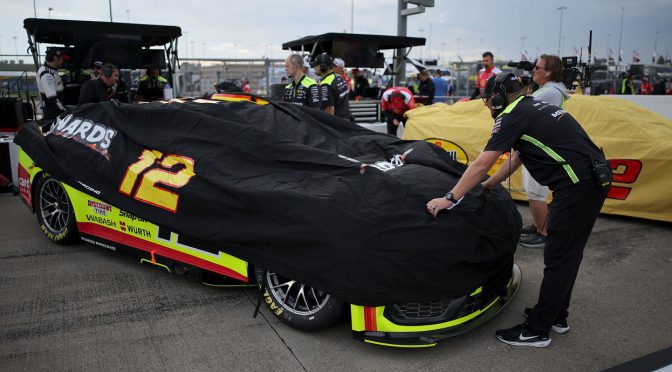
Blaney was bitten by the metric again at Kansas thanks in part to a late-race crash at Bristol with Carson Hocevar. (Perhaps you heard about it.) The No. 12 Team Penske Ford started 25th at Kansas, and again Blaney nabbed a single stage point in 10th place when the green-checkered flag waved.

And as you might imagine, there have been some mixed emotions surrounding the metric.

“I got done saying last week, ‘Oh, the metric is what it is.’ And now I’m starting to slowly hate it like you all for what’s been happening to us,” Blaney said ahead of last week’s race at Kansas. “I thought we did a great job (at Bristol) dealing with starting in the back. I think we got to 20th after starting 29th before the (competition) yellow, and then did a good call to stay out. I thought our car was good enough to establish track position and then play around with it during that second yellow in the first stage to get some stage points, and then flip and stay out, and we were able to win the second one, so I thought we handled that really, really well.

“You never know how each week is gonna go. No matter where you qualify, you have to adjust to it and then kind of audible as the race goes on and cautions fall, but it is tough. I mean, pit-stall selection is also brutal when you don’t get to pick it or you pick towards the end, especially at these places or tracks where (calls to take) two tires are really big. Getting wedged in between a couple guys that you’re gonna be racing around all day is always tough, but I feel like we’ve done a good job at what we’ve been given.”

His teammate Joey Logano has seen both sides of the metric — starting 13th at Darlington but then starting second at Bristol and on pole at Kansas.

“I mean, it’s played a fair amount because it’s been a few races where it’s been obviously an effect,” Logano said of the metric in a Wednesday teleconference. “Obviously last week (at Kansas), we were on the right side of it; Darlington, we weren’t. So it just kind of comes out in the wash most of the time, but it still rewards performance. It rewards running well. It rewards the points and those type of things. I personally don’t have a huge issue with it. I mean, tell me a better way and maybe I’ll change my opinion, but it seems to be OK. Maybe we can tweak it some, sure, but it’s definitely played an effect some, for sure.”

Ultimately, the metric has become a topic of conversation in the NASCAR world because of an uncharacteristic stretch of unfortunate weather scenarios in three of the first four weeks of the postseason. But with such high stakes in determining the next Cup Series champion through this 10-race stretch, a system that heavily values recent on-track performance appears the most fair way to solve a circumstantial qualifying problem.

Thankfully, the days of determining qualifying order by a literal random draw are in the past, as are the times that rained-out qualifying sessions meant lining the starting grid by season-long owners points. Performance and results matter. And when Mother Nature interrupts with a washed-out time-trial session, at least the metric relies on what drivers have done lately than any random method.
NASCAR officials announced changes to the Cup Series’ superspeedway package on Thursday, ahead of the Oct. 25 race at Talladega Superspeedway.

After a new rules package debuted for the regular-season finale in August at Daytona International Speedway, the rear spoiler has been shortened to a height of 3.5 inches for the YellaWood 500, which marks the eighth of 10 races in The Chase presented by Mobil 1.

RELATED: Cup Series schedule | Chase standings

The adjustment reduces the spoiler size by an additional half-inch from changes made ahead of the Aug. 29 event at Daytona, in which the original 7-inch spoiler was reduced to 4 inches. That move, made in conjunction with a reduction in horsepower, was done to provide drivers more maneuverability in the pack-racing style of action that remains a signature of NASCAR’s superspeedway racing.

“It seemed like it was a win at Daytona,” Jamie McMurray, analyst and 2010 Daytona 500 champion, said on NASCAR Inside the Race. “All the drivers thought they could build a bigger run at Daytona than they had in the past. I applaud NASCAR for taking a little bit more off, taking that next step. The other thing to consider is that Talladega is about eight feet wider than Daytona, so this gives you a little more options if you can generate a run to be able to make a pass. So my anticipation is fairly high for seeing how this works out.”

Additionally, NASCAR has adjusted its stage lengths for the Talladega event to match the spring race, with the conclusion of Stage 1 set at Lap 98, Stage 2 at Lap 143 (a 45-lap segment) and the checkered flag scheduled for Lap 188 (45 laps), barring overtime. Original stage lengths were set at 60-120-188.

The intended goal of shortening the lattermost stages is to reduce the incentive for race teams to conserve fuel and instead incentivize a full-throttle race to the checkered flag.

MORE: Buy Talladega tickets

“We haven’t had stage points in a Chase format, and as we’ve seen this year, the stage points make a huge difference,” McMurray said. “You can have an average finish at the end if you’re able to capitalize on those stage points, and the fact that these guys are going to have to all go out and race to the end of all these stages and get as many points as they can, it’s going to be fun to watch.

“I’m sure that the teams will find a loophole in this somewhere, but as we talked about before, anytime you go with a rules change, it’s always fun to watch who can figure out the next little trick.”

After winning at Gateway a few weeks ago, when he was still just one of the challengers in a crowded Cup Series Chase presented by Mobil 1 field, Kyle Larson pumped the brakes on talk that he was fully “back.”

“Back to what?” he said. “Back to 2021? No. Back to 2023? No.”

“But we’ve been definitely building to get back to Victory Lane. I don’t know if we’re quite yet to where we can go dominate like we have in the past, but a day like today definitely gives you confidence.”

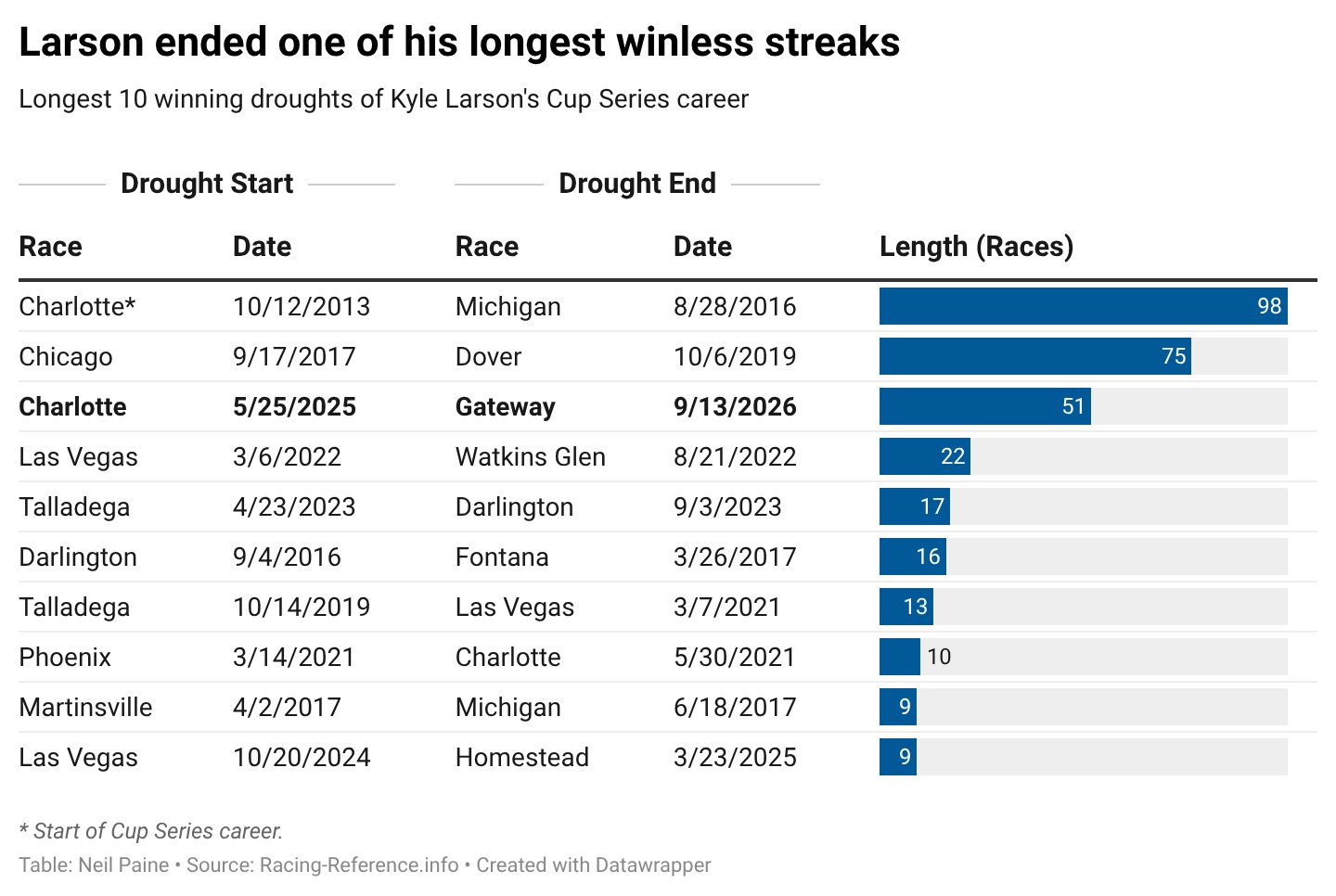
Larson was just coming off a 51-race winless streak before driving to Victory Lane in St. Louis, which was itself not among his most dominant career wins; with a Driver Rating of 129.5, it was his 10th-least dominant victory out of 34 in his career. (To wit: Joey Logano had the higher rating on the day despite Larson winning.) So he could be forgiven for still thinking the No. 5 team was in the process of rebuilding its form.

Now, though? It’s impossible to deny that Larson is back to dominating races the way he did at his peak.

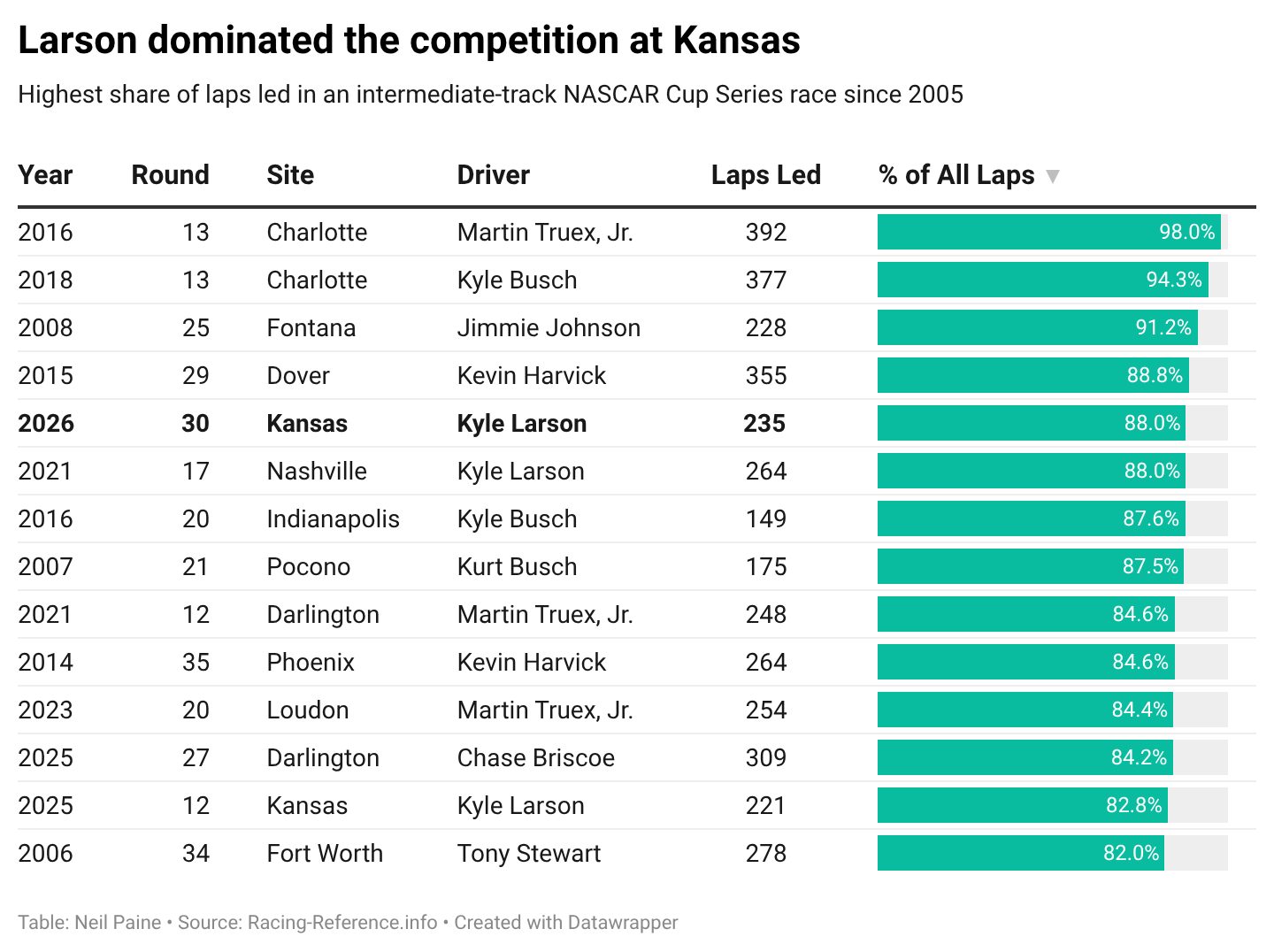
Following a second-place finish behind Logano at the Bristol Night Race, Larson rattled off a ridiculously dominant drive at Kansas to secure his second win in three races. He set a new track record (at any level) with 235 laps led, plus swept the stages and the fastest-lap bonus to tally a 76-point day, the maximum possible under the current scoring system. Larson’s 88% share of laps led was the 13th-highest by a winning driver in the loop-data era (since 2005), and the fifth-highest at an intermediate track in that span:
Chart comparing Kyle Larson's dominance in the fall 2026 race at Kansas to other dominant performances on 1.5-mile tracks since 2005.

The only time Larson was challenged was when Chase Briscoe passed him for the lead on Lap 238 and led each of the next 23 times around the track. But Larson stayed close to the bumper of the No. 19 car and, with seven laps remaining in the race, re-took the lead for good.

We mention Larson’s brush with second place to illustrate the fact that, in NASCAR, there is no such thing as true perfection. Only three modern-era races have ever seen a winning driver lead 100% of all possible laps — Jeff Burton at New Hampshire in 2000, Cale Yarborough at the Nashville Fairgrounds in 1978 and Yarborough at Bristol in 1973. Of those, only Burton’s came in the past 48 years, and only Yarborough at Bristol was truly wire-to-wire, starting on pole as well.

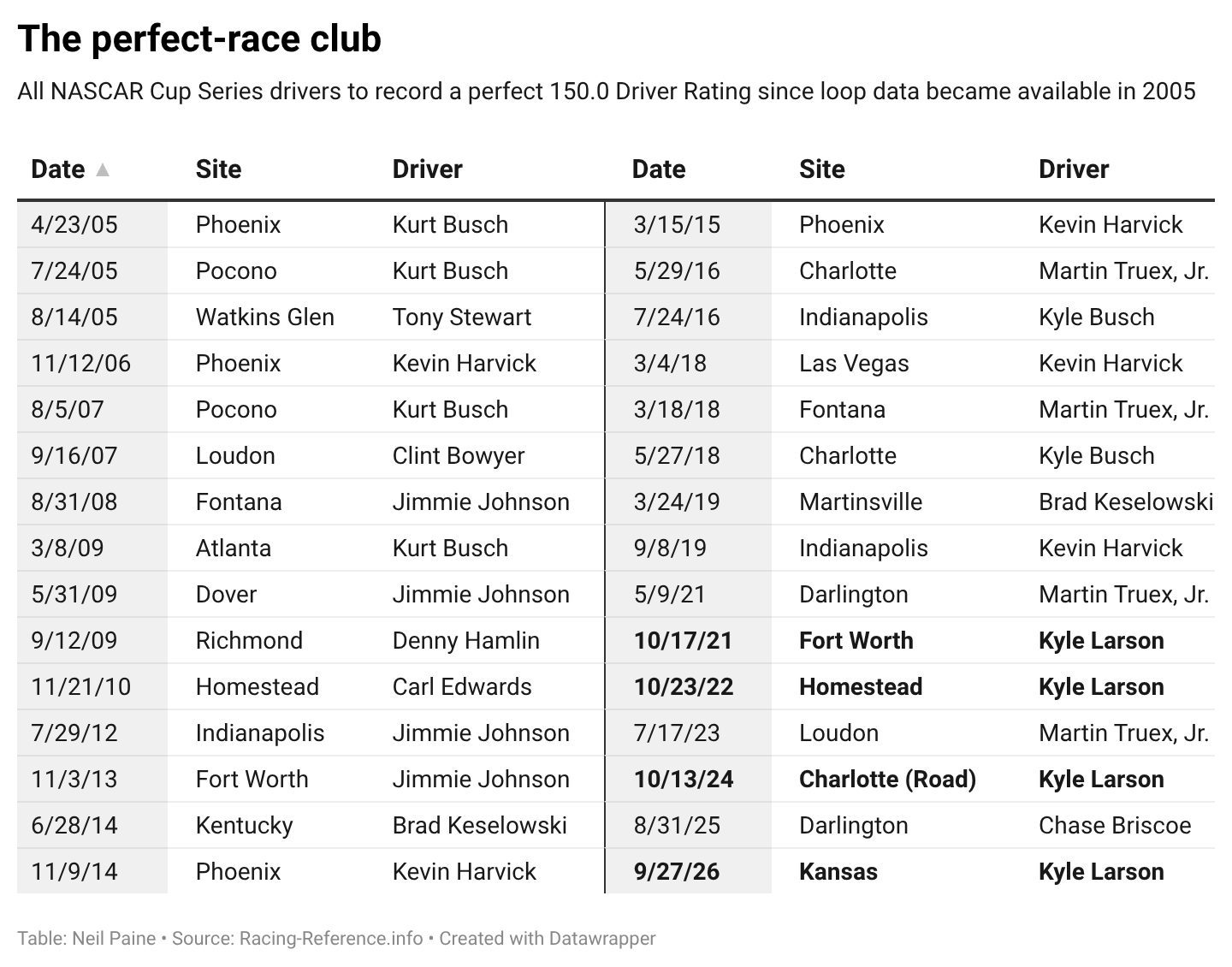
But there are degrees of perfection to be had, regardless. The Driver Rating formula — which grades drivers on a combination of finishing position, average running position and average speed, with bonuses for things like winning, leading laps and running up front — is capped at the top with a mark of 150.0 deemed to be the “perfect” performance. (This is our NASCAR version of the fabled 158.3 QB rating in football.) And Larson pitched one of those perfect games on Sunday, recording a nice, round 150.0 in the rating column at Kansas.

Again going back to 2005, that was just the 30th perfect 150.0 race recorded anywhere, the fifth of the Next Gen era (since 2022), and the first since Briscoe at Darlington more than a year ago.
Chart showing drivers who've posted a perfect 150.0 Driver Rating since 2005 when the stat became available.

As we’ve noted before, Larson is the active king of the perfect (or near-perfect) drive. He owns four of the past six perfect-rated days to happen in the Cup Series, dating back to the 150.0 he notched at Texas during the 2021 playoffs. He’s also had them at Homestead-Miami (2022), the Charlotte Roval (2024) and, now, Kansas (2026).

He’s also had a number of near-miss brushes with perfection — six races with a rating greater than 149.0 but less than 150.0 (yes, somehow those fractions of a point shy of perfection are meaningful):

  • 5/30/2021: Charlotte (149.5)
  • 6/6/2021: Sonoma (149.2)
  • 6/20/2021: Nashville (149.7)
  • 9/21/2024: Bristol (149.7)
  • 4/13/2025: Bristol (149.6)
  • 5/11/2025: Kansas (149.7)

In that piece from May 2025, we concluded that no current-day driver was more liable to explode for such a dominant showing in any given race than Larson. But that hadn’t necessarily been as true in 2026 until recently. During the regular season, Larson had just three races rated 120.0 or higher — Bristol (137.1), San Diego (124.2) and Kansas (122.5) — and saw none crack 140.0, much less challenge for a 150.0. By comparison, rival Denny Hamlin had seven races grade out at or above 120.0, four at or above 130.0 and one at or above 140.0 for good measure. 

While he still ranked fourth in average Driver Rating (trailing only Hamlin, Ryan Blaney and Tyler Reddick), we noted that Larson’s consistency — i.e., his ability to avoid poorly rated days — was becoming as much or more of an asset than his high-ceiling performances.

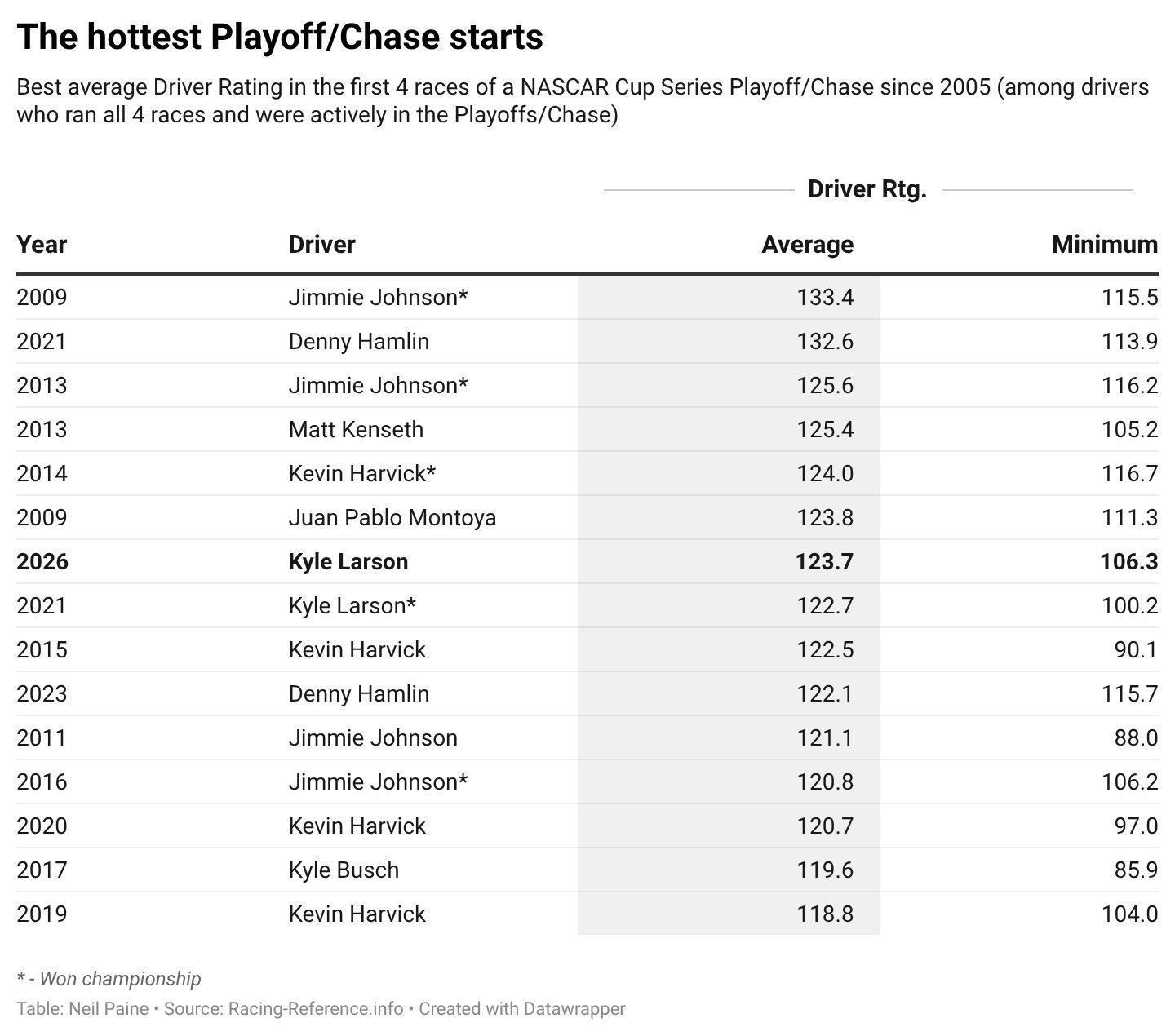
When the high ceilings are back, though, look out. With an average rating of 123.7 through the first four races of The Chase, none lower than a 106.3, Larson is off to one of the hottest four-race starts of any Playoff/Chase driver since 2005:
Chart showing the hottest starts to the playoffs/Chase since 2005.

Those types of early runs don’t always guarantee a championship, of course. For every Jimmie Johnson in 2009, there was a Denny Hamlin in 2021, Matt Kenseth in 2013 or Juan Pablo Montoya in 2009. But Larson’s barrage has coincided with less dominant runs and/or finishes from some of the leading counter-candidates for the 2026 crown. (Hamlin has seen his average rating fall from 100.6 in the regular season to 98.9 in The Chase, while Blaney has an average finish of 19.3 since The Chase began.)

As a result, Larson has gone from being in a dead-heat with Hamlin at the top of my Chase forecast odds to being the clear favorite at 57%, versus 29% for Denny and 10% for Christopher Bell. In other words, The Chase is suddenly Larson’s to lose — and while under the old system, we still might not have seen him race for the championship, his recent dominance in the current one may make him awfully hard to catch.

NASCAR officials spent nearly two days analyzing video from multiple altercations in the ValleyStar Credit Union 300 at Martinsville Speedway before issuing penalties Tuesday.

Seven team members were punished for two separate fights Saturday. The first incident took place after a heat race and resulted in fines and probation for four competitors in the NASCAR Regional series.

RELATED: Heim involved in altercation at Martinsville hot dog stand | Multiple penalties issued after Heim fight

The heaviest punishments went to three team members for an attack on Brickyard 400 winner Corey Heim in the pits after Saturday night’s main event.

Team owner Chad Bryant was fined $2,000 and suspended indefinitely. Chad Bryant Racing team members Steven Civatarese ($1,000 fine, indefinite suspension) and Ryden Lapcevich ($500, probation through 2027) also were penalized.

On the latest episode of the “Hauler Talk” podcast, NASCAR vice president of racing communications Mike Forde said the identities of all the perpetrators were finalized Monday night after the lengthy review of an event that featured nearly 90 drivers entered and at least a few hundred team members.

“There’s no facial recognition software at Martinsville Speedway, so it took a little bit of time to find out,” Forde said. “We had to hunt down the IDs of a couple people during the heat race so we were able to get everyone accounted for, and it boils down to very simply what we’ve said. When a crew member gets involved and puts his or her hands on a driver, that is unacceptable, and we are going to react in kind.

“We took it seriously. I hope that’s a message to those up and down the NASCAR ranks, whether it is a local racing series event or a NASCAR Cup Series event. When crew members get involved with putting their hands on the drivers, we’re going to react in a fashion that you probably don’t want to dip your toe into those waters.”

After taking the checkered flag in second, Heim collided with Chad Bryant Racing driver Treyten Lapcevich in a Turn 1 crash that precipitated the fight.

“We reviewed that,” Forde said of the post-race collision between Heim and Lapcevich. “I believe we had everyone into the hauler afterwards. We did review that (incident) and chose not to penalize and focused more on the fight and the crew members.”

MORE: Las Vegas weekend schedule

Other topics covered by Forde and senior director of racing communications Amanda Ellis during the 71st episode of “Hauler Talk,” which explores competition issues in NASCAR:

— An interview with Carl Goodman, the managing director of powertrain at NASCAR, about how the post-race engine dyno process was handled after Kansas Speedway.

— The future of the metric formula used to set starting lineups in the event of qualifying being rained out.

Click on the embed below to listen or search for “Hauler Talk” wherever you download podcasts to hear it on your phone, tablet or mobile device.

Nate Ryan has written about NASCAR since 1996 while working at the San Bernardino Sun, Richmond Times-Dispatch, USA Today Co. and for the past 10 years at NBC Sports Digital. He is a contributor to the “Hauler Talk” show on the NASCAR Podcast Network. He has also covered various other motorsports, including the IndyCar and IMSA series.

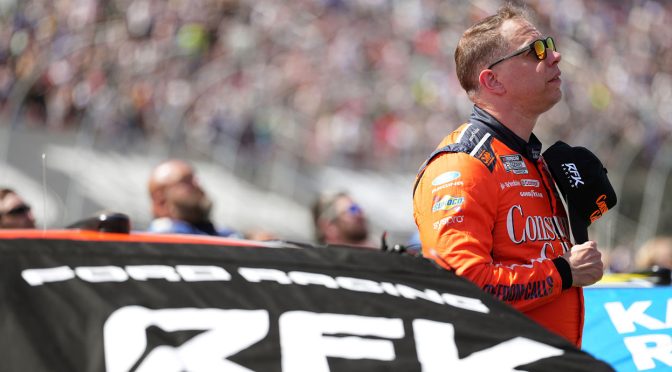
Brad Keselowski and RFK Racing announced Tuesday that the two parties will part ways following the conclusion of the 2026 NASCAR Cup Series season, a late and surprising development in the sport’s free-agency landscape.

After five years as a co-owner and driver for the RFK Racing team, Keselowski departs with the intent of continuing his storied racing career, adding in a Tuesday statement: “I’m nowhere near ready to be done as a driver. I still have a lot I want to accomplish in this sport, and I’m looking forward to what comes next.”

Therein lies the problem: What’s next?

MORE: Cup Series standings | Keselowski through the years

There is little to no room at the inn as the bulk of seats for the 2027 NASCAR Cup Series season are already occupied. Many of the most prominent vacancies have already been filled: Wood Brothers Racing welcomes Jesse Love in place of Josh Berry, who takes over the No. 42 Toyota at Legacy Motor Club. That move left John Hunter Nemechek without a 2027 ride, but RFK Racing’s sudden opening could alter his outlook after the organization reaffirmed its commitment to fielding three Cup cars next season.

Keselowski is the type of driver a team would make space for: The 2012 Cup Series champion ranks 25th all-time with 36 Cup Series wins and sits fourth all-time with 39 NASCAR O’Reilly Auto Parts Series victories to pair with his 2010 O’Reilly title. But where can he realistically land?

An initial scope of the landscape says he may be forced into a sabbatical season, sidelined from full-time Cup competition. Speculation quickly spread to Kaulig Racing, which fields two full-time entries with current drivers AJ Allmendinger and Ty Dillon. Allmendinger and team CEO Chris Rice confirmed in June that Allmendinger’s contract with Kaulig runs through 2029 with options through 2032, securing Allmendinger’s status with Kaulig for years to come. Dillon’s status has not yet been confirmed for 2027, but industry sources believe driver changes are not expected at Kaulig for next season.

What makes Kaulig a fascinating topic of conversation for Keselowski speculation, however, is its obvious ties to Dodge and Ram. Kaulig is fielding five Ram trucks in the NASCAR Craftsman Truck Series in 2026 as parent company Stellantis returns to NASCAR’s national-series ranks for the first time since 2012. In February, Stellantis’ North American Motorsports competition director Kevin Kidd affirmed: “We aim to get back in the Cup Series” with Dodge.

But in a Thursday interview on SiriusXM NASCAR Radio, Rice said that he is not in talks with Keselowski: “I have not had any conversations with Brad Keselowski about driving a Dodge, even if Dodge comes back. Obviously, it’s super late, and you don’t hear me talking about it much, so that should tell you what’s happening.”

Keselowski becomes an interesting party in this conversation because of his past with the famed manufacturer. Keselowski won the 2012 NASCAR Cup Series championship driving a Dodge for Team Penske and stands as the manufacturer’s most recent winner in Cup Series competition. If no seats present themselves for Cup competition in 2027, would Keselowski be willing to spend a year fighting for a championship in the NASCAR Craftsman Truck Series with Kaulig’s Ram outfit? If so, Stellantis could rally around Keselowski as a potential face for its future return to Cup Series glory.

Alex Bowman re-signed with Hendrick Motorsports in July to return to the No. 48 Chevrolet for the 2027 season, which he plans to make his final full-time campaign. Current Trackhouse Racing driver Connor Zilisch is already signed to take over the No. 48 beginning in 2028. Austin Cindric has reiterated his preference not to disclose contract information but has indicated he will return to the No. 2 Team Penske Ford, Keselowski’s former ride, despite the team’s lack of a formal announcement. Ricky Stenhouse Jr. also signed a multiyear contract extension to remain the driver of the No. 47 Hyak Motorsports Chevrolet.

Austin Hill will become the full-time driver of the No. 33 Richard Childress Racing Chevrolet, taking over the renumbered No. 8 car following the tragic passing of Kyle Busch in May. The team has also indicated a return for longtime driver Austin Dillon, pilot of the No. 3 Chevrolet his grandfather Childress owns.

Changes are also not expected at Spire Motorsports, where drivers Daniel Suárez and Michael McDowell appear likely to stay. Suárez joined the team ahead of the 2026 campaign on a one-year deal with “a path forward for multiple years,” Spire co-owner Jeff Dickerson said during Suárez’s introductory press conference. McDowell joined Spire on a multiyear contract beginning in 2025 and emphasized a “long-term” deal with time remaining during a May press conference at Watkins Glen International.

Cole Custer and the No. 41 Haas Factory Team Chevrolet appear unlikely to part ways despite a disappointing season for the 2023 NASCAR O’Reilly Auto Parts Series champion, entering Sunday’s race at Las Vegas Motor Speedway (5:30 p.m. ET, USA Network, HBO Max, PRN Radio, SiriusXM NASCAR Radio) 32nd in the points standings. The same can be said for Cody Ware, driver of the No. 51 Rick Ware Racing Chevrolet that his father owns.

That appears to leave Keselowski on the outside looking in for the 2027 Cup Series schedule unless something unforeseen opens another opportunity elsewhere. But until Tuesday, Keselowski’s departure from RFK Racing was unforeseen, too.

Two of NASCAR’s biggest aces arrive for a wild weekend ahead in Las Vegas — holding very different hands.

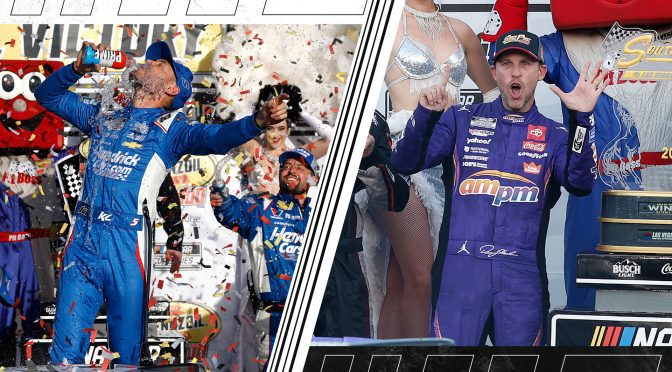
Hendrick Motorsports driver Kyle Larson currently has the firmest grip on the standings and more momentum than anybody in the sport, riding high after perhaps the most dominant performance of anyone this season. But his fellow title contender in Joe Gibbs Racing’s Denny Hamlin has the clear best 1.5-mile-track resume in the field — and two consecutive wins at Las Vegas Motor Speedway, site of Sunday’s South Point 400 (5:30 p.m. ET, USA Network, HBO Max, PRN Radio, SiriusXM NASCAR Radio).

Just 26 points separate them atop the Cup Series standings entering Race No. 5 of The Chase presented by Mobil 1. But will that deficit grow or shrink — or flip — on Sunday? It’s truly a heads-or-tails scenario between them, and it almost feels like a given they’ll finish 1-2 in some order.

RELATED: Kansas results | Cup Series standings

If the Kansas City stomping we saw out of the No. 5 Chevrolet on Sunday was Larson’s emphatic statement that he’s fully “back,” Las Vegas offers Hamlin a particularly inviting place to respond in grand fashion.

The defending and two-time champ turned a one-point lead over Hamlin entering Kansas into a 26-point advantage by taking literally everything available to him: both stages, the fastest-lap point and the race win for the first maximum 76-point day under the current scoring system. Every other Chase driver lost ground to him.

(He didn’t get a chance to win the pole with qualifying washed away, but we can probably guess how that would’ve gone.)

It continued a remarkable opening stretch for the 34-time Cup winner, as Larson has finished fifth, first, second and first through four Chase races, producing a 2.25 average finish — the best through the first four races of any postseason since The Chase debuted in 2004.

BY THE NUMBERS: Hamlin vs. Larson

And yet, if there is a driver-track combination capable of making that 26-point cushion look considerably smaller by Sunday night, Hamlin at Las Vegas makes a convincing case. Hamlin knows the opportunity is there for the taking.

“We just gotta, I mean, do what we’ve been doing in Las Vegas,” Hamlin said after Kansas Speedway. “That’s a track that, you know, I feel like I’ve got a great feel for, especially in the race, and so we’ll see how it all plays out.”

What Hamlin has been doing on NASCAR’s traditional 1.5-mile tracks extends well beyond Vegas, too. His finishes in the six such races this season echo the elite level Larson has started The Chase with: No. 11 has secured first, fourth, second, third, third and third at these intermediates.

Hamlin is the only driver to finish in the top five in all six, and his 2.67 average finish is tied with Jimmie Johnson in 2005 and Bobby Labonte in 1999 for the best ever through the first six 1.5-mile races of a season. He has also spent 83% of the laps run on those tracks inside the top five. He just lives there.

His eight-race streak of top-five finishes on 1.5-mile tracks, dating to Kansas last fall, is the longest active streak and matches Johnson’s 2004-05 run among some of the best such stretches in NASCAR history. Whether or not he winds up with the Bill France Cup in November, Hamlin has certainly put together a championship-capable season to this point.

Chase drivers at 1.5-mile tracks in 2026

Statistics courtesy of Racing Insights
DriverLas VegasKansas-1TexasCharlotteChicagolandKansas-2AVG
Denny Hamlin1423332.7
William Byron3789476.3
Bubba Wallace959226910.0
Chase Elliott2813711811.2
Tyler Reddick13144361111.5
Ryan Blaney16241077511.5
Daniel Suárez181961141412.0
Christopher Bell4203822612.0
Chase Briscoe8323341412.2
Ty Gibbs5936681713.5
Kyle Larson7234534113.8
Chris Buescher610530192315.5
Austin Cindric1912153813216.5
Ryan Preece11111433321018.5
Carson Hocevar2213723223320.0
Joey Logano1530378122020.3

The table really makes Hamlin’s consistency impossible to miss, while making Larson’s 13.8 average finish look almost bizarre beside his current form. Two 34th-place results, at Texas and Chicagoland, have punished Larson’s average considerably. Remove those clear outliers and his other four 1.5-mile finishes this season are seventh, second, fifth and first — probably a much more accurate picture of where he’s at on these tracks. Recent history would suggest so, anyway.

And while Hamlin owns the overwhelming edge in finishing consistency, Larson has actually led more laps on 1.5-mile tracks this year: 412 to Hamlin’s 393. Christopher Bell is a distant third among Chase drivers with 145 (but could be the one to break up the party this weekend, if anybody can).

That neatly captures the statistical tug-of-war between the championship’s top two. Hamlin has been remarkably steady from the jump. Larson and Co. have taken time to get there along the winding path of volatility — yet appear to be locked in at the moment — but when the No. 5 hits, it tends to hit hard. Kansas was the latest example. Hamlin finished third and still watched Larson take 25 points out of him in one afternoon.

Larson knows just how quickly the reverse could happen.

“I only have a 26, I think, point lead on Denny,” Larson said after Kansas. “That could be swallowed up in a hurry. I scored 76 points today. So, Denny could go have a max points day next week, and I could blow an engine, like Noah (Gragson) did in the first stage, and I’m down 70-some points right there.”

The overall 1.5-mile stats still favor Hamlin, but his best argument that such a swing is possible might simply be the venue.

He has won the last two Cup races at Las Vegas and can become only the second driver to win three straight there, joining Johnson, who accomplished the feat from 2005-07. This spring, Hamlin overcame a speeding penalty at the first stage break, took the lead on the final restart and won while scoring 70 points. Larson finished seventh.

But calling Las Vegas solely Hamlin’s race to lose would be ignoring the guy across the table from him.

Larson has three Cup wins at the track of his own, and his 881 laps led are already the most in Las Vegas history. His 8.9 average finish is also the best among drivers with more than four starts, and he has finished first or second in six of his 11 Vegas starts since joining Hendrick Motorsports.

In the Next Gen era alone, Larson has led 657 laps at Las Vegas — nearly three times Hamlin’s 232. So while Hamlin owns the broader 1.5-mile argument in 2026, Larson has more than enough Vegas-specific evidence to push back.

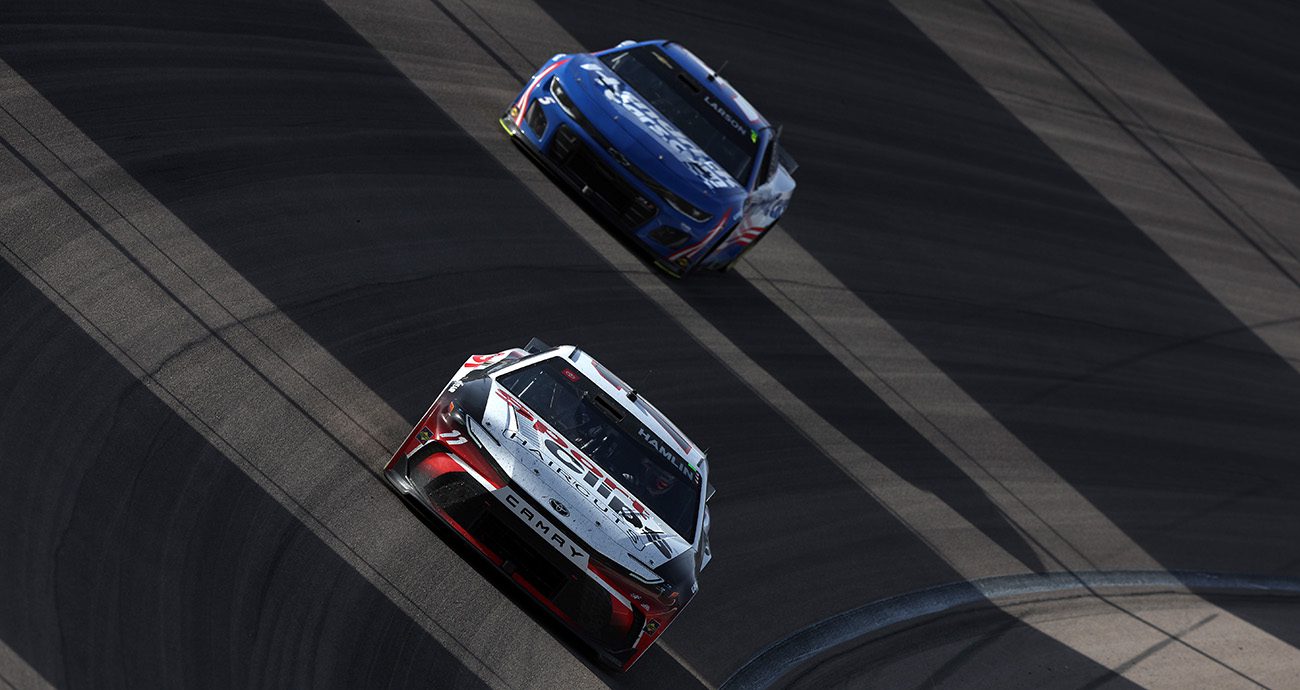
kyle larson and denny hamlin drive at las vegas
Meg Oliphant | Getty Images

There is also reason to believe Kansas will not necessarily translate directly to Sunday.

Larson’s biggest advantage there came early in runs, when the No. 5 could create separation before Hamlin’s car began to come back to him. But Vegas presents a significantly more complicated challenge for drivers.

“It’s a lot different track,” Hamlin said. “You got to have something for the bumps, and so I feel like we struck a good balance of that over the years, and it’s taken many years to get us to that point, but hopefully we’ve still got the speed that we had there in the spring.”

The numbers, though, obviously suggest both drivers should have plenty of it.

MORE: Chase Report: Where we stand before Las Vegas

Larson enters Las Vegas with control of a Chase that has already spun itself around a handful of times with six-plus weeks to go. Hamlin arrives with the strongest 1.5-mile record in the field and back-to-back wins at the track.

A pair of aces in Sin City, 26 markers apart.

Time to show the cards.

The NASCAR Cup Series and O’Reilly Auto Parts Series continue their respective Chases presented by Mobil 1 this weekend at Las Vegas Motor Speedway. Each series makes its second visit to the 1.5-mile facility this season. Both races feature 36 entries, meaning no drivers will fail to qualify. Single-car, single-lap qualifying will set the starting lineups for both races. See the qualifying orders for Las Vegas below.

MORE: Weekend schedule | How to watch NASCAR on TV

Cup Series
Single-car qualifying will occur at 5:35 p.m. ET on Saturday (truTV).

POSITIONNUMBERDRIVERMETRIC
151Cody Ware34.900
24Noah Gragson34.800
321Josh Berry32.300
447Ricky Stenhouse Jr.31.100
541Cole Custer30.900
688Connor Zilisch #30.800
738Zane Smith30.100
810Ty Dillon29.800
933Austin Hill(i)27.500
1035Riley Herbst26.500
1171Michael McDowell24.900
1216AJ Allmendinger22.300
133Austin Dillon22.200
1497Shane van Gisbergen21.900
1534Todd Gilliland19.900
1648Alex Bowman19.800
1743Erik Jones17.500
1842John Hunter Nemechek17.200
191Ross Chastain16.200
206Brad Keselowski13.800
2177Carson Hocevar (C)26.400
2217Chris Buescher (C)20.600
2322Joey Logano (C)15.200
247Daniel Suárez (C)14.600
2554Ty Gibbs (C)13.700
2660Ryan Preece (C)11.200
2745Tyler Reddick (C)9.800
289Chase Elliott (C)9.500
2923Bubba Wallace (C)9.000
3024William Byron (C)8.500
3119Chase Briscoe (C)5.200
3220Christopher Bell (C)5.100
3312Ryan Blaney (C)5.000
342Austin Cindric (C)4.400
3511Denny Hamlin (C)2.700
365Kyle Larson (C)1.000

O’Reilly Auto Parts Series
Single-car qualifying will occur at 3:05 p.m. ET on Saturday (ESPN Unlimited).

POSITIONNUMBERDRIVERMETRIC
147Dawson Cram37.300
255Joey Gase35.300
345Lavar Scott #34.800
431Blaine Perkins31.600
553Blake Lothian 30.800
607Josh Bilicki30.700
70Garrett Smithley30.600
802Ryan Ellis29.100
992Josh Williams28.900
1096Anthony Alfredo27.500
1148Patrick Staropoli #26.600
1239Ryan Sieg25.800
1327Jeb Burton24.700
1491Mason Maggio22.800
1528Kyle Sieg22.700
1642Matt DiBenedetto22.500
1732Andrew Patterson19.300
1887Lee Pulliam18.100
1951Jeremy Clements16.100
2024Harrison Burton15.000
2144Brennan Poole14.500
2226Dean Thompson12.000
2318William Sawalich5.600
2488Rajah Caruth (C)19.400
2521Austin Hill (C)18.100
261Carson Kvapil (C)17.700
2720Brandon Jones (C)13.500
282Jesse Love (C)13.100
298Sammy Smith (C)9.400
3099Parker Retzlaff (C)9.200
3154Taylor Gray (C)8.100
3241Sam Mayer (C)6.700
3317Corey Day (C)5.600
3419Brent Crews # (C)3.600
357Justin Allgaier (C)3.400
3600Sheldon Creed (C)1.000

* Required to qualify on time
# denotes series rookie
(i) denotes ineligible for driver points
(C) denotes Chase participant in either the owner or driver championship

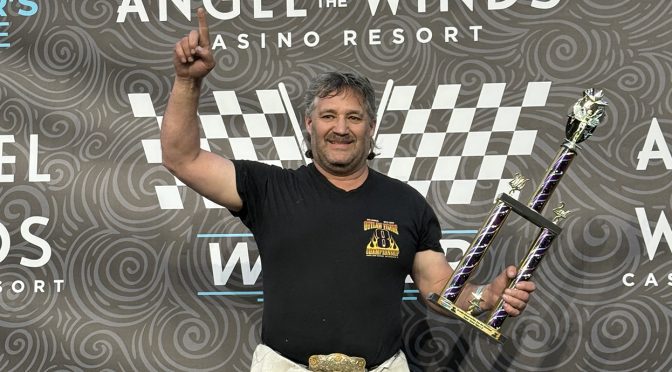
John Carlson has put together one of the most storied careers of any driver at Evergreen Speedway. Even though he came up just short of a ninth track championship this season, he insists he isn’t going anywhere.

In fact, he has something even bigger he’s racing for next season.

Carlson began racing 32 years ago, and in that time he’s won eight track championships at Evergreen, a NASCAR Local Racing Series track in Monroe, Washington.

Those championship have come in three different divisions. He won four in seven years racing in the FEAR Super Series from 2003-2009, secured three in Evergreen’s NASCAR Outlaw Figure 8 division, and most recently won a NASCAR Stock Figure 8 title in 2023.

This summer, Carlson was battling defending champion Mackenzie Repin for the Super Stock Figure 8 championship, and the two were tied going into the final race. On finale night, Carlson outqualified Repin, giving him a two-point advantage. But she got the better of him by one spot in both the heat race and feature, and her win in the feature gave Repin the championship by one point.

“It really could not have been closer,” Carlson said. “I feel good this year. We had a couple of bad races that set us back and that kind of hurt the whole points situation, but that’s kind of part of the racing game. Sometimes you have good nights and sometimes you have really bad nights.”

John Carlson
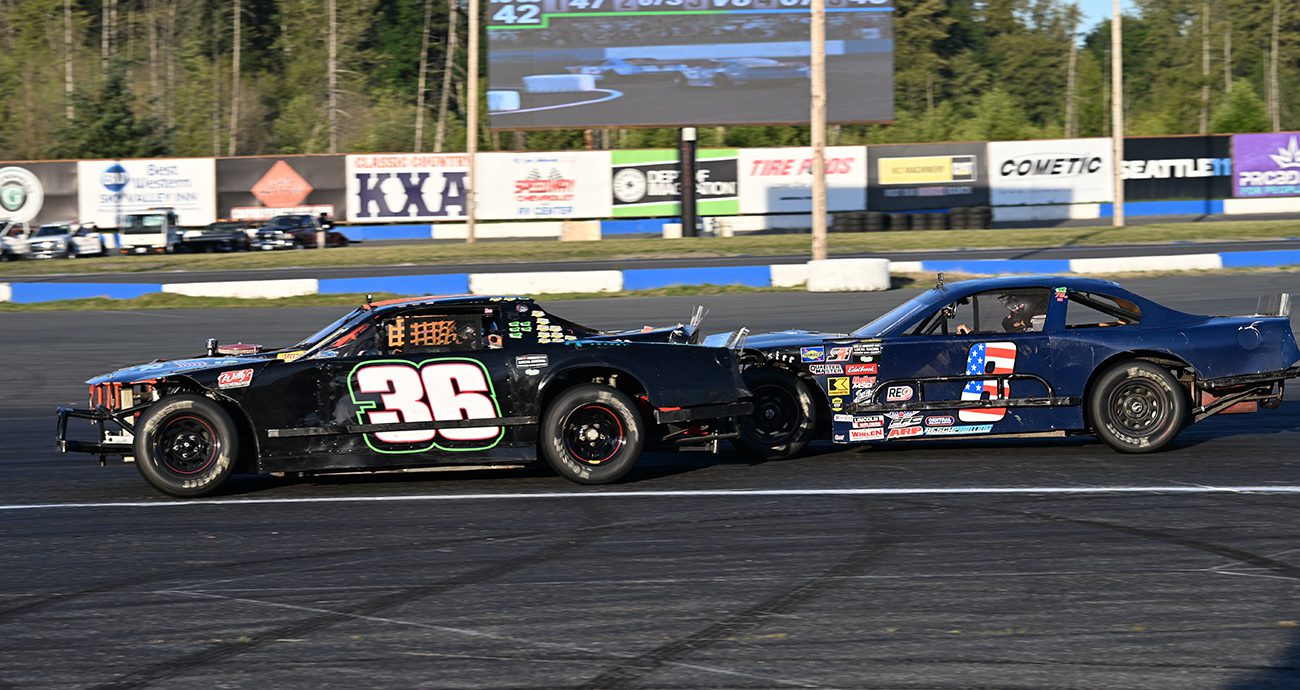
John Carlson (36) fell one point short of winning a track championship in the Super Stock Figure 8 division this year at Evergreen Speedway. (Photo: Jeff Harris)

Carlson’s rookie year was in 1994. He got into cars thanks to his dad, who Carlson called “a backyard mechanic.”

“He liked to build motors and he was into drag racing when I was little,” Carlson said. “Not on a professional level or anything like that, just racing up and down the streets and causing trouble, that sort of thing.”

Circle track racing was something Carlson fell into. He and a friend were looking at cars and eventually his friend brought one. After they tried racing a few times, Carlson purchased the car from his friend, and more than three decades later he’s still going.

Eventually, he realized Figure 8 racing was his favorite.

“I guess it’s just a passion,” he said. “Once you get into something, when it comes to racing, doesn’t matter what it is, it just becomes a passion and something you love doing. Figure 8 is just a whole lot different than any other kind of racing because you’re on the outside of a car on one corner then you’re on the inside of him on the next corner, plus you’ve got an intersection that you’re going through twice a lap and you have to have to deal with that. And sometimes you get open track and sometimes you’ve got three or four cars you’ve got to go through.

“All these years later, after learning things in different cars, it’s been quite the road, that’s for sure. It’s been a lot of fun traveling all over the country, different places, racing different tracks, that sort of thing. Meeting a lot of new people, making friends everywhere.”

Carlson also takes pride in the career he’s built, even if he doesn’t like to show it.

“I don’t really talk or brag about it or do anything like that,” he said. “It’s just racing for me and having fun. After the first four or five it was kind of cool. And then I got seven and I was like, now I’m in the category with kind of like Richard Petty and Dale Earnhardt and Jimmie Johnson. But in my own mind, as far as that goes anyway.

“It’s kind of a cool deal to have eight championships out at Monroe (Evergreen).”

While Carlson said losing this year’s track championship hurt, he had bigger aspirations for the season. He raced at Oregon’s Coos Bay Speedway to earn extra points towards the NASCAR Local Racing Series Division IV national and regional championships.

John Carlson
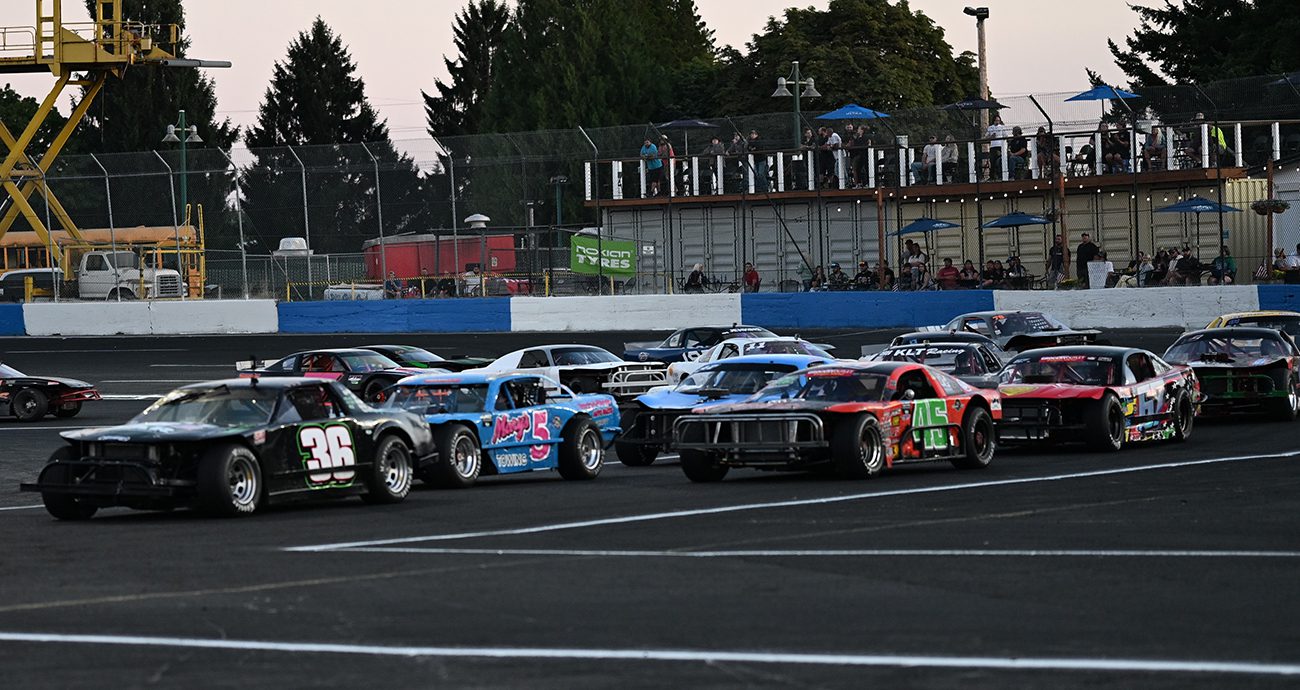
John Carslon (36) leads the pack during a Super Stock Figure 8 event this season at Evergreen Speedway. (Photo:

Carlson ended the year sixth in West Division IV points, so he missed out on another championship this year, but going for the title gave him the opportunity to try something new. Coos Bay is a three-eighths-mile dirt track and Carlson had never raced on dirt before.

“It’s different because the cars are front-wheel drive cars, they’re little four-cylinder cars and I’m used to big horsepower rear-wheel drive stuff, and it’s completely different driving style,” Carlson said.

“That was a little different trying to learn and figure that out. I need a little bit more time in the dirt and racing it to get a little faster and a little better, so that’s one thing I’m kind of looking forward to doing is playing in the dirt a little bit more. I had a lot of fun.”

Racing for a regional championship is the No. 1 priority for Carlson in 2027 because, “I’ve got to have that notch in my belt now.”

Whether he’s going around a Figure 8 track in Washington or playing in dirt in Oregon, Carlson will be racing somewhere just about every weekend next year. After 32 years, he isn’t ready to slow down.

“You always want to try to stay better than everybody else,” he said. “I’ve had a handful of people ask me when I think I’m going to quit racing, and I’ve told them, ‘Well, I guess about the point where I’m not competitive anymore.’ If I’m just out there fooling around in the fields and just a back marker and not being competitive anymore, then maybe it might be time to put somebody else in the car and let them have fun and me just sit back and be a car owner.

“I haven’t got there yet. I’ve still got a lot of bite in this old dog I guess you could say.”

NASCAR officials have issued multiple penalties following the ValleyStar Credit Union 300 late model event at Martinsville Speedway on Saturday night, when multiple Chad Bryant Racing team members attacked reigning NASCAR Craftsman Truck Series champion Corey Heim in the pit area.

The post-race altercation followed an accident shortly after the checkered flag that saw Heim and Treyten Lapcevich, who was driving Chad Bryant Racing’s No. 77, crash in Turn 1.

The most severe penalty was levied against team owner Chad Bryant, who was fined $2,000 and suspended indefinitely from NASCAR. Bryant has also been suspended from the 2027 ValleyStar Credit Union 300 at Martinsville and will be under NASCAR probation for one year. He must also complete anger management training through NASCAR’s approved program.

Two members of Bryant’s crew – Steven Civatarese and Ryden Lapcevich – were also penalized.

Civatarese has been fined $1,000 and suspended indefinitely from NASCAR. He is also suspended from the 2027 ValleyStar Credit Union 300 and will remain on NASCAR probation for one year.

Ryden Lapcevich, younger brother of Treyten Lapcevich, was fined $500 and placed on NASCAR probation until Dec. 31, 2027. Bryant, Civatarese and Ryden Lapcevich violated Sections 12-6.1C & 12-6.1C2 of the NASCAR Rule Book, which pertains to member-to-member confrontation(s) with physical violence.

Heim, who won the NASCAR Cup Series events at Naval Base Coronado and Indianapolis Motor Speedway this season, was driving the No. 22 for Nelson Motorsports during the ValleyStar Credit Union 300.

He led a large portion of the race before losing the lead to eventual winner Caden Kvapil. He and Treyten Lapcevich engaged in a heated battle for the runner-up position late in the race, which led to the incident shortly after the checkered flag.

Heim has not formally commented on the incident, but has reacted on social media. He revealed Monday via an X post that he had acquired the sign from the Martinsville Speedway hot dog stand, where the altercation with Bryant’s crew took place.

In addition, four other penalties were issued as the result of an altercation after the conclusion of the second heat race Saturday at Martinsville.

Dylan Jenks and Ryan Burrow have each been fined $500 and placed on NASCAR probation until Dec. 31, 2027. Brad Housewright and Chase Burrow have each been fined $250 and also placed on NASCAR probation until Dec. 31, 2027.

All four also violated Sections 12-6.1C & 12-6.1C2 of the NASCAR Rule Book.

With this being the second race of a three-week stretch on intermediate tracks, Goodyear is bringing the same tire setup used last weekend at Kansas for this Sunday’s NASCAR Cup Series Chase presented by Mobil 1 race at Las Vegas Motor Speedway (5:30 p.m. ET, USA Network, HBO Max, PRN Radio, SiriusXM NASCAR Radio).

Cup Series teams have experience with this Goodyear left- and right-side tire combination from several intermediate tracks on the schedule, including the Las Vegas spring race earlier this year.

RELATED: Las Vegas weekend schedule

“Our intermediate tire package has been run consistently throughout the year, and has raced at a number of tracks like Las Vegas since the March race here,” said Justin Fantozzi, Goodyear’s Director of Racing for the Americas. “Teams can lean on this wealth of data to decide on their setups as the stakes get higher with each race in The Chase.”

NASCAR O’Reilly Auto Parts Series teams last ran this setup at Texas Motor Speedway in May. Meeting the standard for 1-mile tracks or longer, the 15-inch Goodyear tires will also feature inner liners on Saturday in Sin City (7:30 p.m. ET, The CW, ESPN Unlimited, PRN Radio, SiriusXM NASCAR Radio).

Tire allotments for each team competing this weekend:

  • Cup Series: 11 total sets — 8 new sets for the race, 1 for qualifying, which transfers to the race and 2 for practice.
  • O’Reilly Auto Parts Series: 6 total sets — 4 new sets for the race, 1 for qualifying, which transfers to the race and 1 for practice.