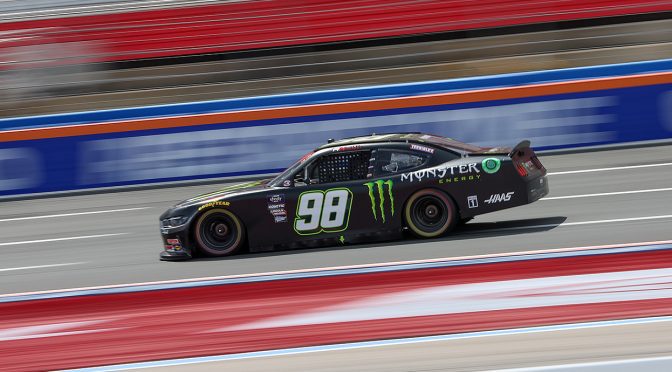
CONCORD, N.C. — Riley Herbst’s day at Charlotte Motor Speedway came to a crushing end just 30 laps into the 200-lap event for the NASCAR Xfinity Series.
Herbst attempted to clear AJ Allmendinger’s No. 16 Chevrolet off of Turn 2 before contact from Allmendinger sent the No. 98 Stewart-Haas Racing Ford Mustang down toward the inside wall.
“I haven’t seen a replay. I passed him twice cleanly,” Herbst said. “I slid him, racing at Charlotte. It’s fast, it’s hot. I think next week at Portland is his favorite track. So we’ll see what happens.”
Through 11 races in the 2024 season, Herbst has tallied two top-five finishes and four top-10s. The Stewart-Haas Racing driver will finish 38th after his early exit before the end of Stage 1.
“He had a run off the top, which is fine,” Herbst said. “And he could’ve tried to slide me back and get some momentum, but instead he just caught my left rear and hooked me. So, it’s unfortunate, but probably unfortunate for him.”
Ultimately, Allmendinger proceeded to finish fifth in Saturday afternoon’s event.
Flights between North Carolina and Indiana are becoming plenty frequent this week. Racing with one team’s NASCAR Cup Series stock car in the Carolinas, then traveling northwest to race with another team’s NTT IndyCar Series entry in the 108th running of the Indianapolis 500.
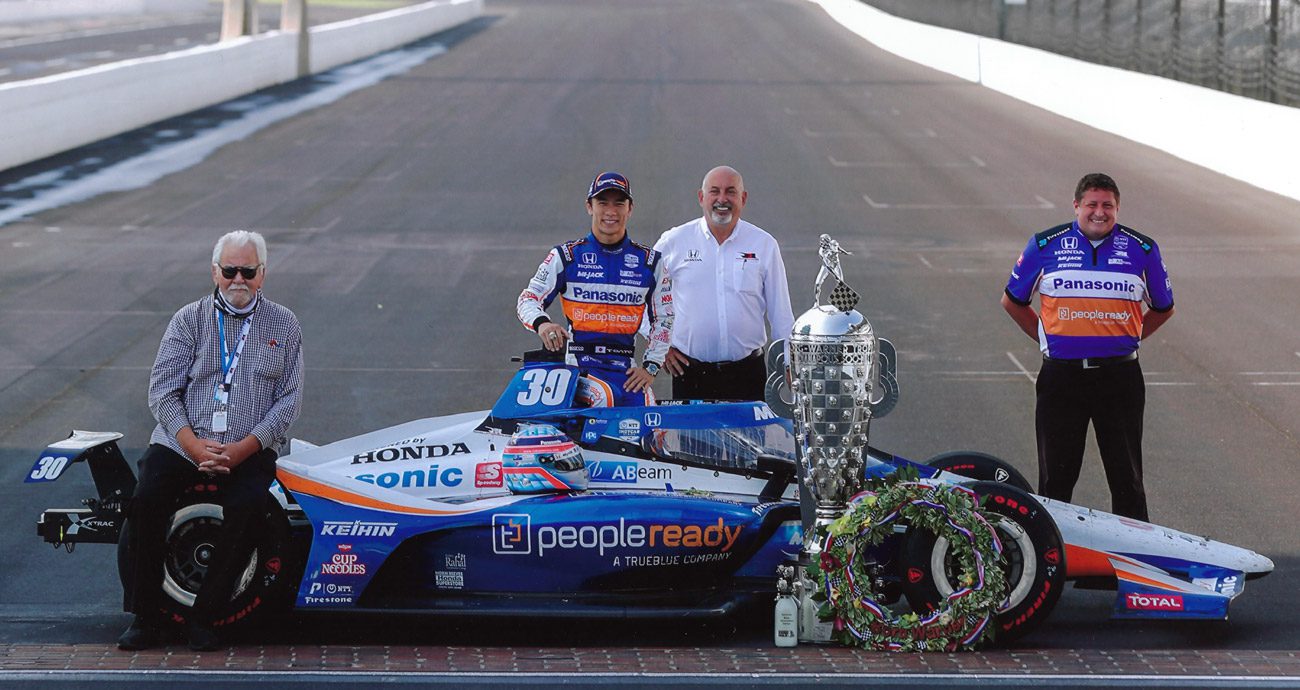
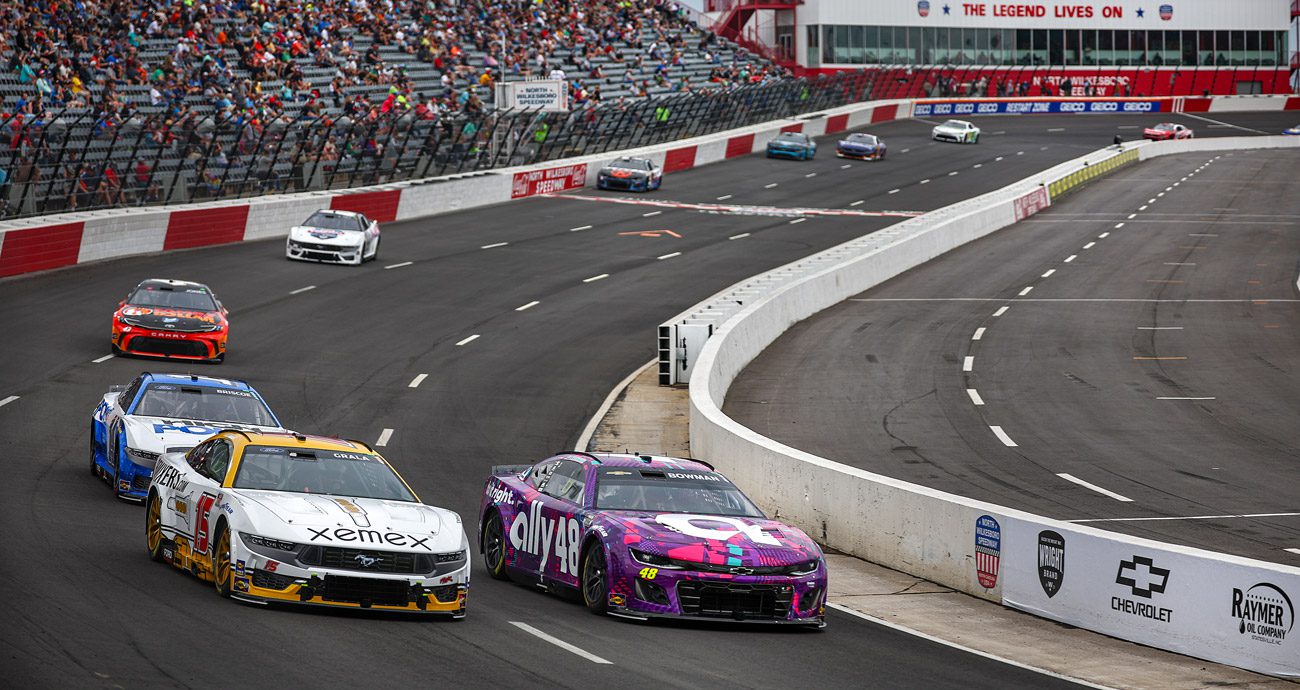
No, we are not talking about Kyle Larson this time. This one is about Brent Wentz, who will be spotting Takuma Sato’s No. 75 Rahal Letterman Lanigan Racing entry in the Indy 500 before jetting back to Concord, North Carolina, to spot Kaz Grala’s No. 15 Rick Ware Racing Ford in the Coca-Cola 600 at Charlotte Motor Speedway on Sunday (6 p.m. ET, FOX, PRN Radio, SiriusXM NASCAR Radio).
Wentz has spent decades working in NASCAR, winning the Daytona 500 with Matt Kenseth and the No. 17 RFK Racing team twice before winning Xfinity championships with both JR Motorsports and Team Penske. He then won the 2020 Indy 500 as a Turn 3 spotter for Sato in Wentz’s inaugural Indy appearance. Wentz even podiumed this winter in the Rolex 24 at Daytona, spotting the No. 40 Wayne Taylor Racing with Andretti’s entry to a third-place finish with drivers Jordan Taylor, Jenson Button, Colton Herta and Louis Delétraz.
Now, the Pennsylvania native has a chance to achieve even more greatness: Wentz will attempt the Indy 500-Coke 600 same-day double as a spotter for Sato in Indianapolis and Grala in Charlotte, “checking the box” of another amazing addition to his already stout resume.
“It does rank up there pretty high,” Wentz told NASCAR.com. “It’s like, I’ve watched John Andretti and Tony Stewart, Kurt Busch and all these drivers do it. But I’ve never seen anybody that actually works within the two series try to do it, so I thought I might as well give her a whirl.”
Indeed, the crew-member double is perhaps rarer than the drivers’ double. Danny “Chocolate” Myers, famously the longtime gas man for Richard Childress Racing’s “Junkyard Dogs” that pitted Dale Earnhardt’s No. 3 Chevrolet, managed to fuel both an A.J. Foyt entry in the 1998 Indy 500 before flying back to Charlotte to gas up Earnhardt’s car in the Coke 600 that night. Unfortunately for Myers, both entries’ races finished prematurely: The drive line in Billy Boat’s No. 11 car gave up after 111 of 200 laps at Indy, and Earnhardt crashed out of the Coca-Cola 600 with 64 laps remaining when Randy LaJoie washed high into the No. 3 exiting Turn 4.
Twenty-six years later, Myers still wishes the full No. 3 crew had gotten to pull the double together but dearly treasures the memory of pitting an Indy car and a Cup car in such storied events on the same day.
“I don’t want anybody to think that I’m trying to put myself in the same category with these guys who go up and run 500 miles and run 600 miles,” Myers told NASCAR.com. “But just to be able to go and do that and do both of them on the same day? Pretty proud of that.”
This weekend marks Wentz’s turn from atop the spotter stand. A familiar background with Sato and the RLL Racing team led the program back to Wentz during the winter to get the figurative ball rolling.
IMS Museum via Brent Wentz
“The opportunity to do the double came up a little bit before the LA Coliseum race,” Wentz said. “I got a phone call from Rahal Letterman. I really didn’t think it was going to be possible because of my commitments to Rick Ware. But I proposed it to (RWR president) Robby Benton and Rick, and they said, ‘Yeah, go for it. It’d be a good story, and you’re at the point of your career where you’re checking boxes.’ When am I ever going to get the opportunity to do it again, right? So they gave me the blessing, and we just went on with it.”
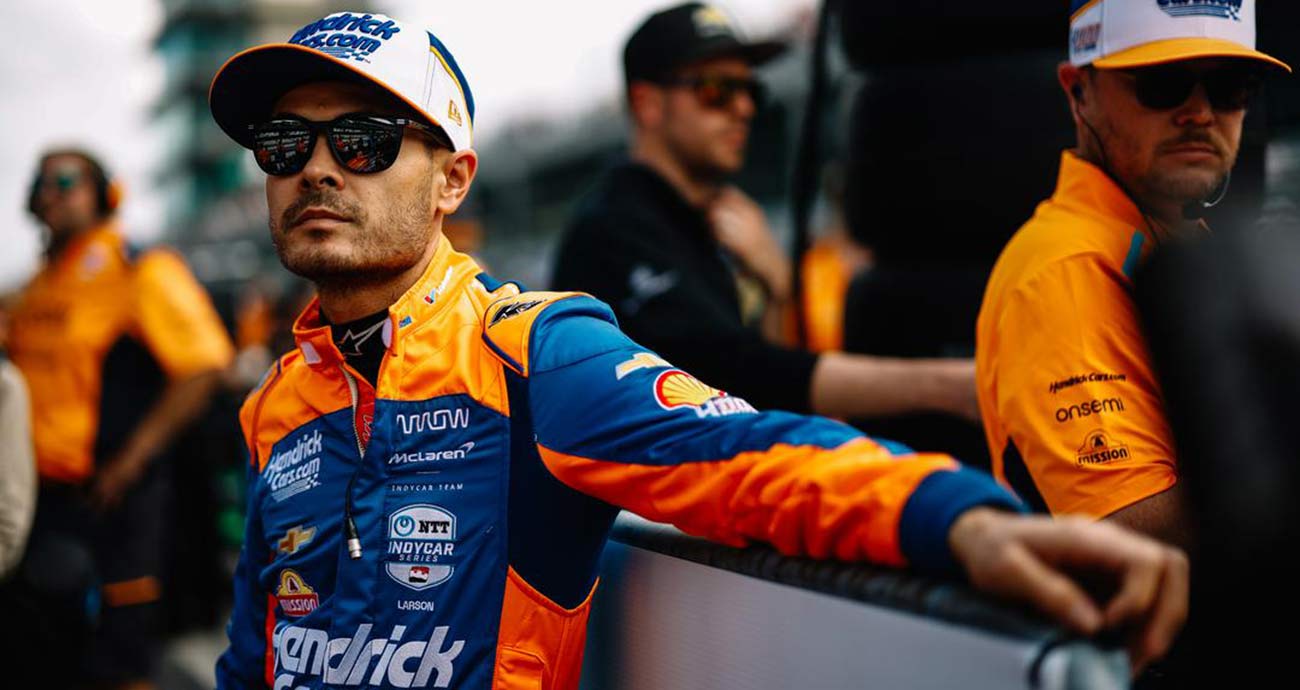
But while Larson’s famed and long-well-known attempt has the support, effort and backing of Arrow McLaren and Hendrick Motorsports, Wentz’s attempt is more modest and self-reliant.
“It did come with a lot of hurdles of trying to find transportation back after the 500 and getting the people the right passes to take care of their necessities and let me use one of their jets and things like that,” Wentz said. “But I think we finally got it all set in stone the last week. So, a little stressful trying to get it all figured out because I’m on my own little island, you know? I’m not Hendrick Motorsports; I’m not Kyle Larson. But, you know, I tried to use my connections and things like that to make it happen. And I think we’re at the point where we’re all ready to go.”
This is also not the first time Larson and Wentz crossed paths with similar goals in mind. Wentz served as a secondary spotter on road courses for Larson’s No. 5 Chevrolet through his 2021 championship run, leading to a Victory Lane visit together at Watkins Glen International.
Wentz said there may have been opportunities to simply share a ride with Larson, spotter Tyler Monn and the rest of the Hendrick crew en route to Concord from Indy. But that path seemed less appealing to Wentz — not because of its ease but in case of any early departures for either team.
“Yeah, you can talk to the Hendrick people and do that,” Wentz said. “But you know, Kyle is a great driver, and he’ll do a good job, but if he has some kind of weird mechanical problem or something halfway through the race, well, they’re not going to wait for me to get done with my job before they go back to Charlotte. So yeah, just, you know, trying to get it all figured out (and) set in stone was a little bit of a stressful time, but you know, the goal is to get it done.”
So, how exactly will the logistics of Wentz’s plan work? In his research efforts to coordinate this bucket-list journey, the three-hour average of an Indy 500 affords a post-race window of roughly two hours to leave the track and arrive at the airport if the race begins at 12:45 p.m. ET.
“I believe it’s like an hour flight from Indianapolis to Concord, so you do have a good amount of time — but it’s still cutting it close,” Wentz said. “For me, doing it independently, it’s going to be a little bit more of a challenge to get there in time. Kyle, (NBC Sports analyst and Coke 600 racer) Jimmie Johnson … those guys, they’re gonna have it figured out, right? They’ve got so many connections and so many ways to get back and forth from helicopters and police escorts and just a lot of stuff that I’m not going to have access to, they’re going to have.
“Like I said, my deal is a little different. But, you know, the opportunity to do it was there, so we’re going to do our best to knock it out the best we can.”
Jared C. Tilton | Getty Images
The added effort comes from his family behind the scenes, specifically his wife, who will have Wentz’s truck ready and waiting for him upon landing in Concord to hustle over to the speedway.
Benton, a former racer himself with limited starts across the Xfinity, Truck and ARCA Menards series, is serving as Wentz’s pinch hitter on the NASCAR stand in Wentz’s absence. Benton spotted Grala’s No. 15 Ford in last weekend’s All-Star Open practice at North Wilkesboro Speedway and will do the same in this weekend’s Coke 600 practice on Saturday (5:05 p.m. ET, FS1, PRN Radio, SiriusXM NASCAR Radio).
He’s also prepared to serve as the starting spotter on Sunday if circumstances slow down Wentz’s Charlotte arrival time.
“We’re just trying to keep everything in-house to keep it simplified,” Wentz said. “And we know that maybe I won’t get back to the 600 for the national anthem. Maybe I’ll get back 50 laps into the race or 10 laps into the race. We’ll just see how the day goes in Indianapolis and kind of work on it from there. But we tried to keep it all in-house, simple so we could go through the kinks as a company and not have to drag people into it.”
Spotting for IndyCar versus NASCAR has its different nuances — ones which Wentz will need to be plenty conscious of as he prepares for 1,100 miles of racing to spot. The most significant difference, he said, is how he relays which driver is nearing.
In NASCAR, he notes, drivers’ numbers are how competitors are known and branded. That doesn’t quite translate to IndyCar, which is more reliant on the paint schemes themselves.
“When you’re spotting NASCAR, you could say, ‘five (car lengths) back to the 6 car,’ and Kaz would be like, ‘Alright, well that’s Brad (Keselowski).’ In IndyCar, the numbers aren’t as relevant, right? Like, you can say who’s the 21 car in IndyCar, and half the people won’t know that it’s Rinus VeeKay because you’re not branded by your number. So the biggest thing is learning the paint schemes and learning who’s in what car. You spot by names. In IndyCar, you don’t spot by numbers. So you’ve got to learn … the paint schemes.
“I think that’s the hardest thing from one to the other is just knowing who you’re racing because I’m not at the IndyCar races every week anymore to know who’s in what car,” added Wentz, who spotted for Callum Illott last season. “And a lot of things change and a lot of sponsors change. But in reality, it’s all relevant. IndyCars are way faster, but they’re all going the same speed. So it’s all relevant. You’re spotting; you’re just doing the same thing you do in NASCAR. It’s just at a different level.”
Sunday, Wentz takes both of his day jobs to a new level. And with one Indy 500 ring in his collection, there is a valid question to be asked: What happens if he wins again with Sato?
“That’s yet to be determined. So we’ll see,” Wentz said. “If that happens, I think I still want to go back because my commitment to the people that let me do it, gave me the opportunity to do it, is in Charlotte, so I think that’s where I need to be. I’ll fly back and kiss some bricks Monday if that needs to be done.”
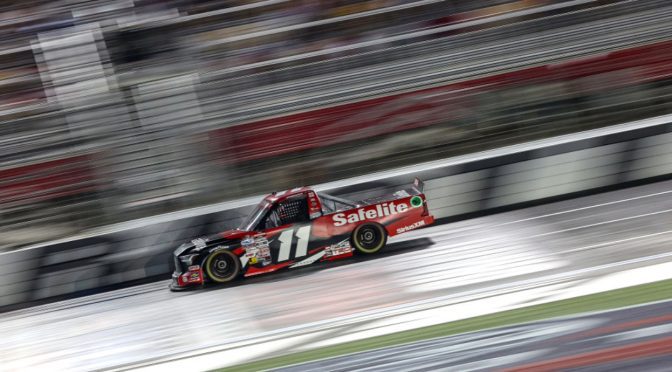
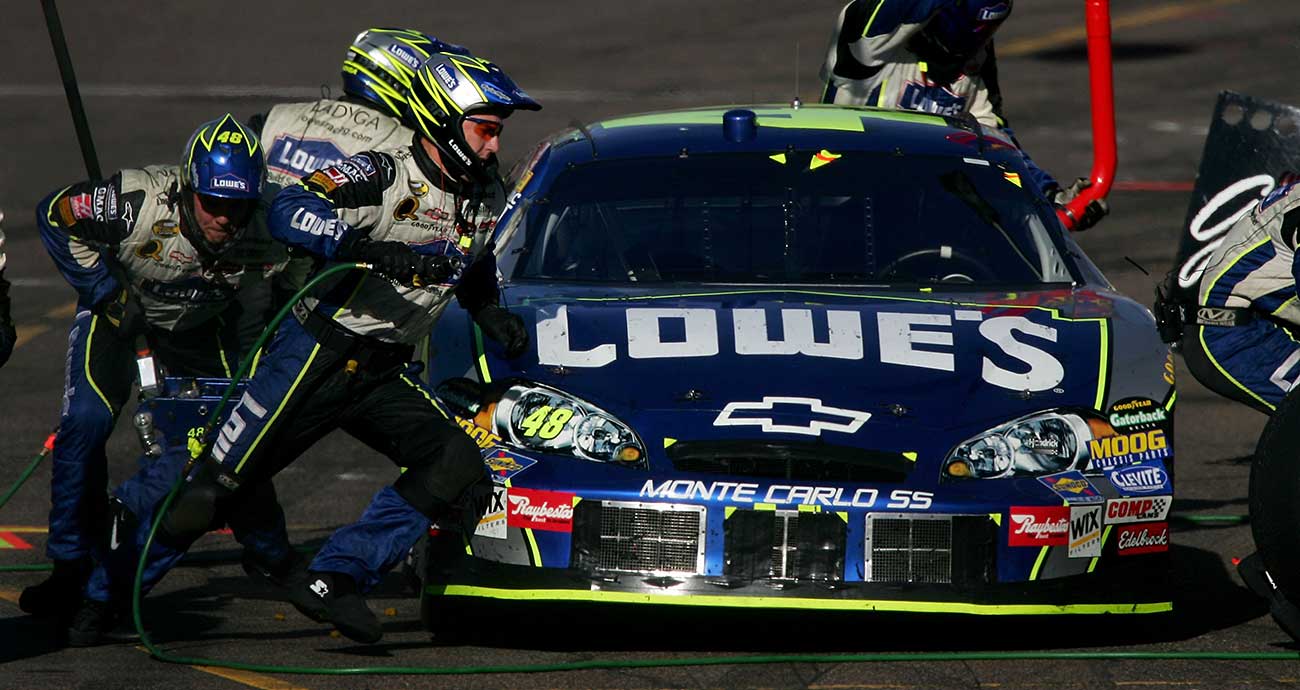
CONCORD, N.C. – Corey Heim led a dominant 72 laps and swept both stages at Charlotte Motor Speedway in the Craftsman Truck Series showdown under the Friday night lights. But ultimately found himself with an immediate disqualification after it was discovered that the No. 11 truck had three lugnuts not secure in post-race inspection, per Section 10.5.2.5.D in the NASCAR Rule Book.
The No. 11 Tricon Garage team made multiple pit-road errors in the closing laps of the 134-lap affair. The first was an issue with the jack, which caused the jackman to leap into action and sprint over the wall to find a replacement, but the damage had already been done.
Heim would restart the next to last caution back toward the back of the pack, but that is where Heim came to shine as he bobbed and weaved past the slower trucks and fought his way back into the top 10 within a matter of laps.
Unfortunately, another error would occur again, as a late caution flew within 10 laps of the checkered flag, putting the No. 11 team back on pit road for four fresh tires. This time, an issue with the left-rear tire put them behind the eight-ball. Heim would get back up to the second place within the final 10 laps and that is where the No. 11 would have finished. With the disqualification, the No. 11 team will be credited with a 36th-place finish.
Corey Heim entered Friday’s Truck Series event second in the driver standings, only four points off of Christian Eckes, Heim also leads the series in the win column with three.
The Truck Series heads to World Wide Technology Raceway next weekend for the Toyota 200 (1:30 p.m. ET, FOX, MRN Radio, SiriusXM NASCAR Radio).
CONCORD, N.C. — Nick Sanchez showed what an opportunist can do when the right moment presents itself.
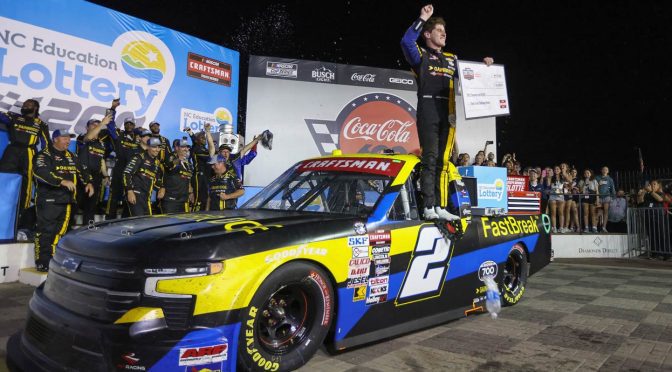
Taking advantage of fresh tires and a quick pit stop, Sanchez charged from the 10th position on a restart with nine laps left in Friday night’s North Carolina Education Lottery 200 at Charlotte Motor Speedway and held off Corey Heim to win his second NASCAR Craftsman Truck Series race of the season — and of his career.
Sanchez crossed the finish line 0.507 seconds ahead of Heim, who fell just short after two snafus on pit relegated him to the runner-up position — temporarily. Sanchez collects a $50,000 bonus as the winner of the first Triple Truck Challenge event of the season.
After the race, Heim’s troubles multiplied when inspectors found three lug nuts not safe and secure on his No. 11 Toyota, resulting in a disqualification that promoted Stewart Friesen to the runner-up position.
“It’s awesome — my No. 2 Gainbridge Chevrolet,” said Sanchez, who qualified 16th for the 11th Truck Series race of the season. “What can I say more about this (Rev Racing) team? We started off bad. It didn’t affect us. We went to work. We put ourselves in position when it mattered most.
“This is for Chris Showalter, my car chief. Birthday today, 700th truck start. This is for him, and it’s great to get number two.”
Remarkably, Showalter has been a part of the series for every race since its inception in 1995.
Sanchez led only the final nine laps. Heim led 72 before the penalty and Christian Eckes 37.
After dominating the first two stages of the race, Heim dropped to 27th under caution for Matt Crafton’s collision with the outside wall on Lap 79 when the jack malfunctioned and failed to lift his No. 11 Toyota.
Heim roared through the field to fifth before Chase Purdy slammed the Turn 2 wall to cause the fifth caution. Like Sanchez, Heim pitted for fresh tires, but a problem with the lug nuts on the right rear wheel cost him valuable time — and ultimately cost him dearly with the disqualification.
Grant Enfinger was credited with third, followed by Matt Mills, Ben Rhodes and Jake Garcia.
Eckes, who entered the race as the series leader, started from the rear after contact from Kaden Honeycutt’s Chevrolet during practice damaged his No. 19 Chevy and prevented him from making a qualifying run.
That was just the start of Eckes’ problems. Alternator issues kept him on pit road for extended stops during the stage breaks and relegated him to starting spots of 28th and 27th for the second and final stages, respectively.
But Eckes recovered to take the lead after staying out for a restart on Lap 88, and he was still in front — albeit close on fuel — when the caution for Purdy’s accident slowed the field. Eschewing a pit stop for new tires under the final caution, Eckes slipped to 10th at the finish.
Honeycutt, who won Stage 1 after Heim’s penalty and finished third in Stage 2, also went to the rear after leaving his pit stall during the second stage break with a fuel dump can still attached to the input valve of his truck.
Despite the setback, Honeycutt had enough speed in his Chevrolet to recover to seventh at the finish. Connor Mosack, Dean Thompson and Eckes completed the top 10.
NOTE: In addition to the disqualification of the No. 11 truck, the Nos. 5 and 38 trucks were each found with one lug nut not safe and secure, which will result in a monetary fine.
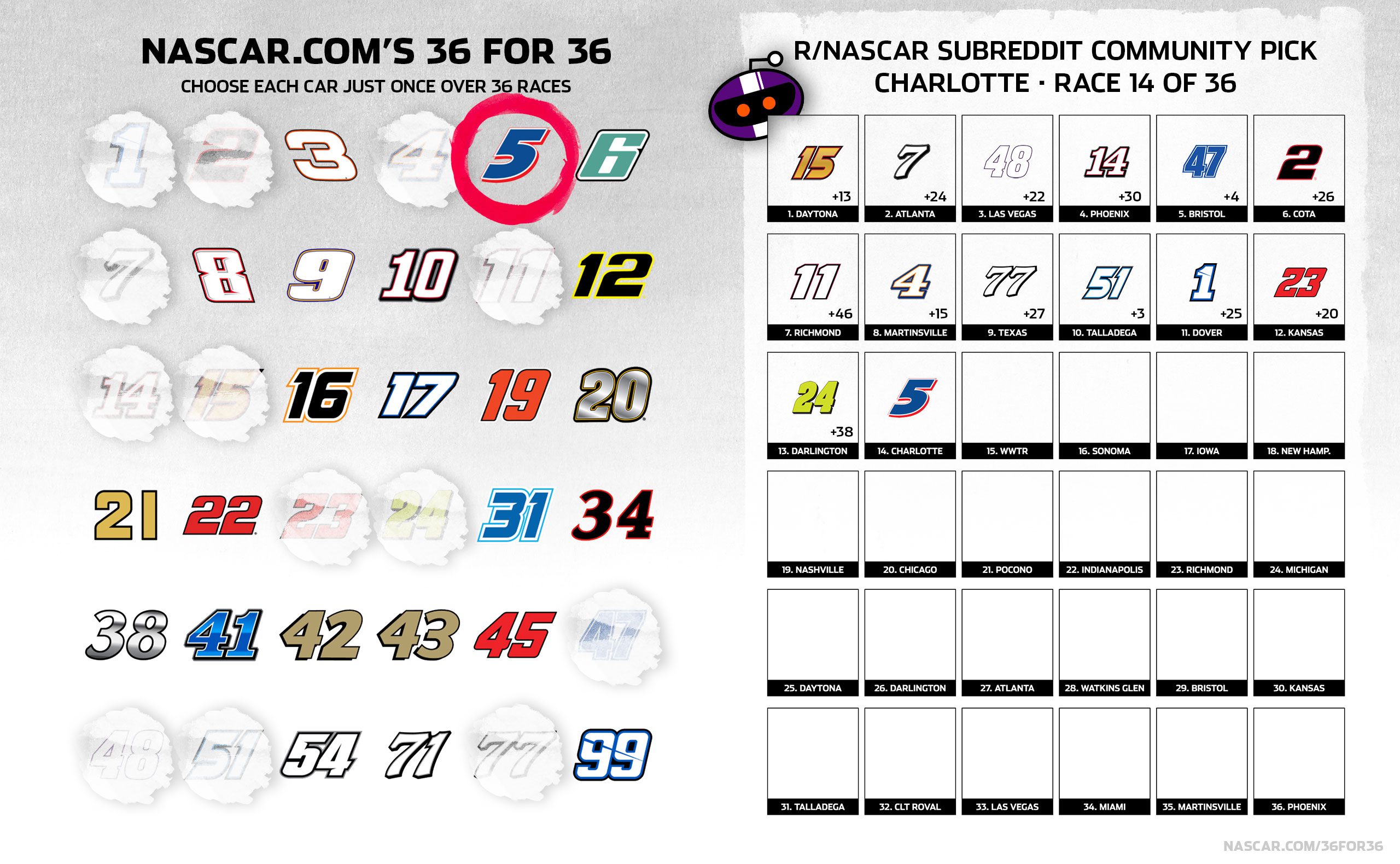
NASCAR.com’s 36 for 36 continues at Charlotte Motor Speedway.
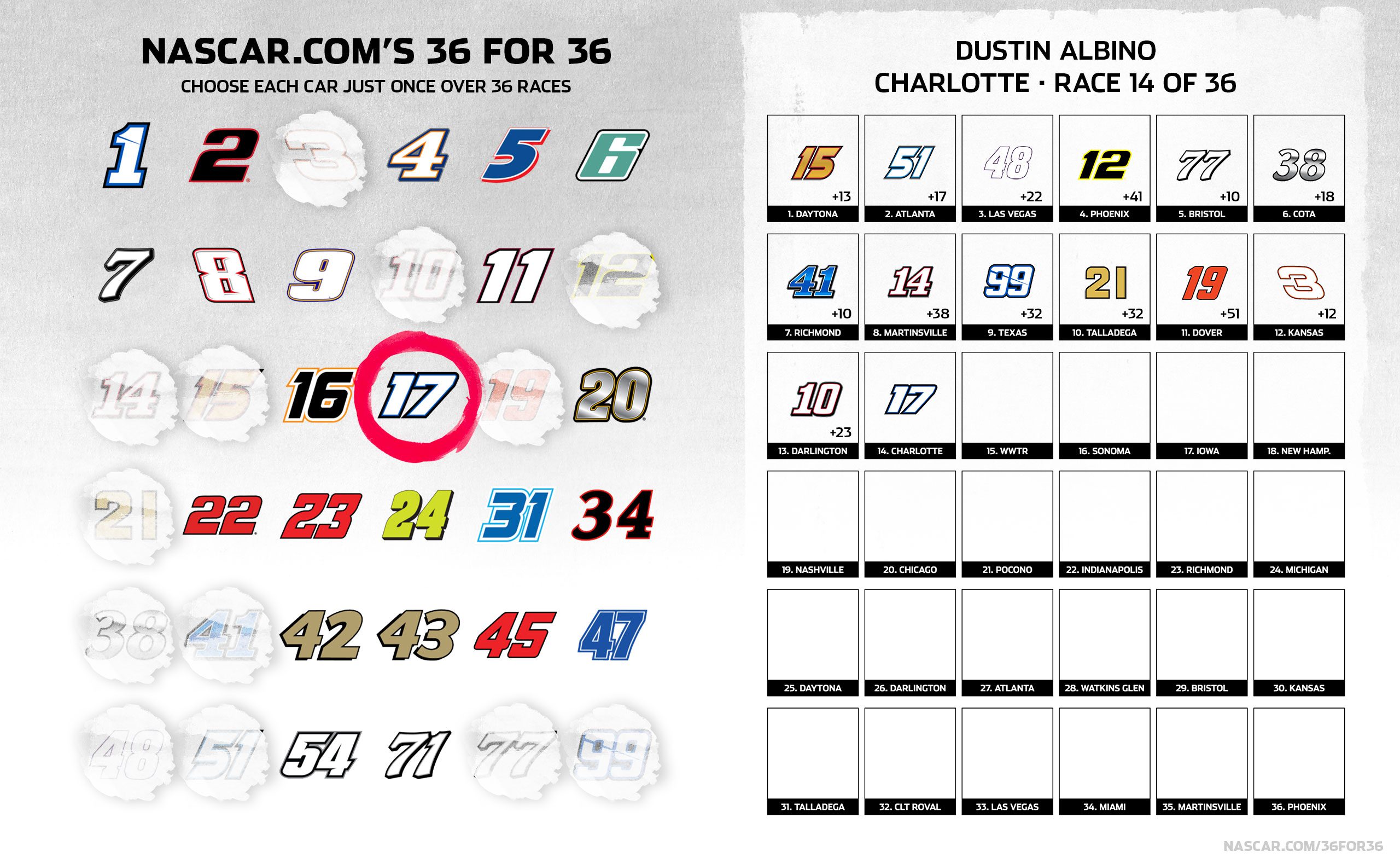
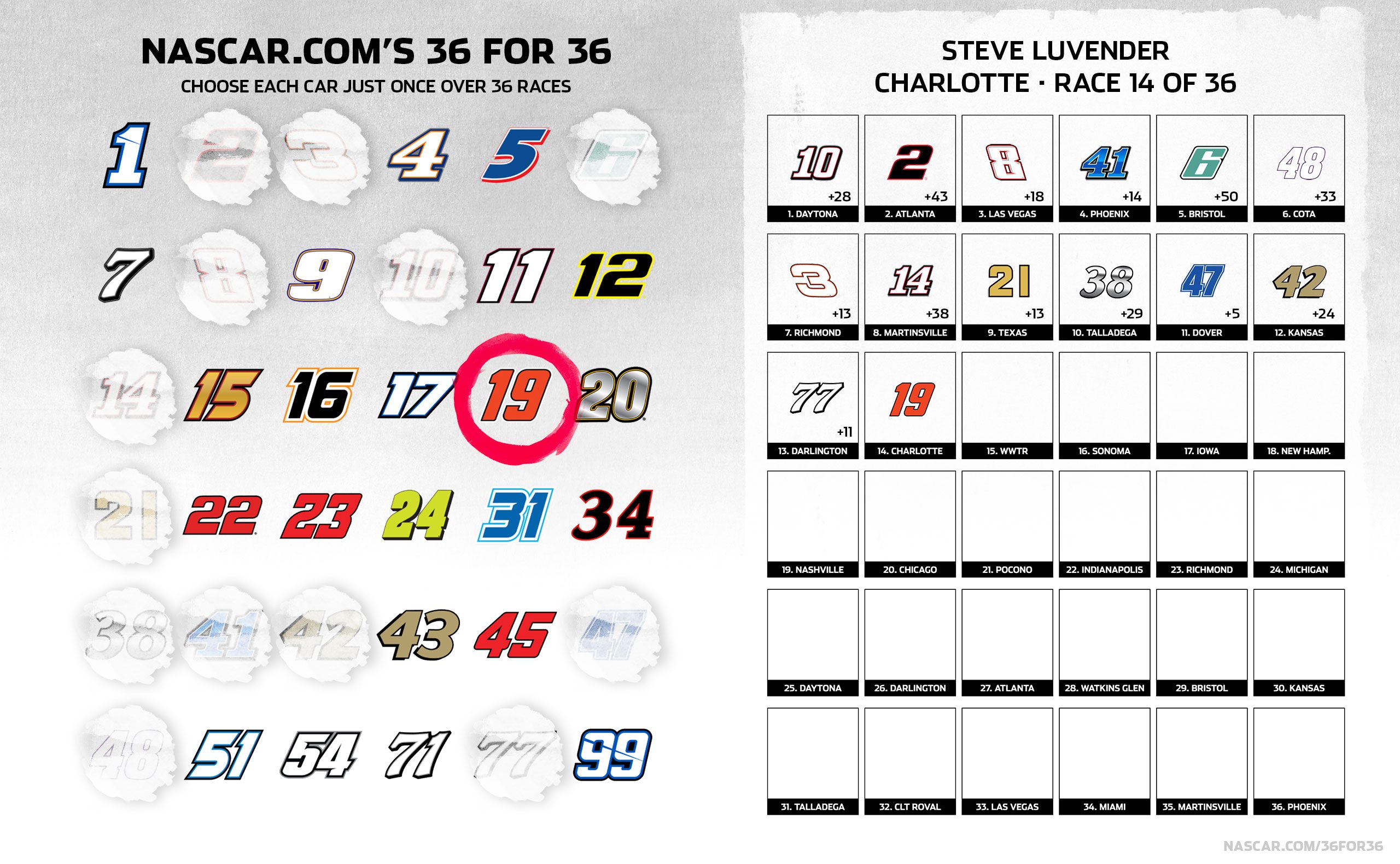
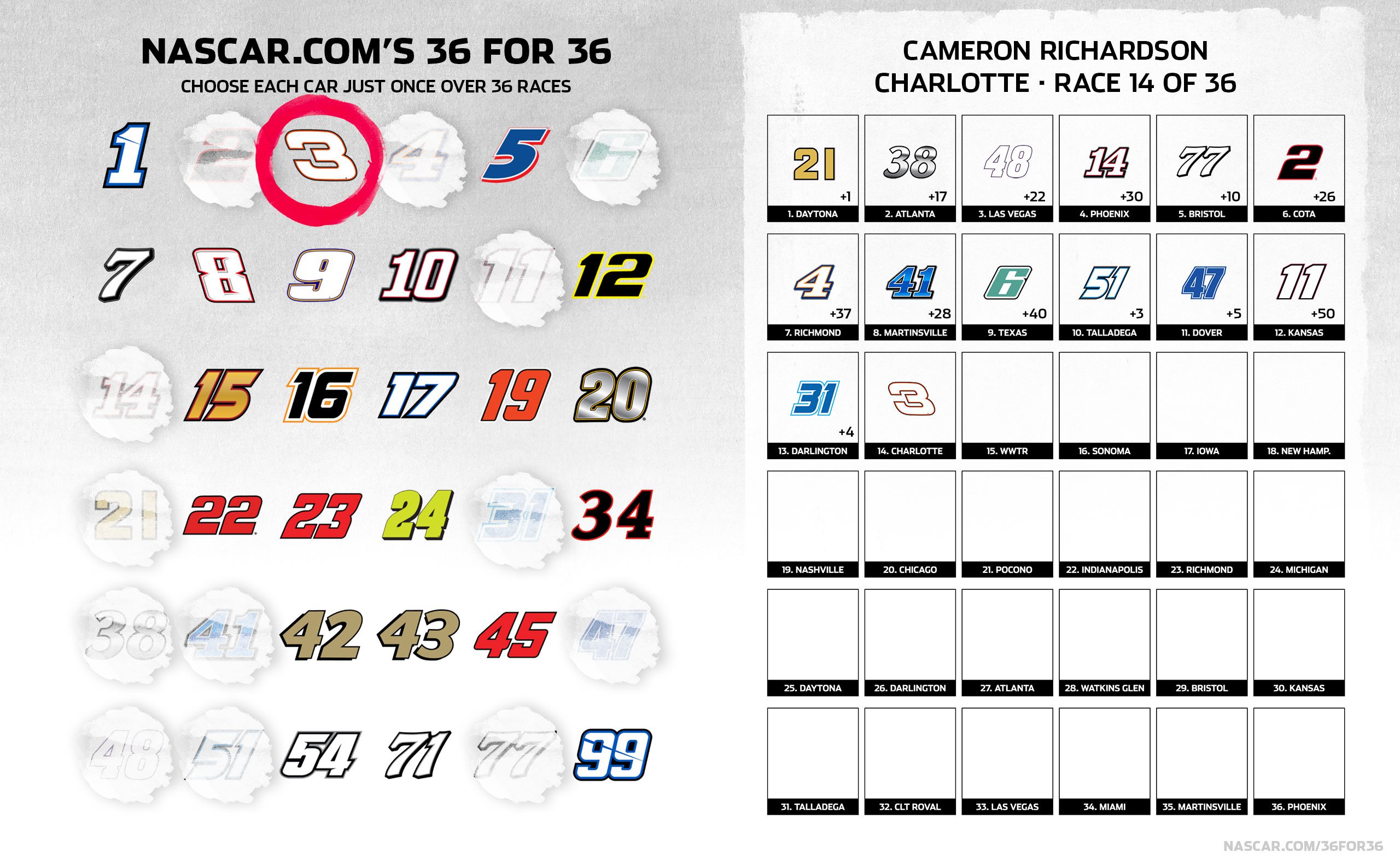
With 36 races and 36 full-time Charter cars, our players select one car per race, but there’s a simple twist: once they’ve made the pick, they can’t choose that car again for the rest of the 36-race season. Yes, that means every car will be selected exactly once … a survivor pool, by another name.
Follow along weekly as our panel of pickers — Dustin Albino from Jayski, along with Steve Luvender and Cameron Richardson from NASCAR.com — embarks on a season-long journey to think like strategists and prove their picking prowess.
We’ll also feature a fourth “community” 36 for 36 pick each week, as decided by fan vote on the r/NASCAR subreddit. Can the collective vote topple our trio of full-timers?
Current Standings:
T-1. Dustin Albino: 319
T-1. Steve Luvender: 319
3. r/NASCAR Community: -26
4. Cameron Richardson: -46
Race 14 of 36: Charlotte
The Cup Series’ last points-paying race in Darlington tightened up our 36 for 36 leaderboard quite a bit. Cameron Richardson’s Daniel Hemric pick didn’t quite pan out, earning him just four points and sending him to the bottom of the standings. Carson Hocevar netted Steve Luvender 11 points, while Dustin Albino’s 23-point pick of Noah Gragson tied him with Steve for the top spot in the standings. The r/NASCAR community used a heavy hitter — William Byron — whose 38-point afternoon was the highest-scoring of our pickers and moved the subreddit to just 26 points out of the lead.
Our panel had the week off from their usual picking duties for the All-Star Race, but they’re back in action for Sunday’s Coca-Cola 600. The 600 is, technically, the most valuable race on the schedule due to its unique added fourth stage — and, thus, an opportunity to earn more points. How will they play this one?
Jayski’s Dustin Albino: No. 17, Chris Buescher
Dustin’s pick last week: No. 10, Noah Gragson (23 points)
Total season points: 319 (first place, tied)
Dustin: There is an old saying, “Strike while the iron is hot” and there is, arguably, no driver hotter in the Cup Series than Chris Buescher. Sure, he experienced heartbreak at Kansas, losing out to Kyle Larson in the closest finish in Cup Series history. Then, he was on the wrong side of a slide job gone bad from Tyler Reddick at Darlington. But the No. 17 team is helping lead the Fords back to relevancy, as Buescher has been a consistent player in the outcome of these races. He’s had race-winning pace at the last two intermediate tracks and was fast at Las Vegas earlier this season before he literally drove the right-front wheel off. OK, maybe the tire was left loose, but you get the point.
NASCAR.com’s Steve Luvender: No. 19, Martin Truex Jr.
Steve’s pick last week: No. 77, Carson Hocevar (11 points)
Total season points: 319 (first place, tied)
Steve: The four-stage Coca-Cola 600 is a huge opportunity to gobble up a possible 10 extra points, regardless of finishing position. Ross Chastain, for instance, finished 15th in the 2022 600 but earned the third-most points — including more than race winner Denny Hamlin — due to racking up 26 points from stages alone. With that in mind, I’m going with Martin Truex Jr. this weekend. MTJ has earned the third-most stage points so far in 2024 (107), behind only Kyle Larson (159) and Denny Hamlin (110). Larson would have been an obvious choice for the stage-point play, but uncertainties around the Indianapolis 500/Coca-Cola 600 double aren’t worth the risk; I’ll save him for the playoffs. (Better believe the No. 5 is part of my Fantasy Live lineup, though.)
Cameron’s pick last week: No. 31, Daniel Hemric (4 points)
Total season points: 273 (fourth place)
Cameron: At some point, the 2024 season has to turn around for the No. 3 team as it sits 31st in points. Charlotte could be the place for it to gain some much-needed momentum as Dillon broke through for this maiden Cup win in 2017 and has three top 10s in the last four oval races around the 1.5-mile facility. In 2022, he was on the brink of taking the lead on the final lap before getting turned in a four-wide kerfuffle coming down the frontstretch. Give me another solid day for the No. 3 this Sunday.
r/NASCAR Community: No. 5, Kyle Larson
r/NASCAR’s pick last week: No. 24, William Byron (38 points)
Total season points: 293 (third place)
It was a close one, but the r/NASCAR community selected Kyle Larson in this week’s voting thread. Will he capitalize on the Indianapolis-Charlotte double?
Here’s what Redditors had to say:
u/Quasar_24: “On one hand, I have serious concerns that Kyle will be pretty fatigued. But on the other hand, gestures towards Indianapolis.”
u/SeattlePassedTheBall: “I think we need to capitalize on him here when there’s 4 stages instead of 3.”
u/michigan_matt: “Exactly this. You have to use an HMS car at a track where you get 4 stages when they’ve won over half the 1.5 mile races in the NextGen. If we didn’t just use Byron he’d be the guy, but since he’s not and we’re saving Chase for road courses, you have to go Kyle.”
Check back next week to see how our pickers fared as the season-long 36 for 36 journey continues. And, if you’ve got a competitive itch beyond meticulously managing your Fantasy Live lineup each week, feel free to save or print your own 36 for 36 sheet and see if you can beat our pickers and the Reddit community!
INDIANAPOLIS — The fifth driver to attempt racing the Indianapolis 500 and Coca-Cola 600 in the same day, Kyle Larson has a shot at becoming the first to win either — or perhaps even both.
But there’s some personal history the Hendrick Motorsports superstar would like to avoid making Sunday.
Over two decades of participating in literally thousands of races in various series and vehicles, Larson recalls no instance in which he started a race and was forced to exit the cockpit because of inclement weather or a scheduling conflict.
“I don’t think so,” Larson said before final practice for the 108th Indy 500 at Indianapolis Motor Speedway. “So hopefully, we keep it that way.”
Two days removed from his Indy 500 debut, the biggest question mark about the 2021 NASCAR Cup champion’s bid at racing immortality has shifted from can it happen to if and when will it happen.
An iffy forecast Sunday morning in Indianapolis has prompted a wave of virtually endless and unanswerable questions for what’s been dubbed “The H1100.”
If the Indy 500’s 12:45 p.m. ET green flag is delayed by rain, how long can Larson wait for the race to begin before heading to Charlotte Motor Speedway?
If he starts a delayed Indy 500, would he get out before the checkered flag to make a dash to take the green for the Coca-Cola 600?
Or would he stay at the Brickyard for the duration and risk missing the start of the 600 (and potentially jeopardizing his Cup playoff eligibility that is contingent on starting all 26 regular-season races)?
It’s a decision that ultimately will be made by team owner Rick Hendrick, whose automotive empire sponsors both the No. 5 Chevrolet in Cup and the No. 17 Dallara-Chevrolet fielded jointly in the Indy 500 by Hendrick Motorsports and the Arrow McLaren IndyCar team.
And with the infamously fickle Indiana weather, it’s unlikely a call will be made until absolutely necessary. Hendrick said earlier this week that “we’re going to let it play out, and we’ll make that decision Sunday,” and Larson still was resigned to that waiting game during an Indy 500 Media Day session Thursday.
“Sure, yeah, it’s stressful because weather is always unpredictable,” he said. “But you just don’t really know until it’s happening. So it’s hard to plan for weather. You can have all these plans and backup plans and backup plans for the backup plan. But you just can’t really do anything or react until it’s kind of the moment.
“That’s what’s a little bit stressful. Yeah, it doesn’t look too promising for Indy on Sunday, but I think for me where I sit, if it’s going to rain, I hope it rains all day. That way it can just get pushed to Monday or something, and then Charlotte is not going to rain, I just hope it doesn’t rain. Again, it’s weather. The forecast changes kind of every day.”
The good news is that aside from a few hiccups, Larson continued to make progress Friday in the final Carb Day practice.
Though he brought out a yellow with 15 minutes remaining in the two-hour session by running out of fuel on track, Larson was towed back to the pits without incident. He enjoyed another productive session in navigating traffic, ranking 13th fastest (224.761 mph) of 33 drivers while turning 74 laps. That came on the heels of 70 laps in a two-hour practice Monday on the 2.5-mile oval where he will attempt to make 200 laps Sunday.
“I thought my car handling was good,” said Larson, who also practiced pit stops. “I didn’t suck up as good as Monday. The pit stop stuff just was getting familiar with that. It’s different from a NASCAR pit stop, and I felt comfortable with all that. We checked a lot of boxes off. I’m sure there are more things I can do to generate runs, and I’ll talk to my teammates about what I can do.”
Aside from Alexander Rossi, Pato O’Ward and Callum Ilott, Larson had a small army of team members to lean on Friday.
Joe Skibinski | Penske Entertainment
With his Cup team off Friday (practice and qualifying for the Coke 600 will begin Saturday at 5:05 p.m.), 18 members of the No. 5 crew hopped a Hendrick jet Friday morning from North Carolina to Indy and spent the day in Gasoline Alley.
An hour after practice, Larson and crews for the Indy 500 and Coke 600 gathered for photos around the No. 17 at its garage stall.
“It’s really special,” said Cliff Daniels, the crew chief for Larson’s Cup team. “First, thank you to Mr. Hendrick and everyone at Arrow McLaren just for giving us the opportunity to come experience this world. Our team is a team of racers, and they have a lot of passion for it, and to be able to be there and experience what we are today, it’s really special. And Kyle has obviously done a great job.
“Hats off to this team. They’ve done an amazing job with a little bit of a slow start to (last) week and getting behind. They rebounded and had an amazing qualifying effort. And just to see Kyle be so natural in this environment. It’s been a lot of fun to be a part of, the team is communicating great. They’re executing a really good day today, too, to get them ready for Sunday, so it’s been a lot of fun to be part of. We all knew his natural talent and ability is, of course, there.”
Another familiar face has been Hendrick Motorsports technical director Brian Campe, who has been embedded with the Arrow McLaren team since last week and will call Larson’s strategy in the Indy 500.
Arrow McLaren sporting director Tony Kanaan, the 2013 Indy 500 winner, has been at Larson’s side constantly the past two weeks to offer advice and a sounding board for the transition.
“There are a lot of folks helping him out, coaching him,” Daniels said. “I know his teammates at Arrow McLaren have been helping him a lot as well. That environment, and just putting all those resources and people together to help him, he’s been soaking it up like a sponge. And he’s been adaptive and reactive and learning the whole time. He’s communicated a lot of that with me. It’s been fun to be part of, there’s new things he’s learning. Different lingo, different ways to talk about his approach and strategy that he enjoys so much.
“He’s such a racing purist that getting in and grinding out the week and the strategy and the practice and all that is right up his alley, and he’s been doing a great job with that.”
Larson will start fifth Sunday as he tries to become only the second driver to complete all 1,100 miles of both races since Tony Stewart in 2001.
Stewart drove at Indy that year for Chip Ganassi, who has his own history with Larson after giving him his first Cup ride 10 years ago.
“I’m not the least bit surprised with how he’s doing,” Ganassi said of Larson before practice Friday. “I think he’ll do great. I think if he can get in and out of the pits, he’ll be fine. I look forward to him to do very well here. I hope he does. I just hope I’m in front of him.”
Larson just hopes for clear weather and fast cars Sunday. He concedes that there would be pluses and minuses if the Indy 500 were postponed to Monday.
“There would be a level of disappointment,” he said. “There would also be a level of happiness because you have time to recover and all that. But in my mind, it wouldn’t feel quite like ‘The Double.’
“I would love for it to be two sunny days in both places and get all 1,100 miles in or at least attempt both races in the same day.”
Nate Ryan has written about NASCAR since 1996 while working at the San Bernardino Sun, Richmond Times-Dispatch, USA TODAY and for the past 10 years at NBC Sports Digital. He is the host of the NASCAR on NBC Podcast and also has covered various other motorsports, including the IndyCar and IMSA series.
CONCORD, N.C. — The NASCAR Craftsman Truck Series celebrated a milestone Friday night at Charlotte Motor Speedway to kick off a full Memorial Day weekend of action. The series will take the green flag for the 700th time in its history, and with that, one individual will also complete the same milestone.
Chris Showalter serves as the truck chief for the No. 2 Chevrolet piloted by Nick Sanchez at Rev Racing and has been working in the Truck Series since its inaugural race at Phoenix Raceway in 1995. On Friday night, Sanchez delivered the best possible anniversary present: A victory. In a career full of winning, there’s a new favorite win for Showalter.
“(This race) just probably popped to No. 1,” an emotional Showalter told FOX Sports. “It’s a long battle, you know? It’s about people, and I love this group of people. I’ll do anything for this group of people.”
The milestone was heavy on Showalter’s mind even before the North Carolina Education Lottery 200 began.
“If I could’ve told you 30 years ago that I would still be doing this, I would’ve called you crazy,” Showalter told NASCAR.com. “It’s just a testament to all of the great race teams that I have been with and all of the people that I have surrounded myself with that keep me coming back every week. The Truck Series has always been a big family to me.”
This race is special for a number of reasons, not the least of which is that Friday happened to be Showalter’s birthday.
“I sat outside last night as it was raining, thinking about how I was going to be able to handle today, and I’ve done pretty well so far because I’m a pretty emotional person,” Showalter said. “The family, I believe, is going to show up; they haven’t said a word, so that means they’re coming. The (No. 2) guys haven’t said a whole lot, too, so I’m sure there’s a big surprise coming. I’m sure I’ll be in tears here in a little bit.”
That premonition proved accurate. Even more impressive than a career spanning almost three decades is that Showalter — nicknamed “Showie” by his peers –- has never missed a race in the series.
Sanchez immediately dedicated his win to Showalter upon exiting his truck, and was eager to explain how critical a role he plays.
“I mean he’s the backbone of the team,” Sanchez said. “And I think everyone on the team would agree. I was with him last year, and it’s like having two or three crew chiefs, and Showie would be one of them, right? He’s someone that he knows what he wants in a truck and sometimes he calls his shot setup-wise. He’s so important and he’s being doing this so long.
“Today was his birthday, it was his 700th race and it all worked out perfect.”
Showalter began his career with Liberty Racing with driver Butch Miller during the inaugural Truck season in 1995 and quickly excelled in his role. He then made the move to ThorSport Racing for one year before moving to Joe Gibbs Racing with drivers J.D. Gibbs and Coy Gibbs.
Joining Rev Racing for Sanchez is the latest step in a career full of milestones for Showalter, becoming the truck chief for the No. 2 during Sanchez’s rookie campaign. Throughout the past two years, the team has now shared eight top fives and 20 top 10s with seven pole awards. The team also celebrated a win in the season-opening race at Daytona to start the 2024 season.
“It was great starting off the season with a win,” Sanchez said. “More importantly, it was a testament to how hard the team works to bring the best truck each week to the track. I am extremely lucky to work with and rely on Showie and the guys. His knowledge is vast, and his experience is extremely beneficial to our race success. Cheers to 700 on a day that also happens to be his birthday. We are hopeful to celebrate in Victory Lane.”
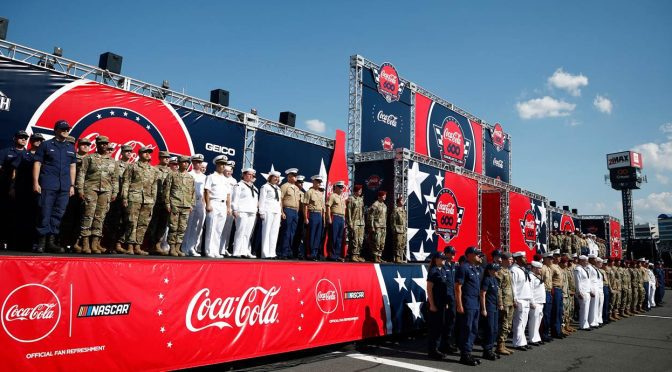
DAYTONA BEACH, Fla. — This Memorial Day weekend will serve as the launching pad for the NASCAR community to formally honor and recognize the United States Armed Forces through its annual NASCAR Salutes Together with Coca-Cola program.
Anchoring the opening weekend is the powerful 600 Miles of Remembrance tribute, where every NASCAR Cup Series car in Sunday’s Coca-Cola 600 (6 p.m. ET, FOX, PRN Radio, SiriusXM NASCAR Radio) features the name of a fallen service member on the windshield. NASCAR and Coca-Cola will host Gold Star Families at Charlotte Motor Speedway, including many whose loved ones will be honored in the race.
“Coca-Cola North America cherishes the opportunity to honor the valor and sacrifice of our military heroes and their families in such a significant way each NASCAR season,” said Chris Bigda, Senior Director of Sports Marketing at Coca-Cola North America. “We’re looking forward to partnering with Speedway Motorsports, NASCAR and the racing community to show our appreciation throughout the entire NASCAR Salutes window, especially this Memorial Day weekend as we pay tribute during the 65th running of the Coca-Cola 600 to those who made the ultimate sacrifice.”
NASCAR Salutes Together with Coca-Cola officially kicked off with a new 30-second television spot that debuted during FOX’s broadcast of the NASCAR Cup Series All-Star Race at North Wilkesboro Speedway this past Sunday. The campaign will continue celebrating the service and sacrifice of U.S. military members and their families through a multitude of at-track integrations, original content features and fan engagement opportunities through the NASCAR Cup Series race at Nashville Superspeedway on June 30. Fans can visit www.nascar.com/salutes to learn more.
“NASCAR has always displayed a deep-seated appreciation for our nation’s service members throughout its 76-year history, and we’re proud to continue partnering with Coca-Cola and our entire industry to express our gratitude for the incredible sacrifices those individuals and their families make on behalf of all Americans,” said Pete Jung, Senior Vice President and Chief Marketing Officer at NASCAR.
In conjunction with NASCAR Salutes, the sanctioning body has announced a new NASCAR Impact partnership with Honor and Remember to continue recognizing fallen service members and the sacrifices of their families. For more than a decade, Honor and Remember has collaborated with the NASCAR industry to host Gold Star Families at race weekends and display the organization’s dedicated symbol of remembrance – the Honor and Remember Flag – at race tracks across the country, including Charlotte Motor Speedway.
NASCAR Impact this week also launched a campaign to support the mission of Sound Off, a nonprofit organization founded to help reduce veteran suicide through free and anonymous mental health support for veterans and service members. Forty-seven percent of military members who show signs of PTSD or depression do not seek help, in part because of fears related to stigma or blowback. Sound Off provides a platform where military members who would otherwise avoid mental health support can engage anonymously with veterans with similar lived experiences. NASCAR is encouraging veterans across its fan base to download the fully encrypted Sound Off app and register as peer supporters.
In addition to those mentioned above, other NASCAR Salutes activities across the industry include:
Discounted grandstand tickets are available to military members throughout NASCAR Salutes and all season long with NASCAR Miltix Presented by GEICO. Active military and veterans can verify their status through SheerID and purchase tickets by visiting NASCAR.com/miltix.
At NASCAR events during the campaign, service members from local bases will have access to complimentary grandstand tickets and unique VIP experiences made possible by Vet Tix and the NASCAR Troops to the Track Program.
NASCAR Troops to the Track, presented by Chevrolet, honors and pays tribute to the men and women of the U.S. Armed Forces by inviting service members from local military installations to VIP experiences at NASCAR races, including hosting military personnel at World Wide Technology Raceway and Nashville Superspeedway during NASCAR Salutes.
Mechanix Wear will provide NASCAR officials and Cup Series teams special camouflage “MultiCam Mechanix Wear” gloves for the Coca-Cola 600.
For the seventh season, Mack Trucks, the “Official Hauler of NASCAR,” will wrap one of its NASCAR haulers in support of NASCAR Salutes for Memorial Day weekend. Fans voted for one of several different paint schemes in April. Mack will reveal the winning scheme on its social media channels leading into the Coca-Cola 600 weekend.
In the weeks leading up to the Coca-Cola 600, Charlotte Motor Speedway continued its annual Mission 600, pairing the Coca-Cola Racing Family and other drivers with military bases to educate the NASCAR community about the day-to-day lives of the men and women who serve.
Xfinity, a Proud Premier Partner, will display red, white, and blue Xfinity windshield headers on their race cars during the NASCAR Xfinity Series Bet MGM 300 at Charlotte Motor Speedway. This initiative showcases Xfinity’s commitment to hiring veterans, National Guard and reserve service members, and military spouses who bring unique skills and experiences to Comcast NBCUniversal.
The NASCAR Craftsman Truck Series will also display red, white and blue windshield decals on all trucks racing in the North Carolina Education Lottery 200 at Charlotte Motor Speedway.
Continuing its tradition, Goodyear will replace its iconic “Eagle” sidewall design with “Honor and Remember” during the Coca-Cola 600 in recognition of the organization working closely with the industry to honor Gold Star Families who have lost family members as a result of serving.
NASCAR will continue to utilize its handicap-enabled “Mobility Pit Box” throughout the NASCAR Salutes campaign to host mobility-impaired race fans and veterans attending races at Charlotte Motor Speedway, Sonoma Raceway, and New Hampshire Motor Speedway. The Mobility Pit Box was designed and announced by Toyota last year. It was gifted to NASCAR at the beginning of the 2024 season to expand its availability, highlighting Toyota’s vision of “Mobility for All.”
Ford Motor Company will pay tribute to veterans and active service members in a special pre-race moment, including several specially wrapped vehicles ahead of the NASCAR Cup Series race at Nashville Superspeedway on June 30.
Universal Technical Institute, NASCAR’s Official Automotive Education partner for more than 20 years, in partnership with the United Service Organizations, will host a group of 50 active-duty military service members at their Mooresville campus for a day of motorsports industry immersion. Service members will tour UTI’s Mooresville NASCAR Technical Institute campus, visit a race shop, and talk about industry training and employment opportunities.
NASCAR, Coca-Cola Consolidated, and Charlotte Motor Speedway teamed up with several local community organizations – including Rebuilding Together of Greater Charlotte and Habitat for Humanity of the Charlotte Region – to complete home rebuild projects for veterans in conjunction with the NASCAR Salutes program.
Like most collections, the one at the top of Mike Trower’s staircase is personal — curio cabinets, picture frames and shadow boxes all stocked to the edges. “I’m a pack rat of stuff,” he says, adding with understatement that there’s plenty more. “Just little odds and ends.”
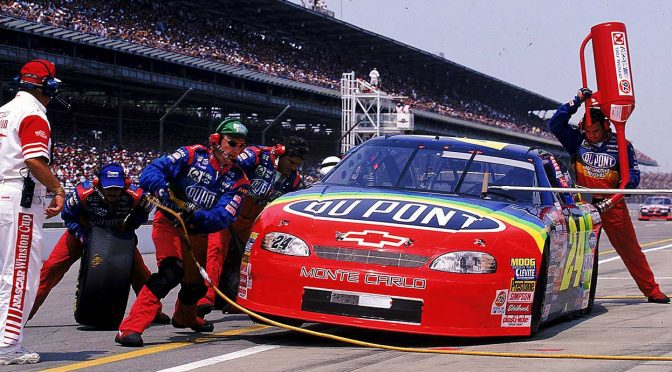
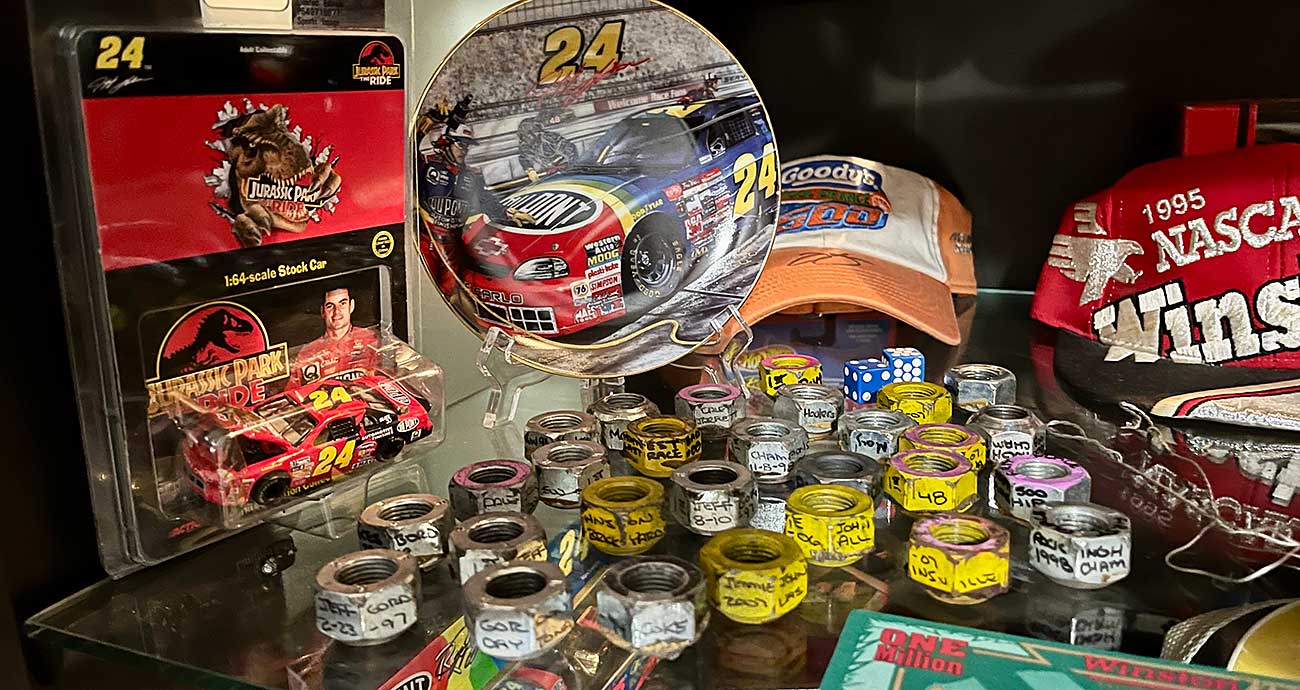
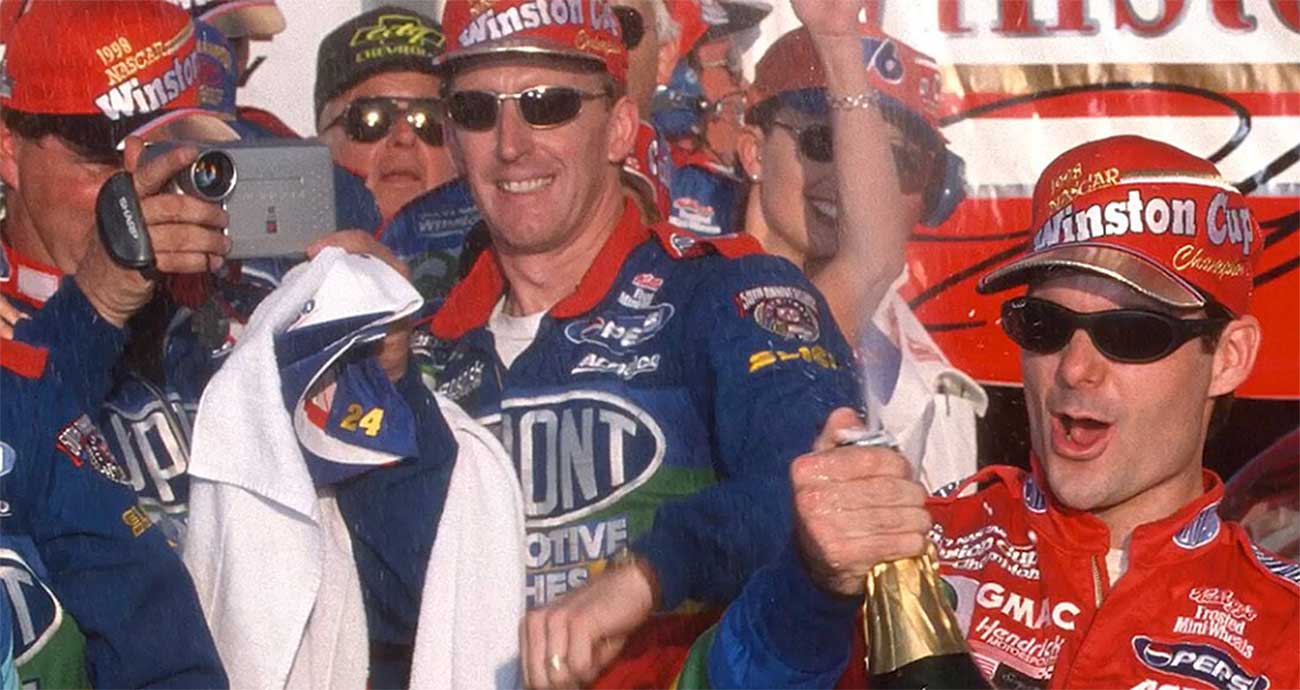
Beyond the sentimental value, Trower’s collection is far more than just trinkets and knick-knacks. It’s a personal walk through NASCAR history, with keepsakes marking his remarkable 27-year run of success with some of the most decorated pit crews in the sport. Besides the trophies, fire suits and champagne bottles from repeated trips to Victory Lane, he has the lug nuts to prove it.
“I just got in the habit of, if we won the race, I’d reach down and pick up five or six lug nuts, and I’d send them to my family at home,” Trower says, “and it’s just one thing that I always thought was cool. I just thought … you can’t buy that.”
Trower’s name might not come first when reflecting on stock-car stardom, but for those who know, his track record and longevity as one of NASCAR’s top tire changers during a revolutionary era in pit-stop performance have made him a legend. A member of the original Rainbow Warriors crew that helped make the No. 24 Hendrick Motorsports group one of the most proficient teams in racing history, Trower is credited with 73 points-paying Cup Series wins – 49 with Jeff Gordon, nine with Dale Jarrett and 15 with Jimmie Johnson – all drivers who reached the NASCAR Hall of Fame.
That’s a lot of lug nuts – many secured and unfastened personally by Trower — that found their way from pit road to home, marked with driver names, track names and years in fine-point Sharpie, and stored in cabinets, a tall glass jar and multiple shoeboxes. It’s a stacked list: Five Cup Series championships, four Daytona 500 wins, the Winston Million, multiple Coca-Cola 600 wins, the first Brickyard 400. When those three drivers made pit stops on the way to all of those crown-jewel victories, Trower was part of a select group of over-the-wall elite making sure that the pit service happened as efficiently as possible.
Zack Albert | NASCAR Digital Media
“Mike was, in his day, one of the best, if not certainly the best, on pit road,” said Ray Evernham, a Hall of Famer who was the No. 24 Chevrolet crew chief during the Rainbow Warriors era. “Mike was good, he was steady, he was fast and he just didn’t make mistakes. When he came to the 24 car, that immediately set the bar for what everybody else had to do. You had to keep up with Mike. The jack man, the rear-tire guy, the tire handler — Mike was our target.”
Trower’s durable nature and reliable hand with a pit gun made him a fixture at going over the wall well into his 40s. Multiple former colleagues voluntarily likened him to pit road’s Tom Brady; another drew comparisons to Cal Ripken Jr., baseball’s iron man. More remarkably, his quarter-century-plus of pit-stop excellence came as Trower also worked a full-time job with Duke Energy.
Now 59, those years of five lugs on and five lugs off are behind him, but the mementos and the impressions he made are lasting.
“He’s kind of like a Tom Brady, right? He wasn’t always the best athletically, he wasn’t always the most flashy, but he always got the job done,” said Chad Knaus, who changed tires in his early years alongside Trower and is now Hendrick Motorsports’ VP of Competition following his legendary career as a crew chief. “He just always used his resources, used the people around him, he was always very physically fit, and just worked at it. That’s just it. He was a worker, and he worked hard to make sure that he stayed in tune as the car has changed, the technique changed, the wheels and the equipment and all of that. He just stayed engaged.”
• • •
Mike Trower grew up in New Hampton, Iowa, and his exposure to racing came early. He attended his first Cup Series race at Michigan International Speedway as a fifth-grader in the mid-1970s, and witnessed his first Daytona 500 in 1977 (he’s been to 47 more in the years since). By his middle school years, he was already helping his father, Dave, with the race cars that he campaigned at local area tracks.
An advertisement for a pit crew school near the 1-mile Rockingham track brought him to North Carolina shortly after his high school graduation. When the training course was abruptly canceled, Trower stuck with the move, going to a two-year tech school the next town over. He began his full-time job in 1984 with Duke Energy – then known as Duke Power – charting a path with an engineering role in distribution, a career he holds to this day.
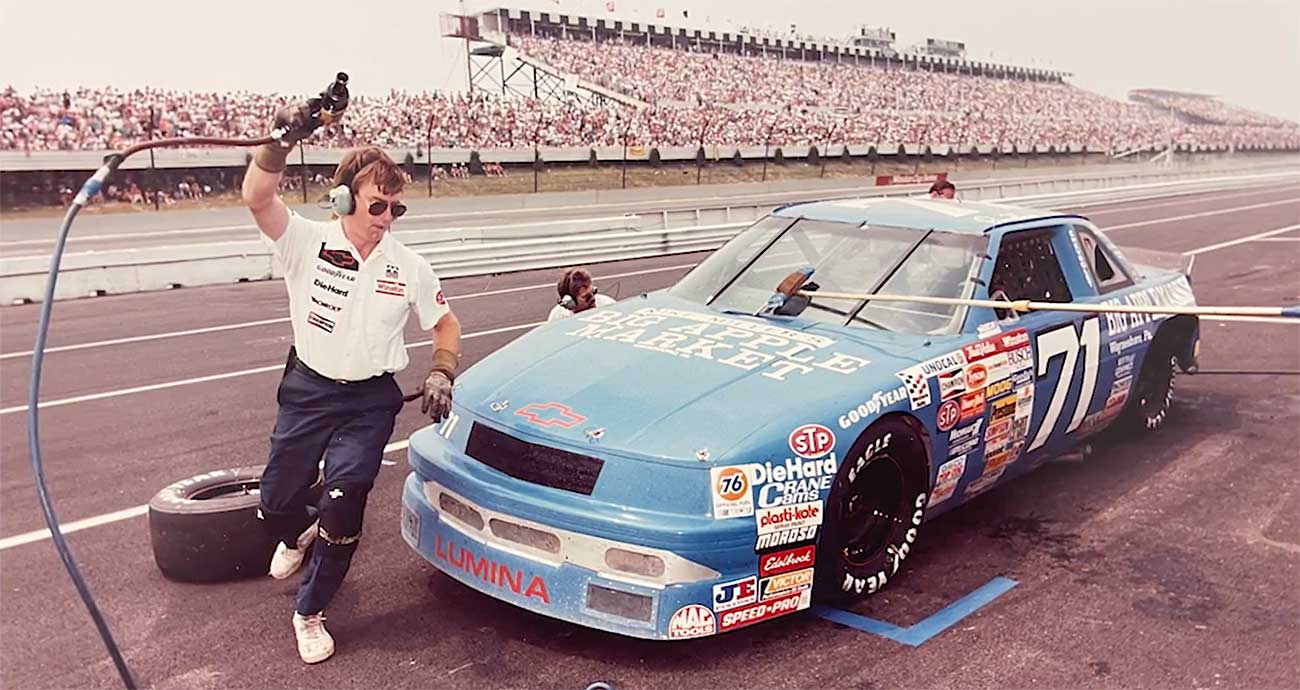
Trower’s journey in big-league racing began with independent driver/owner Dave Marcis, first wielding the fuel catch-can before eventually graduating to changing tires. His first Daytona 500 as a pit crew member came in 1986, and he recalled asking if the team needed help the next week at Richmond. After Marcis asked his crew chief how he’d done, the answer was yes. “So I started and I went to every race after that,” he said.
Trower family photo
Pictures of his earliest days with Marcis’ team show how primitive the uniforms were by today’s standards – a short-sleeved shirt with the orange Helen Rae Special colors, maybe a ballcap instead of a helmet, pants with polyester, sneakers, leather batting gloves and volleyball knee pads: “They were as thin as thin could be.”
Though he savored his time with Marcis’ No. 71 team, Trower was looking for a change once the 1992 season rolled around. He had bought a house, was starting a family, and the demands of road-tripping to races on the weekend while holding down full-time employment elsewhere had become difficult to manage. He looked for the right fit on a team that flew to the farther-flung tracks.
Enter Evernham, who had an established connection with Marcis through their time with the International Race of Champions (IROC). Trower had also changed tires on Evernham’s Modified car in a Cup Series preliminary event at North Wilkesboro Speedway.
Evernham was starting a group that would advance pit stops into their next era of progression, building on the foundation that the Richard Childress Racing “Junkyard Dogs” and the legendary Wood Brothers team had established. The just-formed No. 24 team also had a young hotshot named Jeff Gordon behind the wheel, and as crew chief, Evernham needed a professional support staff. The team’s debut came in the 1992 season finale at Atlanta, long regarded as one of NASCAR’s greatest races. Gordon’s debut was a noteworthy component, but it also let Evernham see how Trower and the rest of the crew would react in the spotlight.
“I think that was really a good test because there were so many people on the 24 team that had really not run or been part of a Cup race, and certainly hadn’t been over the wall in a real event,” Evernham says. “So it was very important for that, and we learned a lot. And the biggest thing we learned is how much we weren’t ready, so thank goodness that Mr. Hendrick let us go ahead and run that race to get prepared for Daytona, because it let us know how far off we were.”
The crew rounded into prime-time form with assistance from Andy Papathanassiou, a former Stanford football player with a master’s degree in organizational behavior, who started just three months before the No. 24 team’s debut as the first pit-crew coach the sport had seen. He was a hands-on player/coach in that first season, manning the jack while Trower changed tires.
Trower’s willingness to learn and his “coachability” were key impressions he made on Papathanassiou, but so was his work ethic – a trait handed down from his father, who worked diligently in his career with John Deere – and his professionalism, which was further shaped by Evernham, Hendrick and the work relationships that followed.
“He was a great athlete, a great thinker,” Papathanassiou says now. “Very good at making adjustments, and I don’t mean adjustments on the car, but adjustments to his own movements. Mike was always willing to give something a shot and work through it till he got it right. How can you do something better? How can you shave off not only time, but how can you add consistency? You can’t just be fast, because if individuals are fast, if they try to do things faster, faster, faster, someone’s going to make a mistake, and that blows up the pit stop and that creates a slow execution.
“Mike always had that mentality, that consistency for an individual and consistency for all the individuals on the team lead to team speed. He always had the right perspective, and then he was always willing. He wasn’t just on the front-tire changer or on the right-front guy and that’s all (he’d) do. Mike was willing to move around.”
Getty Images
Papathanassiou set the standard for the pit-stop practice and workout regimens that would set the team apart, but those drills preceded Hendrick Motorsports’ expansion into building training facilities. The group made do with their surroundings, and Trower remembers carrying wheels, pushing shop rags from one end of the garage floor to the other, piggyback drills, wheelbarrows and lunges. He did this by making a beeline when his Duke Energy duties ended to arrive at the shop around dinnertime. When darkness fell, Trower recalls that the team lit one side of the practice area by opening the shop’s garage doors, then illuminated the other with headlights from their personal vehicles.
“We used to run up and down the hill with people on each other’s backs, for God’s sake,” recalls Shane Parsnow, a tire changer alongside Trower in the 1998 season and who will reach 28 years at Hendrick’s engine department in June. “We didn’t have a full-time gym back then. There was no gym. We would kind of improvise in the fields, just doing drills and crossovers and calisthenics and push-ups and jumping jacks to run and get winded. That’s what we had to work with.”
The method to that makeshift madness paid dividends. The team was already making itself known as a contender but raised more eyebrows in winning the annual pit crew competition at Rockingham in 1994, upstaging the No. 2 Team Penske crew that had won the year before. The Rainbow Warriors lowered the No. 2 team’s record by three seconds, proof that their agility training and videotape study to improve their technique were taking hold.
Other teams began to adapt with their own versions of Evernham’s and Papathanassiou’s system, but the No. 24 team was early to the punch, with Trower as a standard bearer. Knaus recalls the group bonding on the road, packed into a wedge-shaped Chevy Lumina van adorned with sponsor DuPont’s bright colors. At the track, though, the crew was all business.
“He’s a player that anybody would want on their team,” Evernham says. “Mike, I always talk about, is a salt-of-the-earth guy. Mr. Hendrick used to say that to be successful, you’ve got to show up, show up on time, show up with your game face on. Mike and I did hundreds of races together, and he did that every day. I look at him and say that if our team had a team captain, team leader besides Andy Papa at that time, that would have been Mike. Mike set the standard for the other guys. Practice hard, work hard, clean, neat, and just a pleasure to work with.”
For all the wins in the Rainbow Warriors era, Trower says he has a favorite. Gordon was eligible for the seven-figure Winston Million bonus in the 1997 Southern 500, and rugged Darlington Raceway dealt out its traditional four hours of late-summer heat and fury. More than one wall scrape put the No. 24 team in damage-control mode, and multiple adjustments were needed to help the car’s handling.
“I jokingly say it, but I felt like my face was melting off,” Trower says. “You stick half of your body under there, trying to reach around red-hot brake rotors and trying to put a full spring rubber in and making sure everything’s right.” Gordon fought back and outdueled both Jeff Burton and Dale Jarrett in the closing laps, aided by the Rainbow Warriors winning the race off pit road on the team’s last two stops.
“I remember jumping over the wall. My wife was there. My son was there,” Trower recalls. “It was just like, right after the race, that excitement, everything, and I almost felt like I was going to pass out. It just felt like you went way high, and then it was like, it’s almost like the blood just coming out of your head, and you had to just sit down. It was like, holy smokes, and that was the most incredible race.”
• • •
As with most sports powerhouses, the time of the Rainbow Warriors’ dominance eventually came to an end. Evernham left the team during the 1999 season to help spearhead Dodge’s return to NASCAR. Less than three weeks after that mid-October announcement, Robert Yates Racing — flush with budget and resources — hired away the entire No. 24 crew, Trower included, to pit Jarrett’s championship-winning No. 88 Ford.
The transaction was monumental. Pit-crew movement was commonplace in those days, but rarely did it make headlines. And many of those deals that came before it were brokered with informal agreements rather than signed contracts.
“It was a group that had stayed together for those six years from ’93 through ’99, and like so many championship groups, dynasties, whatever you want to call it, there were now next chapters, next steps that were starting to be developed,” Papathanassiou says. “Ray and Dodge was one. That crew had a lot of attention and gained a lot of recognition over the years with such great work. It was a highly sought-after bunch, so sure, it was difficult.”
Hendrick expressed his disappointment publicly, and the organization moved forward with Papathanassiou implementing the next stage in his industry-changing strategy with a pit crew development program. Trower & Co. — now dressed in Ford Quality Care’s red, white and blue gear – won in their first race out, with Jarrett at the Daytona 500 in 2000.
“When you feel like you’re good as a group together, and you feel like we’re stronger as a group together than we are individually, we wanted to keep that,” Trower says. “That move was another step in that elevation of the importance of pit crew.”
Any initial resentment wouldn’t last. After four years working at what he called a “super-special place” at Yates, the tougher work-to-shop-to-home commute had taken a toll. He shifted to work for two years with the former MB2 Motorsports team and driver Scott Riggs. While there, Trower’s pit-stop work caught the eye of former colleague Knaus — who had ascended to a crew chief role on the No. 48 Chevrolet for Jimmie Johnson – when the two teams pitted in neighboring stalls during an event at Dover.
Those conversations set in motion Trower’s return to Hendrick Motorsports just as Johnson was beginning his title-winning ways.
“He picked up, but it wasn’t the same,” Papathanassiou says. “He came back not only as a crew member on the team, but also as an example, as a leader, as a veteran for what we wanted to shape that team into. He was the one that had been there, done it. He could talk from a level of not only being able to do it right then and there, right in front of you, but from the experiences we had on the 24 car with Jeff Gordon in the Rainbow Warrior days. Mike brought all of that to the table when he returned with the 48.”
Jonathan Ferrey | Getty Images
Championships, multiple race wins and many more lug nuts came home with Trower, who began to wind down in his third decade of over-the-wall service. “It was just time,” he says in reflection, and he kept at it with stints with the Wood Brothers, JR Motorsports and finally with Tommy Baldwin Racing in his later years.
“Nobody wants to admit it,” Trower says, “but as a pit-crew guy, you get a little age, you start to lose a little bit, a little step or whatever and you’re probably not going to be on that top-tier team maybe again. But that didn’t deflate anything I did about enjoying pitting a race car, and that fun with just hanging around with the guys.”
Even after his final pit stop at the end of the 2013 season, he remained close with the Hendrick organization as a consultant, helping with coaching and observing the No. 48’s pit-crew personnel. In 2016, he was given his last championship ring – a large, bejeweled 7X that’s in the center of a five-by-five case in Trower’s upstairs room — to mark Johnson’s history-making season.
“The thing I really liked about Mike is anytime I called him, he was like, ‘Yeah, man. I’m there. Whatever you need,’ ” Knaus says. “As we were having some pit crew struggles on the 48, I called him multiple times to say, ‘Hey, can you just come watch? Can you just come try to help? Can you just give a little bit of guidance?’ And he never once wavered, and that says a lot about his character. And you know what, one thing that’s pretty interesting is when he would speak, everybody would listen, and that just tells you right there how solid he is.”
The markings of that final pit stop are arranged in their own case in Trower’s office. Baldwin gave Trower the air wrench, and his car chief spun the 10 lug nuts off the front two tires, zip-tied them together and gave them to the veteran tire-changer. They’re secured next to his gloves and pads, in the familiar pentagon pattern that he coordinated and repeated thousands of times.
“It’s a mental game as much as it is a physical game,” Parsnow says, calling Trower a Ripken-esque player when he assesses his former teammate. “You can’t let the aspects of the race or the crew chief or the driver yelling, interfere with what you’ve got to do. And he was able to put that out and just focus on his task at hand. He was committed to it. Add all those things up, that’s what made him so good for so long.”
• • •
The NASCAR Hall of Fame elected its 15th class earlier this week. A small gathering of its inductees have experience going over the wall – Knaus, Kirk Shelmerdine, Junior Johnson and Leonard Wood, to name some — but those were celebrated for their larger roles in the sport.
The Hall of Fame has inducted drivers, team owners, executives, crew chiefs, engine builders, mechanics and broadcasters. The time for its first honoree either as a pit crew team or individual feels overdue.
“I used to tell people this story all the time,” Knaus says. “In my office, all those years of me being a crew chief, every week … I would watch the races throughout the course of the week. I would be there working, doing whatever it is and in my office, every time the caution came out, you would stop and watch the pit stops, and that’s what all the fans do, right? It can be droned out, just running, running, running, and as soon as the caution comes out and cars are coming down pit road, everybody’s paying attention. Nobody takes a bathroom break during a pit-stop cycle.
“And I completely agree with you, that I feel like that these guys — and soon-to-be gals because we’re seeing some of them — need to be recognized in that manner, and Mike would be a guy that would and should be considered. If you go all the way back to when he was changing tires for Dave Marcis, right through the championships that he won, and the people that he helped, he would definitely be a candidate.”
Recognition has instead come in other forms – in years past with the former Copenhagen/Skoal All Pro Team and the annual pit crew competitions, and currently with the Pit Crew Challenge that’s a component to NASCAR’s All-Star Weekend. But should NASCAR’s Hall come calling, Evernham is among those calling Trower a “first-rounder.”
“As important as the pit crew members have been to the success of every driver that’s in the NASCAR Hall of Fame, every owner, every crew chief,” Evernham says, “behind that is an incredible pit crew, and those guys deserve a spot in the Hall of Fame.”
NASCAR Digital Media
Trower demurs at the mention of stock-car enshrinement, instead crediting the pit crews who paved the way for the Rainbow Warriors – the Wood Brothers and the RCR “Flying Aces” – and those who followed their path, including the “Killer Bees” that serviced Jack Roush’s No. 17 Fords for Matt Kenseth. In reflecting on his own legacy, Trower remains steadfast with the “team first” mentality that carried him all those years. Hearing his name held up as an example for how things should be done on pit road remains a source of pride.
“I didn’t have the fastest hand speed, I wasn’t the quickest around the car at all, but I tried to be smooth and consistent and repeatable with what I did,” Trower said. “I felt like I had the speed necessary, or I wouldn’t have been able to be part of teams and things that I was. I felt like there were people that, you give it one shot, I’ll probably get beat, but give me a string of them, and I think I can come out on top, because I felt like I could do the things over and over. … I just wanted to be a good teammate and do my part, be accountable for what I do.”
In talking with Trower’s former colleagues, one recurring thing stood out.
Knaus: “He has always been a very, very good tire changer. I would bet that he could get down and do it again today.”
Evernham: “Gosh, I don’t even know how old Mike is right now, but I’ll tell you what: I bet he’d surprise some of these guys on pit road.”
Trower says he’s ready to take Knaus and Evernham up on those bets.
“That’s funny,” he laughs. “You don’t have to talk to Ray or Chad, you could talk to me, and I’d say yeah, I think I could still do it.”
Trower turns 60 in September, old enough to remember when the 20-second barrier for pit stops fell and thinking then that he’d seen it all. The single-lug wheel fastener of the Next Gen car has helped speed up pit-stop times, but that performance threshold is now in the nine-second range and quicker for the highly trained pit crews of today.
Trower still stays active by going to the gym, hitting the exercise bike in his office and working in the yard. When he speaks of his time in the sport, you can tell that the lure of pit road is still strong.
“I’d like to try the one lug-nut thing and see how it is,” Trower says. “In your mind, can you do it as good? You know, probably not. But I don’t think anybody that’s competitive … I don’t consider myself an athlete, but the athletic ability or the skill to do something? Yeah, it’s always hard. You’re never going to say, ‘Nah, I’m done. I could never do that again.’ In the back of your mind or part of the front of your mind, I’d have a hard time if somebody called today and said, ‘You changed five lug nuts for 27 years. We need somebody for the Xfinity race this weekend. We’ve got to have somebody to fill in.’ Oh, yeah, it’d be hard for me to say, ‘Ah, no, I don’t think so.’ In my mind, I’d be saying, yeah.
“I’m not saying I’m going to be full-steam up to par, but yeah, I feel like I can still lay down a competitive pit stop with a little bit of warm-up and a little bit of practice.”
Xfinity and Truck Series teams, the Tom Brady of pit road is waiting for your call. And he can bring his own lug nuts.
Throughout the 2024 NASCAR season, Ken Martin, director of historical content for the sanctioning body, will offer his suggestions on which historical races fans should watch from the NASCAR Classics library in preparation for each upcoming race weekend.
Martin has worked exclusively for NASCAR since 2008 but has been involved with the sport since 1982, overseeing various projects. He has worked in the broadcast booth for hundreds of races, assisting the broadcast team with different tasks. This includes calculating the “points as they run” for the historic 1992 finale, the Hooters 500 at Atlanta Motor Speedway.
The following suggestions are Ken’s picks to watch before this weekend’s Coca-Cola 600 at Charlotte Motor Speedway.
The inaugural race at Charlotte Motor Speedway was originally scheduled to run in May of 1960 but various issues with construction of the new facility pushed the race back to June 19th.
The chaotic beginning of the track soon followed once the green flag dropped for the inaugural event. 60 cars started the event in front of over 35,000 fans. From issues with the track holding to multiple drivers being disqualified for cutting through the infield to the pit, issues plagued the day in almost every way possible.
A horrifying crash involving Don O’Dell and Lenny Page saw O’Dell’s car slam into the side of Page’s car. His car was destroyed and it left Page needing serious assistance. Journalist Chris Economaki came to his rescue and was later credited with saving his life.
Jack Smith seemed to have the race in his full control until a ruptured gas tank ruined his chance at the victory.
Joe Lee Johnson took advantage of Smith’s misfortune and captured the checkered flag by a whopping four laps over Johnny Beauchamp.
Bobby Johns, Gerald Duke and Buck Baker rounded out the top five.
A handful of legends paced the front of the field at Charlotte in June 1963, as the race came down to a few drips of fuel.
Over half of the 44 starters faced issues throughout the day in a race that turned into a battle of attrition. Some of the drivers who didn’t see the checkered flag that day included Ned Jarrett, Richard Petty, Buddy Baker, Buck Baker and Ralph Earnhardt.
Junior Johnson and his “Mystery Motor” Chevrolet dominated the race, leading a race-high 289 of 400 laps but couldn’t hold on for the victory.
Fred Lorenzen took control of the lead and had just enough fuel to sputter across the start/finish line for the race win.
The victory kicked off a hot stretch for the Elmhurst, Illinois driver, as his Charlotte triumph kicked off a stretch where he won five of the 13 races he entered. He also grabbed 10 top-three finishes over the same span.
The first five finishers in the race were later elected to the NASCAR Hall of Fame: Lorenzen, Johnson, Rex White, Joe Weatherly and David Pearson.
The first 12 races of the 1980 Cup Series campaign were full of parity, as a group of future Hall of Fame drivers traded trips to Victory Lane.
Darrell Waltrip led the way with three victories, while Buddy Baker, Richard Petty and the reigning Rookie of the Year Dale Earnhardt won two. Cale Yarborough, David Pearson and Bobby Allison, who won the previous race at Dover, all topped the field once.
Waltrip entered the race at Charlotte looking to become the first driver to win three consecutive World 600 events.
Despite the fact that seven drivers had made the trip to Victory Lane, it was Kannapolis, North Carolina’s Earnhardt in full control of the season standings.
The budding superstar held a 102-point advantage over Petty and was 215 points up on Waltrip in fifth.
The 600-mile stock-car test at Charlotte looked to be another race that would fall into the lap of one of the previous winners in 1980, as they had combined to win 16 of the previous 18 races at the track.
Qualifying again pointed to it being one of those seven that would be victorious at the end of the marathon, as they qualified in seven of the first nine positions.
Coincidentally, one driver was an outlier in both of the aforementioned statistics. Benny Parsons captured the October 1977 race at the track and also qualified his No. 27 car in sixth for the race.
The series’ theme of being wide open continued, with outstanding racing accounting for 47 lead changes. Unfortunately, heavy rain slowed the race a handful of times, but that didn’t turn the crowd away from seeing a late-race battle between Waltrip and Parsons.
The two drivers traded the lead back and forth multiple times over the final 126 laps before Parsons took command of the final two en route to Victory Lane for the first time in 1980.
Earnhardt led 105 laps but was involved in a multi-car incident that left him with a 20th-place finish. His crew chief, veteran Jake Elder, left the team following the race. The team put 20-year-old Doug Richert in charge and the new combination paid off, as the No. 2 team captured the championship at the end of the season.
NASCAR Research & Archives Center | Getty Images
You can watch these three races and hundreds more by visiting NASCAR Classics.