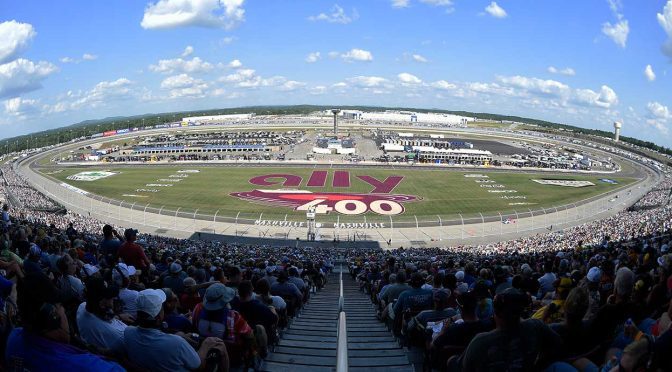
Ally 400
(⏰ Sunday, 3:30 p.m. ET | NBC | NBC Sports App | PRN Radio, SiriusXM NASCAR Radio)
Weekend schedule | TV schedule | Weather tracker | NASCAR 101
Location: Lebanon, Tenn.
Track length: 1.33 mile
Race purse: $8,915,372
Race distance: 300 laps | 399 miles
Stages: 90 | 185 | 300
—
Starting lineup: Denny Hamlin to lead field to green Sunday
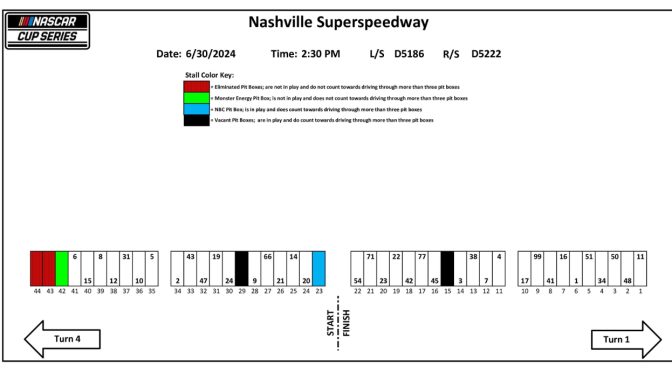
Pit stall assignments: See where drivers will pit
Defending winner: Ross Chastain, June 2023 | NASCAR’s history in Nashville
Key things to watch
Saturday sessions
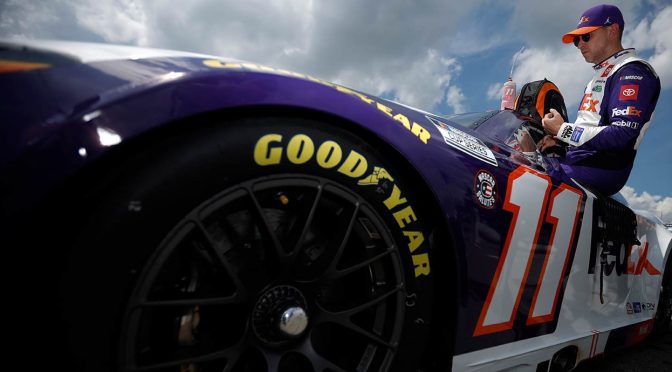
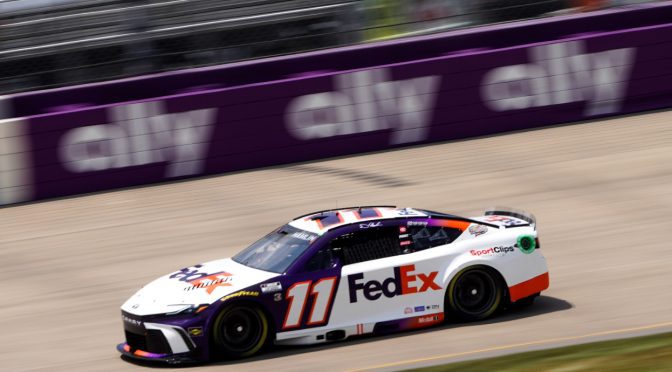
Denny Hamlin sped to his second Busch Light Pole of the season with a 160.354-mph lap in the No. 11 Joe Gibbs Racing Toyota. It’s his second Nashville pole in the last three years and his 42nd in his career — good for 13th on the NASCAR Cup Series’ all-time list.
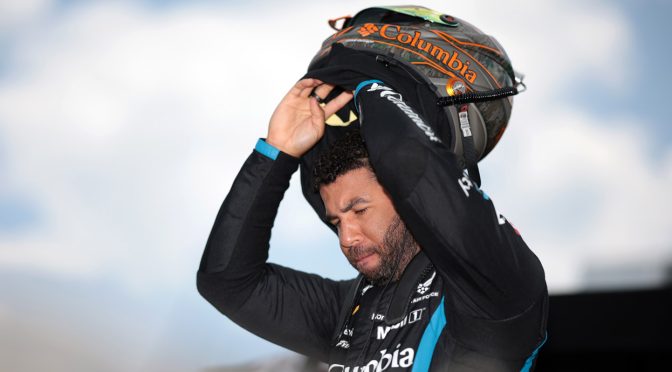
Joe Gibbs Racing cars were also fast in practice as Ty Gibbs set the pace in the 20-minute session, notching a 159.287-mph lap in the No. 54 JGR Toyota. Ryan Blaney was second-fastest, Bubba Wallace third on the speed chart and Blaney tops in the consecutive 10-lap averages category. | Practice results
Big story line
Four-car breakaway in season’s first half
The 2024 Cup Series campaign officially turned past the halfway point after last weekend’s event at New Hampshire Motor Speedway, and for the first time after 18 races, there are four three-time winners at the top of the heap — Christopher Bell, William Byron, Denny Hamlin and Kyle Larson. Bell joined the group last weekend with his NHMS victory, placing him among the quartet atop the Cup Series Playoffs picture. The six drivers just below them in those standings — Tyler Reddick, Ryan Blaney, Austin Cindric, Chase Elliott, Brad Keselowski and Daniel Suárez — are all one-time winners this year.
With 18 races left on the Cup Series schedule and 10 winners on the books, there’s still plenty to be decided in the eight-race span between now and the regular-season finale at Darlington Raceway on Sept. 1. Six playoff berths are still waiting to be unlocked, and Martin Truex Jr. has the highest points total without a victory. Closer to the bubble, the provisional elimination line is a volatile place. Joey Logano vaulted above it last week, supplanting Bubba Wallace, who tumbled out after a crash and now faces a 13-point deficit to climb his way back in.
Two drivers currently outside the top 16 in Cup Series points have won races this year, with Daniel Suárez (18th place) and Austin Cindric (21st) getting the inside track to the postseason hunt. Another such winner below the top side of the bubble would make the elimination squeeze that much tighter.
Further up the playoff pack, Hendrick Motorsports teammates Elliott and Larson head to Nashville tied atop the Cup Series standings. Both are former Nashville Superspeedway winners, and the path to the Regular Season Championship and its 15 playoff-point bonus goes through them — for now, at least. Hamlin lurks in third place, 40 points back, with designs on passing them both if he gets hot in the summer stretch.
TICKETS: Don’t miss the July 7 Chicago Street Race
History tells us…
So far at Nashville, it’s Chevrolet. The Cup Series history books at Nashville Superspeedway still might come in pamphlet form, but even with the smaller sample size, it’s a 3-for-3 sweep for Chevrolet drivers in Victory Lane at the 1.33-mile track. Larson was first to the winner’s commemorative guitar in 2021, followed by teammate Elliott the next year. Last season’s laurels landed on Ross Chastain, who started from the pole position and led 99 of the 300 laps, including the final 34 in Trackhouse Racing’s No. 1 Camaro.
Positive indicators for Nashville still exist for the Cup Series’ other two manufacturers. Toyota drivers have been runner-up in the two most recent Nashville events, and Ford has enjoyed a modest turnaround after going winless in the first 12 races this year, with Mustang drivers winning three of the last six events.
Nashville’s history also shows a potential trend for qualifying’s bearing on the results. All three Cup Series winners at Nashville have driven to victory from a top-five starting spot.
He may not be the betting favorite to win, but watch out for…
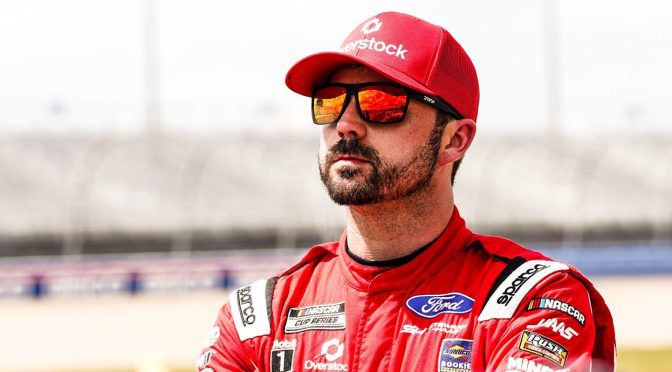
JOSH BERRY. Sunday’s 300-lapper will mark Berry’s first Cup Series start at Nashville, but there hasn’t been much of the typical rookie learning curve in his most recent stretch. Berry is fresh from finishes of seventh at Iowa and third last weekend at New Hampshire, results that stand in sharp contrast to his 55-1 opening odds (13-1 odds on race day).
Though the Stewart-Haas Racing operation is closing down at season’s end, Berry isn’t going out with a whimper, registering four top-10 finishes in the last six races. It’s been a promising audition for a ride next season, and Berry has even more motivation this weekend to perform in front of a hometown crowd. The 33-year-old driver hails from Hendersonville, Tennessee — just northeast of Music City. He’ll take the green flag on the front row in the second starting position Sunday. | Nashville odds
Speed reads
Our biggest pieces of the week — get covered for race day from all angles.
• Fresh face for No. 19: Chase Briscoe to join Joe Gibbs Racing in 2025 | Read article
• Against the odds: Inside Briscoe’s career arc: ‘There was a miracle in there’ | Read article
• Larson on Briscoe’s move: No. 5 driver razzes Bell, sizes up new-look JGR | Read article
• Reversing course: Inside Kyle Busch’s quest to shake recent skid | Read article
• The award goes to …: Ryan Blaney nominated for Best Driver ESPY | Read article
• Watkins Glen go-around: Tire test produces different options, eventful spins | Read article
• Streak, for starters: Chase Elliott, all top 20s so far in 2024 | Photo gallery
• NASCAR Salutes: Michael McDowell pays Fort Campbell a visit | Read article
• Nashville’s pickers: Active Cup Series drivers with wins at Nashville Superspeedway | Photo gallery
• Power Rankings: Leaning into Larson’s talent in Tennessee | Photo gallery
• Turning Point: Bell’s ascent, plus the narrowing path for playoff eligibility | Read article
• Racing Insights: A 1-2 punch for JGR? Inside our experts’ projections | Read article
• Field of 16: How the projected playoff picture shakes out with eyes on Nashville | Read article
• 36 for 36: Check out this week’s survivor pool picks | Read article
• Fantasy Update: Sit vs. start on debate Hamlin, plus Berry’s rise |Read article
• NASCAR Classics: Some Music City memories from our video archives | Read article
• Paint Scheme Preview: Fresh designs are the Tennessee type | Pick your favorite
Fast facts ⏩
Race-relevant statistics, brought to you by the experts at Racing Insights.
• Pole-starter Denny Hamlin has won the last three Cup Series races on concrete-surfaced tracks — most recently at Dover (April 2024) and the last two at Bristol (March 2024 and September 2023).
• A trio of three-time winners from last season have yet to win this season: Chris Buescher, Kyle Busch and Martin Truex Jr.
• Three drivers have been running at the finish in every race this season: Chase Elliott, Daniel Hemric and Martin Truex Jr.