For the first time in his 10-year NASCAR Xfinity Series career, Ryan Truex will enter the weekend as a defending winner. And of all circuits, it’s at his home race track: Dover Motor Speedway.

Hailing from Mayetta, New Jersey — roughly two hours and 15 minutes from the Monster Mile — Truex is too young to remember the first time he visited Dover. It was when his father, Martin Truex Sr., competed in the Busch North Series. His earliest memory is sitting in the grandstands near the end of the frontstretch when his older brother, Martin Truex Jr., won his first Xfinity Series race with Chance 2 Motorsports in the fall of 2004.

Nearly 20 years later, the Truex family is still the talk of the town, sweeping the Xfinity and Cup Series events last season.

WATCH: Monster burnout at Monster Mile following Truex win | Truex discusses emotional Dover victory

“I don’t even remember my interview on the frontstretch,” Ryan told NASCAR.com. “I feel like I just blacked out and all the things that I’ve wanted to say over the years, I totally forgot all of them and said whatever came to mind.”

Truex’s career voyage has been filled with twists and turns. The former top prospect had his first shining moment in 2012 at the same concrete Dover track, leading 43 laps and being passed by Joey Logano for the lead with six laps remaining.

Ten years later, Truex returned to JGR after varying stops in all three series. In 2022, the results of his six races fell below expectations with a single top-five finish. But as part of his agreement with Toyota, he chose some of his events for the 2023 season. Dover was at the top of his list.

“That one stood out — and he talked about it a lot, so I knew it would be a big deal for him,” Jason Ratcliff, who crew chiefed the No. 19 car last year, said.

Monsoon-like precipitation washed out practice and qualifying that Friday at Dover, leaving Truex to go off his notes from a few hours in the Toyota simulator to prepare for the 200-lap race. While the simulator is a tool, he hadn’t competed in an Xfinity race at Dover since 2018 when he was driving for Kaulig Racing. As he said, “There is always that little bit of doubt — at least for me — when I haven’t been somewhere in a while to show up and be fast.”

The No. 19 Toyota started 12th but powered to the lead by the end of the opening stage. Truex cruised to victory in each of the first two stages.

“I kept passing cars and once I got towards the front, I felt, ‘This thing is pretty good,'” he said. “Once I took the lead, that’s when it clicked to, ‘This is a car that is good enough to win.’

“From that point, my sole focus was to stay in control of the race. Once you lose control and lose clean air, it’s so hard to make that back up. I think we could have with how good the car was, but my goal from then on was no mistakes.”

Ryan Truex celebrates in Victory Lane following his NASCAR Xfinity Series victory at Dover Motor Speedway.
James Gilbert | Getty Images

During the 94-lap dash to the finish, Truex’s primary concern was making a green-flag pit stop. With 33 laps remaining, Ratcliff called his driver to the treacherous pit road for the final time.

“The most vulnerable spot for me was the green-flag stop,” Truex added. “I feel like pit road, in general, for me as a part-time guy, is my most vulnerable time of the race where I’m most prone to making mistakes. I was a bit conservative on pit road just to make sure I wasn’t the guy that threw the race away.”

Sheldon Creed came to pit road 11 laps shy of making it the distance, handing Truex the race lead. When the checkered flag flew, he became a NASCAR winner in his 188th national touring series start.

The triumph — and 124 laps led, to boot — was beyond validating.

“To do that as a part-time guy is a huge sticking point for me,” Truex said. “There are not many people who have done that over the years. If you look back at the past 10, 12 years of Xfinity, every guy that’s been able to win in a part-time schedule – especially this limited of a schedule at six races – is in Cup or were in Cup. I feel like that shows that if you can go out and do it, people know that and take value in that.”

Truex celebrated with roughly 20 to 30 friends when he returned home to North Carolina that evening. He had two weeks to celebrate it, with the next race — his final start in 2023 — coming at Darlington Raceway, which proceeded with a bye week.

“I didn’t know if I would be back this year or not, I didn’t know what was next or if I was done racing. I was going to be bummed out if I was,” Truex said. “You just have to take the opportunities and make the most of them and keep digging.”

While Truex’s day job is helping Toyota Racing Development with its Cup Series simulator, JGR upgraded him to 10 races for the 2024 season. This weekend’s race at Dover will be his fifth and just the second on a non-drafting-style track. Truex has a pair of top-10s in his four starts this season, with a best finish of seventh at Texas.

MORE: Dover weekend schedule

“I feel like my stock has risen over the past year and I’ve been able to create some value in what I can bring to the table and what I can offer to a race team,” Truex said.

The most challenging part of Truex’s job remains finding funding. Since the start of 2023, his new approach has been to hone his effort into driving instead of being a better salesman or marketing guy.

“I think on-track stuff for me right now has been an improvement and I’m the best I’ve ever been,” Truex said. “I think I can go out and win at any track any time we show up. We will see if that works out or if I end up with no sponsors and no ride.”

Should Truex end up getting a full-time ride, watch out.

“He’s a great driver,” Ratcliff said. “I think if you put him in something where he can build some consistency, he would win a lot of races and be a championship contender.”

The 2025 NASCAR Hall of Fame Fan Vote is now open, and that means you have the opportunity to cast your ballot and help decide who should be enshrined among NASCAR’s greatest.

Voting begins on April 24 at noon ET and closes on May 19 at noon ET. To vote, follow the embedded link.

RELATED: NASCAR Hall of Fame announces Class of 2025 nominees 

Voters may “select” up to two nominees from the Modern Era ballot and up to one nominee from the Pioneer Era ballot. To complete the submission form, you must provide your email address. Fan voters may submit up to one overall vote per day per email address.

Dale Earnhardt, Bill France Sr., Bill France Jr., Junior Johnson and Richard Petty made up the inaugural class in 2010. The 2024 Class saw Donnie Allison, Jimmie Johnson and Chad Knaus get inducted. Don’t miss out on your chance to help honor other legends of the sport in 2025.

NASCAR Hall of Fame officials announced their newest list of nominees Wednesday for the Class of 2025, adding Greg Biffle, Randy Dorton and Jack Sprague — a trio of championship-winning candidates — to the Modern Era ballot.

Ray Hendrick and Bob Welborn, both named on NASCAR’s 50 and 75 Greatest Drivers list, were added to the Pioneer ballot. Short-track legend Larry Phillips, a nominee since 2014, was moved from the Modern to the Pioneer ballot, and safety innovator Dean Sicking joins the list of five nominees for the Landmark Award for Outstanding Contributions to NASCAR.

Voting Day for the Class of 2025 is scheduled for May 21. Two honorees will be selected from the 10 names on the Modern Era ballot, and one will be elected from the five Pioneer nominees. Fan balloting, which will count as one vote among those cast by the voting panel, is now open.

RELATED: Hall of Fame Fan Vote now open

Biffle, 54, is the most recent competitor on the list, a winner of 19 Cup Series races who was named to NASCAR’s 75 Greatest Drivers list last year. His path to NASCAR’s top tour included championships in what is now known as the Xfinity Series (in 2002) and the Craftsman Truck Series (2000). He last competed in 2022.

Dorton made his mark in shaping Hendrick Motorsports’ engine program and guiding the team to some of its greatest successes, including nine NASCAR national-series titles. The legendary engine builder died in an aviation crash in 2004 at age 50, but his legacy and leadership lives on with an engine department that crossed the 500-win plateau last fall.

Sprague was a founding member on the Craftsman Truck Series driver roster, and he rose to prominence as a three-time champion (1997, 1999, 2001) and a 28-time winner. The 59-year-old Michigan native made 297 Truck Series starts, plus an additional 132 in other NASCAR national series.

Biffle, Dorton and Sprague join seven returning nominees on the Class of 2025’s Modern Era list (in alphabetical order): Neil Bonnett, Tim Brewer, Jeff Burton, Carl Edwards, Harry Gant, Harry Hyde and Ricky Rudd.

Ray Hendrick became known as “Mr. Modified” with his trademark red “Flying 11” cars collecting an estimated 700 victories in both the Modified and former Late Model Sportsman tour, the precursor to today’s Xfinity Series. Hendrick, who died in 1990 at age 61, was named one of NASCAR’s All-Time Top 10 Modified Drivers in 2013 and was chosen for the International Motorsports Hall of Fame in 2007.

Welborn was a three-time champion in NASCAR’s former Convertible Division, where he was a 19-time winner. In addition to his dominance of the ragtop tour, the North Carolina native won nine times in what’s now the NASCAR Cup Series and holds the distinction as the pole winner for the first Daytona 500.

Phillips, the Missouri short-track ace who won five championships in the NASCAR Weekly Series, was moved to the Pioneer list of candidates after 10 ballot appearances. Hendrick, Phillips and Welborn join incumbent nominees Banjo Matthews and Ralph Moody on the Pioneer ballot. Late Model Sportsman standout Sam Ard and motorsports legend A.J. Foyt moved off the ballot this year.

Sicking, 66, has been instrumental in advancing motorsports safety through the development of SAFER (Steel And Foam Energy Reduction) barrier technology. The civil engineer and inventor joins Alvin Hawkins, Lesa France Kennedy, Dr. Joe Mattioli and Les Richter on this year’s list of Landmark Award nominees.

Randy Dorton was a mastermind engine builder whose legacy endures to this day.

Dorton’s NASCAR career began in the 1970’s assembling engines for legendary crew chief Harry Hyde, and continued to the formation of his own company Competition Engines.

But it was Dorton’s partnership with Rick Hendrick in 1984 that changed everything. Dorton served as lead engine builder for Hendrick Motorsports from 1984-2004 winning 136 NASCAR national series races and setting the foundation for an engine shop that has won more than 500 NASCAR races.

Dorton’s engines won nine NASCAR championships (Cup – 1995-98, 2001, Xfinity – 2003, Truck – 1997, ’99, 2001), three DAYTONA 500s, six Coca-Cola 600s, four Brickyard 400s, seven Southern 500s and five NASCAR All-Star Races.

Beyond the on-track success, Dorton’s leadership style and foresight helped shape Hendrick Motorsports, as well as engine programs across NASCAR.

Dorton tragically died in a plane crash that took the lives of 10 members of the Hendrick Motorsports family in October 2004.

Randy Dorton bio

Born: May 1, 1954
Died: Oct. 24, 2004
Hometown: Concord, North Carolina

Championships (9)
Cup – 1995-98, 2001 (engine builder)
Xfinity – 2003
Truck – 1997, ’99, ’01

Years on Ballot: 2

Early success on local short tracks in Michigan led Jack Sprague to North Carolina and a legendary career in the NASCAR Craftsman Truck Series.

After winning several track championships in the NASCAR Weekly Series, Sprague found his footing with the formation of the Truck Series in 1995.

He finished fifth in the series’ inaugural season and followed with an impressive streak which saw him finish first or second in the standings in five of six years (1996-2001).

Sprague won Truck Series championships in 1997, 1999 and 2001 for Hendrick Motorsports, becoming the first three-time champion in series history.

In 297 starts, he captured 32 poles and 28 wins, finding Victory Lane everywhere from short tracks to Daytona.

Sprague’s success in the formative years of the Craftsman Truck Series have made him one of the all-time greats of the series.

Jack Sprague bio

Born: Aug. 8, 1964
Hometown: Spring Lake, Michigan

Championships (3)
Truck – 1997, 1999, 2001

Truck Series Stats
Competed: 1995-2011
Starts: 297
Wins: 28
Poles: 32
Years on Ballot: 2

The original “Mr. Modified,” Ray Hendrick is one of the winningest drivers of all time, amassing more than 700 modified and late model sportsman wins between 1950-88.

Hendrick’s success started in his home state of Virginia, where his famous No. 11 was known to all. He won five track championships at South Boston Speedway — four modified and one late model sportsman.

Hendrick was known as a driver that was willing to race ‘anywhere and everywhere,’ filling his schedule with modified and late model sportsman races across the East Coast. Though he made his name dominating short tracks, Hendrick also produced impressive victories at Talladega, Charlotte and Dover.

Despite never winning a Modified Division championship, Hendrick finished in the top 10 in the standings nine times from 1960-69.

Hendrick was named one of NASCAR’s 75 Greatest Drivers and one of NASCAR Modified’s All-Time Top 10 Drivers.

Ray Hendrick bio

Born: April 21, 1929
Died: Sept. 28, 1990
Hometown: Richmond, Virginia

Modified / Late Model Sportsman Stats
Competed: 1950-88
Wins: 700+
Years on Ballot: 2

When you think of the NASCAR Convertible Division, you think of Bob Welborn.

In 1956, the “King of Convertibles” found his niche in the newly formed NASCAR Convertible Division. Welborn had reasoned that convertibles were going to take over the sport because the fans could physically see the driver.

In its inaugural season, Welborn would compete in 45 of the 47 events grabbing three wins and the series championship. He would go on to dominate the series for the next two years capturing 15 poles, 14 wins, and becoming the back-to-back-to-back Convertible Division champion.

In 1959, Welborn won the first NASCAR Cup Series points-paying race held at Daytona International Speedway, the convertible qualifier for the inaugural Daytona 500, earning the race’s pole position.

In 183 starts in the NASCAR Cup Series, Welborn captured nine wins and seven poles.

Welborn was named one of NASCAR’s 75 Greatest Drivers.

Bob Welborn bio

Born: May 5, 1928
Died: Aug. 10, 1997
Hometown: Denton, North Carolina

Championships (3)
Convertible – 1983-84

Convertible Division Stats
Competed: 1956-59
Starts: 111
Wins: 19
Poles: 18
Years on Ballot: 2

Greg Biffle was first noticed nationally during the 1995 NASCAR Winter Heat Series. On the advice of Benny Parsons, Jack Roush hired Biffle and the pair experienced immediate — and lasting — success.

“The Biff’ quickly made a name for himself in the NASCAR CRAFTSMAN Truck Series winning the 1998 Rookie of Year award and the 2000 series championship.

Similar success came in the NASCAR Xfinity Series — a 2001 Rookie of the Year award followed by the 2002 championship, the latter making him the first driver with championships in both the Xfinity Series and the Truck Series.

And while Biffle was unable to win a Cup Series championship in 14 full-time seasons, he earned 19 wins in 515 starts and was a perennial playoff contender. Biffle finished in the top 10 in the standings six times, including a runner-up finish in 2005.

Biffle was named one of NASCAR’s 75 Greatest Drivers.

Greg Biffle bio

Born: Dec. 23, 1969
Hometown: Vancouver, Washington

Championships (2) Xfinity — 2002, Truck — 200

Cup Series Stats
Competed: 2002-16
Starts: 515
Wins: 19
Poles: 13
Years on Ballot: 2

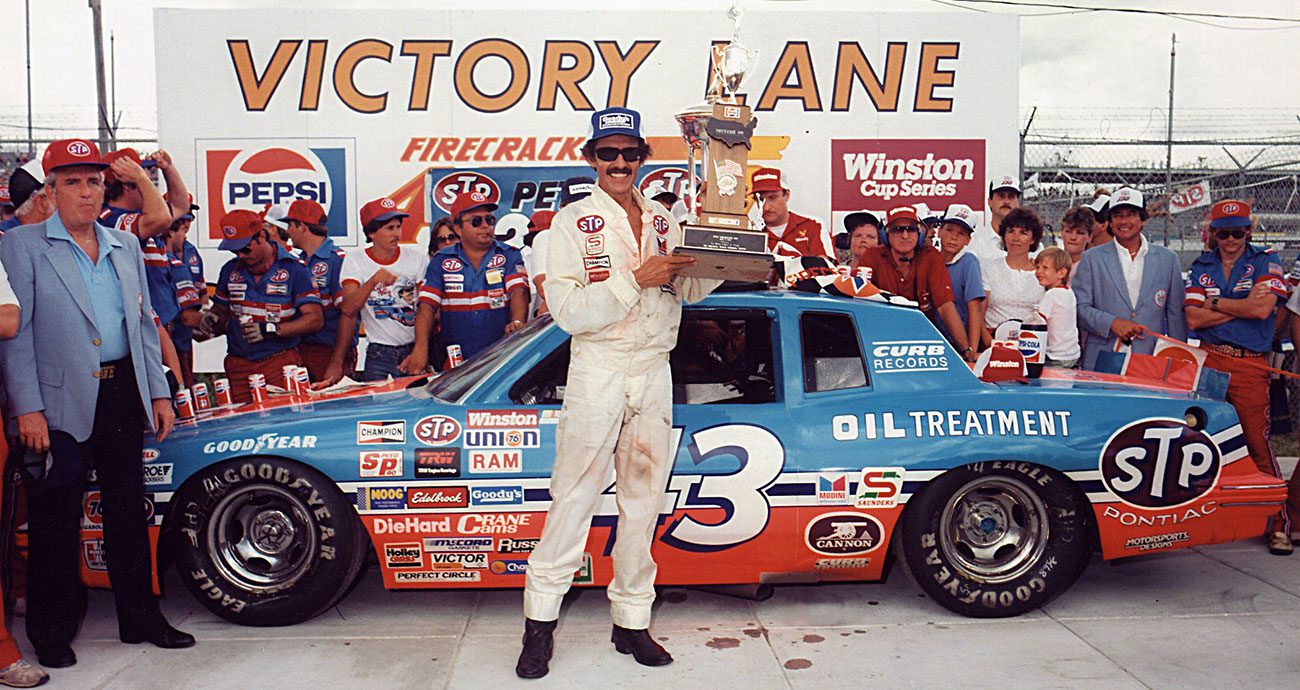
Legacy Motor Club revealed on Wednesday a paint scheme for the organization’s No. 43 Toyota that will pay tribute to the Petty family during its 75th anniversary in NASCAR.

The Toyota will don the iconic ‘Petty Blue’ and ‘Day Glo Red’ colors for Sunday’s Cup Series race at Dover Motor Speedway with LMC partner Dollar Tree using its vendor program STP Fuel Additives.

The scheme also pays tribute to Richard Petty’s 200th win in NASCAR that came in 1984 at the Daytona summer race.

Legacy Motor Club's special paint scheme at Dover pays tribute to this paint scheme — when Richard Petty won his 200th Cup Series race in 1984. (Getty Images)
Legacy Motor Club’s special paint scheme at Dover pays tribute to this paint scheme — when Richard Petty won his 200th Cup Series race in 1984. (Getty Images)

Full-time driver Erik Jones’ name will remain above the door Sunday, although he’ll miss Dover’s race recovering from an injury sustained in a wreck last weekend at Talladega.

“I think the influence that the Pettys have had on NASCAR is self-explanatory; you can see it through everything that has happened,” Jones told NASCAR.com last week prior to his injury. “They have been around for 75 years with Lee, then on to Richard, Maurice, Kyle, Adam, and everyone else that has been involved. The years of racing they have put in, the success that they have had in the sport, and the hand that they have played in bringing the sport to its current height, I think is in huge part to the Petty Family.

“It has been such a huge honor for me to drive the No. 43 for them over the last handful of years while also getting to know them (the Petty Family) better and being a part of it; they are just a really neat family and a neat group of people.”

Jones, 27, has driven the No. 43 since 2021. He reached Victory Lane in the iconic number in the 2022 Cook Out Southern 500 at Darlington Raceway.

Corey Heim will instead pilot the special scheme at Dover when he makes his Cup Series debut.

“Wishing Erik a quick and full recovery,” Heim posted on social media yesterday. “I’m ready to make the most of this opportunity.”

NASCAR and Speedway Motorsports officials announced Tuesday the format for this year’s NASCAR All-Star Race, introducing a new strategy element with multiple tire choices and adding a new-look qualifying procedure to the May 19 exhibition event at North Wilkesboro Speedway.

The All-Star Race returns to the historic 0.625-mile oval for the second consecutive year, again with a 200-lap main event (8 p.m. ET, FS1, MRN Radio, SiriusXM NASCAR Radio) and a select field of eligible NASCAR Cup Series drivers bidding for a $1 million payday. But teams will have three types of Goodyear tires on hand — a baseline “prime” tire, a softer “option” tire, and wet-weather tires should conditions warrant.

RELATED: Cup Series schedule | Buy All-Star Race tickets!

The prime tire was developed through Goodyear testing at the repaved track last month and will have the conventional yellow lettering on the sidewalls. The option tire — which will have distinctive red sidewall lettering — uses the same rubber compound as the wet-weather tires in a slick, providing improved short-term grip but more rapid wear. Teams will be required to qualify on the prime tire and start the main event on the option tire; tire changes beyond those times will be the teams’ choice.

The use of tire alternatives comes as NASCAR competition officials explore ways to enhance the series’ short-track package and in the wake of a March 17 race at Bristol Motor Speedway where increased tire wear produced an intriguing strategy twist. At Bristol, teams and drivers were forced to manage their tires — conserving them to prolong their life, or pushing forward at the risk of blistering or failure.

The non-points event provides an opportunity for competition officials to launch a low-risk trial balloon, says NASCAR Senior Vice President and Chief Racing Development Officer John Probst, who added “never say never” about the format’s potential for future races.

“I would say that we’ve often used the All-Star Race in the past to try some things,” Probst said last weekend at Talladega Superspeedway. “It’s an opportunity for us without the pressure of points being paid, and certainly … with the cooperation of Goodyear and our teams, in this case, a chance to just try something. When we were at Bristol, we certainly saw a very entertaining race there when tire wear became something they had to manage, and so it’s just an opportunity for us to try it. If it does look good, we will certainly consider it.”

Eligible drivers include Cup Series points-race winners from this season and last year, previous All-Star Race winners competing full time, and past Cup champions who also race full time. The top two finishers from Sunday’s 100-lap All-Star Open preliminary qualifying race (5:30 p.m. ET, FS1, MRN Radio, SiriusXM NASCAR Radio) will transfer into the main event, and a final berth will be determined by the results of fan voting, which is now open.

VOTE NOW: NASCAR All-Star Race Fan Vote open through May 19

Friday’s qualifying sessions will set the starting lineups for both the Open and for a pair of 60-lap heats scheduled Saturday that will establish the All-Star Race’s lineup.

The 200-lap main event will have two breaks this year — one at the halfway point and another at Lap 150 with the following rules, allotments, and other details for the tires:

— Teams will have nine sets of tires for the weekend — five sets of primes, four sets of options. Teams will have three sets of primes and two sets of options for the preliminaries (practice, qualifying, heats, Open), and two sets each of primes and options for the main event.

— Teams must use all four tires of the same type at all times — no mismatching, for instance, of left-side primes and right-side options.

— Qualifying for both the All-Star Open and the All-Star Race will be conducted on prime tires.

— Teams may select either tire type for the start of practice, heats and the Open.

— Teams must start the All-Star Race on option tires. Teams must also make a pit stop for four tires at the midpoint break of the qualifying heats, the Open, and the All-Star Race.

Ty Gibbs' crew performs a pit stop during the NASCAR All-Star Race at North Wilkesboro.
Jared C. Tilton | Getty Images

Friday’s qualifying for eligible All-Star Race competitors will have a different structure this year, with the Pit Crew Challenge incorporated into the format. Drivers will take the green flag to start their qualifying attempt and run one lap at speed. On the second lap, the driver will bring the car to pit road at the pit-lane speed limit for a four-tire stop and mock fuel delivery, then complete the qualifying attempt by returning to the track and racing back to the checkered flag. Total elapsed time will determine the pole starter for both the All-Star Race and the first heat.

The Pit Crew Challenge will be judged from a pair of timing lines near the designated pit boxes — one pit stall before and one pit stall after. The team with the fastest penalty-free stop between the timing lines will be crowned as the Pit Crew Challenge winner, and the results will determine pit-stall selection order for the main event.

“That’s a way we thought would be a good reward beyond the monetary recognition and the bragging rights you get by winning the pit-stop competition,” Probst says, “but then also that group of guys can affect where their team pits during the All-Star Race.”

The format was developed in coordination with Speedway Motorsports President and CEO Marcus Smith, who helped bring the North Wilkesboro track back to life after 26 years of near dormancy. Further vetting of the format was provided by Kevin Harvick, a two-time All-Star Race winner during his driving days who will help call this year’s festivities from the FOX Sports booth.

“As we were bringing this all together, in addition to consulting Goodyear and the teams, we wanted to bounce off some more ideas, and Marcus has always been willing to innovate on the side of if it’s aero packages, or different formats, or reconfiguring of race tracks,” Probst said. “He’s always been a proponent of innovating and trying things in the All-Star Race, and this was an example of working with Goodyear and SM to come up with some solutions. We ran them by Kevin in Texas, just to get his feel on it and made some modifications based on feedback that he gave us, as far as how long we’d have those stages, if you will, for the All-Star break and what tires they should be on. So thanks to them for just providing the input as far as how we were going to do this.”

NASCAR officials provided an option-tire choice during the All-Star Race in 2017, but the experiment made only minimal difference in performance or wear. Probst said that the softer tire used seven years ago produced lap times nearly half a second faster at Charlotte Motor Speedway; at North Wilkesboro, Probst said, such a gain would be more pronounced at a track that’s more than twice as short as Charlotte’s 1.5-mile layout. Probst also indicated that tire falloff was expected to be more dramatic this year.

Even though NASCAR has used softer-compound tires in a previous All-Star events on an intermediate-sized track, Probst said the primary target for a more aggressive tack with tires remains the circuit’s short tracks — using 1.366-mile Darlington Raceway as an unofficial dividing line between those track types.

“The moment we get over into the Darlington, mile-and-a-half-type stuff, that’s a little bit different beast and arguably right now some of the best racing we have going on,” Probst says. “So I think we would tread pretty lightly when we got into say, Darlington and above, but certainly that Darlington and below are tracks right now that are squarely in our focus for development of tires. I’ve learned long ago, never say never, never say always, but if this works, we will experiment with it on the bigger tracks, but it will probably be at a test, not in any kind of points or even exhibition race to start.”

Probst applauded Goodyear’s willingness and flexibility to experiment with different tire choices, but also noted the tiremaker’s diligence in developing the All-Star weekend rubber on an accelerated timetable.

“It’s always difficult to ask your tire partner to build a tire like this, because they build great tires, and we’re asking them to actually build a tire that’s going to wear out and maybe fail ultimately if the teams drive it too hard for too long,” Probst said. “So we’re actually trying to thread the needle of making entertaining racing without the tire becoming the overwhelming story from a failure perspective, because in a way it’s what we’re asking for, but Goodyear as a company is not going to want to be seen with their tires failing even though that’s what we’re asking for. So we’ve been asking them to do things that probably make them a little uncomfortable to do from a corporation, but they have been phenomenal to work with.

“Everything we’ve asked them to do, they’re willing to consider and in this case, we’re taking advantage of a non-points race to get a little aggressive. If this works well, then we’ll continue to take steps in this direction and just keep walking down a path of trying to get the tires to really wear out and have to be managed.”