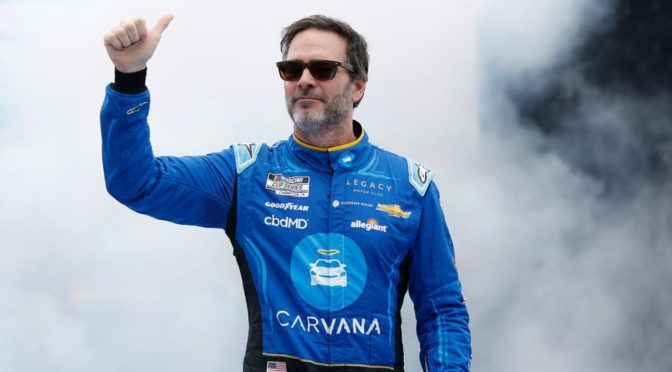
Seven-time NASCAR Cup Series champion Jimmie Johnson will make his first venture in 2024 with Toyota as his co-owned Legacy Motor Club will switch from Chevrolet at the end of this season.
Not only will he be working behind the scenes with Toyota, but he will hop into a Toyota Camry at some point in the future according to Toyota Racing Development president David Wilson. Wilson made the comment Tuesday on SiriusXM NASCAR Radio’s “The Morning Drive.”
“100 percent. Yes, you will see him [Johnson] in a Toyota,” Wilson said. “That will be very moving and emotional for me personally, professionally, for Toyota. Now I’ll let Jimmie fill in the blank, but I will just say that Jimmie Johnson will be racing a Toyota Camry before he is done as a race car driver.”
Johnson had raced exclusively with Chevrolet since making his NASCAR national series debut in the Xfinity Series in 1998.
Since becoming co-owner of Legacy Motor Club prior to the start of the 2023 season, Johnson has made three starts for the team, competing at the Daytona 500, Circuit of The Americas and the Coca-Cola 600. He is also scheduled to run the Grant Park 220 on July 2 as NASCAR makes its debut on the Chicago Street Course (5:30 p.m. ET, NBC, MRN, SiriusXM NASCAR Radio, NBC Sports App).
A decade after his career in the ARCA Menards Series West concluded, Jonathon Gomez has begun to rekindle his love for short-track racing.
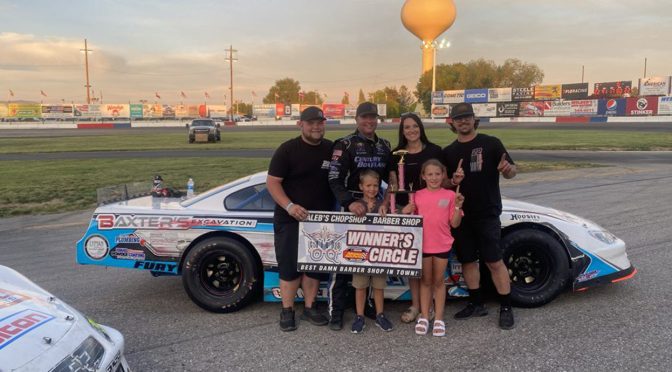
Gomez took a sabbatical from motorsports shortly before the turn of the decade to focus more on his family, but he returned to active competition last year. He primarily competes at Meridian Speedway and Magic Valley Speedway, a pair of NASCAR Advance Auto Parts Weekly Series tracks in his home state of Idaho, while occasionally venturing out to different states.
With two wins already at Meridian this year, Gomez feels comfortable with where his Super Late Model program currently stands, adding each track requires a different approach to get up front.
“Meridian is a quarter-mile, while Magic Valley is a third of a mile,” Gomez said. “I have more laps at Magic Valley, so it’s easier for me to pass there with two grooves, especially when you have full inverts. They call Meridian the concrete jungle, so it can be pretty hectic trying to get from the back to the front most of the time since it’s a bottom-feeder.”
Gomez never had the chance to run a West Series race at either Meridian or Magic Valley, but he said his time in that division helped prepare him for what to expect at both tracks.
The opportunity for Gomez to initially compete in the West Series came about in 2009, when he successfully qualified for NASCAR’s Drive for Diversity program. That enabled him to secure a part-time ride with RTD Motorsports the same year.
After putting together several consistent runs for RTD and later Richard Thompson in 2009, Gomez and his father John elected to start their own program the following season. The results were almost immediate for Gomez, as he led 35 laps in his team’s first race at California’s All American Speedway before a penalty relegated them to last in the running order.
The next three years would see Gomez emerge as a mainstay in the West Series. Although he was unable to pick up a victory with his own team, Gomez would tally eight career top-five finishes, including a career-best performance of second at Phoenix Raceway in 2011.
Jonathan Gomez was a regular in the ARCA Menards Series West from 2008-2012, earning a total of eight career Top 5s. (Photo: Doug Pensinger/Getty Images)
Being able to race alongside champions like Mike David, Jason Bowles and Eric Holmes, along with Cup Series veterans like Kyle Busch and Michael Waltrip, is what made the West Series special for Gomez. He added that their experience and composure provided valuable insight into how to conduct himself on track.
“I learned a lot from the veterans,” Gomez said. “There were a lot of people that taught you about respect on the track, and most of us worked on the cars ourselves. You had to earn that respect from people, and I’ve carried that with me through the driving I still do today.”
The highlight of each West Series season for Gomez was always the Toyota All-Star Showdown at Irwindale Speedway. It provided him and the other regulars a chance to showcase their skills against the East Series, international NASCAR champions, and a few surprise guests that included Joey Logano, Ricky Carmichael and Travis Pastrana.
During the final year of the Toyota All-Star Showdown in 2011, Gomez brought his own car home third behind Bowles and the previous season’s NASCAR Pinty’s Series champion, D.J. Kennington, which he still considers to be one of his favorite memories as a driver.
Gomez had high hopes for his NASCAR career following a strong 2012 season in the West Series and was optimistic about earning a NASCAR Craftsman Truck Series ride. When those plans did not materialize, Gomez reassessed his situation and decided to pursue racing specifically to have fun.
This decision meant Gomez would shut down his West Series team to focus on running big Super Late Model events out West like the Winter Showdown and the Montana 200, the latter of which he won in 2013.
Traveling around the western part of the United States during the mid-2010s remains some of the most fun Gomez has had in his career, as it allowed him to spend more time with his family while explicitly focusing on wins as opposed to just racing for points.
Now that he has fully immersed himself with racing following his hiatus, Gomez considers himself fortunate to still be contending for wins against his competition and believes he can still accomplish so much at the age of 40.
“After 2015, we quit racing and I stayed out of it until 2018 when I ran a handful of local races,” Gomez said. “Last year I bought a Modified and got back racing again, so this is my first full year running Super Late Models. Taking that much time off and still being able to win races is fantastic.
“I’ve had to learn so much in a short amount of time, so it’d be great to see this hard work pay off.”
A busy schedule is ahead for Gomez to close out the second half of 2023. Along with balancing out weekly events at Meridian and Magic Valley, Gomez plans to hit several more Super Late Model events such as the Summer Showdown at Evergreen Speedway, which he has not competed in since 2014.
Racing has changed tremendously since Gomez last raced Super Late Models regularly, but he still maintains a strong passion for the sport and is ready to write more successful chapters over the next few years.
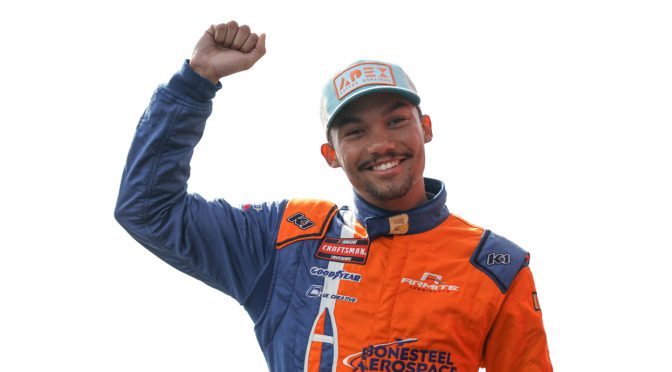
Brad Perez is a well-known commodity in the NASCAR garage. After all, he’s been working behind the scenes since 2019 for middle-of-the-road teams, such as JD Motorsports, Martins Motorsports, Rackley W.A.R and now Emerling-Gase Motorsports.
For Perez to just be part of the racing industry was once a far cry. As someone with Dominican and Puerto Rican heritage and growing up in Florida in a middle-class family, he didn’t have the resources to go racing. Instead, he focused on playing baseball, which his father played in college in the Dominican Republic.
As a child, it was Perez’s grandmother that noticed his love of cars. He had a Sam Bass poster of Jeff Gordon’s paint scheme, and he was in love.
After attending his first race at Homestead-Miami Speedway in 2001, Perez became “obsessed” with racing. So much so that he tried his hand at go-karts at age 7 but crashed after completing only a couple of laps. He was never told why he couldn’t return to the track.
“It grew like a resentment from my parents because I really wanted to do it,” Perez told NASCAR.com before racing at Sonoma Raceway. “I didn’t understand the financial side at the time, so I ended up playing baseball.”
Perez was hooked on “NASCAR Racing 2003 Season” and met some people in the racing industry on the game servers. But he never hopped back inside a race car until he returned to Miami GP Raceway nearly 10 years later, the same venue where he thought his racing career was over before it started.
But the itch of racing never went away.
“I didn’t really care where it ended up,” Perez said of racing. “I figured I was too old by the time I started racing to ever get somewhere. I just wanted to see if there was a way I could race.”
While playing NR2003, Perez met Jay Lopez, who formerly worked at JD Motorsports. When Perez expressed he wanted to be around racing “because that’s really the only thing that made me happy,” Lopez suggested working for JDM on the side. One problem: Perez never turned a wrench in his life.
“All I did was play baseball, go on [NR2003] and occasionally race,” Perez said. “I have no background in mechanics. [Lopez] said, ‘We’ll teach you, it’s fine.'”
Perez took that to heart and began helping kids with their karts at the tracks. He also began running Spec Miatas, which piqued his father’s interest after seeing his son’s success.
Logan Riely | Getty Images
“That was a big thing, convincing my dad because it was the first time he spent any money doing anything,” Perez noted. “We went half and half on this car, and it was a hunk of junk – a fast hunk of junk – but it was all us working on it.”
While outperforming some of the best in Spec Miatas in 2019, Perez realized he had competitive talent. He didn’t want to shortchange himself, so he went on the sponsorship hunt after figuring out how much it cost to race.
Perez recalled asking companies: “If I did this, would you be able to support it? I don’t know when it’s going to happen or where it’s going to happen, but if I were to do this, could you do this?”
The tipping point was speaking with Curtis Sutton, co-owner of Rackley W.A.R. and CEO of Rackley Roofing, Inc. There are other people who helped Perez, and he swore secrecy over ever revealing their names. But without Sutton’s help, Perez “would have been a lot short.”
“It was important to me because Brad is a very unique and driven individual,” Sutton said. “He never made excuses and always owned any mistake he made. Brad is always happy, energetic and he is always trying to help in whatever way he can. My sponsorship was a way of telling him to keep reaching for his dreams and never give up.”
Perez got his first shot on the NASCAR scene in 2021, competing for Josh Williams Motorsports in the ARCA Menards Series at Watkins Glen International. He has an intensive background in road-course racing, which is where he feels most comfortable.
On that August afternoon, Perez started and finished 24th, having to retire from the race early due to a brake issue.
“His talent on road courses is very good,” Williams said. “A lot of people don’t know this, but I would have Brad come over to the shop whenever there was a road-course race, and he would help me practice for road courses. We would get on iRacing and try to help me out with different road courses. It helped me a ton.”
Last season, Perez made his first national touring series start at Circuit of The Americas for Reaume Brothers Racing. In two Craftsman Truck Series starts in 2022, he posted an average finish of 21.0. He also made his Xfinity Series debut at Watkins Glen last year, placing 20th for Emerling-Gase Motorsports. He finished 23rd late in the season at the Charlotte Roval.
In 2023, he competed in a pair of road courses in the Xfinity Series with two 29th-place finishes. He was also the relief driver for Leland Honeyman at Portland International Raceway earlier this month. Perez’s next scheduled race in the Xfinity Series is at the inaugural Chicago Street Race on July 1.
Overall, Perez believes he’s made a good impression through his first seven NASCAR starts.
“I feel like I’ve proved I can bring a car home,” Perez said. “That’s what it’s like in the back half of the field. It doesn’t really matter where you finish, just that you bring the car home. Being competitive is big as far as trying to get up the ladder, but bringing a car home is what gets you back in a car and keep going.
“That has helped put me in a car this year. Without me doing that, I don’t think many people would trust me now to do that and not for an astronomical price.”
Of Perez’s talent, Williams said: “He’s really good. I think with more seat time and more opportunities, these road-course races, I think he could run inside the top 10.”
For now, though, Perez is staying occupied. Along with working at Emerling-Gase Motorsports, he’s a driving instructor for the Ford Performance Racing School at Charlotte Motor Speedway and works at the BMW Performance Center in South Carolina. At the track, he’s in charge of the tires of the No. 53 Xfinity team, primarily led by crew chief Paul Clapprood.
And the end goal? Race more frequently, including on ovals.
“I think it’s the same goal that I had originally, but I think now I can accomplish it,” Perez said. “I just want to be able to get paid to race. I want to race as much as I can. I want to be happy.”
6/13 UPDATE: Legacy Motor Club has notified NASCAR that it will appeal the No. 43 penalty.
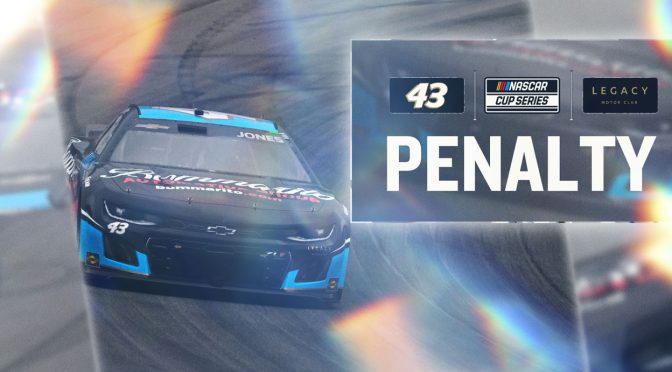
NASCAR penalized the No. 43 Legacy Motor Club team with an L1-level infraction following the Cup Series race on Sunday at World Wide Technology Raceway near St. Louis. The Chevrolet, driven by Erik Jones, was found to have a modified greenhouse in post-race inspection, according to a NASCAR spokesperson.
The result of the penalty is the loss of 60 points and five playoff points for the team and driver. NASCAR also suspended crew chief Dave Elenz for the next two races and fined him $75,000.
The section referenced in the NASCAR Rule Book was 14.1. Overall Assembled Vehicle Rules and 14.1.2.B Engineering Change Log. It is the same issue the sanctioning body found on two Hendrick Motorsports cars earlier this year.
The greenhouse is the top portion of the Cup Series car, including the roof, plus the front and rear glass — everything from the top of the doors upward. Modifications to this area would be made by teams in an attempt to gain an aerodynamic edge.
There were two other penalties announced this week, both in the Craftsman Truck Series following the race last weekend at World Wide Technology Raceway:
— NASCAR fined Charles Denike, crew chief of the No. 19 Chevrolet driven by Christian Eckes, $2,500 for a lug nut that was not secure in post-race inspection.
— NASCAR fined Andrew Abbott, crew chief of the No. 02 Chevrolet driven by Chris Hacker, $5,000 for a window-net violation. The team and driver also lost 25 points.
There were no penalties announced coming out of the Xfinity race last weekend at Portland International Raceway.
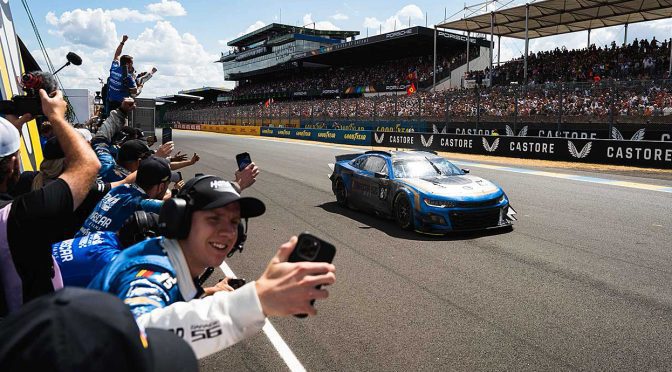
LE MANS, France — A major “last day of school” feel shaped the celebration of the Garage 56 project’s last act as Jimmie Johnson churned out the final laps Sunday afternoon at the 24 Hours of Le Mans. Handshakes and hugs, champagne toasts and some tears signaled the end of what’s been a journey through multiple years of development, a chock-full week of festivities and tuning in la République, and two full sweeps of a clock’s hour hand that counted it all down.
The specially built Chevrolet Camaro ZL1 and the team that brought it to life wowed the international motorsports crowd gathered for all those moments in the Le Mans centennial. The moment was worth cherishing, but the culmination also came with the pang that the work was finally complete and with the tantalizing thought of what might be next on the global stage.
“I wish we could come back and do it again. I don’t want it to be over,” Johnson said after leaving the grime-covered No. 24 Chevrolet in parc fermé and arriving back in the Hendrick Motorsports paddock. “This moment, though, with everybody, I hate that it’s over because we had such a good time. I hope to come back without a doubt and do this race again, but this moment in time, this group of people won’t happen again. It’s just impossible, so I’m sad about that.”
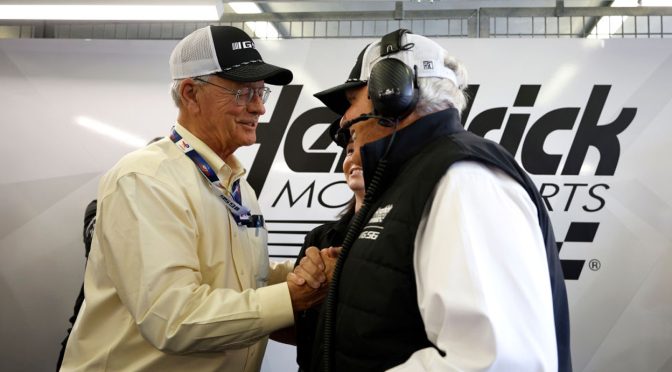
Bubbly spirits after the popping of corks were part of the elation and relief. Jeff Gordon, an ambassador for the sport since his days as a driver and now as a Hendrick Motorsports executive, greeted NASCAR chairman and CEO Jim France with the suggestion that they toast first before shaking hands. Johnson waved as he joined co-drivers Jenson Button and Mike Rockenfeller in thanking the cheering fans gathered outside the Garage 56 pit stall.
The Camaro itself had accomplished a big segment of its mission by completing 2,413.1 miles – into the great beyond in terms of stock-car durability and into the surreal with the Next Gen model bulling its way through Le Mans’ famous corners and the thundering Mulsanne. But the drivers also pushed the car into its own category of speed, giving the Innovative Car entry an edge in lap times over the LM GTE Am class and making an impression on fans and teams alike.
“I know we pissed off some GT cars out there because we were racing them and all of that, but you know what, it’s a race. We were over here to race, and that’s what we did,” said project lead Chad Knaus, Hendrick Motorsports’ VP of Competition. “I think the fans loved it. I think the people in Le Mans loved it when we went down for scrutineering, and I’ve seen nothing but smiles on people’s faces every time they’ve seen that race car.”
The answer to what’s next on Knaus’ list syncs up with Hendrick’s stateside racing operations. The crew had NASCAR Cup and Xfinity Series broadcasts running on a pair of monitors in the Le Mans garage during the 24-hour run, keeping tabs on its primary teams a continent away.
All three national series are off this weekend until racing resumes June 23-25 at Nashville Superspeedway, so at least some rest is in order. But what the Garage 56 project might inspire, he said, is anyone’s guess.
“Honestly, I would take a couple days off, and then I’m gonna go to Nashville,” Knaus said. “But yeah, I don’t really know what’s next. I don’t know. We’ll have to see. There’s got to be some ripple effect to this, I would have to assume. We had hoped to open some eyes in a positive manner. But you know, our foremost concern right now is to try to get our four cars all qualified for the final race in Phoenix and battle for the NASCAR championship. And if we can pull that off, what happens subsequently, happens.”
Chris Graythen | Getty Images
Team owner Rick Hendrick made a major investment in making the Garage 56 project breathe, and he was alongside France on the pit wall when the No. 24 Chevy made its final pass on the Circuit de la Sarthe’s main straight. His thrust was to make sure that the rest of the global racing community saw his team as a first-class operation, off the track and on it. With the on-track portion of that mission going better than expected, Hendrick imagined with the rest of us what other ships the Garage 56 initiative might launch into international waters.
“I was listening to TV this morning, where they were talking about how the car corners and how impressive they were, so we checked all the boxes,” Hendrick said. “And so we’ve had people say, now how can we run a class for these cars? I said talk to that guy in the yellow shirt.”
“That guy” that Hendrick motioned toward was Jim France, whose father dreamed up the distant forerunner to this NASCAR to Le Mans project in 1976. France had demurred earlier in the week about specifically where international stock-car racing – outside of the already established NASCAR Whelen Euro Series, Mexico Series and Pinty’s Series – might go from here, but took heart in the first impression that the Garage 56 team had made.
“Our goal was to be running at the end and have a good finish, and I feel like we’ve accomplished all that,” France said. “The other most important thing is I think the fans over here enjoyed what we were doing. And that’s very gratifying to know that we were embraced by Le Mans fans and accepted as a part of the event.”
NASCAR’s participation in the 100th-anniversary event added to an already diverse lineup in the 62-car field. Seven manufacturers alone competed in the top Hypercar class, led by Ferrari’s drive to a captivating overall triumph in its first go at Le Mans in 50 years, and four more automakers vied for the GT laurels.
Inviting other automotive brands to join NASCAR’s trio of Chevrolet, Ford and Toyota, Gordon said, would be another step in replicating some of that same intrigue on the grid.
“I think a lot of people have their own view of NASCAR from afar, and I think it just opens up the door to a lot of possibilities,” Gordon said, after noting the pressure of representing the project’s partners, the team and the country at Le Mans. “I do think that there’s a way for NASCAR to be more global and bring in more manufacturers. We’re happy with the ones we have, but you know, we all know how important that is. And so I think this definitely got a lot of the European fans, probably, to become more bigger fans of NASCAR if they weren’t already.
“And then who knows what could happen next. You know, this was a unique opportunity, and I’m glad Jim France and NASCAR came up with the idea, and it was pulled off the way that it was, and we’re just gonna take it from here and see where it goes.”
The immediate future for the Garage 56 effort will be a trip next month to the Goodwood Festival of Speed, a giant festival for petrolheads with all walks of cars visiting the Duke of Richmond’s estate in England. The next destination would likely be a place of prominence in Rick Hendrick’s vast collection of historic vehicles, and a possible side trip to the NASCAR Hall of Fame would rank as a brilliant idea.
Part of the project’s unique nature was to bend opinions about how stock-car racing is perceived outside of American soil. Spectators at Le Mans referred to the Garage 56 entry as “a NASCAR” or “the NASCAR,” and who are we to correct them as long as they think it’s cool.
But the other distinctive twist to the project was the narrowed-down focus. More than a year of creative thinking, preparation, testing and development went into just one prestigious race. While that event was the longest many in the NASCAR industry might experience, by two sweeps of the clock, it had come to an end.
“It’s bittersweet,” said Jessica Hook, the Garage 56 team’s chief of staff. “There’s obviously the relief side of it, but now that I do finally see all these people together, I’m gonna miss them. To think that after today, we won’t have these weekly meetings or things to talk about with this project, I think I just was in denial about it. And now that it’s here, it’s a little sad. I’m gonna miss a lot of these guys there. It’s been great getting to know everyone and meet all these intelligent, smart people, and I think they’ve made me a better person because of it.”
The post-race celebration lasted longer than most back home, and the choice of blended wine for partners, team members, friends and family seemed to fit the occasion and the setting.
“Do it again next year!” one fan yelled out before the group beckoned Jimmie Johnson out from the shade of the garage and into the afternoon sun.
NASCAR penalized the No. 21 Xfinity Series team of Richard Childress Racing for a lug nut that was not secure in post-race inspection last weekend at Sonoma Raceway. As a result, the sanctioning body fined crew chief Andy Street $5,000.
In the penalty that was handed out Monday, NASCAR cited Sections 8.8.10.4a in the Rule Book, which has to do with tires and wheels and notes lug nut(s) not properly installed.
Austin Hill drove the No. 21 Chevrolet to an eighth-place finish in Saturday’s DoorDash 250, and he is second in the series standings. The Xfinity Series next races on June 24 at Nashville Superspeedway (3:30 p.m. ET, USA Network, PRN, SiriusXM NASCAR Radio, NBC Sports App).
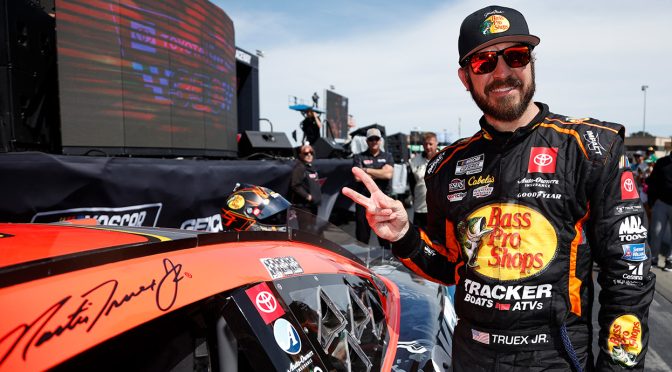
SONOMA, Calif. – Any concerns about Toyota struggling on road courses have expired after Martin Truex Jr.’s dominant win at Sonoma Raceway Sunday afternoon.
The 2017 NASCAR Cup Series champion led 51 of 110 laps for his fourth career win at the Bay Area road course and second victory of the season. That part wasn’t surprising.
But after Toyota’s dismal performance on road courses at the beginning of the Next Gen era one year ago, the improvements in 2023 have been striking. The manufacturer is now 2-for-2 this year, with 23XI Racing’s Tyler Reddick stomping the competition at Circuit of The Americas in March before Joe Gibbs Racing’s Denny Hamlin won the Sonoma pole ahead of teammate Truex’s victory. Quite the turnaround from last year’s trip to Napa Valley, when Toyota’s highest-finishing driver was Kurt Busch (18th).
“When we came here last year, it’s probably one of the worst races we’ve had at our race team,” Joe Gibbs said Sunday. “We just really struggled. We got off to a slow start all of last year, as everybody knows. I think really what happened, what I’m proud of, as the year went, I felt like we got a little better, little better, little better, little better.”
Indeed, fellow JGR driver Christopher Bell was victorious on the final road course of 2022, the Charlotte Motor Speedway Roval, but he only led the final two laps that afternoon in a surprising walk-off win that propelled him through to the Round of 8 in the NASCAR Playoffs.
But last year’s Sonoma performance was jarring, particularly seeing then-three-time winner Truex struggle to a 26th-place finish.
“We had some issues last year that we’d show up at road courses, and we would kind of outsmart ourselves where we’re trying to, like, reinvent the wheel,” Truex said, “come up with some super-crazy trick setup because we knew our cars were not as good as the other manufacturers. So we shot ourselves in the foot a few times, and here was one of them, for sure. Like we came here and completely disregarded everything we know about this track thinking it was a new car, and it’s going to be different, and we ran terrible, and it was like, ‘OK, that was dumb. We’re idiots.'”
But JGR, one of the sport’s winningest teams, didn’t shy away from the challenge. As the team worked to learn through last year’s new vehicles, the manufacturer came into 2023 with a new nose that helped alleviate some of the issues that plagued them on the twisty road courses.
“I think some of the changes with the aero package helped us. It fixed what potentially we thought were some of our weaknesses,” said James Small, crew chief for Truex’s No. 19 Toyota. “We have a better understanding of the car on road courses now and what we need. We were having to do things last year that were so out of the box to try and make the car do things in certain areas that we thought it needed to do. Now everything just makes more sense. We don’t seem so stupid anymore.”
The competition has taken notice as well. Kyle Busch, who spent 15 years driving for Joe Gibbs Racing through the 2022 season, has finished second on both road courses this year in the No. 8 Richard Childress Racing Chevrolet. He closed the gap to Truex on occasion late in Sunday’s race but never enough to challenge for the lead.
“The Toyotas were terrible on road courses last year, and here they are kicking our butt. I guess just get Kyle out, and you guys will be OK,” Busch said with a laugh. “No, I’m kidding. But they’ve gone to work and done their homework and have done a good job. So with this lower downforce aero package, we’ve got our work cut out for us, and that’s kind of been our Achilles’ heel, but at least we’ve gotten two seconds at road courses with it.”
Bell was never quite as strong as teammates Truex or Hamlin, who led 33 laps from the pole before crashing out of contention, but the No. 20 Toyota came home with a ninth-place finish to back up the overall improved showing from the manufacturer Sunday.
“Yeah, tremendously better,” Bell said. “The whole Toyota group was a lot stronger than last year. I’m proud of the effort from those guys, and I’m proud of this 20 group. I felt like, at times, we deserved better than a ninth, and then at times, we didn’t deserve ninth. We got some good stage points and a top-10 in our Rheem Camry, and we will move on to Nashville.”
SONOMA, Calif. – For the second straight season, Chris Buescher left Sonoma Raceway with a top-five finish, his No. 17 RFK Racing Ford fourth at the checkered flag to back up his 2022 runner-up effort.
That was no solace for the veteran Texan, who simply wanted a trip to Victory Lane instead.
“We came here to win, and we’re not holding the trophy right now,” Buescher said. “That’s not to take away from what everybody at RFK has done and the consistency that we have at road races and what we’re able to do no matter which one it is. Can’t say enough about how proud I am of everybody working so hard on that. But just wanna win one of these things.”
Indeed, Buescher has emerged as a regular contender on road courses since the Next Gen car debuted in 2022. His last seven road races have each produced top-10 finishes, a span dating back to last year’s Sonoma visit. That also includes a 10th-place finish at the Indianapolis Motor Speedway road course after his No. 17 car caught fire mid-race.
“All the top 10s and top fives in road racing is great,” he said. “It’s cool stats, and it’s consistency, and that means we’ll be ready for when things go our way. It’s a good day. Just want more.”
Instead, it was the No. 19 Toyota of Martin Truex Jr. that dominated the day, leading 51 of 110 laps around the 1.99-mile, 12-turn road course. Buescher was fast, but he was never able to properly challenge Truex for position.
“I really wanted a shot to try to fight the 19 there. It’s really the only car I didn’t quite get around,” Buescher said. “I think we had speed at times – two runs – and just didn’t work with track position. Everybody did a really nice job at RFK and our Fifth Third Bank Mustang. They did a great job on pit road, had some good strategy calls there. We’re where we needed to be, just needed it to finish a little bit differently for us, but it was a really strong day.”
Heading into the season’s lone off week, Buescher sits 11th in regular-season points, 102 points above the 16-driver elimination line to qualify for the NASCAR Playoffs. Of the drivers who have yet to win, Buescher has collected the third-most points behind only Ross Chastain and Kevin Harvick, all with a 13.8 average finish, on pace to be a career-best by nearly four positions.
The points are great. But Buescher has little interest in them.
“I hate points racing. I hate every part of it,” Buescher said. “I know it’s a big part of our sport and continues to be more and more a part of it, but I just want to go race to win and not worry about the rest of it.”
After struggling mightily last year at Sonoma Raceway in the debut season for NASCAR’s Next Gen car, Martin Truex Jr. pulled off a dominating 180-degree turnaround in Sunday’s Toyota/Save Mart 350.
Overcoming an inopportune caution and leading a race-high 51 of 110 laps, Truex scored his second victory of the season and his fourth at the 1.99-mile road course, most among active drivers and second only to Jeff Gordon’s five in track history.
Truex’s 33rd career victory, by a 2.979-second margin over runner-up Kyle Busch, was a far cry from last season’s lackluster performance when Truex started 28th and finished 26th.
“Hats off to my team,” said Truex, who was winless in the 2022 campaign. “To be so bad here last year and to come back and do that with the same car basically, it’s really unbelievable. Just proud of them. We’re having a great year. I feel really good about our team …
“Man, it just feels incredible to have a day like that and a run like that and a team like I have. They’re doing everything right, and it’s a lot of fun to drive these cars … This is why you go through years like we had last year. You just keep fighting. You never give up on it. You always believe in each other.
“We haven’t changed anything on our team other than parts and pieces. It’s just through a lot of hard work of a lot of people.”
On Lap 33, Truex passed Joe Gibbs Racing teammate and pole winner Denny Hamlin for the top spot, after Hamlin led the first 32 laps and won the race’s first stage. For the next 18 laps, it appeared that Truex and Hamlin would deliver a 1-2 punch to the rest of the field.
That was before a tire from Zane Smith’s Ford bounced off the inside pit wall into the middle of pit road on Lap 50. The resulting caution turned the race upside down and handed the lead to Busch, who had pitted seven laps before the yellow.
Busch won the second stage — his second stage victory of the season — but Truex caught the No. 8 Chevrolet on Lap 69, out-braking Busch into Turn 7 and regaining the lead. Truex pitted on Lap 75 but reclaimed the top spot five laps later and held it until Hamlin hit the wall in Turn 12 on Lap 92, ping-ponged between the two frontstretch barriers and broke the right rear toe link on his Toyota.
Chase Elliott, Tyler Reddick and Ryan Blaney stayed out on older tires during the ensuing caution, but Truex made short work of those drivers, retaking the lead off Turn 4 on Lap 97, with Busch following him into the second spot.
Busch chased Truex over the final 14 laps — to no avail.
“I wish we had a little bit more,” said Busch, who won last Sunday at World Wide Technology Raceway. “I tried really hard at the end to at least try to keep Martin honest. Felt like I could beat him a little bit on a lap, then I would mess up. He would beat me by a little bit more on the next lap. We were just kind of trading a little bit there. He was able to pull away there late …
“We gave it everything that we had. We made a lot of changes. We got a lucky break there with a yellow with only three laps on tires, so we were able to kind of cycle to the front. Once we got up there, we could maintain pace with some of the good cars and have a good top-three-speed race car. Just kind of flip-flopped the race a little bit.
“Good fortunes for us. Nice to come out here with a P2 after a win last week.”
Joey Logano finished third, followed by Chris Buescher and Elliott. AJ Allmendinger, Michael McDowell, Kyle Larson, Christopher Bell and Ross Chastain completed the top 10.
Truex leads the series standings by 13 points over William Byron, who finished 14th. Grant Enfinger came home 26th in relief of Noah Gragson, who missed the race because of concussion symptoms deriving from a hard wreck last Sunday at WWT Raceway.
Note: Inspection in the Cup Series garage is complete with no issues, confirming Truex Jr. as the race winner.
DAYTONA BEACH, Fla. — For more than two years, a collection of executives and engineers from NASCAR, Hendrick Motorsports, Chevrolet, Goodyear and IMSA worked to execute NASCAR Chairman and CEO Jim France’s vision to compete in the 24 Hours of Le Mans.
The all-star collaboration — which includes the winningest team, manufacturer and tire in the sport’s 75-year history — met and exceeded expectations, both on and off the track, during the iconic race’s centenary edition. With the help of three world-renowned drivers (seven-time NASCAR Cup Series champion Jimmie Johnson, 2009 Formula One world champion Jenson Button and two-time 24 Hours of Le Mans winner Mike Rockenfeller), the NASCAR Garage 56 program delivered the sights and sounds of NASCAR to race fans from around the world.
The NASCAR Next Gen Garage 56 Chevrolet Camaro ZL1 was a hit from day one in Le Mans, among fans, media and even other competitors. And it was fast on track, consistently putting down lap times that bettered cars in the GT class. The car ran near the top of the GT field for more than 20 hours until a drive line issue sidelined the team for more than an hour. Overall, the car was running at the finish, completed 285 laps on the 8.4-mile circuit and finished 39th in the 62-car field.
“That was unbelievable,” said France, whose inspiration for the project came from his father, NASCAR founder Bill France Sr. who brought two stock cars to Le Mans for the 1976 edition of the race. “That was thousands of hours of hard work by hundreds of people that went into making this thing happen. And then the way the team and the pit crews and everybody performed all week, it was just fantastic.”
“I hope my dad and my brother are somewhere up there looking down and smiling, but the goal when we set out was to try and finish the race running at the end and not be last. And we accomplished that.”
“It makes me proud for our sport,” said Rick Hendrick, owner of Hendrick Motorsports and NASCAR Hall of Famer. “The last thing I’d want to do is for us to come over here and fall on our nose. That’s what I was worried about. From the very beginning with Chad (Knaus) and Greg (Ives), I said we’ve got to do this right. We don’t spare any expense. Our NASCAR teams can do any kind of race they want to do. I mean, they got the talent, they’ve got the engineers, and they got a lot of smart people and they can do whatever.”
“I feel like we had already captured the trophy right when they dropped the green flag,” said Chad Knaus, Hendrick Motorsports Vice President of Competition who oversaw the Garage 56 program for the organization. “The thing I’m most proud of is that this wasn’t really anybody but a few people’s full-time job. Everybody accepted this task as a passion project and something that they wanted to participate in. And when you get people like that put together, you can do anything.”
Johnson, who accomplished his goal of running stints in a variety of conditions – day, night and wet – also finished the race for the Garage 56 team, running the final 90 minutes.
“My heart is full,” Johnson said. “For all the reasons we know — coming here with NASCAR, Hendrick, Chevrolet, Goodyear. Many of the people here working were on different teams that I won races and championships with. There were so many familiar faces, to have this experience was just off the charts. My bucket is full. I’m really happy.
“The fan reception — whether it was at the parade, or on the cool down lap just now. Even the corner marshals were going nuts. Everything was just incredible.”
Rockenfeller, who did a majority of the testing and simulation work for the car, started the race for the team.
“It’s amazing to finish the race, that was priority number one,” Rockenfeller said. “I think it’s something I will look back to later on with my kids and always will be high on my memory in terms of high level races I did. It has been such a great team, not only my teammates, but everybody on the team. The full journey, I mean, what can I say? I made a lot of friends. And I think we did a good job.”
Button, whose participation was perhaps the biggest surprise when announced, ran 97 laps.
“What amazing people,” Button said. “To take their Cup car and turn it into an endurance car for Le Mans, it’s staggering. They’re the best in the business, I’m proud to be working with these guys.
“It’s difficult because there’s so much emotion, we’re all tired. And this is it. You know what I mean? This is it. This is the last time this car is racing. So it’s kind of sad, but then you just got to think about living in the moment.”