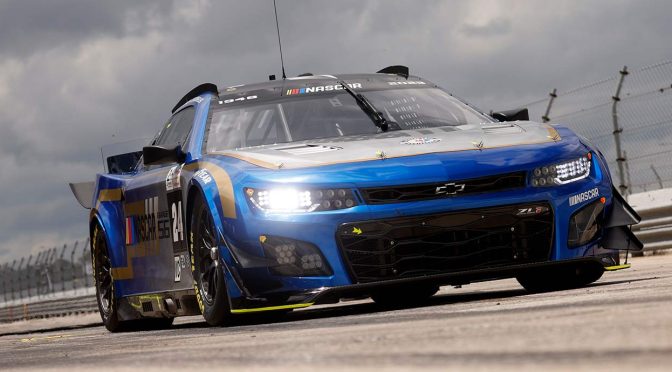
SEBRING, Fla. – A sunny sky, low humidity and a historic sports-car track greeted the NASCAR Garage 56 Project at Sebring International Raceway on Tuesday as the team turned its final test laps before the No. 24 Next Gen Chevrolet Camaro ZL1 is loaded up for its trip to compete in the historic 24 Hours of Le Mans on June 10-11.

Drivers Jimmie Johnson, Mike Rockenfeller, Jenson Button and Jordan Taylor ran laps in both the primary and backup Camaros all day Monday and the early part of Tuesday, working out any lingering technical bugs in the car and also practicing pit stops and driver changes underneath the “Gurney Terrace” overlooking Sebring pit lane.

New stickers have now been affixed to the cars – including the boxed letters “IC” just in front of the front wheels, marking the single-car “Innovative Car” class that the Garage 56 Chevrolet will compete in at Le Mans.

RELATED: Day 1 recap from Sebring

Hendrick Motorsports team owner Rick Hendrick flew into the Sebring airport adjacent to the rural track late Tuesday morning to see the car on track and take a photo with the approximately 50 team members guiding the test. The Garage 56 entry is a combined effort with Hendrick Motorsports, IMSA, Chevrolet and Goodyear – representatives from all invested in the project there to wish the car “au revoir.”

“I feel really good about it,” said the seven-time NASCAR Cup Series champion Jimmie Johnson, who, like Hendrick, will be making his first trip ever to the Le Mans endurance race. “We’ve put in many hours, a lot of work, a lot of collaboration and I feel like we’re in a really good spot. This has been a great test this week, really just working on the small details literally down to things like what color are the buttons on the steering wheel and is the black light inside the car bright enough in the right areas that we can see the dayglow buttons to push at the right time.

“We’re really in a good place.”

Johnson, now a team owner/driver with Legacy Motor Club in the NASCAR Cup Series, will drive in the iconic Coca-Cola 600 at Charlotte Motor Speedway on Sunday, May 28 and then leave immediately for Paris where he will undergo a nearly day-long mandatory orientation the next day.

“There’s a requirement that every new driver must come in and drive their simulators and work through all their procedures,” Johnson said. “They use a different safety car procedure; they have slow zones. There are some nuances I need to learn and that’s what the sim session is for.”

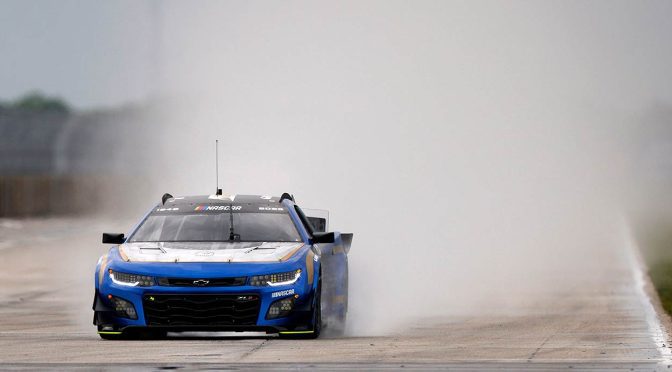
The Garage 56 Camaro finds its mark on pit road at Sebring International Raceway
Chris Graythen | Getty Images

His teammate Rockenfeller was equally satisfied with the Sebring test sessions. The drivers – all dressed in plain black driver’s suits – were smiling in between discussions with the engineers.

“As a driver or engineer, you always like to have more time and do more stuff and prepare better,” said Rockenfeller, a sports-car champion and former Le Mans winner (2010), adding with a smile, “Luckily there is a fixed date, or we would continue to test for another three years. That’s normal in racing.

“I think we are feeling quite good to be honest. I am quite confident we are prepared. We have to go to Le Mans and it’s a different place, different track and see what challenges we will face there in terms of set-up with the car or issues we may face that we didn’t here. Then you have to react. We have a great team here.”

There were lots of smiles in the team’s trackside temporary tented headquarters. NASCAR Chief Executive Officer Jim France and IMSA President John Doonan joined Hendrick to take a final look at the Garage 56 Project before the cars are sent overseas. Former NASCAR Cup Series crew chief Greg Ives is crew chief on the No. 24 and Hendrick Motorsports executive Chad Knaus is overseeing the project for the team.

“The thing I’m most proud of is all the partners that have come in, and the sound of that race car,” France said watching laps from pit lane and declaring with a smile. “A year ago, at the Sebring race we sat down here and now to go over and watch them race is an exciting moment.”

“A lot of European fans are familiar with our IMSA cars and when a NASCAR car shows up there it’s going to be unique for a lot of European fans to actually see one up close and personal. And of course, we’ve got a fantastic driver lineup.”

“We were able to get NASCAR drivers,” he said smiling, noting that Johnson, Rockenfeller, Button and Taylor have all made NASCAR Cup Series starts in the last two seasons.

Shortly after the morning session ended, the full gathering of drivers, owner, crew and racing executives stood alongside the cars for a final photograph before they all dispatch to France to see their hard work in action.

“Now we’ve got to go do it,” Hendrick said. “There’s a tremendous amount of pride in this from our organization, Goodyear, Chevrolet, NASCAR, IMSA. You don’t have to talk to Jim France very long to know what this means to him. And I was honored he asked us to do this.”

Kyle Larson’s emotional Martinsville win — just listen to him choke up on his scanner after his first victory at the 0.526-mile short track — was a career-high watermark for the driver, who thought he’d never win at the oldest track on the NASCAR circuit.

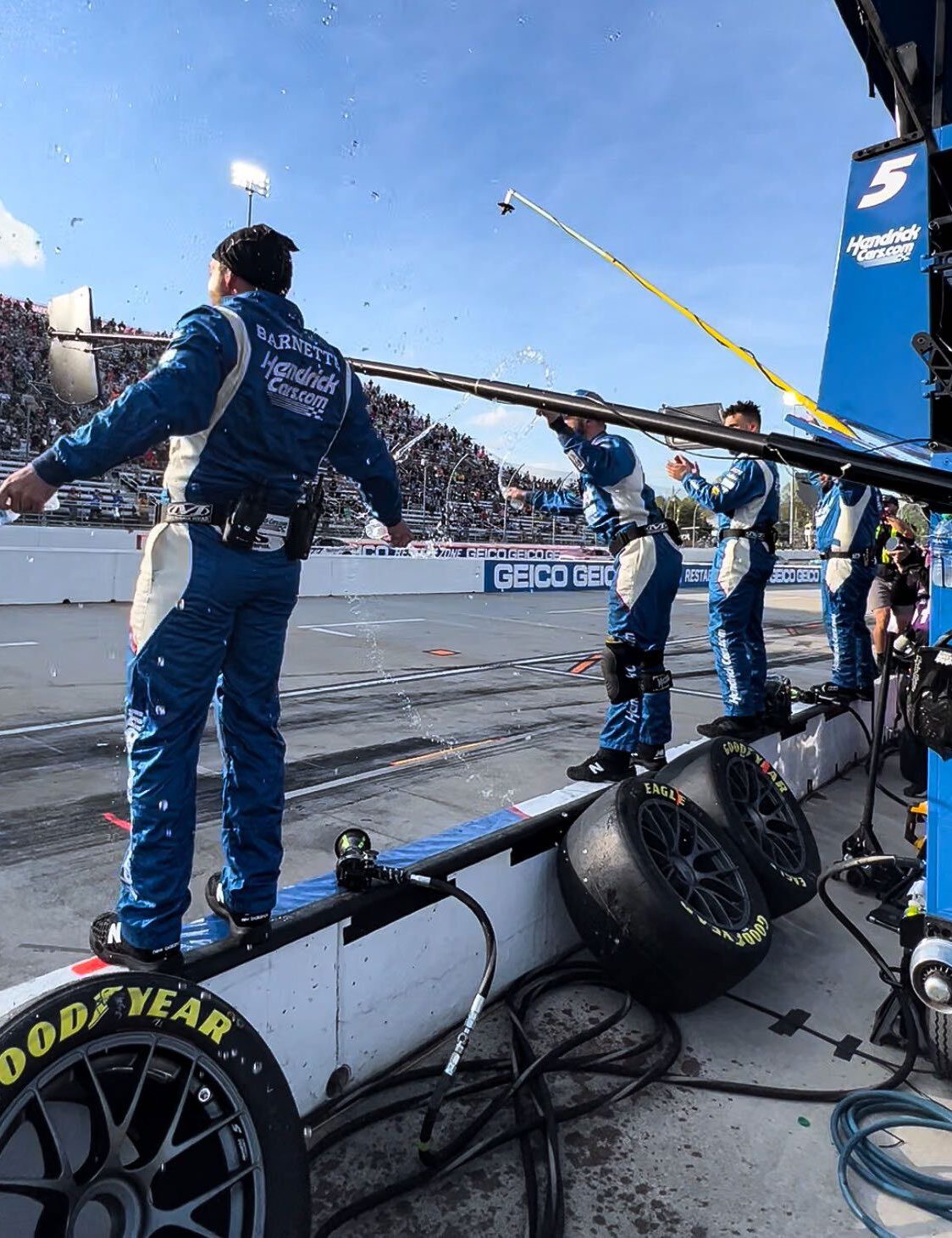
That he did speaks to his growth and grind as a NASCAR Cup Series driver, and also to the pit crew making adjustments to the No. 5 Hendrick Motorsports Chevrolet.

At Martinsville, the five-man pit crew of Blaine Anderson (front-tire changer), veteran R.J. Barnette (tire carrier), Brandon Harder (fueler), Brandon Johnson (jackman) and Calvin Teague (rear-tire changer) delivered its collective best race performance of the season.

RELATED: See full Martinsville Race Rewind | Cup standings

According to data provided by Racing Insights, Larson’s pit crew recorded both the single fastest four-tire pit stop of the race and the overall fastest average four-tire stop on the afternoon.

Pitting on Lap 293, the No. 5 crew turned a 9.677-second stop — the sixth-fastest of the entire season.

Brittney Wilbur | NASCAR Studios

For the entire race, Larson’s team averaged 10.051 seconds for four-tire stops. It was the best of the afternoon at a track with a tricky pit-road configuration — not to mention tight pit stalls — and through nine races, it’s the fastest average time of the season.

“They kept working on it and got us better and better,” Larson said. “You know, never once did I really feel like we had the car to win, but we made the right strategy calls and did the right things (on pit road).”

While it was Larson’s team that allowed him to gain spots on pit road, it was ultimately crew chief Cliff Daniels’ winning call of taking two tires on the final pit stop that was the final piece of Larson’s day that led to a memorable win.

“I’ll be the first to admit for 200 laps, we weren’t a winning car. Our car just wasn’t great,” Daniels said. “Some of that was what was in our car, and some of that was kind of the track conditions. … I think being able to be more aggressive on the strategy side, get some spots on pit road or spots on what your strategy is, certainly, that’s helpful.”

PIT ROAD STATISTICS

Following a banner day by Larson’s team, read on below to see the 10 fastest four-tire stops of the season and the 10 fastest pit crews, on average, throughout the season, according to Racing Insights.

TEN FASTEST FOUR-TIRE PIT STOPS IN 2023

Rank Track Driver Time
1 Richmond Corey LaJoie 9.309 seconds
2 Richmond Corey LaJoie 9.615 seconds
3 Phoenix Ty Gibbs 9.643 seconds
4 Richmond Chase Briscoe 9.647 seconds
5 Phoenix Chase Briscoe 9.676 seconds
6 Martinsville Kyle Larson 9.677 seconds
7 COTA Martin Truex Jr. 9.684 seconds
8 Phoenix Kyle Busch 9.688 seconds
9 Richmond Tyler Reddick 9.749 seconds
10 Las Vegas Alex Bowman 9.776 seconds


BEST PIT CREWS BY AVERAGE FOUR-TIRE STOP (SEASON-LONG)

Rank Team number Driver Average stop
1 14 Chase Briscoe 11.269 seconds
2 24 William Byron 11.282 seconds
3 6 Brad Keselowski 11.381 seconds
4 99 Daniel Suárez 11.410 seconds
5 5 Kyle Larson 11.411 seconds
6 7 Corey LaJoie 11.433 seconds
7 23 Bubba Wallace 11.471 seconds
8 8 Kyle Busch 11.474 seconds
9 54 Ty Gibbs 11.509 seconds
10 48 Alex Bowman 11.519 seconds


The Final Appeals Officer ruled Tuesday to amend the L2-level penalties issued to Kaulig Racing for unapproved parts modifications entering the March 12 weekend at Phoenix Raceway, but rescinded the points deductions at NASCAR’s request.

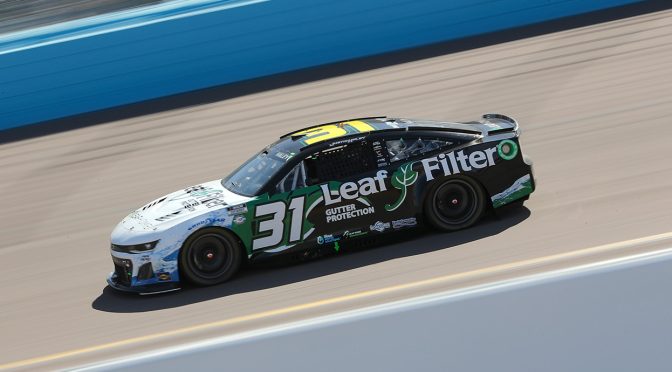
The decision states that “the Appellant violated the Rule(s) set forth in the Penalty Notice,” upholding the fine of $100,000 issued to the No. 31 NASCAR Cup Series team of driver Justin Haley but removing the loss of 100 championship driver points and 10 Playoff points initially issued to Haley. The four-race suspension levied to crew chief Trent Owens remains, however.

The Final Appeals Officer for this meeting was Bill Mullis.

“In the interest of fairness, NASCAR has requested that I remove the driver/owner race and playoff points from the penalty to Kaulig Racing,” said Mullis. “I have agreed to this request, per the Rule Book. During its opening remarks, NASCAR stated it believes that the violations did occur, the penalties were appropriate and the three-person appeals panel ruled correctly. But, because the Kaulig infraction closely mirrored that of Hendrick Motorsports (modified louver at Phoenix Raceway), NASCAR requested I rule in the same manner as the three-person appeals panel following the Hendrick Motorsports appeal on March 29. The information I heard in the room this morning created an overwhelming and unique circumstance. In fairness to the team and sanctioning body, as NASCAR documented in its remarks, this request is fully in the interest of fairness and consistency, and I agree.”

NASCAR released a statement following the ruling.

“NASCAR believes that Kaulig Racing committed the violations documented in the penalty notice, that the penalties were appropriate and that the three-person appeals panel ruled correctly when hearing the Kaulig appeal on April 5. However, in the interest of treating all competitors fairly, NASCAR today requested that the Final Appeals Officer remove the race and playoff points from the penalty. The Kaulig and Hendrick Motorsports violations involved the same modified part found during the same race weekend (modified louver at Phoenix Raceway), and with fairness and consistency top of mind, NASCAR requested that the FAO match the final Hendrick Motorsports penalty.  NASCAR believes that the updates made to the Rule Book will address similar issues in the future and keep its promise to the owners for strict penalties when single-source parts are modified. We are pleased with the swift resolution to today’s appeal, appreciate Bill Mullis’ ruling and now look forward to this weekend’s events at Talladega Superspeedway.”

Kaulig Racing also reacted to the decision, publishing a statement Tuesday afternoon.

“Kaulig Racing is pleased with the ruling of the Final Appeals Officer to amend the original L2 penalty issued by NASCAR following the confiscation of a louver at Phoenix Raceway. Regarding these unique circumstances, it means the world to us as an organization that the sanctioning body is working hard to ensure fairness and consistency across the board within our sport. We are focused ahead on Talladega and look forward to getting our season back on track with Justin Haley.”

MORE: Full Talladega schedule

While NASCAR discovered the hood louvers from all four Hendrick cars before practice on March 10 at Phoenix, Kaulig Racing’s louvers were discovered during pre-qualifying inspection on March 11. NASCAR officials confiscated the parts from all five vehicles and took them back to the R&D Center in Concord, North Carolina, for further examination. The team used an unmodified louver in the March 12 race, in which Haley finished 27th.

The hood louvers — which you can see on this Next Gen 3D model — are openings or vents in the hood that serve as a release point for ducts that transfer air out of the radiator. The system is intended to decouple engine performance from aero performance, offsetting the practice of teams taping off air intakes and placing undue pressure and heat strain on the car’s engine.

In the initial penalty report, the following sections of the 2023 NASCAR Rule Book were cited: Sections 10.5.1.A Guiding Principles Relative to Penalties; 14.1 C&D&Q Overall Assembled Vehicle Rules; 14.5.4.2.A Radiator Duct.

COLORADO SPRINGS, Colo. — Leidos, a Fortune 500® science and technology leader, and its Dynetics team have announced their intention to compete in another moon race through a promotional partnership with NASCAR. The partnership will be a collaboration between two organizations in the areas of speed, safety and reliability. Details of the collaboration as well as the design and technology of the Lunar Terrain Vehicle (LTV) were unveiled during a special event at the Space Foundation’s 38th annual Space Symposium, the premier assembly for the global space ecosystem.

To view the partnership teaser video please click here.

“We are thrilled to unveil our lunar vehicle design and to announce our exciting new promotional partnership,” said Leidos CEO Roger Krone. “This groundbreaking collaboration between Leidos and NASCAR takes both companies into uncharted territory, just like we believe our rover will do for NASA and its astronauts. We aim to pave the way for human exploration of space and inspire the next generation of engineers, scientists and innovators to reach for the stars.”

“NASCAR partnering with Leidos couldn’t make more sense when it comes to this vehicle,” said Pete Jung, NASCAR senior vice president and chief marketing officer. “With both companies being known for exciting innovations in distinctive fields, this collaboration brings together ideas that normally don’t meet in other developments. We are eager to watch this uniquely designed rover traverse different areas of the lunar surface.”

Leidos is looking ahead to the next phases of NASA’s Artemis program after the successful launch of Artemis I on Nov. 16, 2022. The company has submitted a bid for the Human Landing System Sustaining Lunar Development contract, a critical component of NASA’s efforts to establish a sustainable presence on the moon. In addition, Leidos is currently working on the Universal Stage Adapter (USA) for NASA, a crucial piece of equipment that will enable the transport of large payloads, including the Lunar Terrain Vehicle recently unveiled by the company. Leidos is demonstrating its commitment to advancing the frontiers of space exploration and helping to shape the future of human spaceflight with these projects.

“We are fully committed to supporting NASA’s ambitious plans for lunar exploration,” said Steve Cook, president of the Leidos Dynetics Group. “As an industry leader in space technology, we are uniquely positioned to help NASA achieve its objectives, providing everything from necessary crew mobility to workhorse flexibility for building a lunar base. We believe that our innovative solutions and unmatched expertise make us the ideal partner for NASA as it works to establish a sustainable presence on the moon and beyond. At Leidos, we are proud to be at the forefront of this historic mission. We look forward to continuing our partnership with NASA to push the boundaries of human exploration and discovery.”

The rover design is a masterclass in simplicity, harkening back to the engineering that made the Apollo missions successful, while incorporating modern innovations that prioritize sustainability. The rover’s components have been meticulously designed to support the safety and well-being of astronauts as they drive across the lunar landscape. One innovation stands out: it supports male and female crew members across varying height and weight scales, promoting inclusivity in space exploration. By combining cutting-edge technology with a sustainable design philosophy, Leidos is leading the charge in creating a brighter future for humanity both on and off Earth.

Leidos and its Dynetics team bring a wealth of experience to the table, with a long-standing reputation as trusted providers of advanced space systems and services to NASA. NASCAR, on the other hand, boasts a powerful marketing engine and a passionate fan base, as well as a proven track record of developing high-performance race cars that push the boundaries of what’s possible. Combining their strengths and expertise, this collaboration marks a new chapter in NASA’s quest to explore the universe and push the boundaries of human achievement.

Roush Industries of Livonia, Michigan, provides automotive design and manufacturing experience for the project. Other project partners include Collins Aerospace, Motiv Space Systems, Moog, A-P-T Research, Sophic Synergistics and the Center for Advanced Vehicular Systems at Mississippi State University.

“NASCAR is excited about our promotional partnership with Leidos,” Jung said. “Our partnership can take us to the moon — and potentially beyond.”

The NASCAR Cup Series season continues on Sunday at 3 p.m. ET when the sport’s biggest stars hit the track for the GEICO 500 at Talladega Superspeedway. All the action will air live on FOX, MRN and SiriusXM NASCAR Radio.

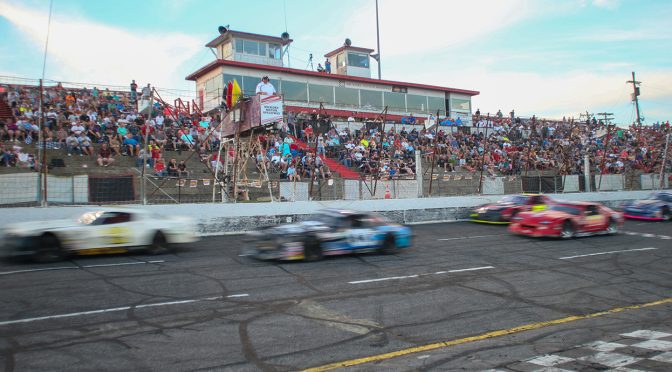
Dubbed the “Birthplace of the NASCAR stars,” Hickory Motor Speedway will once again welcome fans and competitors for three marquee events during the 2023 season.

The 0.363-mile asphalt oval in Hickory, North Carolina will host the second edition of the Jack Ingram Memorial on June 10, the Bobby Isaac Memorial on Sept. 2 and the Fall Brawl on Nov. 11.

Those events are part of a packed season-long schedule of NASCAR Advance Auto Parts Weekly Series racing that will be available to watch live on FloRacing, the official streaming home of all NASCAR Roots properties.

RELATED: Watch Hickory’s 2023 race action live on FloRacing

The 2023 edition of the Jack Ingram Memorial will look to build off an incredible inaugural event last season that saw JR Motorsports NASCAR Xfinity Series driver Josh Berry triumph during the 111-lap main event for Late Model Stock Cars held in honor of NASCAR Hall of Famer Jack Ingram.

Limited Late Models, Street Stocks, Super Trucks and Renegades will also be in action live on FloRacing on June 10.

Another race held in honor of a NASCAR Hall of Famer, the Bobby Isaac Memorial takes center stage at Hickory Motor Speedway on Sept. 2. The race will be headlined by a 150-lap Late Model Stock Car race in addition to features for Limited Late Models, Street Stocks, Super Trucks and Pro Late Models.

Drivers such as Dale Jarrett, Jack Ingram, Tommy Houston, Bob Pressley, Robert Huffman, Dennis Setzer, Coleman Pressley, Berry, Sam Mayer and most recently Ryan Millington have taken home the checkered flag during the Bobby Isaac Memorial.

FloRacing will present live coverage of the Bobby Isaac Memorial on Sept. 2.

Finally, the racing season at Hickory Motor Speedway will end with a bang thanks to the annual running of the Fall Brawl on Nov. 11. Late Model Stock Cars will battle for 200 laps around Hickory’s historic confines.

Last year Coleman Pressley, making his return to Hickory as a driver for the first time in several seasons, won his second Fall Brawl. Denny Hamlin, Rodney Childers, Ben Rhodes, Berry, Taylor Gray and Anthony Alfredo are just some of the previous Fall Brawl winners.

Limited Late Models, Pro Late Models and Street Stocks will also be part of the action during the Fall Brawl, which will be shown live on FloRacing on Nov. 11.

Hickory Motor Speedway has not yet announced purses or race day schedules for these events.

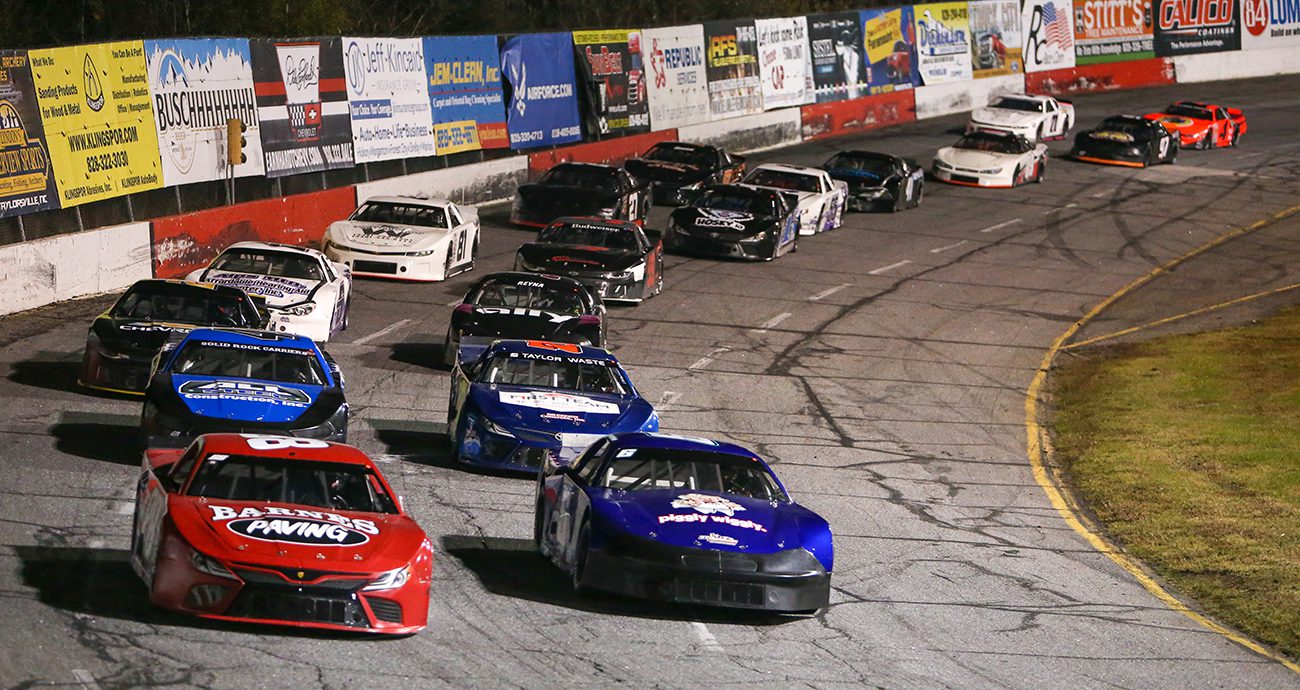
Action during the Fall Brawl at Hickory Motor Speedway on November 12, 2022. (Photo: Adam Fenwick/NASCAR)

These three races are just a small part of a busy and exciting season of racing at Hickory that is already underway. Doug Barnes Jr. swept the season opening Twin 40s for the Late Model Stock Car class on March 4 and Landon S. Huffman and Tyler Matthews split Twin 40s on March 11.

With an old and abrasive racing surface, Hickory’s 0.363-mile oval presents one of the Southeast’s stiffest challengers for racers. Featuring 14 degrees of banking in Turns 1 and 2 and 12 degrees of banking in Turns 3 and 4, the historic venue that first opened in 1951 continues to host some of the best racing in the region.

Fans can witness that racing for themselves on most Saturday nights through the rest of the season. More than 20 nights of racing are on the schedule at Hickory.

Below is Hickory Motor Speedway’s complete race schedule for 2023. (Schedule subject to change.)

Date Event Divisions
March 4 Season Opening Blowout Late Model Stocks, Limited Late Models, Street Stocks, Renegades, Pro Late Models, Crate Modifieds
March 11 Weekly Racing Late Model Stocks, Limited Late Models, Street Stocks, Mini Stocks
March 17-18 Pro All Stars Series Super Late Models, Late Models, Mini Stocks
March 25 Weekly Racing Late Model Stocks, Limited Late Models, Street Stucks, Super Trucks, Renegades
April 1 Weekly Racing Late Model Stocks, Limited Late Models, Street Stocks, Super Trucks
April 8 Weekly Racing Late Model Stocks, Limited Late Models, Street Stocks, Super Trucks, Renegades
April 15 SMART Modifieds Modifieds, Sportsman
April 22 CARS Tour Late Model Stocks, Pro Late Models
April 29 Weekly Racing Late Model Stocks, Limited Late Models, Street Stocks, Super Trucks, Renegades
May 6 Weekly Racing Late Model Stocks, Limited Late Models, Street Stocks, Super Trucks, Renegades
May 20 Bumgarner Oil Night Late Model Stocks, Limited Late Models, Street Stocks, Super Trucks, Renegades
May 25 ASA STARS National Tour Super Late Models
June 3 Weekly Racing Late Model Stocks, Limited Late Models, Street Stocks, Super Trucks
June 10 Jack Ingram Memorial Late Model Stocks, Limited Late Models, Street Stocks, Super Trucks, Renegades
July 8 Birthday Night Late Model Stocks, Limited Late Models, Street Stocks, Super Trucks
July 15 Southeast Super Trucks Super Trucks
July 22 Weekly Racing Late Model Stocks, Limited Late Models, Street Stocks, Renegades
July 29 CARS Tour Throwback 276 Late Model Stocks, Pro Late Models
Aug. 5 Weekly Racing Late Model Stocks, Limited Late Models, Street Stocks, Pro Late Models, Crate Modifieds
Aug. 12 Weekly Racing Late Model Stocks, Limited Late Models, Street Stocks, Super Trucks, Renegades
Aug. 26 Weekly Racing Late Model Stocks, Limited Late Models, Street Stocks, Super Trucks
Sept. 2 Bobby Isaac Memorial Late Model Stocks, Limited Late Models, Street Stocks, Super Trucks, Pro Late Models
Sept. 16 Championship Night Late Model Stocks, Limited Late Models, Street Stocks, Super Trucks, Renegades
Oct. 21 Southeast Super Trucks Super Trucks
Nov. 11 Fall Brawl Late Model Stocks, Limited Late Models, Pro Late Models, Street Stocks

When NASCAR announced its first long-term carbon emissions goal on Tuesday as part of a robust new impact platform, the move signaled the beginning of a new era in sustainability for America’s top motorsport.  

At the core of NASCAR IMPACT — an umbrella platform spotlighting sustainability, community engagement and other social initiatives — is NASCAR’s plan to reduce its carbon footprint to zero across its core operations by 2035.  

“It’s an ambitious goal but one that holds us accountable as we begin to think about sustainability differently,” said Eric Nyquist, NASCAR’s Chief Communications & Impact Officer. “There is much work to be done but the fundamental objective is clear: we must reduce our emissions over time.” 

The commitment to achieving net zero operating emissions over the next 12 years followed NASCAR’s first comprehensive measurement of its carbon footprint. The study measured total emissions from all NASCAR offices, owned race tracks, national series races and other related operations in 2022.  

“This begins the next phase of our sustainability effort,” said Riley Nelson, NASCAR’s Head of Sustainability. “Measuring our carbon footprint will become an annual process, and as we improve year-over-year with the support of the industry, we’ll identify new ways to contribute to a cleaner and healthier environment.” 

In addition to the long-term operating emissions goal, NASCAR’s carbon measurement informed near-term sustainability priorities including 100% renewable electricity at owned race tracks and facilities, the development of a sustainable racing fuel, expanded recycling efforts and on-site EV charging stations.  

NASCAR will track progress toward its sustainability goals in an annually published NASCAR IMPACT Report. The report will measure the collective impact of other impact-driven functions including The NASCAR Foundation, diversity, equity and inclusion, STEM education, supplier diversity through sourcing and procurement, as well as a national partnership with Boys & Girls Clubs of America — the Official Youth Community Partner of NASCAR. 

In celebration of NASCAR’s 75th Anniversary season, The NASCAR Foundation will host a 75-hour giveathon on May 16-19 with a goal to raise $750,000 for more than 500 nonprofit organizations across the country.  

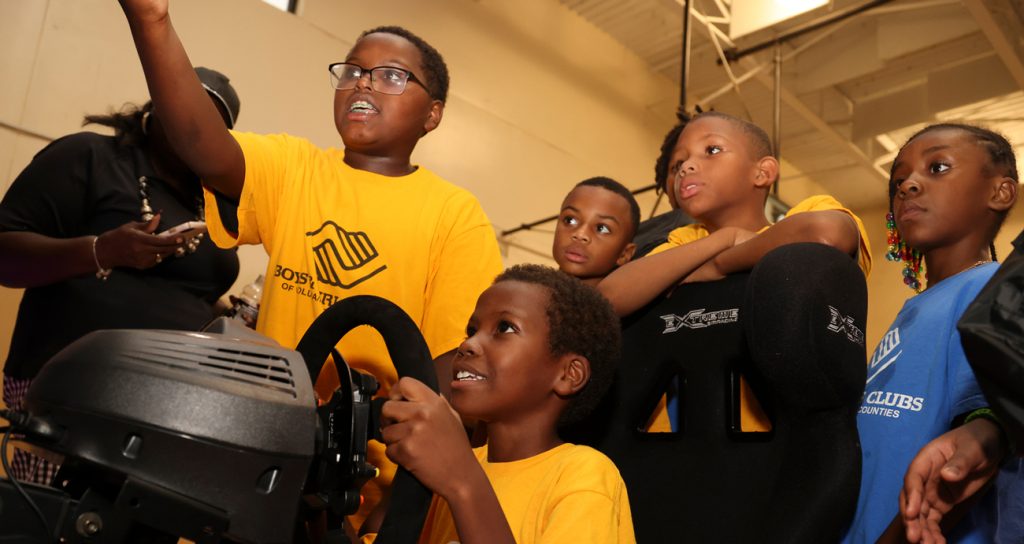
Members of the Boys and Girls Clubs of America play on a simulator

Last season, NASCAR hosted Boys & Girls Club teens at 15 NASCAR Cup Series race events as part of immersive, workforce readiness experiences designed to showcase career opportunities in the industry.  

NASCAR’s elevated focus on community engagement parallels new milestones in sustainability. In February, the 2023 Busch Light Clash at the LA Memorial Coliseum became the sport’s first zero waste event. Supported by the University of Southern California and LAMC staff, the race event achieved a 90.1% waste diversion rate, diverting more than 11.7 tons of waste from landfills. 

Earlier this year, NASCAR became the first global sports property to join the Clean Energy Buyers Association (CEBA), a community consisting of more than 350 energy customer companies and their partners. CEBA counts nearly 100 companies from the FORTUNE 500 list among its ranks.  

Now for NASCAR, the attention shifts to reaching net zero operating emissions — or emissions that fall under the categories of scope 1 or scope 2. According to the Environmental Protection Agency, these are the emissions that come from sources that NASCAR controls or that are associated with the company’s purchased electricity.  

As NASCAR waves the green flag on a new approach to sustainability, its leadership is excited about the opportunities to build on its environmental strategies. 

“With NASCAR IMPACT, we’re striving to achieve a higher standard in the areas of sustainability and more broadly, social responsibility,” said Nyquist. “NASCAR has a significant role to play in improving the well-being of our communities and the health of our planet, and our commitment reflects that.” 

Note: With the launch of NASCAR IMPACT and new sustainability strategy, NASCAR has discontinued its NASCAR Green platform. NASCAR Green was established in 2009 as the sport’s first industry-wide sustainability platform.

SEBRING, Fla. — Even with the 24 Hours of Le Mans less than two months away, the Garage 56 team is still finding out new things about its Chevrolet Camaro ZL1 entry. Jordan Taylor, the group’s Le Mans alternate driver and de facto coach, lifted up the car’s hinged roof flap before a morning test run and found just a body panel underneath.

“We should keep some snacks in there,” Taylor said to teammate Mike Rockenfeller, perhaps thinking about the sustenance needed for the endurance race that awaits.

“Is that where they smuggle the moonshine?” Rockenfeller cracked back with a grin. “They still do that?”

There was no rum-running Monday at Sebring International Raceway during the first of two days of Garage 56 testing, no illicit transport of white lightning through the center of the Sunshine State in a nod to NASCAR’s bootlegging roots. Instead, the historic 3.74-mile circuit was the proving ground for final tuning before the car heads to France for the 100th-anniversary classic June 10-11.

RELATED: Garage 56 livery from all angles

New stickers adorn the side of the Garage 56 primary car for Le Mans
Zack Albert | NASCAR Studios

The two cars on hand at Sebring both looked the part of being race-ready, with the No. 24 number plate newly affixed along with other certification stickers for the FIA and ACO governing bodies. The cars also bore a sticker identifying the Next Gen-based racer’s Le Mans classification — “IC” for “Innovative Car.”

As for the rest of the final preparations, Monday was a step toward making those complete.

“From a purely durability point of view, I think everyone’s pretty confident,” said Taylor, noting the strides the team made in endurance testing here in February. “A couple of small things that we’re still running through at this test to see how everything shakes out, but yeah, working on little handling and tuning tweaks to make the car quicker and more competitive and fitting into what the ACO (Automobile Club de l’Ouest) wants to see. So a lot of little details, but I think it’s nice to be here practicing more, our pit stops, driver changes, and the Le Mans-specific rules that we’re going to need to do over there. So it’s good to have everyone here to get into that routine again, going into those basics.”

The team made laps under clouds and drizzle in the morning hours Monday before partial sunshine took over for most of the afternoon. The two cars that shared a giant tent in the Sebring paddock were 001 — the test car that has made the majority of the laps in the project’s development stage — and 002, the primary race car for Le Mans. The team is opting to limit the track time for the 002 Camaro during the two-day stretch, hoping to save some wear and tear before reaching the grand stage.

The Hendrick Motorsports crew worked to keep things moving, even after rain that lingered longer into Monday morning changed up some of the schedule. “It’s good to get some wet running,” Taylor said. “I think the car only did one real test in the wet, and at Le Mans, it can rain at any point. So working with Goodyear on some new wet options was high on our list.”

The final dress rehearsal comes exactly one year and one month after the Garage 56 project was launched here to much fanfare during the Mobil 1 Twelve Hours of Sebring weekend in 2022. A rendering of the prototype car had flashed onto the screens during that presentation, a blink-and-you’ll-miss moment that approximated what the car might look like.

Monday, two Le Mans-ready Camaros roamed the same Sebring paddock as once-imagined race cars come to life.

“Just having watched this group grow together and mature together, it’s really a fully functioning race team that wasn’t even in existence some 13 months ago,” said Jeff Andrews, Hendrick Motorsports’ president and general manager. “So, it’s been spectacular. It certainly is a privilege for Hendrick Motorsports to be involved and very honored that we were chosen to get these race cars prepared and be here on behalf of Mr. France and Chevrolet and really everybody that is going to make this happen. So it’s a combination of a lot of hard work with a lot of different companies involved and suppliers, and some really, really good race cars on the track, and obviously some amazing talent who are going to be driving these race cars in Le Mans. It’s been great to watch.”

Garage 56 team members (from left) Jimmie Johnson, Mike Rockenfeller, Jordan Taylor and Greg Ives talk shop at Sebring International Raceway
Zack Albert | NASCAR Studios

MARTINSVILLE, Va. — With all four Stewart-Haas Racing entries qualifying inside the top seven, Sunday seemed bound to be a statement day for the organization.

But despite combining to lead 264 of 400 laps at Martinsville Speedway, the final running order didn’t quite reflect a breakout race for SHR.

MORE: Full Martinsville recap | Points standings

Ryan Preece scored his first career pole in the NASCAR Cup Series and proceeded to lead the first 135 laps of Sunday’s race. Chase Briscoe led a career-high 109 circuits around the 0.526-mile oval. Kevin Harvick paced the field for 20 laps, and veteran Aric Almirola netted the race’s best average running position at 4.76 — 0.01 better than Briscoe.

At the checkered flag, though, Briscoe was the only SHR driver bringing home a top-five finish. Almirola was sixth, but Preece and Harvick both finished outside the top 10 — 15th and 20th, respectively.

“We led the wrong handful of laps,” said Greg Zipadelli, chief competition officer at SHR. “We did (do well) as a group, but it’s really frustrating when you have little things that cost you.

“It was nice to see all four cars qualify well, and they all raced well. But this is a little bit different race track. It’s not like you can take what you did here and go anywhere else with it. So everybody at the shop is working hard and appreciate their effort, and to have four of them qualify up there and lead a bunch of laps.

“Just, man, we gotta get this monkey off our back and win a race.”

Ryan Preece leads at Martinsville
Sean Gardner | Getty Images

Preece’s day went south at Lap 135. His No. 41 Ford led the field onto pit road under caution for Harrison Burton’s spin. But parked at pit stall No. 2 — the first available stall from pit exit thanks to his pole position — Preece launched out of his pit stall in an attempt to win the race off pit road, incurring a speeding penalty that sent him to the rear of the field for the impending restart. Pitting so close to the end of pit road, Preece “didn’t think we could” speed from that pit box.

“But I guess it’s my job to know that,” Preece said. “It’s unfortunate, but when we had track position, I think it showed that we had a really fast HaasTooling Ford Mustang, but you can’t do those things. You can’t make mistakes.”

RELATED: Part 1 of Preece’s long road back to Cup

Mired in traffic, Preece only charged to the brink of the top 20 until the final run to the checkers, unable to work through the thicket of cars ahead of him.

“That first run, I think we climbed to 23rd or 21st, so I thought there was opportunity,” Preece said of his comeback. “But after three pit stops, everybody else got their car that much better. You saw Joey (Logano), they stayed out and gained track position, and he ran second. I mean, he was gonna go a lap down for a while, so you can’t make mistakes.”

Kevin Harvick races at Martinsville
Sean Gardner | Getty Images

Harvick was a legitimate contender all day, leading 19 laps in Stage 2 en route to his first stage win since 2020. During green-flag pit stops around Lap 300, Harvick was set to cycle to the lead before a Lap 303 caution. But after pitting under caution at Lap 344 and exiting fourth, Harvick immediately cut a right-front tire, relegating the 2014 champion to the rear of the field as he pitted a second time.

Stewart-Haas Racing has shown early speed with the debut of this year’s short-track package, with Harvick nearly victorious at Phoenix Raceway before an impressive showing by all four drivers at Martinsville.

That, in part, adds to Sunday’s sting as none of them broke through for the victory.

“For us as a company, we knew that short tracks (are) where we were really going to need to capitalize,” Briscoe said. “And that’s where it’s kind of frustrating knowing that we didn’t lock ourselves in today when we had a great opportunity.”

Since the beginning of the 2021 season, SHR has combined to win just four races — Almirola’s New Hampshire triumph, Briscoe’s inaugural Cup win at Phoenix in March 2022 and Harvick’s back-t0-back victories at Richmond and Michigan last summer. To see all four cars with speed again was encouraging for the program despite the end results.

“It was a really good day for Stewart-Haas,” Briscoe said. “It’s kind of the Stewart-Haas that there was three or four years ago, right? And it was nice to kind of see that again. So yeah, really good day for the company. I just wish that one of us was taking home the grandmother clock.

“I felt like a Stewart-Haas car probably should have won the race, and we just couldn’t catch the breaks we needed there at the end. But, overall, a great day. That’s something that, as a company, we needed to go and run up front. All four cars were really competitive. I wish one of us would have won the race, but you’ll have that.”

In nine races, Almirola’s sixth-place finish at Martinsville is his only top 10. The No. 10 team has suffered five finishes of 30th or worse, saddling Almirola with a 23.9 average finish, the worst of his full-time career. But while he may have been the company’s lone driver not to lead Sunday’s race, his race-best average running position was no accident — and, indeed, it was a necessary performance.

“We just had a few things throughout the race that if we could go back and do different, we’re sitting in Victory Lane,” Almirola said. “I feel very confident in that. I think we were arguably the best car throughout the day. At different points, we were maybe a third- or fourth-place car, but for most of the day, we were the best race car on the race track and just didn’t put the whole thing together. But it’s nice to be frustrated with a sixth after the start of the season we’ve had.”

The series heads to Talladega Superspeedway for the GEICO 500 on Sunday (3 p.m. ET, FOX, MRN, SiriusXM NASCAR Radio). Zipadelli is cautiously optimistic the momentum built at Martinsville might carry to the high-banked superspeedway.

“We’ve got to work on the intermediate (tracks). We’ve got a speedway next week,” he said. “Our cars were pretty good there so far this year. So hopefully, we go there and capitalize.”

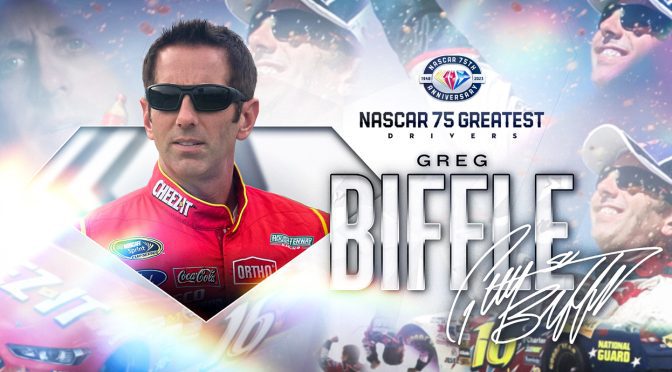
After a career spanning two decades that saw an astounding 56 NASCAR national series wins, Greg Biffle has earned his place among the greatest drivers in racing history — solidified by his selection to NASCAR’s 75 Greatest Drivers list in celebration of the sport’s diamond anniversary.

While ‘The Biff,’ as he was famously called, still races from time to time, it was his spectacular start in the late 1990s and exceptional run through the 2000s that ultimately tells the tale of his remarkable career.

Biffle raced full-time in all three national series, amassing 19 Cup Series victories, 20 wins in the Xfinity Series and 17 triumphs in the Craftsman Truck Series. His 19 premier series trophies have him level with Davey Allison, Buddy Baker and Fonty Flock, with a high-water mark coming in his six-win campaign during the 2005 season, when he finished a career-best runner-up in the standings.

NASCAR 75: Updated 75 Greatest Drivers list | View historical timeline

In 14 seasons of year-round competition, Biffle finished top five in the Cup Series points standings three times, narrowly edged out by Tony Stewart in his closest title bid. He did manage to win the Xfinity Series championship in 2002, just two years after being crowned a champion in the Truck Series — both while driving for Hall of Fame owner Jack Roush.

Though Biffle has stepped away from full-time competition at the NASCAR national level, the longtime veteran made five starts in 2022, including the season-opening Daytona 500. His last full season was in 2016.

MORE: See all of Biffle’s premier series victories

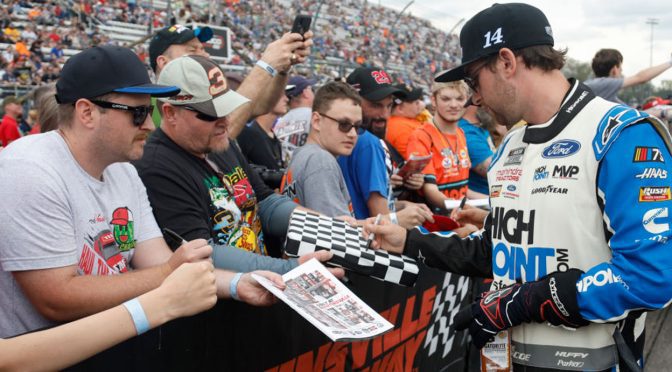
Chase Briscoe underwent successful surgery on his broken left middle finger early Monday morning, his wife Marissa announced via Twitter.

Briscoe suffered the injury while racing a dirt late model on April 6, contacting the wall in qualifying, which ripped the wheel out of his hand and broke the finger.

MORE: Martinsville results | Points standings

The driver of the No. 14 Stewart-Haas Racing Ford went in for surgery at 5 a.m. ET on Monday and was out by 7:45 a.m.

“Chase is out of surgery and all is well,” wife Marissa Briscoe wrote. “Thank you everyone for the prayers. Keep them coming!”

Though he admitted concern leading into the Bristol dirt race, Briscoe was never slowed by the injury, instead scoring consecutive fifth-place finishes at Bristol and Martinsville, respectively.

“I told Jamie Little on the TV broadcast maybe I need to break another finger,” Briscoe joked Sunday. “It’s kind of been the turning point for us all year long.”

Indeed, the past two NASCAR Cup Series races have produced the team’s first two top fives of 2023, highlighting a stretch of five top-15 finishes in the past six races.

Briscoe said his finger was “OK” in Sunday’s NOCO 400 at Martinsville, but moments of discomfort reminded him he was still racing injured.

“I definitely had some pain there a little bit,” said Briscoe, who led a career-high 109 laps. “You know, it was really hard for me when I’d get really far turned to the left, but then also it was extremely hard for me to counter-steer. So I had to be really patient about making sure I was straight up off the corner, which probably obviously was helping me there quite a bit.

“But yeah, it was OK. I’m sure I’m going to be in quite a bit of pain tonight but gotta be at the hospital at 5 a.m. and see what they can do.”

The Cup Series returns to action Sunday at Talladega Superspeedway for the GEICO 500 (3 p.m. ET, FOX, MRN, SiriusXM NASCAR Radio).