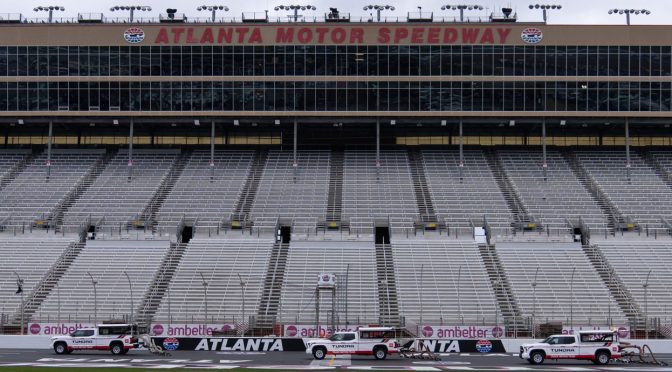
HAMPTON, Ga. – Christian Eckes finished where he started Saturday’s Fr8 208 NASCAR CRAFTSMAN Truck Series race at Atlanta Motor Speedway — with a lot of turmoil in between.
Eckes claimed his second victory in the series in overtime, choosing the bottom lane and front-row position for a restart on lap 136 of 137.
After leading the first 30-lap stage of the race wire-to-wire, however, Eckes sped on pit road and lost track position. He spent the rest of the event working his way back to the front.
Sean Gardner | Getty Images
In a race that featured a record 11 cautions for 58 laps, the driver of the No. 19 Chevrolet restarted 13th on Lap 103, but three yellow flags later, he was on the inside of the front row beside leader and ultimate runner-up finisher Nick Sanchez for the overtime restart.
Eckes surged ahead, took the white flag in the lead and was out front when NASCAR called the final caution of the race for a wreck in Turn 4 involving Tyler Ankrum, Stewart Friesen and defending series champion Zane Smith.
“It’s been a tough offseason,” said Eckes, in his first year with owner Bill McAnally after driving for ThorSport Racing in 2022. “I’m driving harder than I ever have — I have a lot to prove. The people know who they are.
“I’m really happy. Thanks to (crew chief) Charles (Denike), everybody on this team. They work so damn hard. This is what makes it all worth it. I’m pumped. It’s going to be a really good year.”
John Hunter Nemechek ran third after leading a race-high 53 laps to Eckes’ 35. Nemechek had the lead for a restart on Lap 121, but was shuffled back in traffic.
Bayley Currey finished fourth, earning his first NASCAR national series top five, and Ben Rhodes came home fifth after giving Eckes a much-needed push to the lead.
Matt DiBenedetto, Chase Purdy, Timmy Hill, Matt Crafton and Jack Wood completed the top 10.
Corey Heim’s defense of his Truck Series victory here last March ended early. He recovered from a mid-race pit-road collision, but his Tricon Garage No. 11 Toyota sustained significant front-end damage when he jammed up behind the No. 2 Chevrolet of Sanchez on a restart. He retired after completing just 83 laps and finished 34th in the 36-truck field.
The Craftsman Truck Series’ next race is scheduled next Saturday, March 25 (1:30 p.m. ET, FS1, MRN, SiriusXM) at Circuit of The Americas.
Note: Inspection in the Craftsman Truck Series garage was completed without major issue, confirming Eckes as the race winner.
HAMPTON, Ga. — Clean racing has historically been regarded as a sign of respect, something Kyle Busch openly stated that NASCAR Cup Series garage has “completely lost” during his media availability Saturday at Atlanta Motor Speedway.
Busch aired his comments in response to questions about the latest on-track developments between Ross Chastain and Denny Hamlin, resulting in a tangle in the closing laps last weekend at Phoenix Raceway. NASCAR officials confirmed that Hamlin’s post-race comments on his weekly podcast, where he openly admitted his actions were intentional, contributed to his eventual penalty for the incident.
“We have completely lost any sense of respect in the garage area between drivers,” Busch said. “That’s where the problem lies. Nobody gives two [expletives] about anybody else and it’s just a problem where everybody takes advantage of everybody as much as they can.”
Busch’s frustration wasn’t exclusive to his former longtime Joe Gibbs Racing teammate, but the current culture in the premier-series garage as a whole. And he openly acknowledged that it wasn’t always this way.
“We’re all selfish, granted,” Busch admitted. “But there was an etiquette that did live here. Mark (Martin) started it, Tony (Stewart) really lived by it, I think Jeff (Gordon) lived by it. … So, I mean, it did exist.”
Still one of the veteran leaders in the garage, Busch states that his effort in instilling the value has fallen on deaf ears — so much so to the point where he doesn’t even try to correct it anymore.
“I’ve tried to talk to guys,” Busch said. “They don’t listen. So, I’ve lost interest in talking to them.”
As far as his solution and potential repercussions, Busch was straight to the point: “When you intentionally drive over somebody because they made a move on you or something that you didn’t like, then, you know, you’re gonna get punched in the face afterwards.”
William Byron, winner of the last two NASCAR Cup Series races, doesn’t think the penalties he suffered for his team’s unauthorized modifications to the hood louvers on his No. 24 Chevrolet will have an effect on the way he races.
True, Byron lost 100 driver championship points and 10 of the 13 playoff points he accumulated in his two wins at Las Vegas and Phoenix — pending Hendrick Motorsports’ appeal — but his early success hasn’t dulled his motivation to win more races.
“Yeah, certainly the points is something that we just adjust to,” Byron said. “It’s early in the season. The cars are extremely fast. We obviously had the pace last week to win regardless, so I think that’s going to continue. I think with that pace, we’re just going to use that to our advantage to make up points.
“We didn’t intend on really relaxing after a win anyways this year. So I think, going into the next however many weeks that we’ve got until the playoffs, we’re going to push really hard. I think we’re just going to give it everything, every week. We had a good week of preparation; lots of time in the sim (simulator), lots of time at the shop. Just excited for all of that to continue.”
Byron will start 11th in the Ambetter Health 400 at Atlanta Motor Speedway on Sunday (3 p.m. ET, FOX, PRN, SiriusXM NASCAR Radio).
HAMPTON, Ga. — Nearly one year after RFK Racing and Brad Keselowski’s No. 6 Ford team was levied an L2-level penalty, the veteran driver-owner reflected back on the incident with a seasoned outlook.
“It was tough,” Keselowski told media Saturday at Atlanta Motor Speedway. “Immediate emotions are to be frustrated and angry, but I don’t feel that way today. In fact, when I saw NASCAR a couple weeks ago, we had a car get inspected after Daytona, I made a comment to them and I said, ‘Thank you. It’s one of the best things to ever happen to us.’ We came out of it better. It was good for the industry.”
RFK Racing’s penalty following last year’s spring race at Atlanta set the organization back 100 driver points and 100 owner points, among other fines and suspensions, serving as the first major penalty of NASCAR’s Next Gen era. Since then, only Front Row Motorsports’s No. 34 team (with driver Michael McDowell), Kaulig Racing’s No. 31 team (with Justin Haley) and all four Hendrick Motorsports teams have received this level of penalty — though the latter five are currently appealing their penalties.
Nonetheless, Keselowski has focused forward and the organization has improved its on-track numbers tremendously, perhaps jump-started by Chris Buescher’s dominant victory in last fall’s Bristol Night Race.
Heading into Sunday’s race at Atlanta, both cars sit in the top 10 in points through five weeks in the 2023 season — a significant upward trend from past seasons’ performance. Keselowski also leads all Ford drivers with 685 laps run inside the top 10.
So, from the outside looking in, it is clear there is a different energy and a different philosophy — and Keselowski agrees.
“From our perspective, it changed our culture inside of the company to where we had better behaviors,” Keselowski said. “I thought it set a tone for the industry.
“Again, I can’t speak for Hendrick, but with our issues. I think I made a few comments a month later about the importance of penalties in the garage. They serve a purpose. I think it’s really easy — and I’ve fallen victim to this as well — to look at NASCAR as the boogieman. In a lot of ways, they’re trying to help us and trying to help the sport and make sure that it can be healthy.”
After a strong effort in Saturday’s qualifying session, Keselowski will roll off fourth in Sunday’s Cup Series Ambetter Health 400 (3 p.m. ET, FOX, PRN, SiriusXM NASCAR Radio), his best starting position this season.
Joey Logano won the Busch Light Pole Award for Sunday’s NASCAR Cup Series race at Atlanta Motor Speedway in Saturday’s qualifying session.
The 2022 NASCAR Cup Series champion drove his No. 22 Team Penske Ford to a pole speed of 177.374 mph, besting teammate Austin Cindric for the premier spot on the starting grid.
Following the pair were Ryan Blaney, Brad Keselowski and Aric Almirola to round out the top five.
“Nobody really knows what they have for handling yet, but hopefully we have a little bit of both in this thing and we can control the race,” Logano said. “Obviously, Team Penske had a great day today and we’ll try to continue that tomorrow.”
Jonathan Bachman | Getty Images
Series points leader Kevin Harvick finished the final round in sixth with a 176.769 mph hot lap. Fords swept the top eight qualifying spots, with Kyle Larson as the top Chevrolet driver in ninth and Christopher Bell’s Toyota completing the top 10.
That’s the first time since 1965 at Beltsville (Md.) that Fords have qualified for the top eight spots on the grid. Saturday’s result is even more impressive, given that no Chevrolets attempted to qualify for the Beltsville race, where Fords took positions one through 10.
“I’m hoping it’s transferable to the race,” Logano said of Ford’s Saturday qualifying strength. “I think it’s pretty obvious at this point throughout the field where certain manufacturers have gone over the offseason with some of their changes to the noses and whatnot. It’s pretty obvious that this is kind of our wheelhouse – when you come to superspeedways or bigger race tracks like Fontana, Michigan, Atlanta, Talladega, Daytona. I think those will probably be our strongest race tracks and it kind of showed again today.”
Qualifying was not immune to a handful of spins and skids, headlined by BJ McLeod and Ty Gibbs in the opening round and Christopher Bell during the final round. Ford dominated the opening round, spearheaded by Logano. Eight of the top 10 machines to qualify for the final round were Fords.
Sunday’s Ambetter Health 400 is scheduled for 3 p.m. ET (FOX, PRN, SiriusXM NASCAR Radio). It’s the fifth race of the Cup Series season.
The Busch Light Pole Award was Logano’s second of the season, second at Atlanta (but first with NASCAR’s superspeedway competition package) and 28th of his career. Inevitably, Logano’s success on the big track brought back memories of his early days in racing, when he competed in Legends cars at Atlanta.
“I’ve never been on the front row at a superspeedway — forget a pole,” Logano said. “Doing it here at Atlanta for me is special. So many memories here. I lived up in one of those condos for five years and raced Legends cars out here for six years. Just the memories of walking into Victory Lane a minute ago to get the pole award and thinking about driving my Legend car in there, with my dad and how cool that was, and always dreaming about being on the big track when I was running the quarter-mile all the time. …
“I guess I try to keep those thoughts up front in my mind.”
Inclement weather canceled qualifying for both the NASCAR Craftsman Truck Series and NASCAR Xfinity Series at Atlanta Motor Speedway on Friday afternoon.
The Truck Series’ session, originally scheduled for 3:05 p.m. ET, was the first to be washed out by rain that lingered over the 1.54-mile quad-oval. That placed points leader Zane Smith’s No. 38 Front Row Motorsports Ford on the pole for Saturday’s Fr8 208 (2 p.m. ET, FS1, MRN, SiriusXM NASCAR Radio), the third race of the Craftsman Truck Series season.
The starting lineup was set by performance metrics, which provides a total number based on the previous event, per the NASCAR Rule Book: 15% of a fastest lap time position, 25% of the driver’s final race finish position, 25% of the owner’s final race finish position and 35% of the Owner Points position.
With NASCAR Xfinity Series qualifying also canceled, Sammy Smith will start on pole for Saturday’s RAPTOR Tough 250 (5 p.m. ET, FS1, PRN, SiriusXM). Smith claimed his first career win one week ago at Phoenix Raceway piloting the No. 18 Toyota for Joe Gibbs Racing.
NASCAR Cup Series star Christopher Bell is set to make his long-awaited return to the series that first offered him a taste of national series competition.
Hattori Racing Enterprises announced Friday afternoon that the 2022 Cup Championship 4 contender will pull double-duty at this May’s historic return to North Wilkesboro Speedway when he straps into the No. 61 Toyota with support from Toyota Tsusho. Bell, the 2017 Craftsman Truck Series champion, has only made one series start since hoisting the hardware — a 28th-place finish from the pole at Bristol Motor Speedway in 2018.
To date, the 28-year-old has seven wins in 54 career series starts, making a Championship 4 appearance in both of his full-time seasons there.
Bell is also slated to participate in that weekend’s NASCAR All-Star Race (May 21, 8 p.m. ET, FS1) behind the wheel of his No. 20 Joe Gibbs Racing Toyota.
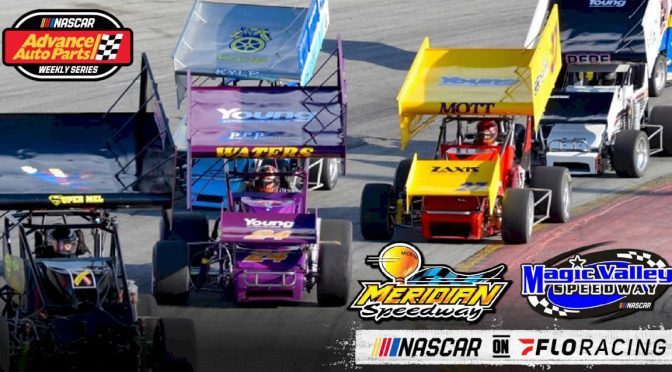
One of the most exciting race tracks with one of the most diverse schedules to appear on FloRacing in 2022 was Boise, Idaho’s quarter-mile Meridian Speedway. Between Late Models, Modifieds, and Pavement Sprint Cars, Meridian Speedway offered something for every fan that tuned into the broadcasts on FloRacing last year.
Now, Meridian Speedway is back on FloRacing once again in 2023, and joining it on the platform for select events is its sister track in Twin Falls, Idaho, the 1/3-mile Magic Valley Speedway.
Idaho has proven to be a hot-bed for pavement Sprint Car racing, especially at Meridian Speedway, with big events like the Pink Lady Classic and the Diamond Cup highlighting the schedule. Those are just a couple of the highlights on Meridian’s schedule, along with big events like the Treasure Valley 125 for the Super Late Models, as the entire calendar will be seen live on FloRacing for the second year in a row.
“Our transition to full-time broadcasts at Meridian Speedway on FloRacing in 2022 was a great experience,” said Meridian Speedway’s general manager, Adam Nelson. “We had worked with FloRacing previously on select events, so it was a pretty natural evolution.”
The Sprint Cars will hit the track at Magic Valley Speedway for the first time in 2023 on Saturday, April 29. The event will be the first from Magic Valley to be broadcast live on FloRacing and the first of two events during the 2023 season to appear on FloRacing. The second event will be the Super Modified Cup held on Saturday, August 12.
“As for Magic Valley Speedway, we are excited to sample a few events from the 1/3-mile on FloRacing this year with Winged Sprint Cars in April, and Super Modifieds in August. That includes all of the local divisions seen weekly live and in-person by the great race fans in the Magic Valley.”
The season-opener at Meridian Speedway will take place on Saturday, April 8, with Modifieds, Pro Late Models, Legends and more on the order of events for the day.
Meridian Speedway opened in 1951 and has been racing ever since. From 2015 to 2019 it was a stop on the ARCA Menards West (formerly K&N Pro Series West) schedule. Magic Valley Speedway first opened its gates in 1986.
In addition to events at Meridian and Magic Valley, FloRacing subscribers will gain access to watch 1,200+ live races including the ARCA Menards Series West and other NASCAR Roots events throughout the country.
📍 Location: Hampton, Georgia 📐 Track length: 1.54-miles
🎟️ Buy tickets: Three races this weekend 💰 Race purse: $8,725,965 📏 Race distance: 260 laps | 400 miles 🔢 Stages: 60 | 160 | 260
—
🚗 Pit stall assignments: Where drivers will pit on Sunday
📋 Starting lineup: Where drivers will start on Sunday 🏆 Most recent winner: Chase Elliott, July 2022
Key things to watch 🔑
Top story line
Can William Byron complete the trifecta? Byron won the last two races — Las Vegas Motor Speedway and Phoenix Raceway — in impressive, last-gasp fashion over teammate Kyle Larson. Sunday, he aims to join the elite list of drivers with three consecutive victories in NASCAR history. And go figure, he was the car to beat here in the 2022 March race and ended up in Victory Lane, so he should be among the favorites to get the job done again. Byron will try to keep his momentum after a penalty was issued to each of Hendrick Motorsports’ four race teams on Tuesday, setting them back in the current drivers’ and owners’ points standings.
At least 25% of the field will lead a lap on Sunday. Last year’s inaugural race on the repaved and reconfigured asphalt was historic, featuring a record 20 lead changes and close-quarters racing throughout. Five of those drivers, including eventual race winner William Byron who led a race-high 111 laps, led over 20 laps — and 12 different drivers went on to lead a lap in the July race. Though a small sample size, the ‘new’ Atlanta has already proven to be a high-paced, back-and-forth race track that caters to multiple drivers battling for the lead when it’s time to decide a winner.
He may not be the betting favorite to win, but watch out for…
Daniel Suárez. Suárez finished fourth in this race last March and it wasn’t a fluke, evidenced by his strong sixth-place result in the scorching July race. His confidence from last season’s success at the reconfigured Georgia track should carry over well, coupled with his hot start to 2023. Before last week at Phoenix Raceway, Suárez and Alex Bowman were the only drivers with a top-10 finish in every race this season — but the No. 99 pilot’s streak was snapped in the desert. Still, in search of the elusive first win of the new campaign, expect Suárez to be a contender Sunday.
Practice and qualifying
Fords are the fastest. Blue ovals locked out the top eight spots in the starting lineup for Sunday’s Cup race. Joey Logano earned his second pole of the 2023 season with Team Penske teammate Austin Cindric joining him on the front row. Ryan Blaney, Brad Keselowski, Aric Almirola, Kevin Harvick, Chris Buescher and Chase Briscoe make up the rest of the first four rows. | For more info, read the full qualifying recap
Familiar favorites ⭐️
Our biggest pieces of the week — get covered for race day from all angles.
💎 NASCAR 75: Check out exclusive NASCAR content throughout the anniversary season | Learn more, explore
Hot off the press 📰
Key stories and breaking news from the week leading up to the race.
• Hendrick Motorsports, Kaulig Racing: L2-level penalty issued Tuesday | Read more
• Kyle Busch: Drivers have ‘lost respect’ in garage area | Read more
• Brad Keselowski: Reflects on 2022 penalty: ‘One of the best things to ever happen to us’ | Read more
• Denny Hamlin: Penalized, fined for intentional contact with Ross Chastain | Read more
• Elton Sawyer: Modifications ‘obvious’ on Hendrick, Kaulig cars | Listen here
• Advance to Victory Lane: Predicting Sunday’s race winner, results | Read more
• Jimmie Johnson: Seven-time champion set to race at COTA, Coca-Cola 600 | Read more
• Denny Hamlin on contact with Ross Chastain: ‘It wasn’t a mistake’ |Read more
• Doubleheader: Xfinity Series, Truck Series set to race Saturday | Read more
• Hailie Deegan: Driver partners with AdventHealth to celebrate Women’s History Month | Read more
• 23XI: Team, Dr Pepper announce third cycle of tuition program | Read more
• NASCAR Brasil: New Sprint Race season begins this Sunday |Read more
Get in on the action 💰
Think you know NASCAR? Put your mettle to the test with gaming, fantasy and Fan Rewards.
• Fan Rewards: New in 2023, get rewarded for your participation | Learn more • Fantasy Live: Still time to get on the leaderboard and win big this season |Tips for 2023 • NASCAR BetCenter: Don’t miss your chance to make picks each week | Visit the BetCenter
• Going the distance: 2023 Cup Series championship odds | See them here • The Action Network: Can’t-miss Atlanta prop bet for Sunday | Read more
Georgia on my mind 🍑
It’s Year 2 of the repave and reconfiguration at Atlanta, but this track still has a lot of incredible history.
• Winner, winner: All-time winners at Atlanta | See who has the most
• Do you remember?: Memorable moments at Atlanta | Relive them here
• Photo Memories: Harvick gets unexpected first Cup Series win | Watch the video
• Greatest Race Ever: Making the case for the 1992 Hooters 500 | Relive the past here
• Pace out front: Top 10 lap leaders in Atlanta history | See them here
• Race Rewind: Late charge sets up Elliott’s big win at Atlanta | Best moments, highlights
• eNASCAR: Steven Wilson wins on iRacing at Atlanta | Watch the final laps
Take some notes 📝
Five hard-hitting, race-relevant statistics, brought to you by the experts at Racing Insights.
• This season will be the first time there will not be a scheduled 500-mile race at Atlanta.
• Chevrolet drivers have won the last six races on drafting tracks.
• Kyle Larson will make his 300th series start on Sunday, and only seven drivers have won on their 300th start.
• The driver that led the most laps in each race this season failed to win three out of the four races.
• In the 2022 March race, 20 different drivers led a lap, the most ever at Atlanta.
Larry McReynolds walked along pit lane at Atlanta Motor Speedway an hour before the season finale in 1992. He looked up at the grandstands and marveled at how packed they were. Atlanta had drawn big crowds for races before, but never like this. On that day’s broadcast, ESPN reported it was the largest sports crowd in the history of the state of Georgia.
The fans — 162,500 of them, according to racing-reference.info — gathered in advance of a race unprecedented in NASCAR history: Three drivers were battling for the championship, with three more technically still in the hunt. The fact six drivers could win the championship that day meant nerves jangled up and down pit lane, among drivers, crew members and crew chiefs, as they wondered what chances fate would offer them and whether they’d capitalize on them if given the chance.
“I don’t think I’ve ever been this nervous in my life,” said driver Davey Allison, who entered the race with a slim lead driving for Robert Yates Racing with McReynolds as his crew chief. “We just want to have an event-free race, try to stay out of trouble, and be around at the end.”
He went zero for three on that list.
NASCAR Research & Archives Center | Getty Images
In the No. 7 pit stall, Alan Kulwicki and his crew tried to block out the nerves, though without much success. Often tightly wound and vocal on the radio, Kulwicki started barking even before the green flag dropped. During the parade laps, Apache helicopters dropped low, low, low, right over the cars. “Get them helicopters out of here!” Kulwicki snapped, as if his team could do anything about it.
Forgive Kulwicki for his impatience. He entered the race in second place, 30 points behind Allison. He could take the biggest swing that day, as his underdog status meant he had nothing to lose, and if he wanted to take that swing without a helicopter a few feet from his deck lid, it’s hard to blame him.
“The only thing we really talked about before the race is, let’s not talk about the championship until it’s time to talk about the championship,” crew chief Paul Andrews said.
And finally, there was third-place Bill Elliott (40 points behind Allison), “Awesome Bill from Dawsonville,” the favorite son of the state and NASCAR’s perennial most popular driver. He drove the No. 11 for Junior Johnson. Johnson — the legendary driver turned transformational team owner — had tried to sign Kulwicki a few years earlier. But Kulwicki, a driver-owner infamous for an exacting attention to detail, which he demanded of himself and his crew, didn’t want to cede control, so he turned Johnson down.
Whether being spurned by Kulwicki made Johnson and Elliott want to beat him even more is hard to say, but either way, Kulwicki as the small-team owner-driver going up against the Goliaths of Johnson/Elliott and Yates/Allison was an irresistible story line.
There had never been a day like this. ESPN play-by-play man Bob Jenkins made that clear: “We try to tell ourselves that it’s just another race,” he told viewers. “But it isn’t.”
Allison and McReynolds, Kulwicki and Andrews, Elliott and Johnson, Jenkins and the fans squeezed in the grandstands, camping in the infield and watching at home, all knew something big was about to happen.
Just how big, they didn’t know.
They were about to witness, take part in, and help create the best race in NASCAR history.
———-
In NASCAR, we love to talk about superlatives — fastest lap, closest finish, best driver, best race.
Some of that, you can prove. Fastest lap is a simple measure of time and distance, and Elliott set a mark in 1987 at Talladega (212.809 mph) that will likely never be beaten. Closest finish is also easy to quantify, even if the lightning-fast technology that discerns what the human eye can’t is anything but simple.
Best driver … well, that’s a little tougher. Some fans hold up championships as the ultimate barometer. But wins, longevity, finishing better than your equipment are all factors, too, as is the eye-test.
NASCAR Research & Archives Center | Getty Images
Best race is tougher still to pin down. For a race to be great, it needs lead-footed driving, big-name drivers doing big-time things, holy-cow moments, historic significance and that ever-elusive “It Factor,” an indelible quality that combines all of those things and somehow transcends them, too.
Some great races have a single great part — the Kurt Busch-Ricky Craven finish in 2003 at Darlington, the Hail Melon last year at Martinsville — which make them memorable and maybe even historic, but their lack of greater context leaves them just short of best ever.
Richard Petty’s 200th win in the Firecracker 400 in 1984, Dale Earnhardt’s 1998 Daytona 500 victory and the 1979 Daytona 500 all qualify as best ever. Let’s cross the first two off as admittedly awesome but too singular — they were about individual drivers conquering individual mountains, and outside of that don’t stand out for historical value, even if President Ronald Reagan giving the start your engines command before Petty’s win was inarguably sublime.
The 1979 Daytona 500 belongs in a conversation about superlative NASCAR races — most important, most memorable, most talked about — but not best ever. Only three cars finished on the lead lap. Five others finished a lap down. The 10th-place car, driven by Frank Warren, finished three laps down. The race was important, memorable, historic, etc., just not best ever.
The final race of 2004 has a strong case. It was the highly anticipated season finale in the first year of the Chase playoff system. It came soaked in pathos as the sport was mourning the loss of 10 people in a crash of a Hendrick Motorsports plane, and two Hendrick drivers had a chance at the title. The race itself was intense; the key moment was when contender Kurt Busch’s tire fell off. He recovered from that to finish fifth and win the title by eight points.
The five men who started the race still in the hunt — Dale Earnhardt Jr., Mark Martin, Jeff Gordon, Jimmie Johnson and Busch — are all either in the NASCAR Hall of Fame already or will be.
There’s nothing keeping that race from being best-ever … except, perhaps, that its intensity has been repeated, to varying degrees, every year since. Because the sport has had an unending string of compelling season finales, none of them stands out as singular. As great as each of those races might have been, their existences were predictable because of the format.
Which takes us back to Atlanta Motor Speedway and the 1992 Hooters 500, which was unprecedented in having six contenders still alive.
———-
Rick Houston, the great and longtime NASCAR journalist, covered the race. He wrote a book about it, which suggests on its own he would place it high in the NASCAR pantheon of great races. The title clinches it: “NASCAR’s Greatest Race.”
“The 1992 Hooters 500 was a race that had every conceivable kind of story line from the outset,” he wrote. “This was the very best the sport had to offer, and then some.”
Part of that very best was the personalities in the race. No fewer than 20 owners and drivers in the race are now enshrined in the NASCAR Hall of Fame, including all three of the top contenders and their team owners. This was the final race for Richard Petty, the King, owner of 200 wins and seven championships, and the first race for Jeff Gordon, who won four championships and 93 races. They both crashed out early. Dale Earnhardt, who matched Petty’s seven championships and tallied 76 wins, led 44 laps but stumbled to a 26th-place finish. That’s 369 career wins and 18 championships among just three drivers.
Even the broadcast booth was star-studded — Ned Jarrett and Benny Parsons were both Hall of Famers, combined for three championships and were iconic and popular personalities.
The tension started with a wreck among the race leaders on Lap 2 and didn’t let up for 500 miles. Elliott and Kulwicki avoided that first wreck, and Allison collected minor damage. Trouble started soon thereafter. Kulwicki’s transmission broke on the first pit stop, so he never dropped his car lower than fourth gear the rest of the race. His team pushed him down pit lane, a tactic normally forbidden but allowed by NASCAR under the circumstances.
On Lap 96, Petty was involved in a crash that sent his car up in flames. He famously said later he had hoped to go out in a blaze of glory but instead just went out in a blaze.
NASCAR Research & Archives Center | Getty Images
ESPN repeatedly showed a “points as of now” graphic detailing who was in the championship lead. The graphic showed a different leader five times in a row as the drivers moved up and down the scoring pylon (Allison, then Elliott, then Kulwicki, then back to Allison, then back to Kulwicki).
Allison had already endured a terrible 1992. His brother, Clifford, died in a crash during Busch Series practice at Michigan. Davey was taken to the hospital after a crash in the All-Star Race and suffered a broken arm in a wreck at Pocono in which his car flipped 10 times. During the race, he reported running over something on the track, which damaged his car. Gordon’s crew chief, Ray Evernham, has said the team left a roll of duct tape on the hood, it fell off on the track and Allison hit it. Allison’s race and season ended in a crash on Lap 254 when he couldn’t avoid Ernie Irvan, who lost control of his car when he cut a tire.
That left the championship battle to Elliott and Kulwicki. The math was complicated, made even more so by the fact scoring was done by hand. It was clear that even if Elliott won the race, Kulwicki could still win the championship if he finished second and led the most laps. What was not clear was who was going to lead the most laps.
In Kulwicki’s pit, someone marked an X for every lap led. In the ESPN booth, Ken Martin, then a statistician for ESPN and now the director of historical content for NASCAR, charted who led every lap and was responsible for the accuracy of the “points as of now” graphics.
“I’ve worked in a broadcast booth for over 500 live events, whether it’s NASCAR, IndyCar, Le Mans, even Formula One, and there’s never been a booth like that as far as the tension,” says Martin. “Your heart was in your throat from the very start, and it never let up.”
And for good reason. Sometimes the cars were so close Martin had to lean out the window and look down at the start-finish line to make sure he saw for sure who led that lap. This was hugely important. If he missed or was wrong about who led even a single lap, that would throw off his calculations, which could lead to ESPN erroneously reporting who won the championship. For example, Kulwicki led Lap 80 over Elliott by less than a foot. If Elliott instead had led that lap and the rest of the race played out the same, he would have won the championship. That was the closest lap, and there were several others of not much more than a fender.
The tension ramped up as the final round of pit stops neared. Kulwicki stayed out a few extra laps, risking running out of gas to clinch the most laps led mark. When he finally stopped for his gas-and-go, he left his pits assured of the championship if he finished second, which was his running position at the time. That became a big if, though, when team members realized they had not gotten as much gas into his tank as they hoped.
The gas man, Tony Gibson, told his wife to move their car close to the exit, because if they ran out, he was going to run to the car and make a hasty exit to avoid everybody who would be mad at him. The team radioed Kulwicki to tell him the news. Normally he was voluble on the radio. “It was crickets,” crew chief Andrews said. “He didn’t know what to say then.”
Eventually, Kulwicki asked for an explanation, and Andrews carefully reported the news. He told him that the third-place car was so far behind that Kulwicki didn’t face any real danger of being passed. He couldn’t coast to the finish line, but there was no need to bull his way there, either.
As the final laps ticked down, Martin worked in the ESPN booth, checking and rechecking his numbers so he could be 100 percent confident in declaring Kulwicki the champion, paving the way for Jenkins’s iconic call: “Bill Elliot comes off the fourth corner. He wins the Hooters 500. But Alan Kulwicki is coming off of corner No. 4 knowing that he is winning the championship. There’s the checkered flag for Alan. He’s the champion for 1992!”
NASCAR Research & Archives Center | Getty Images
Some races feel mammoth in the moment but shrink as they disappear into our memories, fading as super-exciting at the time but having no lasting impact, like a relationship that starts with a great first date but goes nowhere after that. Not this one. It is constantly hashed and rehashed in the 31 years since.
“I don’t think anyone realized so much would come out of that race,” Ed Hinton, a retired NASCAR writer who covered the sport for ESPN, Sports Illustrated and the Orlando Sentinel, told author Herb Branham. “That race has grown way behind what it was to begin with, in importance.”
The day itself — with the thrilling points race won by the underdog and the retirement of Petty — was enough. But without question, this race occupies an exalted place in NASCAR history because of what happened after it. It’s chilling to rewatch the broadcast now. After Allison’s race ended with a crash, he gave a gracious live interview to ESPN. “There will be other years,” ESPN’s Jenkins told the audience. “There’s no question about that.”
But there weren’t other years. Allison died the following July in a helicopter crash.
In his Victory Lane interview, Kulwicki talked about giving up on trying to win the race and instead winning the championship. “There will be other races. But this championship is what I wanted.”
He never won another race. He entered only five more Cup races before dying in a plane crash the following April.
Still, the race’s legacy isn’t only about tragedy. It’s also about triumph and change.
The late David Poole, who covered NASCAR for the Charlotte Observer for 13 years and was one of the most astute commentators the sport has ever had, wrote a book about the race, too. He called it, “Race With Destiny: The Year that Changed NASCAR Forever.” He saw the race as the end of one era and the beginning of another, a now widely held view that became possible only in retrospect but about which there were hints, even that day.
The fact it was Petty’s final race and Gordon’s first race is eerie. Gordon was a highly touted young driver. But nobody knew he would win 93 races and four championships and take the sport to Regis and Kelly, Saturday Night Live and corporate boardrooms across the country. It was the only race to feature Petty, Dale Earnhardt and Jeff Gordon — perhaps the three most important drivers in NASCAR history (and arguably the three best).
You can’t draw a straight line from the Hooters 500 in 1992 to the introduction of the playoffs in 2004 or NASCAR’s current elimination format. But those changes didn’t happen in a vacuum, either. When NASCAR officials sought ways to inject late-season drama into the sport, the 1992 season finale would certainly have been a contributing factor in their decision. Said Martin: “Consciously or subconsciously, I would agree that NASCAR officials thought, how can we capture that magic of Atlanta 1992 again?”
And that’s what makes the Hooters 500 race the best ever. We want to capture its magic again and again.