Larry McReynolds walked along pit lane at Atlanta Motor Speedway an hour before the season finale in 1992. He looked up at the grandstands and marveled at how packed they were. Atlanta had drawn big crowds for races before, but never like this. On that day’s broadcast, ESPN reported it was the largest sports crowd in the history of the state of Georgia.

The fans — 162,500 of them, according to racing-reference.info — gathered in advance of a race unprecedented in NASCAR history: Three drivers were battling for the championship, with three more technically still in the hunt. The fact six drivers could win the championship that day meant nerves jangled up and down pit lane, among drivers, crew members and crew chiefs, as they wondered what chances fate would offer them and whether they’d capitalize on them if given the chance.

RELATED: Full NASCAR 75 coverage

“I don’t think I’ve ever been this nervous in my life,” said driver Davey Allison, who entered the race with a slim lead driving for Robert Yates Racing with McReynolds as his crew chief. “We just want to have an event-free race, try to stay out of trouble, and be around at the end.”

He went zero for three on that list.

Bill Elliott holds the trophy for winning the 1992 Hooters 500 at Atlanta Motor Speedway.
NASCAR Research & Archives Center | Getty Images

In the No. 7 pit stall, Alan Kulwicki and his crew tried to block out the nerves, though without much success. Often tightly wound and vocal on the radio, Kulwicki started barking even before the green flag dropped. During the parade laps, Apache helicopters dropped low, low, low, right over the cars. “Get them helicopters out of here!” Kulwicki snapped, as if his team could do anything about it.

Forgive Kulwicki for his impatience. He entered the race in second place, 30 points behind Allison. He could take the biggest swing that day, as his underdog status meant he had nothing to lose, and if he wanted to take that swing without a helicopter a few feet from his deck lid, it’s hard to blame him.

“The only thing we really talked about before the race is, let’s not talk about the championship until it’s time to talk about the championship,” crew chief Paul Andrews said.

And finally, there was third-place Bill Elliott (40 points behind Allison), “Awesome Bill from Dawsonville,” the favorite son of the state and NASCAR’s perennial most popular driver. He drove the No. 11 for Junior Johnson. Johnson — the legendary driver turned transformational team owner — had tried to sign Kulwicki a few years earlier. But Kulwicki, a driver-owner infamous for an exacting attention to detail, which he demanded of himself and his crew, didn’t want to cede control, so he turned Johnson down.

Whether being spurned by Kulwicki made Johnson and Elliott want to beat him even more is hard to say, but either way, Kulwicki as the small-team owner-driver going up against the Goliaths of Johnson/Elliott and Yates/Allison was an irresistible story line.

There had never been a day like this. ESPN play-by-play man Bob Jenkins made that clear: “We try to tell ourselves that it’s just another race,” he told viewers. “But it isn’t.”

Allison and McReynolds, Kulwicki and Andrews, Elliott and Johnson, Jenkins and the fans squeezed in the grandstands, camping in the infield and watching at home, all knew something big was about to happen.

Just how big, they didn’t know.

They were about to witness, take part in, and help create the best race in NASCAR history.

———-

In NASCAR, we love to talk about superlatives — fastest lap, closest finish, best driver, best race.

Some of that, you can prove. Fastest lap is a simple measure of time and distance, and Elliott set a mark in 1987 at Talladega (212.809 mph) that will likely never be beaten. Closest finish is also easy to quantify, even if the lightning-fast technology that discerns what the human eye can’t is anything but simple.

Best driver … well, that’s a little tougher. Some fans hold up championships as the ultimate barometer. But wins, longevity, finishing better than your equipment are all factors, too, as is the eye-test.

Jeff Gordon pictured outside his car before his first NASCAR Cup Series race in 1992 at Atlanta Motor Speedway.
NASCAR Research & Archives Center | Getty Images

Best race is tougher still to pin down. For a race to be great, it needs lead-footed driving, big-name drivers doing big-time things, holy-cow moments, historic significance and that ever-elusive “It Factor,” an indelible quality that combines all of those things and somehow transcends them, too.

RELATED: Jeff Gordon through the years

Some great races have a single great part — the Kurt Busch-Ricky Craven finish in 2003 at Darlington, the Hail Melon last year at Martinsville — which make them memorable and maybe even historic, but their lack of greater context leaves them just short of best ever.

Richard Petty’s 200th win in the Firecracker 400 in 1984, Dale Earnhardt’s 1998 Daytona 500 victory and the 1979 Daytona 500 all qualify as best ever. Let’s cross the first two off as admittedly awesome but too singular — they were about individual drivers conquering individual mountains, and outside of that don’t stand out for historical value, even if President Ronald Reagan giving the start your engines command before Petty’s win was inarguably sublime.

The 1979 Daytona 500 belongs in a conversation about superlative NASCAR races — most important, most memorable, most talked about — but not best ever. Only three cars finished on the lead lap. Five others finished a lap down. The 10th-place car, driven by Frank Warren, finished three laps down. The race was important, memorable, historic, etc., just not best ever.

The final race of 2004 has a strong case. It was the highly anticipated season finale in the first year of the Chase playoff system. It came soaked in pathos as the sport was mourning the loss of 10 people in a crash of a Hendrick Motorsports plane, and two Hendrick drivers had a chance at the title. The race itself was intense; the key moment was when contender Kurt Busch’s tire fell off. He recovered from that to finish fifth and win the title by eight points.

The five men who started the race still in the hunt — Dale Earnhardt Jr., Mark Martin, Jeff Gordon, Jimmie Johnson and Busch — are all either in the NASCAR Hall of Fame already or will be.

There’s nothing keeping that race from being best-ever … except, perhaps, that its intensity has been repeated, to varying degrees, every year since. Because the sport has had an unending string of compelling season finales, none of them stands out as singular. As great as each of those races might have been, their existences were predictable because of the format.

Which takes us back to Atlanta Motor Speedway and the 1992 Hooters 500, which was unprecedented in having six contenders still alive.

———-

Rick Houston, the great and longtime NASCAR journalist, covered the race. He wrote a book about it, which suggests on its own he would place it high in the NASCAR pantheon of great races. The title clinches it: “NASCAR’s Greatest Race.”

“The 1992 Hooters 500 was a race that had every conceivable kind of story line from the outset,” he wrote. “This was the very best the sport had to offer, and then some.”

Part of that very best was the personalities in the race. No fewer than 20 owners and drivers in the race are now enshrined in the NASCAR Hall of Fame, including all three of the top contenders and their team owners. This was the final race for Richard Petty, the King, owner of 200 wins and seven championships, and the first race for Jeff Gordon, who won four championships and 93 races. They both crashed out early. Dale Earnhardt, who matched Petty’s seven championships and tallied 76 wins, led 44 laps but stumbled to a 26th-place finish. That’s 369 career wins and 18 championships among just three drivers.

RELATED: Memorable moments at Atlanta

Even the broadcast booth was star-studded — Ned Jarrett and Benny Parsons were both Hall of Famers, combined for three championships and were iconic and popular personalities.

The tension started with a wreck among the race leaders on Lap 2 and didn’t let up for 500 miles. Elliott and Kulwicki avoided that first wreck, and Allison collected minor damage. Trouble started soon thereafter. Kulwicki’s transmission broke on the first pit stop, so he never dropped his car lower than fourth gear the rest of the race. His team pushed him down pit lane, a tactic normally forbidden but allowed by NASCAR under the circumstances.

On Lap 96, Petty was involved in a crash that sent his car up in flames. He famously said later he had hoped to go out in a blaze of glory but instead just went out in a blaze.

Richard Petty's driving career ended after his No. 43 Pontiac caught fire after a wreck in the 1992 Hooters 500 at Atlanta Motor Speedway.
NASCAR Research & Archives Center | Getty Images

ESPN repeatedly showed a “points as of now” graphic detailing who was in the championship lead. The graphic showed a different leader five times in a row as the drivers moved up and down the scoring pylon (Allison, then Elliott, then Kulwicki, then back to Allison, then back to Kulwicki).

Allison had already endured a terrible 1992. His brother, Clifford, died in a crash during Busch Series practice at Michigan. Davey was taken to the hospital after a crash in the All-Star Race and suffered a broken arm in a wreck at Pocono in which his car flipped 10 times. During the race, he reported running over something on the track, which damaged his car. Gordon’s crew chief, Ray Evernham, has said the team left a roll of duct tape on the hood, it fell off on the track and Allison hit it. Allison’s race and season ended in a crash on Lap 254 when he couldn’t avoid Ernie Irvan, who lost control of his car when he cut a tire.

That left the championship battle to Elliott and Kulwicki. The math was complicated, made even more so by the fact scoring was done by hand. It was clear that even if Elliott won the race, Kulwicki could still win the championship if he finished second and led the most laps. What was not clear was who was going to lead the most laps.

In Kulwicki’s pit, someone marked an X for every lap led. In the ESPN booth, Ken Martin, then a statistician for ESPN and now the director of historical content for NASCAR, charted who led every lap and was responsible for the accuracy of the “points as of now” graphics.

RELATED: Richard Petty through the years

“I’ve worked in a broadcast booth for over 500 live events, whether it’s NASCAR, IndyCar, Le Mans, even Formula One, and there’s never been a booth like that as far as the tension,” says Martin. “Your heart was in your throat from the very start, and it never let up.”

And for good reason. Sometimes the cars were so close Martin had to lean out the window and look down at the start-finish line to make sure he saw for sure who led that lap. This was hugely important. If he missed or was wrong about who led even a single lap, that would throw off his calculations, which could lead to ESPN erroneously reporting who won the championship. For example, Kulwicki led Lap 80 over Elliott by less than a foot. If Elliott instead had led that lap and the rest of the race played out the same, he would have won the championship. That was the closest lap, and there were several others of not much more than a fender.

The tension ramped up as the final round of pit stops neared. Kulwicki stayed out a few extra laps, risking running out of gas to clinch the most laps led mark. When he finally stopped for his gas-and-go, he left his pits assured of the championship if he finished second, which was his running position at the time. That became a big if, though, when team members realized they had not gotten as much gas into his tank as they hoped.

The gas man, Tony Gibson, told his wife to move their car close to the exit, because if they ran out, he was going to run to the car and make a hasty exit to avoid everybody who would be mad at him. The team radioed Kulwicki to tell him the news. Normally he was voluble on the radio. “It was crickets,” crew chief Andrews said. “He didn’t know what to say then.”

Eventually, Kulwicki asked for an explanation, and Andrews carefully reported the news. He told him that the third-place car was so far behind that Kulwicki didn’t face any real danger of being passed. He couldn’t coast to the finish line, but there was no need to bull his way there, either.

As the final laps ticked down, Martin worked in the ESPN booth, checking and rechecking his numbers so he could be 100 percent confident in declaring Kulwicki the champion, paving the way for Jenkins’s iconic call: “Bill Elliot comes off the fourth corner. He wins the Hooters 500. But Alan Kulwicki is coming off of corner No. 4 knowing that he is winning the championship. There’s the checkered flag for Alan. He’s the champion for 1992!”

Alan Kulwicki races in his No. 7 Hooters Ford in the 1992 Hooters 500 at Atlanta Motor Speedway.
NASCAR Research & Archives Center | Getty Images

Some races feel mammoth in the moment but shrink as they disappear into our memories, fading as super-exciting at the time but having no lasting impact, like a relationship that starts with a great first date but goes nowhere after that. Not this one. It is constantly hashed and rehashed in the 31 years since.

“I don’t think anyone realized so much would come out of that race,” Ed Hinton, a retired NASCAR writer who covered the sport for ESPN, Sports Illustrated and the Orlando Sentinel, told author Herb Branham. “That race has grown way behind what it was to begin with, in importance.”

The day itself — with the thrilling points race won by the underdog and the retirement of Petty — was enough. But without question, this race occupies an exalted place in NASCAR history because of what happened after it. It’s chilling to rewatch the broadcast now. After Allison’s race ended with a crash, he gave a gracious live interview to ESPN. “There will be other years,” ESPN’s Jenkins told the audience. “There’s no question about that.”

But there weren’t other years. Allison died the following July in a helicopter crash.

In his Victory Lane interview, Kulwicki talked about giving up on trying to win the race and instead winning the championship. “There will be other races. But this championship is what I wanted.”

He never won another race. He entered only five more Cup races before dying in a plane crash the following April.

Still, the race’s legacy isn’t only about tragedy. It’s also about triumph and change.

The late David Poole, who covered NASCAR for the Charlotte Observer for 13 years and was one of the most astute commentators the sport has ever had, wrote a book about the race, too. He called it, “Race With Destiny: The Year that Changed NASCAR Forever.” He saw the race as the end of one era and the beginning of another, a now widely held view that became possible only in retrospect but about which there were hints, even that day.

The fact it was Petty’s final race and Gordon’s first race is eerie. Gordon was a highly touted young driver. But nobody knew he would win 93 races and four championships and take the sport to Regis and Kelly, Saturday Night Live and corporate boardrooms across the country. It was the only race to feature Petty, Dale Earnhardt and Jeff Gordon — perhaps the three most important drivers in NASCAR history (and arguably the three best).

You can’t draw a straight line from the Hooters 500 in 1992 to the introduction of the playoffs in 2004 or NASCAR’s current elimination format. But those changes didn’t happen in a vacuum, either. When NASCAR officials sought ways to inject late-season drama into the sport, the 1992 season finale would certainly have been a contributing factor in their decision. Said Martin: “Consciously or subconsciously, I would agree that NASCAR officials thought, how can we capture that magic of Atlanta 1992 again?”

And that’s what makes the Hooters 500 race the best ever. We want to capture its magic again and again.

Stewart-Haas Racing announced Thursday that Kevin Harvick will compete in his final NASCAR All-Star Race using the car number that started his Cup Series career, switching from his current No. 4 back to No. 29 for the May 21 invitational that marks the circuit’s return to North Wilkesboro (N.C.) Speedway.

The news comes ahead of Sunday’s race (3 p.m. ET, FOX, PRN, SiriusXM) at Atlanta Motor Speedway, where Harvick won in just his third Cup Series start on March 11, 2001. His emotional victory there came just three weeks after replacing the iconic Dale Earnhardt after his death in the Daytona 500. His Richard Childress Racing team quickly promoted him from the Xfinity Series ranks and changed the team’s car number from the No. 3 that Earnhardt made famous to No. 29.

RELATED: Photo memories: Harvick’s first win | Atlanta weekend schedule

Harvick’s No. 29 Ford for the All-Star Race will feature a retro design that pays tribute to his first win from 22 years ago at Atlanta. His sponsor, Busch Light, will also revert to period-correct branding on the car’s hood and fenders.

“When I sat in the 29 for the first time, it really wasn’t by choice, but I definitely wouldn’t have done it any differently,” Harvick said in a news release from his SHR team. “Dale’s passing changed our sport forever, and it changed my life forever and the direction it took. Looking back on it now, I realize the importance of getting in the Cup car, and then I wound up winning my first race at Atlanta in the 29 car after Dale’s death. The significance and the importance of keeping that car on the race track and winning that race early at Atlanta – knowing now what it meant to the sport, and just that moment in general of being able to carry on – was so important.”

Kevin Harvick's No. 29 Chevrolet leads the pack on the way to his first Cup Series victory in 2001 at Atlanta Motor Speedway
Jon Ferrey | Allsport

Harvick announced in the offseason that this Cup Series campaign would be his last. He’s set to join the FOX Sports broadcasting team after the season.

The 47-year-old driver spent the first 13 seasons of his Cup Series career with Childress, scoring 23 of his 60 career victories in RCR’s No. 29. Harvick joined Stewart-Haas in 2014 and has driven the No. 4 ever since.

The No. 29 has been out of Cup Series circulation since Harvick last drove it in the 2013 season finale, his final start for RCR. The Childress team brought back the No. 3 the following season, when Austin Dillon took over the seat.

In reviving his original car number, Harvick said that many of his earliest moments in NASCAR’s top series were also his most monumental.

“With this being my last year as a Cup Series driver, we wanted to highlight a lot of these moments, and many were made at RCR in that 29 car,” Harvick said. “So, with the All-Star Race going to North Wilkesboro – a place with a ton of history – we thought it made sense in a year full of milestones and moments to highlight where it all started.”

Harvick has competed in 22 editions of the All-Star Race, qualifying for the main event each year of his Cup Series career and winning twice (2007, 2018). This year’s non-points invitational will mark the first All-Star Race at the .625-mile North Wilkesboro track, which last hosted NASCAR’s top circuit in 1996.

The facility has undergone extensive renovations in advance of the All-Star Race, but with special care taken to preserve the track’s history and old-school feel.

PHOTOS: Construction update from North Wilkesboro

“I don’t know the last time the All-Star Race was the most anticipated event of the season,” Harvick said. “Fans are going to show up in droves. North Wilkesboro is a great short track, the asphalt’s worn out, and I think it’s going to be a fantastic event.”

Harvick enters this weekend’s Ambetter Health 400 as the Cup Series points leader, with three top-10 finishes in four races this season. He is a three-time Atlanta winner, adding victories in 2018 and 2020 to his Cup Series breakthrough in 2001.

After three weeks out west, NASCAR teams finally return to race back east and just a little south of their home bases and prepare for what will be a thriller at the newly configured Atlanta Motor Speedway.

Last season, Atlanta rolled out a new look that turned the 1.5-mile speedway’s style of racing into a miniature Daytona International Speedway and Talladega Superspeedway. The track was re-paved along with banking increases that saw the turns elevated from 24 to 28 degrees. The racing surface narrowed in width from 55 feet to 40 feet, creating more of a pack-racing environment.

Before Sunday’s Ambetter Health 400 (3 p.m. ET, FOX, PRN, SiriusXM NASCAR Radio), prepare for the race with trends to watch, notable moments and the on-track schedule for the weekend.

RELATED: Projected Atlanta results | Odds for Atlanta

HENDRICK PENALIZED 🚨

The biggest news entering this weekend at Atlanta is the L2-level penalty handed to the Hendrick Motorsports camp.

The Nos. 5, 24, and 48 were all docked 100 owner points as well as 10 playoff points (Note: the No. 9 was not docked driver points due to Josh Berry subbing for the injured Chase Elliott.) The penalties were issued due to unapproved parts modifications at Phoenix Raceway. The No. 31 Kaulig Racing Chevrolet driven by Justin Haley was also penalized for the same issue.

After Phoenix, Alex Bowman was the points leader but with the penalty, Bowman has fallen to 23rd. Two-time 2023 winner William Byron dropped to 29th and Kyle Larson to 32nd.

RELATED: More on Hendrick Motorsports’ penalty

TRENDS TO WATCH

— Chevrolet is seeking its fifth straight win to open 2023; Chevy was the last to accomplish this feat in 1995

— Chevrolet has won the last three Atlanta races; Ford has won the prior five races

— Toyota has not won at Atlanta since 2013

— Martin Truex Jr. owns nine top 10s in the last 10 Atlanta races

NOTABLE MOMENTS

2001: Harvick wins his first Cup race in photo finish with Gordon | WATCH

2005: Carl Edwards bests Jimmie Johnson for first Cup win | WATCH

2016: Johnson ties Earnhardt on all-time wins list | WATCH

2022: Byron wins first race on Atlanta reconfiguration | WATCH

ON-TRACK SCHEDULE

Saturday, March 18

— 11:35 a.m. ET: Cup qualifying (FS1, PRN, SiriusXM NASCAR Radio)

Sunday, March 19

— 3 p.m. ET: Ambetter Health 400 (FOX, PRN, SiriusXM NASCAR Radio)

MORE: Full weekend schedule at Atlanta

RULE CHANGES/GOODYEAR TIRE NOTES

This season, no practices will take place on weekends at Daytona International Speedway, Talladega Superspeedway and Atlanta Motor Speedway.

In the event of a lost wheel that is contained to pit road, the offending team will be subject to a pass-through penalty under green-flag conditions. If the infraction occurs during a caution period, the offending team will restart at the tail end of the field.

If the wheel breaks free outside of pit road, the new rules guidelines mandate a two-lap penalty, plus a two-race suspension for two crew members. Each penalty is series-specific: Violations in one series will not impact those crew members’ eligibility to participate in other series.

Following last Sunday’s race at Phoenix, competition officials issued a safety violation for the loss or separation of an improperly installed tire/wheel from the vehicle (Sections 8.8.10.4 A&C) to the No. 10 Stewart-Haas Racing Ford driven by Aric Almirola. Crew members Ryan Mulder (front tire changer) and Sean Cotten (jack) were suspended for two races.

Teams will run the same tire setup used at Daytona and Talladega.

RELATED: See rules changes for 2023

FAN REWARDS

Fans can get in on the action all season long with NASCAR Fan Rewards, a free program that rewards fans for participating in the action when they watch races and play NASCAR Fantasy.

There’s no cost to join. Fans must be 18 years or older to participate in the program.

Earn points by checking into a race from home or at the track, setting your Fantasy Live lineup, making purchases on the NASCAR.com shop and more. Points can be redeemed for race tickets, merchandise and VIP experiences at the track, including pace car rides and waving the green flag at qualifying.

JOIN TODAY

FANTASY LIVE

Want to manage a team and race your way to the top of the leaderboards? Check out NASCAR Fantasy Live, which is open now. The free-to-play game lets you choose your drivers each week and show off your crew-chief instincts by garaging a driver by the end of Stage 3, and there is a $25,000 prize for the winner.

How to play: Fantasy Live | Set up a team today!

ALSO ON NASCAR.COM

Get additional camera views by logging on to NASCAR Drive, where each week, a select number of in-car cameras will be available – as well as a battle cam and an overhead look.

NASCAR has partnered with LiveLike to add fan engagement to the NASCAR Mobile App. Log in to the mobile app during the race for polls, quizzes, the cheer meter and more — and see instant results from NASCAR fans like you.

Austin Hill won the NASCAR Xfinity Series season opener at Daytona International Speedway. Two weeks later, Hill triumphed on 1.5-mile Las Vegas Motor Speedway.

On Saturday, the series leader will try for his third victory of the season on a 1.5-mile track that thinks it’s a superspeedway in the nightcap of a NASCAR doubleheader, the Raptor King of Tough 250 at Atlanta Motor Speedway (5 p.m. on FS1, PRN and SiriusXM NASCAR Radio).

RELATED: Full weekend schedule for Atlanta | See entry lists

Fresh pavement applied before last year’s races radically changed the character of the Atlanta track, transforming it from a slip-and-slide 1.5-miler to a venue that behaves more like a superspeedway, where cars draft in precariously close quarters.

That’s a bonus for Hill, the defending race winner who has claimed three of his four career Xfinity victories on tracks that feature a superspeedway competition package. But the driver of the No. 21 Richard Childress Racing Chevrolet will have stiff competition.

Full-time NASCAR Cup Series driver Justin Haley, a four-time Xfinity winner on superspeedways, is moonlighting in the No. 10 Kaulig Racing Chevrolet this Saturday.

“It’s probably my favorite race track right now on the schedule,” Haley said. “It’s just something so different than any other track we go to, with the high speeds and it being an in-between track.”

Driving the No. 20 Joe Gibbs Racing Toyota, John Hunter Nemechek should also be a contender on Saturday. He has started the season with four straight finishes of sixth or better, including a victory at Auto Club Speedway and a runner-up result at Daytona.

In other series news, defending Craftsman Truck Series champion Zane Smith couldn’t have asked for a better start to his title defense.

For the second straight year, Smith won the season opener at Daytona and the driver of the No. 38 Front Row Motorsports Ford finished second at Las Vegas—to Truck Series career victory leader Kyle Busch, no less—to claim the series lead.

Now Smith comes to a track where his drafting skills should stand him in good stead in Saturday’s Fr8 208 (2 p.m. ET on FS1, MRN and SiriusXM NASCAR Radio).

Smith, however, will have to beat defending race winner Corey Heim and TRICON Garage Toyota teammate John Hunter Nemechek, who is running both Saturday races.

Take it with a grain of salt, given the recent changes to the track, but Toyota drivers have won five of the last six Atlanta races, including last year on the repaved surface.

The exception to the recent Toyota dominance is Grant Enfinger, who won in a Ford in 2020—the only time a Ford driver has triumphed in 21 Truck Series races at Atlanta. Enfinger is behind the wheel of the No. 23 GMS Racing Chevrolet this year.

“Atlanta is a lot different since the reconfiguration,” Enfinger said. “It races more like a superspeedway, rather than a conventional mile-and-a-half track. With the banking and newer asphalt, we will all have a lot of grip, which provides for tight racing. We will have to be aggressive on the track and pit road to position ourselves to be upfront for the end.”

For the first time in more than a decade, a new NASCAR series is set to take the green flag.

The NASCAR Brasil Sprint Race, the sanctioning body’s fourth international series, will begin its inaugural season Sunday, March 19 at Autódromo Internacional Ayrton Senna in Goiânia, Brazil. Practice and qualifying will take place Saturday, March 18.

The series, which is a partnership between NASCAR and the GT Sprint Race series, will host eight events at five tracks in Brazil throughout the course of the 2023 season.

“Growing the fanbase and growing the NASCAR brand is something we focus on every day, whether that’s in the United States domestically or outside the United States,” said Chad Seigler, NASCAR’s Chief International Officer. “For us and our team, we’re willing to expand the ways that we can take the excitement that happens here in the United States every week and be able to showcase that style of racing outside the United States.”

NASCAR has already shown there is a desire from both race fans and competitors to have NASCAR-style competition in markets outside the United States thanks to the success of the NASCAR Pinty’s Series, NASCAR Mexico Series and NASCAR Whelen Euro Series.

“What we’ve seen with the existing international series that we have in Mexico, Canada and Europe is that there is a strong passion for NASCAR-style racing,” Seigler said. “For us, when we start to look at new markets, we’re always wanting to identify new markets outside the United States that will not only share that passion, but embrace it.”

A logo of the NASCAR Brasil Sprint RaceEven before the announcement of NASCAR’s impending arrival in Brazil, the country already featured a strong motorsports culture.

For that reason, Seigler sees the addition of NASCAR Brasil Sprint Race to the sanctioning body’s list of series as a major win for the future of not just NASCAR, but for those from Brazil who one day hope to compete in one of NASCAR’s three national divisions.

“When you look at the country of Brazil, motorsports is easily one of the most popular sports in the country,” Seigler said. “We already have strong television viewership in the region. The racing itself and with our promoter, what we’ve watched over the last several years with them, it matches up with who we are. It’s side-by-side, fender-to-fender, competitive racing.

“A strong focal point is going to be on driver development and talent development. In addition to having that NASCAR-style racing that people are accustomed to seeing, it’s about providing a pathway for drivers who may decide they want to come to the United States.”

Many of the drivers competing in NASCAR Brasil Sprint Race have extensive racing experience in both Brazil and abroad.

A few examples are Guga Lima and brothers Leo and Rafa Reis.

Lima, 26, competed in Europe in Formula cars during his teenage years and later raced in the Toyota Racing Series’ New Zealand Championship. The former McLaren Driver Academy participant has been racing stock cars in Brazil since 2015.

Brothers Leo and Rafa Reis will race as teammates during the inaugural NASCAR Brasil Sprint Race season. Both began their careers in karts before advancing to the HB20 Cup in Brazil, where Rafa Reis, 21, has claimed two championships, and Leo Reis, 19, has claimed one.

Fans interested in watching the action from the opening race of the season will be able to do so live on the NASCAR Brasil Sprint Race YouTube page.

In many ways, Melissa Fifield has served as a pioneer for NASCAR’s oldest division in the Whelen Modified Tour.

While she has not logged the statistical feats of series legends like NASCAR Hall-of-Famers Richie Evans, Mike Stefanik and Jerry Cook, Fifield has amassed more starts than any other woman in the Whelen Modified Tour with more than 125 dating back to her debut in 2014.

Fifield has emerged as a mainstay on the Tour despite a lack of the funding utilized by her competition. That makes the distinction of being the “Iron Lady” of the series a primary source of pride for the Wakefield, New Hampshire native.

“This is a pretty great milestone for me,” Fifield said. “I’m very proud to have made this many starts and hope to keep making many more. It’s been tough during some of these years, but I’m proud of this accomplishment and all the hard work that’s gone into it.”

RACING REFERENCE: Career stats for Melissa Fifield

Melissa Fifield
(Photo: Adam Glanzman/NASCAR)

Watching the seasoned veterans of the Tour mix it up at New Hampshire Motor Speedway during her childhood is what initially piqued Fifield’s interest to one day race in the series herself.

It took Fifield a few years to convince her parents on pursuing a career in auto racing.

Melissa Fifield
(Photo: Mike Lawrence/NASCAR)

Once she got behind the wheel at age 12, Fifield quickly showcased her capability as a driver by winning a Champ Kart championship at Londonderry Raceway in 2006.

There were opportunities for Fifield to head down south and further develop her talents in a late model, but she admitted her heart belonged in the northeast. She was determined to chart her own path in the NASCAR Whelen Modified Tour, even if it meant doing just about everything herself.

After formally breaking into Modified racing in 2012 and garnering valuable track time competing against drivers like Rowan Pennink and Jon McKennedy, Fifield finally accomplished her childhood dream in 2014 by making her Modified Tour debut with her own operation.

Fifield will be the first to tell anyone her time on the Tour has been far from a smooth ride. She is still searching for her first top 10 in the series, with her best finish being a 15th at Wall Stadium in 2019.

Despite dealing with the pitfalls of owning a small team, Fifield still enjoys every chance to take a green flag on the Tour.

She added that nothing compares to racing alongside the best drivers from both the northeast and around the country.

“I just love racing,” Fifield said. “[The NASCAR Whelen Modified Tour] is one of the best series out there, and I think we have the best drivers. Not only with our regulars, but we also have races where we get to compete with NASCAR Cup [Series] stars. Racing with those people only makes you a better driver.”

Melissa Fifield
Since making her series debut in 2014, Melissa Fifield’s black and pink No. 01 has become one of the more familiar cars in the NASCAR Whelen Modified Tour. (Adam Glanzman/NASCAR)

Maintaining her Modified team is only one of many responsibilities Fifield must handle daily.

When she’s not at the track, Fifield runs a car dealership that’s connected to her race shop in New Hampshire. The two jobs frequently overlap for Fifield, who is not hesitant to assist customers on race day and provide them a glimpse into what she does on weekends.

Putting equal emphasis on multiple occupations is a trait Fifield shares with many of her fellow competitors on the Modified Tour. This lifestyle leads to numerous long days and nights for Fifield, but she still has a strong passion for both jobs and welcomes the obstacles each new day brings.

“Some days are better than others as far as both businesses go,” Fifield said. “I love being an entrepreneur and having the challenge of balancing out two businesses. It makes for some exciting times and also some stressful ones.”

Melissa Fifield
(Photo: Adam Glanzman/NASCAR)

Another passion to which Fifield devotes herself is spreading awareness on highway safety. She serves as an official spokesperson on the topic in New Hampshire.

With distracted driving becoming a more pressing issue, especially amongst teenagers and young adults, Fifield wanted to use her platform to encourage responsibility on the highways. She frequently visits high schools around the state to provide insight that could save a student’s life.

The main goal of Fifield’s activism on highway safety is to set a positive example for the next generation by using her own experiences to show them hard work and positive choices can turn their own dreams into a reality.

“I try to correlate having safety in the car and what it’s like to drive on the track with how to drive safe on the road,” Fifield said. “That involves wearing your seatbelt and not driving distracted. There are no distractions in a race car. So it all goes well together.”

Now a 10-year veteran of the NASCAR Whelen Modified Tour, Melissa Fifield hopes to inspire other women who wish to join the series. (Photo: Adam Richins/NASCAR)

Inspiring others is a major reason why Fifield remains motivated to improve her equipment and show she can be competitive.

Only a handful of female drivers have raced on the Modified Tour since its inception in 1985. Among the most successful was Renee Dupuis, who earned a pair of top-10 finishes across her 116 starts in the series and is the only woman to earn a front-row starting position.

Fifield would love to eclipse the milestones established by Dupuis during her time on Tour, but she said doing so will require her to find more funding and build consistency with the resources currently at her disposal.

Simply being able to qualify and compete in Whelen Modified Tour events is something Fifield considers a victory. She’s optimistic her involvement in the series will set a precedent for other women who want to race against drivers like Doug Coby, Justin Bonsignore and others.

“I hope [what I’ve done] sets an example for other drivers or anyone out there that does have a dream,” Fifield said. “Don’t ever give up on it, even if you face a lot of opposition. You have to keep going for it because you can accomplish anything you can put your mind and heart to.”

Now in her 10th year, the resolve of the NASCAR Whelen Modified Tour’s “Iron Lady” is still strong as she looks to keep adding to her own legacy in the series.

FRISCO, Texas/MOORESVILLE, N.C. (March 16, 2023) — Dr Pepper and 23XI Racing announced today the return of the Dr Pepper and 23XI SPEED Institute Tuition Program for 2023. The program provides $5,000 each to 23 college students pursuing their interest in a career in the motorsports industry. Two tuition recipients will also receive an internship in their field with 23XI through the 23XI SPEED Institute.

The Dr Pepper and 23XI SPEED Institute Tuition Program was established in 2021 to amplify the efforts of the 23XI SPEED (scholarship, professional education, executive development) Institute in support of the team’s diversity, equity and inclusion (DEI) goals. The initiative continues a longstanding Dr Pepper tradition of supporting academic excellence through sporting events, with the brand having awarded more than $13 million in tuition to deserving students since 2008.

“Tuition giveaways are a time-honored tradition at Dr Pepper,” said John Alvarado, senior vice president of Dr Pepper brand marketing. “Every year, we are inspired by the students who apply, and greatly admire their academic drive and career ambitions. We look forward to welcoming this year’s class and supporting them in pursuit of their dreams.”

RELATED: Learn more about 23XI Racing | Upcoming race schedule 

Steve Lauletta, 23XI Racing president, added, “This season our team is racing under the banner of ‘Forward Together,’ and the Dr Pepper and 23XI SPEED Institute Tuition Program is another great example of how we are embodying that message with our partners. This program would not be as impactful without the support of Dr Pepper and we look forward to another opportunity to provide the next generation of motorsports professionals with assistance as they pursue their education. We are also looking forward to providing work experience to a select number of Tuition Program recipients. The previous interns have contributed to our team in meaningful ways and we anticipate the same from this year’s group.”

Since the inaugural year in 2021, the program has reached nearly 300 students from across the country and distributed over $230,000 in tuition support. Additionally, 23XI Racing has provided opportunities for nine interns to gain first-hand work experience in an industry they care for deeply.

Students interested in applying for the Dr Pepper and 23XI SPEED Institute Tuition Program must be between 18 and 24 years old and pursuing a career in any of the following fields: marketing, communications, human resources, finance, engineering, or trade disciplines in the automotive industry. Individuals meeting these qualifications can apply via a simple video submission process, sharing their stories and explaining why they deserve a tuition award. The application process will open on March 19, 2023 and the deadline to apply is April 30, 2023.

NO PURCHASE NECESSARY. Contest is void outside of the US & where prohibited. Open to legal U.S. residents, 18-24, who are select college students as of date of entry. Begins at midnight CT on March 15; ends 11:59:59 p.m. CT on April 30.

For official rules, eligibility, and more information about the tuition program, visit https://www.23xispeedinstitute.com/drpepper.

Motorcycle riding isn’t something new for Kenny Wallace. Two-wheeling it has been part of his racing family’s history for years, but it’s only now that the activity has had a resurgence.

When Wallace recently dialed back the dirt-track racing that consumed much of his post-NASCAR career, it synced up with a motorcycle-building venture launched by his brother Rusty and nephew Stephen in 2019. Soon, Kyle Petty – an avid motorcycle rider in his own right – began seeing his friend and former broadcasting colleague pop up at the Sturgis Motorcycle Rally, Daytona Bike Week and other biker haunts.

Kenny Wallace in the Xfinity Series garage at Iowa Speedway
Brian Lawdermilk | Getty Images

“I’m thinking, ‘Kenny’s got to go on the ride, man,'” Petty said with his trademark grin.

This year, he will. The Kyle Petty Charity Ride Across America is gearing up for its 27th-anniversary edition this spring, with a community of 225 riders joining in to enjoy a roughly 1,500-mile loop through Utah and Nevada from April 29 to May 5. The event, presented by Cox Automotive, benefits the Victory Junction camp that Petty and his family founded in 2004 to provide life-changing camp experiences for medically fragile children, and to honor the memory of his son, Adam.

RELATED: More about the Kyle Petty Charity Ride

Petty estimates that 35-40 riders will be first-time participants this year. Among those making their debut on the seven-day trek will be Kenny Wallace and his wife, Kim.

“You have to connect the dots a little bit,” Wallace says. “When you go back in our time that we grew up as a family in St. Louis, we raced motocross. So I mean, we have always been motorcycle people. I think racing consumed us, and we just went all in and focused on four tires on the ground, but always had our eyes on motorcycles. My dad rode them as a kid and always told me stories about him and my mom, how they fell in love on a motorcycle. Like I said, we always grew up riding motorcycles, but we raced motocross, and as I got older and the racing started to slow down, Kyle’s exactly right. I looked up one day, and came up for air, so to speak.

“The timing is perfect now where I am. I got out of my dirt racing what I wanted to do, and it’s something I wanted to accomplish. And now this has given me new life, and I really enjoy the people. So when Kyle asked me, I said, ‘Oh, it’s perfect. Yes.'”

It’s a passion shared by Wallace’s brother and nephew. Rusty and Stephen Wallace formed Southern Country Customs four years ago, creating and selling wild custom-built Harley-Davidsons with a certain flair. “These are not motorcycles, these are works of art,” Petty says. “They’re just rolling works of art, man — the craftsmanship, the workmanship, the paint.”

Motorcyclists on the Kyle Petty Charity Ride traverse the American Southwest
Kevin Kane Photography

Motorcycles might be the charity ride’s medium, but the people are its currency. Wallace says he’s received primers for what to expect on the road, but connecting with others is a big part of the lure.

“I think we call it fellowship. When the ride is over, meeting everybody either at the hotel later that night or whether we’re stopping at the gas station, everything’s going to be so new to me,” Wallace says. “I understand that part of life. I understand that when things are new, and you see it for the first time. I’ve done so many things, that some of my friends are gonna go, ‘Oh, yeah, I’ve been there and I’ve done all that.’ And I’m like, ‘Well, I feel bad for you, because it’s old to you.’ For me, the Kyle Petty Charity Ride is so new, it’s exciting. It’s like my first Christmas.”

Says Petty: “Once you get about a day or two in it, the scenery is beautiful, the riding is perfect, everybody’s having a good time or everything’s going the way it’s supposed to go. But it’s the times off the bike when you’re just hanging out with people, hanging out with people that you know and then making new friends, I think that’s the cool part about the ride, so that’s what I always look forward to. … This is the first time for Kenny, this is the first time for a lot of these people, so to see that excitement, it kind of fuels that flame and it fuels that passion for doing this thing.”

This year’s route in the American Southwest hits several scenic spots from its starting and end point in Salt Lake City, making trips to Moab’s desert oasis, the mining town of Tonopah, Nevada, and navigating parts of U.S. Highway 50 – the so-called “Loneliest Road in America.”

The sites with connections to racing history rank as another standout. Riders plan to visit and make a lap around Las Vegas Motor Speedway along the way, but are also scheduled to soak in the Bonneville Salt Flats with land-speed record-setter Jody Perewitz to step in as a special tour guide – all before rolling back to the Utah capital city.

“Now that we’ve gotten older, we just make loops,” Petty cracks. “Man, I’m back to running into circles.”

MORE: Kyle Petty’s heartfelt musical encore

Wallace’s anticipation level remains high for a new voyage on the open road, but he’s also cognizant of the greater meaning to the event. Wallace’s ties to Petty and his family have deep roots, and his memories of Adam note how adept the young racer was at proving himself on the American Speed Association (ASA) circuit as he climbed the racing ladder.

“I’m very clear that when Kyle called me and asked me, that’s what I meant by (saying) I was honored, because we know what the Kyle Petty Charity Ride is all about,” Wallace said. “Adam was, I hate to say it, but I could relate to Adam. He smiled all the time. You know, some competitors kind of sweat on the inside of their body, and Adam was always happy. He was a great talent, a really good race car driver.”

The lasting tribute continues with the works of Victory Junction, which Petty says is back for its first full-fledged year after the outbreak of COVID-19. The pandemic forced two postponements of the charity ride, which returned last year with its 26th edition after a smaller-scale revival in the fall of 2021.

Petty said the medical protocols that were already in place for some campers helped Victory Junction steer through the pandemic better than most facilities. One thing that didn’t change was the level of support; the 2022 ride raised $1.8 million to help fund the camp’s activities.

“Camp is back on track, and camp is thriving,” Petty said. “I will say this, during that whole time, the donations stayed the same. The people that believed in what we were trying to do and believe in camp and what’s going on, they never quit. Even though there was 150 kids at camp instead of 1,500 kids there, people kept digging and kept coming. So we’re in a really good place right now, and it’s going to be a big summer for us.”

SANDUSKY, OHIO — AdventHealth is launching a platform in March during Women’s History Month to celebrate the women working in NASCAR, including women drivers and the business professionals who serve as the backbone of race teams, tracks, agencies and media organizations.

The platform includes a partnership with AdventHealth, NASCAR Craftsman Truck Series and ThorSport Racing driver Hailie Deegan, Women in NASCAR (WIN) and female members of the motorsports media. WIN is an employee resource group that aims to create a supportive community for women and allies in NASCAR offices to foster dialogue and promote professional growth. The organization empowers women at NASCAR by providing opportunities for career development, networking with all levels of the organization and giving back through charitable events in our local communities.

RELATED: View Deegan’s driver page 

“This is an incredible opportunity to recognize the women working across our different offices,” said Kara Terwilliger, Chair of Women in NASCAR. “We’re honored to participate in this important initiative, and we hope to continue empowering women so that our representation in NASCAR keeps increasing. Women like Annie B. France and Sara Christian created a path for us, and we’re here to expand their legacy.”

As part of the partnership, during the March 18 race at Atlanta Motor Speedway, the deck lid of Deegan’s No. 13 Ford F-150 will feature the names of many of the women working in NASCAR. In addition, the name of Sara Christian, who was the first female driver to compete in NASCAR, will appear above the passenger-side door.

“I’m excited to partner with AdventHealth on this important initiative to honor Women’s History Month,” said Deegan. “It’s an honor to recognize the incredible women who paved the way for female drivers, as well as the female business professionals who are important to the day-to-day operation of our sport.”

“As a longtime sponsor in NASCAR, we’ve seen firsthand how important women are to the success of this sport on a weekly basis,” said Audrey Gregory, Ph.D., president and CEO of AdventHealth’s Central Florida Division – North Region. “We’re honored to be part of an opportunity to highlight drivers like Sara Christian and Hallie Deegan, as well as the incredible work of Women in NASCAR.”

Sponsorship of Deegan’s No. 13 ThorSport Racing Ford F-150 during Women’s History Month is just one of the many ways AdventHealth is showcasing its commitment to diversity, equity and inclusion.

MORE: Atlanta weekend schedule | 2023 Truck Series schedule 

“At AdventHealth, we recognize that the customers who step inside our facilities represent all walks of life, and we are better positioned to care for our patients if our team reflects the diversity of the communities we serve,” Gregory added. “And as a woman minority leader within the organization, I am so proud of the relationship we have established with Hailie, driving not only for women in NASCAR, past and present but for all our team members across nine states.”

Tune in to FOX Sports 1 (FS1) to catch all the racing action from Atlanta Motor Speedway at 2 p.m. ET on Saturday, March 18, or listen to the race on the Motor Racing Network Radio (MRN).

The combination of the Next Gen car and a repaved/reconfigured track helped produce two of the wildest races in Atlanta Motor Speedway history last year. Lead changes (46 in the spring race) and caution flags (13 in the summer race) were plentiful as the track played more like Talladega Superspeedway than a typical 1.5-miler.

Hendrick Motorsports swept the races last year with William Byron in the spring and Chase Elliott in the summer, but if Atlanta continues to live up to its superspeedway billing, then it’s still possible a surprise winner could emerge. Remember, Spire Motorsports’ Corey LaJoie was leading last summer’s race with two laps to go before he wrecked on the final restart while running second.

FANTASY LIVE: Set your roster

To shed some light on what could go down on Sunday in the Ambetter Health 400 (3 p.m. ET, FOX, PRN, SiriusXM NASCAR Radio), Racing Insights is here with its advanced statistical formula for picking the winner and full race results. Racing Insights uses data on the current track, current track type, recent performance, teams and pit crews to make its projections.

RYAN BLANEY: Has led laps in five of the last six Atlanta races (85 laps led in that span).

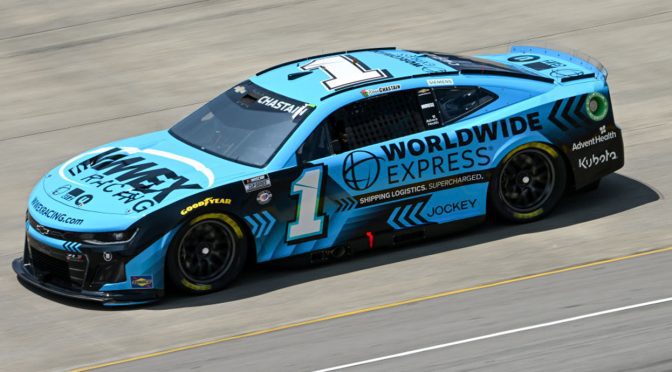
ROSS CHASTAIN: Finished second in both Atlanta races in 2022, leading 74 laps.

ERIK JONES: Finished top 10 in three of the last five races on drafting tracks.

CHRISTOPHER BELL: Has finished sixth or better in three of four races this year, but was 23rd and 19th at Atlanta last year.

TYLER REDDICK: A third-place run at Phoenix was his best of the season, but he did not finish either Atlanta race in 2022.

Projections as of Wednesday, March 15:

RACING INSIGHTS’ PROJECTIONS FOR THE AMBETTER HEALTH 400

Finish Car No. Driver
1 12 Ryan Blaney
2 4 Kevin Harvick
3 1 Ross Chastain
4 11 Denny Hamlin
5 24 William Byron
6 5 Kyle Larson
7 19 Martin Truex Jr.
8 22 Joey Logano
9 8 Kyle Busch
10 14 Chase Briscoe
11 20 Christopher Bell
12 43 Erik Jones
13 99 Daniel Suárez
14 48 Alex Bowman
15 6 Brad Keselowski
16 23 Bubba Wallace
17 2 Austin Cindric
18 10 Aric Almirola
19 17 Chris Buescher
20 3 Austin Dillon
21 7 Corey LaJoie
22 41 Ryan Preece
23 31 Justin Haley
24 45 Tyler Reddick
25 34 Michael McDowell
26 47 Ricky Stenhouse Jr.
27 16 AJ Allmendinger
28 21 Harrison Burton
29 38 Todd Gilliland
30 42 Noah Gragson
31 77 Ty Dillon
32 54 Ty Gibbs
33 9 Josh Berry
34 51 Cody Ware
35 15 J.J. Yeley
36 78 BJ McLeod