Brad Daugherty had spent Sunday morning at Daytona International Speedway, talking over the Daytona 500 plan with driver Ricky Stenhouse Jr. and the rest of his JTG Daugherty Racing team. Patience was one of the messages he preached to his driver, now in his fourth season with the single-car operation. The message resonated, he said.

Daugherty’s day at the track also included a visit with Hall of Famer Richard Petty, whose No. 43 he wore on his jersey in tribute to NASCAR’s king as a five-time NBA All-Star with the Cleveland Cavaliers. He also talked shop with JTG Daugherty competition director Ernie Cope to get a sense of what the day would hold.

Then, ironically because of the abundant Florida sun that blessed Daytona with mostly pleasant weather through the week leading up to Sunday’s 500, Daugherty had to head home.

“I had eye surgery last week, and I had gotten some fluid in my eye and had it drained out of my eyeball, which was a lot of fun,” Daugherty said in a Tuesday morning phone interview. “And so I had a tough time seeing. … Everything got going, and I’ve got a home in Orlando. I just went home because I couldn’t see real well. And so I got in where I could get in the dark and get the man cave fired up, and I sat and watched it on TV, which was great because nobody could bother me and I could watch the whole thing.”

“Made in the shade” was about to take on a new meaning. What Daugherty buckled in for was the longest Daytona 500 in history and a moment of triumph for the underdog team from Harrisburg, North Carolina. Like the rest of the viewing audience, Daugherty had to wait briefly for an official review of the overtime finishing order once the field was frozen by a race-ending crash. Even then, once the ruling came in, it still took a beat for the magnitude to sink in.

“I sat there for a second. And I was like … We just won the Daytona 500. I realized I was by myself, but I was like, ‘OK, this is really great, because you’re talking to yourself,'” Daugherty recalled. “And then I just went nuts. So then my phone started ringing — people from NASCAR calling me, the team was calling me … everybody. I was just like, this is unbelievable. This is an unbelievable moment in NASCAR history, for a little race team at Harrisburg, and for a team that just doesn’t quit.”

RELATED: Daytona 500 results | Power Rankings

Two days later, Daugherty says he’s still trying to sort his way through the more than 200 texts and phone calls from well-wishers, and he’s also soaking in the history he made and shared with his fellow team owners. Daugherty became the first Black primary team owner to win the Daytona 500, and co-owner Jodi Geschickter – who launched the team with her husband, Tad, as an Xfinity Series operation in 1995 – became just the second woman to claim victory in the “Great American Race” from the team-ownership side.

Daugherty was quick to acknowledge the contributions of Black team owners and drivers in his peer group who had built the foundation alongside him – Tinsley Hughes, Bill Lester and Sam Belnavis, who had a partial stake in the Miller-sponsored Stavola Brothers entry that Hall of Famer Bobby Allison drove to his final Daytona 500 victory in 1988. That group includes longtime friend and fellow NBA legend Michael Jordan, who is now with him among the NASCAR team ownership ranks with 23XI Racing and driver Bubba Wallace.

Ricky Stenhouse Jr. raises his arms in celebration with the No. 47 team after their Daytona 500 victory
Chris Graythen | Getty Images

“I get to stand here as the first African-American owner to get to hoist that Harley J. Earl trophy. Man, we’ve made history. This is historical, and nobody can take that from us or take that from me,” Daugherty said. “I’m so proud, and I look forward to hoisting more trophies with my race team. And as we move forward, just a lot of pride. We’re not one of these big, massive race teams. We’re a little, small group of about 50 people, and we just go out every day and beat and bang, and grind and hustle, and there’s a lot of times a lot of days, a lot of nights, man, we get our teeth kicked in. It’s just absolutely what happens. But on days like Sunday, man, it’s all worth it. It’s all worth it. This has all been worth it.”

Stock-car racing had always captured the attention of Daugherty, who was raised in the small town of Black Mountain in western North Carolina. As he grew into his 7-foot frame and became a basketball star first at Charles D. Owen High School and later at the University of North Carolina, his passions were shaped by the picturesque outdoors of the surrounding Blue Ridge hills and the complexion of his community.

“I grew up there with 5,000, 6,000 people, maybe 100 African-Americans, and they’re all my cousins,” Daugherty said. “So, my friends I played basketball with and played baseball with, were always Caucasian males who were my best friends, and so, my life just emulated their life to a certain degree. You know, I’m a country kid, and I like to hunt, I like to fish. I’ll even listen to country music every once in a while, and so I love racing.

“But when I came along and got involved, I mean, it was very stark. And I realized a lot of days that my face was the only face of color at the entire track. And that was always, it was humbling in some respects, but it was never a deterrent. I was never going to let anyone tell me where I couldn’t go, because of the color of my skin, and I’m always going to do whatever I want to do. And so I think that attitude served me well.”

Daugherty was introduced to the Geschickters by Robert Pressley – a longtime Xfinity Series standout and fellow western N.C. resident – in 2008, which turned out to be a pivotal year for the organization. Daugherty eventually became a part of the ownership group, and the team transitioned to a full-time Cup Series entrant the following season.

MORE: ‘We believe!’ message for No. 47 team | Video: Catching up with Stenhouse

Daugherty’s involvement came on the early edge of NASCAR’s increased focus on making the sport more accessible and inclusive for minorities. It’s made strides since those stark days that he initially referenced, and his fellow team owners have sought to further those efforts.

“I mean, America doesn’t just look like the people in the garage have looked like for 55 years,” Tad Geschickter said. “It’s diverse and everyone has different points of view and different talents and treasures. Brad certainly adds a different element to what we do and different thinking and a different background, and I think it’s the same from engineering to tire changers to drivers. It’s sorely needed.

“NASCAR has done the heavy lifting to really call that out as a priority, and we’re going to keep digging in that direction. It’s good for the sport. We need to look exactly like the cross-section America is to continue to build our fan base, so it’s awesome.”

Daugherty says his respect for the Geschickters and their business savvy was mutual.

“They’ve been doing this for 29 years, and just tremendous sacrifice,” Daugherty said. “You hear Tad talk about it all the time, just bootstrapped it along and have put together a pretty remarkable organization. They’re workers. Tad hustles on that marketing side. He’s got a great acumen for marketing and business. And Jodi is just a fantastic businessperson. She’s very, very smart. I mean, there’s times we’ll have meetings and I’m all over the map, and I’ve got OCD real bad and I’ve had two cups of coffee and I’ve got all these grandiose ideas. Tad, he’s a non-conflict guy, so he kind of goes along with things. And so the bridge in the road is Jodi. She will bring my rear end right back into the bull’s eye very quickly while I’m just all over the map, and I love it.”

While Daugherty works to clear his phone of new texts and missed call notifications, one notable interaction has already generated some buzz. Jodi Geschickter relayed during the winning team’s post-race press conference that she spoke with Daugherty by phone after the Daytona 500 victory, and that his conversations with Jordan involved “talking trash.”

Daugherty said Tuesday that outside of his own No. 47 team, he frequently roots for the success of Wallace and Jordan’s No. 23 group. The notion that any playful jabs he sent Jordan’s way were anything more than light-hearted banter made him laugh.

“Aw, man, Michael and I are best friends. He’s awesome,” Daugherty says. “I saw all that today, and that unfortunately becomes clickbait because of Michael’s name, and everyone wants it to be some old NBA rivalry. That’s just garbage. I’ve known Michael since I was 17. I consider him a good friend, and I admire him, and I’m thankful for Michael Jordan. I’m so thankful because without him, a guy like Bubba Wallace doesn’t get a chance, and that’s gonna be long-term.

“So, no trash talk. I’m pulling for MJ, man. I hope these guys win a bunch of races and I hope they win a championship soon. They’re capable.”

According to conventional wisdom, NASCAR stock car racing was a regional sport born in the Southeast and confined to that geographic area until its explosion of popularity in the late 20th century.

That conventional wisdom, however, ignores the flourishing activity in the sport on the West Coast, activity that closely paralleled the rise of NASCAR in the South.

The official “born-on” date of NASCAR is Dec. 14, 1947, when Bill France Sr. called the sanctioning body’s formative meeting in the Streamline Hotel’s Penthouse Club in Daytona Beach.

RELATED: NASCAR 75 coverage | Relive NASCAR’s origin story

But France was widely traveled, and in 1950 — a year after NASCAR ran its first season in what was then called Strictly Stock — he met Oregonian Hershel McGriff at the Pan-American Road Race in Mexico.

“He (France) was there with Curtis Turner to run the race,” McGriff recalled in his induction speech at the NASCAR Hall of Fame in January. “My neighbor had bought me a 1950 Olds for that five-day, 2,132-mile race through Mexico. I found a sponsor to pay the $600 entry fee …

“Bill noticed me because I was competitive throughout the race with him and Curtis. I think out of 132 entries, at 22 years old, I ended up winning the race. There were other NASCAR drivers there, too — Red Byron, Raymond Parks, Fonty and Bob Flock, and Johnny Mantz …

“After the race, Bill invited me to come to the first Southern 500 at Darlington, which was four months later. We drove the car from Portland (Ore.) to Darlington, raced 500 miles and then we drove it back home.”

The race attracted a field of 75 drivers competing for the $5,000 winner’s share, a colossal prize at the time. Driving the 1950 Oldsmobile, McGriff started 44th and finished ninth, 26 laps down. Mantz won the inaugural crown-jewel event by nine laps.

McGriff’s presence at the Southern 500 was more than just cross-pollination between East and West. It fueled France’s vision of creating a national — even international — sport.

By 1951, NASCAR’s top series, by then known as “Grand National,” had California on its schedule. Marshall Teague won the debut Golden State race in front of 9,000 fans at Carrell Speedway in Gardena, a half-mile dirt track.

France’s vision also included the establishment of a West Coast series that could serve to develop the talents of drivers unable to make costly trips to the South.

The Pacific Coast Late Model Circuit, founded in 1954, has evolved into what is now the ARCA Menards West Series after competing under the NASCAR Winston West Series label from 1971 through 2003 (though there were variations of the nomenclature during that period).

During the inaugural season, McGriff won the Pacific Coast Late Model Race at Bay Meadows Speedway in San Mateo. From a nine-race schedule in 1954, the series grew.

France entrusted two key figures with the health and prosperity of the West Coast racing — Les Richter, an all-pro linebacker with the Los Angeles Rams who managed Riverside International Raceway and later became vice president of special projects for International Speedway Corporation; and Ken Clapp, now-retired NASCAR vice president who, by his own estimation, promoted more than 4,800 single-day racing events during his illustrious career.

As the West Series was growing, so was the presence in California of NASCAR’s top division. The NASCAR Cup Series raced 48 times on the road course at Riverside, starting in 1958. From 1970 through 1981, the Riverside race was the opening event on the NASCAR schedule.

From 1971 through 1980, Cup drivers plied their trade at Ontario Motor Speedway, a 2.5-mile behemoth touted as the “Indianapolis of the West.” Appropriately, perhaps, A.J. Foyt won the first two races at Ontario, in 1971 and 1972.

Clearly, NASCAR had established a strong presence in California long before the opening of Auto Club Speedway in 1997. In celebrating NASCAR’s 75th anniversary this season, it’s prudent to remember that NASCAR’s association with the West Coast is almost as venerable.

It wasn’t until 1995, however, that the NASCAR Cup Series had its first West-Coast-born champion — Jeff Gordon. But in the 21st century, drivers born in the Pacific Time Zone have won 13 of 22 series titles.

Racing in the Los Angeles area continues to evolve. Riverside and Ontario are defunct, with Ontario Mills Mall now occupying the site of the large oval. The 2.0-mile configuration at Fontana will leave the Cup schedule in 2024, as NASCAR contemplates its conversion to a half-mile short track.

Anticipating that change, the Busch Light Clash at the Coliseum already has brought two years of no-holds-barred short-track racing to Los Angeles proper — and has brought NASCAR racing to a new, broader audience in the process.

DAYTONA BEACH, Fla. — Brad Keselowski and Chris Buescher produced a banner day for RFK Racing in Sunday’s Daytona 500.

The only problem is neither of them took home a banner to hang.

Buescher powered to a fourth-place finish in double-overtime while Keselowski, the team’s co-owner, was sent careening into the Turn 2 SAFER barrier in the final-lap brouhaha, finishing 22nd and leaving a bitter taste for the teammates after an impressive afternoon in the “Great American Race.”

RELATED: Official results | At-track photos: Daytona

Neither has won the sport’s shiniest crown jewel. Keselowski’s plight has been particularly frustrating, often leading laps just to fall short in his pursuit. Sunday saw the 2012 champion lead the most circuits (42) for the second consecutive year. But that’s all he has to show for either, save for wadded-up feelings and plenty of frustration.

Chris Buescher and Brad Keselowski lead as the field whizzes through Turns 3 and 4 in the 2023 Daytona 500
Mike Ehrmann | Getty Images

Keselowski and Buescher worked in literal tandem all afternoon, each driver pushing the other at respective points at the head of the field. Buescher, a winner last year at Bristol Motor Speedway, led 32 laps around the 2.5-mile tri-oval, second-most only to his teammate and car co-owner.

“The performance and the day that we had is fantastic,” Buescher said. “I gotta be careful because I don’t want to take that away from our group back at RFK, from our folks down here with all of our partners — Fastenal and Fifth Third and everybody that’s here with us. And to come down here and have that kind of run, it’s fantastic for both of us.

“You just, you want to hold a trophy at the end of the day, and we’re not holding a trophy right now. So the end result is the only thing that I’m sitting here bummed about at any level. The rest of the day was awesome.”

Crew chief Matt McCall, the shot-caller on the No. 6 RFK Ford of Keselowski, was left wrenching through busted suspension pieces and bent fenders in the Cup Series garage following the checkered flag. All of it was a too-blunt reminder of the missed opportunities that have evaded this team for two straight seasons — and for his driver, even longer at 14 years.

“I mean, it’s as what you plan to do, and it worked out until it didn’t, right?” McCall said of running up front. “So I mean, it’s frustrating, but that’s Daytona and Talladega and probably Atlanta, so we’ll just keep working away and see if we can put it together one time. Feel like last year was similar spot, little closer to it this time, but race over, didn’t matter.”

DAYTONA BEACH, Fla. — Every Daytona 500 has a defining moment. Some have a defining word.

The word for Ricky Stenhouse Jr.? Believe.

Crew chief Mike Kelley penned “We Believe! TODAY” on a piece of fluorescent orange tape he stuck to the roll bar that sits above Stenhouse’s windshield ahead of Sunday’s Daytona 500. Their No. 47 JTG Daugherty Racing Chevrolet stormed to the win in the 65th edition of the Great American Race, Stenhouse’s third career Cup Series victory.

RELATED: Official Daytona 500 results | Full race recap

The 2023 season serves as a reunion year for Kelley and Stenhouse, a duo that claimed back-to-back Xfinity Series championships together in 2011 and 2012 at RFK Racing (then known as Roush Fenway Racing).

Kelley has continued to help Stenhouse throughout his Cup career, churning as crew chief at RFK during the 2013 season and working closely on his team. Stenhouse’s only prior premier victories came in 2017, winning at Talladega Superspeedway in the spring in addition to the Coke Zero Sugar 400 on July 1 at Daytona.

Along the way, many doubted Stenhouse, who has released from his Roush contract in 2019 in favor of Chris Buescher.

Kelley never gave up.

That carried into race-day morning when Kelley woke up at 3:30 a.m. ET.

“Something this morning felt different,” Kelley said after the victory. “Kind of how our week started. I kept telling myself, ‘If we just keep working on our car and keep believing in ourselves, maybe something will work out.’

“When I woke up this morning, I told myself – and this is something I used to do for Ricky when we had tough days in the Xfinity car – I just wrote him a note that only he would see, and it was on top of the roll bar in front of him, and it said, ‘We believe.’

“That’s been our team’s motto all offseason is ‘we believe.; We’re a small team. We’re not a super powerhouse team. We’re small. I think there’s 40, 45 employees that work in our shop every day. But I have 45 people that believe in what we’re trying to accomplish. We’re trying to get people to believe in Ricky Stenhouse again. We’re trying to get people to believe in myself and the vision that we have.”

Stenhouse affirmed two things Sunday: Kelley’s messaging and why that in-house belief was critical.

“Not winning since 2017, having struggles, ups and downs,” Stenhouse reflected, “to have somebody like Mike, who when he took over the reins as soon as the season was over, it was, ‘hey, I know you can still get this done. We’ve just got to give you the right opportunities. We know if we give you cars capable of running up front, you can do that. We’ve proven that.’

“Yeah, we won here at the Daytona 500, but I still think the fruits of that are going to come later on from his leadership in the shop and making sure. Most of these guys that we have are the same guys we had last year. But he believes in me more than I do, I think, and that’s huge.”

The result after Sunday’s momentous triumph seals Stenhouse forever as a Daytona 500 champion.

Believe it.

As NASCAR waved the green flag on a very special regular season Sunday at Daytona, the sanctioning body also introduced a new creative campaign celebrating its 75th “diamond” anniversary with a set of three commercial spots showcasing the sport’s past, present and future.

The first spot – titled “Anthem” – debuted as part of a special pre-race moment during FOX’s telecast of the Daytona 500 on Feb. 19 and focuses on NASCAR’s 75-year journey to this point.

MORE: All things NASCAR 75

“This 75th Anniversary campaign was created to honor the rich history of NASCAR and celebrate our bright future with the same adrenaline-inducing intensity that resonates with our fans,” said Pete Jung, senior vice president and chief marketing officer at NASCAR. “This is one of the biggest and boldest campaigns and creative executions in the history of the brand. We’re grateful to have incredible creative partners that helped bring the campaign to life, and optimistic this milestone will be an opportunity to deepen our relationship with NASCAR fans new and old throughout this 75th anniversary season.”

“Anthem” is a 60-second thrill ride that races through NASCAR’s evolution from humble beach beginnings to America’s No. 1 motorsport, anchored by a No. 75-branded car that sheds its skin to reveal race cars from different eras.

Developed with agency partner 77 Ventures Creative and directed by Mark Jenkinson of Imperial Woodpecker over several days in Barstow, California, the spot combines original footage, historical highlights and reenactments, and computer-generated imagery (CGI) to recreate some of the sport’s most memorable moments: from Cale Yarborough scrapping with Bobby and Donnie Allison at the 1979 Daytona 500 through Dale Earnhardt dumping Terry Labonte for a Bristol win in 1999 and onto Denny Hamlin inching out Martin Truex Jr. for the 2016 Daytona 500 victory.

It closes with the campaign line “Always Forward” – an ode to NASCAR’s speed and motion on the track as well as its future progression off it.

“Commemorating NASCAR’s 75th anniversary was a creative opportunity that allowed us to revisit the genesis of the sport and look forward to the future,” said Meredith Weiss, managing director at 77 Ventures Creative. “ ‘Always Forward’ honors that history while also inspiring us to stay tuned for what is in store. The 75 car was a perfect vehicle (no pun intended) for telling that story because the car’s physical transformation over the years has paralleled the evolution of NASCAR into a new era.”

“Anthem” will be followed in the spring by a “Present” spot showcasing the stories of today’s young stars. An imaginative “Future” spot – focused on the potential that lies ahead – will break later in the summer.

The 75 car will be featured across all three ads, connecting the work with a metaphorical central character that helps reveal layers of NASCAR history and hints at future possibilities.

Each spot will have 60 and 30-second versions that run on television and across social and digital inventory.

DAYTONA BEACH, Fla. – The week-long frenzy surrounding Jimmie Johnson’s return to NASCAR on the sport’s grandest stage reached its fevered peak in Sunday’s Daytona 500. The seven-time Cup Series champion was part of an elite group of stock-car racing greats who gave the command to fire engines, and the broadcast and pre-race build-up matched the fanfare.

By the time it came to get down to the business of racing in his unretirement debut, Johnson demonstrated that he still had his veteran poise, if not the Daytona good fortune. His first go in the No. 84 Legacy Motor Club Chevrolet that he co-owns ended in the calamity of an overtime wreck and a 31st-place finish.

“All in all, just a great day. I hate that we didn’t get to the finish line, but we got a lot closer than I thought,” Johnson said at the end of his 20th Daytona 500. “If I would have taken a bet before the race started, I would have thought some issues earlier than that, but we had a great day. The Carvana car was awesome. Very, very proud of this race team. Unfortunately, we didn’t get the finish line.”

RELATED: Daytona 500 results | At-track photos: Daytona

Johnson started 39th in the 40-car field, sharing the back row with Travis Pastrana, who celebrated with his friend after both drove their way into the starting lineup in Wednesday night’s qualifying. He made incremental progress through the first stage, placing seventh by the first break in the race.

Johnson hit a snare near the end of Stage 2, nabbed for speeding on pit road during a Lap 122 stop. The penalty dropped him to the tail end of the field, and Johnson was at a loss to explain it.

“I don’t know how,” he radioed the team. “No worries.”

Jimmie Johnson exits his wrecked No. 84 Chevrolet after a late-race crash in the Daytona 500
James Gilbert | Getty Images

The more calamitous events were yet to come in the final stage. Johnson’s No. 84 caught a smidge of damage from a seven-car stackup on Lap 182 of a scheduled 200, but he remained in contention on the back end or fringes of the top 10 as the race pushed into extra laps.

A crash that sent the event into its second overtime proved to be Johnson’s undoing, halting his day nine laps short of the end.

“I thought we had decent pace, and I thought he did a good job at the end of Stage 1, just continuing to drive forward,” No. 84 crew chief Todd Gordon told NASCAR.com. “I thought longer in the run, we were in better position. We got into some damage there about midway through the last stage, got hit pretty hard in the right-side door. It didn’t look bad. These composite bodies don’t really show you the hit you got, but I think we damaged the exhaust and lost a little bit of pace there and just couldn’t keep up to where we needed to be.

“It’s speedway racing, right? You get to the end of these races, and people push pretty hard, pushing through the corners is a pretty hairy thing, and we got caught up in it. I’m pretty proud of the effort that we put together. I thought we had a pretty good race car. We had something we could have worked with. We’ve got some growing to do.”

In terms of the notion that the 47-year-old driver might have shown any rust in his first NASCAR race since the end of 2020, Gordon just smiled.

“Seven-time champion still knows how to drive a race car, right?” said Gordon, a Daytona 500 winner himself as Joey Logano’s crew chief in 2015. “It’s not that he’s been sitting at home on a rocking chair. He’s been IndyCar racing. So to bring it back here, I thought he did a great job, and he’s competitive. He’s competitive. He wants to win, and unfortunately, we just got caught up in the things today, but I felt like, before that point, we were in a good place to be able to. I don’t feel like he races at 100% until it’s time, and I felt like we had a little something left.”

DAYTONA BEACH, Fla. — A new era for Kyle Busch began painfully familiar — wrecking out of the Daytona 500, still unable to check the only empty box on his tremendous list of crown-jewel wins.

RELATED: Daytona 500 results | At-track photos: Daytona

The two-time Cup Series champion has won about everything a driver could strive for in his 18 prior seasons — Darlington’s Southern 500, Charlotte’s Coca-Cola 600, the Brickyard 400 at the famed Indianapolis Motor Speedway. Yet the win column sits goose-egged in the “Great American Race” after 18 tries, a streak that only continued in his first regular-season race with Richard Childress Racing.

From left, Kyle Busch, AJ Allmendinger and Denny Hamlin crash on the final lap of the 2023 Daytona 500
Mike Ehrmann | Getty Images

The final overtime saw Rowdy take the white flag fifth, second in the outside lane giving a hard charge to the rear bumper of Joey Logano to charge to the lead in Turn 1. But Turn 2 saw the field fly apart. Before Busch could make a move to try and win the race, he was clipped in the left-rear quarter panel and sent spinning driver-side first into the outside SAFER barrier.

The No. 8 Chevrolet paced the field for six laps Sunday night — all of them when it seemed they would matter most. Busch led Laps 197-202 in a race that was scheduled to end at Lap 200. The 65th annual season opener became the longest yet, concluding at Lap 212 thanks to two overtime finishes.

“I think this is the first time I led Lap 200,” Busch lamented. “I wish it was 1998 rules.”

In 1998, another famed black hat of the sport ended what was a 20-year pursuit of the Harley J. Earl Trophy when Dale Earnhardt Sr. wheeled Richard Childress’ No. 3 car into Victory Lane.

Twenty-five years later, the KFB fairytale nearly became reality. The nightmare continued instead.

“It’s just par for the course,” Busch said. “Just used to it, and come down here every year to just find out when and where I’m going to crash and what lap I come out of the care center.”

MORE: Recap all the Daytona action | See final laps of Daytona 500

The first overtime restart saw Busch control the restart alongside teammate Austin Dillon. Busch ducked from high to low in an effort to link the Nos. 8 and 3 with William Byron’s No. 24 Hendrick Motorsports Chevrolet.

“It looked like it was kind of working,” Busch said, “but we got too much separation off of two, and I tried to back up to get to them. And when they hit me, it got me really squirrely, and then Austin checked up and then it just — the accordion happens, and everybody gets running over everybody.”

That triggered the wreck that led to a second overtime.

After another missed opportunity in NASCAR’s biggest spectacle, Busch was simply left soured at the infield care center.

“Who won? I don’t even know who lucked into it,” he said.

The answer: Ricky Stenhouse Jr., who snagged his third career Cup victory, first Daytona 500 and first triumph since winning the 400-miler at Daytona in July 2017.

“There you have it,” Busch said.

DAYTONA BEACH, Fla. — Joey Logano came close to adding more history to his hearth once again in Sunday’s Daytona 500.

After winning the 2022 NASCAR Cup Series championship – not to mention the 2015 edition of the “Great American Race” – Logano almost added another crown jewel to his growing Hall of Fame resume in the 65th running of the Daytona 500 at Daytona International Speedway. However, his late-hour push toward the front wasn’t quite enough to seal the deal in overtime, and a last-lap caution turned the outcome into a career-defining victory for Ricky Stenhouse Jr. instead, leaving Logano as the runner-up.

RELATED: Official race results | At-track photos: Daytona

“Pissed off, that’s where I’m at right now, with a little bit of a smile at least,” Logano said after a quick pit-road debrief with his No. 22 Team Penske Ford group. “We finished it, which is all right, but gosh, I hate finishing second in the 500. You’re so close to winning the biggest race of the year. … What do you do? It’s over now, you move on, but we were so close to winning this thing. So proud of our team and what we’ve done from coming off the championship and carrying momentum into the season, but finishing second in the 500 in an extremely solid race is just, argh! It stings. It hurts right now.”

Logano led six times for 12 laps in a bid for his second 500 crown, and he was lined up in fourth place for the final restart, sitting behind Stenhouse on the outside lane. Three-quarters of the way through the next-to-last lap, Stenhouse gained a bit of a margin and shifted lanes, leaving Logano to lead the top side with Kyle Busch’s No. 8 Richard Childress Racing entry behind him.

Even as the only Mustang driver among the top nine — the “lone horse,” he said — Logano actually inched ahead after the white flag when Stenhouse’s No. 47 JTG-Daugherty Racing Chevrolet was forced three-wide with Kyle Larson in the middle. When Larson’s car faded heavily and spun sideways, the ensuing multi-car tangle behind the front-runners prompted a race-ending yellow flag.

“Second is the worst, man,” Logano said. “You’re so close. Leading the white-flag lap there, I was up front. Kyle (Busch) gave me a good push, and, yeah, you’re watching in the mirror, and you’re three-wide across there. I felt like the three-wide was going to hurt a lane; looked like Kyle (Larson) was getting pushed ahead, and then Ricky started getting pushed ahead.

“I knew if I went to the bottom, my car didn’t handle good enough. I already got pushed off the bottom once, and I thought, if I go down there, I’m probably going to get wrecked, and I don’t know if I can get down there in time to throw the block and so I didn’t want to wreck my car either.”

Logano came through with his No. 22 Ford largely unscathed in an eventful race where many of his fellow competitors were not as fortunate. The Sunday performance also backed up a rock-solid showing in the days leading up to the 500 – fifth-fastest in time trials, a victory in a Duel qualifying race and a third-place starting spot for the main event.

“We had the performance the whole week we’ve been down here,” No. 22 crew chief Paul Wolfe told NASCAR.com. “The Fords were fast, that was encouraging. Proud of our pit crew. We executed really well and that put us in position there at the end really to get the lead. Gosh, it’s just so hard to get through one of these races clean and to be that dang close. It just stings right now. Typically, second’s a good run but it just doesn’t feel like it right now for everything it took to get ourselves here.”

While the result was bittersweet, Logano made it a priority to give credit where credit was due and offer his congratulations in his televised interview, saying from experience, “There’s nothing like winning the Daytona 500.”

Even with the video review of the finish indicating a clear victory for Stenhouse, Logano mostly kept his foot on the gas on his way back to the start-finish line for the final time. He actually edged ahead of Stenhouse’s No. 47 to take the checkered flag and yellow flag first – an action that briefly and incorrectly put his No. 22 atop the scoring pylon before the accurate finishing order was listed.

“I was in denial,” Logano said with a laugh. “I still am.”

Contributing: John Crane

DAYTONA BEACH, Fla. — In the longest Daytona 500 in NASCAR history, Ricky Stenhouse Jr. got help from an unexpected source and won the sport’s most prestigious race when a wild wreck froze the field in the second overtime.

Stenhouse and reigning NASCAR Cup Series champion Joey Logano were battling for the lead on Lap 212 when contact from Aric Almirola’s Ford started Travis Pastrana’s Toyota spinning in Turn 2. Pastrana’s Camry clipped the Chevrolet of Kyle Larson and set it rocketing into the outside wall.

Tires screamed, sparks flew and smoke billowed as the cars of defending race winner Austin Cindric, Brad Keselowski, Kyle Busch, AJ Allmendinger, Denny Hamlin, Bubba Wallace and Ryan Blaney were all collected in the chaotic wreck.

But when NASCAR hit the button to illuminate the caution lights, Stenhouse’s No. 47 JTG Daugherty Chevrolet edged ahead of Logano’s Ford, thanks to a timely shove from the third-place finishing Toyota of Christopher Bell, who, like Stenhouse, arrived at the pinnacle of pavement racing from a dirt-track background.

NASCAR declared Stenhouse the winner of the 65th running of the event, a perfect christening of the renewed relationship between the driver and crew chief Mike Kelley, with whom Stenhouse won his two NASCAR Xfinity Series championships more than a decade earlier. It also gave manufacturer Chevrolet its 25th win in the Great American Race.

RELATED: Official race results | At-track photos

“Yeah, I think this whole offseason Mike just preached how much we all believed in each other,” Stenhouse said after climbing from his car. “They left me a note in the car that said they believe in me and to go get the job done tonight. I made a few mistakes. We were able to battle back.

“This Kroger Continental team worked really, really hard in offseason, great pit stops, Hendrick engines. Glad a Chevy won.

“Man, this is unbelievable. This was the site of my last win back in 2017. We’ve worked really hard. We had a couple shots last year to get a win and fell short. It was a tough season, but, man, we got it done. Daytona 500!”

It was a remarkable victory and a perfect highlight for the 75th anniversary of NASCAR racing. Stenhouse is the first driver from a single-car team to win the Great American Race since Trevor Bayne shocked the racing world with Wood Brothers Racing in 2011.

The win was Stenhouse’s third in the Cup Series and first since he took the checkered flag in the Daytona summer race in 2017, snapping a streak of 199 races without a victory. JTG Daugherty hadn’t found Victory Lane since Allmendinger triumphed at Watkins Glen in 2014, a drought of 266 races.

With a push from Kyle Larson after the second overtime restart, Logano held the lead with one lap left.

“Second is the worst, man,” Logano lamented. “You’re so close. Leading the white flag lap there, I was up front. Kyle gave me a good push and, yeah, you’re watching in the mirror, and you’re three-wide across there. I felt like the three-wide was going a hurt a lane; looked like Kyle was getting pushed ahead, and then Ricky started getting pushed ahead.

RELATED: Joey Logano finishes second in 2023 Daytona 500

“I knew if I went to the bottom my car didn’t handle good enough. I already got pushed off the bottom once and I thought, if I go down there, I’m probably going to get wrecked, and I don’t know if I can get down there in time to throw the block (on Stenhouse) and so I didn’t want to wreck my car either.”

At 212 laps (530 miles), this Daytona 500 was three laps and 7.5 miles longer than the 2020 race, which held the previous record.

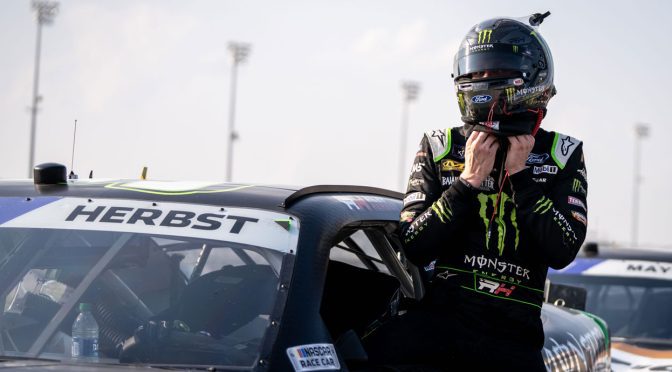
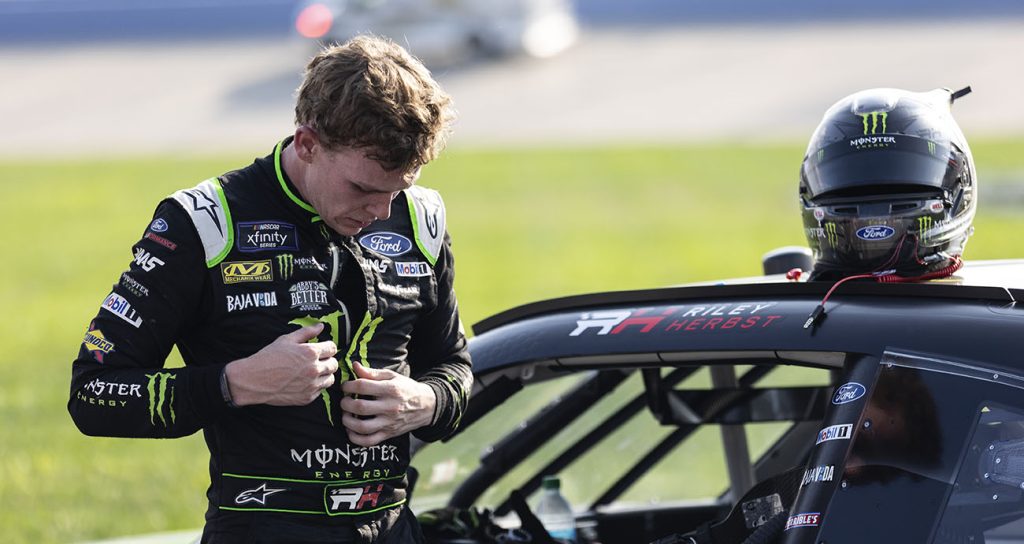
Chris Buescher finished fourth after leading 32 laps, second most to Keselowski’s 42. Pole winner Alex Bowman was fifth, followed by Allmendinger, Daniel Suarez, Ryan Blaney, Ross Chastain and race rookie Riley Herbst.

Blaney made a remarkable recovery after sustaining serious damage in the first wreck of the afternoon.

Until then, the calm of the first 295 miles of racing gave no indication of the chaos to come.

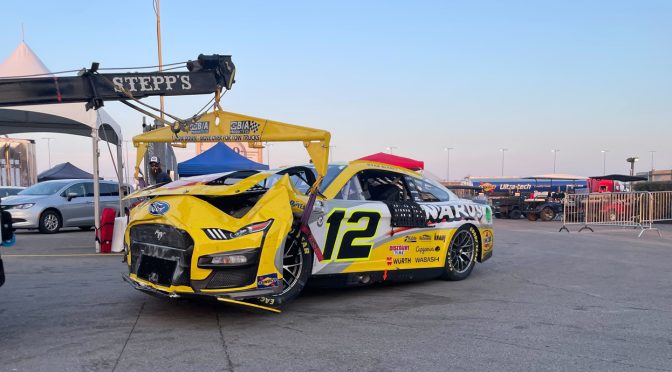
The race ran without incident until Lap 118 when contact from Kevin Harvick’s Ford turned Tyler Reddick’s Toyota sideways in Turn 4. After bouncing off the outside wall, Reddick’s crippled No. 45 Camry came to rest at the entrance to pit road and was towed to the garage.

The No. 43 Chevrolet of Erik Jones and the No. 9 Camaro of 2020 series champion Chase Elliott also sustained terminal damage in what became a nine-car incident.

Blaney lost a lap on pit road under repair, while others involved—Kyle Larson, Kyle Busch, Daniel Suarez and Martin Truex Jr.—remained on the lead lap.

“It looked like some guys got tangled up, up front,” Elliott said. “Those of us in the back were just scattering to kind of miss it. It looked like the No. 5 (Larson) and the No. 43 (Jones) kind of went to the apron.

“By the time we got slowed up, they were coming back across the track, and I was the lucky winner to get there first. It’s a bummer—long ways to go. Hate to end the day, but it is what it is.”

Note: Post-race inspection in the NASCAR Cup Series garage is complete with no issues. The Nos. 17 and 48 will be taken back to the NASCAR R&D center for further inspection.

Contributing: Staff reports.

Which channels have NASCAR programming this week? We answer that and give the weekly NASCAR television listings here in the NASCAR TV schedule.

Note: All times are ET.

MORE: How to find USA Network | How to find FS1 | Get FOX Sports App | Watch on USA Network | Get the NBC Sports App | Watch on Peacock | FloRacing | How to watch NASCAR International

Monday, Feb. 20
2 a.m., NASCAR Xfinity Series: 2023 BEEF. It’s What’s for Dinner. 300 at Daytona (re-air), FS1
10 a.m., NASCAR Xfinity Series: 2023 BEEF. It’s What’s for Dinner. 300 at Daytona (re-air), FS2
Noon, NASCAR Cup Series: 2023 Daytona 500 (re-air), FS2
6 p.m., NASCAR Race Hub, FS1
10 p.m., NASCAR Race Hub (re-air), FS2
11 p.m., NASCAR Cup Series: 2023 Daytona 500 (re-air), FS1

Tuesday, Feb. 21
2 a.m., NASCAR Xfinity Series: 2023 BEEF. It’s What’s for Dinner. 300 at Daytona (re-air), FS1
4 a.m., NASCAR Cup Series: 2023 Daytona 500 (re-air), FS1
6 p.m., NASCAR Race Hub, FS1
6 p.m., Dale Jr. Download, Peacock

Wednesday, Feb. 22
Midnight, NASCAR Cup Series: 2023 Daytona 500 (re-air), FS2
3 a.m., NASCAR Craftsman Truck Series: 2023 NextEra Energy 250 at Daytona (re-air), FS2
6 p.m., NASCAR Race Hub, FS1
6 p.m., Dale Jr. Download, Peacock

Thursday, Feb. 23
6 p.m., NASCAR Race Hub, FS1
6 p.m., Dale Jr. Download, Peacock

Friday, Feb. 24
Noon, NASCAR Pace Lap, MAVTV
3 p.m., NASCAR Pace Lap (re-air), MAVTV
6 p.m., NASCAR Race Hub, FS1

Saturday, Feb. 25
Noon, NASCAR Xfinity Series practice and qualifying at Auto Club Speedway, CANCELED
1:30 p.m., NASCAR Race Hub Weekend Edition: Fontana, FS1
2 p.m., NASCAR Cup Series practice and qualifying at Auto Club Speedway, CANCELED
4 p.m., NASCAR RaceDay: NXS Auto Club Speedway, FS1
5 p.m., NASCAR Xfinity Series: Production Alliance Group 300 at Auto Club Speedway, FS1, POSTPONED

On MRN:
2 p.m., NASCAR Cup Series practice and qualifying at Auto Club Speedway, CANCELED
4:30 p.m., NASCAR Xfinity Series: Production Alliance Group 300 at Auto Club Speedway, POSTPONED

Sunday, Feb. 26
Noon, NASCAR Cup Series practice and qualifying at Auto Club Speedway (re-air), FS1
2 p.m., NASCAR RaceDay: Auto Club Speedway, FS1
2:30 p.m., NASCAR RaceDay: Auto Club Speedway, FOX
3:30 p.m., NASCAR Cup Series: Pala Casino 400 at Auto Club Speedway, FOX, FOX Deportes
8 p.m., NASCAR Xfinity Series: Production Alliance Group 300 at Auto Club Speedway, FS2

On MRN:
2:30 p.m., NASCAR Cup Series: Pala Casino 400 at Auto Club Speedway
7 p.m., NASCAR Xfinity Series: Production Alliance Group 300 at Auto Club Speedway