Sixty years ago, Darlington Raceway president Bob Colvin wanted to add a spark to his track’s springtime event. The race previously had distinguished itself from the longer, more prestigious Southern 500 as an event for the short-lived NASCAR Convertible Series. Even though that division folded after the 1959 season, Darlington still awarded full Grand National (now Cup Series) points for ragtops in that race for three more years.

That 300-mile race, held 60 years ago today at the South Carolina oval, wound up as one of stock-car racing’s most intriguing oddities in an era when the sport was still trying to find itself and larger speedways were beginning to bloom. The event was divided into two races, an overall winner was declared from a formula that averaged out the two results, and the field for the back half of the doubleheader went green from — gasp — a standing start.

NASCAR Hall of Famer Joe Weatherly won the first 110-lapper and finished second in the next segment to take the overall win, but the spark that Colvin sought to kindle never fully ignited. Having math as the path to Victory Lane created more confusion than excitement, and the race structure was relegated to a one-off footnote in the track’s grand history.

Sixty years later, the NASCAR Cup Series reconvenes at rugged Darlington Raceway for Sunday’s Goodyear 400 (3 p.m. ET, FS1, MRN, SiriusXM). The national series tripleheader will be the setting of NASCAR’s Throwback Weekend, which will continue the celebration of the sport’s rich history in its 75th anniversary season.

RELATED: Darlington weekend schedule | ‘Too Tough To Tame’ steeped in history

For all the remembrances planned, the Southern 500 memories will be the likely headliners, but so will the classic Ricky Craven-Kurt Busch spring-race showdown from 20 years back; they’ll be the grand marshals for Sunday’s 400. Weatherly’s 1963 triumph won’t make the highlight-reel list, but it’s worth exploring the quirks that have kept it a NASCAR curiosity all these years later.

First, the format. The first 110-lap portion used a traditional rolling start. The winner of the first leg received an extra payout and the first 10 finishers in each race also pocketed a monetary bonus — a nod toward the awarding of stage points in modern-day NASCAR events.

Between each race was a 30-minute break, which allowed time for mechanics to make repairs or adjustments for Race 2. That second race lined up according to the opener’s finishing order, but the field set sail from a standstill after a 10-second countdown to the flag. The cars would be gridded in staggered, alternating rows of two and three — done so to provide more evasive paths for trailing drivers in case of a stalled car near the front.

“I consider this standing start downright silly,” Hall of Famer Bud Moore, who owned Weatherly’s No. 8 Pontiac, told The Charlotte Observer. “But the fans will enjoy it, because there should be a lot of banging of race cars. I just hope the car which starts in front of Joe doesn’t stall. Better yet, I hope nobody starts in front of Joe.”

The points system to determine the overall winner was more convoluted, with potential flaws lurking within the rules. Each driver’s finish in each race earned points, and the result in the second race was weighted slightly more. Weatherly was bullish on how each dash would create the incentive to race harder, but at the same time, the format had its shortcomings. An overall winner could be crowned on consistency, without winning either segment or even leading a lap, and the first car to the checkered flag wouldn’t necessarily be the victor. Weatherly was intent to make the calculations a moot point with a heavy right foot.

“This race seemed to be planned for the chargers,” Weatherly told the Winston-Salem (N.C.) Sentinel two days before the race. “A driver knows he’s going only 110 laps in each race, so he’s going out there and push his car for all it’s worth. The guy who intends to stroke had better stay out of the way. I think I’m really going to like this race.”

NASCAR Hall of Famer Joe Weatherly kneels alongside his No. 8 Pontiac
NASCAR Research & Archives Center | Getty Images

Still, Weatherly was lightly regarded among the favorites, given the strength of Fords and Chevrolets at the start of the 1963 season. Ford had won the year’s first two big-track events with Tiny Lund in the Daytona 500, and then with Fred Lorenzen in the Atlanta 500. Lorenzen and fellow Ford driver Fireball Roberts were first and second in the race’s unofficial odds established by Jim Hunter, then a staff writer at The State in Columbia, South Carolina, who would become Darlington Raceway’s president 30 years later. Weatherly — the defending series champ — was the ninth choice in Hunter’s odds, going off as a 10-1 shot.

Lorenzen emerged with the pole position after three days of time trials, but his day was done shortly after the rolling start to the opener. On Lap 2, the Illinois campaigner lost control of his No. 28 Holman-Moody Ford and crunched the wall on the main straight. “I hit a slick place and just lost it,” he told reporters later.

Rex White was caught up in the incident, but managed to steer his No. 4 Chevy away from Lorenzen’s car to escape a more severe blow. “Rex did a fine job of driving avoiding me,” Lorenzen said. “He was heading straight for me but somehow got by me. His driving probably saved my life.”

With those two favorites sidelined, that left the top spot to Junior Johnson, who led 80 of the 110 laps in Race 1. When the transmission on his No. 3 Chevrolet gave out on the final lap of the first event, Weatherly capitalized for the win and extra prize money.

Of the 31 cars that started, 25 remained to make a go of it in Race 2. Richard Petty had found trouble in the opener, finishing sixth after running over debris and popping a tire on his No. 42 Plymouth. But he made the best of the standing start, charging ahead when Weatherly double-clutched and fought through vapor lock at his launch.

Newspaper accounts reported that the crowd roared its approval of the unusual starting procedure as the field clambered into Turn 1, but the rest of the second race had a less favorable reception. Petty was dominant in winning Race 2, but Weatherly finished as the runner-up, eight seconds behind and with little need to press Petty further for the overall win.

Weatherly’s finishes of first and second that Saturday afternoon equaled a winning point total of 197.8. He made just one pit stop in each race, and his final stop was a speedy 12 seconds for fuel only. Roberts survived a first-race tangle with Bobby Johns to place third in each event, netting him 191.7 points — good for second overall.

As for Petty, the lengthy pit stop to change his flat tire in the first half likely cost him the overall win, and his finishes (sixth, first) calculated to 189.9 points, third-best. The day’s effort, though, gave him the lead in the Grand National standings and some extra spending cash — $1,500 for winning the second race.

“I’ll say this,” Petty told the Greensboro (N.C.) Record, “I probably wouldn’t have won as much money as I did if there hadn’t been two races.”

MORE: Race results | Darlington throwback paint schemes

Other opinions were split on how successful the experimental format had been. Weatherly — who crowed post-race about how Moore’s tuning expertise had put Ford’s favorites in their place — had a different appreciation for the race procedures, especially since they made him $11,100 richer.

“I don’t care what kind of races they have,” Weatherly said, “just as long as they draw bigger crowds so the purses will get bigger.”

By the time anticipation started building for the Southern 500, Darlington’s Labor Day classic later that year, newspapers reported that track officials had quietly opted to scuttle the format for future 300-milers. Later accounts suggested that the move came at NASCAR’s urging. Either way, the race structure was mothballed, leaving the 1963 event earmarked for obscurity in the history books.

A modern-day look at the results sheet helps explain why. Petty was the first driver to the checkered flag, but just made the last spot on the overall podium after the formula was run. The “laps completed” column also reads like a jumble, failing to follow the numerical listing of the finishing order. David Pearson, for instance, crashed out after 180 laps and was credited with 12th place; G.C. Spencer completed 210 laps — 30 more than Pearson — but finished behind his Dodge teammate in 13th.

The radical procedures didn’t stand the test of time, but the head-scratching has endured. Ford driver Jimmy Pardue spoke for many when a fan asked post-race what he thought of the format.

“I guess it’s all right,” he said. “I’d just like to know where I finished.”

Checking the math, Pardue was ninth.
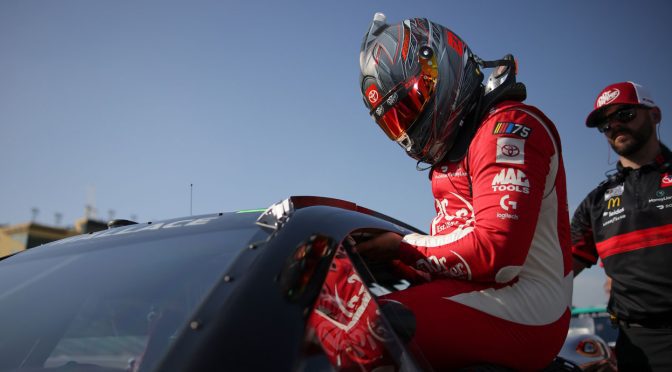
Speed was plentiful at Kansas Speedway last weekend, and that wasn’t just for the Next Gen cars alone.

Pit road was popping in the Sunflower State as teams put up some of the fastest times of the year. According to data by Racing Insights, six of the 10 single fastest four-tire pit stops of the year came at Kansas, including spots 2-6 on the list (full top 10 is below).

RELATED: Kansas results

The quickest of those was on Bubba Wallace’s No. 23 Toyota for the 23XI Racing team. His stop of 9.509 seconds on Lap 84 was the best of the day and the second-fastest of the entire season among all NASCAR Cup Series teams.

Most teams now display their own pit-stop time in their own pit box, and the data from the Next Gen cars essentially allows teams to see everybody’s times. At least one pit crew member credits that visibility leading to a spirit of competition at Kansas.

“I think when you start seeing faster stops, people start reaching for that,” said Ryan Flores, tire changer on the Team Penske No. 12 team and co-host of the “Stacking Pennies” podcast. “The only way to start reaching for that time is to take a bigger risk. Some guys fall in love with a certain (time) trying to be faster, and pit road is as hard as it’s ever been. The risk matches the reward, but the risk is really high.”

Wallace’s team consistently hit on pit road all day. In addition to having the fastest time on one four-tire stop, the No. 23 team also averaged the best time on all four-tire stops at 10.121 seconds.

Buoyed by the strength of crew Austin Dickey (front changer), Adam Hartman (rear changer), Brad Donaghy (tire carrier), Jorden Paige (jackman) and
Joshua Pech (fueler), Wallace drove to a fourth-place finish at Kansas, tied for his best finish of the year.

That pit-road performance moves the No. 23 team into fifth place on the season-long chart of fastest average four-tire pit stops of the year (see more below). William Byron’s No. 24 crew remains at the top of the rankings following Kansas.

See below to analyze additional pit-road statistics from Racing Insights.

10 FASTEST FOUR-TIRE PIT STOPS IN 2023

RankTrackDriverTime
1RichmondCorey LaJoie9.309 seconds
2KansasBubba Wallace9.509 seconds
t-3KansasTy Dillon9.543 seconds
t-3KansasDaniel Suárez9.543 seconds
t-5KansasJosh Berry (No. 48)9.576 seconds
t-5KansasKyle Larson9.576 seconds
7RichmondCorey LaJoie9.615 seconds
t-8PhoenixTy Gibbs9.643 seconds
t-8KansasAric Almirola9.643 seconds
10RichmondChase Briscoe9.647 seconds

BEST AVERAGE FOUR-TIRE PIT STOPS TIMES IN 2023

RankNumberDriverAverage stop
124William Byron11.227 seconds
21Ross Chastain11.237 seconds
t-36Brad Keselowski11.253 seconds
t-35Kyle Larson11.253 seconds
523Bubba Wallace11.257 seconds
64Kevin Harvick11.402 seconds
78Kyle Busch11.445 seconds
899Daniel Suárez11.447 seconds
911Denny Hamlin11.519 seconds
1014Chase Briscoe11.549 seconds

BEST PIT CREW BY RACE IN 2023

** Pit Times are in seconds

TrackFastest 4 Tire PitAverage 4 Tire Stop
DaytonaWilliam Byron 11.278Kyle Larson 12.763
Auto ClubDaniel Suárez 9.777Ross Chastain 10.896
Las VegasAlex Bowman 9.776Chase Briscoe 10.259
PhoenixTy Gibbs 9.643Corey LaJoie 10.404
AtlantaKyle Busch 10.243Kyle Busch 11.094
COTAMartin Truex Jr. 9.684Austin Dillon 10.668
RichmondCorey LaJoie 9.309Alex Bowman 10.388
Bristol DirtNANA
MartinsvilleKyle Larson 9.677Kyle Larson 10.051
TalladegaDaniel Suárez 11.011Ross Chastain 11.577
DoverBrad Keselowski 9.766Brad Keselowski 10.099
KansasBubba Wallace 9.509Bubba Wallace 10.121
DarlingtonKevin Harvick 9.576Martin Truex Jr. 10.162
CharlotteWilliam Byron 9.383William Byron 10.008
GatewayTy Gibbs 9.710Alex Bowman 9.743
SonomaKyle Busch 9.185Kyle Busch 10.089
NashvilleKyle Larson 9.281Chase Briscoe 10.081
Chicago StreetChase Elliott 11.877Kyle Larson 12.799
AtlantaAlex Bowman 10.177Daniel Suárez 11.044
New Hampshire Daniel Suárez 9.677Denny Hamlin 10.176
PoconoDenny Hamlin 9.810Ross Chastain 10.327
RichmondDaniel Suárez 9.260Ty Gibbs 9.764
MichiganDaniel Suárez 9.777Austin Dillon 10.310
Indianapolis RCTy Gibbs 11.178Ty Dillon 12.279
Watkins GlenBubba Wallace 10.942Kyle Larson 12.456
DaytonaErik Jones 10.277Erik Jones 11.578
DarlingtonChase Briscoe 9.409Austin Dillon 10.134

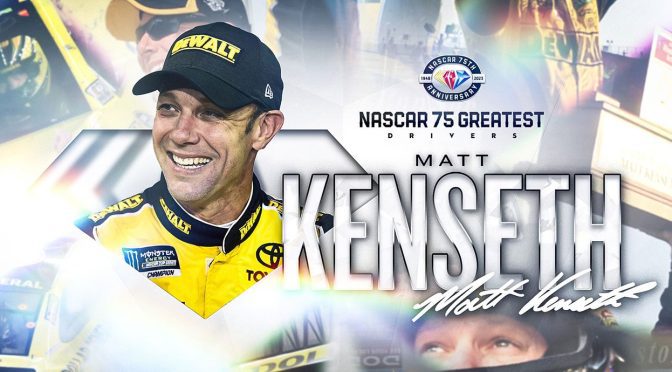
Fresh off a NASCAR Hall of Fame induction earlier this year, 2003 Cup Series champion Matt Kenseth can add another accolade to his stacked resumé after being named one of NASCAR’s 75 Greatest Drivers on Wednesday.

The 39-time Cup Series race-winner was a fixture at the front of the field during the sport’s rise to mainstream prominence in the early 2000s, his championship run in 2003 marking the final such title in the non-playoff era. His victory tally slots him tied for 21st on the all-time winner list and includes wins at 19 of the 23 different tracks at which he competed more than once. He additionally won the 2004 All-Star Race at Charlotte Motor Speedway.

While collecting just one victory during his championship season, it remained a dominant campaign in which he led the points standings for the final 32 weeks of the season, turning in his second-best average finish (10.3). And don’t think that the playoff system implemented after his title run hindered him in any way — Kenseth, from that point on, was a contender in the playoffs for 13 of the next 14 seasons, twice finishing runner-up.

RELATED: Latest drivers added to 75 Greatest Drivers list

Known for his prominence on the sport’s superspeedways, Kenseth tallied two Daytona 500 crowns and another victory at Talladega, tossing in a Southern 500 win in 2013 at Darlington Raceway — NASCAR’s original “superspeedway.”

Before Kenseth’s JGR stint came a longtime tenure driver for Jack Roush, during which came his 2003 title triumph. He later returned to drive for Roush in a part-time capacity in 2018, followed by a partial one-season run with Chip Ganassi Racing in 2020.

MORE: Matt Kenseth through the years | All of his Cup Series wins

Kenseth also has 29 career Xfinity wins, good for eighth-best all-time. He finished in the top three in that series in 1998 and 1999, finishing just shy of good friend Dale Earnhardt Jr. in both seasons.

Throughout its 75-year history, NASCAR has been synonymous with numerous groups and organizations. But perhaps none has carried more significance than the sport’s relationship with the U.S. military.

From pre-race flyovers to the annual Coca-Cola 600 Memorial Day Weekend at Charlotte Motor Speedway, NASCAR and the armed forces have seemingly been joined at the hip.

That history includes champions and other major contributors to the sport who have carried many of the skills and life lessons learned in the military over to civilian life, and particularly into their roles with NASCAR.

“There’s no question about how things I learned in the military helped me in civilian life, things like leadership, guidance or how to run a tight ship,” said Dale Inman, who was an Army ordnance specialist before he became crew chief for all seven of Richard Petty’s NASCAR championships (plus an eighth title with Terry Labonte). “Whether in the Army or NASCAR, if you’ve got five or more people under you, you’ve got to have a leader, right?

“And you’ve got to respect the leaders. When I became a crew chief, people did respect me, and I certainly learned a lot from the military. You’ve got to be disciplined, you know.”

The sport is once again celebrating its close ties with the military thanks to NASCAR Salutes Together with Coca-Cola. Let’s pay homage to some of those close ties:

**************************

Perhaps the most notable service member who went on to racing stardom was NASCAR Hall of Famer Bud Moore. Before he became a championship-winning crew chief and team owner who won three NASCAR Cup Series championships and 63 races, Moore was without question an American hero.

After being drafted as an 18-year-old in 1943, Moore became a prolific machine gunner, taking part in the 1944 D-Day Invasion, and served under famed Army Maj. Gen. George S. Patton. Moore was eventually awarded two Bronze Stars for his bravery and five Purple Heart Medals for a variety of injuries he suffered.

In addition to Moore, one of the most successful engine builders in NASCAR history, Henry “Smokey” Yunick, served four years in World War II (1941-45) in the Army Air Corps, piloting a B-17 Flying Fortress bomber on over 50 missions across Europe.

There was also NASCAR’s first-ever champion, Army hero Red Byron, who suffered debilitating injuries in a bombing mission in World War II that left him hospitalized for more than two years and nearly cost him his left leg.

While he lay in a hospital bed, Byron had a goal that served to inspire him: to return to race in NASCAR. He’d go on to win the sport’s first championship (Modifieds in 1948) and then the first Cup Series championship in 1949 (known back then as the Strictly Stock Division).

RELATED: Hamlin visits Arlington National Cemetery

And then there was Bill France Jr. The son of NASCAR founder Bill France Sr., he was one of the primary reasons why NASCAR became so synonymous with the military. After spending two years at the University of Florida, the younger France served two years in the U.S. Navy as a Petty Officer 3rd Class ordnance specialist (guns and bombs) in the mid-1950s.

It was during his military stint that the younger France helped recruit several former service members to begin a career in racing, particularly those who had mechanical aptitude that they learned while in the service.

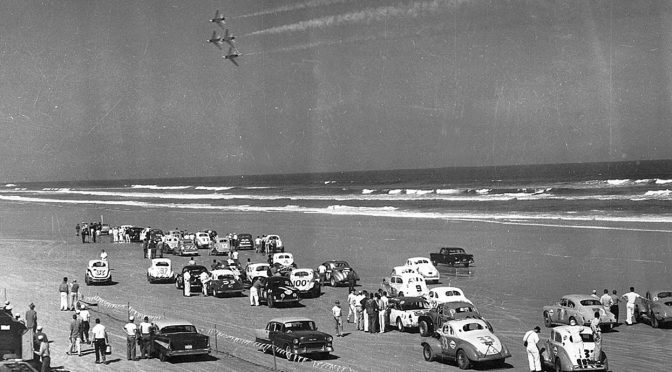
When he returned to the sport after fulfilling his military obligation around 1956, France helped engineer one of the first flyovers in 1957 and 1958 when the Navy’s famed Blue Angels performed over the Daytona beach races before Daytona International Speedway opened in 1959.

The Blue Angels also were featured on the cover of the 1961 Southern 500 program at Darlington Raceway to celebrate the 50th anniversary of Naval Aviation. It was those early flyovers that would lead to flyovers before most NASCAR Cup races, a tradition that continues to thrill fans today.

****************************

Today, the partnership between NASCAR and the military is as strong as it has ever been. Charlotte Motor Speedway has proudly presented a yearly salute to the troops every Memorial Day weekend before the Coca-Cola 600 for nearly 40 years.

And this year, one individual — Navy Lt. Cmdr. Jesse Iwuji, now better known as Xfinity Series driver Jesse Iwuji — will be front and center, showcasing what serving in the military has done for him and his own career and life.

A graduate of the U.S. Naval Academy, Iwuji spent nearly a decade on active duty while also beginning a racing career — at the very advanced age of 26 (he’s now 35) — in his off-duty time.

Iwuji will not compete in the May 27 Xfinity race, but he will host a special Gold Star event honoring military members and their families before the Coca-Cola 600 on May 28.

Now in the Naval Reserves, Iwuji has become a perfect illustration of the partnership between the military and NASCAR. The example he’s set has led to others enlisting in the military with the hope of eventually following in Iwuji’s footsteps into NASCAR as drivers or team members.

“Starting at that age and without any real knowledge of racing, starting with no real pathway because I didn’t come from the racing world, I had to basically draw upon what I learned from the Naval Academy and in the Navy,” Iwuji said. “One of those attributes was being resourceful. There’s no book that says, ‘Here’s the steps to becoming a professional race car driver.’

“You have to be ridiculously resourceful because you have to put into place all the different things that it takes to be a race car driver. It’s not just learning how to race a car well, it’s learning how to drive a race car, how to find funding, how to be marketable, how to be a professional ambassador not only for your brand, your personal brand, but for the brands that support us and the motorsport that you’re in.”

Jesse Iwuji from on the grid at Talladega Superspeedway in 2022.
Sean Gardner | Getty Images

Iwuji has become an ambassador for NASCAR to not just the Navy, but all branches of military service. And he has been an inspiration to individuals he’s met at the track. In fact, so many individuals have sought advice from him about what they should do with their lives, potentially joining the military and eventually entering the world of NASCAR, that he has written a primer he sends to those who either request it or who Iwuji feels will help them in their path forward.

“I have a lot of different fans reach out to me almost pretty much on a weekly basis, not only just at the track, but also through social media,” Iwuji said. “A lot of them wonder what’s military life like? What’s it like balancing your military duties and balancing what you’re doing with racing with their businesses, and all that together.

“So I developed what I call a playbook in which I describe my pathway into NASCAR and what I had to do to get to where I got to. My pathway might work for some, or it might not work for others.

“I try to help people get to the right mindset. Because when you’re going into any journey, you’re going to go through difficult times, and if your mindset isn’t where it needs to be, you’ll never make it.”

Iwuji gets satisfaction in pointing individuals to careers in the military, NASCAR or both.

“The greatest thing is when you send people this information, and a year or two later, they reach back out to you and they’re like, ‘Hey, because of you, I’m on my way,’ ” he said.

That’s why the military-NASCAR connection is as important today as it was 30, 40 or more years ago. In addition to Iwuji, dozens of current NASCAR members proudly claim to have served in the military.

“I think the tie-in with NASCAR and the military is very important,” Iwuji said. “It’s something that we need to continue to grow every single year. I love what we do with the NASCAR programs, what we do during the month of May, Veterans Day and all the other patriotic weekends of the year. I love how NASCAR is super supportive of it.

“It’s very important because NASCAR is the No. 1 motorsport in the U.S. It’s a very patriotic-type sport because of its fan base. So why not have the No. 1-most patriotic sport, the No. 1 motorsport, why not have that heavy tie-in with our nation’s military, which is something very important and near and dear to everybody’s heart, right?

“Because without our men and women out there who are serving, deploying, going out there risking their lives, risking their limbs, why not continue to honor them, to support them for everything they do.”

MORE: Full NASCAR Salutes coverage

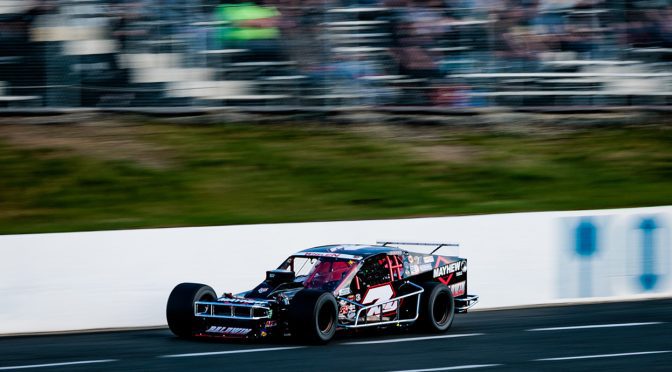
Following Saturday’s NASCAR Whelen Modified Tour race at Monadnock Speedway, the No. 7 Tommy Baldwin Racing modified driven by Doug Coby was issued a penalty as a result of post-race inspection.

The rules infraction is as follows:

Penalty Level: P3

20D – 12.1 Coil Springs A.6. After the vehicle has cleared pre-qualifying or Pre-race technical inspection, one (1) coil spring rubber insert, not to exceed one (1) full coil of the front coil spring, acceptable to NASCAR Officials, will be permitted.

Crew chief Tommy Baldwin was issued a $1,500 fine and was suspended from the NASCAR Whelen Modified Tour until the fine is paid. Baldwin is also under NASCAR probation until December 31, 2023.


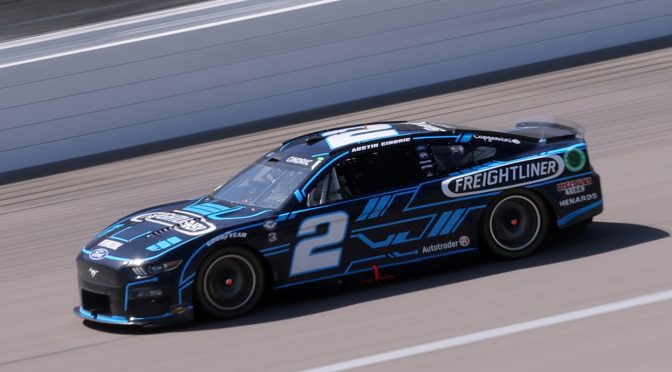
NASCAR officials penalized the No. 2 Team Penske Ford team Tuesday for the loss of a tire after last weekend’s events at Kansas Speedway.

Austin Cindric drove the No. 2 Ford to a 31st-place finish in Sunday’s AdventHealth 400. Earlier in the race, a flat right front tire forced him into contact with the wall going into Turn 1. The tire then subsequently broke off and began rolling away onto the track, a violation detailed in Section 8.8.10.4.A & C in the NASCAR Rule Book, pertaining to loss or separation of an improperly installed tire/wheel from the vehicle..

RELATED: Cup Series standings | Full Darlington schedule

As a result, crew members Keiston France and Patrick Gray have been suspended from the next two Championship Series events.

The Cup Series next races in Sunday’s Goodyear 400 at Darlington Raceway (3 p.m. ET, FS1, MRN, SiriusXM NASCAR Radio).

David Pearson was the master of Darlington.

In 47 career starts there, the Silver Fox won 10 times and scored 12 poles. Pearson developed a formidable rhythm at the 1.366-mile track, varying his speed to catch and pass competitors at the optimum points on the track.

In his race car, Pearson was the epitome of calm and one of the foremost drivers in NASCAR history at saving his equipment for the end of a race.

RELATED: David Pearson through the years

Darlington always occupied a special significance for the NASCAR Hall of Famer from Spartanburg, S.C. Pearson may have been unflappable on the race track, but when his son Larry took the lead with 18 laps left in a 1995 NASCAR Xfinity Series race at Darlington, the Silver Fox was a nervous wreck.

Pearson was so agitated that he left the track and drove to a spot where he could park his car and listen to the finish on the radio. When Larry crossed the finish line to win the 147-lap event, Pearson sat in his car and wept.

As NASCAR celebrates its 75th anniversary, it’s important to remember that Darlington was the sport’s first “superspeedway,” before restrictor plates changed that distinction in the late 1980s.

MORE: Full Darlington schedule | See throwback schemes

Opened in 1950, egg-shaped Darlington featured a smaller, tighter turn at one end of the track to preserve a minnow pond that prevented the construction of symmetrical corners. That design choice has always been an essential aspect of the track’s character.

Darlington has proven itself worthy of not one, but two distinct nicknames. To those who raced there in the early days, it was the “Lady in Black,” a nod to the pitch-black asphalt covering corners barely wide enough to accommodate two cars with fresh tires.

As its notoriety grew, Darlington became “The Track Too Tough to Tame,” and even winning drivers rarely could leave a 500-mile race at the speedway without a “Darlington stripe” worn into the right sides of their cars.

“It’s a track where you really have to race the track as much as the competitors,” said NASCAR Hall of Famer Terry Labonte, whose two victories at Darlington came 23 years apart (1980 and 2003). “I’ve thought to myself before (that) it would be hard to go out there and run 500 miles by yourself and not hit the wall at least once or bounce off it or something.”

From its opening in 1950 Darlington Raceway has been host to the Southern 500, one of NASCAR’s crown jewel events. Johnny Mantz, from Long Beach, Calif., drove cross-country to compete for the colossal $10,000 first prize in the inaugural event and took the checkered flag more than nine laps ahead of runner-up Fireball Roberts.

In 1978, driving for Billy Hagan, Labonte made his NASCAR Cup Series debut in that event and immediately turned heads with a fourth-place finish.

Labonte’s Southern 500 win in 1980 was his first in the Cup Series. His Cup victory at Darlington in 2003 was his last.

“What a tough track,” Labonte said. “We always seemed to have a pretty good run on Labor Day weekend and had some good finishes… But if your car’s not right, you can get lapped pretty easily there.”

As a track, Darlington has embraced not only its own history but also that of NASCAR as a whole. Throwback weekend, where paint schemes on the cars pay homage to heroes of the past, is one of the most highly anticipated events on the NASCAR schedule.

The throwback paint schemes will be on display throughout the upcoming weekend, which will culminate in Sunday’s Goodyear 400 (3 p.m. ET on FS1, MRN and SiriusXM NASCAR Radio).

Elton Sawyer, NASCAR’s Senior Vice President of Competition, said Tuesday that his group would monitor tensions between Cup Series drivers Ross Chastain and Noah Gragson, adding that no penalties will come following Sunday’s altercation at Kansas Speedway.

Sawyer’s remarks came Tuesday morning on SiriusXM NASCAR Radio’s “The Morning Drive,” where he recapped the doubleheader for the Craftsman Truck Series and Cup Series at the 1.5-mile Kansas City, Kansas, track.

RELATED: Watch: Exclusive look at Gragson-Chastain incident | Hear what Gragson said to Chastain before incident

“We’ve looked at that, we’ve talked about it and we’ll continue to have conversations with Ross and Noah,” Sawyer told SiriusXM. “As we’ve said before, our sport is an emotional sport. Our guys, again, using Sunday, everybody was on the edge, so when you felt like your day hasn’t gone the way you had hoped it would and someone may have impacted that in a way that you’re not happy, you’re gonna show your displeasure.

“We’ll continue to have some dialogue with those two organizations to make sure we’re in a good place, but thought that Noah and Ross both … they got to a level there that, obviously, we would have preferred not to have seen, but they were both showing their displeasure of what happened, but again, it’s an emotional sport, and from time to time, you are going to have disagreements and you’re gonna see that.”

A tight on-track battle between Chastain and Gragson during Sunday’s AdventHealth 400 prompted a face-to-face confrontation between the two on pit road after the checkered flag. Gragson grabbed Chastain’s fire suit during their heated conversation, which turned physical with a punch thrown and landed by Chastain before NASCAR security officials intervened.

Sawyer additionally told SiriusXM that race officials will not get involved in altercations of that nature and that drivers will be allowed to “have their space” and talk about their displeasures. However, once an incident rises to a physical level, security officials will then get involved to break up the altercation.

In a separate topic covered in Sawyer’s radio appearance, Sawyer said that the decision by NASCAR officials to display unapproved parts from the No. 3 Richard Childress Racing Chevrolet last weekend at Kansas will be standard procedure moving forward.

The RCR No. 3 team was issued an L1-level penalty after the Cup Series race weekend at Martinsville Speedway after officials found a splitter stay — one of the six bars used to connect the splitter to the body frame as part of the underwing assembly — that did not comply with the NASCAR Rule Book. The No. 3 team appealed, but the penalty was upheld in a May 2 hearing.

MORE: National Motorsports Appeals Panel upholds L1-level penalties for No. 3 RCR team

Officials indicated that transparency was the goal in making unapproved or modified parts available to view in the NASCAR hauler on the opening day of a Cup Series race weekend.

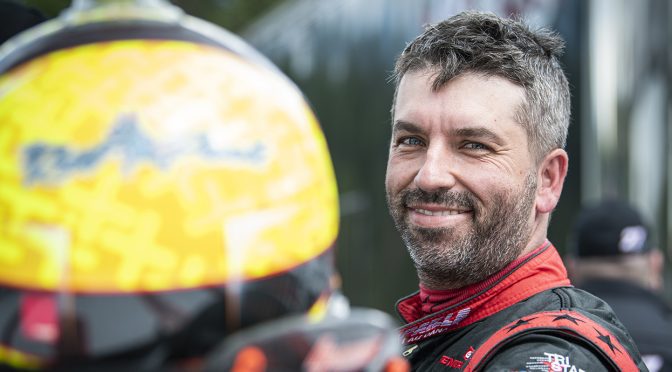
In 2013, Marc-Antoine Camirand thought his racing career was all but over.

Up to that point, the driver from Saint-Léonard-d’Aston, Quebec had spent most of his time focused on racing sports cars. However, by the time 2013 rolled around, funding had all but dried up.

That’s when a unique opportunity at Canada’s Circuit Trois-Rivières rejuvenated his career.

“At that time, I was actually thinking my career was almost over because I was struggling to find money,” Camirand said. “Then Dominic [Fugere, the promoter of the Grand Prix de Trois-Rivières] told me about this opportunity.”

A special Sportsman division race was held that year during the Grand Prix de Trois-Rivières, with the winning driver receiving an opportunity to compete in the NASCAR Pinty’s Series race that weekend.

With nothing to lose, Camirand jumped at the opportunity. He won the Sportsman race and made his NASCAR Pinty’s Series debut the following day driving for White Motorsports.

“We qualified third, we didn’t finish the race, but we still qualified third and did really good,” Camirand said. “Then after that, my NASCAR career started.”

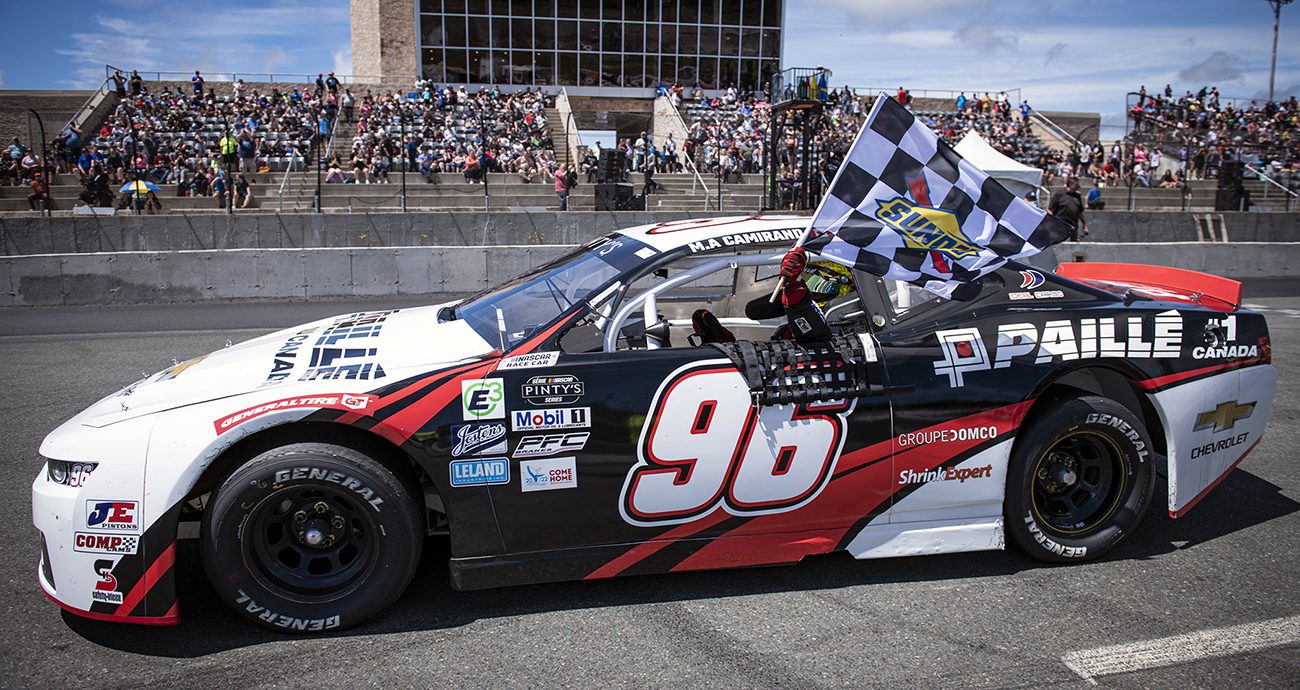
Fast-forward to 2022, and Camirand won a career-best three races en route to his first NASCAR Pinty’s Series championship while driving for the new GM Paillé Racing Team. In all he’s made 72 series starts, winning five times.

“It’s hard to believe we did all that crazy work throughout the winter to bring a new team, new car and everything,” Camirand said. “So proud of that team [to] achieve that championship.

“We knew that the team we put together was really, really good. We weren’t expecting to win the championship.”

(Photo: Matthew Manor/NASCAR)

The 44-year-old Camirand credited a lot of the success in 2022 to Robin McCluskey, his crew chief. The two first worked together during Camirand’s early years in the NASCAR Pinty’s Series at White Motorsports before reuniting at GM Paillé.

“I worked together with Robin [McCluskey – crew chief] back at White Motorsport, and we knew the connection was really good that time,” Camirand said. “We knew some day that we’d work together again, so we put that team together with GM Paillé.”

Now as the reigning NASCAR Pinty’s Series champion, Camirand has a new set of challenges to face.

In the history of the NASCAR Pinty’s Series, no driver has won back-to-back championships. Camirand wants to be the first.

“It’s another challenge for us,” said Camirand. “We know this series is really competitive so to do it again this year will be hard to do. But that’s definitely the plan, to try and win a championship again in 2023.”

The team has been hard at work preparing for the opening race of this season, scheduled for this Saturday, May 13 at Sunset Speedway in Innisfil, Ontario (Live on FloRacing at 6:45 p.m. ET). They’ve spent the offseason building a new car and massaging another to give Camirand his best chance at winning a second title.

“The offseason was very busy. We’ve built another chassis and we’ve prepped the other chassis also to get ready for the first race of the season,” Camirand said. “We’re in a lot better position than when we were in the same spot last year.”

With the CARS Tour’s second visit to North Wilkesboro Speedway arriving on May 17 during NASCAR All-Star Week, there is now clarity on the what the field will look like when the green flag flies.

Just like in 2022, this year, a limit was placed on the amount of Late Model Stock drivers who can compete in the Window World 125. The maximum number of entries was increased from 30 to 39 cars for 2023 to create plenty of room for full-time drivers and special one-off competitors.

STREAMING: Watch Late Model features at North Wilkesboro live on FloRacing

Of the 38 spots, a portion was reserved to those inside the Top 26 in owner points after the most recent CARS Tour event at Ace Speedway. Five provisionals were reserved for full-time drivers or those enrolled in the series’ Touring 12 loyalty program, while the remaining seven positions belong to current or former NASCAR Cup Series drivers.

Below is a look at how the Window World 125 entry list currently looks based on CARS Tour owner points and announced entries.

North Wilkesboro Speedway(Photo: Adam Fenwick/NASCAR)

Top 26:

  1. 8 JR Motorsports (Carson Kvapil)
  2. 77 Chad Bryant Racing (Connor Hall)
  3. 03 Lee Pulliam Performance (Brenden Queen)
  4. 08 McCaskill Motorsports (Deac McCaskill)
  5. 16 McCumbee Elliott Racing (Chad McCumbee)
  6. 15 Millington Motorsprts (Ryan Millington)
  7. 95 Carroll Speedshop (Jacob Heafner)
  8. 10 Mike Darne Racing (Kaden Honeycutt)
  9. 24 Chad Bryant Racing (Mason Diaz)
  10. 6 R&S Race Cars (Bobby McCarty)
  11. 2 Lee Pulliam Performance (Brandon Pierce)
  12. 44 R&S Race Cars (Conner Jones)
  13. 04 Bassett Racing (Ronnie Bassett Jr.)
  14. 81 Timmy Tyrrell Racing (Mini Tyrrell)
  15. 32 Miracle Motorsports (Zack Miracle)
  16. 98 AK Performance (Tyler Ankrum)
  17. 14 Jimmy Mooring Racing (Jared Fryar)
  18. 8B Top Gun Motorsports (Chase Burrow)
  19. 43 Setzer Racing and Development (William Sawalich)
  20. 1 Mike Darne Racing (Andrew Grady)
  21. 42 Cook Racing Technologies (Carson Brown)
  22. 57 Carroll Speedshop (Connor Zilisch)
  23. 4 TwoBoros Performance Shop (Dylon Wilson)
  24. 0 Sellers Racing (Landon Pembelton)
  25. 97A CR7 Motorsports (Jason Kitzmiller)
  26. 22 Nelson Motorsports (Landon Huffman)

Series Provisionals:

  1. 99 Riggs Racing (Layne Riggs)
  2. 5B Bryant Barnhill Racing (Bryant Barnhill)
  3. 67 Bolin Family Racing (Cameron Bolin)
  4. 20 Mitchell Mote Performance (Josh Dickens)
  5. 87 JFCO Racing (Tate Fogleman)

Promoter’s Provisionals:

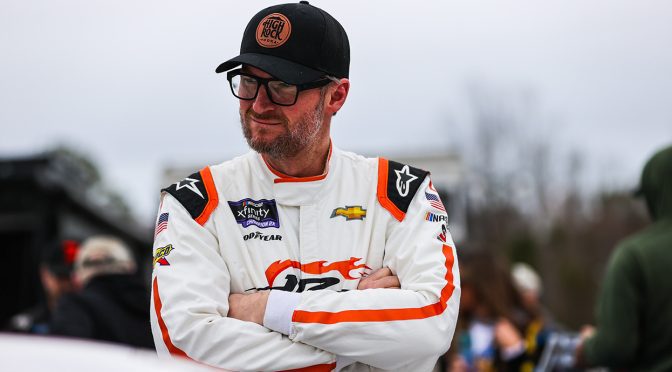
  1. 3 JR Motorsports (Dale Earnhardt Jr.)
  2. 62 Kevin Harvick Incorporated (Kevin Harvick)
  3. 99 R&S Race Cars (Daniel Suarez)
  4. 28 Pinnacle Racing Group (Ross Chastain)
  5. 5 Chad Bryant Racing (Chase Briscoe)
  6. 6K Hedgecock Racing (Brad Keselowski)
  7. 21 Chad Bryant Racing (Harrison Burton)

The 100-lap Pro Late Model Tour event preceding the Window World 125 will also have a 38-car starting grid. Any driver who places inside the Top 36 in time trials will earn a spot in the field, with the final two positions being determined by a provisional.

On-track activity for the CARS Tour at North Wilkesboro begins Wednesday, May 17 with Late Model Stock qualifying at 4:45 p.m. ET. The first green flag flies at 7:45 p.m. ET, and all the race action can be viewed live on FloRacing.