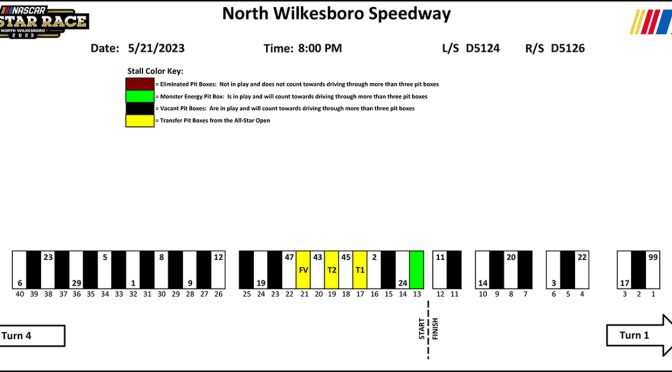
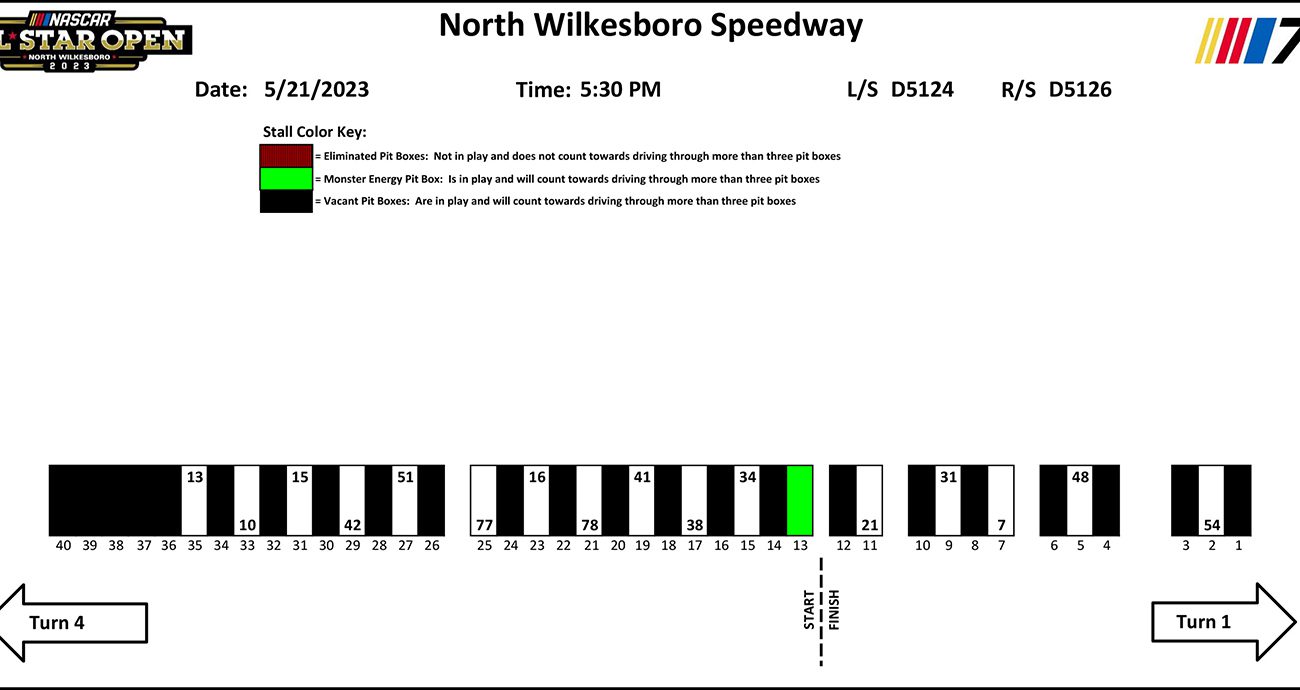
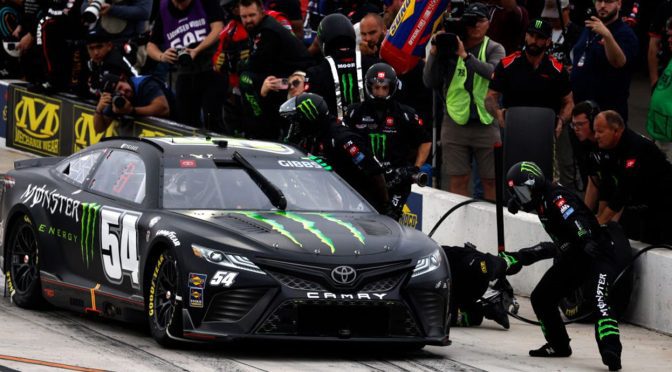
See above where your favorite driver will pit in Sunday’s All-Star Race in the NASCAR Cup Series at North Wilkesboro Speedway (8 p.m. ET, FS1, MRN, SiriusXM NASCAR Radio).
For the first time since 1996, it’s NASCAR race weekend at North Wilkesboro Speedway.
The NASCAR All-Star Race is back in the state of North Carolina and shifts to the 0.625-mile oval in Wilkes County at the historic short track, which welcomes back the Cup Series and its modern-day stars on Sunday night (8 ET, FS1, MRN, SiriusXM NASCAR Radio).
With the All-Star Race comes unique changes to the weekend format, at the forefront of which are a Pit Crew Challenge and heat races. The main goal, however, remains a simple, easy-to-follow setup that’s bound to excite throughout this special weekend.
• Lineups for the two heat races and the All-Star Open were determined by Friday’s Pit Crew Challenge, which featured each team performing a four-tire pit stop. The winning No. 54 Joe Gibbs Racing team of driver Ty Gibbs started Sunday’s All-Star Open from the pole position.
• The 21 teams locked into the All-Star Race were split into two heat races on Saturday night. Those who finished first, third, fifth and so on in the Pit Crew Challenge competed in the first heat race; those who finished second, fourth, sixth and so on competed in the second heat.
• The two 60-lap heats helped determine the starting positions in Sunday night’s $1 million main event. The results of the first heat set the inside row — first, third, fifth and so on — for the starting grid of the All-Star Race, while Heat 2 set the outside, even-numbered positions.
• The 16 drivers not yet locked into the main event fought through the 100-lap All-Star Open event to earn one of two transfer positions into the All-Star Race. The top two finishers advance to the All-Star Race. In addition, the Fan Vote winner also bumps from the Open into the All-Star Race. The award is granted to the driver with the most votes who did not already advance via the transfer positions.
Heat Race No. 1: Results
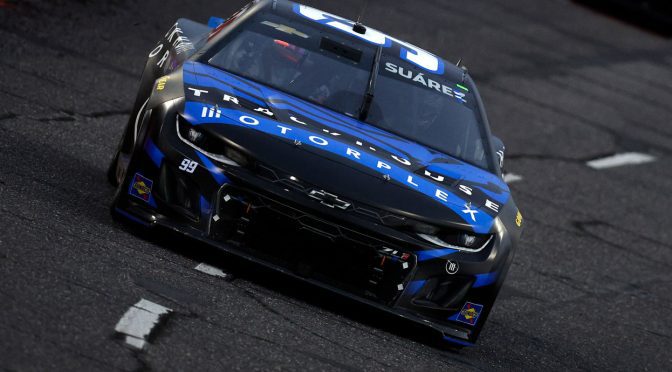
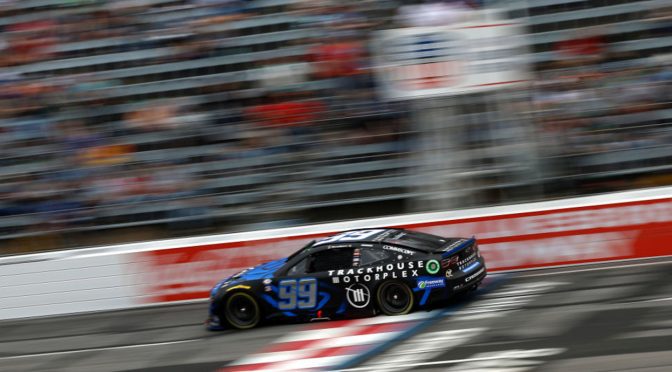
A switch to wet-weather tires before the race didn’t sway the field from attempting to put on their best during the 60-lap sprint to the finish. After Chase Elliott initially rose atop the field, Daniel Suárez vaulted ahead of the No. 9 Chevrolet on Lap 27 and held strong to hold off a resurgent Joey Logano to win the opening heat.
“I think we had more grip with the wets than we did with the drys,” Suárez said of the tire choice for his heat. “These tires, for some reason, they had so much forward drive … I feel like our car was pretty damn good.”
Finishing Spot
Car Number
Driver
1
99
Daniel Suárez
2
22
Joey Logano
3
14
Chase Briscoe
4
20
Christopher Bell
5
11
Denny Hamlin
6
12
Ryan Blaney
7
9
Chase Elliott
8
29
Kevin Harvick
9
2
Austin Cindric
10
47
Ricky Stenhouse Jr.
11
43
Erik Jones
Heat Race No. 2: Results
A perfect game might mainly refer to baseball or bowling, but in the case of the second heat race, it also applied as Buescher swept all 60 laps en route to the win. Contact with the wall bumped Kyle Larson back to an eighth-place finish.
“I liked our Fastenal Mustang on slicks — I was really happy with it,” Buescher said. “I didn’t want to put ‘rains’ on. I felt like it was still pretty dry out there. I guess it was starting to drizzle a little.”
Finishing Spot
Car Number
Driver
1
17
Chris Buescher
2
3
Austin Dillon
3
24
William Byron
4
6
Brad Keselowski
5
23
Bubba Wallace
6
19
Martin Truex Jr.
7
8
Kyle Busch
8
5
Kyle Larson
9
1
Ross Chastain
10
45
Tyler Reddick
All-Star Open: Results
Acting as a sub-in for an out-of-action Alex Bowman didn’t dissuade Josh Berry from capitalizing on contact between Ty Gibbs and Michael McDowell to seize the lead and hold it en route to winning the top Open spot for the All-Star Race. A rebound from Gibbs helped the No. 54 Toyota collect the final Open position. Gragson’s win in the Fan Vote, meanwhile, cemented the final berth.
Finishing Spot
Car Number
Driver
1
48
Josh Berry
2
54
Ty Gibbs
3
10
Aric Almirola
4
41
Ryan Preece
5
16
AJ Allmendinger
6
15
JJ Yeley
7
42
Noah Gragson
8
77
Ty Dillon
9
7
Corey LaJoie
10
78
Josh Bilicki
11
21
Harrison Burton
12
51
Ryan Newman
13
34
Michael McDowell
14
31
Justin Haley
15
38
Todd Gilliland
16
13
Chandler Smith
FULL STARTING LINEUP FOR ALL-STAR RACE (Sunday, 8 p.m. ET, FS1)
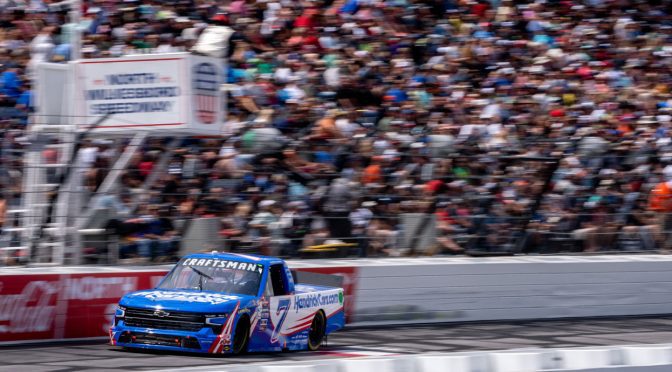
NORTH WILKESBORO, N.C. – Ty Majeski registered a hard-fought runner-up finish in Saturday afternoon’s Craftsman Truck Series race, unable to quite chase down a victorious Kyle Larson in overtime. He matched his best result of the season, but the atmosphere of a rejuvenated North Wilkesboro Speedway was one aspect that truly held his attention.
“I’m glad you brought that up. I mean, this place is packed. I don’t know that the Truck Series will see a better crowd than this all year,” said Majeski, who was barely 2 years old when the track held its last race. “So, good to see. Hopefully, we can go back to some cool places – Rockingham, here, of course, Milwaukee’s back on our schedule, we went back to IRP (Indianapolis Raceway Park) last year. That place is back, so hopefully, we see a pattern here and keep marching in this direction. It’s fun going to all these short tracks where this series belongs.”
A near-capacity crowd of some 30,000 filled the historic 0.625-mile track for the Tyson 250, the Truck Series’ first event here since 1996. The celebration marked the venue’s return to NASCAR’s national series rotation, and the hearty fans basked in the circuit’s rebirth.
Among them were the competitors, who battled each other and the rough, well-worn racing surface.
“This is one of the things that I don’t think anybody can complain about,” said 10th-finishing Grant Enfinger. “I think the race put on a great show, too. Very happy that they left this old surface, but to revitalize a historic track, it’s pretty, pretty special to be part of it. Had somewhat of an electric atmosphere, kind of like Eldora (Speedway) used to be for our Truck Series — only amped up a little bit from that. Pretty cool deal what they did.”
The event marked a bit of a history lesson for some of the series’ younger competitors. When Goodyear held a tire test for the truck tour here two months ago, all three of the participating drivers – Corey Heim, Carson Hocevar and Zane Smith — were not born at the time of the track’s closure. “I mean, it’s a bloomin’ travesty they left this place,” said Hocevar, who placed fourth.
Some of North Wilkesboro’s character was also new to the 30-year-old Larson, who didn’t know the track’s traditional post-race procedures for winners and their vehicles.
“I wasn’t watching races when I was 4 years old, either, so I didn’t know how Victory Lane worked,” Larson said. “I didn’t know that you ride this elevator up. That’s honestly probably the coolest Victory Lane I’ve ever been in.”
For the Truck Series regulars, the cool factor was only matched by what was likely the tour’s biggest attendance figure this year.
“This might be it right here,” Majeski said. “That’s pretty damn cool, so hopefully, we put on a good show.”
NORTH WILKESBORO, N.C. – Kyle Larson proved an admirable substitute on Saturday at North Wilkesboro Speedway.
Subbing for injured Alex Bowman — who had been scheduled to race the No. 7 Spire Motorsports Chevrolet — Larson led 138 of 252 laps in winning the Tyson 250 in overtime.
Larson is the first driver to win a NASCAR-sanctioned race at revitalized North Wilkesboro in 27 years. The victory was Larson’s third in 15 NASCAR Craftsman Truck Series starts.
At the end of the two-lap overtime, Larson beat ThorSport Racing’s Ty Majeski to the finish line by 0.974 seconds. Matt DiBenedetto ran third, followed by Carson Hocevar, Bubba Wallace and pole winner Corey Heim.
“It was a really fun track there, especially in the truck where you can use the apron and such at both ends,” said Larson, who was making his first Truck Series start of the season. “I had a good time. That was a lot of fun on the long runs.
“I wasn’t supposed to run. Unfortunately, Alex got hurt [in a sprint car accident], and I got the opportunity to run this.”
Larson made the most of his opportunity, dominating the action and charging from sixth after a Lap 228 restart where the first three cars in the running order stayed on the track during the 11th caution, and fourth-place Majeski gained track position with a two-tire pit stop.
On Lap 238, Larson passed Wallace for the lead and held it through one more caution and the overtime.
Thanks to pit strategy, Majeski salvaged the runner-up finish.
“Yeah, we just missed it today,” Majeski said. “Sometimes when you’re in the back with nothing to lose, you make gutsy calls, jumping on two tires there, and we were just able to hold off guys who put four tires on. So, a subpar day for us turned into a good finish.”
The race was the first in the series at North Wilkesboro since 1996 when the Craftsman Trucks ran at the 0.625-mile short track for the second time. Saturday’s renewal produced a record 12 cautions for 81 laps.
The harshest of on-track incidents came on Lap 201 when the truck of Tyler Ankrum was forced into the outside backstretch wall. As Ankrum slowed, Rajah Caruth’s No. 24 Chevrolet and the Fords of reigning series champion Zane Smith and Ben Rhodes suffered a chain-reaction collision that eliminated the three trailing trucks.
Before the wreck, Smith had suffered a pit road speeding penalty that sent him to the back of the field.
“Just a product of what happens when you get put back there,” said Smith, who started the race in the rear of the field because of three failed inspections and had worked his way into the top five before the speeding penalty.
The Truck Series will next trek to Charlotte Motor Speedway to race in the North Carolina Education Lottery 200 on May 26 (8:30 p.m. ET, FS1, MRN, SiriusXM NASCAR Radio).
Note: Post-race technical inspection concluded without issue in the NASCAR Craftsman Truck Series garage, confirming Larson as the race winner.
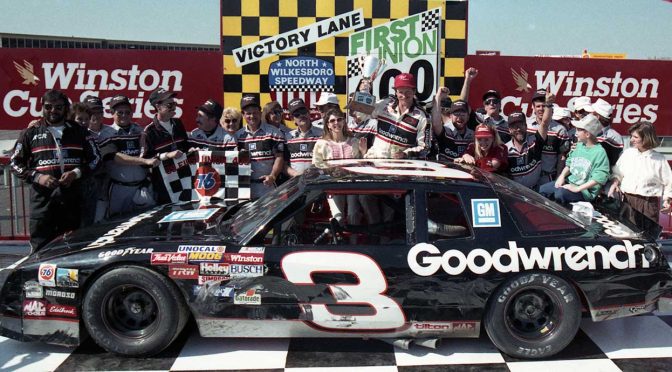
NORTH WILKESBORO, N.C. — When Dale Earnhardt won at North Wilkesboro Speedway on April 16, 1989, the left side of his black No. 3 Chevrolet showed evidence of battle scars and scrapes in true “Intimidator” form. The Goodyear logos were nearly worn clean off the left-front tire’s sidewall, but the rubber his Richard Childress Racing entry sported was still far from nondescript.
Earnhardt’s victory here 34 years ago in the First Union 400 was significant as the first win for Goodyear radials. The new tire design replaced the former bias-ply construction and proved to be a pivotal point in the “tire wars” era at the end of the 1980s.
The NASCAR Cup Series’ return to North Wilkesboro after a 27-year absence has kindled plenty of nostalgia ahead of Sunday’s All-Star Race (8 p.m. ET, FS1, MRN, SiriusXM NASCAR Radio). But it’s also stoked some fond memories for Greg Stucker, the tiremaker’s director of race tire sales.
“Obviously, we learned a lot going into that, and things have changed dramatically since then,” says Stucker, who joined Goodyear’s team in 1979. “But it was a pretty good introduction for the radial tire package, without a doubt. So that’s why North Wilkesboro kind of has a really soft spot in our heart.”
Goodyear had competition for the 1988 and the start of the ’89 season in the form of Hoosier Tires, led by president Bob Newton. The Indiana-based company took on its neighbors from Akron, but the resulting arms race for better on-track performance often came at the cost of durability. Teams often switched alliances depending on which tire was faster, and blowouts led to crashes, which carried far more peril in those days before SAFER barriers and HANS devices.
“That’s what eventually led to us being the sole supplier in 1997,” Stucker says. “I think Bill (France) Jr. said that tire wars are not a good thing for everybody. So it was, let’s move on.”
Goodyear helped to make that transition with the development of a racing radial tire, which has a centered construction around the crown of the tire versus the angled, overlapping ply structure of the bias-ply tires. Goodyear had planned their rollout for the ’89 Daytona 500, but the durability component hadn’t been perfected; Earnhardt and Ford rival Bill Elliott were involved in a pair of crashes before “The Great American Race,” and Goodyear reworked the design.
“We came here to test in preparation for the spring race and tested with Junior — imagine that. Terry Labonte drove for Junior Johnson because they obviously knew the track so well,” Stucker recalled of the test just a few weeks before the race. “And we came with what we thought was going to be the right setup.”
The team built up to 100-lap runs, eventually trying a configuration that eliminated rear stagger, placing a harder-compound right-side tire on the left-rear. The feedback was positive, and Stucker remembers the lap times being consistent and fast.
Despite some apprehension that the radials had less adjustability, Goodyear stayed with the setup once April arrived in North Wilkesboro. There was also skepticism from the Hoosier camp, which doubted that the radial design would work on heavy stock cars, especially at larger ovals.
That distrust was answered by Phil Holmer, Goodyear’s stock-car field manager at the time, who told the Associated Press before the North Wilkesboro race that April: “By the time the leaves turn color, we’ll be using them everywhere.”
The race was a forerunner to proving that point. Rusty Wallace won the pole position on Hoosiers, with his crew chief Barry Dodson favoring them after a North Wilkesboro win on those tires the previous fall. But many were undecided, even during the race weekend, and the 32-car field was a nearly even split – 17 starting on Goodyears and 15 on Hoosiers.
The great Tom Higgins of the Charlotte Observer wrote that the race’s results had potentially revolutionized the Cup Series, calling it a “radial rout.” Earnhardt led 296 laps, holding off Alan Kulwicki down the stretch. Wallace’s Hoosiers gave way, and by Lap 77, he had gone a lap down to early leader Darrell Waltrip on Goodyears. By Lap 110, all 31 cars that were still running had bolted on Goodyear rubber.
Goodyear continued to develop its radial design, phasing them in at larger tracks as the season went on. But North Wilkesboro was a turning point; Hoosier withdrew by the end of April and only made a brief return to NASCAR’s top series in 1994.
“There was really no specific reason that we chose North Wilkesboro other than it was the right time on the calendar, the right-size tire, the right-sized race track,” Stucker said. We decided to step into the short tracks, and then it progressed from there.”
Zack Albert | NASCAR Studios
The progression of the sport has made a full-circle trip back to North Wilkesboro for this weekend’s All-Star Race. The invitational event will be held on the same racing surface that Earnhardt won on; fresh asphalt was last placed on the 0.625-mile track in 1981.
The abrasive surface and tight confines, Stucker says, are expected to provide a tire-management challenge. Cup Series and Craftsman Truck Series teams tested here in March to get a feel for the considerable wear, and Goodyear officials scanned the surface to find a common connection with other established tracks – the comparison wound up being similar to Atlanta’s old pavement and current-day Darlington.
“We landed on the Richmond and Phoenix setup. That was our control,” Stucker says, noting that Goodyear went with more durability than the Martinsville configuration. “We tried softer, harder, left sides, right sides, and that just seemed to be in the sweet spot. All three drivers felt like that was a good, reasonable setup. The soft stuff was just way too soft. The hard stuff, it was just hard to get a hold of the race track.
“We were probably leaning that way anyway because obviously, we’re going to come here to fairly unknown race track for most of these guys, so at least we can give them a tire that they’re familiar with, that they’ve raced before. We felt like that was also a benefit.”
The last time Goodyear’s trucks were parked in the North Wilkesboro infield for a race weekend came in 1996 when the Cup Series last visited the North Carolina foothills. The return is being celebrated as a revival of stock-car racing’s roots. For Stucker and Co., it’s also a reminder of a key part of Goodyear’s racing history.
“If you look back on 1988, you know, we both crossed the line at times, right?” Stucker says. “I think we learned a lot, and we certainly figured out with a radial tire that the tire can be much more robust in a lot of ways than the bias tire was. I think we felt like that also gave us an edge.”
“I mean, this place had a ton of grip,” said Preece, who finished fourth in the modified event. “A lot of people will compare Myrtle Beach as one of those tracks we had on the East Coast that has no grip. If you decide to go, you’re just going to burn your stuff up, but it never had grip.
“This place, it has tons of grip. But you’re going to pay the price if you choose to go after it. So that’s what I thought was very unique about this race track. It just destroys tires. But at the same time, you can, if you choose to go. Hard. You can go hard.”
The hotly anticipated Pit Crew Challenge helped kick off the 2023 NASCAR All-Star Race festivities in the Cup Series’ long-awaited return to North Wilkesboro Speedway Friday evening.
Ty Gibbs and the No. 54 Joe Gibbs Racing Toyota team won the competition to score the pole for Sunday’s All-Star Open (5:30 p.m. ET, FS1) and pocket an extra $100,000 for the team.
Daniel Suárez and Chris Buescher leading their respective heat fields to the green Saturday evening as their teams posted the two fastest stops in the Pit Crew Challenge among those already locked into Sunday’s main event.
See where your favorite All-Star driver will start in the two heat races on Saturday night (7:30 p.m. ET, FS1, MRN, SiriusXM NASCAR Radio) and in Sunday’s All-Star Open.
NORTH WILKESBORO, N.C. — The pit crew of Ty Gibbs busted off a 13.012-second stop to win Friday night’s Pit Crew Challenge and the $100,000 winner-take-all prize that goes with it.
With his team’s victory, Gibbs will start on the pole for Sunday’s NASCAR All-Star Open as he tries to qualify for the NASCAR All-Star Race that follows (8 p.m. ET on FS1, MRN and SiriusXM NASCAR Radio).
Daniel Suárez’s No. 99 Trackhouse Racing Chevrolet team earned the pole position for the first of two Saturday night heat races (7 ET, FS1, MRN, SiriusXM NASCAR Radio) that will set the order for the All-Star Race. In a competition that included both All-Star and Open teams, Suarez is already qualified for the main event.
“This team has been through a lot this year,” said Gibbs’ veteran rear tire changer Mike Hicks. “Pulling this out here is a big confidence builder.”
Gibbs’ 13.012-second stop included the time it took for NASCAR Cup Series rookie to drive his No. 54 Joe Gibbs Racing Toyota into the pit stall and to exit after the work was complete. In addition to Hicks, Gibbs’ pit crew includes front changer Blake Houston, tire carrier Jacob Holmes, jackman Derrell Edwards and fueler Peyton Moore.
“It’s huge,” said JGR pit crew coach Brian Haaland. “These guys put in so much work that people don’t see. Most of the time when things go wrong, it gets highlighted. So it’s nice that they were able to perform in a really intense environment out there against all their peers and run the fastest pit stop.
“Ty did a fantastic job getting the car exactly where we needed it, and (crew chief) Chris (Gayle) with his mechanics gave us a little help on setup. It was a lot of extra work for those guys — it was a complete team effort today.”
Suárez’s team features front changer Josh Bush, rear changer Jerick Newsome, tire carrier Jeremy Kimbrough, jackman Josh Appleby and fueler Milan Rudanovic. Collectively, they orchestrated their stop in 13.297 seconds in a competition where pit crew performance sets the order for both the All-Star qualifying heats and for the All-Star Open.
Suarez’s crew edged the No. 17 RFK Racing Ford team of driver Chris Buescher, who will start on the pole in Saturday’s second heat after a stop in 13.381 seconds.
The competition was rife with mistakes, as the crews competed for the top prize money under huge pressure to perform at top speed. A five-second penalty for a loose wheel, for instance, cost Brad Keselowski the top starting spot in Heat 1. Keselowski’s team was second fastest overall at 13.044 seconds, but the penalty dropped him to 26th overall.
Chase Elliott’s team was fourth fastest at 13.577 seconds, earning the driver the second starting position in the first heat race. Hendrick Motorsports teammate Josh Berry’s crew was fifth at 13.677 seconds. Berry will start next to Gibbs in the Open.
Austin Dillon’s team was sixth fastest at 13.712 seconds, giving the driver of the No. 3 Richard Childress Racing Chevrolet the second starting spot in the second heat.
Twenty-one drivers already are eligible for the All-Star Race, either by winning a NASCAR Cup Series points race in 2022 or 2023, or as former Cup champions or former winners of the All-Star Race.
The top two finishers in the Open will advance to the main event, along with the winner of the Fan Vote.