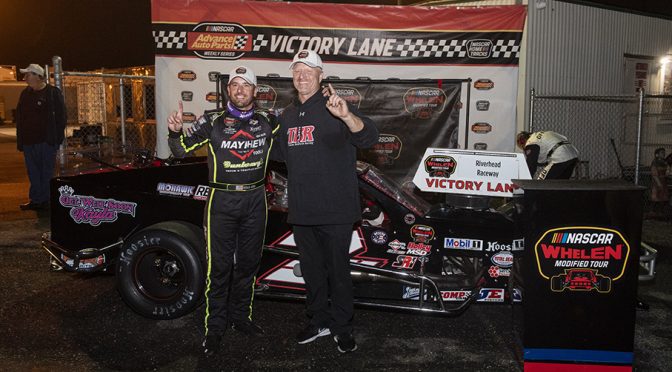
MILFORD, Conn. – Fresh off a victory at Riverhead Raceway last Saturday, Doug Coby and Tommy Baldwin Racing will team together again to join the NASCAR Whelen Modified Tour this weekend at Lee USA Speedway for the inaugural Granite State Derby presented by USA Insulation.
Coby will drive the No. 7NY for Baldwin’s team in the first Whelen Modified Tour race at the New Hampshire oval in over two decades. Lee, known for its abrasive surface and tire conservation, will be difficult for Coby and Baldwin to tackle – but with momentum on their side coming off a victory in New York – the team is excited to hit the track together again.
Coby does have experience winning at tracks that require excessive amounts of tire conservation. The six-time Whelen Modified Tour champion won the last Whelen Modified Tour race at Myrtle Beach Speedway in 2019 – a track that is similar to Lee, when it comes to strategy. With Baldwin calling the shots on the pit strategy and Coby behind the wheel, the combination feels like they will be in the running to make it two straight wins.
Coby will step back into the No. 7NY seat to allow Jimmy Blewett additional time at home and keep the Baldwin Racing entry in contention for the Whelen Modified Tour owners championship. Through three races, the team leads the owners points by 12.
“At Myrtle Beach you couldn’t even go 100 percent,” Coby said. “In these races, it’s definitely timing of when you take tires, v.s. when the cautions fall. In the last race I won at Myrtle Beach, we timed our pit stop well, when some others stayed out and were hoping for a caution later in the race, but it never came out. Being a six-tire race at Lee, it’s a big difference to be able to come into the pits twice. Someone may even try to time it right and only pit once and not need the second stop. The race is going to be about pacing yourself and not abusing the car. At Riverhead, I was able to pace myself the whole race, and knowing how the car responded to it, it gives me a lot more confidence. At Lee, we will be in a tire saving mindset from the drop of the green. Lee is a great facility and the track is a ton of fun.”
The event schedule for the Granite State Derby presented by USA Insulation will include one Whelen Modified Tour practice session from 1:40-2:40 p.m., followed by Mayhew Tools pole qualifying at 5:30 p.m. The drop of the green flag for the 175-lap race is scheduled for 7 p.m. All tickets will be available at the track and are also available in advance at JDVProductions.com. The race will air live on FloRacing for those who can’t make it to the track.
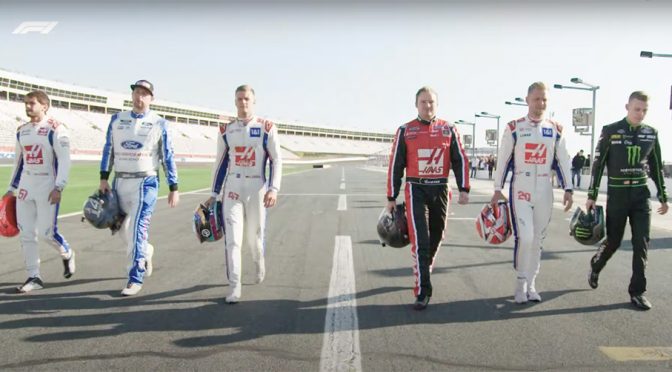
Stewart-Haas Racing drivers Chase Briscoe, Cole Custer and Riley Herbst recently played host to Haas F1 drivers Kevin Magnussen and Mick Schumacher at Charlotte Motor Speedway to let their global counterparts give stock-car racing a whirl.
From the sounds of it, the F1 gang did not disappoint. And may have even shocked the Cup Series stars a bit, thinking they were bound to wreck on Lap 1.
This was pretty unreal to be apart of! Whenever two different forms of motorsports come together it’s awesome to hear about the similarities and differences between cars.
Editor’s note: Bozi Tatarevic is a professional racing mechanic and pit crew member. He will provide technical analysis for NASCAR.com throughout the 2022 season.
The NASCAR Next Gen car made its first visit to Kansas Speedway last weekend and showed us that the overall package continues to impress at intermediate tracks.
As seen earlier in the year at tracks like Auto Club Speedway, drivers had to battle challenging conditions and try to get a handle on lift-off oversteer, along with the increased loads on the left rear tire which caused flats for a handful of drivers. Cars were breaking loose early and the No. 14 of Chase Briscoe experienced a lift-off oversteer condition in Turn 4, resulting in Briscoe spinning and going through the grass. Luckily the grass had been cut overnight which, combined with the splitter height of the Next Gen car, allowed him to drive off without significant damage.
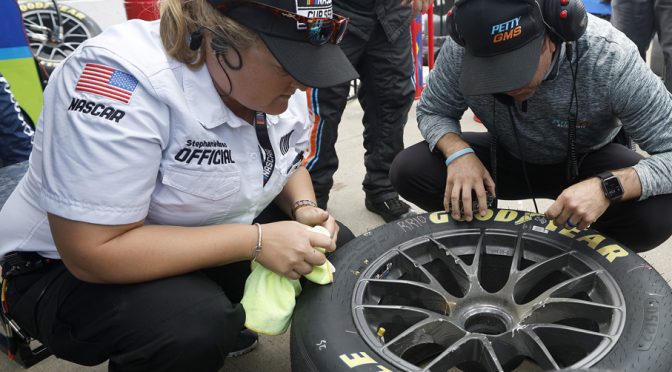
Another spin happened around lap 60 as we saw the No. 99 of Daniel Suárez appear to have a left rear tire go flat and result in a spin. This would end up being a continuing trend as multiple cars would end up losing their left rear as the race progressed and this is likely based on multiple factors. Goodyear released notes before the race that noted the significance of the air pressure in that left rear tire and that could impact the durability of the tire due to the loads that it was estimated to see at Kansas.
Goodyear shared that the loading of the left rear has increased on the Next Gen car because of the independent rear suspension and aerodynamic balance being shifted more to the rear of this car. Goodyear responded to these increases by recommending that teams add two more psi (pound-force per square inch) to the left rear than what they put in the left front to attempt to compensate for those increased loads.
“The amount of air pressure in the tire should directly correlate to the amount of load on that corner of the car,” Goodyear Director of Racing Greg Stucker said. “If the amount of load increases – like it has on the left-rear of this Next Gen car – you need to increase the load-carrying capability in that tire, which is done via air pressure. If you run below our recommended pressures, the tire can over-deflect, sustain damage and result in an air loss.”
While Goodyear can make recommendations on tire pressures, teams are still free to make their own decision on what they want to run and it is obvious that some are more aggressive than others. The Next Gen car allows teams to change dynamic camber on the rear of the car due to the design of the independent rear suspension and some teams are choosing to be more aggressive with their camber settings which can have a significant impact on the loads seen at the rear of the car. Choosing to be more aggressive on camber typically requires higher air pressure in the tires to compensate and teams are chasing that perfect balance of camber and air pressure, with some appearing to miss it.
Dynamic camber is the angle of the tire relative to the car when it is under load on the track compared to static camber which is the measurement of that angle when the car is sitting still in the paddock or the tech-inspection bay. In addition to the camber and tire settings, there is also a factor of impact loading on the left rear of the car as many cars appear to have a setup that leaves them sitting on the left rear shock at the beginning of a run which results in larger impact loading.
Every team that wants to be fast will chase an aggressive setup and finding the perfect balance is key. It is apparent that some teams have chosen to be more conservative. Cars like the No. 18 of Kyle Busch were seeing issues at intermediate tracks early on in the season but have been more stable in recent races.
While a blanket air pressure recommendation is helpful, it might be a good idea for Goodyear and NASCAR to potentially take some notes from sportscar racing where many series have set up recommendations based on how much camber the car is running. In those cases, the more camber that a car is set up with, the lower air pressure that they are allowed to run since the two have a combined impact on the tire loads. These left rear flats are also self-policing to an extent as teams learn where the limits are and begin to run a bit more conservative as the season goes on.
Pit road also had some chaos. The right rear tire of the No. 43 of Erik Jones was stuck during one of the stops with the wheel not wanting to budge. Based on a review of the incident it appears that the wheel nut was overtightened which resulted in it getting bound up against the wheel and having to be cut off to be removed.
Chris Graythen | Getty Images
Justin Fiedler, who is the rear tire changer of that No. 43 tweeted that he got the wheel nut too tight in the previous stop and while this has happened in the past, it never created such a large issue. Tire changers have been cautious all season to make sure that wheels are tight because the penalties for losing a wheel are severe. This has resulted in some occasions where wheels have been overtightened, but typically they can be removed even if they require a bit of extra work. In this case, it looks like the steel wheel nut ended up fusing to the aluminum wheel after being tightened and re-tightened during the previous stop.
Based on the information we know of the design of the wheel nut, the wheel, and the wheel gun it is likely a combination of multiple factors that caused this incident, including the hardness of the steel used for that wheel nut along with the amount of torque that the wheel gun produces. Based on observation of pit stops and how wheel nuts go on and off the hubs, it is likely that they are being overtightened in many cases as the wheel gun likely produces more torque than is required for this combination. Unfortunately, the teams are not allowed to make adjustments to the guns so tire changers have to use their best judgment when they believe that the wheel nut is tight enough.
As we shared recently, there are options to measure the torque of the wheel guns at the moment that the wheels are being fastened that can notify the tire changer and even the crew chief on the pit box when wheels are properly torqued. But those are currently not allowed in the series. Teams and officials are likely taking notes from all of these pit-stop incidents and as with other elements of the Next Gen car, will make adjustments to make them more useful for teams and prevent similar incidents in the future.
Kansas provided for exciting racing and showed us who has been keeping the best notes since the first few intermediate track races, proving that even though teams are optimizing these cars that there is still room for growth.
The Inaugural Granite State Derby, the first race of the new Whelen Granite State Short Track Cup bonus program, will also feature a Kentucky Derby theme in its pre-race ceremonies.
This marks the sixth time the Tour has visited Lee USA Speedway dating back to 1993. That first race was won one of the Tour’s greatest stars, Reggie Ruggiero, who led 94 of 102 laps on his way to victory. Other Tour winners at Lee USA Speedway include Jamie Tomaino (1994), Tim Connolly (1995), Rick Fuller (1996) and Ed Flemke Jr. (1998).
A stacked entry list featuring an even mix of Modified Tour regulars and local Riverhead heroes are set to descend onto the historic quarter-mile bullring on Saturday evening with the goal of building momentum heading into the summer.
Inaugural Granite State Derby presented by USA Insulation at Lee USA Speedway
What to watch for:
For the first time since his victory to open the NASCAR Whelen Modified Tour season in February at Florida’s New Smyrna Speedway, Matt Hirschman is back with the Tour this Saturday night at Lee USA Speedway.
Hirschman, one of the top Modified stars of the Northeast, will be in search of his sixth career Tour victory. While no active Tour competitor has competed in one of the previous Tour events at Lee, Hirschman is among a select handful who has raced there and even has a victory at the track.
His competition includes Doug Coby, who returns to the seat of Tommy Baldwin Jr.’s No. 7 after winning last Saturday’s race at New York’s Riverhead Raceway. Justin Bonsignore will try to get back on track after another rough outing due to a mechanical issue, while Eric Goodale looks to pad his Tour points lead.
Anthony Nocella will attempt his season debut after a part failure forced him to sit out the second race of the season at Richmond Raceway. J.B. Fortin also returns to action after opting to skip Riverhead following the birth of his daughter, Joelle.
Other Tour regulars scheduled to be in action include Ron Silk, Kyle Bonsignore, Dave Sapienza, Austin Beers, Jon McKennedy and Craig Lutz. Spencer Davis makes his third attempt of the season, while Jake Johnson is back in the Boehler Racing Enterprises No. 3 for his second start of the year.
The complete entry list for the inaugural Granite State Derby presented by USA Insulation can be found here.
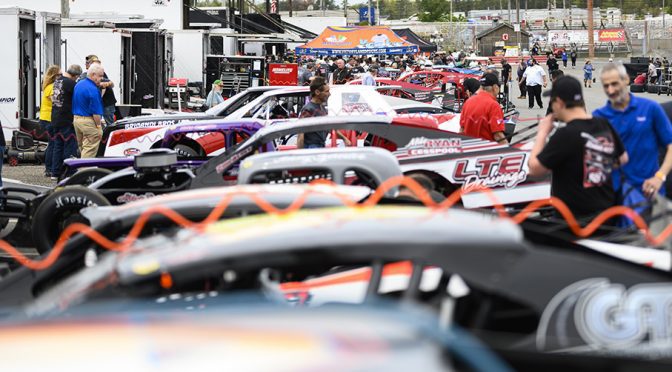
Cars line up before the New Smyrna Visitors Bureau 200 for the NASCAR Whelen Modified Tour during Night 2 of the World Series of Asphalt Stock Car Racing at New Smyrna Speedway in New Smyrna Beach, Florida, on Feb. 12, 2022. (Photo: Adam Glanzman/NASCAR)
RACE FACTS
Race
Inaugural Granite State Derby presented by USA Insulation
Schedule: Garage opens at 11 a.m. ET … Final practice from 1:40-2:40 p.m. ET … Single-car qualifying (two laps) at 5:30 p.m. ET … Race at 7 p.m. ET
Qualifying: Two consecutive qualifying laps. Faster lap determines qualifying position. Adjustments or repairs may not be made on the vehicle after the vehicle has taken the green flag at the start/finish line. NASCAR reserves the right to have more than one vehicle engage in qualifying runs at the same time. Starting field for the inaugural Granite State Derby presented by USA Insulation is limited to 28 starters including Provisional Positions. Vehicles will be impounded after qualifying. Vehicle must qualify on race setup.
Tire allotment: The maximum tire allotment available for this event is 12 tires per team. All tires used for qualifying and the race must be purchased at the track and scanned by Hoosier, unless otherwise approved in advance by the Series Director. Four (4) tires must be used for qualifying and to begin the race. All qualifying tires must remain in impound until released by NASCAR Officials. The remaining tire allotment may be used for practice and/or change tires during the event. The tire change rule is six (6) tires, any position.
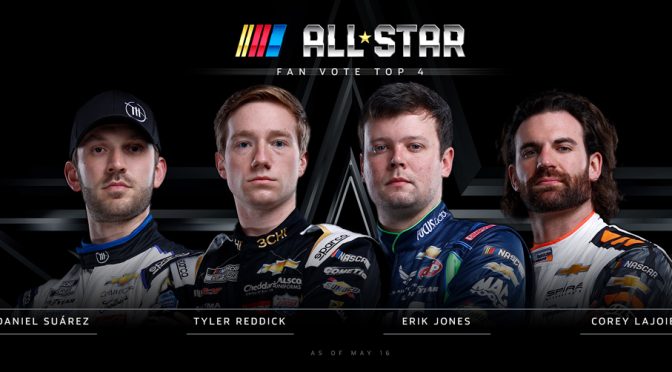
The All-Star Race Fan Vote is headed into its final stretch, and it’s up to you to decide who will become the latest winner to participate in NASCAR’s annual classic with $1 million on the line Sunday at Texas Motor Speedway (8 p.m. ET, FS1, MRN, SiriusXM).
A look at the most recent tally of votes reveals that these are the top-four drivers, with polls set to close on Friday, May 20 at noon ET. Listed in alphabetical order:
— Erik Jones, driver of the No. 43 Chevrolet for Petty GMS Motorsports
— Corey LaJoie, driver of the No. 7 Chevrolet for Spire Motorsports
— Tyler Reddick, driver of the No. 8 Chevrolet for Richard Childress Racing
— Daniel Suárez, driver of the No. 99 Chevrolet for Trackhouse Racing
Don’t delay in getting your vote in today for one of these four drivers, or one of the other drivers who is eligible for this year’s fan vote. Remember, you can vote once daily right up until the deadline on Friday, and votes that you share on social media count double.
Editor’s note: This story was first published on April 28.
NASCAR and Texas Motor Speedway revealed Thursday on FS1’s Race Hub the qualifying and race formats for the 2022 All-Star Race and All-Star Open on May 22 (8 p.m. ET on FS1, MRN, SiriusXM NASCAR Radio), with $1 million on the line for the race winner.
This year’s running will feature a new qualifying format for drivers already locked into the All-Star Race. Qualifying will consist of two rounds. The first round will see a single lap in reverse order of the current 2022 owner points. The top-eight qualifiers in the first round will transfer to a head-to-head elimination bracket.
The eight-car elimination bracket will put a heavy emphasis on pit crews, allowing their talents to shine to better their drivers’ qualifying position. It will feature two cars staged in temporary side-by-side pit stalls near the end of pit road. At the sound of an alert, each pit crew will perform a four-tire pit stop, and at the drop of the jack, drivers will exit their pit stalls onto the track with no speed limit on pit road. The first car back to the start-finish line will advance to the next round.
The final pairing will compete for the pole.
Drivers eliminated in the Round of 8 will start in positions 5-8 based on their one-lap speeds from the first round of qualifying. Drivers eliminated in the Round of 4 will start in positions 3 and 4 based on their one-lap speeds.
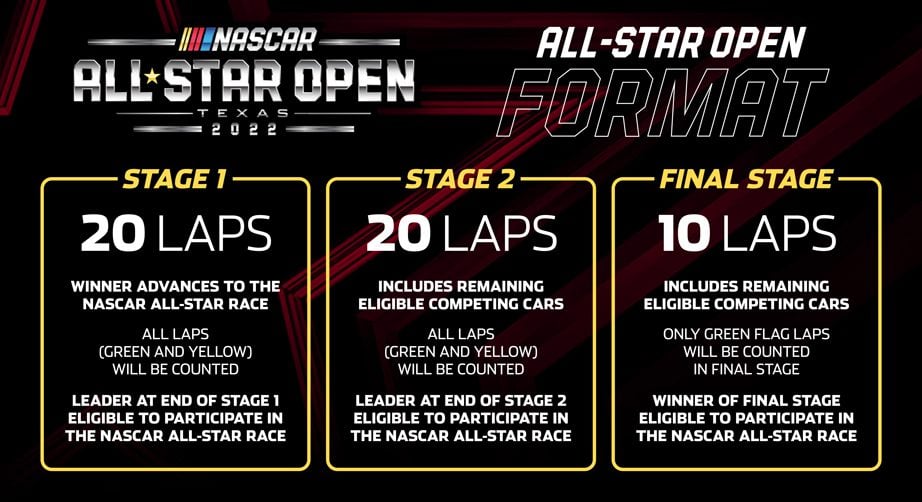
The All-Star Open will consist of a more traditional format with single-car, single-lap qualifying in reverse order of 2022 owner points. The Open race format will break down into three stages (20 laps, 20 laps, 10 laps). The winner of each stage will advance to the All-Star Race, along with the winner of the Fan Vote.
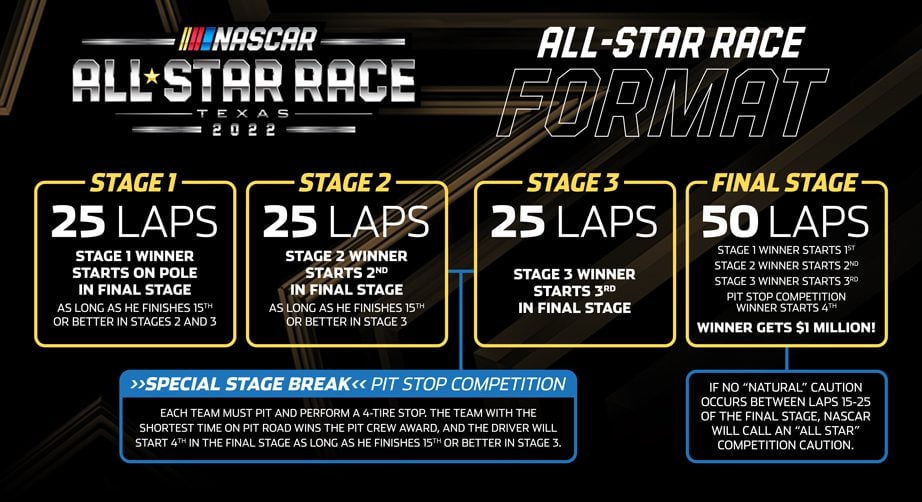
For the 125-lap main event, there will be four stages — three 25-lap stages and one 50-lap stage. The winner of Stage 1 will start on pole in the final stage as long as they finish 15th or better in Stage 2 and Stage 3. The winner of Stage 2 will start second in the final stage as long as they finish 15th or better in Stage 3. The winner of Stage 3 will start third in the final stage.
There will be a special stage break at the conclusion of Stage 2 where all teams must pit and perform a four-tire stop. The driver and team with the shortest time on pit road (pit in to pit out) will win the pit-crew award and start fourth in the final stage as long as they finish 15th or better in Stage 3.
Another added feature will be unique to the final stage. If a natural caution does not occur between Lap 15 and Lap 25, NASCAR officials will throw an “All-Star” competition caution.
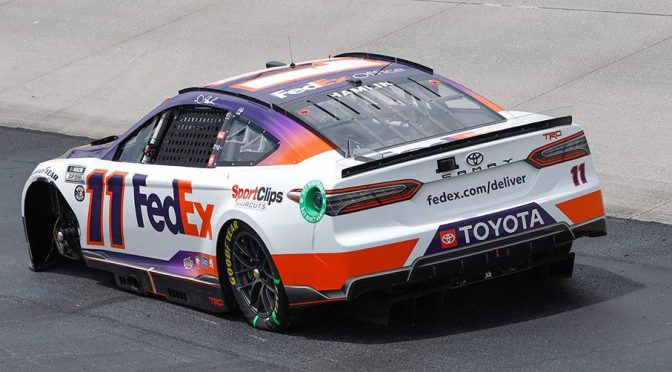
Joe Gibbs Racing on Wednesday will formally appeal its penalty stemming from a detached wheel at Dover Motor Speedway earlier this month.
The No. 11 Joe Gibbs Racing Toyota team for driver Denny Hamlin was issued a penalty for violating Section 10.5.2.6 of the NASCAR Rule Book, which specifies the separation of an improperly installed wheel. Because of the safety violation during the DuraMAX Drydene 400, four-race suspensions were each issued to No. 11 crew chief Chris Gabehart, jackman Derrell Edwards and front-tire changer Blake Houston.
While under appeal, the JGR crew members listed in the penalty report have been permitted to participate for the No. 11 team, helping Hamlin achieve a fourth-place finish Sunday as Kansas Speedway. The team will present its case Wednesday to three members from the National Motorsports Appeals Panel.
The night of May 16, 1992 was either going to feature one of NASCAR’s brightest moments or one of its dimmest.
Millions of dollars had been invested into a state-of-the-art system provided by Musco Lighting that would enable NASCAR and Charlotte Motor Speedway to host The Winston All-Star Race at night for the first time in its brief history.
The goal of this initiative was to give The Winston a jolt of popularity, but the concerns over being able to apply the concept of Saturday night short track racing onto a much larger scale persisted as the monumental event drew closer.
To ensure conditions at Charlotte would be safe to race at night, NASCAR and Charlotte turned to short track veteran Dave Mader III for a test run. Mader had qualified for The Winston that year by driving a car for Melling Racing that Bill Elliott had won in during the 1991 season.
Mader recalled being stunned at finding out that he would be the guinea pig determining the efficiency of the lights Musco had built for Charlotte.
“We were by our car and saw race director Dick Beaty coming our way with all the drivers,” Mader, now 66, told NASCAR.com. “Everyone surrounded the car, and Mr. Beaty said that since I was the most active night racer [at Charlotte], they wanted me to go around the track.
“I asked for [Dale Earnhardt] to go out, and everyone just started laughing.”
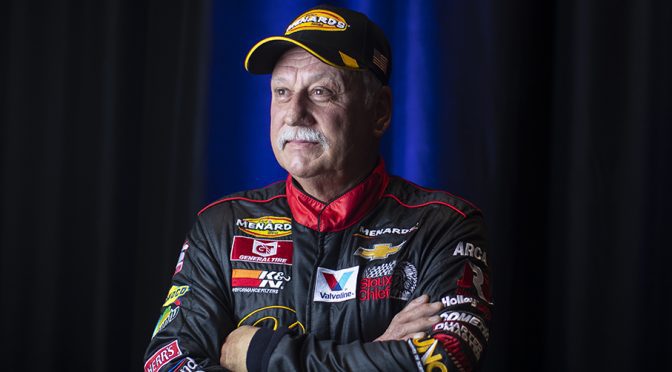
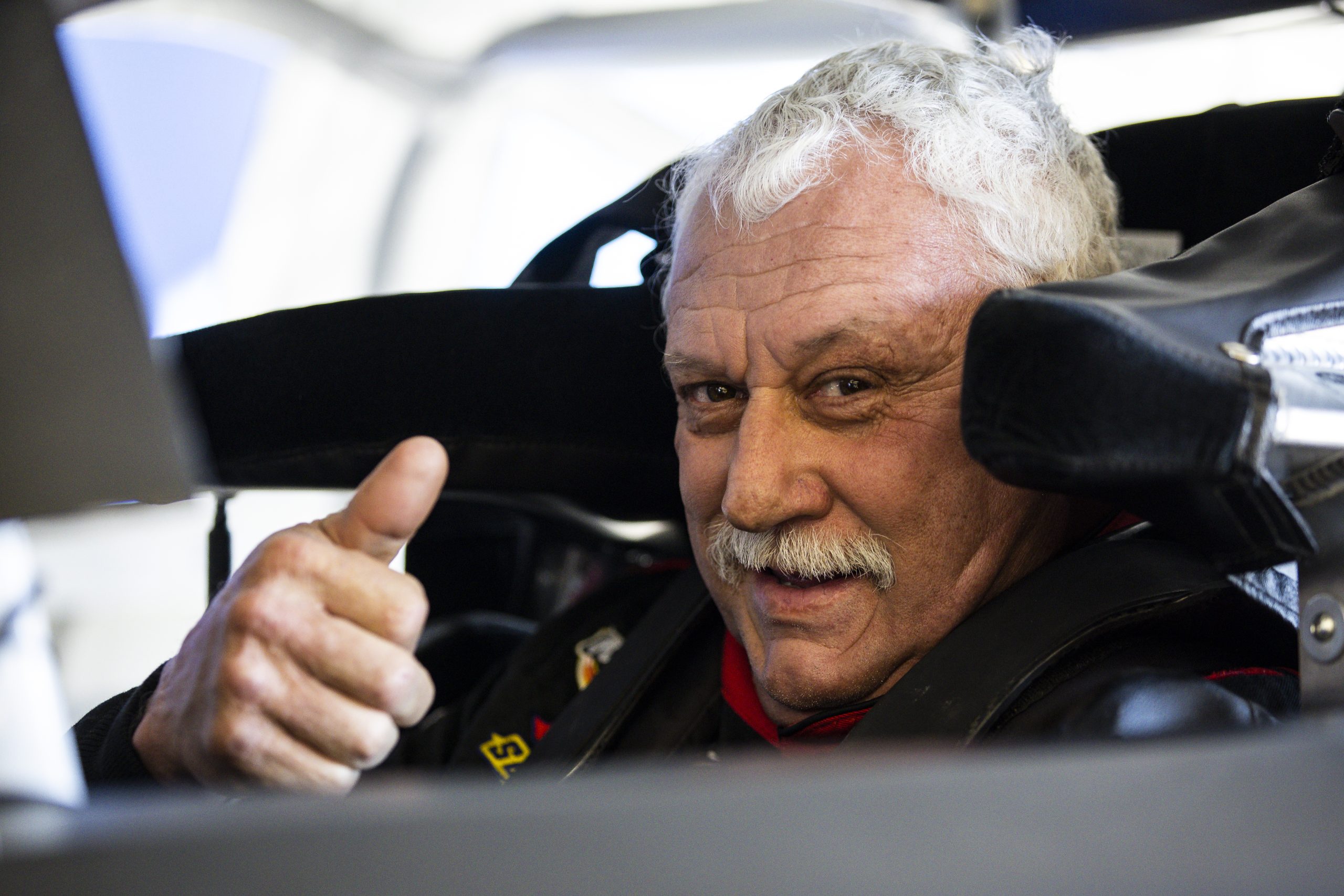
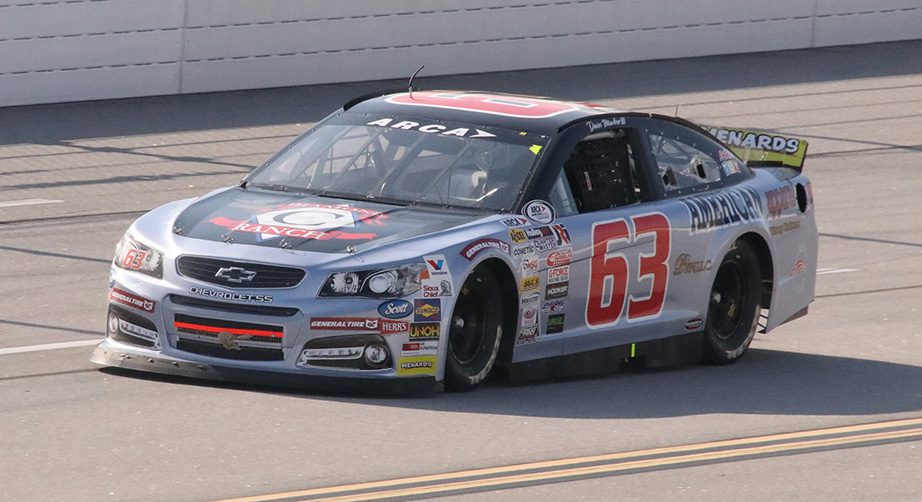
Dave Mader III is still actively involved with racing, with one of his ventures being a part-time driver in the ARCA Menards Series. (Photo: Adam Glanzman/NASCAR)
Mader was among the many initial skeptics of former Charlotte track president Humpy Wheeler’s plan to run The Winston at night.
Despite having accumulated numerous accomplishments during his short-track career that included four consecutive NASCAR All-American Challenge Series titles in the 1980s, racing on an intermediate track at night was something Mader thought was impossible, but he was still intrigued to see how the unique concept would be executed.
Anticipation quickly built for the 1992 Winston when the decision to run the race at night was announced in October of 1991. With only a few months at their disposal, Wheeler, Musco and Speedway Motorsports Inc. quickly went to work installing the Mirtran reflective-lighting systems around Charlotte.
Once everything was sorted out with the lights, a public test session was organized in April of 1992 that allowed more than 38,000 fans to see the best NASCAR Cup Series drivers make laps around Charlotte at night, with Mader being among those in attendance.
As day gradually transitioned into night, the apprehension in the garage area gradually rose as the drivers convened with Beaty to determine which of them would have the honor of formally breaking in a newly illuminated Charlotte track.
Gene Roberts, who was Mader’s crew chief with Melling Racing at the time, said Earnhardt was the driving force behind convincing everyone that Mader was the perfect candidate to take those first nighttime laps.
“Nobody wanted to go around Charlotte that fast under the lights,” Roberts said. “I remember Dale Earnhardt looking over to Darrell Waltrip and saying to go get Dave Mader since he ran Saturday night shows all the time. They figured he would be more used to that kind of deal, and they wanted him to go out there first.”
With a little coercion from Roberts, Mader proceeded to climb into his No. 9 Maxx Race Cards Ford to make five laps around the track, all while Earnhardt, Waltrip, Davey Allison, Kyle Petty and the rest of the eligible drivers for The Winston carefully looked on.
Mader returned to an anxious pit road with a glowing review of the evening track conditions, providing his competitors all the confidence they needed to climb in their cars and fully commit to the idea of One Hot Night.
“I got out of the car, and Mr. Beaty asked what I thought,” Mader said. “I told him it was going to be fine, but the lights on the inside of the track were going to cast a shadow off the car closest to the bottom. Not even three minutes later, everyone was cranking up and pulling out on the track. We stood there wondering if that was the craziest thing we had ever seen.”
With all concerns about the Winston quelled after the successful test session, a quick month passed before everyone returned to Charlotte for one of the most hyped events in NASCAR history at the time.
The mindset Mader had entering the weekend was the same as usual; to be the first driver across the finish line. But he knew immediately that the 1992 Winston was going to be much different than any race he had experienced once he stepped inside Charlotte.
For Roberts, the magnitude of the moment did not really set in until he helped push Mader’s car out onto the frontstretch for pre-race ceremonies.
“That place was standing room only,” Roberts said. “None of us had ever been that close to a crowd that big. They were only about 40 feet away from the bottom edge of the track, and it was absolutely scary for me. These people are shouting, screaming and hanging on the fence. You could literally feel the vibration off the crowd.”
Dave Mader III prepares to run in the ARCA Menards Series pre-race practice at Daytona International Speedway on Jan. 15, 2022. (Photo: James Gilbert/NASCAR)
Roberts could not take in the energetic atmosphere in the grandstands for long, as he had to turn his attention back toward the car to make sure Mader remained competitive through the 70-lap race after qualifying 12th.
The first segment for Mader was all about building confidence. Although he fell to the rear of the lead-lap cars, Mader felt the car provided by Roberts and his Melling Racing crew was still strong enough to contend for a top 10.
That confidence was tested when Mader found himself on the outside of the front row for Segment 2 after the invert, a challenge that the short track veteran took in stride.
“It wasn’t any different from any other restart I’ve been a part of,” Mader said. “I grew up racing the Allisons, Neil Bonnett, Red Farmer, Freddie Fryar, Darrell Waltrip and many more, so I was never intimidated by Dale Sr., Richard Petty or anyone else. It was exciting, but I just wasn’t aggressive enough.”
Mader admitted that if given another chance to redo the second segment restart, he would not have been as cautious while racing leader Geoff Bodine to put himself in a more ideal position for the final 10-lap shootout.
Instead, Mader gradually dropped back through the pack until the end of the second segment. His night ultimately came to an end four laps from the finish after a tight battle with Harry Gant resulted in Mader’s car bouncing off the outside retaining wall in Turn 4.
As soon as Mader climbed out of his car, he had a front-row seat to the now-iconic finish that saw Kyle Petty turn Allison into the outside retaining wall while trying to reach the checkered flag first.
Like everyone else in attendance that night, Mader was concerned Allison had been seriously injured in the crash. Finding out that Allison had suffered a broken collarbone and a few bruises came as a major relief for Mader after seeing and hearing the driver’s side impact he took into the wall.
“All of that happened right in front of where we were pitted,” Mader said. “It was really horrible, and Davey was so lucky to live through that. The impact was awful, and the fact that he survived was really a testament to the cars and the helmets.”
Once the chaos of the final lap and its aftermath settled, Mader was thrilled to see his long-time friend Larry McReynolds share the honor of winning NASCAR’s first All-Star event at night with Allison. The victory continued a hectic-but-successful season for the duo that saw them win five races and finish third in the Cup Series point standings.
Mader and Roberts would not be as fortunate after the 1992 Winston. The partnership between them at Melling Racing only lasted until the following weekend in the Coca-Cola 600 before Mader was replaced by Chad Little for the rest of the season.
Three decades have passed since that night, and the two are still heavily occupied with motorsports. Mader drives part-time in the ARCA Menards Series and competes in weekly races down south, while Roberts takes part in vintage racing back in his home state of Georgia.
Dave Mader III makes a lap around Talladega Superspeedway in the ARCA Menards Series. (Photo/NASCAR)
Roberts says he knew NASCAR was undergoing a monumental culture change with the 1992 Winston and anticipated that several other tracks would quickly follow Charlotte’s lead and install their own lighting systems over the next few years.
“It was a time-changer,” Roberts said. “NASCAR has been in a cutting-edge mode for a long time now, and they were really trying to up their game. We could see that changing of the guard when it came to how people wanted to view NASCAR. For me, it was a spectacular night even though we didn’t get to compete where we wanted to.”
Roberts’ prediction soon came to fruition, as many historic NASCAR tracks like Daytona International Speedway, Martinsville Speedway and more have all hosted night races since the 1992 Winston.
While Mader knew nothing was stopping NASCAR from reaching their night racing ambitions, he considers himself honored that the sanctioning body trusted his experience and input when it came time to put Musco’s system to the test, kickstarting a new era for the sport.
Making those first nighttime laps around Charlotte remains one of the proudest moments of Mader’s long career.
“This is right behind winning the Snowball Derby in 1978,” Mader said. “I’ve never started a Daytona 500, and [the 1992 Winston] was even bigger than that. I got to experience it firsthand, and I still love talking about it. I didn’t realize what it meant to make those first laps until many years later, and it’s so cool to be someone who has done something significant in NASCAR.”
Even though Mader’s impact on the 1992 Winston was small, those initial laps he made around Charlotte during that April test session helped cement One Hot Night as a significant and cherished part of NASCAR lore still fondly remembered 30 years onward.
After another month-long break in the schedule, the NASCAR Whelen Modified Tour returned to action Saturday with the first of three events this year at New York’s Riverhead Raceway.
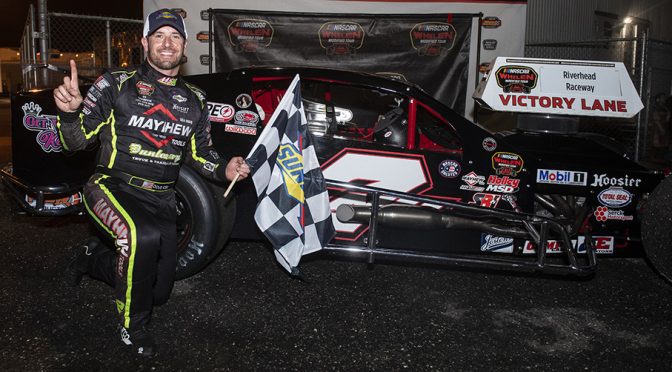
The race was dominated by Doug Coby, who received the call Tuesday to pilot Tommy Baldwin Jr.’s No. 7 at Riverhead while originally scheduled driver Jimmy Blewett cared for his ill daughter.
Coby started third in the Miller Lite 200 and took the lead early from polesitter Timmy Solomito, a position he held for nearly the entire race.
He survived an overtime restart to collect the victory, his 32nd Tour victory in his first start of the season.
Below are the key takeaways from Saturday’s Miller Lite 200, beginning with Coby’s triumphant return to the NASCAR Whelen Modified Tour.
Doug Coby becomes a super sub
Coby was never supposed to race at Riverhead on Saturday night, but he certainly made the most of an unexpected opportunity.
The driver from Milford, Connecticut, was practically untouchable during the Miller Lite 200 behind the wheel of Tommy Baldwin Jr.’s No. 7. The dominant performance by Coby allowed him to earn his third Tour victory at the quarter-mile bullring in the last four Tour stops at the track.
“This was a really cool opportunity to drive this car, under unfortunate circumstances, of course,” Coby told FloRacing on Saturday night. “Jimmy Blewett was supposed to be in the car. We’re just thankful that his daughter, Kayla, is home from the hospital, and from what I hear things are improving.
“The Modified Tour is a great big family. We all like to rub nerf bars and wreck each other and do all sorts of crazy stuff, but we all hang out together. Jimmy’s a good friend of mine, so I’m happy to hear his daughter is home, and to go out there and win one for Kayla was pretty neat.”
The six-time NASCAR Whelen Modified Tour champion announced earlier this year that he’d be taking time off from the Tour this season with plans to complete in four Tour events as well as a few Open Modified events elsewhere.
However, Coby’s win Saturday night at Riverhead proved he still has plenty of ability left should he ever decide to return to the Tour on a regular basis.
His next scheduled NASCAR Whelen Modified Tour race is on July 16 at New Hampshire Motor Speedway.
Another strong Riverhead run for Patrick Emerling
Patrick Emerling’s runner-up showing Saturday continued his recent hot streak at Riverhead.
During the Tour’s three visits to Riverhead in 2021, Emerling did not record a finish worse than second. The final trip saw Emerling lead a race-high 85 laps and hold off defending Tour champion Justin Bonsignore for his third and final win on the year.
Unfortunately for Emerling, Saturday’s Miller Lite 200 followed the trend of the other two 2021 races at Riverhead with Coby finishing one spot in front of him, but he feels confident he can add two more wins to his resume for the other planned Riverhead races this year.
Regardless of whether Coby ends up running those events, Emerling said he will be in a much better position to come away victorious at Riverhead if he shows pace in both practice and qualifying.
“We need to get a little bit of a better starting position,” Emerling said. “We just have to do our thing out there, but Doug was really good tonight. We were also good, but I just couldn’t get going on that restart. We’ll get them next time.”
More bad luck for Bonsignore
After winning the most recent NASCAR Whelen Modified Tour race at Richmond Raceway in April, Justin Bonsignore thought all his bad luck was behind him.
Unfortunately, that wasn’t the case.
On Lap 59, Bonsignore suddenly slowed as smoke billowed from his No. 51 Phoenix Communications modified, resulting in the first caution flag of the race.
He was able to return to the track later in the race and completed 143 laps but finished 25th in the 30-car field.
The defending and three-time Tour champion is now 10th in the series standings after three races, 36 points behind leader Eric Goodale.
Ron Silk’s third-place finish was his best result of the season. He is now second in the Tour standings, two points behind Goodale and one point ahead of Tommy Catalano.
A number of local drivers were entered in the Miller Lite 200 at Riverhead Raceway, with Dylan Slepian proving the best of the bunch following his fourth-place finish.
Solomito was the only other driver besides Coby to lead laps Saturday night. He led 17 circuits but faded to a fifth-place finish by the time the checkered flag waved.
John Baker, making just his fifth NASCAR Whelen Modified Tour start, earned a career-best sixth-place finish.
Defending track champion Kyle Soper scored his sixth career top-10 finish with the Tour, all of which have come at Riverhead. Another local, John Beatty Jr., earned his fifth career top-10 finish with the Tour. They have all come at Riverhead, as well.
The NASCAR Whelen Modified Tour season continues Saturday, May 21, with the running of the inaugural Granite State Derby presented by USA Insulation at New Hampshire’s Lee USA Speedway. The race will be streamed live by FloRacing starting at 7 p.m. ET.