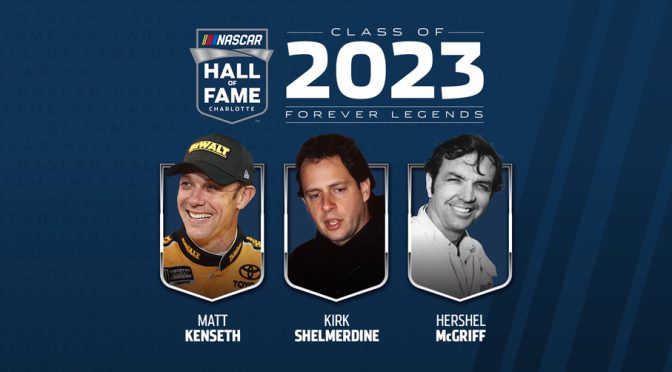
CHARLOTTE, N.C. — Driver Matt Kenseth and crew chief Kirk Shelmerdine — both champions at NASCAR’s highest level — will become the newest Modern Era members of the NASCAR Hall of Fame, along with ageless Hershel McGriff, who was elected from a group of five Pioneer Division nominees.

Longtime NASCAR executive Mike Helton also was named the recipient of the Landmark Award for Outstanding Contributions to NASCAR during the announcements made by NASCAR chief operating officer Steve O’Donnell at the NASCAR Hall of Fame in Charlotte, North Carolina.

HALL OF FAME: 2023 nominees | All-time members

Kenseth and Shelmerdine were voted into the Hall of Fame from a group of 10 nominees by the NASCAR Hall of Fame Voting Panel, which met in person for the first time since 2019. The panel met via Zoom in 2020 and did not meet in 2021 because of the coronavirus pandemic.

Kenseth, who led the Modern Era vote with 69 percent, won the NASCAR Cup Series championship in 2003, his fourth full season of competition. Included in his 39 career victories (tied for 21st all-time) are wins in NASCAR’s marquee races — the Daytona 500 (twice), Southern 500, Coca-Cola 600 and NASCAR All-Star Race.

Getty Images | Getty Images
Getty Images

Kenseth’s championship also had ramifications that remain part of the sport today. Though he led the Cup standings for the final 32 events of the 2003 season, he won the series title with one victory. That contributed to the impetus for a playoff, which was introduced the next year and evolved into the elimination format currently in place.

Kenseth also posted 29 victories in the NASCAR Xfinity Series — eighth-most all-time.

“It feels good,” Kenseth said during an interview on SiriusXM NASCAR Radio. “It’s obviously a huge honor just to be on a list or to be under consideration, but to be voted in really means a lot to me. It’s kind of like the bookend of your career.

“It’s not for anything you did today, but what you did throughout your career. Kind of like the perfect bookend. To go into the Hall of Fame when everything is said and done and all over, to kind of look back at it, it’s pretty neat.”

Kenseth added that, in retrospect, his view of his own career has changed over the years.

“I’ve slowly been changing my view of my career the longer I’ve been away from it,” Kenseth said. “When you’re in the middle of it, I don’t know if it’s a good habit or a bad habit, but it always seemed to work for me, when you’re in the middle of it, you agonize over the losses and the mistakes a lot more than the successes and the wins, unfortunately.

“So I think the longer you’re away from it, certainly, you start to shift your focus a little bit from having knots in your stomach over losing the Daytona 500 in the last corner or getting beat by Jimmie (Johnson) in the last corner way back, 15 years ago, in Las Vegas. Obviously, I still think about it, or I wouldn’t remember that right now.

“Instead of trying to agonize over some of that stuff and trying to figure out how you’re going to be better, you start to change your focus on some of the things that did go right and how extremely fortunate I was to have so many great race teams, crew chiefs, sponsors and owners — everybody that makes it happen to give me the chance to be successful.”

Shelmerdine posted his first win as a crew chief in 1983 at Riverside, California, with driver Ricky Rudd. That was the start of a long skein of success at Richard Childress Racing, where Shelmerdine won championships with NASCAR Hall of Famer Dale Earnhardt in 1986, 1987, 1990 and 1991.

RacingOne
RacingOne

The 1987 season was a watershed campaign for the crew chief from Philadelphia. The Earnhardt/Shelmerdine pairing won 11 races and posted 21 top fives and 24 top 10s in 29 starts.

Shelmerdine took the concept of early retirement to an extreme. In 1992, at age 34, he left his role as crew chief to try his hand at driving. All told, Shelmerdine made 41 starts across NASCAR’s top three national series.

In 50 ARCA Menards Series races from 1993 through 2008, Shelmerdine claimed three victories and finished in the top five 14 times. He was named on 52 percent of ballots during Hall of Fame voting.

“I’m still kind of in shock, actually,” Shelmerdine said. “I’ve been on the ballot before, and there’s a whole lot of pretty big names that should be there as well. I just kind of thought it would be a few years before it happened. But my phone started blowing up about 20 minutes ago, and here we are …

“Racing at the level we were at, the things we were trying to do took everything you had and then some,” Shelmerdine said. “That was pretty much all you did. But the longer away it gets to be, the tougher it is to express how much it meant to us at the time and nowadays. It feels really good to get some kind of fresh recognition for it, because it was pretty big for us back then and in our aging minds, it still is.”

MORE: Photos: Scenes from Voting Day

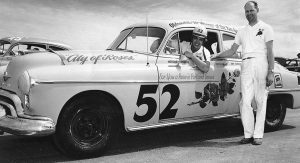
McGriff, who turned 94 in December, competed in NASCAR races for seven decades, starting with the 1950 Southern 500 at Darlington Raceway and ending with the 2018 K&N Pro Series West race in Tucson at age 90.
RacingOne
RacingOne

In 1954, McGriff picked up his only four victories in the Cup Series, at San Mateo, Macon, Charlotte and North Wilkesboro. The driver from Bridal Veil, Oregon, distinguished himself on the West Coast, winning 37 times, third all-time in what is now the ARCA Menards West Series, and earning the championship in 1986.

McGriff was participating in the Kyle Petty Charity Ride when his name was called, so he didn’t get the official word until the motorcycle riders stopped for fuel.

“I always loved the sport,” McGriff said, “but I couldn’t go full-time because I had to raise a family … I started when they didn’t have go-karts — we just drove street cars. Right after World War II, September 16, 1945, I ran my first race (on a dirt track).

“I borrowed my dad’s 1940 Hudson, got a couple of friends to help me and finished 12th or 13th.”

When Helton was named to the NASCAR presidency in 2000, he was the first person outside the founding France family to hold that position. Helton began his nearly five-decade-long career in motorsports as public relations director for Atlanta Motor Speedway.

The safety of the competitors has always been front-of-mind for Helton, who was a leading voice in NASCAR’s commitment to safety and in promoting the creation of the NASCAR Research & Development Center in Concord, North Carolina.

Named Vice Chairman of NASCAR, Helton serves as senior adviser to the sanctioning body and has been a driving force in the charitable endeavors of The NASCAR Foundation.

“It’s kind of humbling,” Helton said. “I’m better suited recognizing people that did things in the sport than accepting. When we first put this Hall together, we kind of knew that it was going to be a big part of our sport going forward, because it could tell of our story from the past. To have been part of that story along the way has been rewarding of its own, but this is kind of out of the box for me. I’m better off recognizing somebody else than being recognized, but I am very grateful.”

On the Modern Era ballot, other top vote-getters (in order) were Harry Hyde, Neil Bonnett and Harry Gant. For the Pioneer Ballot, A.J. Foyt and Banjo Matthews were the other highest recipients of votes, in that order.

An additional vote was cast as the collective result of fan balloting on NASCAR.com. The fan vote went to Kenseth and Gant on the Modern Era Ballot and to Foyt on the Pioneer Ballot.

Contributing: Staff reports
Editor’s note: Bozi Tatarevic is a professional racing mechanic and pit crew member. He will provide technical analysis for NASCAR.com throughout the 2022 season.

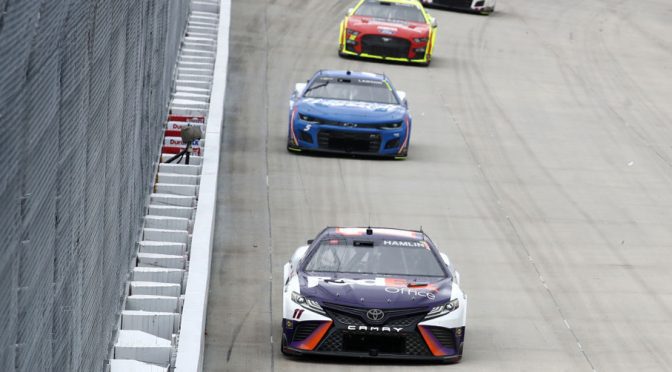
Dover was an eventful race and showed the Next Gen car was able to handle some of the biggest forces of any current race track. Dover Motor Speedway has always been tough on race cars, especially as drivers get into Turn 3 and see incredibly high loads from those bumps, so this was an important test in durability for the cars. Engineers, mechanics, and fabricators have often said that race cars were designed and built with the stresses of Dover in mind, because if they could survive there, then they could survive any other oval on the circuit — and the Next Gen car delivered.

RELATED: Chase Elliott wins at Dover | Full Dover race results

While the parts and pieces on the Next Gen car did their job to tackle the forces of Dover, that didn’t mean drivers didn’t have a battle as Dover acted much like an intermediate track with lift-off oversteer being a common thread. As we discussed earlier this year when we saw incidents at Auto Club Speedway, lift-off oversteer is a condition where load transfer happens from the rear to the front tires of a car as the throttle is lifted, which causes the rear tires to lose traction and the tail of the car to snap around. This is also often referred to as the car snapping loose.

One main difference from Auto Club was drivers were able to save the car much more effectively, and that was likely a result of them becoming more familiar with the handling and changes to the car from a setup perspective. We also saw the improvement in how the cars were able to recover if they got flat during such an incident, as Kyle Larson lost both right-side tires during lift-off oversteer where he slid with the wheels locked up but was able to drive back to pit lane on the flats and get a fresh set of tires. He was able to recover successfully enough from that incident to finish sixth.

The situation on pit lane was equally as chaotic as the Nos. 11 and 16 teams did not successfully tighten all of their wheels. While the situation for the No. 16 appeared to be a typical one where a wheel nut was not torqued all the way down, the situation on the No. 11 was a lost wheel nut during the stop and the car taking off without one mounted at all on the left-front wheel. Going back through the footage of the stop, one can see the tire changer on the left front pulled the old tire and attempted to fasten a wheel nut to the new one, but then he noticed the nut had left the socket. He tried to signal the car to stop, but it was too late as the car had already been lowered from the jack and released.

RELATED: Nos. 11 and 16 Cup teams penalized post-Dover

The wheel nuts for the Next Gen car are captured by the socket on the wheel gun using magnets and an o-ring that is mounted inside of the socket. This way the nut stays in the socket as a new wheel is mounted, so the same nut is used to fasten the new wheel. While this typically doesn’t present issues, on occasion there might be debris in the nut or socket that prevents the socket from being retained, causing it to fly off. The tire changers carry a spare nut on their suit, but in this case, the stop was moving so fast that the tire changer never had a chance to grab the spare before the car departed.

Teams are always trying to find an edge on pit road, and pit stops are as fast as they’ve ever been. But part of the errors we see is that this system is all new to teams and pit crews so they’re learning and adapting to prevent mistakes. Justin Fiedler, who is the rear tire changer on the No. 43 of Erik Jones, shared an excellent thread on Twitter showing his perspective on how these pit stops happen and what he has learned in the first 11 races this year.

Paolitorqueled

As Justin shares, one of the biggest challenges is understanding when a wheel nut is tight because the wheel gun is so different from the previous ones they’ve used, and you only have one chance to get it right versus five in the past. This is not uncommon with this style of wheel and wheel nut because it is being fastened to an aluminum wheel that is typically also prepped on the mating surface with a compound to help the nut seat better, so it is hard to get a feel.

This issue has presented itself in other series and there is technology out there to signal when a wheel is fully tight. Some of that has been implemented on Paoli wheel guns similar to ones that are used in the Cup series. The way these systems work is that a torque sensor is installed on the wheel gun along with LED lights. The torque sensor is programmed to a specific torque where the wheel is known to be tight and the LED lights illuminate on top of the gun for the tire changer to know that the wheel nut has been properly torqued. This solves the issues that Justin mentions in his thread above, which is likely what happened with the No. 16.

The issue on the No. 11 can also be covered with additional equipment that is available for those torque sensor systems as they have a central box that they can be connected to for monitoring and logging. The tightness of each wheel can be displayed on the pit box, and if the crew chief or another crew member notices a wheel is not fully tight, then they can prevent a driver from leaving. This data can also be logged to understand what the trends are in how wheels are tightened so teams can get additional data for training and NASCAR and Paoli can get data for possible improvements to the wheel gun.

PaolipitstopmonitorLosing a wheel is something that should not happen, and luckily the instances we’ve seen so far this year have not created dangerous situations. However, the industry should do everything possible to make sure wheels are safely tightened. Training is the biggest part of that, but technological solutions can also offer an additional layer of security.

Over the course of the past decade, many fans have found reason to cheer on RSS Racing in the NASCAR Xfinity Series. After all, it’s the little team that could, having outrun teams with much larger budgets for years.

Before the 2021 season, RSS Racing made the jump to Ford Performance after running Chevrolets since its entry into the series in 2013.

“With Chevrolet having so many teams, we were pretty low in line of Chevrolets and trying to get some more help,” Ryan Sieg told NASCAR.com. “We figured Ford would want to help more and just tried to get further up on the list to get more help.”

RELATED: Darlington weekend schedule

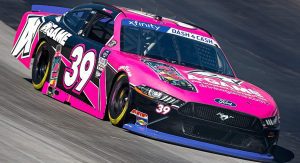
Initially, there were hiccups, causing the team’s results to sag on the race track. Through it all, the No. 39 car had speed, despite just seven top-10 finishes over the 33-race schedule.

Though it was frustrating internally, Sieg anticipated some glitches along the way. This was the first time his small family-run operation had experienced a switch of this magnitude.

“Last year was a struggle swapping over because everything was new and you’re dealing with new people at Roush Yates (Engines) and we were getting acclimated to how they do things after doing everything with Chevrolet for so long,” he said. “But about three-quarters of the way through last year, we got it figured out and it has carried on to this year.”

Carried over, indeed.

During the offseason, RSS Racing hired new employees for its Sugar Hill, Georgia, race shop. The team also received newer Ford Mustangs from Stewart-Haas Racing, and Sieg now has eight cars in inventory for the No. 39 team.

Tim Nwachukwu | Getty Images

On the race track, those newer chassis have paid dividends, with Sieg already matching his seven top 10s from 2021 through just 10 races. And outside of a run-in with Ty Gibbs early into the Las Vegas Motor Speedway race, Sieg has no finishes worse than 11th.

“It’s been a great year,” Sieg said. “We’ve been fast and pretty consistent, just need to keep working harder to work toward the top five and hopefully eventually get a little further up. It’s been a great year. We just want it to be spectacular and we want to win.”

In past years, Sieg has gotten off to similar starts. In 2019, he had five top-10 finishes through the opening 10 races of the season; in 2020, he fell just below that total with four. As the season progresses and the equipment starts to wear, it will be about how RSS can maintain what it has done thus far.

“We always start out pretty fresh, and that’s an advantage,” said Kevin “Cowboy” Starland, Sieg’s crew chief. “Our biggest challenge is going to be staying that fresh. We’re mixing the cars up, and we’ve got enough cars for Ryan now that we can rotate them out and they all perform well. We’re going to try to have the freshest stuff come the playoffs.”

The start of the year has been promising for RSS. Currently, Sieg’s average finishing position is 11.8, on pace to shatter his previous best (14.6 in 2019). The team’s goal, this time, is not to fade as the year continues.

“We just have to keep defending,” Starland said. “Keep knocking out the top 10s, be consistent and race hard.”

Part of the increased speed is finding additional sponsorship. Last year, RSS picked up sponsor A-Game — a sports drink that launched earlier this year. With two-time World Series champion Johnny Damon as the face of the company, it has helped the team with marketability.

Sieg’s primary sponsor, CMR Construction & Roofing, is one of the shareholders of A-Game. Putting its brand on Sieg’s car helped ramp up the launch of the drink, while also showing its faith in the underdog team.

“I’m excited about Ryan Sieg,” said Damon, whose A-Game company sponsored the Xfinity Series race at Dover Motor Speedway last weekend. “He’s an up-and-coming racer that cares. He wants to bring it every time he races.”

With still 16 races remaining before the postseason begins, Sieg sits ninth on the playoff grid, 45 points above 13th. He has been a factor for the win at both Talladega Superspeedway and Atlanta Motor Speedway, leading on the white flag at his home track.

MORE: Sieg makes gains at Atlanta | Xfinity Series standings

Sitting with the fourth-best average finish among series regulars, Sieg is confident his team will be part of the playoffs for a third time.

“We’re going in the right direction, and we’ve got a couple of speedways,” Sieg said. “Hopefully, we can make a few corrections and find ourselves towards the front for most of the day and try to win somewhere.

“Our stats show that we run right there, and we’ll keep continuing to improve and get better.”

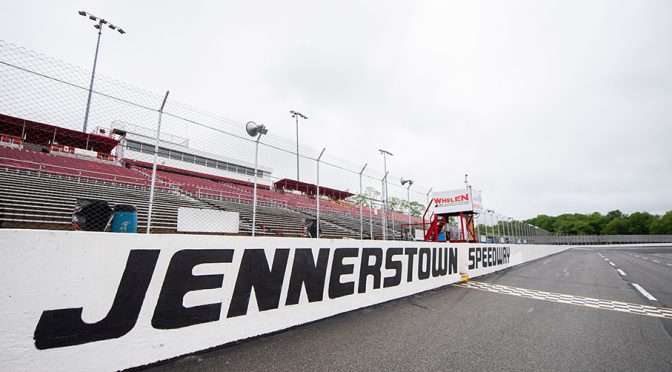
Jennerstown Speedway, which recently rejoined the NASCAR Advance Auto Parts Weekly Series, welcomes back the NASCAR Whelen Modified Tour this Saturday for the running of the Jennerstown Salutes 150.

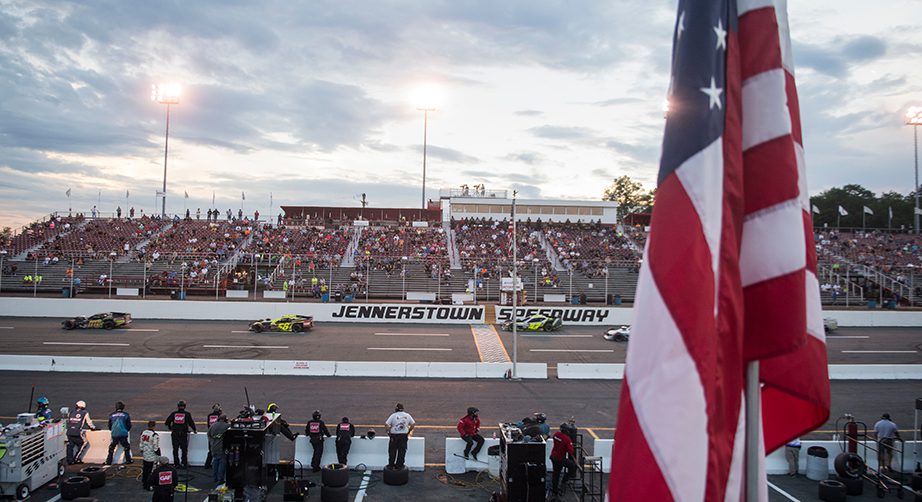
Jennerstown has undergone numerous changes in nearly 100 years of operation, but the facility has maintained a vibrant short track culture that sees the best drivers in the region battle each other for a shot at a track championship.

Nearly every weekend from May to September features some form of on-track activity at Jennerstown. Along with once again host the NASCAR Whelen Modified Tour on May 28, the track’s 2022 schedule also includes monster truck events and prestigious races like the Motor Mountain Masters and CRA Fall Brawl to close out the year on Oct. 1.

FLORACING: Catch the on-track action all year long at Jennerstown Speedway

A stout entry list is expected for Saturday’s Jennerstown Salutes 150. Defending Modified Tour champion Justin Bonsignore headlines the strong field of competitors alongside other notables in Patrick Emerling, Mike Christopher Jr. and Max McLaughlin.

Below is everything to know about Jennerstown Speedway

Jennerstown Speedway

Track Profile

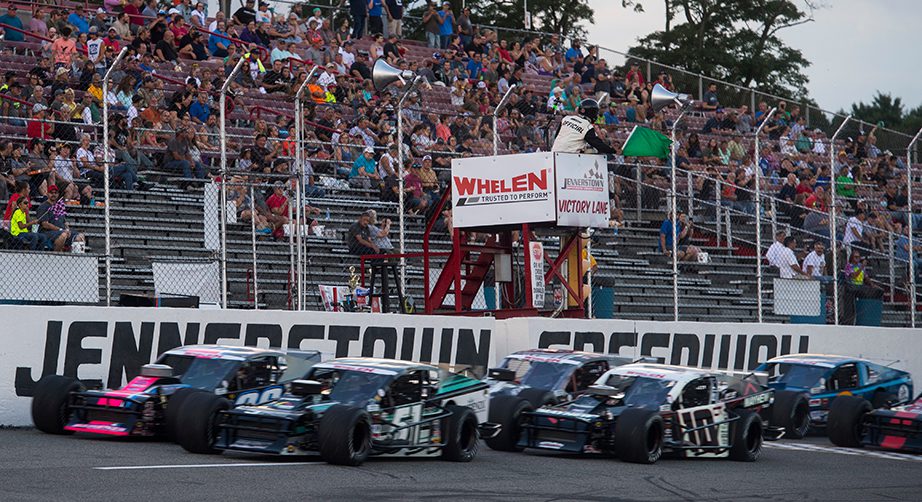
The green flag waves for the NASCAR Whelen Modified Tour at Jennerstown Speedway on August 22, 2020. (Nate Smallwood/NASCAR)
Track Jennerstown Speedway
Location Jennerstown, Pennsylvania
Opened 1929
Length 0.522 miles
Banking Nine degrees in turns, six degrees on straightaways
Surface Asphalt

Constructed on the site of the old Jenners Fairgrounds, Jennerstown was subjected to a variety of different iterations before a major revitalization project in 1967 transformed the track into one of the fastest, half-mile dirt ovals in the United States.

Twenty years later, owner Piney Lanksy elected to turn Jennerstown into an asphalt track. This decision quickly brought NASCAR and other major touring series to the facility, where drivers like Ricky Craven, Steve Park, Johnny Sauter and Mike Stefanik all found their way to Victory Lane.

From a local standpoint, Awtey has been one of the most consistent Late Model drivers at Jennerstown with six track championships; the most of any driver. Other competitors that have multiple Jennerstown titles include Garry Wiltrout and Steve Peles, who briefly co-owned the facility during the early 2000s. 

FOLLOW JENNERSTOWN: Twitter | Facebook

The brief closure of Jennerstown from 2009 until 2013 did little to impact the popularity of the track, as drivers from across the country regularly make the trip up to Pennsylvania for an opportunity to compete at the historic half-mile facility.

Now operating as a NASCAR-sanctioned track, another exciting evening of on-track action is ahead at Jennerstown as the seasoned veterans of the Modified Tour look to add their own chapter towards the track’s long and prestigious history.

Below are the complete lists of winners across all NASCAR divisions at Jennerstown Speedway along with the track champions.

Jennerstown Speedway (Nate Smallwood/NASCAR)

East Series races at Jennerstown Speedway

Year-Race No.  Date Winner
6/12/87
6/17/88
7/22/88
6/17/89
7/22/89
6/16/90
6/15/91
6/13/92
6/12/93
6/11/94
5/6/95
5/5/96
5/4/97
8/22/98
6/19/99
6/17/00

NASCAR Whelen Modified Tour races at Jennerstown Speedway

Year-Race No. Date Winner
6/28/87
5/1/88
7/10/88
4/30/89
7/8/89
7/7/90
7/6/91
7/15/95
6/8/96
6/14/97
6/13/98
6/19/99
7/9/05
6/13/06
6/21/20
8/22/20
5/29/21

NASCAR Southeast Series races at Jennerstown Speedway

Year-Race No. Date Winner
1992-11 7/19/92 Jeff Purvis

Jennerstown Speedway track champions

Year Track champion
1987 Steve Peles
1988 Steve Peles
1989 Steve Peles
1990 Steve Peles
1991 Green Gault
1992 Glenn Gault
1993 Charlie Cragan
1994 Charlie Cragan
1995 Jeff Dunmyer
1996 Jeff Dunmyer
1997 Jeff Dunmyer
1998 Mark Cottone
1999 Richard Mitchell
2000 Barry Awtey
2001 Neil Brown
2002 Neil Brown
2003 Barry Awtey
2004 Garry Wiltrout
2005 Tommy Beck
2006 Mark Smith
2007 Barry Awtey
2008 Jason Mignogna
2009 No champion
2010 No champion
2011 No champion
2012 No champion
2013 No champion
2014 Barry Awtey
2015 Matt Sever
2016 Barry Awtey
2017 Jeremiah Kuntz
2018 Garry Wiltrout
2019 Teddy Gibala
2020 Albert Francis
2021 Barry Awtey

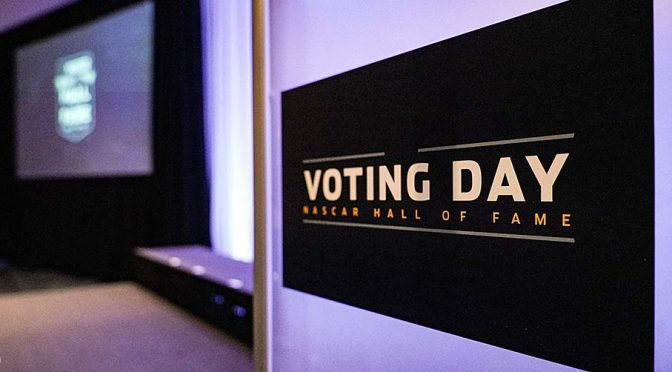
Voting Day for the NASCAR Hall of Fame’s Class of 2023 is scheduled Wednesday afternoon. When this year’s honorees are revealed, NASCAR.com will provide a live video stream of the ceremonies.

BOOKMARK: Watch here on NASCAR.com

The three inductees for the Class of 2023 will be announced Wednesday at 5 p.m. ET from the Hall of Fame’s Great Hall. The recipient of the Landmark Award for Outstanding Contributions to NASCAR will also be revealed.

Fans can tune in to the live-stream broadcast multiple ways — on the NASCAR.com website, through Facebook or by viewing from YouTube. Click below to watch the ceremonies live or set a reminder to tune in. Read on to see more info and the nominees.

THE NOMINEES

NASCAR announced in April the 15 nominees for the NASCAR Hall of Fame’s Class of 2023, a group that will comprise the first Hall of Fame ballot in two years after the COVID-19 pandemic.

Matt Kenseth (2003 Cup Series champion) and Tim Brewer (two-time Cup Series champion crew chief) join the Modern Era Ballot for the first time; A.J. Foyt (seven-time Cup winner) is added to the Pioneer Ballot along with Sam Ard, who was a nominee for the Class of 2020.

RELATED: Class of 2023 nominees | Elliott, Larson to vote

This is the second nomination class under the redesigned format. Ten nominees appear on the Modern Era ballot, five on the Pioneer ballot – designed to honor those whose careers began more than 60 years ago. Two Modern Era candidates and one Pioneer candidate will be elected as the Class of 2023.

Lesa France Kennedy joins the Landmark Award ballot, an award given for outstanding contributions to the sport. Award winners are also eligible for NHOF enshrinement.

In total, there are 62 people on the voting panel. Because there was no Class of 2022, both Chase Elliott and Kyle Larson will participate as one-time voters as NASCAR Cup Series champions. The 63rd vote is determined via a NASCAR.com Fan Vote.

The Modern Era Ballot and Landmark Award nominees were selected by the Nomination Committee, which consists of representatives from NASCAR and the NASCAR Hall of Fame, track owners from major facilities and historic short tracks. The Honors Committee, largely comprised of all living Hall of Famers, Landmark Award winners and Squier-Hall Award winners, selected the Pioneer Ballot.

Following are the NASCAR Hall of Fame Class of 2023 nominees and Landmark Award nominees:

Modern Era Ballot

Neil Bonnett, won 18 times in the NASCAR Cup Series, including consecutive Coca-Cola 600 victories

Tim Brewer, two-time NASCAR Cup Series champion crew chief 

Jeff Burton, won 21 times in the NASCAR Cup Series, including the Southern 500 and two Coca-Cola 600s 

Carl Edwards, winner of 28 NASCAR Cup Series races and 2007 Xfinity Series champion 

Harry Gant, winner of 18 NASCAR Cup Series races, including two Southern 500 victories 

Harry Hyde, 1970 NASCAR Cup Series championship crew chief

Matt Kenseth, 2003 NASCAR Cup Series champion and winner of 39 Cup races 

Larry Phillips, first five-time NASCAR weekly series national champion

Ricky Rudd, won 23 times in NASCAR Cup Series, including the 1997 Brickyard 400

Kirk Shelmerdine, four-time NASCAR Cup Series champion crew chief

Pioneer Ballot

Sam Ard, NASCAR Xfinity Series pioneer and two-time champion

AJ Foyt, won seven NASCAR Cup Series races, including the 1972 Daytona 500

Banjo Matthews, built cars that won more than 250 NASCAR Cup Series races and three championships

Hershel McGriff, 1986 NASCAR West Series champion

Ralph Moody, two-time NASCAR Cup Series owner champion as mechanical genius of Holman-Moody

Landmark Award

Janet Guthrie, the first female to compete in a NASCAR Cup Series superspeedway race

Alvin Hawkins, NASCAR’s first flagman; established NASCAR racing at Bowman Gray Stadium with Bill France Sr.

Mike Helton, named third president of NASCAR in 2000; career included track operator roles at Atlanta Motor Speedway and Talladega Superspeedway

Lesa France Kennedy, NASCAR Executive Vice Chair and one of the most influential women in sports

Dr. Joseph Mattioli, founder of Pocono Raceway

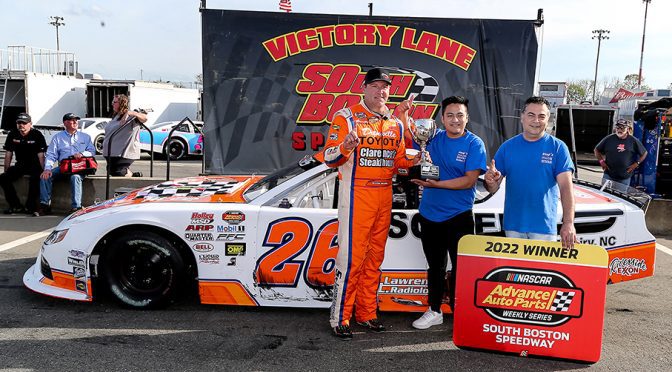
Peyton Sellers’ defense of the NASCAR Advance Auto Parts Weekly Series national championship is off to a fantastic start.

The two-time Weekly Series national champion is the early leader in the NASCAR Advance Auto Parts Weekly Series Division I standings, which were revealed for the first time this year on late Tuesday afternoon.

Sellers has scored four victories in 11 starts at a pair of Virginia race tracks – South Boston Speedway and Dominion Raceway – to earn 294 points thus far. He has nine top-five and 10 top-10 finishes in addition to his four victories early in the year.

RELATED: 2022 NASCAR Advance Auto Parts Weekly Series standings

He has a 58-point advantage ahead of Layne Riggs, who leads the Weekly Series ranks with five victories early this season between South Boston and Dominion. Another Virginia competitor, Mason Bailey, is currently third in the Weekly Series standings.

Hickory Motor Speedway rookie William Sawalich finds himself fourth overall, with ARCA Menards Series East championship leader Sammy Smith currently scored fifth thanks to an impressive start to the season during the World Series of Asphalt Stock Car Racing at Florida’s New Smyrna Speedway.

In addition to leading the national standings, Sellers is also the current leader in the race for the Virginia State championship as well as the Southeast championship. Other regional championship leaders include Jared Russel (Midwest), Brett Kressley (Northeast) and Linny White (West).

Other state championship leaders early in the season are Brett Yackey (Arizona), White (California), Jace Hansen (Colorado), Smith (Florida), Zachary Webster (Idaho), Mike Brightman (Massachusetts), Kyle Crump (Michigan), Sean Hingorani (Nevada), Matt Kimball (New Hampshire), Ed Dachenhausen (New York), Sawalich (North Carolina), Russel (Oklahoma), Preston Luckman (Oregon), Kressley (Pennsylvania), Kade Brown (South Carolina), Ronnie McCarty (Tennessee) and Naima Lang (Washington).

NASCAR uses a driver’s best 18 finishes from any sanctioned track in North America to determine the National champion. Drivers received two points for every NASCAR-licensed competitor they finish ahead of, up to 16 cars; and can receive two bonus points for winning from a starting position five through eight, and four points for winning from ninth or further back. State and province championships utilize the best 14 races.

NASCAR officials penalized two Cup Series teams Tuesday for lost wheels during last weekend’s event at Dover Motor Speedway.

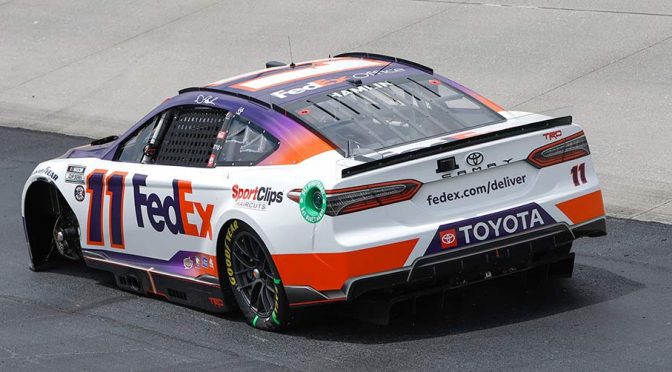
The No. 11 Joe Gibbs Racing Toyota team for driver Denny Hamlin and the No. 16 Kaulig Racing Chevrolet team of AJ Allmendinger were each issued penalties for violating Section 10.5.2.6 of the NASCAR Rule Book, which specifies the separation of an improperly installed wheel. Because of the safety violations during the DuraMAX Drydene 400, four-race suspensions were issued to each of the following crew members:

RELATED: Hamlin’s woes at Dover | Cup Series standings

No. 11 team: Crew chief Chris Gabehart, jackman Derrell Edwards, front-tire changer Blake Houston
No. 16 team: Crew chief Matt Swiderski, front-tire changer Keiston France, jackman Jonathan Willard

UPDATE: On Wednesday, a NASCAR spokesperson said Joe Gibbs Racing will appeal the penalties to the No. 11 team. While under appeal, the JGR crew members listed in the penalty report will be permitted to participate for the No. 11 team.

In the Xfinity Series, two wheel-related penalties were handed out after Dover. The JR Motorsports No. 1 Chevrolet team for driver Sam Mayer was hit with four-race suspensions to three crew members for the loss of a wheel during Saturday’s 200-miler. Crew chief Taylor Moyer and crew members Orane Ossowski (rear changer) and Markus Pierce-Brewster (jack) were suspended for the next four events.

Additionally, the No. 16 Kaulig Racing Chevrolet team on the Xfinity side was fined for having one unsecured lug nut in a post-race check. Crew chief Bruce Schlicker was fined $5,000.

NASCAR officials also announced an indefinite suspension to Jason Houghtaling, the result of a behavioral penalty under Sections 4.4.e of the Rule Book (NASCAR Member Code of Conduct). Houghtaling had been listed as the crew chief of Jesse Iwuji Motorsports’ No. 34 entry on team rosters for the first eight races of the season.

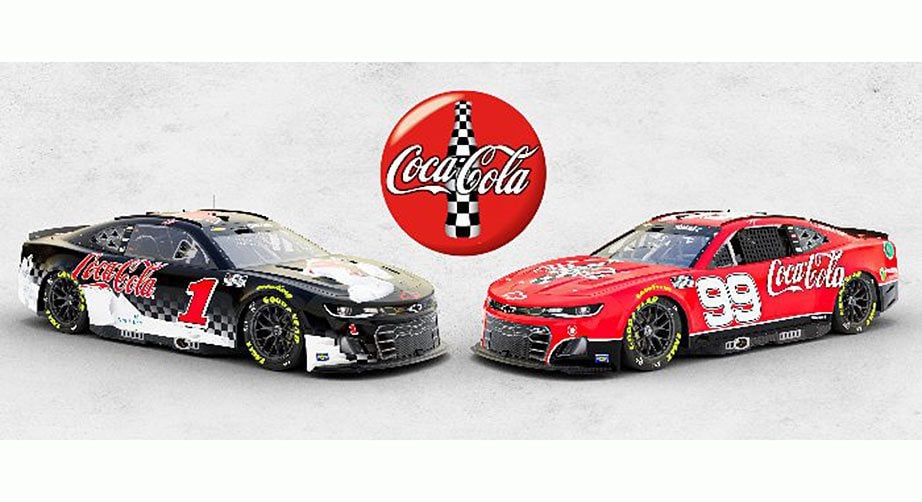
Trackhouse Racing unveiled its retro-styled Nos. 1 and 99 Chevrolets on Tuesday for NASCAR Throwback Weekend at Darlington Raceway, paying tribute to the Earnhardt family legacy.

RELATED: Buy Darlington tickets | Throwback paint schemes

The organization will field matching Coca-Cola liveries for Ross Chastain (No. 1) and Daniel Suárez (No. 99) in Sunday’s Goodyear 400 (3:30 p.m. ET, FS1, MRN, SiriusXM), honoring the cars Dale Earnhardt Sr. and Jr. drove in NASCAR’s 1998 exhibition race at Twin Ring Motegi in Japan. That event marked the first time that father and son had raced against each other.

“We wanted to do something that honors the legacy of the sport, recognizes our valued partners at Trackhouse Racing and something that fans can get behind,” Trackhouse owner Justin Marks said in a team release. “We think this is the right combination marrying the history of the Earnhardts who are both Hall of Famers, acknowledging our support from Coke and Chevrolet, plus supporting the fans excitement for Throwback Weekend in Darlington.”

Marks also plans to pay tribute to NASCAR Hall of Fame nominee Harry Gant, driving his No. 33 Oldsmobile during pre-race ceremonies. Marks owns the car, which Gant drove to four consecutive Cup Series victories in September 1991. Gant kicked off that historic streak at Darlington Raceway.

MORE: Memories of ‘Mr. September’


2022 May3 Trackhouse Darlington Main Image
Trackhouse Racing

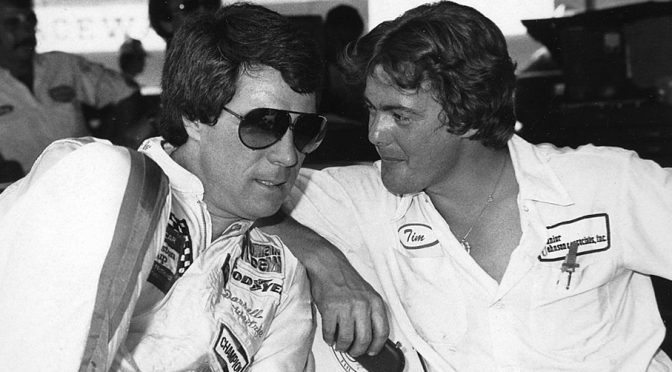
Tim Brewer will never forget April 4 of this year, when he received one of the most important and humbling texts he ever has.

“The text said, ‘Hey, Brewer, we’d like you to be on Sirius (NASCAR) Radio at 4:15 this afternoon, we want to talk about the nominees for the NASCAR Hall of Fame,” Brewer told NASCAR.com. “My question was, ‘Well, who are we going to talk about?’ And they said, ‘Brewer, you!’”

He still was a bit mystified until less than five minutes before he was about to go on-air. He received a call from the NASCAR Hall of Fame, informing him that he was one of 15 former NASCAR greats who were nominated for the Hall’s Class of 2023.

RELATED: Tim Brewer crew chief stats | Meet the Class of 2023 nominees

“You could have knocked me over with a feather because I never expected it, never, not in my lifetime,” Brewer said. “But since then, I mean, the phones and texts, you would not believe the list I have of people who’ve reached out to me.”

Brewer will find out if he is one of the newest members of the Hall when the voting panel convenes Wednesday to make its final selections.

If Brewer is fortunate to be a first-ballot pick — one of four first-time nominees who are up for selection — it will cap off a career as one of the most successful crew chiefs in NASCAR Cup Series competition, who then became popular as a broadcaster with his “cut-away car” from his “Tech Garage” from 2007-14 on ESPN.

Not in a bragging way, but Brewer takes as much pride with what he did on TV as he did as a crew chief (53 wins and two Cup championships).

“There ain’t no driver, no owner, no other crew chief that’s got an Emmy except me,” he said with a smile.

Oh yes, and Brewer — who almost always refers to himself in the third-person as simply “Brewer” — is also one of the best storytellers in the business, with some great recollections of NASCAR greats, including Bill France Sr. and Bill France Jr., Dale Earnhardt, Darrell Waltrip, Junior Johnson, Cale Yarborough and countless more.

Here are a few of his favorite stories, both humorous and poignant:

* Bill France Jr.: “We were in a Hilton hotel in Elmira, New York, in the bar, and Bill said he’d buy me a drink and I said I’d buy him one. Then he said to me, ‘OK, here we go. Tell me how screwed up NASCAR is.’ I said, ‘You ain’t got that much time and they ain’t got enough liquor.’”

But all kidding aside, France was one of the individuals Brewer respected most in the business: “How he came up with all the right decisions, I have no clue. But I don’t recall him making a bad one. … He was all-time one of the best.”

* Dale Earnhardt: “Earnhardt and me are sitting in the front row at a driver’s meeting in Atlanta, cutting up as usual. And here comes (golfing great) Arnold Palmer, he’s going to start the race. After the meeting, Mr. Palmer comes down to talk to Earnhardt, and I’m thinking that’s pretty cool. When they had a break, I said, ‘Mr. Palmer, I’ve been watching your golf career ever since I can remember. Man, you’re awesome.’ He said, ‘Tim Brewer, I’ve seen a lot of your race cars win a lot of races.’ And I went, ‘Arnold Palmer knows who the hell Tim Brewer is?’ That was impressive to me.”

* “The four easiest weeks I’ve ever had in my life were in 1981 when we sat on the pole for four weeks in a row with Darrell Waltrip at Martinsville, North Wilkesboro, Charlotte and Rockingham and we won (all) four races. Then we came back again in 1992 with Bill Elliott, when he won four in a row. Winning four in a row twice, go back and do your research and you’ll find out how many guys have done that.”

* “The old guys, they were men, they were tough,” Brewer said. “I saw Harry Gant get out of the car after winning the Southern 500 at Darlington and some guy said, ‘Hey, Harry, great win. What are you gonna do tomorrow?’ Harry said, ‘Well, I’m gonna go put a roof on the chicken house.’ Or when I’d call Cale (Yarborough), his daughter would say he’s out putting up fence posts, digging them by hand with a fence-post puller, not an auger, and he did that from early in the morning until 6 p.m. at night, all by himself.”

***************************

Brewer spent nearly 50 years in racing, starting as a 14-year-old at legendary Bowman Gray Stadium, just a few miles from his Winston-Salem, North Carolina, home.

His first big break came at the age of 18 when he was tabbed to be crew chief by a then relatively unknown driver who also grew up in the Winston-Salem area by the name of Richard Childress. Brewer would remain with Childress for five years before the latter ultimately climbed out of a race car and became a full-time team owner.

RacingOne
NASCAR Research & Archives Center | Getty Images

Brewer served as a crew chief for several eventual members of the NASCAR Hall of Fame, including Childress, Cale Yarborough, Darrell Waltrip, Terry and Bobby Labonte, Davey Allison and Bill Elliott — as well as Tim Richmond, Neil Bonnett, Geoffrey Bodine, John Andretti, Sterling Marlin, Steve Grissom, Mike Wallace, Kevin Lepage, Johnny Sauter and Jimmy Spencer.

His greatest success came while shepherding Yarborough and Waltrip for team owner Junior Johnson, yet another Hall of Famer and for whom Brewer would ultimately work 12 years for from atop the pit box.

In 1978, Yarborough won 10 times in 30 starts to capture one of his three Cup championships. (He’d also win 13 more races in three of the next four seasons with Brewer as crew chief.)

In 1981, Brewer shifted to Darrell Waltrip’s team and led him to 12 wins and one of his three Cup championships, as well.

All told, Brewer commanded teams that won 53 races (in 708 Cup starts), plus 188 top-five and 308 top-10 finishes, paired with 55 poles.

Brewer has done and seen a lot, from under the hood to atop the pit box to in front of the TV camera. But there’s one constant that has marked his entire time in NASCAR:

“Back in the day, it was fun,” he said. “From the time you’d get out of bed, if you was on my crew, you’d put them little old feet on the floor till the time you went to bed that evening, we always had something going on, always. And I just cherished the camaraderie that we went through.”

Brewer had such a fulfilling career he admits to just one regret.

“If I could go back and change one thing in my racing background,” he said, “I wouldn’t have left Junior Johnson in 1981.”

It’s not a surprising regret: From 1978-81, Brewer won 32 combined races and championships with Yarborough (1978) and Waltrip (1981), with neither driver finishing lower than fourth in that span.

Brewer left to join Yarborough with the M.C. Anderson team in 1982, then helped form Blue Max Racing with Raymond Beadle and driver Tim Richmond in 1983-84 before returning to Johnson’s team from 1985-92.

***************************

Brewer is known for his good nature and sense of humor, but he admits the last 18 months have not been easy on him and his family. His longtime business partner and best friend, Nelson Crozier, died one day after Christmas 2020, following a six-year battle with cancer.

While he humbly doesn’t like to talk about it, Brewer was Crozier’s primary caregiver for that entire time, including having Crozier live with Brewer and his wife, Susan, for the last 3 ½ years of his life so they could take care of him.

Then Brewer’s brother, Glenn, lost his wife to COVID-19, while Glenn’s son and Tim’s nephew, Robby, lost his wife, as well.

“I’ve lost several family members, lost a lot of good friends,” Brewer said. “I’ve been going to a lot of funerals. It hasn’t been too good.

“I’ve been taking care of a lot of people. If you’re my friend, you’re my friend, I’ll do anything in the world for you.”

***************************

But even with all the tragedy and sadness he has gone through since 2020, Brewer remains thankful.

At the top of the list is his wife, Susan. They’ve been married 43 years and together 48 years.

Then there is their only child, Scott, who is the car chief for Corey LaJoie in the Cup Series, daughter-in-law Samantha and 8-year-old granddaughter Sloan Marie Brewer. Or as her grandpa likes to good-naturedly call her, “the heir to the throne.”

Brewer, who turned 67 on Feb. 4 (one day before Waltrip’s birthday, although the latter is eight years older), claims he’s semi-retired these days. He plays a lot of golf, travels the country with Susan in their new motorcoach and recently purchased an oceanfront summer home in South Carolina to go along with their longtime regular residence near Statesville, North Carolina.

“You asked me what is Tim Brewer doing these days?” he said. “Well, Tim Brewer’s living a great life and sharing time with Susan that he didn’t never do before. I was always working on race cars, or on an airplane going to a test or the wind tunnel, or going to wring some money out of somebody so we can have better race cars.

“These days, I stand on my deck or raise the blinds in my bedroom and see the Atlantic Ocean. It don’t get better than that. I’m at the point where I’m now 67 years old. When I was 35, I thought, ‘Well, if you’re 40, somebody needs to take you out and shoot you.’ I don’t think that anymore.

“Good moments, bad moments, you know, I’ve had a lot of them. But as long as I can see the ocean and walk in the sand with Susan and carry my dogs (shelties) or go ride in my golf cart, that’s what I do.”

***************************

The Tim Brewer File:

* Age: 67

* Hometown: Winston-Salem, N.C.

* Wife: Married 43 years to Susan

* Children: Son Scott (42)

NASCAR Cup crew chief career highlights: 708 races, 53 wins, 188 top-five and 308 top-10 finishes. Also 55 poles. Best season finish: first in 1978 (driver: Cale Yarborough) and first in 1981 (driver: Darrell Waltrip).

Veteran motorsports writer Jerry Bonkowski specializes in writing Where Are They Now? stories for NASCAR.com. Among those he’s done to date include Derrike Cope, Ernie Irvan, Steve Grissom, Johnny Benson, Stacy Compton, Mike Bliss, Doug Richert, Brian Scott, Robby Gordon, Ricky Craven, Terry Labonte, Kenny Wallace, Trevor Bayne, Ken SchraderShawna RobinsonSam Hornish Jr.Bobby Labonte, Greg BiffleRicky RuddDarrell WaltripMark MartinMarcos Ambrose and Juan Pablo Montoya.

The list of NASCAR drivers from Alaska is short, but one young driver in the state has big dreams of becoming the next.

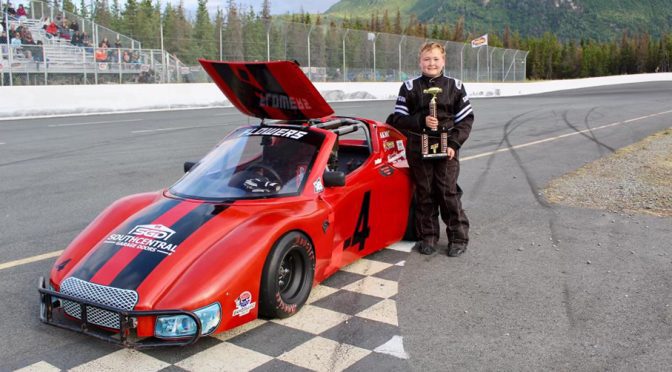
Wyatt Flowers, an 11-year-old from Palmer, Alaska, first began chasing his NASCAR dreams while practicing on a small race track he built in his backyard. His dad would often tell Flowers stories of his own racing days, and Flowers also started collecting hot wheels, racing go karts at a local track, and watching the NASCAR Camping World Truck Series, where he could see fellow Alaskan Keith McGee and his favorite driver, Hailie Deegan, both compete.

“In kind of early 2021 I started to really follow NASCAR, and some of the drivers, whenever they’d win and race, that motivated me to race a little bit,” Flowers said in a recent interview with NASCAR.com.

It was perfect timing for Flowers to get into racing, because last season was also the first year Alaska Raceway Park hosted a Bandolero class. Going from his small backyard track to the third-mile asphalt oval track at Alaska Raceway Park was scary at first, but Flowers caught on quickly.

“From my backyard, my small little race track I kind of made, it was small and for me the turns, they weren’t as good. But going onto the asphalt track, it was way bigger and more open,” Flowers said. “We also practiced a lot in my race car … it was different because in my racer it was open and in my race car, it’s not as open and there’s a lot more high speeds, so that was definitely fun.”

Alaska Raceway Park, located in Palmer, Alaska, is the only NASCAR-sanctioned track in the state.

In seven Bandolero races last season, Flowers only finished outside of the top-three once. He finished the year with two feature wins, two heat race wins, and four poles on the way to a championship in the Alaska Raceway Park Extreme Fun Center Bandolero class.

There weren’t enough cars to separate the Bandolero class into younger and older divisions, so Flowers was one of the youngest in a field that featured competitors up to 17 years old. He got training from his dad and advice from other drivers at the track.

The people at the track are the biggest reason Flowers really fell in love with racing.

“They’d help me and tell me how the track would be,” Flowers said. “All the drivers, the track officials, they would help me and whenever they’d go out they would say, ‘This is how the track is at some times and this is how the track is at another time.’

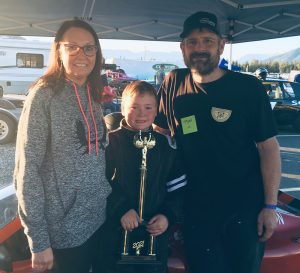
Wyatt Flowers (center) with his father John (right) and mother Amy (left). (Photo: John Flowers)

“One guy helped me. He used to actually race my car at a different track and he was asking me about how I felt in the car and then he would recommend a line for me to run and after I ran that line I was really good.

“Everybody is so nice. They’re all like a family to all of us. They’re super nice, they help out with you a lot. If something happens to a car you go over there and they’ll help you.”

Flowers said the biggest thing he learned was how to control his emotions on the track. He admits there was some fear the first couple times in the car.

“I think after the first race I understood that it doesn’t have to be that scary if you just go out there and you practice a lot and you get used to the car and how it drives,” he said. “So I would say I picked up pretty quickly.”

In addition to driving, Flowers got lessons from his dad on how to get the car ready for the race track every week. While his dad helps with “the harder stuff,” Flowers said, he would often help by painting, putting on stickers and changing tires.

“It’s pretty fun. I like putting it on because it makes me feel good,” he said. “I get into the race and can say, okay I’m at the track, I feel good doing this and stuff. And then sometimes we’ll take off a piece of the body panel, the back part, so we can take a look inside at the motor and oil and where all that is, so that’s fun.”

Flowers will race Bandoleros for at least three more seasons while he waits to become old enough to move up to Alaska Raceway Park’s next class – Baby Grands.

“That’s the class I want to be in,” Flowers said. “They’re kind of like the new Cup cars but a lot smaller.”

The young racer is excited to try all different styles of race car. He wants to eventually move up to Late Models and get to his ultimate dream of driving in the NASCAR Camping World Truck Series.

McGee, who raced five times in the Truck Series last season and once so far this season, was the first Alaskan to race in one of NASCAR’s top three series. He also got his start racing at Alaska Raceway Park.

Now that Flowers knows that racing isn’t scary, he’s ready to go as far with it as he can, and maybe one day add his name to the list with McGee.

“At first I would say maybe I was a just maybe a little bit scared in racing because it was something new to me, but going into this season we gained up to about 10 cars and I learned that it’s not too scary and it became fun for me,” Flowers said. “I’m feeling good. I feel like after a while I’m going to have to get back on the track and get in the car again and get used to it again, but I’m sure that’ll come pretty quick because, like I said, this isn’t as scary and stuff.”

Alaska Raceway Park will host a NASCAR/INEX open practice on May 13 and open then season on May 14 with GCI Late Models, Baby Grands, The Legends of Classic Country 100.9/Pruhs Construction Thunder Stocks, Alaska Army National Guard Bomber Stocks and Extreme Fun Center Bandoleros, all starting at 6 p.m. local time.

The track is also one of one 21 tracks competing in the NASCAR Advance My Track Challenge. The challenge, presented by Advance Auto Parts, is a fan vote that awards the winning track a $50,000 prize. To vote, visit www.AdvanceMyTrack.com.

“I’m just looking forward to a little bit of racing, but one big thing I’m looking forward to is seeing all the other drivers and being with my family,” Flowers said.