Clay Campbell knows exactly the photo you’re talking about, nodding in affirmation before you can even get out the words.

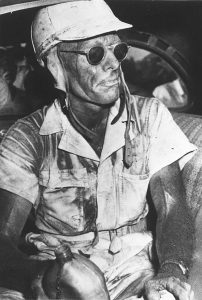
“There aren’t many images that exist of Red Byron,” he said, “but …”
RacingOne
NASCAR Research & Archives Center | Getty Images

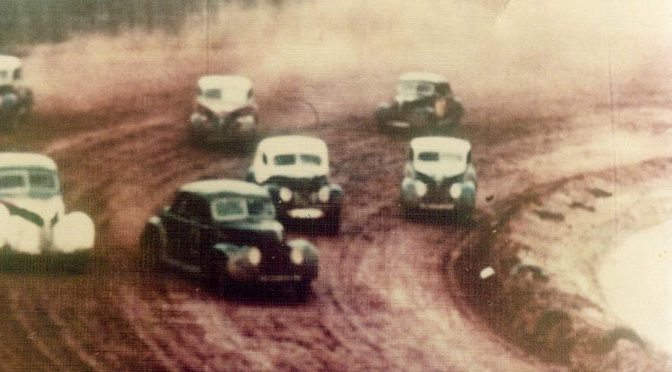
In that historic picture, that photo, there’s the driver who would become the first NASCAR Cup Series champion with an almost-smile of satisfaction on his face. Byron is covered in dirt, wearing post-war sunglasses and a canteen in hand for refreshment. Stock-car racing had barely organized by then, and the historic Streamline Hotel summit in Daytona Beach, Florida, was still a few months away. But that image captured a weathered, 32-year-old Byron on Sept. 7, 1947 after becoming the first winner at Martinsville Speedway, the race track Campbell’s grandfather crammed into a central Virginia gap some 75 years ago.

“If you look back to that day, and if I’m not mistaken, he may have had a rope tied around his waist as the seatbelt, I don’t know,” said Campbell, the speedway’s longtime president. “But, you know, they were daredevils, they were truly daredevils there. There was nothing safe about those cars, no safety features on them, and a lot of them, they drove it to the track to race it.”

The dusty, musty image of Byron offers a quaint early bookend to the first NASCAR weekend of the season, culminating with Saturday night’s Blue-Emu Maximum Pain Relief 400 (7:30 p.m. ET, FS1, MRN, SiriusXM) – the 147th Cup Series event in the track’s rich history.

RELATED: Martinsville weekend schedule | Power Rankings

Saturday’s race will be the first for the seventh-generation Next Gen stock car that has ushered in a new era of racing in NASCAR’s top series this year. Martinsville’s reach is so deep, its first events were pre-Gen 1.

“We were racing at Martinsville before there was a we,” said NASCAR vice chairman Mike Helton, soaking in the exhibit that opened earlier this week to commemorate the track’s diamond celebration.

It’s true. NASCAR founder Bill France Sr. helped to organize that first event, but the race for Modified stock cars pre-dated the sanctioning body’s first season of competition.

Roughly 6,000 fans took in that opening Martinsville program, which featured three 12-lap qualifying heats, a 15-lap consolation race and a 50-lap main event. Admission was $2, with children 12 and under admitted free with a paying adult. Byron won $500 of the $2,000 purse. Two years later, he’d win at Martinsville again, but this time in the new Strictly Stock Division that would become the NASCAR Cup Series. That victory helped him inch closer to sealing the first championship in the circuit’s inaugural season.

H. Clay Earles, Campbell’s grandfather, founded the track at great personal financial risk – a peril that heightened after two early investors bowed out, opening the door for France to join as a partner. Stock-car racing had yet to become a sustained, lucrative business, yet Earles was able to envision what might become of the 30 acres he first purchased from the McCrickard family’s farm plot between the towns of Ridgeway and Martinsville.

Earles bushwhacked through an overgrown thicket when he first explored the land. Soon after, his crews were carving out a half-mile oval with long, narrow straightaways and tight turns – a layout that owed its shape to the hills that cradled it and the railroad that neighbored the backstretch.

“The way it’s in here now, that’s about the only way you could have shoehorned it in here,” Campbell said. “And I think that was just a stroke of luck that it happened that way. There are many half-mile tracks all over the country, but none you’ll find shaped like this. It has a unique style of racing about it, nobody else has.”

MORE: All about Martinsville’s 75th

Another factor that set Martinsville apart in stock-car racing’s infancy was the track’s attention to fan amenities – a rarity in an era filled with fly-by-night race promoters. After the early years of the rutted dirt track kicking up clouds of dust, Earles made Martinsville one of the first paved short tracks on the circuit in 1955. Two years later, North Wilkesboro Speedway – another charter track for the Cup Series – followed suit.

But Earles also took special care to beautify the track he built. Boxwoods and azaleas once lined the turns’ retaining walls, and even the primitive restrooms from the track’s earliest days were decorated with rose beds nearby.

“I remember people asking, ‘Why do you want to do that? It’s a race track,'” Campbell said. “He said, ‘Why can’t a race track look pretty?’ That was his thought process, and he always wanted it to be maintained nicely.”

Early news reports in advance of that first race touted Martinsville as “one of the finest half-mile dirt tracks in the United States,” a state-of-the-art venue with a spacious grandstand. Some 75 years later, those features remain cutting-edge, including the LED lighting system that will illuminate all three nighttime races in this week’s NASCAR national-series tripleheader.

Campbell also noted what has been a common refrain, that the track’s management team has treaded carefully when making changes around the speedway’s grounds. Martinsville has had to adapt and grow to position itself for the future, all while taking care not to upset the rustic charm of the place.

Plenty has changed in 75 years, but the track’s shape and its spirit haven’t wavered.

“It’s been such an evolving business from Red Byron’s historic first win here,” Campbell said. “You’re right, that canteen and his dirty face and the glasses and whatever kind of helmet he was wearing – we’ve come a long way, and for 75 years, Martinsville has been a part of it. So we’re really excited and humbled by the whole thing, and I’ve said it numerous times today: I attribute most of our success to our fans. Without them, we wouldn’t be here 75 years.”
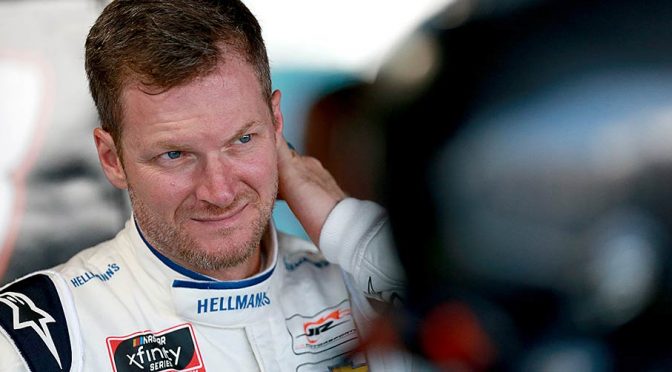
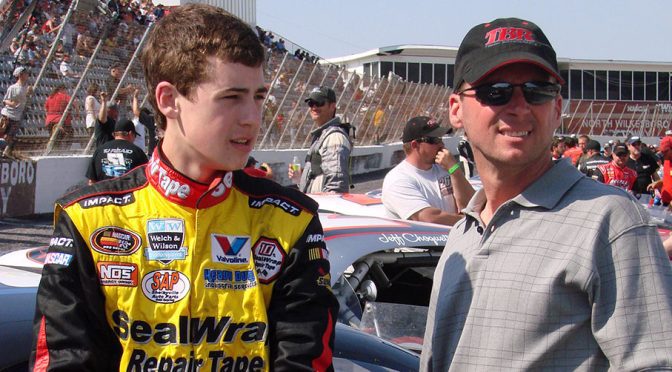
It’s starting to get real for NASCAR Hall of Famer Dale Earnhardt Jr.

The 26-time NASCAR Cup Series winner, NBC broadcaster and JR Motorsports team owner will make his lone NASCAR Xfinity Series start of the season Friday at Martinsville Speedway (7:30 p.m. ET, FS1, MRN, SiriusXM NASCAR Radio), and he and the team are getting the final details just right.

Earnhardt retired from full-time Cup Series competition after the 2017 season. In each year since, he has entered one Xfinity Series race per season in a part-time effort with his JR Motorsports team.

RELATED: Buy tickets now

Friday will mark his first Xfinity Series start at the 0.526-mile Virginia oval. The series returned to Martinsville last season after a nearly 14-year hiatus.

Earnhardt has plenty of Cup Series reps on the track, though. He notched the 23rd of his 26 career Cup Series victories in 2014 at Martinsville, claiming the track’s signature grandfather clock trophy. That win marked his last with crew chief Steve Letarte, who now works alongside Earnhardt as a fellow analyst with NBC Sports.

Since 2018, Earnhardt’s four Xfinity Series starts have produced three top-five finishes. He has competed in two one-off starts at Richmond Raceway (2018, 2021), plus single starts at Darlington Raceway (2019) and Homestead-Miami Speedway (2020).

Earnhardt will drive the No. 88 Hellmann’s Chevrolet on Friday night, and he’ll have a special steering wheel, too. The orange, camouflaged wheel will be auctioned off after the event to raise funds to battle food insecurity through The Dale Jr. Foundation’s partner charities.

PHOTOS: Dale Jr.’s life in NASCAR

Ryan Blaney is no stranger to grassroots racing.

Long before he became a seven-time NASCAR Cup Series race winner and driver for Team Penske, Blaney honed his skills at short tracks across the Southeast.

The son of veteran NASCAR competitor and 1995 World of Outlaws Sprint Car Series champion Dave Blaney, the younger Blaney was a regular competitor with the Pro All Stars Series South, a touring asphalt Super Late Model series.

It’s a time of his life that Blaney remembers fondly.

“When I started running late models at 14 years old, dad was off racing on the Cup side, and these guys that I was racing around, some of them were double my age or triple my age,” Blaney recalled, speaking at the 2022 Advance My Track Challenge launch at the NASCAR Hall of Fame in Charlotte, North Carolina. “They kind of raise you on the weekends, kind of like a second family.

“You go back and you realize just how important those tracks were and those people were.”

During the 2010 and ’11 seasons, Blaney ran the full Pro All Stars Series South schedule in addition to select races with other series.

In that time, he claimed victories at several local short tracks, including Greenville-Pickens Speedway in Greenville, South Carolina, North Carolina’s Hickory Motor Speedway, Tennessee’s Newport Speedway, South Carolina’s Dillon Motor Speedway and Ace Speedway in Altamahaw, North Carolina.

In 2011, Blaney captured the Pro All Stars Series South championship by 24 points ahead of Jay Fogleman, the father of current NASCAR Camping World Truck Series racer Tate Fogleman. By 2012, Blaney was a race winner in the NASCAR Camping World Truck Series, scoring a victory at Iowa Speedway in a truck fielded by Brad Keselowski.

The rest, as they say, is history.

Ryan Blaney during a CRA Super Series Southern Division event at Hickory Motor Speedway in Hickory, North Carolina, on May 23, 2010. (Adam Fenwick)

“I can’t remember one particular moment; there were a lot of really good ones,” Blaney said when asked if he had a favorite grassroots racing memory. “Just racing hard with a lot of really good guys back in the day. The Preston Peltiers, your Ben Rowes and getting into scuffles with them. I saw Preston a couple years ago and we laughed about it, and we’re really good friends. It’s fun to look back on those things and really reminisce.

“They taught me a lot about racing, all those guys whether they were twice my age or my age. I made a lot of good memories with them. Just really neat to be a part of a traveling series week in and week out and you make friends and hopefully not that many enemies.”

Blaney’s experience at the grassroots level is what made him the ideal representative for Advance Auto Parts, the entitlement sponsor of the NASCAR Advance Auto Parts Weekly Series.

“That’s why we partnered with Ryan and the entire Team Penske team, because they stand for supporting racing at all levels,” said Jason McDonell, executive vice president of merchandising, marketing and e-Commerce for Advance Auto Parts. “Ryan and his dad in particular, who obviously have an affiliation with their own track (Sharon Speedway in Hartford, Ohio), and Ryan really spends time thinking and really reminiscing about his youth in terms of what got him to where he is today.

“It was local short track racing, all up here in North Carolina outside of High Point. That’s where he actually learned to drive a late model, and now he’s driving on Sunday. For us, it was the perfect marriage of having a great driver and a great family in a sport that is all about families and is about communities.”

As part of Advance’s support of grassroots racing, the organization announced Tuesday the return of the Advance My Track Challenge. The program spotlights NASCAR short tracks in communities across North America, with one lucky track taking home a $50,000 grand prize.

“The fact that Advance wants to give back to these local short tracks and grassroots of racing just means so much and their commitment to want to see motorsports in general continue to thrive and continue to succeed,” Blaney said. “I couldn’t think of a better partner to be with. It was a huge success last year.

“I’m fortunate for me as a driver to be involved with a company like this that wants to do these amazing things to help these tracks around the country.”

Though he’s extremely busy with his NASCAR responsibilities these days, Blaney admitted he isn’t against the idea of getting back to his roots and racing a Super Late Model at some point in the future.

“I wouldn’t mind,” Blaney said about potentially returning to grassroots racing. “I’m so removed from the Super Late Model world. I haven’t run those things in so long. I don’t even know what cars are good now a days.

“I’d love to go back and run a little bit. Just kind of hard to do it currently. I’d love to maybe jump in it,” Blaney continued. “I’m working on trying to branch out and just kind of run some local stuff. I know Advance would love it.”

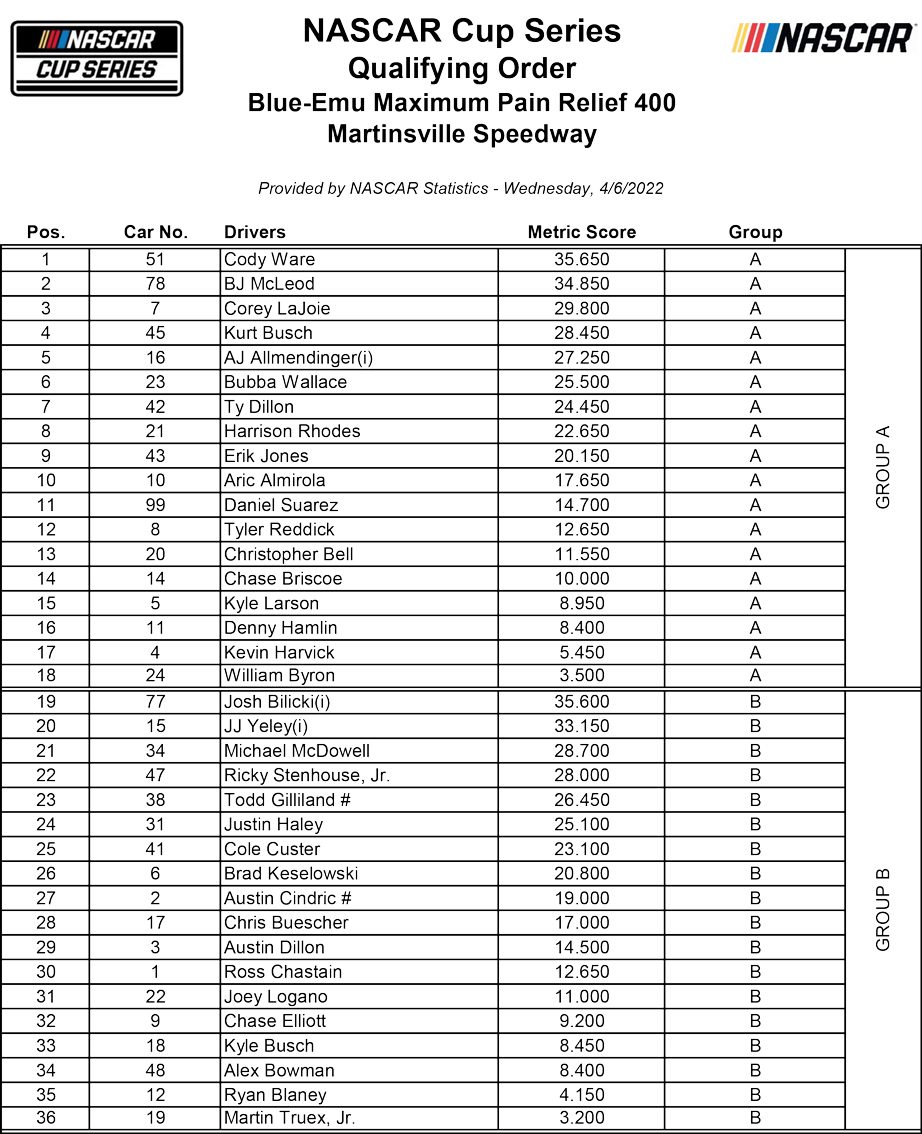
Check out the qualifying order for Friday’s on-track action at Martinsville Speedway (4:30 p.m. ET on FS1) before Saturday’s Blue-Emu Maximum Pain Relief 400 (7:30 p.m. ET, FS1, MRN, SiriusXM NASCAR Radio).

RELATED: Richmond weekend schedule

On most ovals this season, teams will be split into two groups based on odd/even finishing order from the week’s previous race for one warmup/practice session per group. This week’s practice session will be 15 minutes.

That practice will lead directly into single-car, two-lap qualifying that is split up into two groups. The top five drivers from each group will then advance to the second round of qualifying to fight for the Busch Light Pole Award with another single-car, two-lap run.

RELATED: Learn more about the practice and qualifying procedures for 2022


raysmith


Editor’s note: Bozi Tatarevic is a professional racing mechanic and pit crew member. He will provide technical analysis for NASCAR.com throughout the 2022 season.

Richmond proved to be an exciting race as we saw a variety of strategies play out with some teams choosing a six-stop strategy while others opted for seven as they evaluated tire wear and what would be the optimal way to get to the finish line. The seven-stop strategy proved to be the successful one in the end as Denny Hamlin and his crew took the No. 11 Toyota Camry to Victory Lane.

As we shared in our race preview, tire fall-off played a significant factor in the strategies being chosen, but so did pit stops. The debut of the new Joe Gibbs Racing pit-stop choreography ultimately played a factor in allowing Chris Gabehart to execute a successful strategy for the No. 11 Camry.

RELATED: Hamlin hammers point home | Martinsville weekend schedule

The first run of the race replicated much of what we saw in practice and qualifying as Ryan Blaney took off and won the first stage. William Byron joined him up front as teams started the race with the setups they had in qualifying, so similar speed was to be expected. It was no surprise that Blaney led the charge based on what we saw on Saturday.

Kurt Busch had fuel-system troubles early in the first stage that resulted in a caution flag and the opportunity for teams to pit early in the 400-lap race. Kyle Larson led the charge with an attempt at the first alternate strategy as he and a handful of other drivers pitted on Lap 12 for tires and fuel. The stop seemed to work out for Larson in the short term as he was able to work his way up to the top 15 during the first stage but not enough to gain stage points.

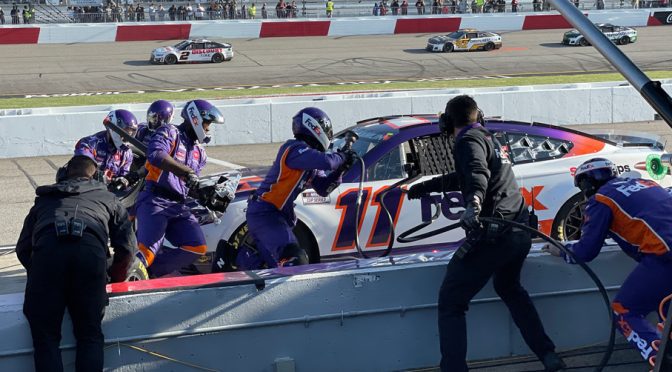
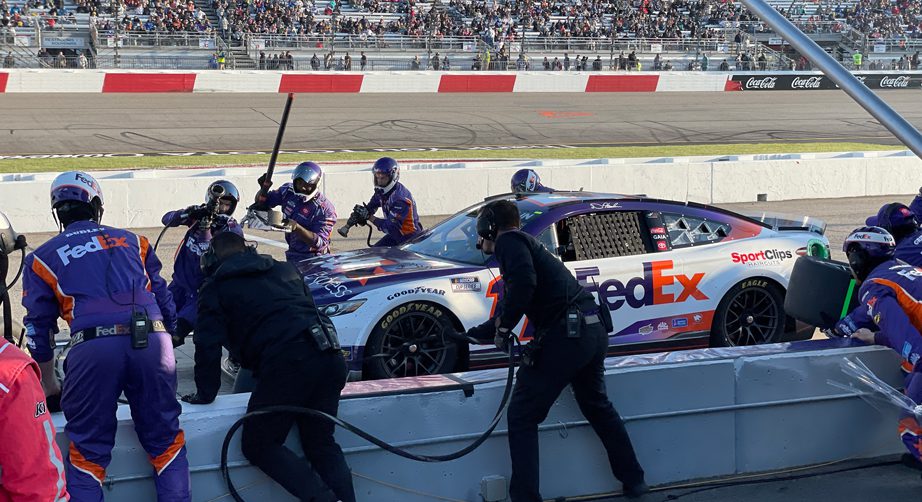
The completion of the first stage brought everyone to pit road and cars pitted on Lap 74. This was a pivotal stop because it allowed teams to make adjustments based on driver feedback and allowed the first chance for the Joe Gibbs Racing pit crews to try out their new choreography.

As shared in the past, this new choreography sends the rear-tire changer around the front of the car so the changer does not have to wait for the car to pass and allows faster access to the right-rear tire. The first set of stops showed some debut jitters as most of the Joe Gibbs Racing pit crews attempted the new choreography but ended up being slower than their traditional pit-stop routine at a first attempt.

While the focus was mostly around Ryan Blaney at the front, there was a battle that was building up a few positions back as Kevin Harvick and Denny Hamlin traded spots right at the edge of the top 10 in the first half of the race. Even though the No. 11 crew had a slower first pit stop than what it had done in practice, it still managed to beat the No. 4 crew by over a second with the new choreography.

Hamlin and Harvick split up as their crew chiefs opted for different strategy plays. Harvick followed the cue of Martin Truex Jr. and pitted at Lap 127, while Hamlin stayed out. This effectively created two groups of cars on track with about six cars staying out in an attempt to gain position toward the end with an alternate strategy.

Jared C. Tilton | Getty Images

That pit cycle gave us a chance for the first look at a faster version of the alternate Joe Gibbs Racing pit stop choreography. The No. 18 crew completed a four-tire change in what was a record 9.2 seconds at the time. The 18 crew would later beat its own record by completing a 9.1-second pit stop on Lap 234, showing the efficiency of that choreography and falling just a tenth short of getting into the eight-second range as predicted before the race.

While the No. 11 crew was not able to beat the No. 18 for fastest stop of the day, it was only a couple of tenths short with stops toward the end of the race in the 9.3-second range. The advantage the No. 11 crew showed during the race was its flexibility to switch back to the traditional-style pit stop in the middle of the race in order to allow a crewmember to make an adjustment more easily on the car while staying within a few tenths of the alternate pit-stop choreography time.

Hamlin finally completed his second pit stop at Lap 154, which cycled him out way back around the 25th position with his teammate Martin Truex Jr. taking the lead after everyone cycled out. This point in the race would effectively split cars into two groups if they were maximizing their tires: Hamlin and those who stayed out were on a seven-stop strategy that would allow them to get a fresher set of tires later in the race; Truex and the majority of the field attempted a six-stop strategy with the goal of gaining enough track position to try to beat those with fresher tires toward the end of the race.

Rodney Childers appeared to notice what Gabehart was doing with the No. 11, so while the No. 4 car started with a strategy that alternated with the No. 11, it switched to following what the No. 11 was doing from Lap 234 – at which point Hamlin and Harvick started to see each other again right around the 10th spot. They eventually made it into top-five range as the race got closer to Lap 300, which showed that they had speed and pointed toward a good battle at the end of the race as both of those cars would have fresh tires they could put on to try to beat those that planned to stay out on the six-stop strategy.

Kyle Busch appeared to be on a six-stop strategy like his teammate in the No. 19 and William Byron, who was leading in the No. 24 as the last 50 laps of the race approached. However, the No. 18 ended up being forced into a seventh stop on Lap 351 as NASCAR noticed a piece of tape on the grille of the car. This effectively took them out of contention of competing with the Nos. 24 and 19 but also didn’t make them competitive with the Nos. 11 and 4 that were on the strategy with the extra stop and had adjusted their cars for that slightly shorter run.

Jared C. Tilton | Getty Images

The tape on the grille of the No. 18 ended up there 200 laps earlier as a crew member mistakenly attached it to the grille that feeds air to the engine and radiator instead of attaching it to the left-front brake ducts that feed air to the brakes. This mistake was likely a combination of the short amount of time available to apply the tape and the unfamiliarity with the duct location on the Next Gen car since the ducts haven’t been open for many races yet.

The design of the radiator duct inlet is such that adding a piece of tape would be negligible as the air is exhausted through duct outlets in the hood and since the grille also feeds the engine intake. Adding any amount of tape that could block off the radiator to offer an aerodynamic advantage would also likely choke the engine of power, detrimental to the engine output. While the tape application did appear to be accidental, NASCAR had to enforce it since it is explicitly outlawed by the rule book and ended up reviewing footage of when it was applied before officials black-flagged the No. 18.

RELATED: Learn more about the relevance of radiator ducts

Hamlin and Harvick cycled out into the top 15 after that last set of pit stops but may not have looked like contenders to many from the outside as they were sitting a lap down with 40 laps to go in the race. Byron had the oldest tires on the track, and as the final laps of the race approached, it looked like that six-stop strategy might see some success as Byron and Truex appeared to be the ones who were going to battle for the win.

Those who looked carefully might have noticed Hamlin and Harvick were marching through the field, and it looked like Hamlin could make it as he was about 10 seconds back from the leaders with 18 laps to go but making up about half a second per lap. The finish becoming a four-way battle started becoming clear with about 10 laps to go. The pace of the No. 11 led me to head to their pit box with the expectation that some passes would be made.

2022april5 Final Laps Bozi
Bozi Tatarevic

Hamlin and Harvick made it by Byron with four laps to go and while Harvick tried his best to reach Hamlin, he was ultimately unsuccessful and Hamlin walked away with the win using a combination of driver, pit crew and strategy to put an entire race together. 

While it may have seemed like Hamlin came out of nowhere, it started becoming clear toward the middle of the race that they were on a strategy that would put them in contention and some of their tools like the new pit-stop choreography helped to make that a certainty.

The No. 11 pit crew saved Hamlin more than six seconds during pit stops over the No. 4 crew as the day went on. But the most interesting stat on the pit-crew side was that the No. 11 crew spent less than a quarter of a second in pit-stop time during the length of the race over the No. 24 crew, even though they completed a whole extra pit stop.

This pit-stop time by the No. 11 included that first pit stop with the reverse choreography that was a little slower since it was their first time doing it in a live race. They were still not only able to meet the crew of the No. 4, which was on the same strategy as them, but match the No. 24 crew for total pit-stop time while doing one more stop in the end that gave Hamlin those fresh tires. That last stop was also directly significant on track position because the No. 11 crew beat the No. 4 crew by half a second in pit-stop time.

Entering and leaving pit road are as significant as the time of the actual pit stop itself and that proved to be another factor for the new pit-stop choreography as Hamlin was able to beat Harvick in overall time on pit road due to the faster stops, even though Harvick was faster than him in getting on and coming off from pit road.

This was the first attempt at this new pit-stop choreography, but it is already proving to be successful in time taken for a tire change. And it is likely to help even further as the crews perfect it and start hitting those stops in the eight-second range. We’re also likely to see additional benefits at tracks where fuel mileage is important as the fueler is now able to stay connected to the car for the whole duration of a fuel can instead of having to disconnect for a couple of seconds while the rear changer comes around.

Richmond was exciting from multiple perspectives, and hopefully it will be a preview of more races to come with heavy strategy and critical pit stops.

2022april5 Final Stop Bozi
Bozi Tatarevic


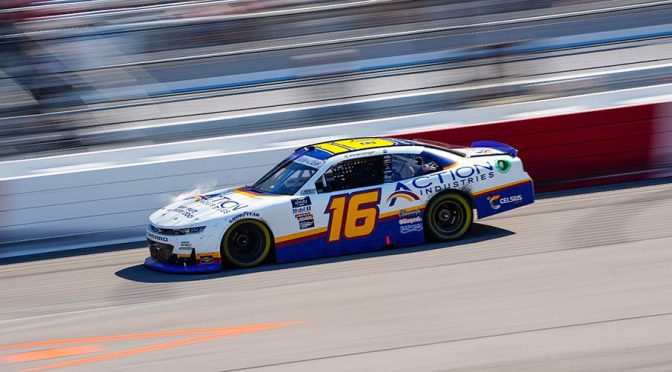
NASCAR officials fined a pair of Kaulig Racing’s Xfinity Series teams for lug-nut infractions found after last weekend’s event at Richmond Raceway.

RELATED: Xfinity Series standings | Weekend schedule: Martinsville

Both the No. 10 and No. 16 Chevrolets from the Kaulig stable each were found with one unsecured lug nut in a post-race check after Saturday’s ToyotaCare 250. Those violations of Section 8.8.10.4a in the NASCAR Rule Book resulted in $5,000 fines to each crew chief — Jason Trinchere (No. 10 team) and Bruce Schlicker (No. 16).

Allmendinger, the Xfinity Series’ points leader, drove to a fourth-place finish Saturday at Richmond. Cassill wound up 15th in the 250-lapper.

RALEIGH, N.C. (April 5, 2022) – Advance Auto Parts (NYSE: AAP), a leading automotive aftermarket parts retailer and entitlement sponsor of the NASCAR Advance Auto Parts Weekly Series (NAAPWS), today announced the return of its Advance My Track Challenge, a program that spotlights NASCAR’s short tracks in communities across North America.

During the program, race fans are invited to vote for their favorite NASCAR Home Track, with the most popular track winning a $50,000 grand prize. The voting window is now open on AdvanceMyTrack.com, with 21 NAAPWS tracks across the U.S. and Canada eligible to win.

The first round of voting concludes Friday, May 6. The top six tracks receiving the most votes will move on to the final round, taking place May 9-13. The track with the most fan votes in the final round will win the grand prize, courtesy of Advance. The track finishing with the second-most votes will receive $15,000, and the third-place track will win $10,000. Teams at winning tracks may use winnings for facility enhancements or to establish community-based programs with schools, nonprofits or other local organizations.

“We are thrilled to bring the Advance My Track Challenge to race fans for a second year,” said Jason McDonell, Advance’s executive vice president of merchandising, marketing and e-Commerce. “NASCAR’s Home Tracks and the Weekly Series play a critical role in our sport, giving local racers and future superstars the opportunity to put on a great show for their communities. This program helps advance historic grassroots racing venues while recognizing the communities with loyal and passionate racing fans.”

“The Advance My Track Challenge is a great partnership with Advance Auto Parts that puts a well-deserved focus on our weekly tracks and the development of their infrastructure to enhance facilities in local communities,” said Ben Kennedy, NASCAR senior vice president, racing development & strategy. “Our roots in racing at the local level are a key part of NASCAR’s history and future success, and this is instrumental in engaging more fans at weekly tracks.”

In support of the program, Advance My Track Challenge branding will be featured on Team Penske’s No. 12 Advance Auto Parts Ford Mustang driven by Ryan Blaney at this Saturday’s race at the Martinsville Speedway in Martinsville, Va. (7:30 p.m. ET, Fox Sports 1).

“Short track racing has been part of my family for generations, and we’ve had great memories at the track,” said Blaney, a third-generation race car driver and 7-time NASCAR Cup Series race winner. “Ensuring the success of local tracks is something that’s important to me and my family, so it’s exciting to have a partner like Advance who is making it their mission to support NASCAR’s Home Tracks. We look forward to racing with Advance My Track Challenge on our Ford at Martinsville, one of NASCAR’s most iconic grassroots-style tracks.”

The Advance My Track Challenge launched in 2021, with the $50,000 grand prize awarded to Berlin Raceway, a 7/16-mile paved oval track located just outside Grand Rapids, Mich. More than 122,000 votes were cast by race fans during last year’s voting window.

Advance’s support of NASCAR’s Home Tracks extends beyond the Advance My Track Challenge. The retailer is using its season-long sponsorship of Blaney’s No. 12 Ford to showcase NASCAR-sanctioned short tracks across the U.S. and Canada. Each week, two different tracks will be featured on Blaney’s car. For every Blaney Cup Series victory, the winning track(s) on his car each will receive $1,200 from Advance. Through Blaney’s three NASCAR victories last season, Advance awarded winnings to six different NASCAR Home Tracks.

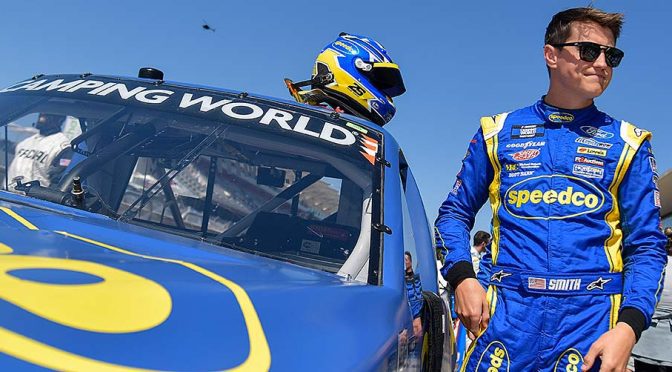
Nobody has started the 2022 Camping World Truck Series season better than Zane Smith. But it almost didn’t come to fruition.

Last fall, Smith was searching for a ride after a “pretty realistic” shot of going Cup Series racing with Chip Ganassi Racing vanished. He also knew he wouldn’t return to GMS Racing for a third season in trucks. He said he was “pretty much committed” to joining Bill McAnally Racing before he was told Front Row Motorsports was interested in adding the California native to its driver lineup.

The rest is history.

“Todd Gilliland is a buddy of mine, so I asked him a couple of questions,” Smith told NASCAR.com last week about joining Front Row for 2022. “I knew I really liked the group, the team on the truck, so that’s what really caught my eye.

“The racing world is extremely cutthroat and scary at times. As I’m getting older, I’m finding it’s not fun at all not knowing when you don’t know what you’re going to do the next year when you have things to pay for, especially when you’re wanting to start life.”

RELATED: Martinsville weekend schedule | Truck Series standings

Front Row wanted an established driver added to its truck lineup, with Gilliland departing for the Cup Series. For team officials, Smith was an easy candidate to move over to the Ford program.

“(Team owner) Bob Jenkins has really been keen on Zane for a little while,” Jerry Freeze, general manager of FRM, said in a statement. “Zane fit in perfectly the moment he came to the shop.”

Since joining Front Row, Smith has found near-instant success. In the season opener at Daytona, the No. 38 truck went to Victory Lane after making a pass for the lead in overtime.

That win was a sizable confidence boost for Smith, who won just once in 2021. It was also a shot in the arm for the No. 38 bunch, which won one race in its first two years as a Truck Series operation. It also allowed for the team to let loose, going solely after playoff points for the rest of the regular season.

“[We’re] making sure we were going to hit the ground running as fast as we could, and we’ve hit the ground sprinting,” Smith said. “I feel like that’s a product of starting [off the year] good at Daytona. Everyone wants to just be rolling at the end of Daytona and it’s like your year is good. When you win Daytona, the rest don’t come easy by no means, but winning is as contagious as losing is. I feel like the communication and confidence in the team, it’s a lot more fun.”

Smith followed up his Daytona win by taking the checkered flag in second place at Las Vegas, rebounding from an early incident that tore off the right-front fender. Unfortunately for the No. 38 team, it was disqualified in post-race inspection for a lug-nut violation.

In the series’ third race of the season at Atlanta, Smith rounded out the top five. But at Circuit of The Americas two weeks ago, the No. 38 team found itself in prime position late in the race.

During a green-white-checkered finish, Alex Bowman and Stewart Friesen charged hard into Turn 12. The two made contact and moved race leader Kyle Busch out of the way, allowing Smith to catapult to the lead.

Logan Riely | Getty Images

“I saw those three get together and I got off the brake pedal as soon as I could and carried as much roll speed past them because I knew once I got past them, I could control it more,” he said. “I was expecting to have a bigger gap. Then, I tried not looking in my mirror and hitting my marks. I looked at it again on the frontstretch and probably had a 10, 12 truck-length gap and knew I had to manage that.”

Smith managed the gap, earning his second win in four races this season. With more than 80% of the season left, Smith has already tied his career-high total for wins in a single season (2020). It’s the best start to the season he’s ever had, he believes, even compared to the 2018 ARCA Menards Series season, when he won three of the first five races.

Without the DQ, Smith would have already bettered his top-five total from 2021, when he finished second in the championship standings. Even still, it’s been a solid stretch of races for the 22-year-old.

“We’re counting a first, second, fifth and a first,” Smith said of FRM’s outlook. “The points may not show it, but it’s been an awesome year so far.”

Team officials are pleased as well.

“Zane runs smart races, the team runs a smart race, and Zane has closed at the end of the races when it counts,” Freeze added. “You just can’t ask for a better start to the season.”

MORE: Camping World Trucks 2022 schedule

On a personal level, it was important for Smith to claim a checkered flag on a road course. Growing up, he raced karts all across the United States, originally competing for Top Kart USA. With his parents – who now live out of a motorhome in California – in attendance, the COTA win was reassurance that their investment paid off.

“All we had to pay for was plane tickets, but to a normal family, flying out every week is extremely expensive,” Smith recalled of his young racing career. “My parents sacrificed a ton to be able to see me do that. That’s all my road course background. I’ll have to give them a replica trophy or something.”

No matter what happens the rest of the year, Smith says he’s having fun so far in his first season at FRM. It’s a young team and Freeze noted that crew chief Chris Lawson has taken reins of the group, making it a formidable team that sits tied for fourth in the regular-season championship battle.

And while Smith had the aforementioned possibility of going Cup racing in 2022 before Chip Ganassi Racing’s sale to Trackhouse Racing last summer, Smith says he is content with where he’s at with FRM.

“I’m not in a huge rush to get to Cup by any means, especially hearing that my name is popping up there,” he said. “I think I can get there sometime, but I know when you do get there, you have to have all the right people, all the right everything and maybe you have a shot at winning.

“I’m having a ton of fun collecting trophies and racing for wins.”

And if Smith performs well enough for FRM, it has two potential landing spots in the Cup Series someday.

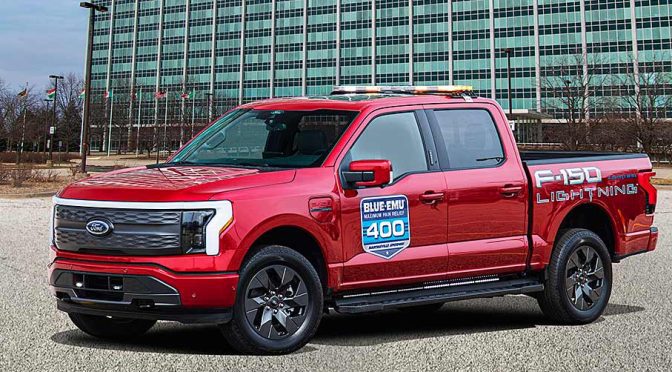
DEARBORN, MI — A fully electric truck that is helping change the future of Ford Motor Company will be on track at Martinsville Speedway as the 2022 F-150 Lightning makes its debut as a pace vehicle for the NASCAR Cup Series on April 9.

RELATED: Full schedule for Martinsville | Buy tickets

Lightning received nearly 200,000 reservations since being unveiled last May and is part of a growing EV portfolio for Ford that includes the Mustang Mach-E and E-Transit.

“Ford is fully invested in electrification and the response to Lightning has been so overwhelming that it was an easy decision to bring it to a NASCAR event,” said Jeannee Kirkaldy, motorsports marketing manager, Ford Performance. “One thing we definitely know is that our fans love trucks and we’re confident that feeling will only grow when they see Lightning out on the track leading the field to green.”

”We can’t wait to show our Ford fans how capable the F-150 Lightning is. With 563 horsepower, 775 lb.-ft. of near instantaneous torque and a 0-60 mph time in the mid-4-second range, I think it will turn some heads out on the track.” said Darren Palmer, vice president, Ford electric vehicle programs.

This marks the second straight year an all-electric Ford vehicle will pace a NASCAR race after the Mustang Mach-E led the field in April at Talladega Superspeedway. Ford became the first OEM to use an electric vehicle to pace a NASCAR race way back in April 2012 when the all-electric Ford Focus paced the field at Richmond, Virginia.

“I haven’t driven the Lightning yet, but if it’s anything like the Mustang Mach-E, it’s going to be a blast,” NASCAR Cup Series driver Ryan Blaney said.  “I hope it ends up being the only thing in front of me once the race starts.”

The Ford F-150 is part of F-Series, America’s best-selling truck 45 years in a row. F-Series recently reached a milestone when the 40 millionth unit rolled off the assembly line in January.

Martinsville Speedway, which is celebrating its 75th anniversary, will host all three top NASCAR touring series, beginning with the Camping World Truck Series on Thursday at 8 p.m. ET. The NASCAR Xfinity Series takes the track on Friday with the NASCAR Cup Series scheduled for Saturday. Both of those races are scheduled to begin at 7:30 p.m.

The NASCAR Whelen Modified Tour picked up where it left off in February at Florida’s New Smyrna Speedway with a trip to Richmond Raceway on Friday night.

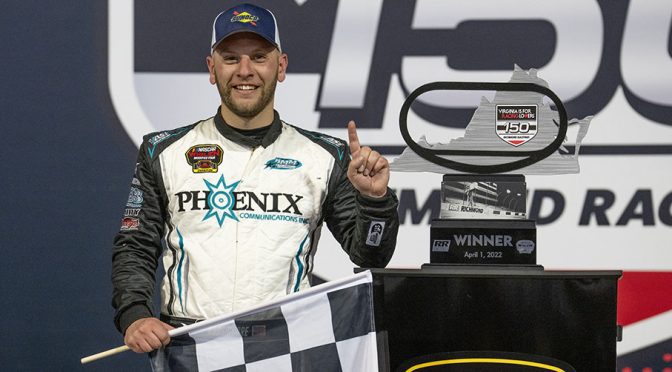
In desperate need of a strong performance after a part failure relegated him to a last-place finish at New Smyrna, defending Tour champion Justin Bonsignore delivered with a victory in the Virginia is for Racing Lovers 150 at the 0.75-mile oval.

RESULTS: Virginia is for Racing Lovers 150 at Richmond

It wasn’t easy for Bonsignore, who led early in the race after starting from the pole before being shuffled back in the field via pit strategy.

He ultimately chased down and passed Tommy Catalano with 11 laps left to secure his 32nd Tour victory and first of the season.

Below are the key takeaways from Friday’s Virginia is for Racing Lovers 150, beginning with Bonsignore’s quick rebound to Victory Lane.

Last no more for Justin Bonsignore

For approximately seven weeks, every day Justin Bonsignore would drive home from work thinking about it.

A last-place finish at New Smyrna meant Bonsignore was last in the NASCAR Whelen Modified Tour standings after ending the 2021 season as the Tour champion for the third time in his career.

The constant reminder of his place in the standings was enough to drive Bonsignore just a little crazy.

Thankfully, he no longer has to think about being last in the standings after his victory Friday at Richmond.

“We have another long break until we can start racing up in the New England area. We have another six weeks off,” Bonsignore said Friday night. “Now we get to spend six weeks going, ‘We won the last time out.’ That’s huge for our confidence.”

The victory catapulted Bonsignore from 31st in the Tour standings to ninth, 20 points behind the duo of Eric Goodale and Tony Catalano, who are tied at the top of the standings.

“The ride home from work each day will get a little better,” Bonsignore said.

RELATED: Catalano family gets confidence boost at Richmond

Ebersole, Beers overcome adversity

Kyle Ebersole and Austin Beers each overcame significant adversity Friday.

Both drivers had issues prior to the Virginia is for Racing Lovers 150, with the trouble for Beers coming during practice earlier in the afternoon.

As he entered Turn 1, the left-rear tire failed on his No. 64 Modified, and he backed his car into the outside wall, resulting in significant damage to his race car.

His crew got to work and managed to get him back on track in time for qualifying, where he qualified 13th. He ultimately came home 11th, the highest finishing rookie in the race.

Ebersole’s bad luck struck during qualifying. As he was coming out of Turn 4 during his qualifying attempt, his car suddenly got sideways, and he spun across the start/finish line, eventually coming to a stop moments later.

It was later discovered that an oil line had come loose on his car, which sprayed oil on the track and on his rear tires, leading to the spin.

His team was able to repair the car in time for the race, where he started 20th. After the completion of 150 laps, Ebersole had managed to make it all the way to fourth, a career-best finish for the 31-year-old from Hummelstown, Pennsylvania.

Solid start for Newman, SS Racing

Prior to Friday’s Virginia is for Racing Lovers 150, former NASCAR Cup Series regular Ryan Newman said he believed SS Racing had brought him a fast race car that was capable of running up front.

He proved that with a strong fourth-place qualifying effort and later backed that up by racing near the front of the field for the first half of the race. He also took a brief turn at the front of the pack, leading two laps just prior to the halfway point.

However, during the second half of the race, Newman began to fall off the pace of the leaders. He slowly fell through the field, eventually finishing 13th for the team co-owned by former NASCAR driver Hermie Sadler and Virginia Senator Bill Stanley.

NOTES:

  • Max McLaughlin, making his first Tour start of the year Friday in the No. 77 Curb Records entry fielded by Gary Putnam, started third and finished 12th after leading 10 laps. He then traveled to Orange County Fair Speedway in Middletown, New York, for a big-block modified race on Saturday and finished second.
  • Two-time Tour champion Donny Lia completed his return to the series Friday with a ninth-place result for Boehler Racing Enterprises after qualifying eighth.
  • Despite losing the air cleaner on his car with 53 laps left and being forced to make an unscheduled pit stop to replace it, Jimmy Blewett was able to pilot Tommy Baldwin Jr.’s No. 7 to an eighth-place finish.
  • Chuck Hossfeld’s third-place finish Friday was the 50th top-five finish of his career with the NASCAR Whelen Modified Tour and his first since 2019. The seven-time Tour winner hasn’t run the full series schedule since 2010.