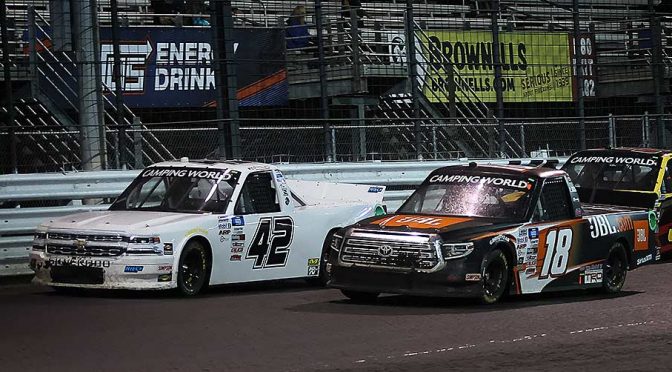
Two teenaged drivers provide an interesting wrinkle to this year’s NASCAR Camping World Truck Series postseason field, with both Carson Hocevar and Chandler Smith getting their first taste of the elimination-style playoffs format.

RELATED: Michigan, Gateway weekend schedule | Track analysis

Hocevar and Smith are the only two first-timers on the 10-driver playoff grid, meaning there’s at least a surface-level experience deficit when it comes to chasing a series title. Does it matter? The answer for both isn’t a clear yes or no, but yes and no.

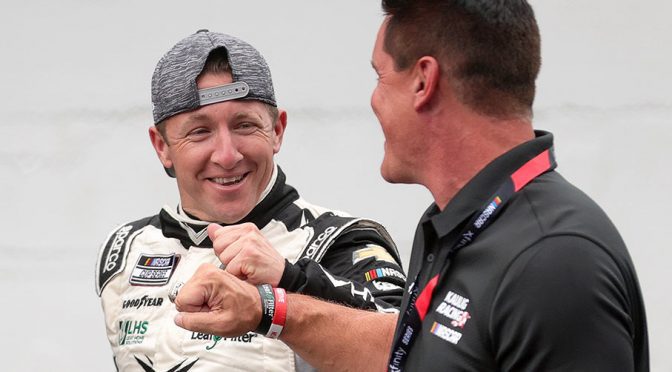
“I definitely think there is an experience gap especially for me and the 42 (Hocevar), the other rookie driver,” said Smith, the 19-year-old pilot of Kyle Busch Motorsports’ No. 18 Toyota. “If you look at all of the other drivers in the playoffs and how many starts that they have compared to us. Look at all of the overall experience and practice they have in the Truck Series compared to myself, so yes, there is a very big experience gap but there is no excuse for it. I feel like we are more than capable of going to win this championship.”

Hocevar, the 18-year-old in Niece Motorsports’ No. 42 Chevrolet, said much the same in Tuesday’s NASCAR Camping World Truck Series Playoffs Media Day, but with a slight additional flourish.

“I mean, I guess it matters but I think we’ve outran a lot of them or most of them a few times this year,” Hocevar said. “So that’s not to say we can’t do it again and do it weekly, so that’s our plan. There’s not a race track in the playoffs besides Talladega (Superspeedway) that I haven’t been to, so that’ll be big. My experience level is at least closer. I’ll at least have something to kind of lean on for my own experience going into these races.”

Their quest to disrupt the closing seven-race stretch begins with Friday’s Toyota 200 presented by CK Power (9 p.m. ET, FS1, MRN, SiriusXM) at World Wide Technology Raceway at Gateway. They’ll have to make those gains from the lower end of the playoff spectrum with Hocevar entering as the eighth seed and Smith tied for ninth.

MORE: Camping World Trucks standings

The two have parallels, both in their seasons and their Truck Series careers to date. Each drove in partial schedules the previous two seasons before joining the circuit full time this year. Both Hocevar and Smith enter the playoffs with three top-five finishes and five top 10s in 2021, and though Smith has a significant edge over his fellow rookie in laps led (165 to 24), both have had real opportunities along the way to notch a breakthrough win.

A common boon to their playoff hopes is a solid support system. Smith has a veteran teammate in John Hunter Nemechek, the series points leader, but also possesses one of the more hands-on team owners in the garage in Kyle Busch. Busch went a victorious 5-for-5 in his partial Truck Series driving schedule this season, but his impact on the ownership side has been that of a teacher who expects great things from his young prospects.

“Kyle is a great mentor, team owner for sure, and a great friend,” Smith said. “He has always been there to help me in anything I’ve ever asked him to. He’s always given me loads of advice when I needed it. I definitely lean on him a lot. I couldn’t ask for a better team owner.”

Hocevar has his own foundation in Al Niece’s camp, with Ryan Truex as a current teammate and Ross Chastain as a former team driver before his rise to full-time Cup Series duty this year. Hocevar’s team has thought enough of his performance that it announced Tuesday he would return to the organization full time in 2022.

Hocevar’s rookie campaign has been a learning experience, with a blend of factors aiding his push into the playoffs.

“It’s been a mixture of things. I wouldn’t say I’ve been learning it on my own,” Hocevar said. “Everybody at Niece, they’ve done this song and dance in 2019 and leaning on Ross, but a lot behind the wheel, you’ve just got to learn on your own. You can only get spoon-fed so much. You’ve gotta take what the race track’s giving you and what the race truck’s giving you on that day and adapt and roll with it, and I think we’ve done that.”

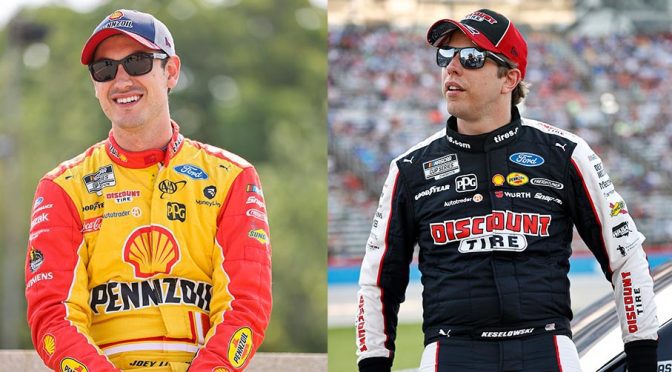
Team Penske has swapped spotters between Joey Logano and Brad Keselowski, a team spokesman confirmed to NASCAR.com. The change will begin Sunday at Michigan International Speedway and carry through the remainder of the 2021 NASCAR Cup Series season.

MICHIGAN: Weekend schedule | Paint schemes | Starting lineup

Coleman Pressley will now spot for Logano and the No. 22 Ford crew, while TJ Majors moves over to Keselowski and the No. 2 squad.

Bob Pockrass of FOX Sports first reported the news.

Logano and Keselowski are guaranteed spots in the 2021 NASCAR Playoffs, which will begin in two weeks, by virtue of victories. Logano won the inaugural race on Bristol Motor Speedway’s dirt track. Keselowski took the checkered flag in April at Talladega Superspeedway.

Keselowski has plans to leave Team Penske at the end of the competitive year for Roush Fenway Racing in a driver-owner role. Logano will return to Penske in 2022 for his 10th season with the organization.

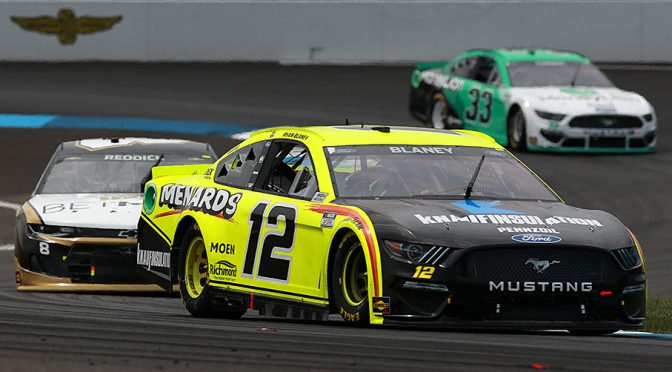
NASCAR officials issued a penalty Wednesday to the No. 12 Team Penske Ford team for a lug-nut violation last weekend at the Indianapolis Motor Speedway Road Course.

RELATED: Cup Series standings

Ryan Blaney drove the No. 12 entry to a second-place finish in Sunday’s Verizon 200 at The Brickyard, but officials found a single unsecured lug nut in a post-race check. That violation of Section 10.9.10.4 (Tires and Wheels) in the NASCAR Cup Series Rule Book has resulted in a $10,000 fine to Todd Gordon, crew chief of team owner Roger Penske’s No. 12.

In the NASCAR Xfinity Series, officials suspended RSS Racing crew chief Shane Wilson for four races for a safety violation at IMS. The penalty report states that the No. 39 RSS team was cited under Sections 12.5.2.5.a (Safety) and 10.9.8.l (Crew Members/Servicing) — the last of which states: “A safety violation may be imposed for any action or omission by a Competitor or vehicle that creates an unsafe environment or poses a threat to the safety of the Competitors, as determined by NASCAR.”

According to an updated entry list, Kevin Starland — listed as the team’s competition director on the most recent NASCAR event rosters — is scheduled to step in as crew chief for the No. 39 and driver Ryan Sieg for Saturday’s New Holland 250 (3:30 p.m. ET, NBCSN, MRN, SiriusXM) at Michigan International Speedway. Starland began the season as the No. 39 team’s crew chief, but was replaced by Wilson, starting in May at Darlington Raceway.

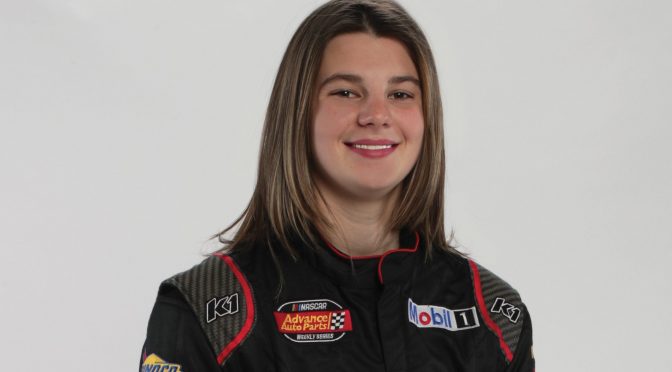
A lot of teenagers play a sport. Isabella Robusto isn’t like most teenagers. At just 16-years old, she’s got a lot on her plate with training for a triathlon, high jump, and being an NASCAR Advance Auto Parts Weekly Series driver for Rev Racing. Oh, and she’s just in high school.

Robusto describes herself as a daredevil. Growing up with her twin brother, Will, she’s always been competitive. The duo started racing go-karts at the ripe age of four and they haven’t gotten off the track yet.

One could say they’re the new generation of racing siblings, move aside Busch brothers.

“We’ve all become hugely involved with it and it’s kind of our whole world now,” Isabella Robusto said.

Up until about two years ago, Isabella and Will competed in every race together, side-by-side. This has been the norm for them for eight years. Nowadays, Will competes with go-karts while Isabella wanted to go the stock car route.

“He was always my main competition because we would both have the same equipment,” she said. “It’s almost like it was a ‘race inside of a race’ because I wanted to win the overall race, but I also wanted the bragging rights that week against him.”

The rivalry went a little too far sometimes, though. They’ve wrecked each other’s cars three times. It was not a good week in her household whenever that happened, she said.

Robusto was named to NASCAR Drive for Diversity Driver Development Program for the 2018 season where she anchored Rev Racing’s Youth Driver Program. In 2020, she transitioned to late model cars. Coming from a legend car, it was a bit of a learning curve. Now, she feels more confident and devotes a chunk of every day studying that weekend’s upcoming track.

Isabella Robusto lifestyleRobusto’s schedule keeps her busy and on the move. Here’s a look at how she juggles her training with getting race ready as she continues her education on-and-off the track.

TRIATHLON TRAINING

The Fort Mill, S.C. native attends virtual school, so she can customize her schedule amidst racing chaos. This isn’t an easy feat.

She spends four to five days a week at the race shop, not including Saturday race days.

On Sundays, she spends the majority of her day training for a triathlon with her former racing coach, Evan York. She has until April 2022 to prepare, but she doesn’t want to wait until the last minute. What do those training days look like? A 30-to-40-mile bike ride, a six-mile run, and a long swim. The hardest part isn’t the constant uphill cardio for her, it’s reintroducing her body to the water.

“Swimming is the hardest part for me. I haven’t swam since I was about six years old and I got in the pool and was like ‘this is gonna be easy because I swam when I was little’,” Robusto said. “It’s way harder than it looks.”

In case you did not think she’s doing enough; she’s also training for the Spartan Race.

Simply put, it’s an obstacle course placed on the uphill side of a mountain with 30 obstacles. The founder, Joe De Sana, wanted the races to be the hardest tests of endurance you can train for.

As athletic as her family is — her father is a former college hockey player and her mother a runner herself — they think she’s “crazy” for pushing her body so far.

READY FOR RACE DAY

On race days, Isabella doesn’t have much of a pre-race ritual, besides eating whole avocados and chugging cotton candy Bang Energy drinks.

“The first time I got a pole in the late model, I was never good at qualifying all last year,” Robusto said. “…One of my crew members on my team gave me a Bang Energy, which I drink every other day for working out now.

“He had me shotgun one before [the] qualifying [race], and I got the pole.  So now I just do that before every qualifying now,” she said. “It’s working because I’ve qualified in the top five every time since I’ve been doing that.”

In less than a year-and-a-half, when she turns 18, she’ll be able to start moving up the ranks andIsabella Robusto at Hickory experiment with more cars. She has goals of reaching the NASCAR Cup Series, NASCAR Xfinity Series, and NASCAR Camping World Truck Series, to see which one she enjoys the most when the time comes. Yes, she’s counting down the days.

The hardest part of being 16 in a professional sport is relating to her peers. She’s been driving for more than a decade, so things like getting a driver’s license, which is big for the average teenager, is not significant to her. Of course, she got a 100 on her test. She got her NASCAR license when she was 14, so no one shouldn’t be surprised.

In 2018, she received the Young Racer Award at the NASCAR Drive for Diversity Awards, at just 14 years old. In front of a 200-person audience full of NASCAR executives, drivers, and peers, Robusto made her speech and remembers it to this day. In 2020, she received the same award, to her surprise. She had no idea she could get it twice.

For now, she wants to remain positive and keep herself in the best shape possible, mentally and physically. With her young age, some people can’t fathom how she handles so much on her plate.

Whenever her friends can’t understand why she’s at the track all day and why she’s always so busy, she brings them to the track on race day. Then, they get it. They’re friends with an up-and-coming NASCAR driver.

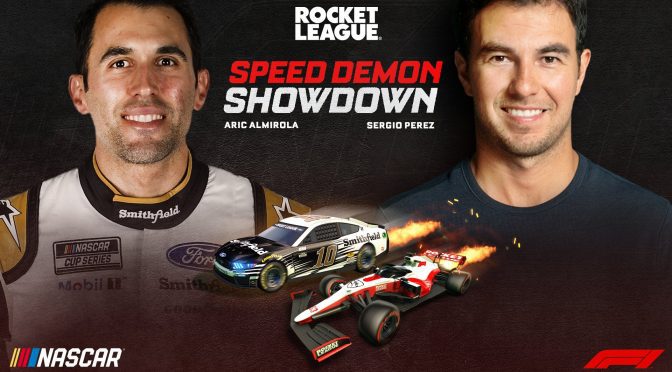
On Thursday, NASCAR and Formula 1 drivers will go head-to-head for the very first time during the Rocket League Speed Demon Showdown livestream! Rocket League, one of the most critically acclaimed sports video games of all time, previously brought the two major motorsports together to headline Rocket League Season 3, which featured iconic cars and team decals from both NASCAR and Formula 1.

Aric Almirola, driver of the No. 10 for Stewart-Haas Racing and recently qualified for the NASCAR Playoffs, will represent NASCAR, and Sergio “Checo” Pérez, driver of the No. 11 for Red Bull Racing Honda and currently top five in F1 driver standings, will represent Formula 1.

Both drivers will compete for the first time on the digital pitch in high-octane matches of Soccar, which is the standard game mode in Rocket League that combines arcade-style soccer with rocket powered cars. In addition, they will dive into a new Limited Time Mode called Speed Demon (which will be live in the game Thursday), where their car’s rocket boosts never end, the ball’s speed is turned up, but less bouncy, and their cars more susceptible to demos on contact with an opponent. The super-fast paced Speed Demon is the ideal mode for the two professional drivers to face off in. Almirola and Pérez will even be playing with their respective NASCAR and Formula 1 cars equipped with their team decals.

“We can’t wait for fans to see the most badass cars in motorsports hit the digital track. We are excited to share the stage with F1 and showcase to a global audience what NASCAR racing is all about,” said Branden Williams, NASCAR’s senior manager of gaming.

Said Pérez: “It’s really cool to interact with other athletes. I’ve had a lot of work lately and I haven’t really been able to practice, but of course we don’t want to lose ever, and that includes video games. That’s what makes it fun for the fans. Rocket League is bringing our sport and gamers closer together and that’s super positive.”

The drivers will also team up with a pit crew of Rocket League Creators and professional players (Arsenal, Tri House, ShockRL, Widow), who will assist either Almirola or Pérez to victory in the Rocket League Speed Demon Showdown. See whose team will come out on top, NASCAR or Formula 1!

The Rocket League Speed Demon Showdown can be viewed on Twitch Thursday at 1 p.m. ET.

In addition, the NASCAR 2021 Fan Pack and Formula 1 Fan Pack will be returning to the Rocket League Item shop from Aug. 19-25.

The 2021 NASCAR Camping World Truck Series Playoffs begin Friday — a seven-race battle among 10 title-eligible drivers for the championship. First up is the Round of 10, featuring World Wide Technology Raceway at Gateway, Darlington Raceway and Bristol Motor Speedway. Two contenders will then be eliminated before the Round of 8, which will include Las Vegas Motor Speedway, Talladega Superspeedway and Martinsville Speedway. Afterward, the Championship 4 will be set and take on Phoenix Raceway on Nov. 5 in a straight-up race for the ultimate trophy.

Here are the 10 drivers (and how they qualified) vying for the title: John Hunter Nemechek (regular-season champion; five wins), Austin Hill (two wins), Ben Rhodes (two wins), Todd Gilliland (a win), Sheldon Creed (a win), Zane Smith (points), Matt Crafton (points), Carson Hocevar (points), Stewart Friesen (points) and Chandler Smith (points).

RELATED: Meet the 2021 Truck Series playoff field 

Now, a Round of 10 track-by-track breakdown:

WORLD WIDE TECHNOLOGY RACEWAY AT GATEWAY

(📅 Friday | ⏰ 9 p.m. ET | 📺 FS1 | 📻 MRN, SiriusXM)

Location: Madison, Illinois
Length: 1.25-mile oval
Distance: 160 laps / 200 miles
Previous winner: Sheldon Creed (2020)

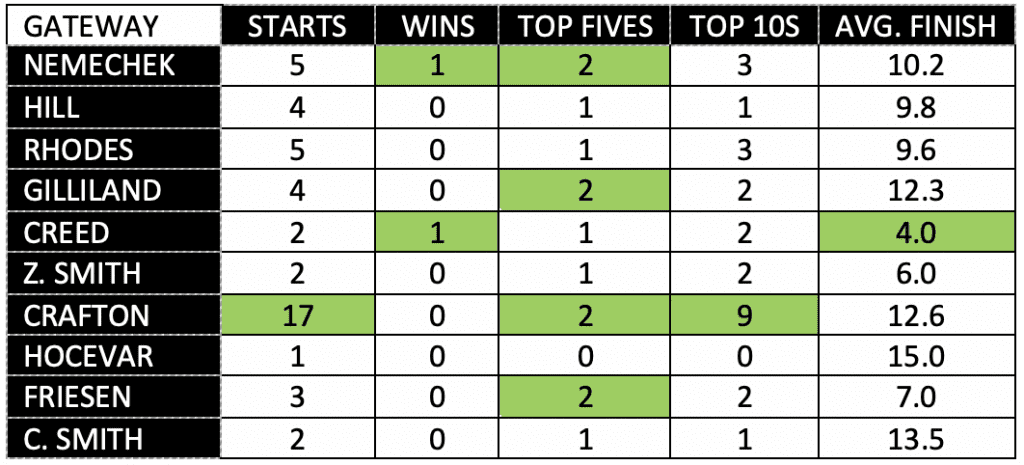
Friday will mark the NASCAR Camping World Truck Series’ only stop at Gateway this year. Sheldon Creed won the 2020 event, and the top-10 finishing order featured an additional three drivers from this year’s group — Austin Hill (third), Stewart Friesen (fifth) and Zane Smith (seventh).

Matt Crafton — a series veteran in his 21st full-time season — has far more Gateway experience than his competitors, though no wins. His top-five and top-10 marks are the best, but John Hunter Nemechek, Todd Gilliland and Friesen still manage to tie Crafton in the top-five category with far fewer attempts. Creed and Nemechek are the only ones with a previous win, and Creed averages the best career finish.

Screen Shot 2021 08 17 At 5.14.41 Pm

DARLINGTON RACEWAY

(📅 Sept. 5 | ⏰ 1:30 p.m. ET | 📺 FS1 | 📻 MRN, SiriusXM)

Location: Darlington, South Carolina
Length: 1.366-mile oval
Distance: 147 laps / 200.1 miles
Previous winner: Sheldon Creed (2021)

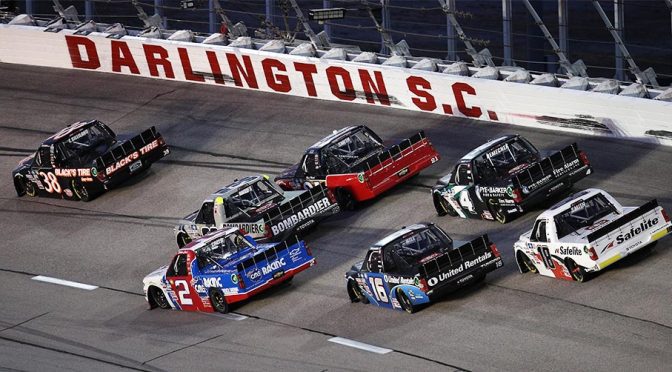
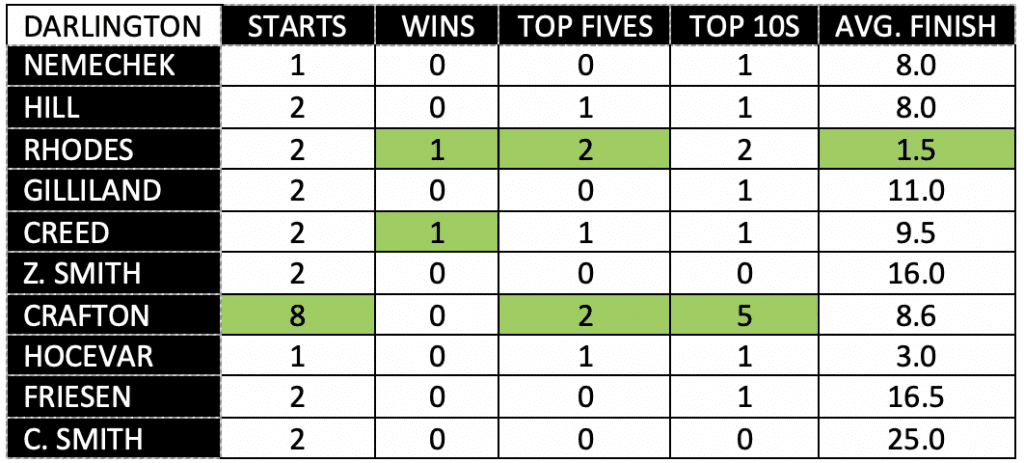
Darlington happens to be the NASCAR Camping World Truck Series’ first true return race, the tour having already raced at this track back in May. Sheldon Creed won that race, surely giving him a confidence boost heading back to the “Lady in Black.” Four other playoff drivers finished in the top 10 — Ben Rhodes (second), Carson Hocevar (third), Matt Crafton (fourth) and John Hunter Nemechek (eighth).

Creed’s win ties him with Rhodes for most wins at Darlington, but Rhodes also holds the most top fives and best average finish. Crafton, understandably so, has the most starts, tying Rhodes with his top fives and then boasting the most top 10s.

Screen Shot 2021 08 17 At 5.14.54 Pm

BRISTOL MOTOR SPEEDWAY

(📅 Sept. 16 | ⏰ 9 p.m. ET | 📺 FS1 | 📻 MRN, SiriusXM)

Location: Bristol, Tennessee
Length: .533-mile oval
Distance: 200 laps / 106.6 miles
2020 winner: Sam Mayer (2020)

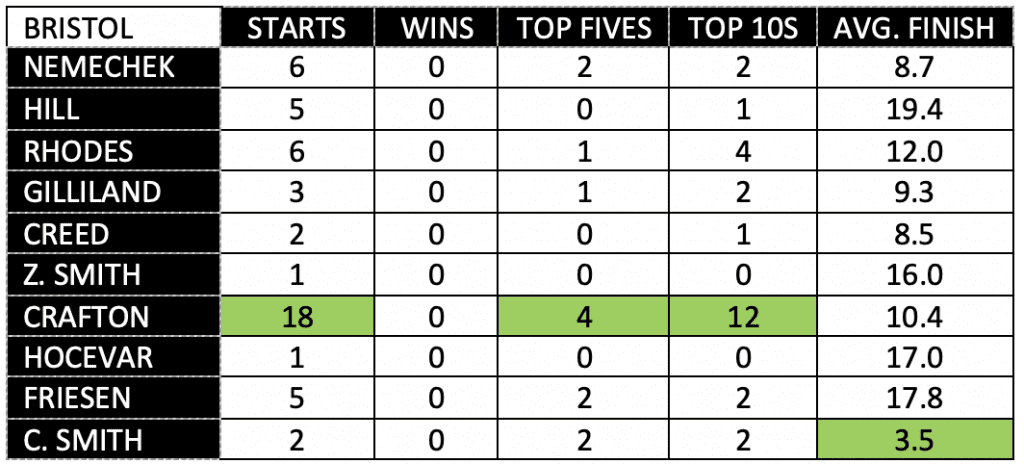
The NASCAR Camping World Truck Series also raced at Bristol Motor Speedway earlier this season in March but on dirt, making it a completely different track for competitive purposes. NASCAR Cup Series regular Martin Truex Jr. won that event anyway, thus further nixing comparisons here.

None of the current playoff drivers have won at “The Last Great Colosseum” before. That gives it a wild-card feel, at least for the postseason picture. Matt Crafton has the most top-five and top-10 finishes, but those line up with his 18 career starts. Same could be said for Chandler Smith and his best average finish — fewer starts, fewer opportunities to skew the numbers.

Screen Shot 2021 08 17 At 5.15.04 Pm

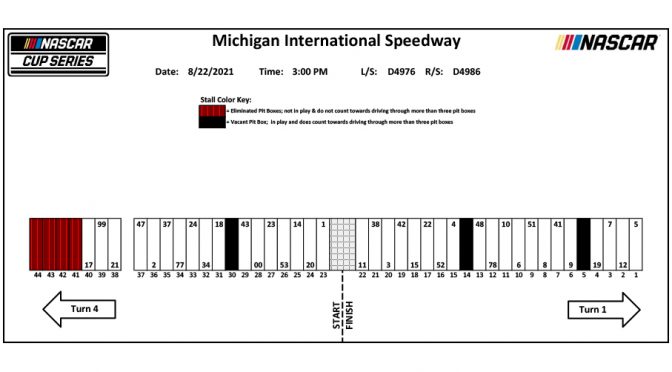
See where your favorite driver is pitting for Sunday’s FireKeepers Casino 400 at Michigan International Speedway (3 p.m. ET, NBCSN, NBC Sports App, MRN, SiriusXM NASCAR Radio).

AJ Allmendinger arguably won the biggest race of his career this past weekend at the Indianapolis Motor Speedway Road Course, the NASCAR Cup Series’ debut on the 14-turn layout.

Even after the triumph, Allmendinger’s primary focus was still on capturing the Xfinity Series championship with Kaulig Racing.

During the course of his NASCAR career, Allmendinger has been known to be cordial with any team he’s part of, yet vocal when he’s not pleased with his race cars. There was too much of the latter at JTG Daugherty Racing, and it took the enjoyment out of racing for the California native. Ultimately, his displeasure led to his departure from the team after the 2018 Cup season.

With no full-time seats open, Allmendinger waited … and waited. In the meantime, he took up a job as an analyst for NASCAR on NBC.

That was until Matt Kaulig, owner of Kaulig Racing, and team president Chris Rice cold-called the veteran driver, asking if he would be open to running a partial Xfinity schedule in 2019 to improve the young organization, particularly on road courses.

Allmendinger agreed.

Allmendinger’s famous smile reappeared, with near-instant success at Kaulig Racing. He crossed the finish line inside the top three in his first two starts, only to be disqualified (Daytona and Watkins Glen), then won in his fifth race at the Charlotte Motor Speedway Roval.

Allmendinger enjoyed racing again. With two more wins, including his first on an oval in 2020, both sides came to an agreement to run the full 2021 Xfinity Series schedule. Nearly two-thirds of the way through the season, the 39-year-old Allmendinger is still relishing his return to full-time NASCAR competition.

“I put so much pressure on myself that there’s always going to be that element of, ‘I’m not having a lot of fun right now’ because I show up to these weekends and I expect greatness out of myself,” Allmendinger told NASCAR.com a few weeks ago. “I want to win every race. I want to be up front. I want to walk into the shop and feel like a badass because I’m bringing something to the team.

“That’s the pressure I put on myself. I joke around, but it’s serious. There are times where it’s not ‘fun’ because I do that to myself. But the difference is, you’ve seen us joking around and what you see with us giving each other crap and going back and forth, that’s real. That’s part of the reason I wanted to be full time because I had that fun on a part-time basis. But then, I would go three or four races without racing — I would go to the shop, but I want to be at the track. I wanted that every weekend.”

Through the opening 21 races of the season, Allmendinger is one of just five full-time Xfinity drivers who have won a race. In early March at Las Vegas Motor Speedway, the No. 16 Chevrolet crossed the finish line first. Three months later at Mid-Ohio Sports Car Course, Allmendinger charged through the field after a late pit-road penalty, securing his second checkered flag of the season.

RELATED: Michigan, Gateway weekend schedule | Xfinity Series standings

Currently, Allmendinger sits second in the championship standings, 82 points below Austin Cindric, who has five victories — including a big one at Indy the day before Allmendinger’s Cup win.

Stacy Revere | Getty Images

“You always want more, and I do feel we’ve given away a couple of wins,” Allmendinger said. “I feel like in every race, we could have been in the top five. There’s probably a couple of top fives we got where we probably should have had a seventh or eighth, but we got a top five out of them. And the ones where we didn’t get top fives, whether it’s mechanical, strategy calls, out of tires, etc., I would say we could have been inside the top seven every race this year.”

Rice said he believes the No. 16 team is having a “building year.” But he also knows Allmendinger is inexperienced when it comes to competing in the Xfinity Series. Still, it’s worth noting that Allmendinger hasn’t competed in an Xfinity Series car at three of the final 12 tracks on the schedule (Michigan, Richmond and Kansas), and just once competed at Phoenix, finishing fifth.

“I think the season has gone OK, but I think we can be a lot better,” Rice says. “A lot of these places AJ is going to for the first time in an Xfinity car, so we’re building on notes. But with no practice and no qualifying, we have to sometimes come back and rebuild on what we built there.”

Jason Trinchere, who has been an engineer in all three national touring series and is in his first year as a NASCAR crew chief, agrees it’s been a solid season. Knowing that he has a wheelman in the driver’s seat doesn’t hurt, either.

“For me, it was a lifetime worth of work for a lifetime opportunity,” he said. “We all know AJ is going to be a contender for each race, so I couldn’t have a better opportunity.”

Rice added that Allmendinger has been a key contributor to the team because he helps lead its driver core of Justin Haley, Jeb Burton and Kaz Grala. At the same time, Kaulig puts no pressure on Allmendinger, which has helped propel him to success.

“We told him we want to win trophies, but at the same time, we want to have fun with it,” Rice said. “I think he knows that and sees we have his back no matter how good or bad he runs. That makes for a big deal.”

With five races remaining in the regular season, it’ll be a tough hill to climb making up 82 points on Cindric to win the regular season championship. Still, second place is awarded 10 playoff points, which could go a long way toward potentially making it to Phoenix Raceway as part of the Championship 4.

MORE: 2021 Xfinity Series winners

Across the board, Allmendinger says he feels the No. 16 team is on par with Cindric’s No. 22 team on a weekly basis. They’ve been 1-2 in the championship standings since Mid-Ohio, nine races ago. So does that make the Nos. 16 and 22 the favorites for the title?

“I don’t think so,” Rice said. “I think you’re going to have some sleepers like Justin Allgaier. Justin Allgaier is good; he’s great at some of those race tracks in the playoffs. Noah Gragson is really aggressive and a guy you have to keep your eye on. Daniel Hemric. I don’t think there are any favorites, but I think there are three or four guys that can really jump up in there and push us, in terms of AJ Allmendinger, Justin Haley and Jeb Burton out of the way, as well as the (No.) 22 car.”

Over the last seven races (the same amount as the playoffs), the No. 16 team has scored eight more points than the No. 22 team. Because of that, Trinchere has his team slotted as a co-favorite to win the championship. “If we’re keeping pace with them,” Trinchere says, “I know come playoff time we can excel when we make that push.”

And though Allmendinger has been around NASCAR for a decade and a half, he’s not letting his thoughts get caught up with the potential of winning a championship. There’s too much of the season left.

“With the way the championship format is, one bad race and you could be done,” he said. “Obviously, it comes down to the last race of the season. If we’re lucky enough to be in the final four in Phoenix, then maybe you start letting your brain be like, ‘OK, it would be big to win a championship.’ But we have so much work, so much progress to make to even worry about that, that I don’t think ahead and allow it to enter my mind.”

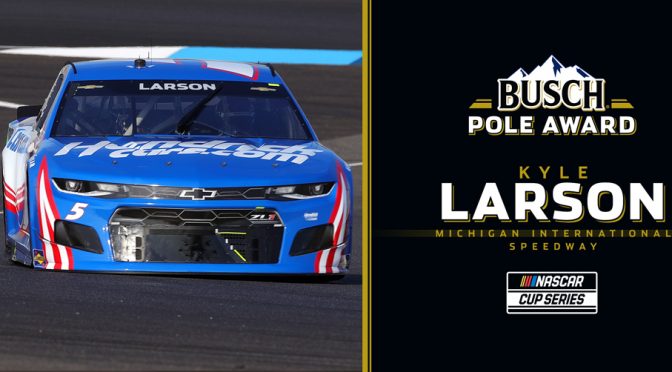
Kyle Larson has won the Busch Pole Award for Sunday’s FireKeepers Casino 400 (3 p.m. ET, NBCSN, MRN, SiriusXM NASCAR Radio) at Michigan International Speedway.

Larson, the series points leader, will start his No. 5 Hendrick Motorsports Chevrolet from the top spot for the fifth time this season. He is a five-time winner this year and a three-time winner at the 2-mile Michigan track in his Cup Series career.

Defending Xfinity Series champion Austin Cindric claimed the pole for Saturday’s New Holland 250 (3:30 p.m. ET, NBCSN, MRN, SiriusXM) in the No. 22 Team Penske Ford at Michigan. Cindric is the series’ most recent winner, claiming his fifth victory of the season last Saturday at Indianapolis Motor Speedway’s road course.

Austin Hill is on the pole for Friday’s Toyota 200 presented by CK Power (9 p.m. ET, FS1, MRN, SiriusXM NASCAR Radio) in the No. 16 Hattori Racing Enterprises Toyota. That race at World Wide Technology Raceway at Gateway will open the seven-race playoffs for the Camping World Truck Series.

RELATED: Michigan, Gateway weekend schedule | 2021 Cup Series standings

As NASCAR adapted to COVID-19 protocols last season, practice and qualifying were eliminated at a majority of national-series events to limit at-track time, exposure and to cut race weekend costs. To determine starting lineups, competition officials used grouped draws, added inversions for weekend doubleheaders, and eventually adopted a performance-metrics formula. That metrics format remains in place this season, drawing on performance from both individual races and season-long results.

NASCAR’s metrics formula for 2021 weighs:

  • 25 percent: Driver’s finishing position from the previous race
  • 25 percent: Car owner’s finishing position from the previous race
  • 35 percent: Team owner points ranking
  • 15 percent: Fastest lap from the previous race

See the full lineup for Sunday’s Cup Series race below.


Start pos.
Driver Car # Team
1 Kyle Larson 5 Hendrick Motorsports
2 Chase Elliott 9 Hendrick Motorsports
3 Ryan Blaney 12 Team Penske
4 Matt DiBenedetto 21 Wood Brothers Racing
5 Martin Truex Jr. 19 Joe Gibbs Racing
6 Kurt Busch 1 Chip Ganassi Racing
7 Kyle Busch 18 Joe Gibbs Racing
8 Kevin Harvick 4 Stewart-Haas Racing
9 Denny Hamlin 11 Joe Gibbs Racing
10 Alex Bowman 48 Hendrick Motorsports
11 Chris Buescher 17 Roush Fenway Racing
12 Ricky Stenhouse Jr. 47 JTG Daugherty Racing
13 Erik Jones 43 Richard Petty Motorsports
14 Tyler Reddick 8 Richard Childress Racing
15 Bubba Wallace 23 23XI Racing
16 Ryan Newman 6 Roush Fenway Racing
17 Justin Haley 77 Spire Motorsports
18 William Byron 24 Hendrick Motorsports
19 Joey Logano 22 Team Penske
20 Brad Keselowski 2 Team Penske
21 Chase Briscoe 14 Stewart-Haas Racing
22 Ross Chastain 42 Chip Ganassi Racing
23 Aric Almirola 10 Stewart-Haas Racing
24 Corey LaJoie 7 Spire Motorsports
25 Michael McDowell 34 Front Row Motorsports
26 Austin Dillon 3 Richard Childress Racing
27 Cole Custer 41 Stewart-Haas Racing
28 Christopher Bell 20 Joe Gibbs Racing
29 Josh Bilicki 52 Rick Ware Racing
30 Daniel Suarez 99 Trackhouse Racing
31 Quin Houff 00 StarCom Racing
32 Ryan Preece 37 JTG Daugherty Racing
33 Garrett Smithley 53 Rick Ware Racing
34 James Davison 15 Rick Ware Racing
35 Anthony Alfredo 38 Front Row Motorsports
36 BJ McLeod 78 Live Fast Motorsports
37 Cody Ware 51 Petty Ware Racing

Practice and qualifying are tentatively scheduled for eight Cup Series races this year. Just one race remains with Busch Pole Qualifying on the schedule — the season-ending championship race Nov. 7 at Phoenix Raceway.

This story first appeared on NASCAR.com on May 5, 2021:

What started after the 2018 season as a clean sheet of paper in NASCAR’s Research & Development Center is now delivered, dressed and ready for its close-up.

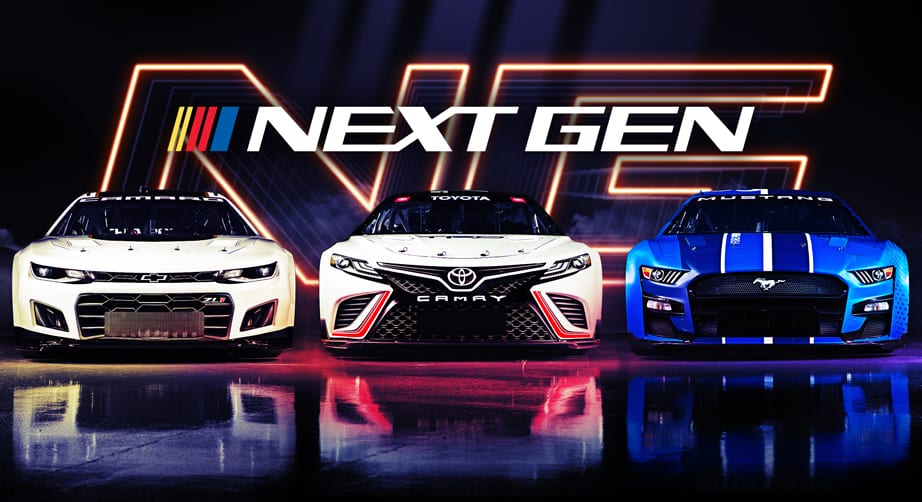
NASCAR’s three automakers released their Next Gen models for Cup Series competition in 2022 on Wednesday at The Park Expo in Charlotte, North Carolina, ushering in a new era of the “Rebirth of Stock.” The model that began its life with a Gen-7 codename and was previously seen in testing prototypes with camouflaged or generic wrap designs has now emerged with three sleek bodies specific to each Original Equipment Manufacturer (OEM).

Wednesday’s public debut of the Next Gen Chevrolet Camaro ZL1, the Ford Mustang and the Toyota TRD Camry for 2022 showed off some of those car-specific characteristics. But in dialing back toward more of a stock feel for better relevance to their production-car counterparts, the Next Gen car also showed off plenty of new components — some that had shown up on test-mule prototypes, but some that the NASCAR industry and fans saw in detail for the first time.

“I think that at the highest level, one of the main goals is just that the sport remains healthy and strong, that it remains attractive to our current OEMs, teams and fans, but also attracts new ones,” said John Probst, NASCAR’s senior vice president of racing innovation. “As we kind of dive into that, it’s sort of your overarching goal. Then we know to be attractive to our OEMs, we need to be relevant to them.”

RELATED: A legacy of safety

Competition officials worked in tandem with the manufacturers in that search for product relevance, adding bigger wheels, a more muscular coupe-style look, the potential for hybrid power in the future and a closer resemblance to each car’s road-going version (think sinews over stickers). But the project also included a heavy focus on the competition side, developing a symmetrical car with features that decrease the dependence on aerodynamics and increase the emphasis on car setup in the hands of teams and drivers.

“If you look at where Gen-6 is today, there’s a big component of it that’s around wind tunnels and simulation,” Probst said, referring to the Cup Series’ current model, which made its competition debut in 2013. “And while that will always be in our sport and rightfully so, we felt like we needed to have that at a level that’s commensurate with the amount of attention that the fans get out of it. We don’t sell tickets to the wind tunnel or to watch engineers run simulations, so just trying to keep things focused on the race track. …

“I think now that the range of adjustment (teams) will have on a week-in, week-out basis will exceed what they have as an opportunity with the hardware they’re running today.”

Wednesday marked the next phase in the path to its 2022 competition debut, a timeline that was delayed by a year after the onset of the COVID-19 pandemic last season. The Next Gen prototype has undergone significant testing, and the OEM unveiling coincided with the model’s 12th on-track test — with Ryan Blaney at the controls of the P3 test car at Texas Motor Speedway.

RELATED: Next Gen project timeline

In the meantime, there’s plenty to unpack from Wednesday’s launch. Car specifications, a list of parts suppliers and other details were released, all ranging from larger, fundamental shifts to smaller but still significant nuances that have gone into the build-out process.

Front and center in the unveiling were the bodies and their coupe-like stance — a shorter rear deck, a lower roof and wider dimensions. The body materials have changed, going from the well-established sheet metal to a durable composite body. Five Star Fabricating, Inc., produces the composite body panels, which were phased into the Xfinity Series starting in 2017.

The resilient nature of the composite, flange-fit bodies has reduced some of the negatives of full-contact racing in the Xfinity Series, a trait that’s expected to carry over with even stronger material for the Cup Series’ new model next season.

“This new car’s going to allow them to get into the wall a little bit, get into each other a little bit, without really any worse for the wear as far as the performance of the vehicle,” Probst said. “We’re really hoping that this encourages them to get a little bit even more aggressive, if that’s possible. Our drivers are pretty aggressive already, but we think this composite body will really allow them to bump and bang a whole lot more.”

Other notes and facets that were released or featured as part of Wednesday’s reveal:

The body of the Next Gen car is designed to be symmetrical, removing the skew and tail offset from the centerline that teams have used to create right-side sideforce. “Again, back to putting the car in the drivers’ hands,” Probst says. “Bigger tires, we’ll have more mechanical grip for them to lean on the tires vs. lean on the body, if you will, through aero.”

The car will also be two inches higher off the ground, with a new splitter up front, a flat underbody and a rear diffuser that channels and transitions airflow moving under the car and reduces the effects of more disruptive “dirty” air behind it.

With safety at the top of mind, the redesigned chassis will feature energy-absorbing foam bumpers in front and back. The reinforced tubing will be rectangular, a shift from the current circular design. Roof flaps will carry over to the new-generation car, but it will also include a lower-mounted diffuser flap that deploys to help keep cars on the ground in the event of a backward slide at the series’ faster speedways.

The Next Gen car will feature increased connectivity, with in-car cameras expected for every car in the Cup Series field — a boon for broadcast and online partners, and ultimately fans. “Our goal is to have more cameras and more camera angles than ever, so that we can engage our fans and get them inside the car with their favorite driver,” Probst says. “We’re working out how to get more data out of the ECU (electronic control unit), getting more camera angles, higher-definition cameras, 360 cameras — you name it — so that when this thing goes live in 2022 that we’re bringing our fans something they haven’t seen before, from the car perspective but also from the broadcast perspective.”

Officials anticipate having two rules packages with the Next Gen car — a low-downforce, low-drag, high-horsepower package for short tracks and road courses, and also a high-downforce, lower horsepower package for intermediate-sized tracks (1.5 miles) and longer. Target horsepower figures for the rules packages are still being determined.

RELATED: ‘More aggressive’ drivers?

The Next Gen car features a new sequential five-speed shifter, which allows drivers to bump forward and back to change gears — a departure from the traditional four-speed H-pattern. The new transaxle is expected to better accommodate the potential for a hybrid engine combination in later models, a timetable that remains uncertain for now.

“I think right now it’s something that we are certainly having a lot of discussions with our OEM partners about,” NASCAR President Steve Phelps said April 25. “The Next Gen car will certainly have the opportunity, if we decide to go to some form of electrification in a hybrid vehicle or hybrid engine, that the Next Gen car has the opportunity for us to drop that engine in there. The timing of it, it’s a difficult one, right? I would have said before COVID, we’re maybe looking at ’23. Timelines are tough just because we need to make sure that all the stakeholders who matter in this discussion, which are our race teams, our OEM partners, that they’re all aligned on what that would look like. It could be ’24. I think frankly the opportunity to have a new OEM partner will largely depend on what happens with that hybrid engine.”

An independent rear suspension replaces the solid rear axle, and the Next Gen car will no longer have a track bar for adjustments. Teams will tune with five-way adjustable dampers and there will be a travel limiter to retain the higher ride height.

The Next Gen car will move from a 15-inch wheel to an 18-inch diameter, and the material will be forged aluminum rather than the current steel. Tires will be wider, up from 10 inches to 12, with a smaller sidewall. Those new dimensions will emphasize mechanical grip with a larger contact patch, and Goodyear officials can build in softer tire compounds for increased grip and fall-off.

Even with a single, center-locking lug nut instead of the current five-lug configuration, tests have shown a half-second is needed to fasten the larger single lug, compared to the 0.8-second speed that a capable tire changer needs to hit all five. No dramatic changes are expected when it comes to the essential choreography of a pit stop.

Each of the three Next Gen models will have manufacturer-specific hood louvers, a release point for ducts that transfer air out of radiator. The system is intended to decouple engine performance from aero performance, offsetting the practice of teams taping off air intakes and placing undue pressure and heat strain on the car’s engine.

With the lower roofline and the potential for a decrease in rear visibility, drivers will be able to see behind them with the aid of a rear-mounted camera.

The Next Gen car will feature larger brakes with a better thermal capacity, rack-and-pinion steering and a 20-gallon fuel cell, up approximately two gallons from the current model.
Scm Nextgen 3oems Hero