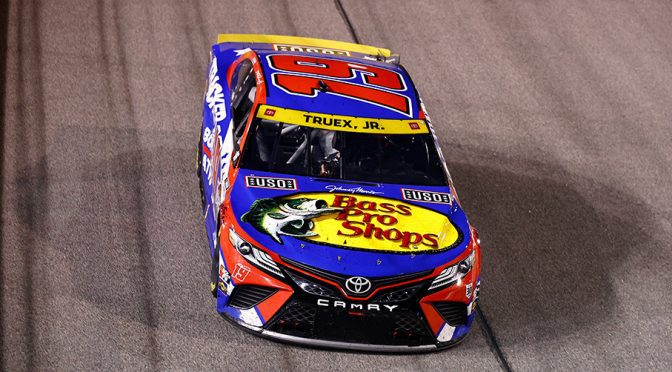
Bristol Motor Speedway hosts an action-packed NASCAR national series tripleheader with the NASCAR Cup Series Round of 16 elimination race, the NASCAR Xfinity Series regular-season finale and the NASCAR Camping World Truck Series Round of 10 elimination race.
Here’s a look at what Cup Series drivers need to have happen in order to advance.
NASCAR CUP SERIES:Last chance to make the Playoffs’ Round of 12
This weekend’s Bass Pro Shops Night Race at Bristol Motor Speedway will bring the first round of the 2021 NASCAR Cup Series Playoffs to a close and four drivers will be eliminated from the postseason. With three drivers locked in and moving on, that leaves nine spots still up for grabs this weekend.
Already Clinched The following three drivers have clinched a spot in the 12-driver Playoff field of the next round: Kyle Larson, Denny Hamlin and Martin Truex Jr. Following Stage 2 at Bristol, Joey Logano, Kevin Harvick and Ryan Blaney locked into the next round. Chase Elliott also locked into the next round during the final stage.
Can Clinch Via Points If there is a repeat winner or a win by a driver who cannot advance to the next round, the following drivers could clinch by being ahead of the 11th winless driver in the standings. The same point requirements listed below would hold true if a new win comes from among Kyle Larson, Joey Logano, Ryan Blaney, Kevin Harvick, Chase Elliott, Christopher Bell, Brad Keselowski, Kyle Busch or Aric Almirola.
Christopher Bell: Would clinch with 36 points, 37 points if Aric Almirola wins.
Brad Keselowski: Would clinch with 41 points.
Kyle Busch: Would clinch with 46 points.
Aric Almirola: Would clinch with 51 points.
Kurt Busch: Would clinch with 54 points.
Alex Bowman: Would clinch with 54 points.
Tyler Reddick, William Byron and Michael McDowell: Could only clinch with help this weekend.
The following drivers could clinch on points with a win by Kurt Busch, Alex Bowman, Tyler Reddick, William Byron or Michael McDowell:
Christopher Bell: Would clinch with 38 points, 39 points if Reddick, Byron or McDowell wins.
Brad Keselowski: Would clinch with 43 points.
Kyle Busch: Would clinch with 48 points.
Aric Almirola: Would clinch with 53 points.
Kurt Busch: Would clinch with 55 points.
Alex Bowman: Would clinch with 55 points.
Tyler Reddick, William Byron and Michael McDowell: Could only clinch with help.
Can Clinch Via Win
The following drivers would clinch on their win alone: Chase Elliott, Christopher Bell, Brad Keselowski, Kyle Busch, Aric Almirola, Kurt Busch, Alex Bowman, Tyler Reddick, William Byron, Michael McDowell.
NASCAR XFINITY SERIES
AJ Allmendinger beat Austin Cindric for the regular-season championship. Brandon Jones, Riley Herbst and Jeremy Clements grabbed the final three playoff spots.
NASCAR CAMPING WORLD TRUCK SERIES
Todd Gilliland and Austin Hill were eliminated from the playoffs after the race at Bristol.
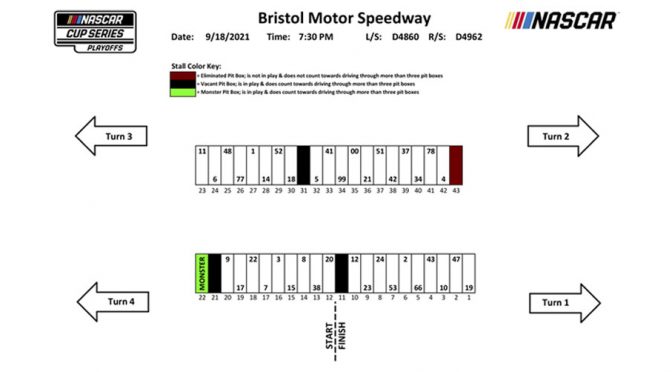
See where your favorite driver will pit for Saturday’s Bass Pro Shops Night Race at Bristol Motor Speedway (7:30 p.m. ET on NBCSN/NBC Sports App, PRN and SiriusXM NASCAR Radio).
DAYTONA BEACH, Fla. – NASCAR announced Wednesday the 2022 NASCAR Cup Series schedule, a slate that spans 39 total events. The 2022 schedule builds on the steps taken in 2021 by adding more new and dynamic venues to host NASCAR’s premier series for the first time.
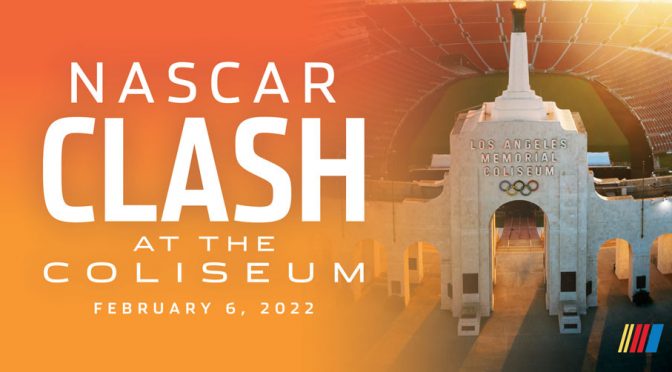
On Tuesday, NASCAR announced the Clash – NASCAR’s prelude event to the Daytona 500 since 1979 – will take place somewhere other than Daytona International Speedway when NASCAR visits the iconic Los Angeles Memorial Coliseum on Feb. 6, 2022.
The NASCAR Cup Series will visit another track for the first time when the green flag flies at World Wide Technology Raceway just outside St. Louis on June 5.
The 1.25-mile asymmetrical oval has hosted 21 NASCAR Camping World Truck Series races since 1998 and was also a part of the NASCAR Xfinity Series schedule from 1997–2010. Numerous NASCAR legends and champions have visited Victory Lane over the years. Dale Earnhardt Jr. (1998, 1999), Kevin Harvick (2000, 2001, 2010), Kyle Busch (2009) and Brad Keselowski (2010) earned wins at World Wide Technology Raceway early in their careers.
“As we demonstrated last year, we are committed to creating the most dynamic schedule for our fans, long term,” said Ben Kennedy, NASCAR senior vice president of strategy and innovation. “With the addition of new and unique venues like the Coliseum and World Wide Technology Raceway, each in markets with passionate NASCAR fans, we’re continuing to build on bold changes to deliver the best racing in the world.
“This latest iteration of the schedule should lend itself to another season filled with drama and great racing on the track, starting with the Daytona 500 and culminating with NASCAR Championship Weekend at Phoenix Raceway.”
In another move – and a nod to recent history – Homestead-Miami Speedway will return to the NASCAR Playoffs mix. The popular 1.5-mile destination track will be a key venue when it hosts the second of three Round of 8 races on Oct. 23. In addition, Texas Motor Speedway (Sept. 25) and Las Vegas Motor Speedway (Oct. 16) will swap dates and lead off the Round of 12 and Round of 8, respectively.
In addition, Kansas Speedway will move up in the playoff schedule, becoming the second race in the Round of 16 (Sept. 11).
The 2022 season will officially kick off with the running of The Great American Race – the Daytona 500 – at Daytona International Speedway on Feb. 20 live on FOX – an event that will also host the regular-season points-race debut of the Next Gen race car. The Cup Series will then immediately head back out West, beginning with a stop at Auto Club Speedway on Feb. 27 – the first time NASCAR will visit the high-speed 2-mile oval in nearly two years – followed by Las Vegas Motor Speedway (March 6) and Phoenix Raceway (March 13).
The Bristol Dirt Race returns to the schedule, this time under the lights on Easter Sunday Night (April 17). The NASCAR Cup Series All-Star Race will also return to Texas Motor Speedway in 2022. The annual event featuring NASCAR’s biggest stars will shift to earlier in the season when festivities get underway on May 22.
After a natural off week (June 19) following the conclusion of FOX Sports’ Cup Series coverage, Nashville Superspeedway will again kick off the NBC Sports’ portion of the schedule on June 26. The action in the Music City will immediately be followed by another fan favorite, Road America, which will highlight Fourth of July festivities for the second consecutive season.
Watkins Glen International will host the penultimate race of the regular season (Aug. 21) followed by an intense regular-season finale under the lights at Daytona International Speedway (Aug. 27) – two distinctly different but equally pivotal tracks in determining the NASCAR Playoffs field.
As previously announced, Phoenix Raceway will be the home to NASCAR Championship Weekend for the third consecutive year, Nov. 4-6.
Start times and specific networks will be announced at a later date, as will the 2022 schedules for the NASCAR Xfinity and NASCAR Camping World Truck Series.
Below is the full 2022 NASCAR Cup Series schedule (playoff races in bold font):
When Curtis Francois announced his intent to revive the former Gateway International Raceway in 2011, his task seemed daunting. A redevelopment plan was in its infancy, and a handshake deal with NHRA’s drag racing tour was all that went along with a starter one-year lease.
Nearly 10 years to the date later, the former racer and real-estate developer with deep ties to the St. Louis area can add a signature event to those bold plans — a NASCAR Cup Series date next June.
The 1.25-mile oval, part of a sprawling motorsports complex now called World Wide Technology Raceway at Gateway, will join the Cup Series schedule in 2022. The news, announced by NASCAR and track officials Wednesday morning, marks the culmination of Francois’ vision for the facility he has revitalized during the last decade.
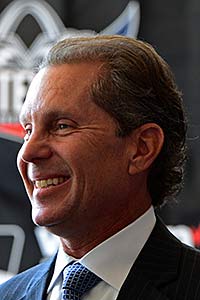
Photo of Curtis Francois by Michael Allio | Icon Sportswire
“You know I think with any business venture of this magnitude, there’s always going to be a challenge. I mean, in this case there were lots of challenges,” says Francois, who raced in IMSA and other sports-car tours plus Indy Lights. “But of all the business ventures I’ve been involved with, this has been the most satisfying and rewarding of anything that I’ve ever done. And I can tell you why: It is amazing to see how our community of racers and fans have come together to pull the rope with us. We never felt like we were in it alone, and there were so many people, really, just as part of the team making it happen.
“We’re just elated for the area, for the fans, and for all those that’ll benefit from having a Cup date here.”
The asymmetrical oval has hosted other NASCAR national series races in the past, but the June 5 event will be the first for NASCAR’s top division. The Xfinity Series ran 15 races at the Madison, Illinois, track from 1997-2010, and the Camping World Truck Series competed at Gateway from 1998-2010 before renewing its association with the track in 2014 to the current day. The venue has also hosted IndyCar events on the oval, and NHRA meets on the adjacent drag strip.
The gap in NASCAR’s tenure at the Gateway track came due to the change in ownership. Dover Motorsports group had operated the track but closed it in the fall of 2010, and Francois took over nearly 10 months later, staving off the facility’s demolition. The road back to hosting NASCAR events would be a difficult one, as Steve O’Donnell — NASCAR executive vice president and chief racing development officer — indicated after Dover did not seek race dates for Gateway in 2011.
“It’s fairly challenging to get back on the schedule,” O’Donnell said then. “NASCAR is not in the business of pulling dates from someone. So once someone opts out, we fill those venues with what we feel like are going to do a good job and have done a good job, Once that schedule is full, it’s quite difficult to get back on there.”
Shortly after Francois’ one-year lease turned into full ownership, Gateway was back on NASCAR’s radar with an annual date for the Camping World Trucks that’s held steady since 2014. IndyCar racing returned three years later.
“It wasn’t until much later that I understood that it would be as big of a challenge as it would be,” Francois says. “I did not know that Steve had made those comments, and it was probably for the best, because I just went about it as saying we’re gonna work as hard as we can every single day, put on great races, provide a great place for fans to come out and enjoy racing, and really do the best that we can to integrate ourselves into the racing world. Certainly, you know, it’s just great to see that that has come now full circle, and coming back to seeing that a Cup date is coming to St. Louis.
“Frankly, the way we went about our business was pretty straightforward. We just put forth our best effort for more than a decade now and letting the results of hard work signal the most clear resounding message that can be heard, that really that the message is one of validation that the Cup Series belongs in St Louis. It just took a long time to really set the stage to make that happen.”
The hard work that Francois references often has come in the form of investments in the track’s facilities. For fans, that’s meant renovated concession areas, restrooms and seating, plus a calendar full of events on the grassroots level. On the competition side, both the oval and drag strip were repaved in 2017, and safety upgrades have been a continual focus.
“The facility’s made a lot of strides,” said Ben Kennedy, NASCAR senior vice president of strategy and innovation. “They had a repave a few years ago to the track, and I know Curtis has some plans as you think about the future of the track in the next two to three years. So, they certainly believe in the track and they believe in the market, and I think one of the great things about it is you’re so close to St. Louis area, only a five-minute drive from the arch and downtown St. Louis, and I think it’ll be a great crowd once we go out there. The truck crowd is always really impressive.”
Start times have not been released for the 2022 Cup Series schedule, but Francois says he anticipates a daytime start for his race-day Sunday. The track plans to take deposits on next year’s race tickets starting in the fall.
Track officials formally unveiled its place on the Cup Series schedule at a media event Wednesday morning in St. Louis’ Ballpark Village, between the home of baseball’s Cardinals and the iconic Gateway Arch. There’s plenty to do before NASCAR’s premier circuit arrives in 2022, but Francois’ vision extends beyond that June debut.
“I think this is just really only the beginning,” Francois says. “We followed our mission, and our mission really has been leading with authenticity. Our model has been to go right back to the grassroots racing fan, and to make sure that they found a home at World Wide Technology Raceway, and we anticipate that we will continue to deliver that going into the future. You know, just really being good listeners to the fans and delivering the best possible experience that we can, we’ll be certainly rock-solid stewards of the community. I think most importantly, while we’re doing all these things, we’ll have some fun doing it.”
NASCAR officials released the 2022 Cup Series schedule Wednesday, unveiling a new-look calendar of events that builds on the dynamic changes that debuted this season while making slight adjustments to the rotation of tracks in the 10-race playoffs.
World Wide Technology Raceway at Gateway is the only new venue added to the schedule of 36 points-paying events. The 1.25-mile oval in Madison, Illinois, outside of St. Louis has hosted Xfinity and Camping World Truck Series events in the past, but next year will mark its Cup Series debut.
Many of the settings will be familiar as teams and drivers introduce the Next Gen car that will debut next season in NASCAR’s top division. The list of points-paying events kicks off with the Daytona 500 on Feb. 20 and closes with the season-ending championship race Nov. 6 at Phoenix Raceway, which will host the finale for the third consecutive year. The three tracks new to the 2021 schedule — Circuit of The Americas, Nashville Superspeedway and Road America — will return for 2022, as will transformations of Bristol Motor Speedway to dirt and Indianapolis Motor Speedway to a road-course layout.
A radical change is coming to the season-opening Clash exhibition with Tuesday’s announcement of a one-off event at the Los Angeles Memorial Coliseum. Other shifts are more subtle, with a slight reworking of the postseason slate that will help determine the 2022 champion.
“The process has been very refreshing for me personally to see everyone work together from all the different industry stakeholders, getting feedback from our teams … and then a lot of feedback from our fans from different studies that we’ve done, too,” said Ben Kennedy, NASCAR senior vice president of strategy and innovation. “So it’s been a very collaborative process, and it’s been really neat to see how it’s been received, both the 2021 schedule and looking forward to see how everyone reacts to ’22.”
Kennedy said 2022 schedules for the Xfinity Series and Camping World Truck Series would be announced in two to three weeks. Among the noteworthy developments on the new Cup Series schedule:
World Wide Technology Raceway at Gateway will bring a St. Louis flavor to the Cup Series calendar when it debuts June 5. The asymmetrical oval has hosted the Camping World Truck Series the last eight seasons and has hosted the Xfinity Series, plus IndyCar and NHRA events at its expansive complex. The addition of Gateway to the schedule will remove an event from Pennsylvania’s Pocono Raceway, which drops from two annual races to one (July 24).
As announced Tuesday on FOX Sports, the venerable Los Angeles Memorial Coliseum will mark the Next Gen car’s competition debut in the Clash exhibition on a temporary quarter-mile oval track on Feb. 6. The eligibility criteria and race procedures will be announced at a later date.
Homestead-Miami Speedway returns to the postseason rotation, bringing its competitive 1.5-mile layout to the Round of 8 lineup on Oct. 23. The South Florida venue hosted season-ending Cup Series event from 2002-19, but had races in June last season and February this year.
Richmond Raceway will transition out of the playoff schedule after a four-year run, taking an Aug. 14 date. Las Vegas Motor Speedway and Texas Motor Speedway will trade places in the postseason, with the Fort Worth track opening the Round of 12 on Sept. 25 and Vegas moving to the Round of 8 on Oct. 16. Kansas also shifts to earlier in the playoff rotation, taking the Sept. 11 slot.
“I think we have a really strong playoff slate right now,” Kennedy says. “That said, we want to keep it fresh, we want to keep it new, we want to keep it exciting, and I think with a lot of the great tracks that we have online, a lot of great tracks that we already have in our schedule, I think we’ve got a bunch of options to play with in the future. So excited about some of the changes we’ll see in ’22. I think, that said, as I think about ’23 and beyond, I think the opportunity for us to rotate some of those playoff venues will be there, something that we’ll definitely take a look at.”
Auto Club Speedway is set to return to the schedule after a two-year absence because of the COVID-19 epidemic. The event, scheduled Feb. 27, re-establishes a three-race West Coast swing as a lead-in to March events for Las Vegas and Phoenix.
The event is slated to be contested on the 2-mile, D-shaped track in Fontana, California. Competition officials have studied redeveloping the facility into a short track, but the go-ahead for such a project has not been made final.
Indianapolis Motor Speedway will return to the Cup Series schedule on July 31, using the grand-prix layout that combines parts of the oval and infield road course. It will mark the second straight year for the 2.439-mile configuration, which ran into issues with the curbing in the late stages of the Cup Series debut there last month, but Kennedy said the door remained open for an eventual return to the historic 2.5-mile IMS oval.
“I think the reason behind that is just, the racing product that we saw on the road course, I think fans liked it quite a bit,” Kennedy said. “I think a few things to work through, and we’ve been working hand in hand with (IMS track president) Doug Boles and the entire team ever since that event, but I think as we look towards the future, it’d be great to get back to the oval. Obviously, a ton of history and prestige around running on the oval and the Brickyard 400, so looking forward to seeing us back there sometime in the future.”
Bristol Motor Speedway’s dirt-track event will be held for a second straight year, this time with a prime-time race under the lights on Easter Sunday, April 17. The 0.533-mile track’s annual night race on its usual concrete surface remains the Round of 16 finale on Sept. 17.
The NASCAR All-Star Race returns to Texas Motor Speedway for the second consecutive year, slated for May 22. The Fort Worth track will become the first venue other than Charlotte Motor Speedway to host the non-points invitational more than once.
Watkins Glen International and Michigan International Speedway return to the schedule, but the two tracks will swap their August race dates. Michigan moves to Aug. 7, while The Glen pushes back to Aug. 21, the next-to-last race before the playoffs field is set.
Daytona International Speedway’s annual 400-miler will slot in as the regular-season finale for the third straight year, running Aug. 27. The annual Southern 500 at Darlington Raceway also stays intact as the opening race to the NASCAR Cup Series Playoffs, remaining a Labor Day weekend fixture on Sept. 4.
The Cup Series will be idle for Father’s Day weekend on June 18-19. The off-weekend will serve as a natural divide for NASCAR’s broadcast partners — the FOX Sports portion of the 2022 slate will end June 12 at Sonoma Raceway, and NBC Sports will pick up the remainder of the schedule starting June 26 at Nashville Superspeedway.
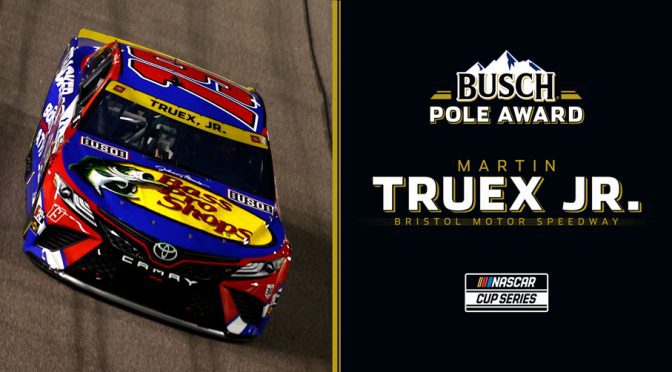
Martin Truex Jr. captured the Busch Pole Award for Saturday’s Bass Pro Shops Night Race (7:30 p.m. ET, NBCSN/NBC Sports App, PRN and SiriusXM NASCAR Radio), the 2021 NASCAR Cup Series Playoffs’ Round of 16 elimination race at Bristol Motor Speedway.
Truex will start his No. 19 Joe Gibbs Racing Toyota from the first spot in search of his first Bristol victory. Truex, a playoff driver, is coming off a win at Richmond Raceway to lock into the Round of 12.
Noah Gragson, fresh off back-to-back wins in the NASCAR Xfinity Series, claimed the pole for Friday night’s Food City 300 (7:30 p.m. ET on NBCSN/NBC Sports App, PRN and SiriusXM) in the No. 9 JR Motorsports Chevrolet. Sheldon Creed, the NASCAR Camping World Truck Series reigning champion and a winner of back-to-back playoff races earned the pole for his No. 2 GMS Racing Chevrolet for Thursday night’s UNOH 200 presented by Ohio Logistics (9 p.m. ET on FS1, MRN and SiriusXM). The Truck race is the elimination race for the Round of 10 in that series.
As NASCAR adapted to COVID-19 protocols last season, practice and qualifying were eliminated at a majority of national-series events to limit at-track time, exposure and to cut race weekend costs. To determine starting lineups, competition officials used grouped draws, added inversions for weekend doubleheaders, and eventually adopted a performance-metrics formula. That metrics format remains in place this season, drawing on performance from both individual races and season-long results.
NASCAR’s metrics formula for 2021 weighs:
25 percent: Driver’s finishing position from the previous race
25 percent: Car owner’s finishing position from the previous race
35 percent: Team owner points ranking
15 percent: Fastest lap from the previous race
See the full lineup for Saturday night’s Cup Series race below.
Start pos.
Driver
Car #
Team
1
Martin Truex Jr.
19
Joe Gibbs Racing
2
Denny Hamlin
11
Joe Gibbs Racing
3
Joey Logano
22
Team Penske
4
Chase Elliott
9
Hendrick Motorsports
5
Kyle Larson
5
Hendrick Motorsports
6
Christopher Bell
20
Joe Gibbs Racing
7
Ryan Blaney
12
Team Penske
8
Kevin Harvick
4
Stewart-Haas Racing
9
Kyle Busch
18
Joe Gibbs Racing
10
Brad Keselowski
2
Team Penske
11
Alex Bowman
48
Hendrick Motorsports
12
Aric Almirola
10
Stewart-Haas Racing
13
Tyler Reddick
8
Richard Childress Racing
14
William Byron
24
Hendrick Motorsports
15
Kurt Busch
1
Chip Ganassi Racing
16
Michael McDowell
34
Front Row Motorsports
17
Ross Chastain
42
Chip Ganassi Racing
18
Austin Dillon
3
Richard Childress Racing
19
Matt DiBenedetto
21
Wood Brothers Racing
20
Chase Briscoe
14
Stewart-Haas Racing
21
Daniel Suarez
99
Trackhouse Racing
22
Erik Jones
43
Richard Petty Motorsports
23
Ricky Stenhouse Jr.
47
JTG Daugherty Racing
24
Ryan Newman
6
Roush Fenway Racing
25
Chris Buescher
17
Roush Fenway Racing
26
Cole Custer
41
Stewart-Haas Racing
27
Ryan Preece
37
JTG Daugherty Racing
28
Bubba Wallace
23
23XI Racing
29
Justin Haley
77
Spire Motorsports
30
Anthony Alfredo
38
Front Row Motorsports
31
Corey LaJoie
7
Spire Motorsports
32
BJ McLeod
78
Live Fast Motorsports
33
Josh Bilicki
52
Rick Ware Racing
34
Quin Houff
00
StarCom Racing
35
JJ Yeley
51
Petty Ware Racing
36
Garrett Smithley
53
Rick Ware Racing
37
James Davison
15
Rick Ware Racing
38
David Starr
66
Motorsports Business Management
Practice and qualifying are tentatively scheduled for eight Cup Series races this year. Just one race remains with Busch Pole Qualifying on the schedule — the season-ending championship race Nov. 7 at Phoenix Raceway.
While big names on the NASCAR Whelen Modified Tour such as Justin Bonsignore, Patrick Emerling, Ron Silk and others ran into issues last weekend at Richmond Raceway, Ronnie Williams capitalized.
He didn’t win, but a third-place finish for the Ellington, Connecticut, native might as well have been one — with it being his best finish in his 37-race Whelen Modified Tour career to date.
“It’s just good to run well on the tour finally,” Williams said in the garage at the Virginia short-track, the first event in nearly 20 years at the venue for the tour. “We had a fourth-place at New Hampshire and now a third here. We’re definitely going in the right direction.”
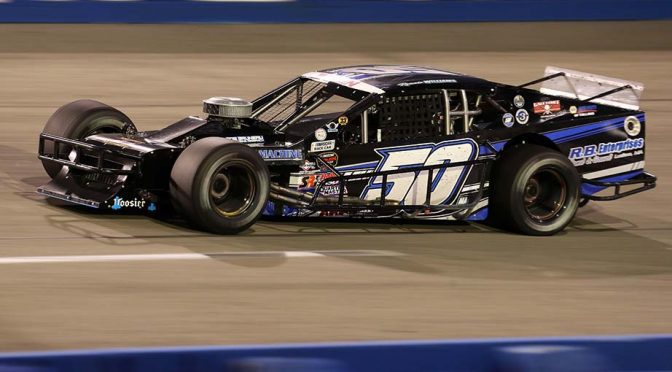
The second top-five this season is the most in Williams’ career over a single season and third overall. A two-time Stafford Motor Speedway SK Modified champion and 2019 Tri Track Open Modified Series champion, Williams has run part-time on the Whelen Modified Tour for the last couple of seasons. And it’s results like Richmond that makes the No. 50 group want to prove themselves more on the big stage.
“I mean, this is an SK modified team out of Stafford,” he said. “And to come here and compete with these guys says a lot.”
Williams led three separate times for a total of 34 laps but wound up falling off towards the end, not being able to hold serve with eventual winner Ryan Preece down the stretch.
“We were really good in the middle part of the race and those laps that we led. We pulled away, but just missed it a little bit. Wish it was 100 laps, not 150. But solid effort overall.”
He did allow himself a daydream a little, though. The “what ifs” of the small, part-time team coming to a big NASCAR national series venue and doing the unthinkable. That was, until he was reminded of how long the race was.
“My spotter came over the radio and said, “it’s only lap 76.” I’m like, ‘crap, we have half way to go,’” he joked. “I’ve had two poles on the tour and I’d never led a lap. I don’t know how that makes sense. But it was kind of nice to go out there and just feel like we belong on the tour.”
Ronnie Williams and his No. 50 team plan to compete in the season-finale, the NAPA Fall Final 150, at Stafford on September 25.
The season-opening Clash exhibition race is about to get a taste of West Coast flavor in 2022, marking a historic first visit to the tradition-rich Los Angeles Memorial Coliseum.
The only venue to host two Olympic Games will add NASCAR Cup Series racing to its 98-year-old portfolio next season. The event is to be contested around a quarter-mile asphalt oval that will be built around the facility’s football field. The Los Angeles event will mark the first time the preseason Clash will be held outside of Daytona International Speedway since its inception in 1979, and it will give the sport its first competitive look at the Next Gen car on Feb. 6 for 2022 in a non-points event.
“We’ve been discussing the Clash for a while, and we’ve had it at the (Daytona) oval for a number of years,” said Ben Kennedy, NASCAR senior vice president of strategy and innovation. “We moved it to the road course this year, but really wanted to think outside the box as we thought about the Clash in the future — and seeing that it’s an exhibition event, we looked at a number of different places and locations that we could host it at, and ultimately narrowed it down to the L.A. Coliseum.
“I think the large fan base that we have here in Los Angeles, the largest that we actually have in the nation, paired with exciting racing and being here in the downtown Los Angeles market, I think will be really special.”
Kennedy said talks with Coliseum officials began two years ago, but negotiations and planning were delayed by the COVID-19 outbreak last spring. How those conversations started was by simpler means than one might think.
“We’ve had these discussions for a while, and they actually came about by us going to their website, finding their contact page and reaching out to them,” Kennedy says. “So, we started that in 2019, I had a few conversations, obviously with COVID put things on pause, but resurfaced and I would say early on this year, I’ve had a ton of dialogue. Over summer, we put a team together a couple of months ago, and really we’re off to the races and running now.”
The 77,500-seat venue has hosted motorsports events in the past, with both supercross and speedway motorcycle races within the stadium. Off-road trucks and rallycross events (including the X Games) have also been competed on temporary dirt courses at the Coliseum in recent years. But an impermanent paved track for big-league stock-car racing will be a first, and construction is scheduled to start on New Year’s Day in 2022.
Kennedy said series officials have considered two or three configurations for the quarter-mile bullring, with iRacing computer simulations helping to determine the track’s real-life profile. Simulated trials have taken place with 5 degrees, 2.5 degrees and no banking in the turns, he says. “You can only go so high, just because of the sight lines and the temporary construction, but we’ve played with a few different ones,” Kennedy says. “We’ll have more at a later date on that.”
A handful of NASCAR Cup Series drivers and competitors in the eNASCAR Coca-Cola iRacing Series have already given the Coliseum track a virtual sim shakedown. “I think a lot of good feedback and intel that we’ve gotten from some of those test events, and I think that will ultimately help us kind of refine exactly what that model is going to look like,” Kennedy says. “So other than that, it’ll be asphalt, quarter-mile. We’ll have a few pit stalls, maybe eight to 10, inside but for non-competitive stuff. If someone has a loose wheel or needs to repair their car, they’ll be able to come in and do that.”
The track will be the shortest that the Cup Series has competed on in the modern era. Currently, Bristol Motor Speedway (0.533 mile) and Martinsville Speedway (0.526 mile) are the smallest layouts on the schedule. In previous years, the circuit visited quarter-mile Bowman Gray Stadium in Winston-Salem, North Carolina, from 1958-1971 and tiny .2-mile Islip (N.Y.) Speedway from 1964-68, 71.
The format and eligibility for the L.A Coliseum preseason exhibition, which is typically shorter than a standard points-paying event, will be announced at a later date. The event has traditionally been open to Busch Pole Award winners from the previous year and other selected invitees. While the race procedures have yet to be made final, Kennedy says the unique venue’s debut will have a new-look structure.
“What I will say, though, is the format will be a little bit different from what we’ve traditionally seen at the Clash at Daytona,” Kennedy says. “So, looking at a few different options. The group has really, really been challenged to think kind of differently about how we have all the different events leading into the main event, and I think a lot of good thoughts and input that we’ve got on it so far, so more to come on all that.”
The non-points invitational will also provide a glimpse of the Next Gen car for the 2022 Cup Series in race conditions. Officials had initially targeted a competitive on-track debut during Daytona’s Speedweeks, but now the seventh-generation Cup Series model will have a Tinseltown premiere.
“I think given that it is a fresh concept, a fresh event, a fresh year, we wanted to start off with a fresh look with the Next Gen car,” Kennedy said.
NASCAR has a steeped tradition of racing in Southern California. National-series events are scheduled to return to Auto Club Speedway in Fontana this year, and the Cup Series also competed in the past at Ontario Motor Speedway and Riverside International Raceway, two venues east of L.A. that have since been redeveloped. The ARCA Menards Series West still competes at Irwindale (Calif.) Speedway, just east of the city limits.
The L.A. Coliseum underwent a $315 million renovation in 2018, replacing the general seating and adding luxury boxes and club-level suites. Series officials toured the facilities during last weekend’s college football matchup between the University of Southern California and visiting Stanford.
The 2022 season-opening Clash has a new look — and a new venue.
The Los Angeles Memorial Coliseum, one of the most storied venues in all of sports and entertainment, will add a new event to its long and decorated list: The Clash at the Coliseum
NASCAR officially announced the news Tuesday evening, confirming the first NASCAR event held at the iconic Los Angeles stadium will take place Sunday, Feb. 6.
The Clash at the Coliseum will also be the first event as part of the venue’s centennial celebration and mark the first time NASCAR’s prelude event to the DAYTONA 500 will take place somewhere other than Daytona International Speedway.
When is the Clash at the Coliseum?
Date: Sunday, Feb. 6, 2022
Start time/TV channel: To be announced at a later date
More: Tickets start at $65 for adults and kids 12 & under starting as low as $10. The Los Angeles Memorial Coliseum offers a variety of seating options from lower to upper bowl, midfield start/finish line seats to premium club seats with access to the exclusive Lou Galen Club Lounge. Premium Club seats will go on sale starting Sept. 29 at 1 p.m. ET following a special pre-sale to current Club Members.
The No. 19 Joe Gibbs Racing Toyota of race winner Martin Truex Jr. was found with one unsecured lug nut in Saturday’s post-race check after the Federated Auto Parts 400 Salute to First Responders, resulting in a $10,000 fine for crew chief James Small.
The No. 77 Spire Motorsports Chevrolet of Justin Haley was found with two unsecured lug nuts after the race, resulting in a $20,000 fine for crew chief Kevin Bellicourt. In addition, Bellicourt is also suspended from the next NASCAR Cup Series Championship Points Event.
In the Xfinity Series, the No. 20 Joe Gibbs Racing Toyota of Harrison Burton was found with a single unsecured lug nut after Saturday’s Go Bowling 250, resulting in a $5,000 fine for crew chief Jason Ratcliff.