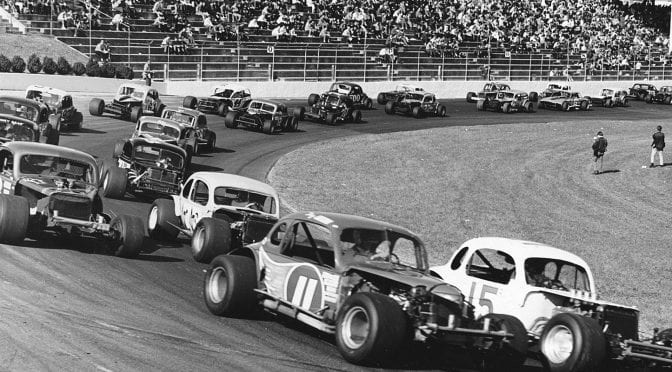
Modified racing at Martinsville is filled with memorable moments. Leading up to the Modified return to the track, here are selected some of the biggest and most important races in Martinsville history.
1948: The Birth of a Jewel
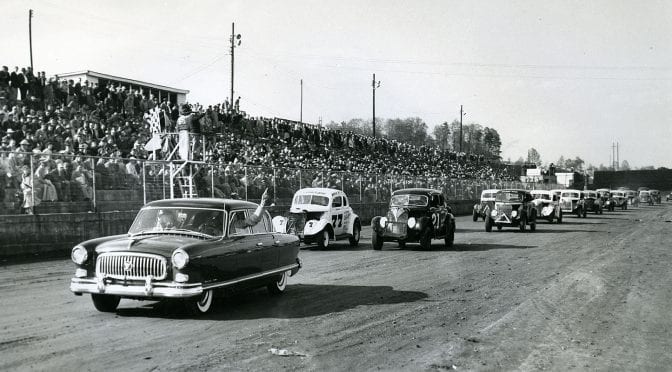
In a field including NASCAR founder Bill France, Buck Baker and Tim Flock, it was Fonty Flock who won the first race at the dirt half-mile oval. While Modifieds wouldn’t race at Martinsville for 18 more years
1966: A Return to Glory
After a nearly two-decade absence, the Modifieds returned to Martinsville on April 23, 1966. Ray Hendrick took the checkered flag, the first of nine Modified victories he picked up at the track. He also earned his first grandfather clock, which the track began awarding to the race winners just two years prior.
Hendrick would go on to be the winningest driver in track history with 20 victories, and was inducted into the International Motorsports Hall of Fame in 2007.
1970: Hendrick Sweeps
Hendrick continued his dominance at Martinsville, becoming the first driver to sweep both the Late Model feature and the Modified feature when he won both races at the Cardinal 500 on Nov. 8, 1970.
It was a banner year for the Richmond, Virginia, driver at the half-mile. He drover his Modified to a win in the Dogwood 500 on April 12, beating runner-up Fred Desarro by six laps. Just two weeks later, he picked up a 100-lap win over Jerry Cook in a NASAR Modified event.
For the November doubleheader, he won the Late Model Sportsman race from the pole in his 1965 Chevrolet Chevelle, then drove his Chevrolet Camaro to a win over runner-up Cook in the Modified race.
1981: Evans Catches Fence and Checkers
Hendrick’s final win at Martinsville came in 1975, the year after Rome, New York, legend Richie Evans earned his first win there.
Evans would win nine times at the “paperclip” but probably none more famous than on March 15, 1981.
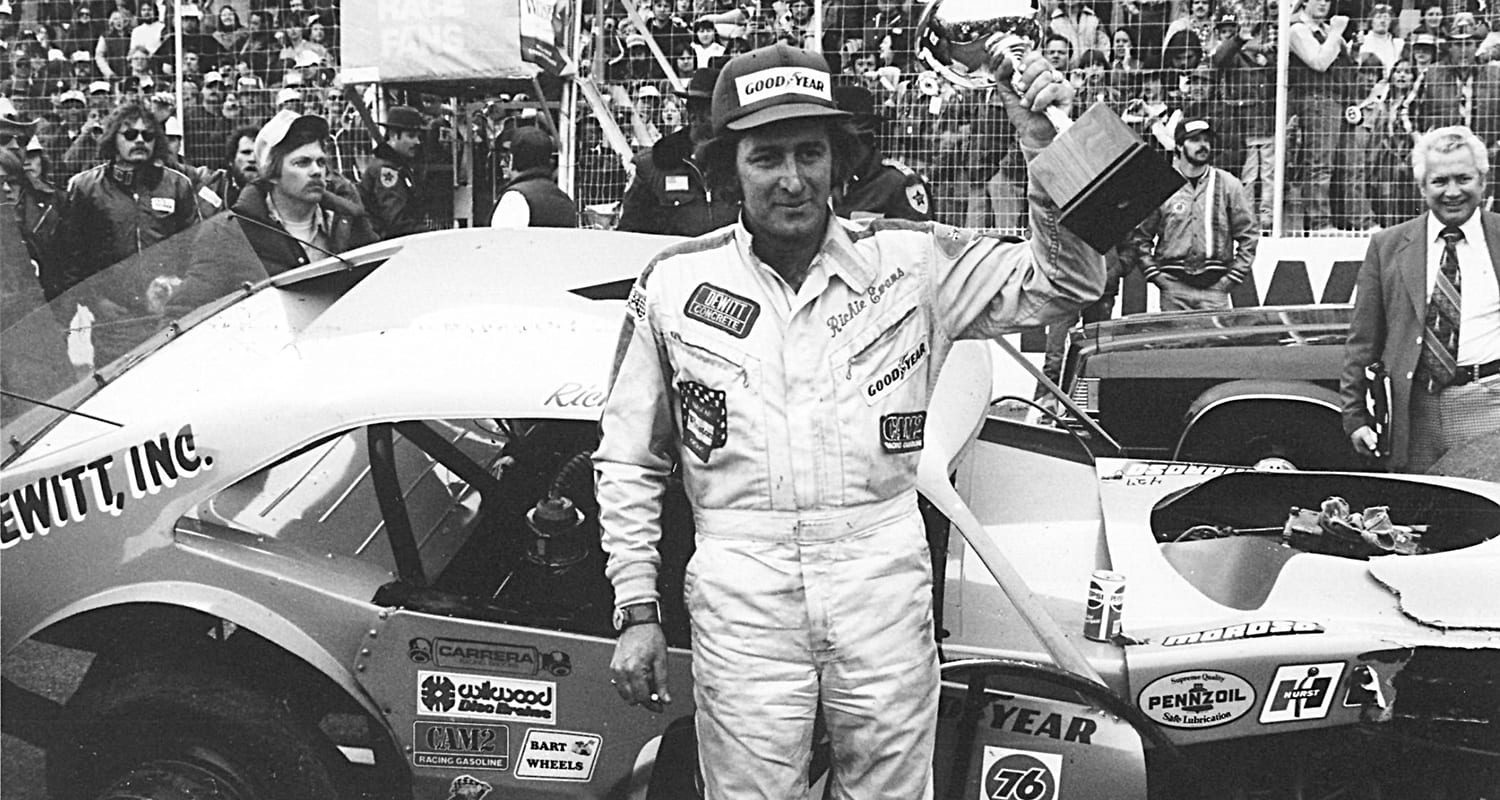
In arguably the greatest finish in the history of both Martinsville and Modified racing, Richie Evans rode the frontstretch catchfence to the win over Geoff Bodine.
“I got him sideways off of 4,” Geoff Bodine says. “I should’ve kept spinning him out, but I let him go. That was my mistake. I was too nice a guy. I didn’t want to wreck him, I just wanted to beat him.”
1985: A Poignant Season Finale
Just four years later, Martinsville and Evans were intrinsically linked again, but for another reason.
In the first year of the NASCAR Winston Modified Tour, Evans won 12 of the first 28 races to clinch his ninth NASCAR modifified title heading into the final race of the season at Martinsville on Oct. 27, 1985.
Three days before the race, Evans crashed in practice, dying when a stuck throttle sent him into the turn-three wall.
The Tour raced on that weekend, with Johnny Bryant collecting his only career Tour win. Bryant was driving for North Carolina car owner David Riggs, and they are the last southern car owner and driver combination to win a Modified race at Martinsville.
“I still remember that win,” Bryant told the Martinsville Bulletin in 2014. “We had a good car that day and I got some breaks and was able to win a race here. He prepared a good car for me.”
Although his car is a bit the worse for wear, NASCAR Modified driver Richie Evans raises another trophy after an obviously hard-fought victory over Geoff Bodine in the most spectacular bump-and-grind finish at the track. (ISC Images & Archives via Getty Images)
F1 driver Daniel Ricciardo has an intimidating extra incentive to earn a podium finish in his first season with McLaren.
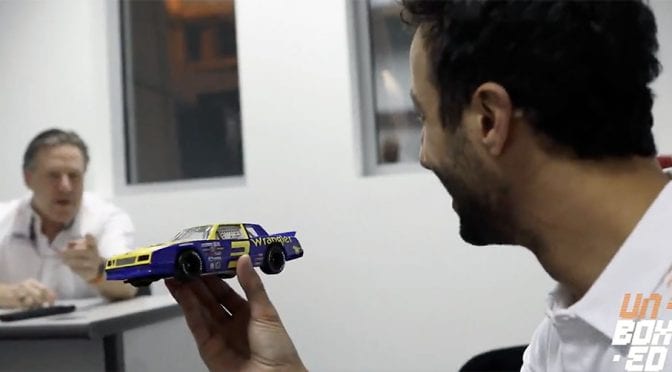
McLaren’s CEO Zak Brown gifted Ricciardo a die-cast of Dale Earnhardt’s iconic 1984 No. 3 Wrangler car, but he upped the ante by betting a drive with the actual car. Brown currently owns the real-life version of Earnhardt’s No. 3 in his personal heritage collection. If Ricciardo is able to finish third or better during his first season with the team, he’ll get to test out the car.
Growing up, Ricciardo was a massive Earnhardt fan. He also drives the No. 3 car in F1 partly because of his fanhood to “The Intimidator.” Ricciardo couldn’t contain his excitement to receive the replica.
Ricciardo has earned 31 podiums over the course of his F1 career, which began in 2011. The 31-year-old from Perth, Australia, recorded two of those podiums last year with Renault F1 Team, which has been rebranded as Alpine.
Kyle Larson was collected by a spinning Christopher Bell on Lap 51, ending both drivers’ chances of winning Monday’s Food City Dirt Race at Bristol Motor Speedway. Martin Truex Jr. cut a tire in overtime.
These incidents worked out just fine for the sportsbooks.
At BetMGM, Larson accounted for about 65% of the money bet on drivers to win the race, including a $30,000 wager at odds of +250 (the bettor would have profited $75,000 had Larson won), one of two five-figure bets on the No. 5 Chevy written at the book. Larson was the easy betting favorite before Monday’s affair.
Truex’s dominating performance earlier in the day in the NASCAR Camping World Truck Series race prompted heavy betting action on the No. 19 Toyota. He drew the second-most action at BetMGM, around 12-14% of handle in the outright market, said Seamus Magee, a Sports Trader at the betting shop.
After Truex’s win in the Pinty’s Truck Race, “we saw a flood of money come in on him to win the Cup race,” Magee said. “The money just kept coming in on him.”
Upon that action, Truex’s odds were shortened to +850 (bet $100 to win $850) by the time the green flag dropped, after opening at +2500.
While Bell was the second favorite and took significant money, Larson and Truex were “the only two big losers for the books,” Magee said.
While Larson was effectively done early, the liability on Truex must have caused some heartburn at BetMGM, as the Gibbs driver was strong until his late-race misfortune, leading a race-high 126 laps and winning the first stage. His in-race odds were as skinny as -190 (bet $190 to win $100) at some books.
Race winner Joey Logano closed at 20-1 odds at BetMGM and trailed Bubba Wallace, Denny Hamlin, Kyle Busch, Chase Elliott and Ryan Blaney in handle, in addition to Larson, Truex and Bell.
Logano’s victory was also a win for DraftKings Sportsbook, where the No. 22 Ford drew only about 3% of the handle in the outright market, outside of the top 10, and closed at 18-1 odds, according to Johnny Avello, Director of Race and Sportsbook Operations.
Specifically at DraftKings’ Tennessee book, Larson drew the most handle, followed by Bell, Busch, Austin Dillon and Elliott. Truex was the seventh most wagered on driver, Avello said.
Did handle follow the hype?
No matter the sport, numerous factors impact betting handle. The magnitude of the event, where it sits on the sports calendar, the time of day it is scheduled for and the competition it faces are among them.
Plenty of hype surrounded the Food City Dirt Race, the first Cup event on dirt since 1970. But rain forced a postponement until Monday, when the race served as sort of a lead-in to the NCAA Tournament’s Elite Eight.
Magee said Bristol handle was slightly better than for an average NASCAR race, which he said is similar to a nationally televised regular-season college basketball game. In addition to the excitement about a race on the dirt, the extra day to wager provided a small boost.
“I think it definitely helped,” Magee said of the race being postponed. “An extra day for it, and it was kind of a precursor to the Elite Eight. For some guys who like betting, it was something to put on before the (basketball games), and you had the Truck race before, which I also think helped the handle.”
Some bettors were hesitant to put too much money on the race, however, because it was so difficult to predict.
“The uniqueness of the dirt is one thing, betting on it is another,” Avello said. “Who has a good handle on dirt? It’s probably a fun race to watch and bet some. I don’t know if it was a race where you could hone in on handicapping like you would another type of race where you have some history on how guys run on certain tracks. This one was a little more difficult to handicap. Let’s face it, the track itself was a little funky, right?”
Turns out, that funkiness was fun to watch, and bettors were inclined to get involved during the race.
“This was one of the better ones in terms of (live) handle,” Magee said. “I think a lot of that was from the buzz on social media that was like, ‘Are you seeing this dirt race? There are wrecks every other lap.’ This looks like one of our better live books.”
NASCAR announced during the race it’s running it back on the Bristol dirt next year, and Magee anticipates even better handle in 2022.
“I am excited to hear they’re going to do it again next year,” he said. “A dirt race at night will sell really well for NASCAR, people will get into it. And as more people are betting on the sport, more people are watching, obviously the handle will go up next year.”
Marcus DiNitto is a writer and editor living in Charlotte, North Carolina. He has been covering sports for nearly two-and-a-half decades and sports betting for more than 10 years. His first NASCAR betting experience was in 1995 at North Wilkesboro Speedway, where he went 0-for-3 on his matchup picks. Read his articles and follow him on Twitter; do not bet his picks.
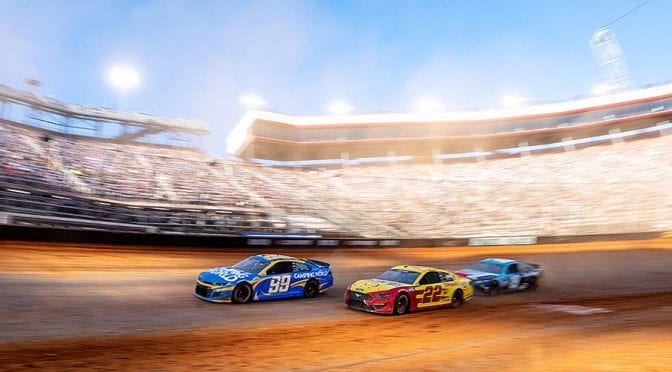
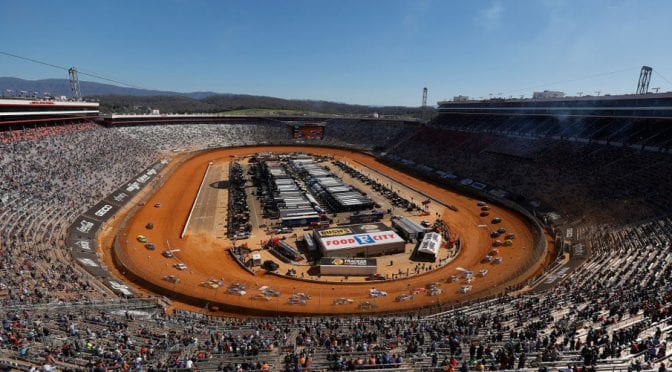
What was old was new again Monday at Bristol Motor Speedway, a track celebrating its 60th anniversary that showed it still has some new tricks in its bag. That newfangled form of nostalgia came in the form of dirt — tons of it — and the resurrection of a surface that hadn’t hosted NASCAR’s big leagues in its modern era.
The Cup Series’ first dirt-track race since 1970 — the first of several big swings made on the 2021 racing schedule — delivered on the drama that the hype had promised, but not without a hitch. To be certain, there were hitches.
“I think the industry had everything thrown at it,” said Steve O’Donnell, NASCAR’s top competition official after the Food City Dirt Race.
None of it came easy, from the logistical hoops to the track transformation to the continual adaptation that was needed throughout the weekend to make two national-series races happen on a not-so-familiar surface. And oh the weather, which ranged from floods, hail, downpours and bright sun. Torrential rain gave the half-mile a thorough soaking, turning the creek that encircles the speedway grounds into a trackside moat by Sunday. The flooding finally subsided but gave the track crew a tall task to prepare for a doubleheader on Monday’s rain date.
By early evening Monday, the organizing parties figured the fun factor outweighed the hurdles and decided let’s do it all over again next year. Tickets for a 2022 dirt redux went on sale with 50 laps to go.
“All in all, I’d give it a thumbs-up with some things to learn, “O’Donnell said, giving nods to track owner Speedway Motorsports Inc. and its staff. “The fans had asked us for years to look at innovation around the schedule. In fact, we’ve been taken to task for not making some moves. We were bold and aggressive this year. I’m proud of the team for doing that, proud of the industry for taking a chance here.”
It’s still on the soon side to tally all of the reviews, but the wide smiles from the drivers dicing it up in Friday’s clear-sky practice day told the early tale, turning once-wary veterans into converts at first blush (see: Kevin Harvick). The uncertainty that loomed over the entire weekend kept churning on race-day Monday, humbling hotshots with extensive dirt backgrounds and making mud-slinging stars out of the surface’s relative newbies.
Race officials mimicked the drivers with their own version of chasing a changing race track, keeping the lines of communication open with the dirt-savvy specialists in the field for their input. Officials added competition cautions to address tire wear, then switched to single-file restarts and groomed the track mid-race to combat visibility issues. As racers are wont to do, they filed it away in their memory banks for 2022, when the Cup Series plans to bring the Next Gen racer to the schedule’s first major zigzag.
“I think the track crew learned a lot with these heavy race cars, what they need to do to be better,” said Ricky Stenhouse Jr., Monday’s runner-up behind race winner Joey Logano. “They adapted well, like I said, with the rain. Those are things that are always changing with dirt-race tracks. They did a good job. Next year is going to be just as much of a toss-up with a different race car.”
An equally sizable toss-up may well be next season’s schedule, which will have work to do to one-up the 2021 edition. Dirt-track racing at Bristol is already confirmed to come back, the glut of road courses on this year’s schedule would be a welcome return, and last week’s reveal of a NASCAR-endorsed Chicago street course on the iRacing simulation at least hints that a temporary road-racing circuit in an urban setting may not be so far-fetched. Variables remain, but the announcement of a Bristol dirt re-up for next year at least allows one of this season’s most buzz-worthy events a chance to grow.
Cup Series drivers and teams flexed their versatility in Bristol’s inaugural dirt-track weekend, and they may be called upon to do more of the same in 2022. Monday’s learning curve was an accelerated one, and even dirt newcomers proved to be quick studies.
“It goes to show,” Logano said, “that the talent in this NASCAR Cup level is something else.”
That goes for the industry, too, in managing the multitude of obstacles to make the first dirt-track race in more than a generation a reality, wrapped in newfangled nostalgia.
Brett Bodine remembers the first time he watched a race at Martinsville Speedway.
The Chemung, New York, driver had flown down in a single-engine plane to watch older brother Geoff compete.
His first impression when he walked into the property?
“I was amazed. I had never seen such a pristine piece of property at a race track,” Brett Bodine says. “Everything about that track was perfect. It was painted perfectly. The shape of the track, it was a perfect layout of a half-mile race track.
“I said, ‘This is heaven. This is a racetrack heaven.’ ”
Not only was the track beautiful to look at, it raced well, too. It was ideally suited for the Modifieds. Almost as it if had been tailor-made for the division. It’s fitting then, that the NASCAR Whelen Modified Tour’s return to the half-mile flat Virginia oval on Thursday, April 8, for the Virginia Is For Racing Lovers 200 will represent far more than the start of the season.
It’s a return to a tradition that dates back to the founding days of NASCAR.
The Modifieds ran the first race held at Martinsville, back on Independence Day of 1948, won by Fonty Flock on dirt.
The list of winners at Martinsville is a who’s-who of Modified legends.
Ray Hendrick and Bugsy Stevens dominated when the Modifieds returned in 1966. Hendrick won nine times from 1966 to 1975, while Stevens won six times from 1967 to 1977. Soon, however, came the era of Richie Evans, who won nine times at the track during his illustrious career.
The 90s saw more parity. Mike Stefanik, Jeff Fuller and Reggie Ruggiero each won three times that decade.
Current Cup Series driver and 2013 Tour champion Ryan Preece got his first victory at the track in 2009. The last driver to win a Modified race at Martinsville was Bobby Santos during his 2010 championship season.
Martinsville is a place where short-track heroes are made. The legend of Martinsville, however, has become mythical.
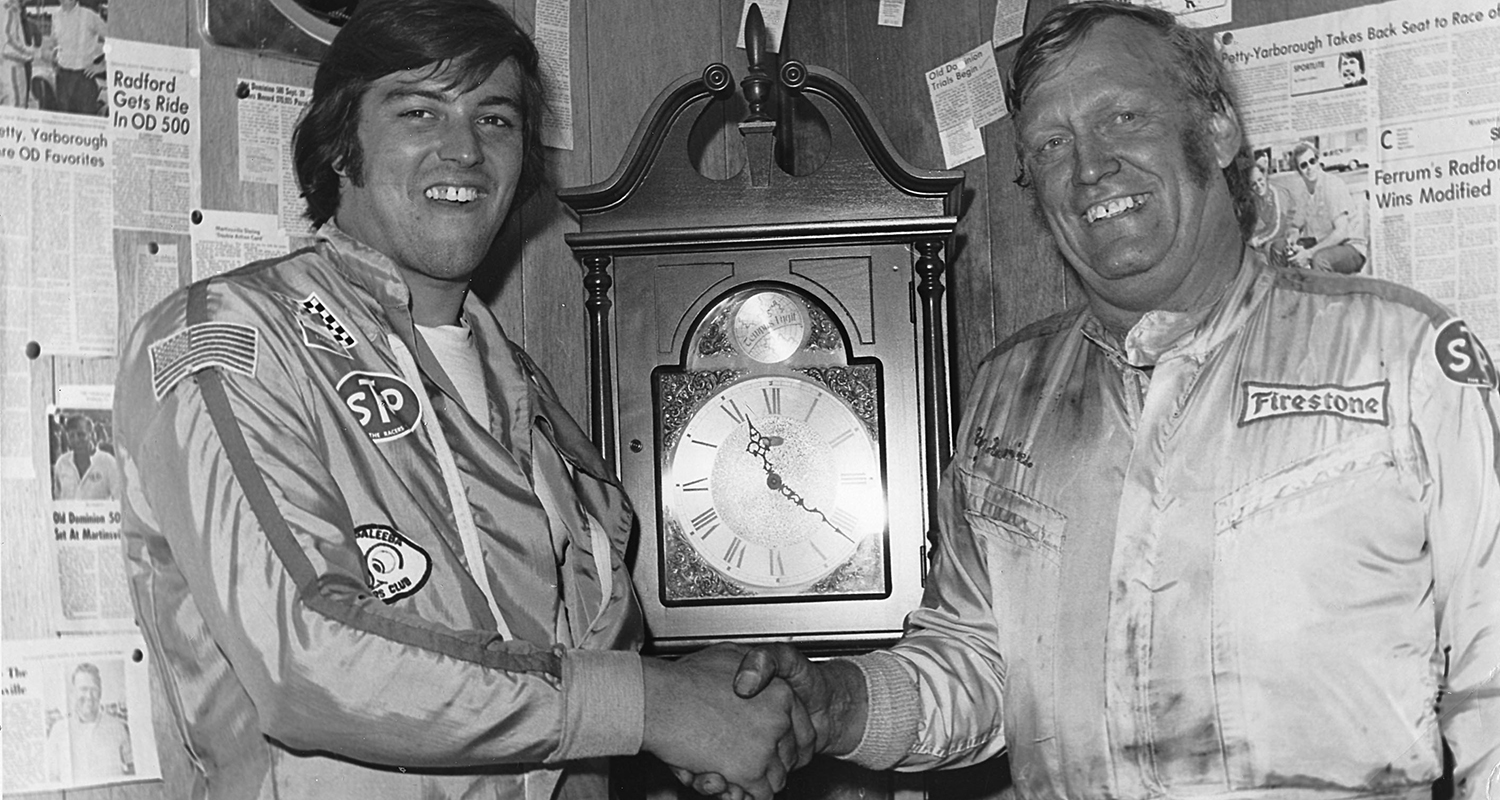
After winning their respective races in the Cardinal 500 Classic at Martinsville Speedway on Oct. 27, 1974, Ron Bouchard (L) and Ray Hendrick (R) pose with one of the grandfather clocks that are awarded to the victors. Bouchard won the NASCAR Modified portion of the event, while Hendrick took home the win in the NASCAR Late Model Sportsman race. (ISC Images Archives via Getty Images)
‘This is a race track heaven’
Brett Bodine’s first impressions were validated when he got behind the wheel in a Modified.
For Brett Bodine, success at Martinsville requires all three of the elements that make racing a challenge: a lot of horsepower, brake management and two different sets of corners.
Bodine eventually went on to win at North Carolina’s North Wilkesboro Speedway in the NASCAR Cup Series, but he still holds his grandfather clocks from Martinsville as the ultimate prizes.
“That’s the ultimate trophy in NASCAR racing,” Bodine says. “You talk to anybody from Cup to Xfinity to Trucks to Modifieds, having one of those in your possession means everything. When you grew up as a kid in the Modified series, to win at the top level of it, that is huge.”
Almost 75 years later, the Modifieds still deliver on the action as they did in the 1960s and 1970s. It’s the same flat half-mile paperclip. Cars race largely the same way around Martinsville now as they did 30 or 40 years ago. It’s more of a surprise when a race doesn’t end in fireworks.
Jeff Fuller, the 1992 Tour champion and a four-time Martinsville winner, saw that same challenge.
“Be mindful of your tires,” Fuller says. “Say you’re starting 10th. Why do you want to be in first on lap 30? It’s all about what you’re going to have coming to the checkered flag.”
Martinsville Speedway President Clay Campbell grew up watching Modifieds slug it out at Martinsville. Ever since he was a boy, Campbell has always cherished ground-pounder action.
“They are real race cars,” he says. “The big tires, the sound and everything like that. A lot of those guys were heroes of mine because they were here twice a year.”
Through the 1980s, Martinsville was far and away the premier stop for Modified racing. Five times it has served as the season finale for the Whelen Modified Tour.
“You went down there, and for that week, a bunch of part-time racers gathered down at that facility, and you felt like a professional,” Brett Bodine says. “You were treated like a professional.”
“It was their Daytona 500,” said Campbell.
Stars from outside the racing world showed up, too.
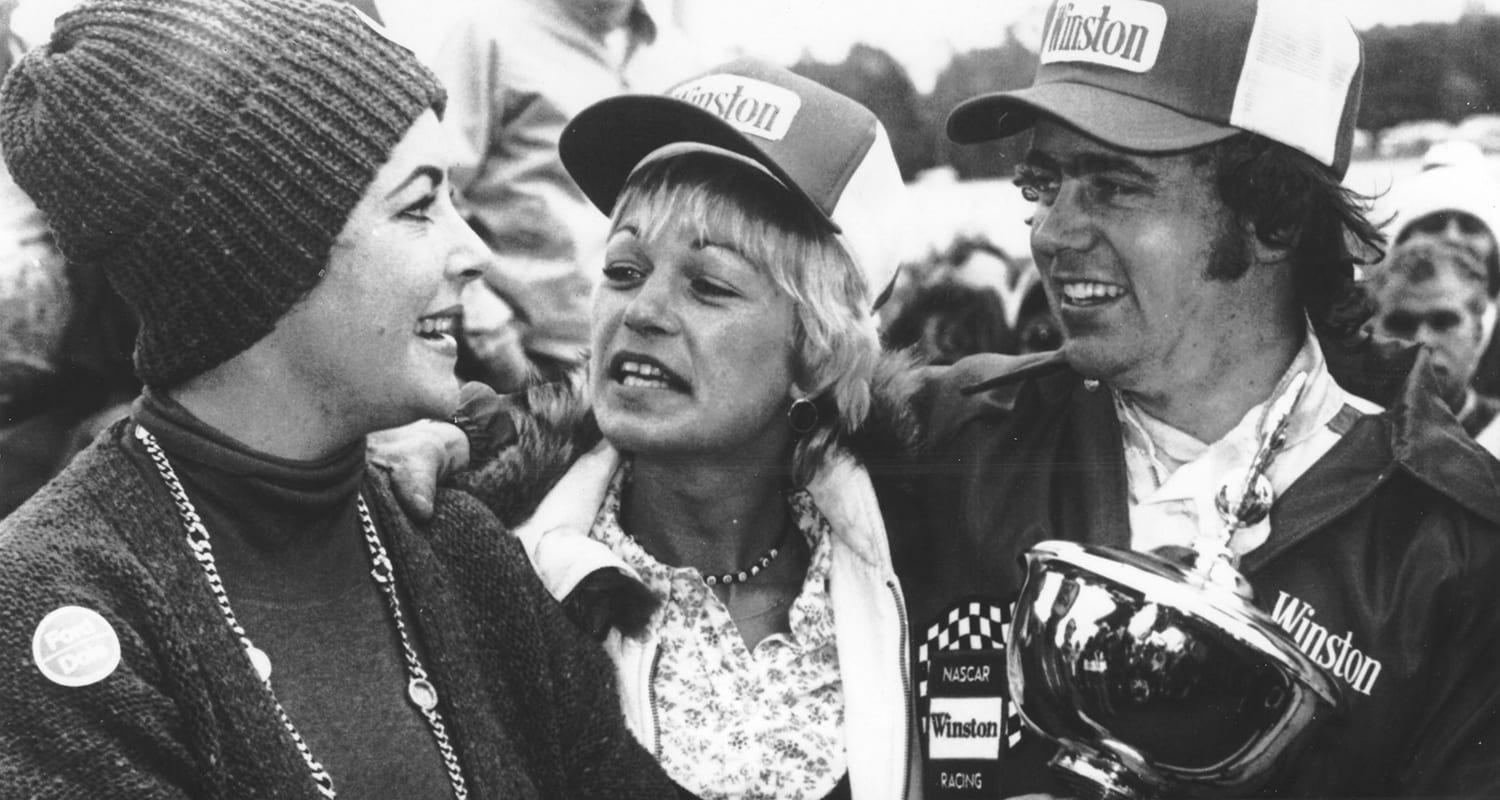
In 1978, Elizabeth Taylor went with then-husband John Warner to the track for the Cardinal 500. Warner was campaigning for a U.S. Senate seat in Virginia at the time. While Warner was supposed to stay for only part of the race, Taylor wanted to watch it all. Geoff Bodine won, and Taylor was sent to Victory Lane to present him with the winner’s trophy.
During the presentation, Taylor gave Geoff Bodine a kiss.
“She kissed me,” he says. “My wife says Elizabeth kissed a lot of guys. But I’m one of them guys.”
Actress Elizabeth Taylor joins Geoff Bodine in victory lane after Bodine won the NASCAR Modified portion of the Cardinal 500 at Martinsville Speedway. (ISC Images & Archives via Getty Images)
The greatest finish ever?
A history of Modifieds at Martinsville isn’t complete without discussing arguably the greatest finish in Modified history: the 1981 Dogwood 500.
The race came down between two of the best: Richie Evans and Geoff Bodine.
Geoff Bodine was trying to make history as the first driver to win both the 250-lap Late Model feature and the 250-lap Modified feature in the same day. He had dominated the race, but in the closing laps, Evans was within striking distance. He bumped Bodine out of the way and took the lead at the white flag. Bodine, however, wasn’t finished.
“I got him sideways off of 4,” Geoff Bodine says. “I should’ve kept spinning him out, but I let him go. That was my mistake. I was too nice a guy. I didn’t want to wreck him, I just wanted to beat him.”
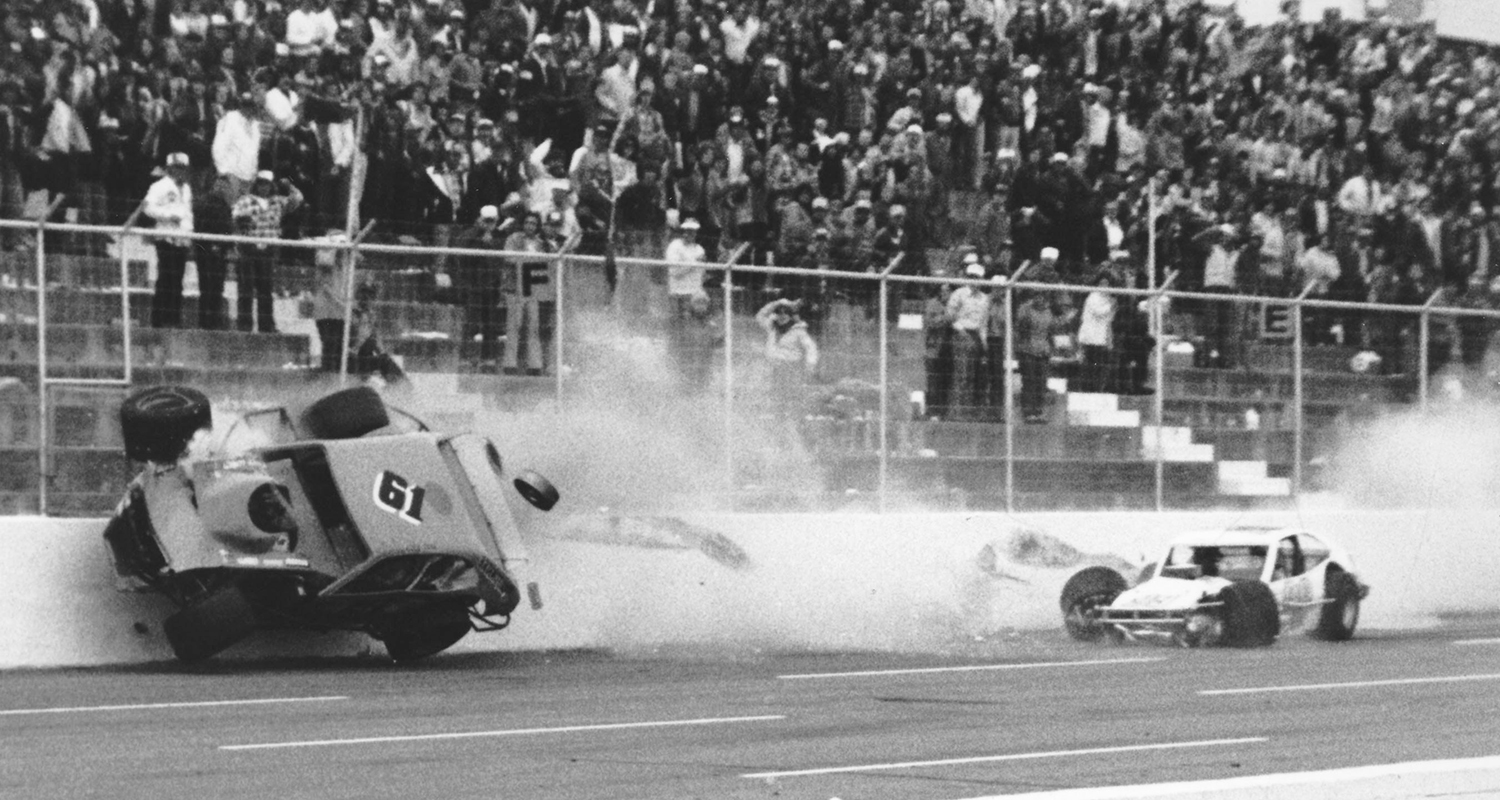
Evans’ car jumped in the air and rode the catchfence to the checkered flag. The last lap was the only lap Evans led all day.
“Richie and I both handled it good,” Geoff Bodine says. “We looked at each other. Everyone thought we were gonna run over and fight each other, but we didn’t fight. We just looked. Even though it happened, we respected each other. It was racing. Good hard racing. I bumped him, and he ended up winning.”
Campbell calls it the greatest finish in the history of the track.
“All the emergency personnel went up to him when everything came to a halt, and [Evans] asked ‘Did I win it?’
“They looked at his tach and he never came off the throttle,” Campbell says. “We’ve got a picture of the flagman. He was waving the checkered flag the whole time, but he had his arm up in front of his head like he was trying to block something from coming across.”
On the final official results chart for the modified division Dogwood 500, the first two finishers were ironically listed as “wrecked.” Richie Evans (No. 61) wrecked ahead of rival Geoff Bodine, and was credited with the victory. (ISC Archives/CQ-Roll Call Group via Getty Images)
The resurrection of a tradition
After an 11-year absence, the Modifieds will return to Martinsville a week from Thursday.
“I tell people time and time again, there’s two questions I’d always receive,” Campbell says. “One was ‘when are you going to put up lights?’ Well, we’ve done that, so I don’t get that question now. The second question: ‘When are you bringing the Modifieds back?’ Check the box on that one.
“If I have anything to do with it, they’re here to stay.”
With racing being such a family sport, Brett Bodine plans on attending this year with his family.
“I plan on taking my kids up there to watch it,” Brett Bodine said. “Only on YouTube videos can they watch me race in Modifieds.
“This is one I want to be in-person to watch, because it means so much to me and my family.”
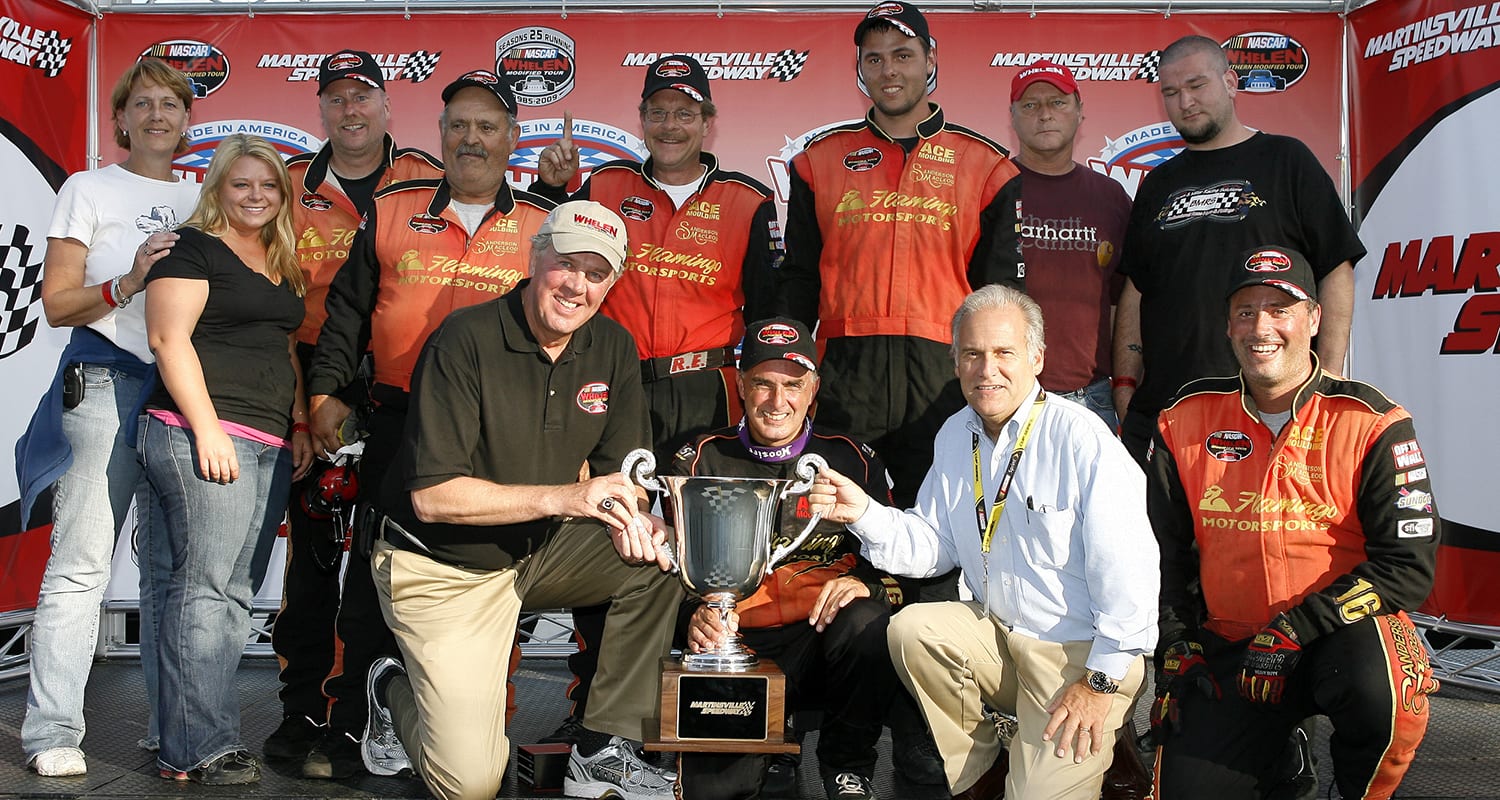
NASCAR Hall of Famer Mike Stefanik won the NASCAR Whelen Modified/Whelen Southern Modified race at Martinsville Speedway in 2009. He holds the trophy with the late Phil Kurze (left) of Whelen Engineering and Martinsville Speedway’s Clay Campbell (right). (Tom Whitmore/NASCAR via Getty Images)
Even while leading late Monday afternoon, Daniel Suarez joked he didn’t know what he was doing during a mid-race interview as he navigated the dirt at Bristol Motor Speedway.
The stat sheet and official rundown said otherwise after the Food City Dirt Race, as Suarez guided Trackhouse Racing Team to its first top-five finish in the NASCAR Cup Series. The 29-year-old Monterrey, Mexico, native made the most of his 150th Cup start, leading a career-best 58 laps and placing fourth, holding the top spot until eventual winner Joey Logano swept by.
“Overall I felt that we’re very close. That always brings a smile to my face,” Suarez said post-race after netting his first top-five result since November 2019 at Texas Motor Speedway. “But it wasn’t close enough, so we have to keep working. Now I’m excited actually that we’re going to come back next year with another shot to race and compete for the win in Bristol on dirt.”
Suarez had soaked in his first-ever dirt experience just six days ago at Smoky Mountain Speedway in Maryville, Tennessee. Midway through the main event, however, he had the look of an old pro. Suarez — who said it took 50-100 laps to find his comfort level — doled out a classic Bristol bump-and-run on early dominator Martin Truex Jr. to put his No. 99 Chevrolet in command.
Alejandro Alvarez | NASCAR Digital Media
Though Logano permanently took control in the 193rd of 253 laps, Suarez held his spot among the top five through ever-changing track conditions and a fateful two-lap overtime dash.
“The last 50 laps for some reason I lost that grip,” Suarez said. “I just couldn’t do much about it. From being a first- or second-place car, I became a fifth- to fourth-place car. That’s exactly where we ended. It’s a learning curve. Like I said, I’m still learning about all this dirt racing. My first time was actually just five days ago. I wasn’t expecting the race track to change that much, but it did. That’s something I have to keep in mind for next year.”
Monday’s result marked a breakout performance for the Trackhouse group, which made a splashing entry into the Cup Series this season with co-owners Justin Marks and Pitbull, plus a technical association with Richard Childress Racing. The organization promised to shake up the status quo in joining the sport, and its early on-track impressions have begun to make incremental inroads toward competing with NASCAR’s more established powerhouse teams.
Suarez and Trackhouse impressed for the second consecutive weekend. Last week at Atlanta Motor Speedway, the No. 99 forged into the top 10 before a late-race speeding penalty unraveled a potentially higher finish. That run combined with Monday’s top five, Suarez said, gives one of NASCAR’s newest teams a building block for more.
“It’s the second week in a row that we’ve been running strong,” Suarez said. “I don’t see this as, OK, we run good because we’re on dirt. I feel like everyone at Trackhouse Racing has done an incredible job to work hard on these cars, get them better. Really a lot of support from RCR, engines and chassis and everything. I feel like we still a long ways to go from where we want to be, but we’re heading the right direction.
“Hopefully we can compete in the top 10, top five like we’ve been doing the last couple weeks on a weekly basis. Eventually we’re going to get a trophy.”
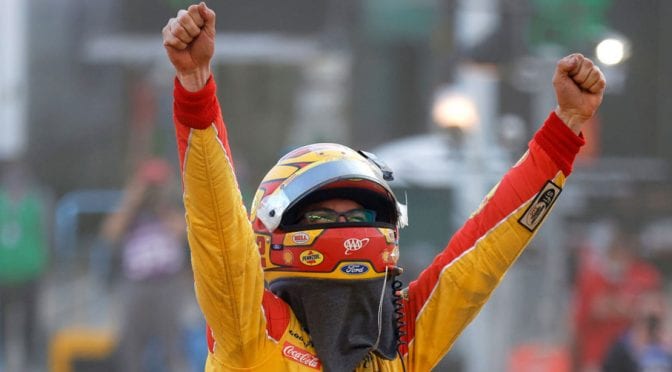
Leading the final 61 laps in the face of a determined charge by Denny Hamlin, Logano won the rain-delayed Food City Dirt Race in overtime at Bristol Motor Speedway, the first dirt-track race for the NASCAR Cup Series since 1970.
But there won’t be that long a gap in the future, given BMS executive and general manager Jerry Caldwell announced during the race that NASCAR will return to the Bristol dirt in 2022.
Logano grabbed the lead from Daniel Suarez on Lap 193 of a scheduled 250 and held it the rest of the way through a caution for the second stage break and a late yellow that sent the race three laps beyond the prescribed distance.
On the final restart on Lap 252, Logano pulled away, as Hamlin tried and failed to find grip in the outside lane and fell to third behind runner-up Ricky Stenhouse Jr. Logano’s winning margin over Stenhouse was .554 seconds.
Logano is the seventh consecutive different winner in seven races this season.
“Man, it’s incredible,” said Logano, who won the second straight race for Team Penske and the 27th of his career, extending his streak of at least one victory per year to 10 years. “How about Bristol on dirt? This is an incredible, unbelievable race track — great job by everyone that prepped the track. Obviously, a lot of work over here the last few days (because of rain that forced postponement from Sunday). We did a lot of work in the dirt department here the last few week. …
“Great car, obviously, to be able to execute the race that we did and get a win. I was getting nervous. There were so many first-time winners and different winners than there has typically been. I said, ‘We’ve got to get a win to make sure we get in the playoffs,’ so it’s amazing to get this Shell/Pennzoil Mustang into Victory Lane at Bristol. There’s nothing like winning at Bristol, but putting dirt on it and being the first to do it is really special.”
Despite late brushes with the outside wall as he chased Logano, Hamlin now has three third-place finishes and six top fives this season.
“I really couldn’t see a whole lot,” Hamlin said, referring to the dusty conditions late in the race. “I was kind of guessing. I thought I could, on that last restart, run the top in hard, but they didn’t prep it in between cautions the way they did before. It was just marbles up there.
“Man, I thought I had a shot there. I cut the 22 (Logano) too many breaks there when he was cutting us off. They had a little better car, it looked like, there in the long run. Proud of this whole team — we’re third best again.”
Suarez held fourth place, followed by Ryan Newman. William Byron, Tyler Reddick, Ryan Blaney, Erik Jones and reigning series champion Chase Elliott in the top 10.
Two of the experienced dirt drivers expected to battle for the victory were eliminated from contention in one dramatic wreck two laps after the restart that followed the first competition caution.
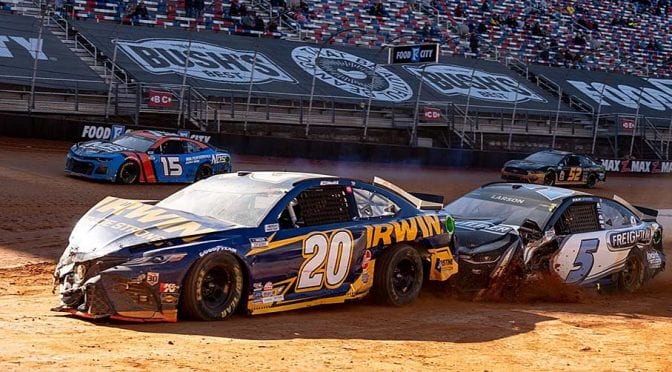
Running second on Lap 53, Christopher Bell spun in the top lane in Turn 2. Kyle Larson, running the top lane behind Bell, plowed into his chief dirt-track rival in a wreck that also involved Kevin Harvick and Ross Chastain.
“Way to go, Bell — way to go,” Larson said sarcastically on his team radio after the wreck.
Larson, at least, was able to continue but lost two laps during repairs. Bell and Chastain fell out of the race in 34th and 35th place, respectively. Larson finished 29th, five laps down.
“I was just trying to run the water in under yellow,” Bell said after a visit to the infield care center. “I knew it was a little bit slick, but I felt like I could go up there and make some time, and I kind of entered shallow underneath of it and tried to pick it up on exit, and it was just really greasy up there.
“That was a lot of fun, being able to be out there for that first run was really cool and hate it that I can’t be out there longer.”
An earlier wreck had given Martin Truex Jr. a fright during his quest to win both a NASCAR Camping World Truck Series race and NASCAR Cup Series event on the same day. (Truex had won the Truck race that started at noon.) Aric Almirola spun on Lap 41 as part of a five-car incident that unfolded in front of Truex, who was leading at the time. Truex barely managed to dodge the crash.
“Holy crap — that was close!” a relieved Truex said on his team radio. But Truex’s luck didn’t hold. After winning the first stage leading a race-high 126 laps, he cut a tire while running third on the final lap of overtime and finished 19th.
The NASCAR Cup Series will be idle next weekend for the Easter holiday, returning to action April 10 at Martinsville Speedway (7:30 p.m. ET on FS1, MRN and SiriusXM NASCAR Radio).
Note: Post-race inspection in the NASCAR Cup Series garage revealed no issues, validating Logano’s win.
NASCAR’s debut on Bristol Motor Speedway’s dirt-track layout won’t be a one-off.
Track owner Speedway Motorsports Inc. announced that its spring NASCAR weekend in 2022 will be held on the dirt. The announcement was made during Monday’s Food City Dirt Race, the NASCAR Cup Series’ first event on a dirt track since 1970.
A limited amount of tickets for both the NASCAR Cup Series and NASCAR Camping World Truck Series events this weekend sold out, with capacity capped to allow for social distancing under COVID-19 protocols. Bristol also announced that tickets for the 2022 Food City Dirt Race were on sale now, with an exact date to be established later.
“There has been so much buzz and excitement around the inaugural Food City Dirt Race weekend that with NASCAR’s blessing, we are thrilled to announce that we will be bringing back dirt in 2022 as part of the NASCAR Cup Series spring schedule,” said Jerry Caldwell, executive vice president and general manager of Bristol Motor Speedway. “The dirt experience is unlike any other for NASCAR fans and could become a must-see event every season.”
NASCAR has held two Cup Series races annually at Bristol since the Tennessee track opened in 1961.
Two heavy favorites — dirt-track experts Christopher Bell and Kyle Larson — were snared by an early crash, hampering their efforts in Monday’s Food City Dirt Race at Bristol Motor Speedway.
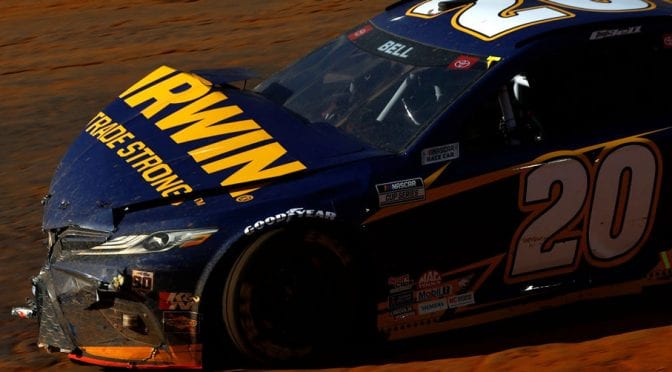
Bell looped his No. 20 Joe Gibbs Racing Toyota on the 51st of 253 laps in Turn 2, collecting the No. 5 Chevrolet of Larson and the No. 42 Chevy of Ross Chastain in its wake. Bell and Chastain were sidelined for the afternoon by the collision, and Larson lost two laps for repairs with substantial damage.
“Way to go, Bell. Way to go,” Larson told his team after the incident. He continued and finished 29th, five laps in arrears.
After a check at the infield care center, Bell explained he lost control shortly after the water truck rounded the half-mile oval as part of the in-race track prep during the first competition caution period. Both drivers have already scratched the win column this year, but their early tangle kept them from a return trip to Victory Lane.
“I was just trying to run the water in under yellow,” said Bell, who was credited with 34th finishing position. “I knew it was a little bit slick, but I felt like I could go up there and make some time and I kind of entered shallow underneath of it and tried to pick it up on exit and it was just really greasy up there. I hate it for all of our partners – Irwin Tools, PristineAuction.com, Toyota, TRD. That was a lot of fun, being able to be out there for that first run was really cool and hate it that I can’t be out there longer.”
An incident with John Hunter Nemechek and Matt Crafton led to a scuffle in the garage after the NASCAR Camping World Truck Series race on the Bristol Motor Speedway dirt.
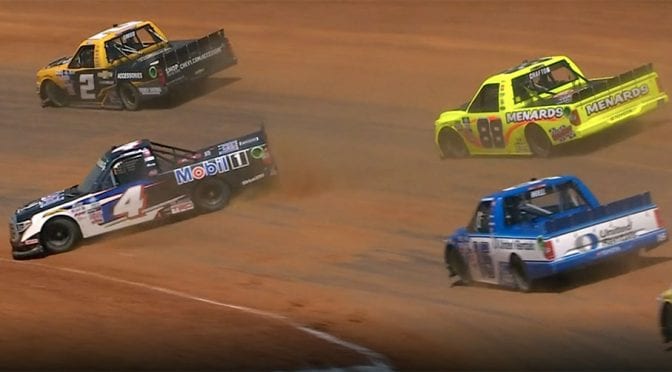
Nemechek went for a spin early in Stage 2 after Crafton ran into the back of his truck. While stopped in the top lane, Nemechek was then hit again, this time by the No. 19 truck of Derek Kraus. Both the Crafton and Nemechek teams were chippy on the radio after the incident.
After climbing out of the No. 4 Kyle Busch Motorsports Toyota, Nemechek gave Crafton a sarcastic round of applause as Crafton drove by under caution.
Then, No. 88 crew chief Carl “Junior” Joiner had this to say over the radio shortly after the incident: “Better keep the crew chief (of Nemechek) under (expletive) order before I punch him in his (expletive) throat. Don’t you ever (expletive) stare at me like that.”
Nemechek was later released from the infield care center where he took shots at the teams of Crafton and Kraus.
“I don’t know. Matt (Crafton) just flat ran over me,” Nemechek told FS1. “That one will be in the memory bank. We were fine. Didn’t hit anything and then there toward the end of that whole deal, the 19 (Kraus) … I guess he and his spotter both need a pair of glasses. I’ll have those for him at Richmond (Raceway).”
Kraus’ spotter, Freddie Kraft, tweeted this in response after the No. 19 truck was forced to retire due to damage.