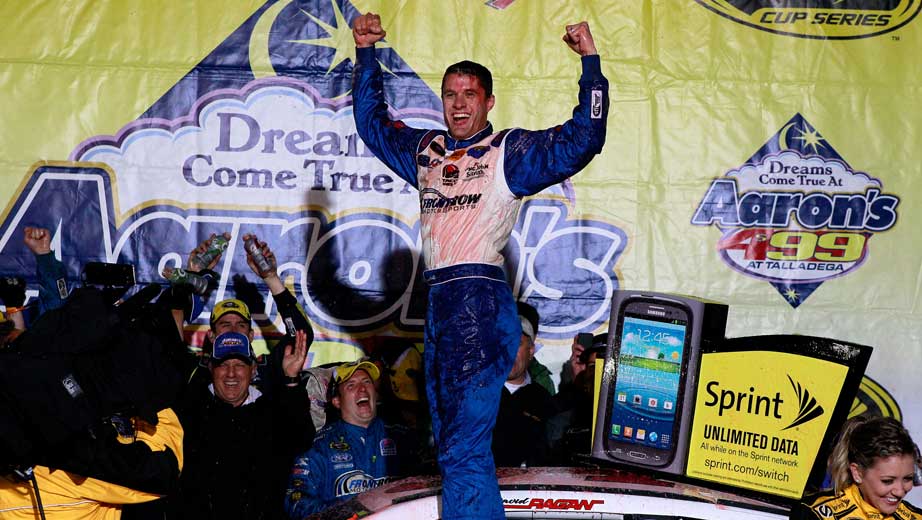
Testing the theory that anyone can win this weekend
A lot of wild and crazy things go on at Talladega — and at this place, that’s before the cars even hit the track. From wrestling in barbecue sauce out in the parking lot to big wrecks and fantastic finishes, the 2.66-mile superspeedway has provided NASCAR fans with plenty of memorable moments over the years.

But when the TV announcer hits the airwaves and says, “Anyone can win at Talladega,” is it true? Or is there more myth to that statement than meets the eye?
Join NASCAR.com’s Zack Albert and George Winkler as they go head-to-head to debate whether Talladega is as wild as it seems.
Winkler: This whole debate started when I was looking at the list of past race winners and thought, ‘Boy, these aren’t a bunch of no-name drivers.’ Sure, the 2013 season brought David Ragan to Victory Lane for Front Row Motorsports‘ first Sprint Cup Series win — and later that same year Jamie McMurray won — but recently the drivers you’d expect to dominate in the series have also dominated at this track.
Going back to 2001 when Dale Earnhardt Jr. got the first of his five wins at Talladega, we’ve seen drivers such as Jeff Gordon, Dale Jarrett, Jimmie Johnson, Kyle Busch, Tony Stewart, Brad Keselowski, Kevin Harvick, Matt Kenseth, Clint Bowyer and Denny Hamlin also take home the checkered flag. While the temptation is strong to think that anyone can win at Talladega because of the unpredictable nature of restrictor-plate wrecks, the recent history has shown that the theory doesn’t hold much water in regards to who finishes atop the stand.
Albert: Well, that makes sense in some regard, George, but that theory overlooks the cumulative history of Talladega’s tendency to play spoiler. The track’s list of all-time winners includes such underdogs as Ron Bouchard, Bobby Hillin Jr., Phil Parsons, Dick Brooks and Lennie Pond — all of whom crashed Victory Lane at the Alabama speed plant and never won again in NASCAR’s top series. The fickle nature of the aerodynamic draft, combined with the horsepower-sapping restrictor plates create almost a hyper-parity at Talladega, where the playing field is even more level.
The track can be a scary place for its frequent, field-thinning pileups, but Talladega’s springtime spot on the schedule has NASCAR’s long shots licking their chops to become Buster Douglas for a day, earning a surprise berth in the Chase for the NASCAR Sprint Cup playoffs.
Winkler: Another thing that gets my wheels turning is the regularity at which the winning driver has come from the top-10 qualifiers in the race. Sixty-three of the 91 Sprint Cup races at Talladega, or 69.2 percent, have been won from a top-10 starting position. That makes it a little more unpredictable than Daytona or Texas, for example, but on par with Martinsville and far more predictable than Auto Club Speedway, where only 52 percent of winners have come from top-10 starts.
You might be thinking, duh, of course the winner of the race is going to come out of the top-10 qualifiers at most tracks, but the fact that Talladega isn’t that far from the norm is further proof that it isn’t as wild as some folks will have you believe.
Albert: Qualifying at Talladega may carry some clout for teams in terms of preparing a specialized plate-track car, but the biggest consequence coming out of time trials is pit-stall selection. Otherwise, the teams may as well draw for starting position out of a hat. The pendulum of drivers dropping to the rear of the field and working back up to the point is always in full swing at Talladega. It’s one of the rare places where a running position in the bottom 10 isn’t a huge cause for concern.
Jeff Gordon won there from a record 36th-place starting position in 2000, and Denny Hamlin‘s victory in this race last year made him one of three winners who started in 34th.
Winkler: Wrapping up here, I don’t want to be a complete ‘Debbie Downer.’ I definitely think it’s worth tuning in for the race, because it’s always fun to see the enormous spectacle that is Talladega. Just don’t be surprised if after all the smoke clears that the driver standing in Victory Lane isn’t all that surprising.
Albert: This is why we all watch — to see the dark horses make a run at the heavyweights. Powerhouse teams don’t have a monopoly on performance at Talladega, where the scrappy Cinderellas, the promising mid-majors and the top-seeded favorites all compete on equal footing. Seeing a fresh face or unfamiliar car number in Victory Lane might be called “stunning” or “shocking” by Sunday’s headline writers, but considering the venue, it might just be the least surprising thing of all.