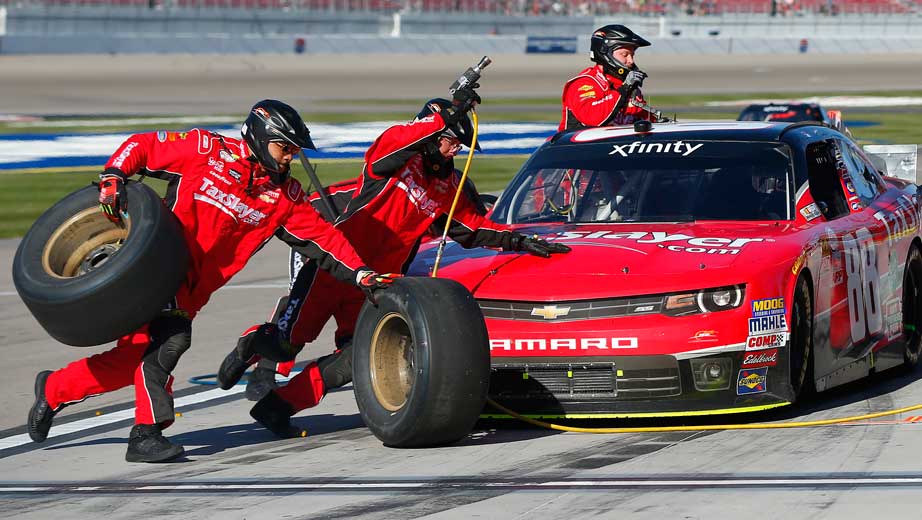
Hendrick Motorsports pit coach Chris Burkey: ‘It’s a grueling time’
On Saturday night, hundreds of fire suit-clad crew members will line pit road for the annual NASCAR Sprint Cup All-Star Race at Charlotte Motor Speedway.
Less than 20 hours later, some of the same crew members will be standing on pit road once more, but at a race track 1,024 miles away – Iowa Speedway.

With their jobs revolving around 12-second pit stops that encompass lightning-fast movement and strength, the life of a NASCAR pit crew member is taxing both mentally and physically. And the growing trend of crew members pitting multiple series– sometimes at different tracks – tacks on another element of exhaustion.
“The guys know it’s a grueling time when you have a non-companion race like that,” Hendrick Motorsports pit crew coach Chris Burkey said, referring to this weekend’s bi-city Sprint Cup and XFINITY races at Charlotte and Iowa. “So you kind of have to get mentally prepared for a late night at the All-Star Race and having to get up early in the morning (Sunday).”
Burkey oversees the development of the Hendrick Motorsports pit crews of Jeff Gordon and Kasey Kahne on a daily basis at the team’s campus in Concord, North Carolina. A former NFL scout for the Miami Dolphins, Burkey also manages the recruiting process of bringing new talent to the pits through the organization’s pit crew developmental program, which grooms young athletes into eventual Sprint Cup pit performers.
But since his arrival at Hendrick Motorsports in 2008, Burkey has noticed a shift in the pit crew industry, as more and more Sprint Cup veteran crew members are pitting lower series’ vehicles in addition to their Cup duties. This is a change from the old method of the newer, less experienced pit performers pitting the lower series’ rides.
“You have a developmental team or a backup team trying to pit against some Cup teams,” Burkey explained. “It’s very hard to beat teams like that. We’re in the world of wins so we just felt like we needed to join suit.”
“…We knew we were probably going to have to shift that way at some point, especially with the caliber of drivers that JRM (JR Motorsports) is putting in their cars.”
Hendrick Motorsports tends to keep most of its crews in the family, servicing Hendrick-affiliated JR Motorsports. This season, the No. 5 crew of Kasey Kahne is pitting the No. 9 XFINITY car for reigning series champion Chase Elliott. Similarly, the No. 24 crew for Jeff Gordon has performed pit stops for the No. 88 Chevrolet, an XFINITY ride that is driven by team owner Dale Earnhardt Jr., as well as Sprint Cup veterans Kevin Harvick and Kasey Kahne. At Iowa, the 2014 NASCAR K&N Pro Series East champion, Ben Rhodes will pilot the car.
“I figured since the majority of the 5 guys had pitted Chase before, last year, they understand how he comes in the pit box, they understand how he does things,” Burkey said. “… Which means a lot because there’s no learning curve on that car there.
“… And then take the 24 – and the 24 being more of the veteran group… Keep the more established group with those stable veteran drivers week-in-and-week-out and give them an opportunity to perform for those drivers.”
Burkey said the extra stops for these veteran crew members has benefited them for the subsequent Cup race. Any extra practice time is crucial for athletes whose performance is measured in spans of 12-second stops on pit road.
“You don’t want to say (the XFINITY or Truck race is) a practice because you want to perform, but it gives them those extra reps leading into the Sunday race,” Burkey said. “When you go to a place like Phoenix, Vegas where you have very slick pit boxes, it gives them the Saturday reps to get accustomed to that and get used to that instead of showing up on Sunday and all of a sudden ‘oh wow, I forgot we have slick pit boxes here, don’t push too hard.’ So a lot of the teams have used those Saturday reps as kind of a tuning-up for the Sunday Cup race.”
But despite the increasing double duty on pit road for Cup crew members, Burkey said Hendrick Motorsports‘ developmental program won’t condense as a result.
“I think it will still continue to grow,” Burkey said. “We’re always still looking for solid, quality back-ups. You can never have too many because just when you think you have too many, you have four injuries and you don’t have enough … It will always help us.”