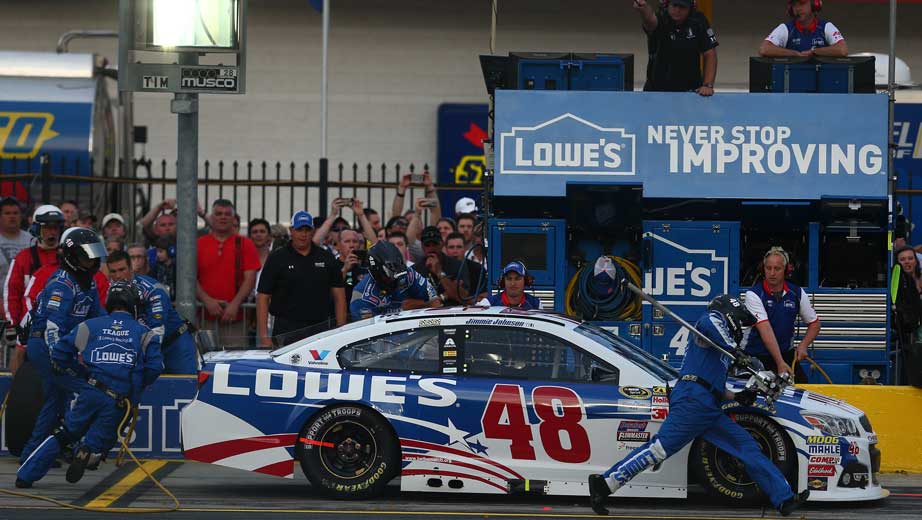
Written warning from NASCAR implies 48 team’s infraction was minor
NASCAR officials gave no details concerning the decision to not penalize the Hendrick Motorsports No. 48 team following Saturday night’s Sprint All-Star Race at Charlotte Motor Speedway, only noting on Tuesday that the team had been issued a written warning.

Following the annual non-points race, it was announced that officials were reviewing a “potential infraction by a crewman of the 48 team” for modifying the side skirt of the white and blue Chevrolet driven by six-time series champion Jimmie Johnson.
Chad Knaus, crew chief for Johnson, said earlier this week that he didn’t consider the issue “a big deal,” noting that the crew had attempted to repair damage to the right side of the car after Johnson made contact with the wall during the race.
NASCAR began policing the altering of side skirts, located in front of the rear tires, after teams began routinely manipulating the pieces in an effort to gain an aerodynamic advantage last season.
According to the NASCAR Sprint Cup Series rulebook, written warnings fall under P1 level infractions in the NASCAR Deterrence System, and generally relate to the most minor of infractions.
Rule 12.5.3.1.a states, “While the warning is primarily for the information of the member or team affected, NASCAR will also advise the garage that a warning has been issued to that member or team. However, NASCAR will generally not specify or detail the infraction publicly unless it pertains to something new or unforeseen that the rest of the garage would benefit by knowing. Warnings are not appealable.”
Multiple warnings could result in the loss of practice time or other activities related to pre-race preparations.
Earlier this year, the SHR No. 10 team, with driver Danica Patrick, was also issued a warning, and information detailing that infraction was made public. Patrick’s team received a warning for an unapproved left-side driver heat shield discovered during opening-day inspection at Daytona International Speedway.
The cars of race winner Denny Hamlin (Joe Gibbs Racing) and runner-up Kevin Harvick (Stewart-Haas Racing) were taken to the NASCAR Research & Development Center following Saturday night’s race. Tuesday, NASCAR said those entries had passed the final post-race inspection.
Helmets for crewmen remain required but unregulated
Nearly every piece of clothing and safety equipment used by crewmen going over the wall to service a car during a race must meet certain safety standards.
One of the only items not required by NASCAR to meet certain SFI specifications are the helmets worn by crewmen.
“You have to look at where we started,” Robin Pemberton, Vice President of Competition and Racing Development, said last week. “The helmets were basically for contact and things of that nature, not fires. … Possibly there will be some development for some purpose (specific) helmets for crew guys.
“As long as you have the (head) sock on … most helmets don’t have fire retardant lines in them anyway.”
Over-the-wall crewmen have been required to wear helmets since the start of the 2002 season. For most, the style of helmet worn depends on their duties once they cross pit wall.
“You need to have good vision and they want coverage — they don’t want lug nuts hitting them in the mouth,” Pemberton said. “It’s morphed in several different ways. Some guys like a three-quarter helmet, some like a shorter helmet; it’s kind of their preference. … I think (the teams are) searching for better ways and other ways to protect their crew guys.”
Among the changes in safety apparel NASCAR will implement beginning June 4 was the notation that fueler aprons “must be worn on the outside of uniform.”
While that might seem like an unusual requirement, it is an issue that has been raised previously, according to Pemberton.
“We’ve had different situations … in an odd pit stop strategy you may have had a rear tire carrier or someone like that assist with the fueling process,” he said, and occasionally the apron would be worn inside the uniform to keep it from interfering in the crewman’s other duties during the stop.
However, NASCAR officials can’t tell if the crewman is in compliance without being able to see the apron, thus the change.