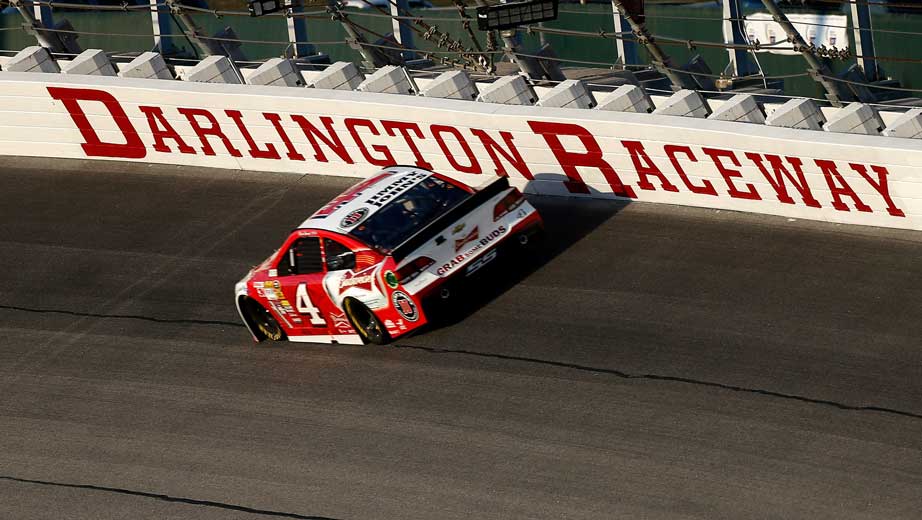
RELATED: Darlington throwback schemes | Fired up for throwback race
It’s 1.366 miles of character-testing asphalt; a track so demanding it required not one nickname, but two.
The Lady in Black.
Too Tough to Tame.
Welcome to Darlington Raceway, host for six and a half decades of one of the most anticipated, most difficult events on the NASCAR schedule.
The Bojangles’ Southern 500 returns to what many believe is its rightful place on the Sprint Cup Series schedule, Labor Day weekend, with history in tow. That history will be on display as the track and various teams adhere to a throwback theme, part of a five-year program that launches this weekend.
“I remember that 1968 Southern win that was on the old (layout); I wouldn’t take anything for that win and then went on to win five Southern 500s,” NASCAR Hall of Fame driver Cale Yarborough said recently.
“I just have so many fond memories of racing here. Even though I had rather win here than anywhere else — because it’s home, it’s the first superspeedway — I absolutely hated to drive this place. It was just so tough to drive. But I still would rather win here than anywhere.”
Yarborough, a three-time champion and member of the NASCAR Hall of Fame, hails from nearby Timmonsville, South Carolina. He made his first Darlington start in 1957 as a teenager. More than 20 years later, he became the first driver to win five Southern 500 titles.
“I was definitely in over my head,” Yarborough said of that first start, which came with car owner Bob Weatherly. “But I came back and won five times and that record stood for 30 years. When Jeff Gordon tied my record (in 2002), I told him, ‘Jeff, you’ve got a long way to go son. Because you never won one on that old Darlington race track.’
“This is a unique place. There’s not another one like it. I think any driver would love to have a win at Darlington on his resume.”
• • •
Fast Fact I: In 1965, Ned Jarrett won the Southern 500 by a whopping 14 laps, the largest margin of victory ever recorded in NASCAR’s premier series.
• • •
The story goes that after purchasing the land for the track, owner Harold Brasington was instructed that he wasn’t to disturb a nearby minnow pond when constructing NASCAR’s first paved speedway. What resulted was a layout that features two vastly different ends of the facility, giving the track a somewhat egg-shaped appearance.
The unique design, along with the application of what was known as “bear grease,” resulted in yet another piece of NASCAR terminology — the Darlington stripe. Cars would often ricochet off the wall as they skirted along the very edge of the outside racing groove.
Because of laws that restricted certain types of commerce on Sunday, the Southern 500 was contested on Labor Day, the first Monday of September, annually from 1950 through 1983.
“I guess what they had in South Carolina at the time were what they called Blue laws. We couldn’t run on Sunday,” Dale Inman, winner of seven championships as a crew chief for Richard Petty and eight championships overall, said. “We’d practice three or four days, practice on Saturday and then we didn’t do anything on Sunday. Then we’d come back and run Labor Day.
“Golly, while we were gone they’d paint the track in bear grease, so when we started the race it was just a different world for awhile.”
The appeal was obvious. Not only was Darlington the first big paved track in NASCAR’s realm, but the purse in the early years was equally impressive as well.
“The first time I went there I think was 1951,” Inman said. “Lord, in those years they started them three abreast. They didn’t use the banking, or very few used it. It was just unheard of at that time.”
Petty won three times at Darlington, including the 1967 Southern 500. But the race that stands out in Inman’s mind came three years later in the spring event.
The track, already known as one of the most treacherous on the circuit, lived up to its billing when Petty’s blue No. 43 Plymouth came off Turn 4, broke loose and struck the inside pit wall with such force that it destroyed the concrete barrier. Petty’s car flipped violently before coming to rest on its roof.
“When we got to him, (the car) was … in the middle of the race track and cars were still going by on both sides,” Inman said. “We unhooked the seatbelt, he kind of came down pretty hard on the roof because he was laying upside down.
“Until he groaned we didn’t think he was still with us. But he did groan so we knew he was OK. The big thing was his shoulder was out of place. It knocked him out.”
Darlington favored no one. Not even NASCAR’s soon to be King.
• • •
Fast Fact II: In 1976, David Pearson won NASCAR’s version of the Triple Crown by capturing the Daytona 500, the World 600 and Southern 500.
• • •
“Bear grease” is no longer a part of track preparation, but the Darlington stripe remains very much in evidence. When track officials moved the start/finish line to what had previously been the backstretch in 1997, the difficulty in navigating the cantankerous old circuit remained unchanged.
Turn 1 didn’t become any easier simply because it was now Turn 3.
“You don’t go to race tracks … going, ‘Man, I’ve got to beat this track,’ ” Hendrick Motorsports driver Dale Earnhardt Jr. said. “The track’s not even a factor, not even a part of the conversation. … But when you go to Darlington, the track is a competitor. The track becomes as big of a challenge as trying to beat the next guy in front of you or outrunning your peers.
“Darlington is one of the few ovals that can reach out and grab you if you’re not paying attention or being careful. Most of the tracks we go to you won’t really run into the wall or spin out unless you have a failure on the car. Here, if you don’t watch every corner, every little thing you do … that challenge of it, how hard it is and the odds are so bad to come here and get a win, you’re up against so much more. I think that’s what adds to the appreciation for what it means to win here.”
• • •
Fast Fact III: The movie “Days of Thunder” starring Tom Cruise debuts in 1990. Cruise’s character, Cole Trickle, scores his first NASCAR win at Darlington Raceway. Naturally.
• • •
At the close of the 1984 season, then series sponsor RJ Reynolds, through its Winston brand, unveiled what was known as the Winston Million, a program that offered a $1 million bonus to any driver winning three of the series “Big Four” events — the Daytona 500, the Winston 500 at Talladega Superspeedway, the Coca-Cola 600 and the Southern 500.
Previously, only two drivers had won three of the four races in a single season — LeeRoy Yarbrough (1969) and Pearson (1976).
In the first year of the Winston Million program, Bill Elliott came to Darlington having won two of the first three, at Daytona and Talladega. In the Southern 500, the future Hall of Famer had to nimbly avoid a spin by Dale Earnhardt and a smoking Yarborough entry in the latter stages of the race to seal the victory.
It was a career-defining moment for the Dawsonville, Georgia native, earning him the nickname “Million Dollar Bill.”
It wasn’t until 1997 before another driver collected the bonus, again with a victory in the Southern 500. Hendrick Motorsports driver Jeff Gordon held off a tremendous charge by Jeff Burton in the final two laps to pocket the bonus in the final year of the program.
• • •
Fast Fact IV: Johnny Mantz won only one NASCAR premier series event — the inaugural Southern 500 held Sept. 4, 1950. The race featured a 75-car starting lineup and took more than six hours to complete.
• • •
Former crew chief Ray Evernham guided Gordon to four consecutive Southern 500 wins from 1995 through 1998. The most memorable win?
“The million dollar win,” Evernham said without hesitation. “Because we did not have a car to win that day.
“We won that as a team and driver; we kept working on the car. I think we made 16 pit stops that day.
“The car was basically destroyed — front clip bent, rear clip bent, door bars … we just stayed after it and won that race and we really shouldn’t have. But we did.”
Evernham won 47 races as a crew chief for Gordon, with victories coming at nearly every stop on the schedule, including Daytona, Charlotte and Indianapolis. But Darlington, he said, holds a special place.
“I love this place,” he said. “It’s still my favorite track. It challenged me. I could make a difference as a chassis person — that’s different from being a crew chief.
“I loved making the car handle. The springs, the shocks, getting all that stuff right. You could make changes here. This is like a damn dirt track. You have to chase it. You chase it all day long — 500 miles, five hours sometimes, you chase this race track.
“You had to have a tough driver and a great pit crew. Our wins here to me are some of our best wins because we really won those races as a group. Jeff had to be the best, I had to be the best, the crew had to be the best. This place, to run as hard and as long as you do here, everything had to be just right. And when I look back at Darlington, they’re some of the most satisfying wins that I had as a crew chief.”