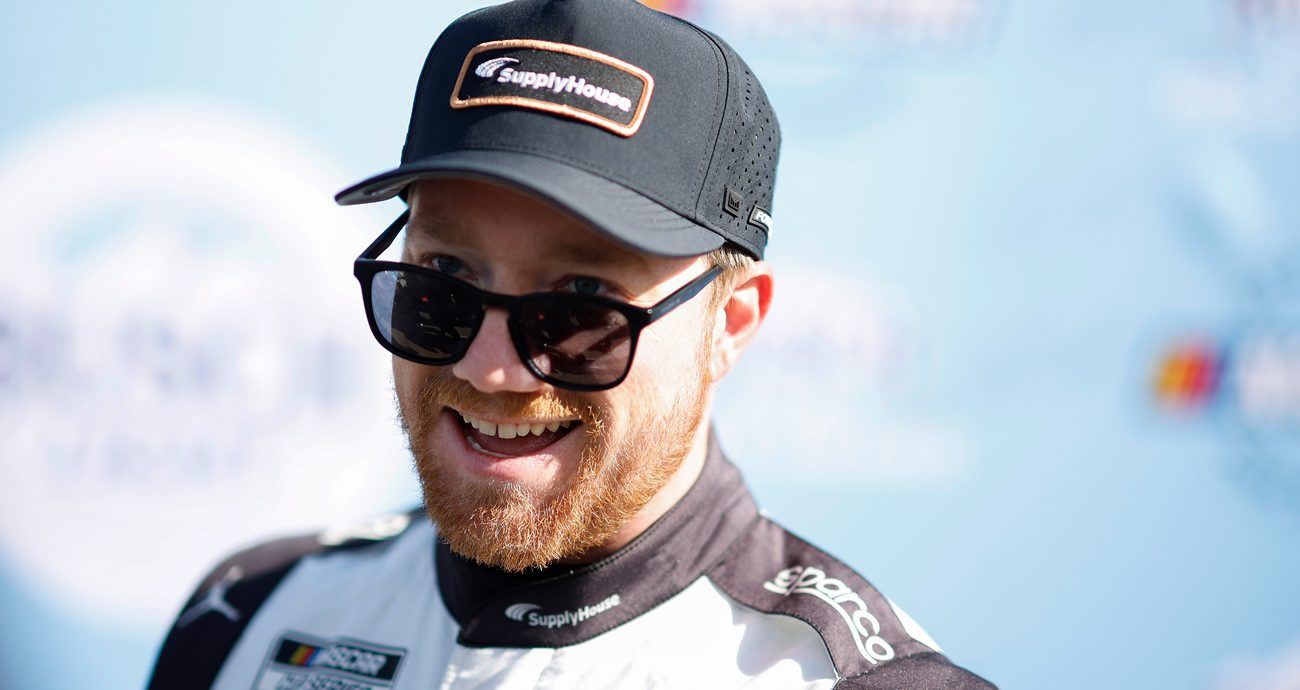
Just when the rest of the NASCAR Cup Series thought it could avoid Tyler Reddick setting up camp yet again in Victory Lane, well, he continued to make it his own personal stomping grounds. This time, it was after an incredible effort to outlast Denny Hamlin and beat Kyle Larson on a NASCAR Overtime restart at Kansas, tracking down and passing the guy who has owned that track at times over the past few years. As has often been the case to start this season, none of that mattered — the No. 45 car was going to find a way to win regardless.
It’s been that kind of year for Reddick. When he won for a fourth time in the season’s first six races last month, we asked: How many victories could Reddick end up with by the end of the schedule — and where might this season rank in the all-time annals? Now, he’s given us no choice but to revisit both questions, because the man simply cannot stop winning races.
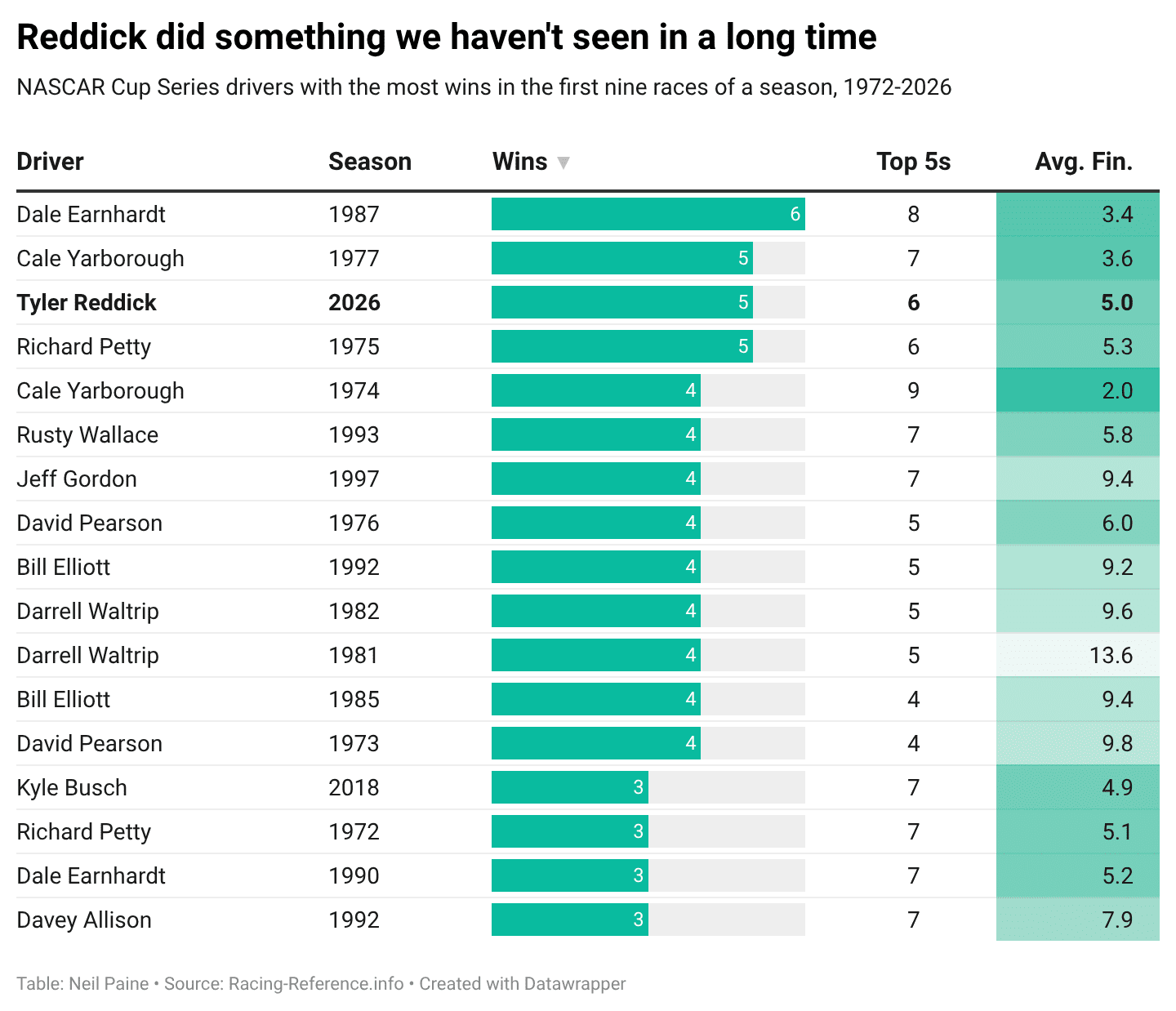
On Sunday, he became one of just four drivers — joining Dale Earnhardt, Cale Yarborough and Richard Petty (basically a who’s-who of NASCAR GOATs) — to claim at least five wins in the first nine races of a Cup season:
At his current pace, Reddick would finish the year with 20 wins, which would be unlike anything we’ve seen in the Cup Series’ modern era — since 1972, nobody has more than the 13 victories recorded by Petty in 1975 and Jeff Gordon in 1998. As amazing as Reddick has been thus far, that’s still fairly far-fetched to imagine. But he still might reach some incredibly rarified levels of winning by the end of the 2026 schedule.
If he wins the rest of the year at the same pace as Petty from 1975, Reddick would end up with 16.7 wins by season’s end. Replicate Gordon’s per-race pace from 1998, and he’d finish with 15.6. Just keep pace with the winningest seasons since the introduction of the Car of Tomorrow in 2007 — Jimmie Johnson in 2007 and Larson in 2021 — and he still finishes with 12.5. Reddick would even flirt with 10 wins — sitting on pace for 9.6 — if he replicates what Larson and Hamlin did (six wins in 35 races) at different times over the past few years.
Of course, that does require Reddick to keep winning at a rate far beyond what he did before this season. To find five wins in his previous resume, you’d need to go back 103 races … or 11.4 times as many as it took him to get the next five. If he merely reverts to his form with 23XI Racing from 2023-25, he’d win just 1.3 additional races this year to end up at 6.3 — possibly setting a new Next Gen Car-era record for checkered flags, but nothing splashier than that.
The truth of what we might expect out of Reddick from here, a quarter of the way through the 2026 schedule, is probably somewhere in between his comparatively modest pre-2026 output and the Gordonesque highs of full seasons we haven’t seen in three decades (and four car chassis ago).
With that in mind, let’s update our projection from last month, which estimated Reddick’s chances to win each remaining race on the schedule by combining his own recent record at each track type with the typical win rates for a driver in the top 10 in the standings since 2022. This time, we’ll include the additional races that transpired since, but we’ll also take it upon ourselves to make a slight adjustment — anchoring to the typical win percentages for top-five drivers instead of top-10 ones, since it would take a massive collapse for Reddick to fall out of that category in the standings at this point.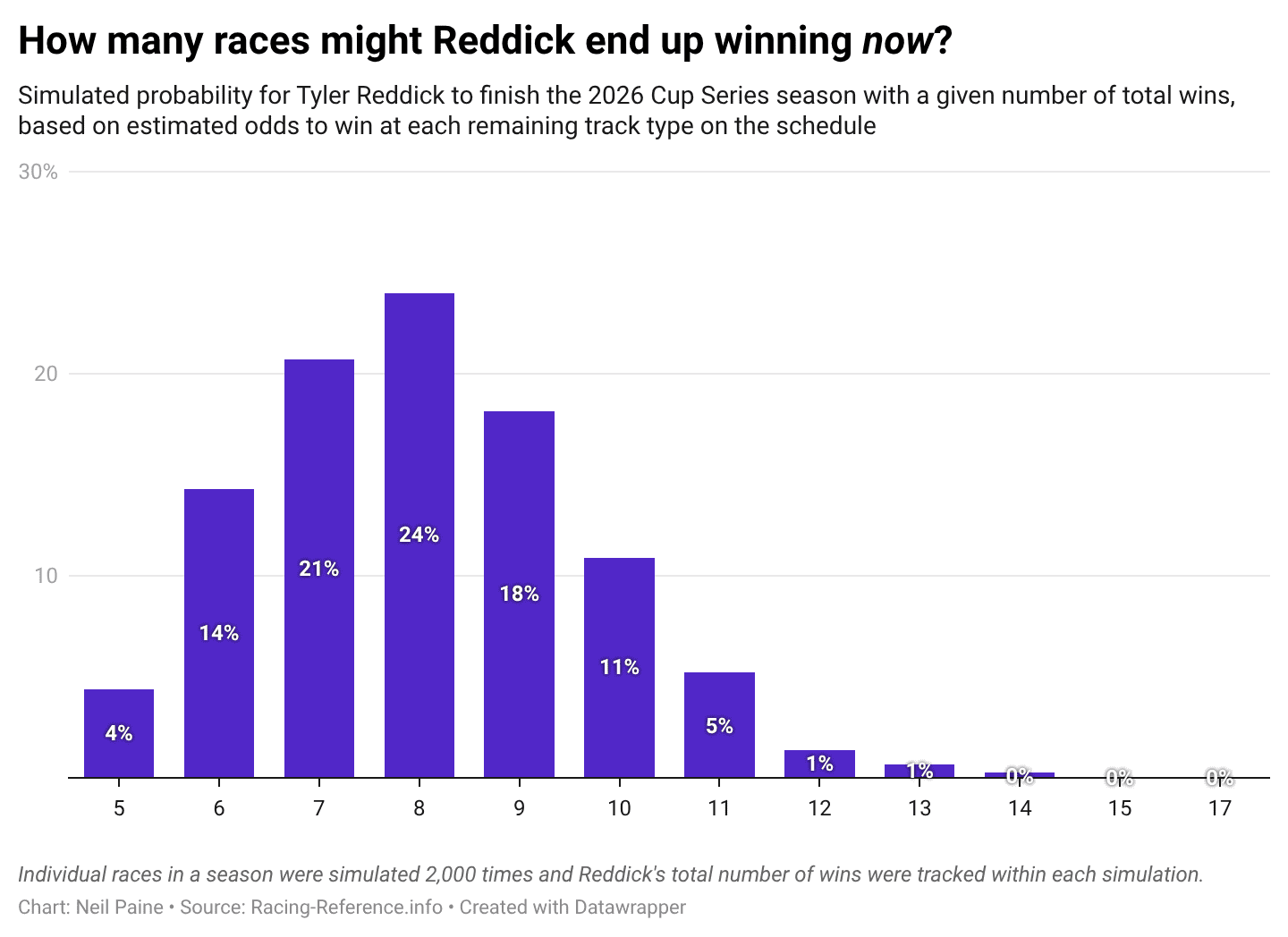
After making our revisions, Reddick now has a 96% chance of winning at least one more race this year and an 81% chance of winning at least two more. According to these simulations, he will most likely grab three more — finishing the season with eight wins — though there’s a 37% chance he wins at least nine and an 18% probability he breaks double-digits, which is 4.5 times the chance he had when we ran our original numbers a month ago.
In 2.4% of simulations, Reddick had 12 or more wins — matching Darrell Waltrip in 1981 and ’82 — and exactly 1% of the time, he at least tied Gordon and Petty’s modern record of 13, breaking it 0.4% of the time.
Would that be the greatest season in Cup Series history? Possibly. But a lot would also depend on what Reddick does in the other 19 races he doesn’t win — and how dominant he is in his wins as well.
For all of his winning, Reddick currently has an average Driver Rating of 110.2 this season — which, while easily leading all 2026 drivers (Denny Hamlin is second at 105.6), would not be the highest of the Loop Data era (since 2005). Kevin Harvick posted a 118.9 average in 2018, and Martin Truex Jr.’s epic 2017 campaign saw him produce a 116.1. In fact, nine other full seasons since 2005 came in with a better average rating than the first quarter of Reddick’s 2026 season: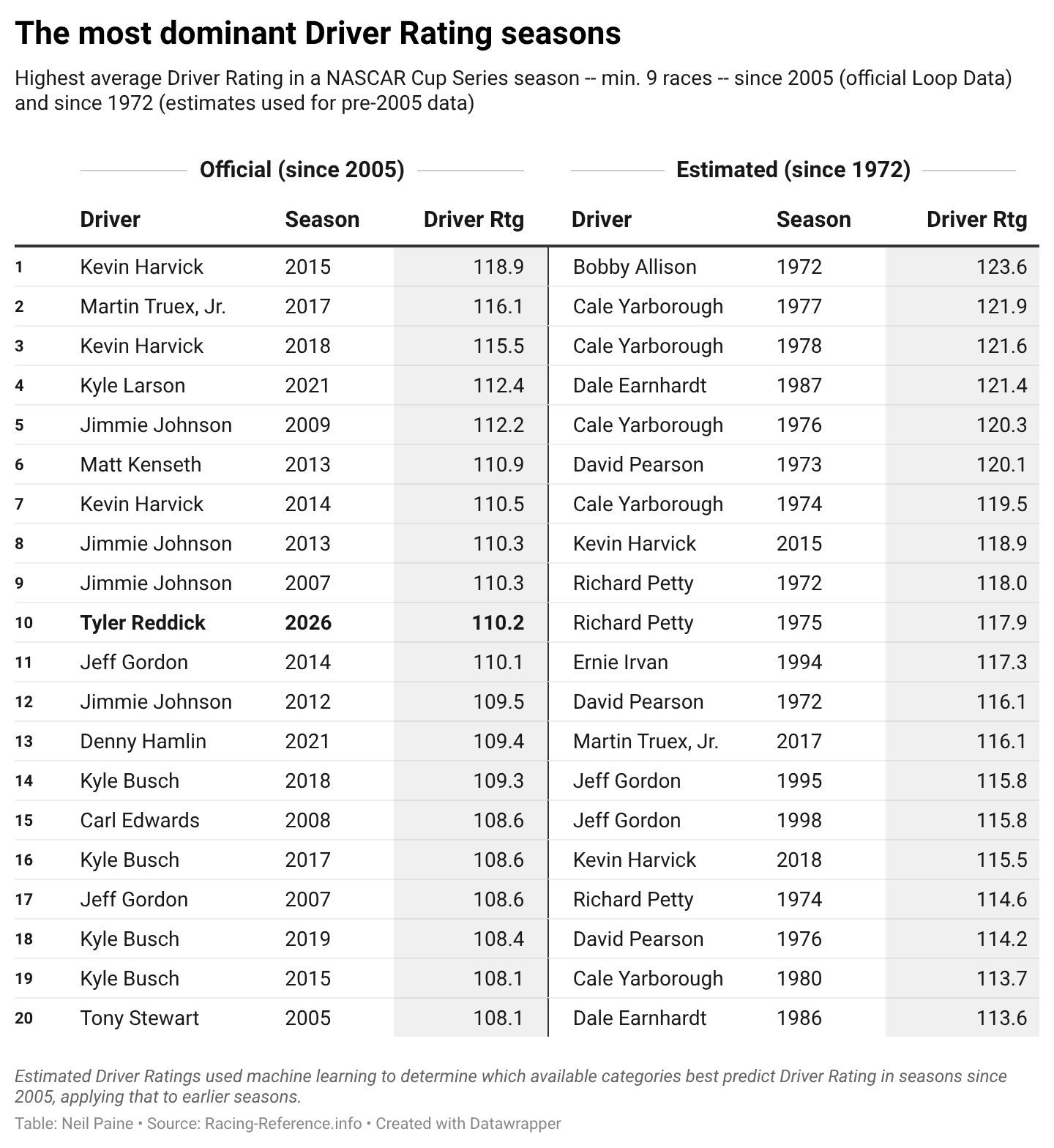
And that’s without even getting into all of those dominant pre-2005 seasons by drivers like Petty, Yarborough, Earnhardt, Bobby Allison and David Pearson. I’ve been playing around with a method to estimate Driver Ratings for earlier seasons using machine learning, and those estimates yield average ratings in the 120s for years like Allison’s 10-win 1972 campaign and Earnhardt’s 11-win 1987. The sport has changed enormously since that earlier era, so it’s hard to say what Reddick would have done in the 1970s — or what Petty and Earnhardt would do in Gen-7 equipment. But in terms of measuring pure dominance, Reddick’s 2026 still has a ways to go to be the undisputed greatest season in history, even if he keeps driving the way he has been to start the year.
Having said that, winning is the point of racing. And Reddick has certainly done a lot of that this season — practically as much as we’ve seen from anyone in the first nine races on the calendar. Because of that, he’s put himself in a position to hit win tallies we weren’t sure we’d see after NASCAR’s modern pivot toward a spec-component car philosophy, redefining the standards around what a special season looks like right now in the process.