It’s no secret that the 2026 season hasn’t exactly been the finest of Kyle Busch’s storied career.
Behind the wheel of the No. 8 Chevrolet for Richard Childress Racing, Busch has scored his fewest top fives (0) and top 10s (1), second-worst average finish (22.1), worst Adjusted Points+ index (63) and worst average Driver Rating (58.0) in the first 10 races of a season. For a driver of his historical stature, it’s been jarring to see results more in line with a backmarker than a Chase contender thus far.
However, there are at least a few reasons to think a “Rowdy” turnaround might be brewing as the season passes its quarter-pole and roars toward the backstretch of the calendar. Some of that has to do with Busch’s most recent result, his best of the season, and some with personnel changes on the pit box. But it also has to do with the tendency for drivers of Busch’s rare ability to adapt and find a late-career resurgence even after it looks like the window has permanently closed.
In an immediate sense, the biggest change for the No. 8 team is new leadership within RCR. After 10 races with James Pohlman replacing Randall Burnett, who’d been on top of the box for Busch during most of the 2023-25 seasons, it was announced Monday that Pohlman was moving to a different position at RCR in favor of Andy Street. Street was Busch’s crew chief at the tail end of last season, with a better average finish in those races (15.8) than the 8-car produced in its other outings (18.3).
Moreover, Busch is coming off his best drive of 2026. At Talladega on Sunday, he scored his first top 10 of the season — as well as his highest Driver Rating of the year, in addition to being his first time cracking a Cup-average rating since COTA (on March 1):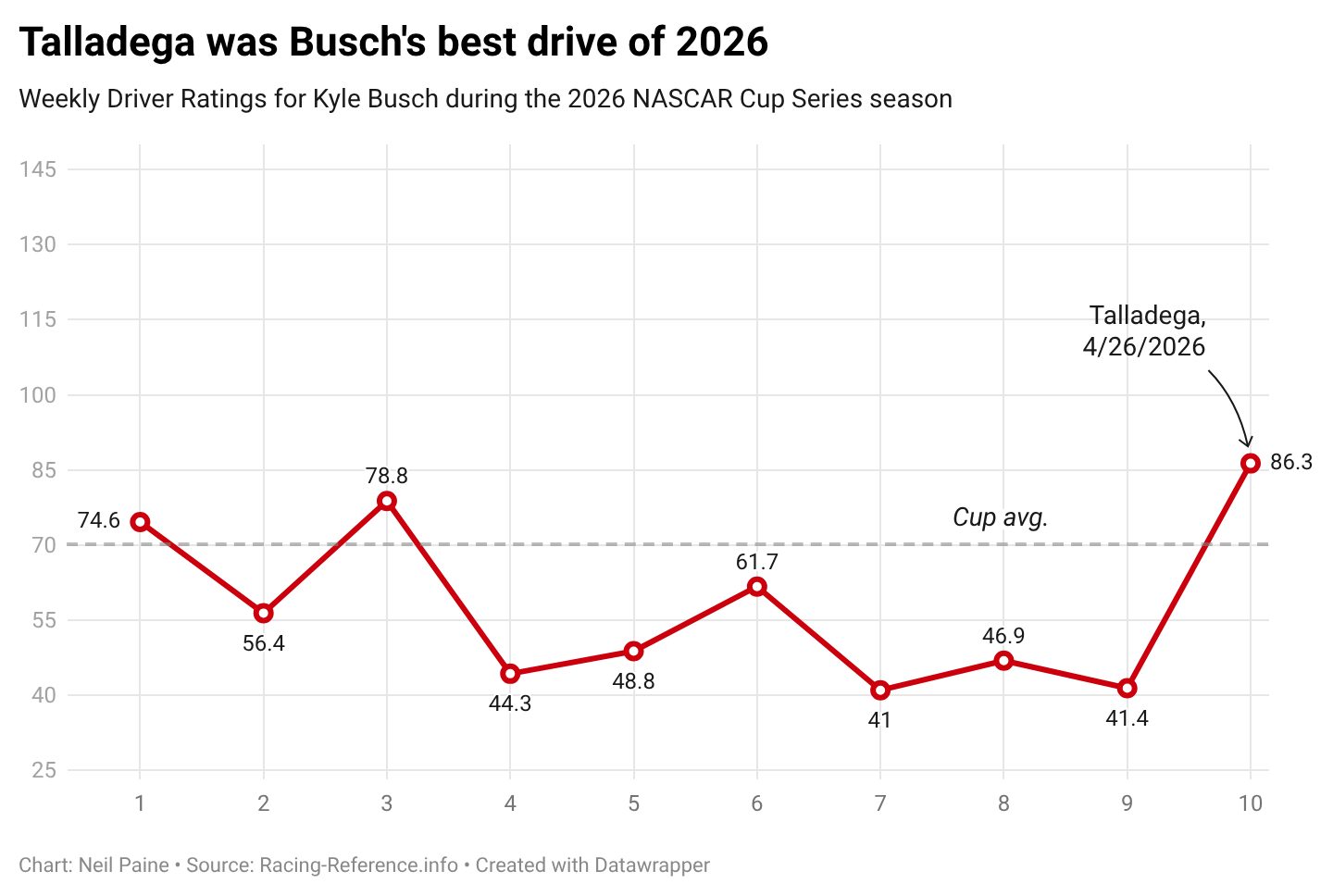
Yes, it was Talladega, where the typical last-lap chaos took out a handful of the drivers who were bunched up in front of him heading out of the final turn. If there was ever a place not to read too much into any given result, it’s probably NASCAR’s biggest, fastest and most chaotic track. But hey, when you’re slumping, any glimmer of hope is welcome.
Absent further improvement, Busch is still fighting through one of the worst career dips in Cup Series history. In the span of nine seasons, his average Driver Rating has fallen from a peak of 109.3 — one of the best ever — in 2018 to this year’s career low of 58.0, a 51.3-point drop. Among modern Cup drivers (since 1972), only Dale Jarrett and Cale Yarborough suffered bigger fall-offs in the same length of time during their careers: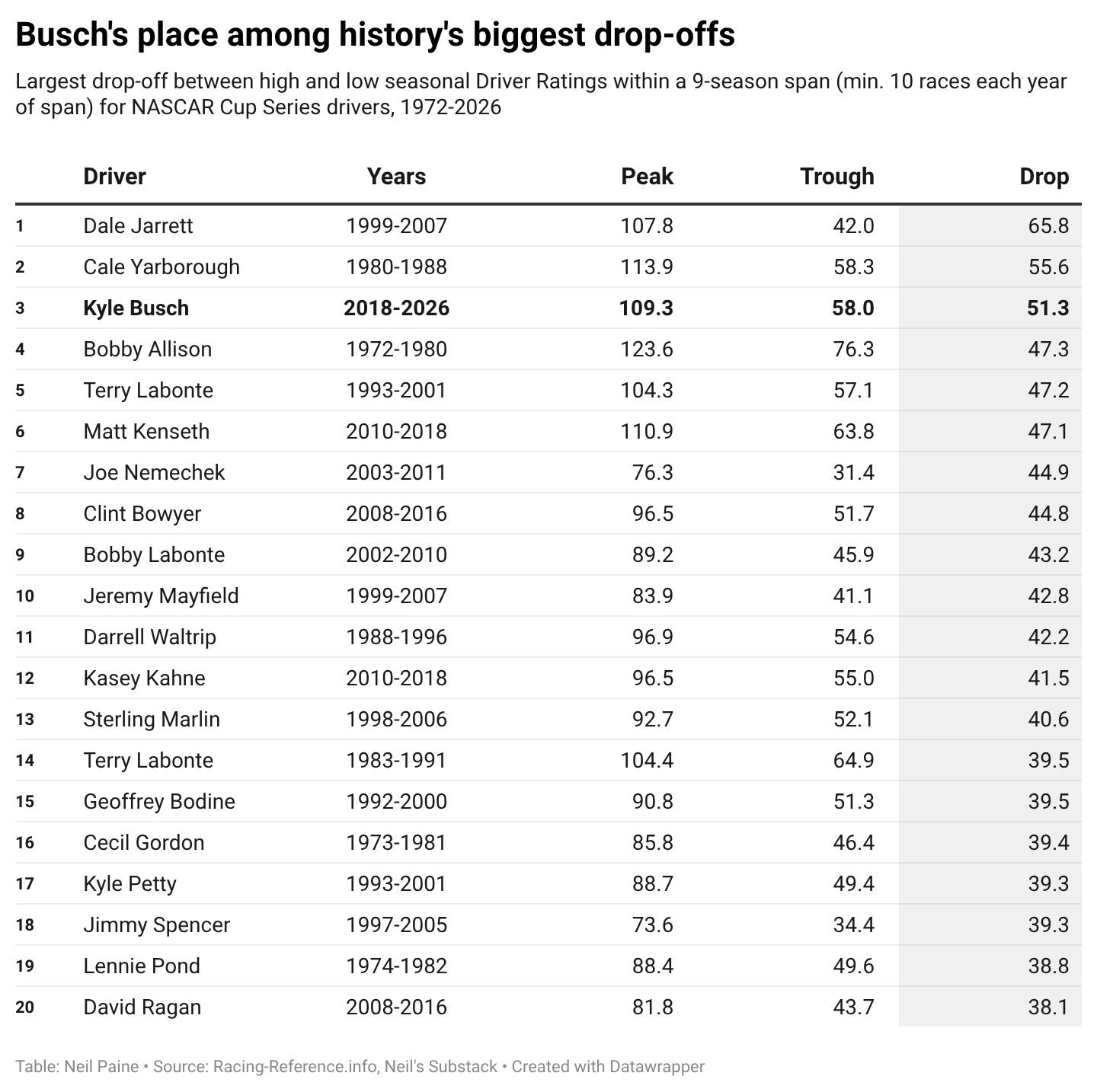
The common theme for these drivers, of course, is that they were all incredible at their peaks, with average ratings well in excess of triple digits. In order to even have 50 points of Driver Rating to spare and still be in Cup at all, you have to be one of history’s best drivers to begin with — and Busch certainly ticks off that box in his career.
This, in turn, offers us some points of comparison that may illustrate how drivers who fell off at ages similar to Busch’s nonetheless found additional acts at the end of their careers. Take, for example, the cases of Bill Elliott, Mark Martin and Ricky Rudd. While none hit Driver Rating depths quite as low as Busch is on pace for in 2026, each did suffer pronounced drop-offs at or around the age Busch is now: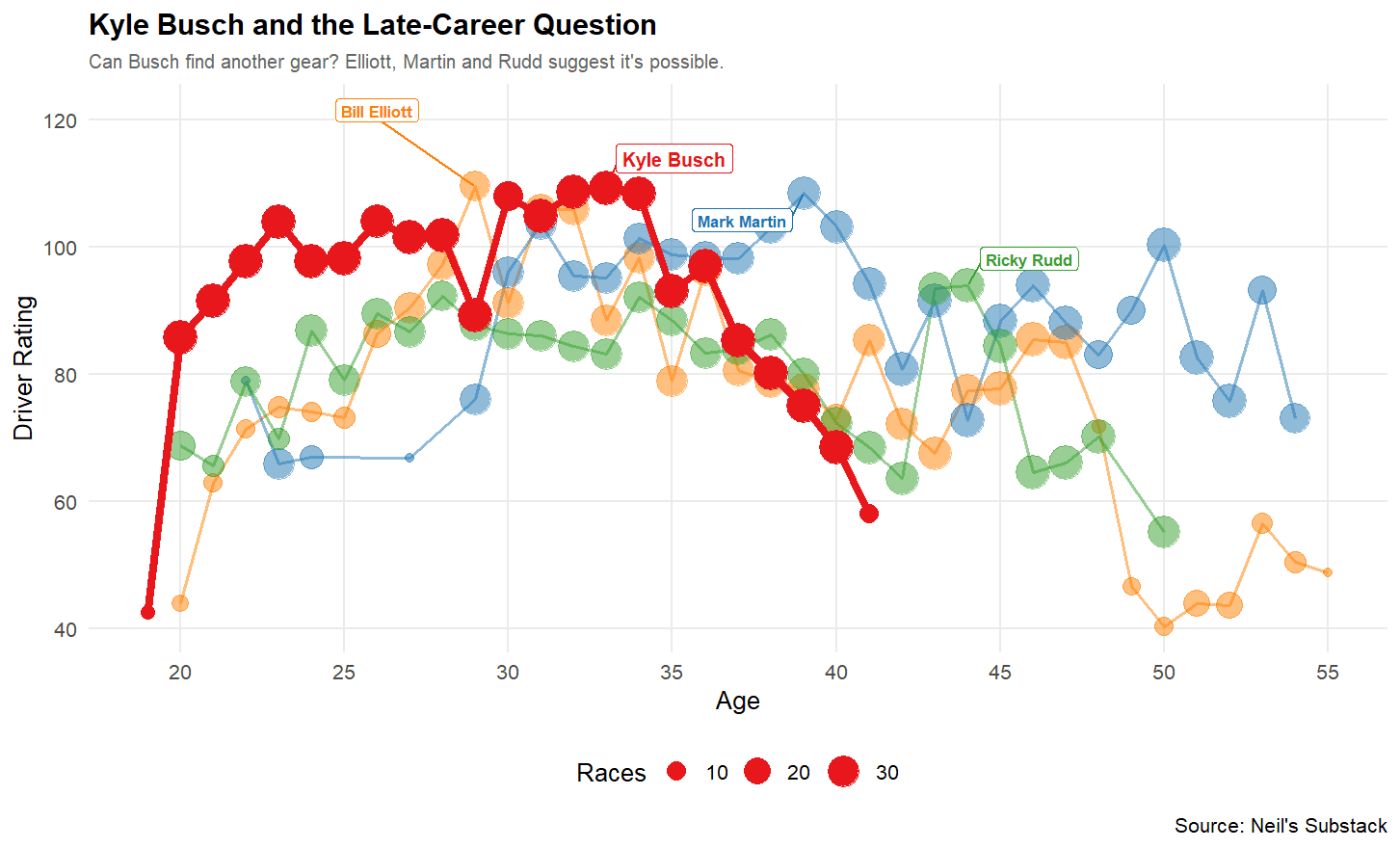
But in each case, they were able to rebound and produce additional seasons with ratings comparable to what they had before the decline. While those are just three historical outliers, we also saw similar — if a bit less dramatic — late-career turnaround arcs from Terry Labonte (whose age-44 rating of 57.1, driving Busch’s own future Hendrick No. 5 in 2001, returned to a 75.7 in 2003) and Brad Keselowski (whose dip to 67.9 in 2022 rebounded to 82.1 the next year and 78.7 this year). Clint Bowyer fell to an unthinkably bad 51.7 running the No. 15 car for Harry Scott, Jr. in 2016, but he was back to a 93.0 rating within a few seasons.

(Granted, Bowyer’s decline was unique, coinciding with the ongoing fallout from Spingate at Michael Waltrip Racing, and his subsequent rebound came on a much better team with Stewart-Haas Racing.)
Some great drivers admittedly never recovered from these fall-offs: Jarrett retired shortly after his poor final few years with Robert Yates and Michael Waltrip, and Yarborough was done after a couple of bad years in 1987 and ’88. Others, like Matt Kenseth (mostly) and Carl Edwards, chose to walk away before the decline phase could even set in.
It’s too late for Kyle Busch in that regard, so he’s got no choice but to power through it and come out on the other side like a Martin, Elliott or Rudd. And if that does end up happening, maybe we’ll point to this week as the moment the turnaround finally began.