NASCAR officials announced penalties Tuesday to the No. 52 Halmar Friesen Racing team in the Gander Outdoors Truck Series after last weekend’s event at Canadian Tire Motorsport Park.

The No. 52 Chevrolet driven by Stewart Friesen to a seventh-place finish Sunday was found with one lug nut not safely secured in a post-race check. As a result, competition officials issued a $2,500 fine to crew chief Tripp Bruce III.

Friesen ranks third among the eight championship-eligible drivers in the Gander Trucks playoff field. The series resumes Sept. 13 at Las Vegas Motor Speedway.

RELATED: Dippel suspended | Borland out indefinitely

Also noted on this week’s penalty report are indefinite suspensions to Gander Trucks driver Tyler Dippel and Monster Energy Series crew chief Matt Borland. Both were issued behavioral penalties, backdated to Aug. 22.

Brittany Logano revealed the retro paint scheme for her husband Joey’s No. 22 Ford for Darlington Raceway on Tuesday, introducing a look that pays homage to Kevin Harvick’s 2007 car design with a winking acknowledgement of their once-fierce rivalry.

Harvick drove a yellow-and-red Richard Childress Racing No. 29 entry to victory in the 2007 Daytona 500. In Sunday’s Bojangles’ Southern 500 (6 p.m. ET, NBCSN, MRN, SiriusXM), those Shell-Pennzoil colors will adorn Joey Logano’s No. 22 Team Penske Ford.

RELATED: Darlington schedule | Throwback gallery

The paint scheme was unveiled with a humorous nod that referenced the height of the Logano-Harvick difference of opinions. In June 2010 at Pocono Raceway, Logano was on the receiving end of late-race contact from Harvick, prompting the then-20-year-old Logano to lash out at the Harvick family in post-race interviews.

Logano took special aim at Harvick’s wife, DeLana, who at the time was a regular fixture atop the team pit box wearing a fire suit that matched her husband’s. Logano’s post-race shot: “I don’t know what his deal is with me, but it’s probably not his fault. His wife wears the fire suit in the family and tells him what to do, so it’s probably not his fault.”

Brittany Logano references the line in the video before motioning her husband out of frame.

DAYTONA BEACH, Fla. — In a one-of-a-kind NASCAR tradition, the venerable Darlington Raceway’s NASCAR Throwback Weekend allows the sport’s best of today to honor the greats of yesterday.

With the nod to great history, the Bojangles’ Southern 500 (Sept. 1, 6 p.m. ET, NBCSN/NBC Sports App, MRN, SiriusXM NASCAR Radio) continues to be a must-see event on the Monster Energy NASCAR Cup Series calendar for fans and a highly-anticipated race for the competitors – both in the garage with special paint schemes and on the South Carolina race track with only two regular-season races remaining before the 2019 NASCAR Playoffs field is set.

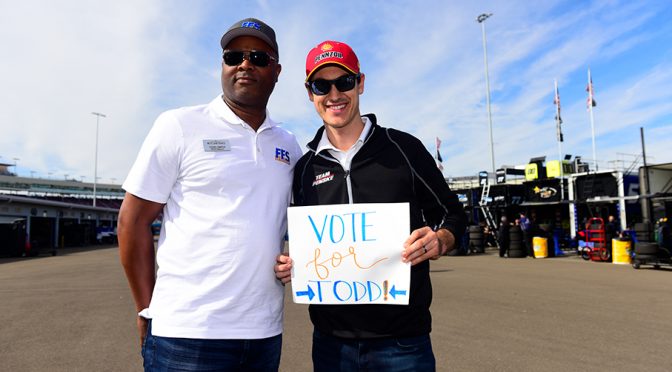
Fans have a chance to vote for what they consider the best car at recreating the sport’s historic vibe. Voting continues until Aug. 30 on NASCAR.com and, judging by the effort teams have put into this unique weekend, deciding for whom to back is no easy task.

VOTE: Favorite Darlington throwback scheme

Among the compelling nods to the past, defending Darlington race winner Brad Keselowski will be steering a black No. 2 Team Penske Ford with a paint scheme that pays tribute to the car’s former driver, NASCAR Hall of Famer Rusty Wallace.

The famous No. 2 is from Wallace’s 1996 season – a five-win campaign – one of 11 multi-win seasons in Wallace’s celebrated Cup championship career. Keselowski drove a tribute to Wallace’s 1990 car – the No. 27 owned by Raymond Beadle – to his first Southern 500 win a year ago.

The previous 2017 season, in Darlington’s throwback race, Keselowski drove a paint scheme honoring one of Wallace’s “favorites” – a car the Hall of Famer nicknamed “Midnight.” That car was so special to Wallace that he included it in his NASCAR Hall of Fame exhibit in 2012. Wallace drove it – as both a Pontiac and Ford – in his two winningest seasons – a 10-victory effort in 1993 and an eight-win mark in 1994.

Two-time Darlington winner Denny Hamlin will also be honoring a NASCAR Hall of Famer. His No. 11 Joe Gibbs Racing Toyota will look like three-time Cup champion Darrell Waltrip’s former race car. For six years, Waltrip drove a No. 11 race car, and while Hamlin concedes Waltrip was often the rival of his favorite driver growing up – Bill Elliott – Hamlin was eager to pay respects to Waltrip this way.

“I grew up a huge Bill Elliott fan and he was one of the toughest competitors, Darrell Waltrip was,’’ Hamlin said at his car’s unveiling in June. “One of my best friends at the time, we grew up watching racing and his favorite driver was Darrell Waltrip. So we would always be sparring back and forth each week whether it be at school or wherever, talking about his driver versus my driver.

“I’ve grown to really like Darrell and everything he represents, and to give 40 years of his life, not only to racing, but he transformed the sport in so many different ways, that’s just an honor to be able to know him and see him off into the sunset.’’

Waltrip retired from the NASCAR on FOX booth earlier this year.

MORE: See all the throwback schemes

One of the cars receiving a huge amount of worthy attention and social media buzz in recent weeks is Bubba Wallace’s No. 43 Petty Motorsports Ford, which will carry the livery of the late Adam Petty at Darlington.

Instead of the famed Petty Blue normally outfitted on the No. 43, the car will be orange, green, purple and yellow – the paint scheme of Adam Petty’s race-winning car from the 1998 ARCA Series race at Charlotte Motor Speedway. Petty, son of Kyle and grandson of Richard, was killed in May 2000 at the age of 19 in a practice session accident at New Hampshire Motor Speedway just as his promising young career was taking off.

“It’s truly an honor and top throwback that I’ve been a part of and knowing the history behind the Petty family and Adam’s vision and seeing it come to life at Victory Junction,’’ Wallace said at the unveiling ceremony earlier this month. “I think this really speaks for Adam and what his vision was. I was too young to know him and I feel like we would have had a great time to grow together to bring this organization back to where it needs to be.’’

Three of the four Stewart-Haas Racing Fords will race with the paint schemes of team owner Tony Stewart from when he won his three Cup championships (2002, 2005 and 2011). Aric Almirola’s No. 10 Ford will carry the livery from Stewart’s 2002 season when the soon-to-be-inducted NASCAR Hall of Fame selection won three races and his maiden Cup championship.

SHR driver Daniel Suarez will steer the No. 41 Ford in Stewart’s 2005 championship livery. Stewart won five races and earned 25 top-10 finishes in 36 races that year, a personal best top-10 mark for the champ.

And lastly, veteran Clint Bowyer’s No. 14 Ford will resemble Stewart’s 2011 championship-winning car. It was one of the most dramatic title runs in NASCAR history, with Stewart – who had been winless in the regular season – hoisting five trophies in the 10-race playoffs, including the Homestead-Miami Speedway season finale winner’s hardware. The three-time champion would retire from full-time Cup racing five seasons later.

“It’s really cool to see all three of these cars together,’’ Stewart said when the team unveiled the looks earlier this month. “I’ve got all three of these championship cars, but not together, so to see these race at Darlington will be really cool and bring back a lot of memories. It just makes me smile.’’

RELATED: Comparing throwbacks from 2015 on

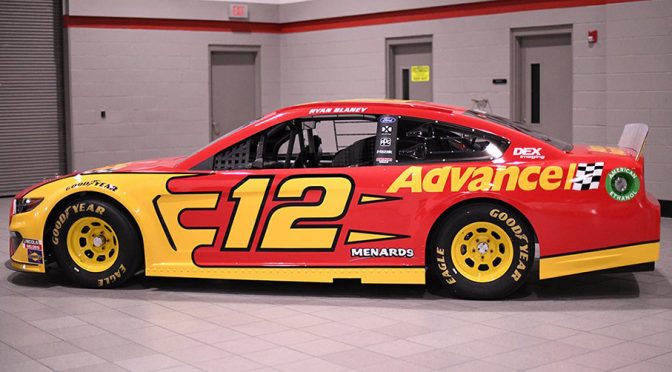
For other competitors, the opportunity to emulate a paint scheme is truly personal. Chase Elliott and Ryan Blaney, for example, will honor their own racing fathers – NASCAR Hall of Famer Bill Elliott on Chase’s No. 9 Hendrick Motorsports Chevrolet and legendary sprint car driver and NASCAR competitor Dave Blaney on Ryan’s No. 12 Penske Racing Ford. Both drivers’ cars will carry the paint schemes from their fathers’ former rides.

Joe Gibbs Racing driver Erik Jones will also invoke a more personal throwback. His No. 20 Toyota will carry a paint scheme similar to the car he drove in his rookie Late Model season.

Seven-time Cup champion Jimmie Johnson will also be fielding a sentimental throwback – his No. 48 Hendrick Motorsports Chevrolet will carry the same colors and design as one of the off-road trucks he raced before landing his opportunity in NASCAR’s big leagues. Johnson ran the truck – nicknamed “Butch” – in several Baja 1000 Trophy Truck class races in 1995, earning the SCORE Rookie of the Year honors as a 20-year-old driver in that division.

In addition to these throwback looks, here are some other highlights to anticipate from Sunday night’s grid:

  • Kyle Busch’s championship-leading No. 18 Toyota will pay tribute to Bobby Hillin Jr. – the two drivers both having “Snickers” sponsorship; Hillin in 1990 and Busch since 2008.
  • Paul Menard’s No. 21 Wood Brothers Ford will carry a tribute to the legendary team’s co-founder Glenn Wood – the NASCAR Hall of Famer having passed away just this January.
  • Alex Bowman’s No. 88 will feature the late Tim Richmond’s livery. Richmond, who drove a season and a half for Rick Hendrick, won 13 career Cup races and was one of the biggest auto racing stars in the 1980s, competing in both NASCAR and IndyCar.
  • William Byron’s No. 24 Hendrick Motorsports Chevrolet will carry the colors of Tom Cruise’s race car in the famed “Days of Thunder” motion picture.
  • Corey LaJoie (Dale Jarrett), David Ragan (David Pearson) and Ryan Preece (Ron Bouchard) are all honoring some of the sport’s most famous winners with their cars.
  • Austin Dillon will recognize his team owner and grandfather, Richard Childress, driving a black-and-gold No. 3 Chevrolet similar to what Childress drove in the late 1970s before another RCR driver, seven-time champion Dale Earnhardt, famously took over the car.

Not only will fans have a chance to take in some NASCAR history this weekend, but the competitors themselves seem so genuinely connected to the paint schemes they will race, and they’re also eager to check out their competitors’ once-a-season looks as well.

The opening Monster Energy Series practice is at 2:05 p.m. ET on Friday, with qualifying set for 2 p.m. ET on Saturday (NBCSN/NBC Sports App, MRN, SiriusXM NASCAR Radio).

Chris Marek is currently second in the late model points standings at Elko Speedway, and he’s fighting for the best finish of his career.

Chris Marek

Marek has seven championships at Elko, a 0.375-mile semi-banked asphalt oval track in Elko, Minnesota, four of which have come in the track’s Division I series. But in all those championships, the highest Marek has finished in the NASCAR Whelen All-American Series national standings is 18th.

Elko Speedway | Facebook | Twitter | Instagram

With two NASCAR races remaining, Marek is 32nd in the national points, and has a goal of cutting that in half.

“I’d really like to get in the top 15 in points,” Marek said. “If we can get up into top 15 that would make it my best year. I think that would be a pretty big goal for us.”

Marek has been racing at Elko for 16 years, starting in the lowest hornets division and working his way up through the ranks.

His family has a long history at their home track, which is about four miles from his team’s race shop. Marek’s uncles raced there in the early ’80s, his grandparents sponsored cars, and his dad ran sportsman cars for a national ASA touring series.

Marek’s father-in-law also raced at Elko. While Marek didn’t technically meet his wife through racing, both his and her parents have known each other since high school and continued their friendship through racing.

“We met through family friends but I think it all kind of boiled down to the race track,” he said.“Pretty much all sides of my family have been out there for a long time racing and have been champions.”

Elko Speedway Points Standings

Img 1520

The rule in Marek’s family growing up was that he couldn’t start racing until he was 16, putting him a bit behind others in the sport. As soon as he was able he was in the car, something he’d wanted to since since he was little.

“I kind of had tall dreams and didn’t really think that I would make it really far,” he said. “I was just a young kid who wanted to race go-karts and things like that. I kind of made the most of it, went out and found some sponsors and got going that way. With my dad putting his eggs in my basket and quitting the traveling series that helped me out a lot.”

He gained the nickname “Cruiser” from his dad’s racing days, and it’s stuck to this day.

Marek is in the only one in his family who still races, but he’s far from alone at the track. Races are a family event for him. Along with his dad, uncles, wife, and kid, his sister, her husband, and kids also enjoy racing, as do his in-laws.

The Marek’s own a family towing business, and have made sure to understand racing is just a hobby. They focus on mostly racing at Elko so the family doesn’t have to take too much time away from the office.

“When we leave it’s taking three out of the seven employees that we have out of the office to go racing,” Marek said. “So we try to make sure that we understand that it’s just a hobby and we’re just doing it for family fun.

“We were a little bit more serious about it earlier in my career, but I’m 30 and married with a kid now so we just don’t work quite as hard at it anymore.”

NASCAR Whelen All-American Series Division I points standings

Even if they don’t spend as much time on the sport as they once did, racing is still serious to the Marek’s. It’s both the family bonding time and the competition that keeps Marek coming back year after year.

“I’m a big competitive person. I really like showing up and kind of picking my brain every week” he said. “But I’d say the biggest thing is definitely the family thing.

“Some weeks you have a rough week and you don’t want to show up or you’d like to take a week off but seeing my 3-year-old crawl in the racecar and ask if we can go to the race shop, and work on the car and spending that time with my parents and brother-in-law and what not, it makes it a little bit more personable than competition. I guess I like both aspects of it.”

Even if racing is just a hobby, Marek isn’t giving up on going for new goals. He has a chance at a fifth track championship, and if not, he still has an opportunity to climb up the national standings.

If that doesn’t happen, as long as he runs consistently and has good finishes every week, he’ll be happy.

No matter what, his family will still be by his side at their home track.

“At Elko, we have a little bigger fan base and have more fun,” he said. “We’re real close, and real fortunate to have a real nice racetrack close to home.”

NASCAR racing will return to Elko Speedway on September 14 with late models, thunder cars, power stocks, legends, and bandoleros.

NASCAR Throwback Weekend is upon us once again, and that means watching dozens of old-school-looking paint schemes take on Darlington Raceway – this time, each car themed from the early ‘90s era. It’s one of the coolest and most unique weekends of the year, but it’s also one that draws some of the most discourse on Twitter – particularly when it comes to which paint schemes are best.

The teams this year have done an excellent job of designing their throwback paint schemes. And since we can’t award a tie for all the cars as the coolest designs, this year I decided to form my opinion by listening to people on Twitter.

RELATED: Every 2019 throwback paint scheme for Darlington

I carefully set a hot-take trap to gather only the most informed opinions – those, of course, come from the people who engage with me on Twitter, each of them terrific, beautiful specimens of people.

https://twitter.com/steveluvender/status/1165949473438220288

Let’s see which rules came out of the trap, shall we?

Number style is a must

Ryan Vargas says the mark of a good throwback is the willingness of a team to change its number font to match the car it’s mimicking.

And, sure, some teams have it easy in this regard – they’re throwing it back to themselves.


Respect the colors

A common thread among those on Twitter (how rare!):

If you’re paying tribute to a paint scheme, respect its original colors, some say.

“Fauxbacks” are acceptable

Ah, yes, the fauxback – or a fake throwback car based only off period-correct design elements and not so much one car in particular. Once a staple of NASCAR Throwback Weekend, we’ve seen fewer and fewer fauxbacks hit the track over the years.

The closest we’ve got to a fauxback this year is Kevin Harvick’s Busch Big Buck Hunter car.

No, a Big Buck Hunter car never raced in NASCAR in the early ‘90s – at least to our knowledge – but the sponsor harks back to a time where we loaded our quarters into the machine at the mall pizza-arcade.

We’ll allow it. Besides, the No. 4 team already raced one of the finest displays of early 1990s cars-manship we’ve ever seen with its Generation X paint scheme at Pocono Raceway.


Reality is a constraint

We don’t know what the future holds, but I say we give this one a shot next year: Let’s guess what NASCAR paint schemes will look like in the year 2050.


Throw it back, or else

Don’t be a party pooper. Everybody else is dressing up. If you don’t participate, bad things might happen.

Mmm, tasty!

It’s true. William Byron’s throwback car does share some similarities with a quiche, defined by Google’s auto-suggestion thing as “a baked flan or tart with a savory filling thickened with eggs.”

Wikimedia Commons image

There are some color similarities between the two, at least.


Now do a silly one!

Sometimes tweets elicit responses that are fun. These are the best types of tweets online.

WHOA, partner. Calm down with this extreme hot take.

Throwback Thursday is real.

I suppose this is technically a correct response to the prompt.

Or … too many rules?

There’s an angle I hadn’t considered. Are we looking at this the wrong way?

Have we wasted our time with this entire discussion? Should we just be happy to have sponsor participation instead of arguing over the nuances of what makes a good throwback?

Maybe we should just sit back and enjoy the show and party like it’s sometime between 1990 and 1994.

Now, armed with knowledge and opinions, don’t forget to cast your vote for the throwback paint scheme you think deserves the title Best in Show.

Mark Barrera’s cubicle at Hendrick Motorsports has a Dallas Cowboys football on the shelf, a Rubik’s Cube on the desk and secrets in the computer. As a graphic artist, he designs the team’s race cars and thus maintains a strict devotion to privacy.

When outsiders make appearances at his work area, he checks his screen to make sure nothing on it reveals how any of Hendrick’s unreleased cars will look. He’s especially cautious about Darlington Raceway throwback cars, because leaks of those are notorious. He never knows which visitor to his work station might be a secret Reddit poster.

Barrera hosted a surprise visit in mid-July for a conversation about this weekend’s throwback cars at Darlington, and he made a quick scan of his station to make sure there was nothing an outsider shouldn’t see. Even though those cars eventually will be raced on live TV in front of millions of people and exist in large part so fans will see and then buy the products on the side of them, it is important to keep them under wraps until the time is right.

RELATED: See Darlington throwback schemes

On that day, two of Hendrick’s special paint schemes had been released, but two had not. Alex Bowman’s No. 88, which pays tribute to Tim Richmond‘s No. 25 Folgers car from 1986, already had been released so Barrera was free to discuss it. He usually tries to conform precisely to the old design — otherwise, he asks, what’s the point? — but in this case, he had to make exceptions, most notably for the numbers.

2019 Axalta Darlington Car 0000 922x520
Courtesy Hendrick Motorsports

Changing the look of the numbers on a car is a big deal, even during throwback weekend. Richmond’s 25 was big and blocky, but Bowman’s 88 remains the way it always is — sleek and slanted, giving the appearance of movement.

It was up to Hendrick’s paint team to turn the rendering into real life. There are multiple challenges with that. A 2-D drawing doesn’t translate exactly into a 3-D car. The colors on Hendrick’s painting shelves — “#24/88 Axalta blue” and “#88 Nationwide Blue” — would not be used and would instead be replaced by a red as close to Richmond’s as they could make.

MORE: First look at Jimmie’s throwback

Even with those wrinkles, Hendrick’s paint team, led by Kevin McCree, spent a few days this month turning a sheet metal body into a work of automotive art, following this recipe:

Apply two coats of primer in a paint bay set at 97 degrees

Bake at 120 degrees for 30 minutes

Sand and clean

Tape and degrease

Spray with sealant

Apply two or three coats of base paint, plus stencil and design work in bay set at 97 degrees

Tape

Bake at 145 degrees for an hour

Untape

Touch up as needed.

After Bowman’s car was painted, it was sent to the mechanics in a bay next to the paint station. McCree and crew watched mechanics work on it like mothers watching someone else hold their newborn. Few things annoy Barrera and McCree more than a Hendrick car taking the green flag anything short of pristine.

Mechanics don’t care about pristine, or at least not as much as Barrera and McCree. Every time they put a tool box on Bowman’s car … or brushed up against it … or looked at it with less than an adoring gaze, McCree and his guys got annoyed.

And don’t get them started about William Byron’s car in the July race at Daytona International Speedway. That car was one of their all-time favorites. The white, the glitter, the fades, the flames … man, it was beautiful … and it never made it into the race, as Byron crashed in a practice session after being hit from behind by Brad Keselowski.24 Mencs Byron 922x400

Keselowski said he ran into Byron to “send a message” he was done lifting. It’s a good thing nobody from the paint team was around, because they might have tried to “send a message” to Keselowski in a manner that would have left Keselowski short of pristine.

While teams want every car to look great, they take particular pride in the throwback cars. Fans, drivers, sponsors, media, team owners, pretty much everyone in the sport zero in on how the cars look at Darlington, far more than any other weekend of the year.

For an answer why, let’s turn to McCree.

“Throwback anything is fun,” he said. “Old race cars are just cool.”

Colors come of age

McCree is right. Old race cars are cool. But really old race cars, not so much. If throwback weekend is a study in NASCAR history, it’s mostly recent history. If teams throw it back too far, the cars would be … well, they’d be boring.

The first season of what is now the Monster Energy NASCAR Cup series was 1949. On the side of champion Red Byron’s Oldsmobile was his number, 22, plus the name of his one and only sponsor: Parks Novelty, which was owned by Raymond Parks, the owner of his team. All of that was painted by hand with a brush.

Red Byron's car
RacingOne

Last year, champion Joey Logano’s Ford — also No. 22 — featured vibrant yellow, deep red, Ford blue, pretty much every other color in the rainbow and included the names of 26 different companies.

The point of a NASCAR race has never changed: Go fast and get to the finish line first. The look of a NASCAR race has changed dramatically, from one-color, one-sponsor cars to today’s high-speed billboards touting enough products to fill a shopping cart. How did we get from designs that were an afterthought at best to men willing to fight over destroyed paint jobs? How did cars come to look like what they look like now?

The journey includes ideas meant to save a buck, innovations that made millions, crazy-sounding schemes that bore unbelievable results and epiphanies on the way to work.

Selling points and STP

The history of NASCAR paint schemes runs parallel with the history of sponsors. Every big change in paint scheme history happened because of sponsors. Those changes came in fits and starts. For NASCAR’s first 20 years, sponsors were almost entirely local body shops, garages and dealerships.

“It was pure economics,” said Kelly O’Keefe, head of creative brand management at Virginia Commonwealth University’s Brand Center. “Owners thought, ‘If I can get a little money from a local business to put a logo on the car, I’m going to do that, because it’s going to help subsidize the cost of my team and my crew.’ ”

For years, those costs were low relative to what they are now, and so was the subsidy.

“The stock cars were used, often very used, and frequently re-built in a garage or barn,” said Jeffrey Richards, a professor in Michigan State University’s advertising and public relations department who is an expert in advertising history and who has photographed the Indy 500 for 46 years and the Brickyard 400 since its beginning. “The drivers weren’t well paid, either.”

In the early 1950s, officials from the car manufacturer Hudson discovered the race track was a good place to find customers. They also learned the faster the cars were, the more customers they would find. Tom Jensen, curatorial affairs manager at the NASCAR Hall of Fame and a journalist who covered the sport for two decades, said that led to the saying, “win on Sunday, sell on Monday.”

RELATED: More on NASCAR Hall of Fame

The first step toward a modern-looking car came in 1959. Late in that season, Lee Petty, the patriarch of the Petty family who won 54 races and three championships, was at a race. His sons, Richard and Maurice, remained behind at the Petty shop in North Carolina repairing a damaged Plymouth Fury. After it was sufficiently repaired, Richard, then 22, had to paint it.

At that point in the family’s racing career, the Pettys’ favorite color was apparently whatever they had in stock. Sometimes they fielded red cars, sometimes black, sometimes white.

When it came time to paint the Fury, Richard had two cans of paint – one can of 1956 Dodge blue, one can of 1957 Chevy white. But there wasn’t enough of either one to cover the car. So instead of buying a full can of one or the other or something else, the man who would become The King combined the two into one pail. He stirred the 1956 Dodge blue and the 1957 Chevy white into one hue.

When that make-do mixture was applied to the car, it was beautiful. It looked like the sky. When Lee Petty came home and saw it, he loved it. Petty Blue, as it became known, soon visited Victory Lane. From that day in 1959 through 1971, Petty cars were Petty Blue. They were Petty Blue when Richard Petty won his first race in 1960. They were Petty Blue when he won 27 races in 1967. They were Petty Blue when he won his first three championships (1964, 1967, 1971).

RacingOne
RacingOne

A few days before the 1972 season opener at Riverside, Richard Petty, his brother, Maurice, and crew chief Dale Inman flew to Chicago to meet with Andy Granatelli, president and CEO of STP, to discuss bringing STP on as a primary sponsor. A snowstorm socked Chicago as the negotiations dragged on. Maurice and Inman left to get to Riverside. Richard stayed behind to close the deal.

STP offered $250,000 — an enormous amount in those days — but Granatelli wanted the car to be not Petty Blue but Day-Glo red, like the cars STP sponsored in the Indy series. Petty wanted the money, but he wanted to keep his cars Petty Blue more because Petty Blue was his lucky color.

Granatelli offered another $50,000. Petty said no to that, too.

Petty flew out to California for the race. Although they didn’t have a signed agreement, both sides apparently felt good enough about the negotiations that STP stickers were affixed to the Petty Blue car. Petty won that race, a genius-level negotiating tactic.

When the contract arrived at the Petty shop before the next race (the Daytona 500), Granatelli included a clause calling for the cars to be Day-Glo red. Petty scratched it out … then signed the contract.

Eventually, Petty and Granatelli agreed the cars would be Petty Blue with a stripe of Day-Glo red, and the now-iconic scheme debuted in the 1972 Daytona 500.

Petty won eight races that season and finished a whopping 80 percent of events in the top five on the way to his second straight championship, the fourth of his seven overall.

As successful as that partnership was on the track, its impact in the sports world was arguably even greater. The paint scheme became a bridge between the company and fans.

“In many ways, that’s the one partnership that started to put NASCAR advertising on the map, and you started to see STP become a very well-known brand because of that,” O’Keefe said. “NASCAR advertising was one of the leaders in the world where now everything is branded. Companies like STP became household names overnight. That’s really the shot heard around the world related to NASCAR marketing and sports marketing in general.”

‘The Man in … Blue?’

Glory Road at the NASCAR Hall of Fame shows in vivid, living color the history of NASCAR paint schemes. The oldest cars are on the lower levels. They are plain and monochromatic. The paint schemes, if they can be called that, were unimpressive at best. Follow Glory Road, designed to look like a track, up the ramp, and the cars get newer and the paint schemes more colorful and elaborate.

The company names become more familiar, too. The appearances of Tide, Folgers and other household products signaled NASCAR’s growth beyond a regional sport. They also heralded another change: Paint jobs became far more sophisticated as companies tried to replicate the success of the Petty Blue and Day-Glo red STP car. More and more companies wanted to build their own bridges to fans and thought beautiful cars were the way to do it.

NASCAR Hall of Fame Glory Road
Jared C. Tilton

The vehicles on Glory Road change from time to time, but somewhere around the midpoint there is usually a car driven by Dale Earnhardt. He is so closely identified with his black Goodwrench car that it’s easy to forget he drove a blue-and-yellow Wrangler car for several years before the black car. As the Hall of Fame’s Jensen put it: “They don’t call him ‘The Man in Blue and Yellow.’ They call him ‘The Man in Black.'”

But he was almost The Man in Blue and White.

The first draft of what became Earnhardt’s black No. 3 Goodwrench Chevy was not black but blue and white.

“GM Goodwrench Parts wanted the car to look like a brake box,” said team owner Richard Childress, who still approves every paint scheme his team fields. “It didn’t do anything at all for me. The word ‘Goodwrench’ faded away.”

Childress built the car to the blue-and-white specifications anyway. In presenting it to Goodwrench officials, he left one side blue and white. On the other side, the team covered the car with black tape. Childress told Goodwrench officials that with a black car on a dark track, the white Goodwrench would stand out.

Goodwrench agreed, and black became Earnhardt’s color. He wore black sunglasses, black shirts and black jeans. He became The Intimidator, the Man in Black, the guy nobody wanted to see in his rear-view mirror. As never before or since, the car and driver became almost one entity.

As president of Dale Earnhardt Inc., Don Hawk used the synchronicity between car and driver to attract sponsors.

“My presentation was, ‘He’s got a swagger off the track and performance on the track that matches that black car,’ ” he said. “It started benign. It became cataclysmic. You couldn’t just paint your car black and be bad. You had to back it with execution.”

The impact of the deals Hawk made — with sunglasses companies, sneaker companies, fast food companies, soda companies and more — reached far beyond the insular NASCAR world. Now that bridge between product and fans had a super cool guide to lead you across it.

That would not have happened if the car was blue and white.

RacingOne
RacingOne

The rainbow connection

In May of 1992, Ray Evernham visited artist Sam Bass to buy a gift for Jeff Gordon, the young driver for whom Evernham would serve as crew chief starting with one race at the end of that season. Evernham had in mind a track program Bass had designed. Bass gave him the program for free in exchange for Evernham giving him a chance to design Gordon’s car.

Bass drew up two versions of the car, and on the morning of the deadline, as he drove to work, he had an idea for a third. He envisioned a car promoting the fact DuPont paint offered an array of colors.

“I was thinking about the (DuPont) oval on the hood and how the lines above it would naturally form a rainbow,” Bass, who died in February, told Autoweek. “I knew the moment I drew it, that this was the one.”

MORE: Remembering Bass through his art

DuPont reviewed 43 submissions for Gordon’s car and chose Bass’s rainbow design.

“I thought the guys in the body shop were going to kill me when they saw it because they knew how difficult it was going to be to paint,” Bass said. “But to their credit, they did it, and they were so proud of it.”

The bright colors did present one problem: They faded and had to be redone often.

Just as the black fit Earnhardt’s persona, the rainbow fit Gordon’s — it looked young, fresh, hopeful. The contrast between Gordon’s rainbow and Earnhardt’s black lined up perfectly with the contrast between the men who drove them. Fresh versus grizzled, youth versus experience, goody-two-shoes versus villain.

“It certainly changed my life forever as a race car driver to come to Hendrick Motorsports and having a paint scheme that now, looking back on it, was so iconic,” Gordon said. “There’s a certain magic that Sam Bass brings to your race car when he designs it.”

Robert Laberge
Robert Laberge

The secret in silver

From when major sponsors arrived in the 1970s through the mid 1990s, teams used one paint scheme for virtually every race in a season. Primary sponsors wanted the look to be consistent, a key component of any advertising strategy. That has changed in recent years, as most teams now have multiple primary sponsors instead of one, and thus multiple paint schemes instead of one.

But that’s a relatively new trend, and in 1995, having a car look different for one race was highly unusual. In 1995, NASCAR celebrated 25 years of collaboration with R.J. Reynolds. To mark that occasion, secret plans were drawn up for Earnhardt to drive a silver car instead of his black one in the All-Star Race. Hawk met with officials from diecast companies and RJR to forge a plan to sell the silver car idea to Childress and Earnhardt.

Hawk talked to Childress first, who told him to get approval from Earnhardt and come back. Changing the car color would have been a huge deal for any driver, even more so for Earnhardt. He didn’t like change for change’s sake, and he was very superstitious. Green cars and peanuts, for example, are considered bad luck in auto racing. Hawk would not have bothered bringing Earnhardt a green car or one sponsored by peanuts because the answer would have been not just no, but hell no.

Hawk presented the silver car idea to Earnhardt carefully. He backed into the subject, hemmed and hawed, like a child afraid to confess to his parents. “Just tell me,” Earnhardt said.

Hawk laid out his case. The silver car would make a killing in the diecast market. It would help the All-Star Race and NASCAR in general. It helped that the race was not a points race, so if Earnhardt finished poorly there would be no championship implications.

Dale Earnhardt silver scheme
Dozier Mobley

Earnhardt agreed to the change, and the secret was kept in a way that would have made Barrera proud. Nobody outside of a small circle had any inkling until an unveiling at Charlotte Motor Speedway. According to Danny “Chocolate” Myers, then Earnhardt’s gas man and now the curator at Richard Childress Racing’s museum, not even crew members knew the car had been painted silver.

“We pulled the car cover off,” Hawk said. “I thought the media was going to die when they saw a silver race car. I’m telling you, it still gives me goosebumps because nobody could believe it.”

That began a trend of teams bringing splashy designs to the All-Star Race, which bled into other parts of the season and eventually led to the introduction of throwback weekend at Darlington. There’s a direct, if not necessarily straight, line from Petty Blue to Earnhardt black to Gordon rainbow to one secret silver car and a driver who had to be talked into approving it to all the throwback designs that will scream across Darlington this weekend.

The thread connecting those paint schemes is, as McCree said, old race cars are cool.

“We still have a romance with cars,” O’Keefe said. “I think it’s exciting to see them roll out. I hope our world never gets so sophisticated that we lose that.”

CONCORD, N.C. – Ricky Stenhouse Jr. will team up with Duane “Dog” Chapman and his exhilarating new unscripted series “Dog’s Most Wanted” when the NASCAR Cup Series returns to the iconic Darlington Raceway for the famed Bojangles’ Southern 500 on Sept. 1. Stenhouse’s No. 17 Ford Mustang will be fully wrapped to promote WGN America’s new series “Dog’s Most Wanted,” which features Duane “Dog” Chapman, his late wife, Beth, and a hand-picked team of bounty hunters bringing criminals to justice. The series premieres on Wednesday, Sept. 4 at 9 p.m. ET on WGN America.

“It’s going to be awesome to have ‘Dog’s Most Wanted’ on the car at Darlington,” Stenhouse Jr said. “We are looking forward to having him at the race and hopefully he can help us track down and capture a trip to Victory Lane.”

RELATED: Darlington weekend schedule

The legendary bounty hunter and TV personality will be in attendance as the green flag waves on the fifth edition of the South Carolina track’s ‘throwback’ weekend.

In this new series, “Dog” and the late Beth Chapman will be supported by a ferocious team of hunters Dog calls “The Dirty Dozen.” Together they will go on a cross-country manhunt to track down a carefully curated list of Dog’s Most Wanted fugitives. In their personal lives, the series tackles the family’s most difficult fight as their beloved matriarch Beth Chapman bravely fights — and tragically loses — her battle with cancer.

“Dog’s Most Wanted” is produced by Dorsey Pictures, a Red Arrow Studios company, along with Entertainment by Bonnie and Clyde. Chris Dorsey (“Building Alaska”), and Matt Assmus serve as executive producers for Dorsey Pictures. Dog and the late Beth Chapman are executive producers for Bonnie & Clyde.

Eleven down, five to go.

The NASCAR Whelen Modified Tour returns to the track at Oswego Speedway on Saturday night, beginning a stretch of two races in two weeks, and four races in five weeks. The busiest point in the championship points schedule comes in crunch time — meaning one slip by a top contender could change the complexion of the season in the blink of an eye.

What better way to spend a Saturday night? Fans can watch Whelen Modified Tour action at the ‘Steel Palace,’ one of the most recognized tracks in the northeast, as part of their annual Classic weekend.


There are just five races remaining in the season, but some of the the talk heading into Saturday’s Toyota Mod Classic 150 presented by McDonald’s might not be about the title chase.

Look out for Matt Hirschman.

The Northampton, Pennsylvania, driver might only have two tour starts this season, but that isn’t any indication to the speed he will likely unload with on Saturday. The last two times the series has been to the New York oval, Hirschman has qualified on the pole, finished second, and first. Out of a total 300 laps, he’s been at the front of the field for 256.

Screen Shot 2019 08 19 At 7.06.00 PmIf anyone is going to end Doug Coby’s streak of success this season, it could be Hirschman. While Coby does lead the championship standings by 47 points over Justin Bonsignore and Ron Silk, Oswego has also been a track where Coby’s shown enough speed to win. In three starts over the last three years, Coby’s worst finish at the .625-mile oval is fourth. He was victorious in the Whelen Modified Tour return to Oswego for the first time in over 25 years back in 2016 en route to one of his five series titles.

Bonsignore has seen similar luck. He’s finished no worse than sixth in his three at Oswego starts, including a second-place finish last year after leading 10 laps in the final stages. Silk, who joins Bonsignore as a driver that needs to gain ground quickly, only has one previous start at Oswego — a ninth-place effort back in 2016.

If you’re looking for a driver who will give you some consistency, Eric Goodale has two consecutive fifth-place finishes at the ‘Steel Palace’, and sits fifth in the championship standings with two months remaining.

Saturday’s racing card includes a 60-lap feature for the ISMA Supermodifieds, and the track will also hold racing events on Friday and Sunday.

RACE FACTS

RACE TOYOTA MOD CLASSIC 150 PRESENTED BY MCDONALDS
PLACE Oswego Speedway, Oswego, New York
DATE Saturday, August 31
TIME 7 p.m. ET
TELEVISION NBCSN, Thursday, September 5, 6 p.m. — FansChoice.TV (Live Broadcast)
TRACK LAYOUT 5/8 mile paved oval
2018 WINNER Matt Hirschman
2018 POLE Matt Hirschman
EVENT SCHEDULE Saturday: Garage Opens: 10:45 a.m., First Practice: 1:35-2:10 p.m., Final Practice: 2:50-3:25 p.m., Group Qualifying: 5 p.m., Autograph Session: 5:45-6:30 p.m., Toyota Mod Classic 150 presented by McDonald‘s: 7 p.m.
TWITTER @OswegoSpeedway @NASCARHomeTrack
HASHTAG #ModClassic150, #NWMT

RACE CENTER | ENTRY LIST

CREW CHIEF HANDOUT: 

The starting field for the Toyota Mod Classic 150 presented by McDonald’s is 28 starters, including provisional positions. The first 22 drivers will secure starting positions through the qualifying process. The remaining six positions will be awarded through the provisional process.

NASCAR group qualifying is in place for this event. Qualifying order will be determined by each vehicle’s fastest single lap speed from the official practice session. The number of groups for qualifying will be determined by NASCAR. Each group qualifying session will be five (5) minutes in duration and the fastest single lap speed of each vehicle will determine starting positions 1st through 22nd. Adjustment or repairs may not be made on a vehicle after the vehicle enters the track to begin the qualifying session. Vehicles may not return to the track or make any further qualifying laps unless directed to do so by a NASCAR Official or in the event of a caution. If a vehicle returns to pit road, the vehicle’s qualifying attempt is complete. Once a vehicle’s qualifying attempt is complete, the vehicle must proceed directly to the designated impound area once it enters pit road. Vehicles will proceed immediately to impound after making a qualifying attempt. Vehicles will be impounded after qualifying/inspection. Vehicles must qualify on race set up.

The maximum tire allotment available for this event is eleven (11) tires per team. Four (4) tires must be used for qualifying and to begin the race. The tire change rule is four (4) tires, any position.


MEDIA CENTER

RaceDayCT.com: Family Affair: Keith Rocco Scores Victory in SK Modified Feature at Stafford | Stafford Notes: Fearn Family Dominate in Late Models, Limited Late Models

ShortTrackScene.com: Where Does 2019 Rank Amongst Doug Coby’s Championship Seasons? | Keith Rocco Gets Fourth Win of 2019 at Stafford

Speed51.com: No Holding Back in ‘The Madhouse’ Season Finale

“Butch” is back.

For throwback weekend at Darlington Raceway, Jimmie Johnson will bring back a paint scheme from the 1990s — well before the seven-time Monster Energy NASCAR Cup Series champion began stock-car racing. It’ll mirror “Butch,” a 1990 Chevy Thunder Sportside that Johnson drove in the Baja 1000 Trophy Truck division for a handful of races in 1995. Just 20 years old at the time, Johnson was the youngest driver to compete in the league and was ultimately named the SCORE Rookie of the Year.

DARLINGTON: Every throwback revealed | Vote for favorites
MORE: Jimmie Johnson diecast

Nelson and Nelson Racing built the original SCORE International Class 8 pickup, which is a category of off-road racing vehicles made from full-sized two or four-wheel drive utility or SUV vehicles. “Butch” won four championships overall — two SCORE Heavy Metal titles and two SCORE Class 8 trophies. Larry Ragland was the first driver.

Johnson joined Nelson and Nelson Racing in 1993 and took over “Butch” in 1995 once Ragland got a new truck. Below is a list of what Johnson and “Butch” accomplished together:

1995 Baja 500 – Finished 10th in Trophy Truck class

1995 Nevada Desert Challenge – Finished 13th in Trophy Truck class

1995 Laughlin Leap Competition – Won with a jump of 86 feet over a man-made obstacle at the finish line

The Bojangles’ Southern 500 is Sunday at 6 p.m. ET (NBCSN/NBC Sports App, MRN, SiriusXM NASCAR Radio).

Dan Corcoran crossed the finish line 27th in the Chevrolet Silverado 250 at Canadian Tire Motorsport Park on Sunday.

Brett Moffitt brought home the win in the race, with Alex Tagliani finishing second, and Ben Rhodes placing third. Sheldon Creed took fourth place, followed by Austin Hill to round out the top five.

Moffitt came away victorious in Stage 1, with Ross Chastain taking Stage 2.

Corcoran earned 10 points over the weekend, giving him 10 on the season. He ranks No. 80 in the NASCAR Gander Outdoors Truck Series overall points standings.

The first-year driver did not pick up any playoff points this week and still is in search of his first playoff points of the season. Corcoran qualified in 22nd position at 102.375 mph.

There were 29 cars in the field and the race endured three cautions and nine caution laps. Prior to the checkered flag, there were six lead changes.

With Moffitt driving his Silverado to glory for Maurice Gallagher Jr., Chevrolet added 40 points to its season totals. Overall, Chevrolet ranks No. 1 with 667 points, followed by Toyota in the No. 2 spot with 652. Ford sits at No. 3 with 599 points on the season.

Race Center