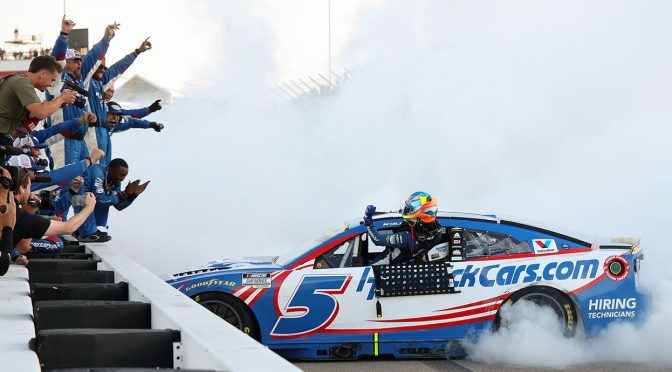
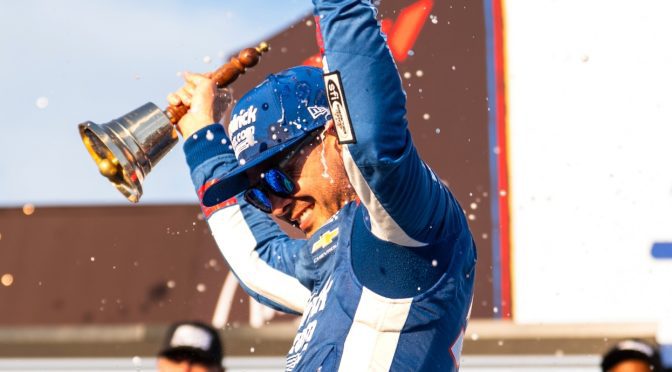
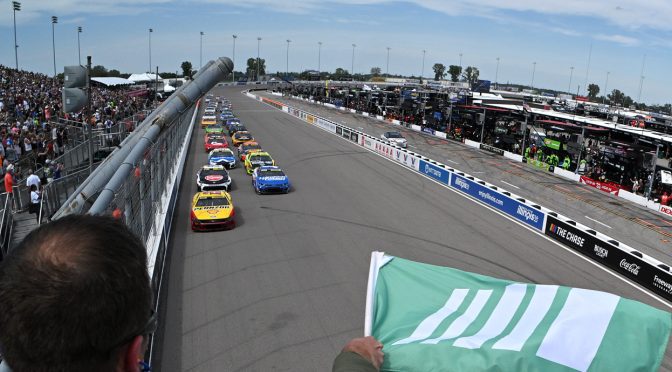
MADISON, Ill. — In a cauldron of chaos, with Chase drivers wrecking and brake rotors exploding through the bodies of NASCAR Cup Series cars, Kyle Larson’s 51-race winless streak ended Sunday at World Wide Technology Raceway at Gateway.
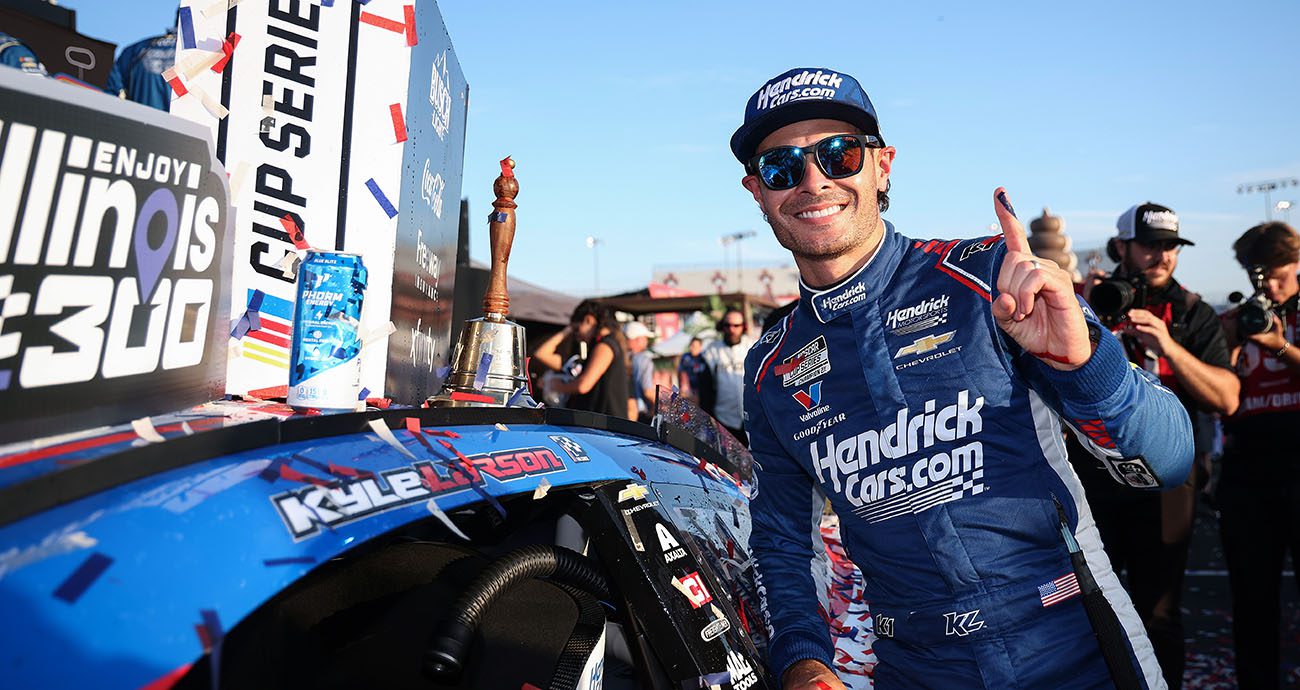
Holding off pole winner Joey Logano and Hendrick Motorsports teammate Alex Bowman on a succession of late restarts, Larson won the Enjoy Illinois 300 in two overtimes to affirm his status as a contender for a third series championship in The Chase presented by Mobil 1.
RELATED: Race results | At-track photos
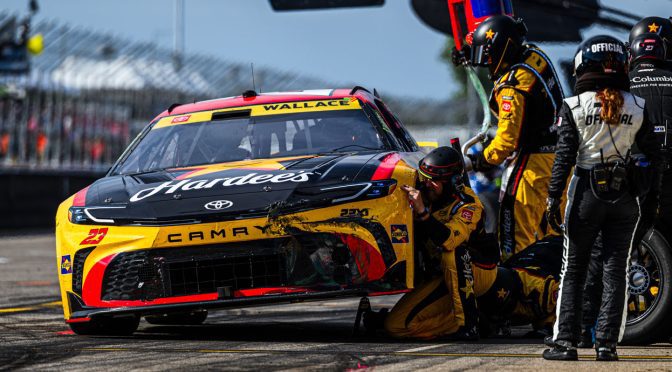
With top seed Denny Hamlin running ninth after a problematic pit stop on Lap 199 of 247, Larson, the defending series champion, gained five positions to second in the Chase standings, nine points behind Hamlin.
The victory was the first for the driver of the No. 5 Chevrolet since May 11, 2025, at Kansas Speedway. Larson, who led 80 laps and won the Stage 2, prevailed for the first time at WWT Raceway and for the 33rd time in his career.
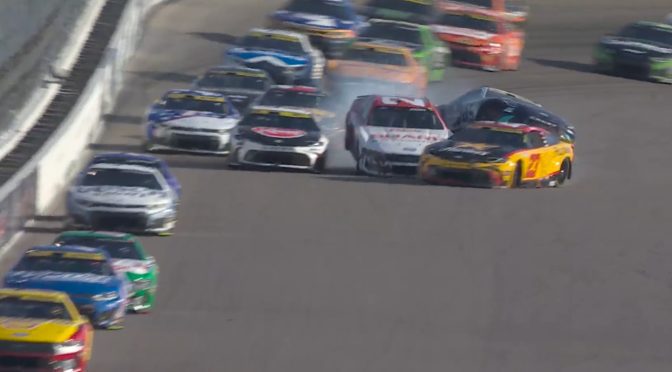
In a race that featured a track-record 18 cautions for 87 laps, Larson passed Logano to the inside moments after a Lap 228 restart that followed a four-car wreck involving Chase drivers Bubba Wallace, Christopher Bell and Tyler Reddick.
Three more cautions and two attempts at overtime later, Larson took the checkered flag 0.333 seconds ahead of Bowman, who grabbed the second position from Logano on a Lap 242 restart.
SHOP: Winner gear
Larson had superior speed at the end of the race, thanks to a four-tire call by Larson himself on the team’s final stop on Lap 201. Logano’s crew chief, Paul Wolfe, opted for right-side tires on the No. 22 Ford’s last trip to pit road, and Larson’s tire advantage — along with strong pushes from Bowman on consecutive restarts — proved decisive.
“Just proud of my team for working so hard, being so patient through all the tough times, the winless streak, all that,” said Larson, who ended a nine-race drought for Chevrolet. “Thanks to the fans, my fans, for also being patient with us, letting us get it figured out,
“How about Hendrick Motorsports? Alex Bowman, can’t ask for a better teammate than him. Gave me the pushes I needed to get clear. Want to dedicate this win to him — and his dog just passed away a couple days ago.”
Bowman, who will retire from full-time Cup racing after next season, executed a solid race, avoiding the pitfalls that caused consternation among other competitors.
“Yeah, super happy for Kyle. Was a really hard weekend just to get on the plane and be here,” Bowman said. “So, yeah, ready to go home. But proud of everybody on this Ally 48 team for helping me through the weekend. Yeah, life is hard sometimes.
“Yeah, I lost my best friend, so just ready to go home.”
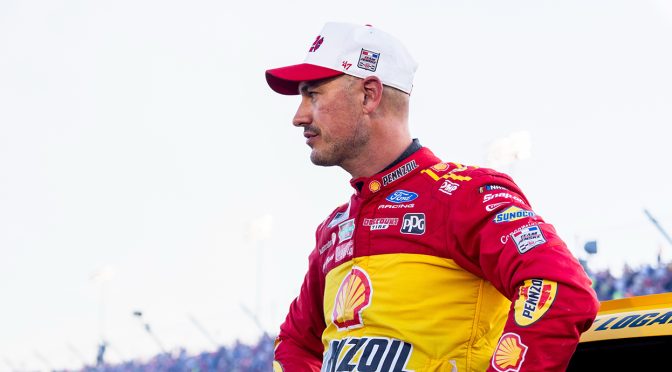
Logano, who led a race-high 96 laps and finished third, had mixed feelings about the outcome for the No. 22 Team Penske Ford.
“The restart where Larson took the lead — that’s where I lost it obviously,” Logano said. “He just rolled the bottom really good and cleared me, which is really surprising.
“His first, like, three laps of every run was pretty spectacular. You had a bunch of three-lap runs there at the end. Once he got there, then the 48 (Bowman) got there, the 24 (William Byron) got there. Had no homies with me. No more friends. On my own …
“I mean, it’s a good run, right? Got a lot of stage points, finished in the top five again, which is obviously what we need to do. Thinking about what the 25 points would feel like right about now, it does stink some.”
RELATED: Logano: ‘Just bitter at the moment’
Logano, who won the first stage and finished second in Stage 2, leaves Greater St. Louis tied for sixth in the Chase standings, having trimmed his deficit to Hamlin from 72 points to 51.
William Byron recovered from a Lap 141 accident to finish fourth, with Ross Chastain in fifth, posting his second top five of the season. Austin Dillon was sixth, followed by Connor Zilisch, Carson Hocevar, Hamlin and Austin Cindric.
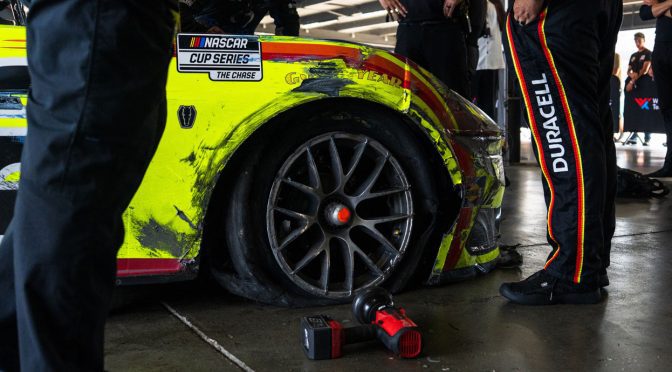
If Logano was somewhat disappointed with his third-place result, his dissatisfaction paled in comparison with the calamities that befell a succession of Chase drivers. Ryan Blaney blew a brake rotor and fell out in 35th place, falling 33 points behind Hamlin.
Five Chase drivers — Blaney, Daniel Suárez, Chris Buescher, Chase Elliott and Chase Briscoe — had gone to the garage before the race ended. Buescher and Elliott both suffered from exploding rotors, with Elliott collecting Briscoe after his No. 9 Chevrolet spiraled out of control.
MORE: Several Chase drivers involved in major final stage wrecks
Bell, last Sunday’s winner at Darlington Raceway, finished 19th and fell one spot to third in the standings, 18 points behind Hamlin.
The bottom five drivers in the Chase standings — Byron, Cindric, Buescher, Ryan Preece and Suárez — are all more than 100 points out of first place and losing touch with the top contenders, although there are eight races left before the title is decided.
The Cup Series competes next in the Bass Pro Shops Night Race at Bristol Motor Speedway on Saturday (7:30 p.m. ET, USA Network, HBO Max, PRN Radio, SiriusXM NASCAR Radio).
Stage 2 recap
Kyle Larson won Stage 2 of Sunday’s race at World Wide Technology Raceway at Gateway.
Joey Logano finished second, followed by Brad Keselowski, Ryan Blaney and Josh Berry. Denny Hamlin, Ryan Preece, Tyler Reddick, Chase Briscoe and Bubba Wallace completed the top 10 and points earners.
After Stage 1’s conclusion, all but 12 lead-lap cars pitted. Among those staying out were Daniel Suárez, William Byron, Denny Hamlin, Austin Cindric and Chris Buescher, all Chase drivers who came for service at least once during the opening frame.
Just four laps under green-flag conditions in Stage 2, Ty Gibbs contacted Erik Jones battling for 18th, sending the No. 43 Legacy Motor Club Toyota spinning. Gibbs had trouble passing Jones for multiple laps before the bump and slide.
MORE: Full Stage 2 results
The race restarted on Lap 60, but it took just four laps until the next yellow. Riley Herbst cut across Shane van Gisbergen’s bumper after Buescher checked up following contact from Carson Hocevar in front of them, spinning across AJ Allmendinger.
A majority of Chase drivers came down pit road, where many teams took two fresh Goodyear Eagles. Hamlin won the race off pit road, and he restarted fourth on Lap 69 with Ross Chastain in the lead.
On Lap 81, Kyle Larson passed Chastain for the top spot to lead laps in the second consecutive race. Chastain pitted during the stage break and banked on a caution later in Stage 2 to refuel. But with 12 to go amid the longest run of the race, he surrendered his fourth-place running position for fuel.
But as Chastain blended back onto the racing surface, Zane Smith suffered an issue entering Turn 1, pounding the outside SAFER barrier. That caution came with exactly 10 laps to go, ending Stage 2 prematurely.
Stage 1 recap
Joey Logano won a chaotic Stage 1 of the Cup race at World Wide Technology Raceway at Gateway, leading all 45 laps.
Christopher Bell finished second despite a late charge for max points, followed by Kyle Larson, Ryan Blaney and Chase Elliott. Carson Hocevar, Chase Briscoe, Alex Bowman, Ty Gibbs and Brad Keselowski completed the top 10 in the second race of The Chase.
MORE: Full Stage 1 results | Watch Logano clinch Stage 1 win
It didn’t take long for the first Chase drivers to have issues. Exiting Turn 4 and heading into Lap 4, the No. 7 Spire Motorsports Chevrolet of Daniel Suárez wiggled and made contact with Tyler Reddick, forcing the No. 45 23XI Racing Toyota into the wall. The Chase drivers were battling for a spot inside the top 15.
Two laps later, Riley Herbst spun in the same spot after contact from Ricky Stenhouse Jr. Herbst slid into the inside wall, suffering front-end and right-side damage on his No. 35 23XI Racing Toyota for the first caution of the afternoon, allowing teammate Reddick to come down pit road for repairs and dropping outside the top 30.
The race restarted on Lap 10, and just five circuits later, Stenhouse went around exiting Turn 2, with the single-car incident resulting in the second yellow of the day. Reddick pitted a second time, and Suárez came for service as well, allowing his team to investigate for potential damage.
On the ensuing restart, another crash broke out toward the back of the field. Michael McDowell got squeezed into the wall by Shane van Gisbergen while racing four-wide, resulting in an incident that also sent Noah Gragson spinning in his No. 4 Front Row Motorsports Ford. The wreck happened in front of Suárez, who suffered minor front and rear damage. He again visited pit road for repairs.
On Lap 28, van Gisbergen washed up the track in Turns 1 and 2, contacting Ty Dillon before spinning himself around for the fourth caution. Under that yellow, a handful of Chase drivers made their first scheduled pit stops, including points leader Denny Hamlin, William Byron, Austin Cindric, Ryan Preece and Chris Buescher.
The rest of Stage 1 remained green, and Logano earned the wire-to-wire victory.
NOTE: Post-race inspection was completed in the Cup Series garage with no issues, confirming Larson as the Gateway winner.
Contributing: Staff report
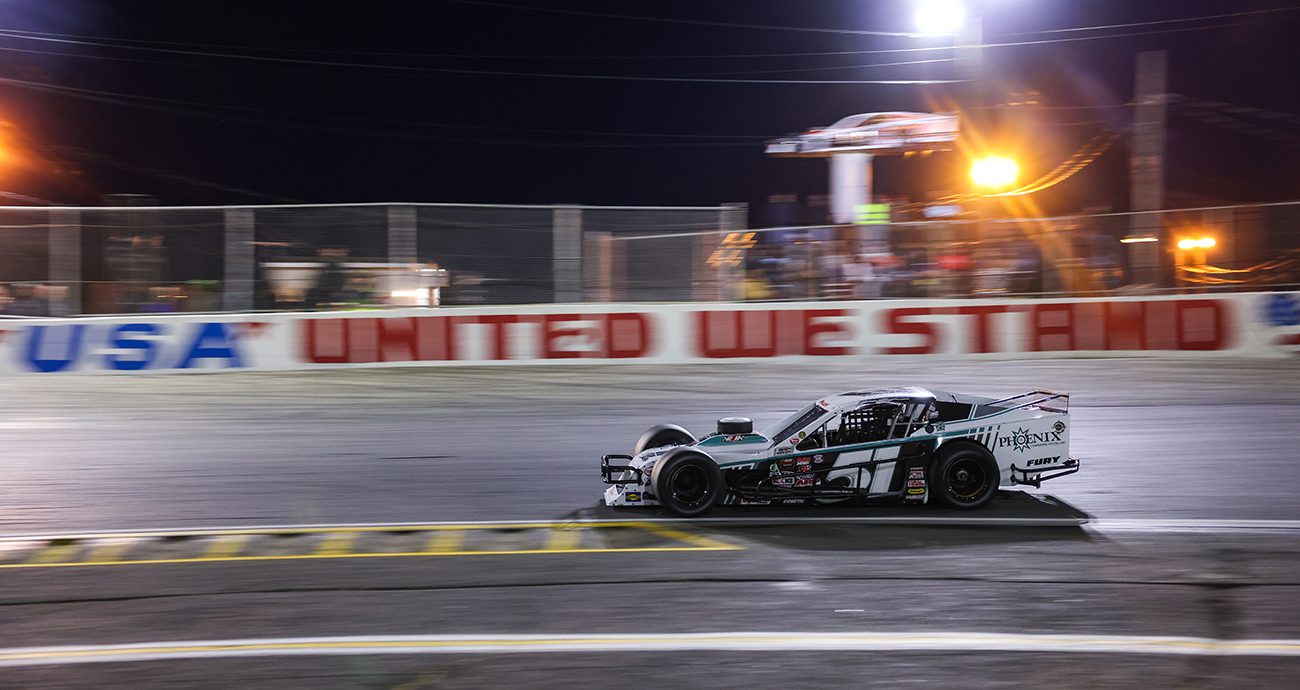
 Riverhead Raceway and Modified racing have gone hand in hand for decades.