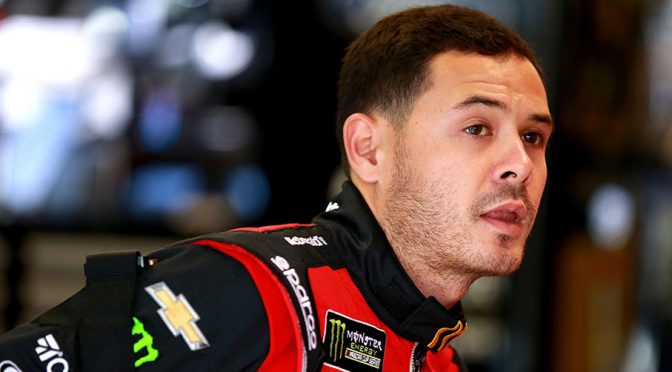
It’s been a busy week for Kyle Larson. In addition to getting ready for the Round of 16 elimination race, the Bank of America Roval 400 (Sunday, 2 p.m. ET on NBC, PRN and SiriusXM NASCAR Radio), Larson and longtime girlfriend Katelyn Sweet got married this week.

The couple got engaged last December and have two kids, Owen and Audrey. Owen routinely steals the show at track as his dad’s biggest supporter, while Audrey was born in May of this year.

NASCAR Vice Chairman Mike Helton appeared on SiriusXM NASCAR Radio’s Morning Drive as part of a one-hour show on Wednesday that was dedicated to helping the victims of Hurricane Florence. Helton joined NASCAR stars Jimmie Johnson and Joey Logano and other dignitaries such as Dover International Speedway President and CEO Mike Tatoian to help drum up support to send food and personal items to those affected by the storm.

“When there’s something like the hurricane, it affects people, it affects us,” Helton told Mike Bagley and Pete Pistone. “And if we’re in a position to help and support those that need the help, then we’re anxious to do that.”

Hurricane Florence relief efforts

Turns out, that’s a creed to which all of NASCAR Nation subscribes. Drivers, tracks and foundations alike all have answered the call with the need for Hurricane Florence relief still great weeks after the storm.

The NASCAR Foundation, for which Helton is board chairman and president, teamed with SiriusXM NASCAR Radio to hold the one-hour telethon earlier this week; and the respective foundations for Kevin Harvick, Jimmie Johnson and Joey Logano quickly ran the tote board up to $50,000 raised. The NASCAR Foundation kicked in another $50,000 during the show, and the $100,000 from those entities equated to 10 truckloads of food and personal items that will be heading to the victims.

Beyond that, drivers are helping in their own personal ways. Among them:

• Team Penske driver Brad Keselowski and his wife Paige are collecting donations that will be used toward the purchase of fuel for first responders. Paige, from the Eastern North Carolina coast, already has made trips to affected areas.

• Ryan and Krissie Newman sent a fleet of trucks to help rescue and relocate pets and affected animals, with Krissie herself donning gear and kayaking into the waters to help. Darlington Raceway and Talladega Superspeedway both provided support for these efforts.

Krissie Newman Florence Relief

• Brett Moffitt is hosting a fundraising campaign where one donor will win a trip for two to the NASCAR Camping World Truck Series finale in Miami.

• Denny Hamlin hosted a golf tournament in Myrtle Beach, which raised money for families impacted by Hurricane Florence.

• Brennan Poole is working with Carolina food banks to help victims.

• NASCAR President Steve Phelps tweeted that he was donating one truck full of food and personal items to be sent into the affected areas.

• Charlotte Motor Speedway, Atlanta Motor Speedway, Bristol Motor Speedway and Talladega Superspeedway all opened up their campgrounds to hurricane evacuees or those seeking refuge.

• The Kevin Harvick Foundation donated two trucks full of supplies.

• Motor Racing Outreach and the Waltrip Brothers Charity Championship sent four trucks of relief supplies.

• MRO and Roush Yates Engines, along with all Charlotte area NASCAR employees, collected supplies that were driven to the impacted areas.

That’s a lot of money and a lot of supplies, but more is needed. Now that the Sirius show is over, you still can help. Log on to NASCARFoundation.org/hurricane to make a donation. Even though the flood waters are receding, the cleanup will be extensive and the need for help will exist for many months.

For the first time in the NASCAR Playoffs drivers will compete on a road course. And for the first time in the Monster Energy NASCAR Cup Series, Charlotte Motor Speedway will be turned into a road course — the Charlotte road course, or the Roval as it is popularly being called.

Here’s what to know about the new track before Sunday’s race, the Bank of America Roval 400 (2 p.m. ET, NBC, NBC Sports App, PRN, SiriusXM NASCAR Radio).

Series racing on the Roval: Monster Energy Series and Xfinity Series

Length: 2.28 miles

Turns: 17

Change in elevation: 35 feet

Tires: Goodyear Eagle Speedway Radials (Cup: 3 sets for practice, 1 set for qualifying, 7 sets for race; Xfinity: 8 sets for the event).

Driving in the rain? Yes, wet weather tires will be on hand should conditions warrant their use. Cup teams are allowed two sets of “wets” for practice and up to four sets for the race; Xfinity teams are allowed up to two sets of “wets” for practice and up to two sets for the race.

Penalty for short-cutting any part of the course: If you short-cut the course (ie: blow through the chicane), you will be required to come to a full stop in one of the pre-determined zones (the restart zone alongside Turns 15-17 if the violation occurs in the Turn 11-12 chicane; the apron before the start/finish line if the violation occurs in Turns 15-17). Teams would be assessed a pass-through penalty if drivers fail to serve their penalties by stopping in the designated areas. Read More

What about restarts? Restarts will not include the chicane in the trioval so that all cars are on an even-playing field, and that the front of the pack does not have an advantage over the back.

Will “local” cautions be in effect? Yes. A spin or incident on certain portions of the track may not yield a full-course caution, but rather a blue flag specific to the area of the track where the incident occurred to warn competitors of an issue.

Playoff implications: This is the first elimination race in the 2018 playoffs for the Monster Energy Series. Twelve playoff drivers in the 16-driver field will advance to the Round of 12 next week at Dover. For the Xfinity Series, this is the second race in the opening round of the playoffs.

The schedule: NASCAR’s top division hasn’t had three road courses in a single season since 1987, when the series visited Riverside (California) International Raceway twice and Watkins Glen once. The Roval’s placement on the Monster Energy Series schedule also breaks up the all-oval monopoly that had held since the 10-race postseason format was introduced in 2004.

The tight confines: Unlike Watkins Glen and Sonoma, which both have gravel traps and paved run-off areas, the Charlotte oval/road course offers few places to veer off course in the event of a problem. That’s led to more than a handful of significant wrecks during testing, with drivers pushing the limits of the curbing and tire barriers that define the course.

Gallons of paint used to give Roval its look: 5,400 (RoadGrip, a British track surface painting company, painted the course. Mycroft Signs painted the frontstretch turf, the wall designs and signage, giving the Roval Grand Prix-style visuals.)

The ‘grass:’ Track officials installed 112,000 square feet of new synthetic turf in place of the existing frontstretch grass. The project stemmed from questions raised by Kevin Harvick among others about how to minimize damage from off-track skids. The intended goal is an even surface that prevents car bodies from digging into the turf. The first driver to overcook Turn 17 in practice will be the guinea pig.

Why is the pit wall pink? To salute breast cancer awareness. Seven-time Monster Energy Series champion Jimmie Johnson led other drivers, celebrities and dignitaries in painting the 1,500-foot wall pink on Thursday, Sept. 20.

How big is the new pedestrian bridge? The 80-foot long, 22,000-pound infield pedestrian bridge is between Turns 2 and 3 and features an open walkway as well as two elevators and will allow spectators to access Roval camping and infield Circle K convenience store.

Track layout: See map below

Contributing: Zack Albert, George Winkler

Overview of the Charlotte Motor Speedway road course.
Chase Wilhelm | NASCAR Digital Media


The “survive and advance” mantra for this weekend’s debut of the Charlotte Motor Speedway oval/road course likely applies for the majority of Monster Energy Series playoffs field. But two Joe Gibbs Racing teammates may be forced to play a bold form of offense on an unfamiliar track.

Erik Jones ranks 15th among the 16 postseason drivers, 21 points off the elimination line heading into Sunday’s Bank of America Roval 400 (2 p.m. ET, NBC, PRN, SiriusXM NASCAR Radio). Right below him sits stablemate Denny Hamlin in the final spot, 29 points below the cut-off level. The lowest-ranking four drivers will be scratched from championship eligibility after Sunday’s event.

RELATED: Clinch scenarios | Full schedule for Charlotte

Neither driver stands in a must-win situation to advance to the Round of 12, though that would scotch the mathematical guesswork by providing an automatic berth. But team owner Joe Gibbs said that both may have to lean more toward a more forceful approach to keep their postseason aims alive.

“I think obviously Erik’s first go-around on this, I think he’ll just have at it, and I think Denny, what we’ve got to do is throw caution to the wind,” Gibbs said. “That’ll be two cars that I think will just be — we’ve got a lot of ground to make up, and so I think they’ll be very aggressive.”

Failing a victory, both Jones and Hamlin would need help plus a new winner in the round (someone other than Brad Keselowski or Kyle Busch) to advance on the basis of points.

MORE: Drivers with clutch playoff momentsPlayoff standings 

Hamlin has never failed to clear the first round since the elimination format was introduced to the Monster Energy Series postseason in 2014. He has shown recent signs of speed by notching three pole positions in close succession near the end of the regular season, but his results haven’t backed those showings up.

That trend was especially evident last weekend at Richmond Raceway, historically one of his better tracks. Hamlin lagged after starting second while his teammate Kyle Busch worked his way from the back of the field to post his seventh win of 2018.

“It just seems like once we get into race trim, it just seems like I can’t get the car to do anything it’s supposed to do,” Hamlin said post-race. “I can make it go fast for a lap in qualifying. It just will not do the things that it’s supposed to do around the race track, and the things that when I watch the 18 (Busch), it’s doing successfully. So it’s just really disappointing.”

The first-ever NASCAR event on the Charlotte Motor Speedway combination road course and oval layout has both drivers and teams bracing for the unknown. But the newfangled circuit has also forced Goodyear Racing engineers to be quick on their winged feet.

The tiremaker’s motorsports division settled on a new road-course tire for the inaugural Monster Energy Series and Xfinity Series events this weekend. But the selection of a new tire construction and compound — much like the circuit itself — was the product of months of collaboration and development.

RELATED: Full schedule for Charlotte

“It’s a real balance and a real compromise to end up with the right tire package,” said Stu Grant, Goodyear’s general manager of global race tires. “The whole process was actually a really great process because there were so many stakeholders and there was such good communication between everybody. It was really a pleasure to be a part of it because it was so interesting.”

The new 2.28-mile course has evolved since the first on-track evaluation nearly a year ago. Since then, the infield section has been made less intricate with the removal of a tight switchback, the oval layout has been broken up by a pair of chicanes (one on the backstretch, the other near pit entrance), while other portions have been more clearly defined by barriers and curbing.

Goodyear’s choice of tire for the weekend events has evolved with the course configurations. Short-track tires and the Charlotte oval-track tire were both examined, but neither of those options performed particularly well for all sections of the circuit.

PHOTOS: Scenes from the summer tests on the course

Two tire tests, an organizational test and many simulations later, Goodyear’s selection became clearer after input from NASCAR competition officials, track representatives, drivers and teams. The Roval tire represents a happy medium somewhere between the rubber used at the Monster Energy Series’ existing road-racing circuits, falling between the higher-speed Watkins Glen International and the slower, more technical Sonoma Raceway.

“There’s no stagger difference, so it’s the same tire all the way around, a road-course construction and a road-course compound,” Grant said. “We ended up with a course configuration that we were able to treat as a road course. There’s not enough speed or time on the oval to demand a different type of tire construction closer to an oval race track. It was really a super-interesting process to go through that step-by-step change.”

Goodyear Racing invited a group of media members to a tour of its headquarters last month for a close-up view of the manufacturing process. Among the tires being built were Goodyear Eagles earmarked for Roval duty, with each tire getting personal treatment by specialists who affix the plies, belts and layers of the fresh rubber by hand before automation stepped in.

The personal touches include each tire’s mark with the signature of the lead technician, adding an extra layer of ownership for Goodyear’s engineers.

“We’ll bring a couple thousand tires each weekend, but in the grand scheme of things compared to consumer tires, these are really small batches,” Grant said. “For us, we need to be able to have the flexibility to be able to make small changes. We need to make small changes to make sure we provide the best tire at each race track, at each event, so we need the flexibility. We can’t afford the super-automation because you lose flexibility when you do that. It works for us. It allows us the freedom to be able to tailor a tire for a particular race track and race car.”

Flexibility may be at a premium this weekend, especially if the weather turns damp. Grant says Goodyear will be prepared with wet-weather tires, with Monster Energy Series teams allotted four sets for Sunday’s Bank of America Roval 400 (2 p.m. ET, NBC, PRN, SiriusXM NASCAR Radio). The treaded rain radials — denoted by white sidewall lettering instead of Goodyear’s traditional yellow — have been used five times in Xfinity Series events, but not yet in Monster Energy Series competition.

MORE: Rain tires approved for Roval events

Should rain tires be deployed for either event this weekend, it would mark their first appearance on portions of a high-banked oval. While such a sight might fuel an outcry for the use of wet-weather tires on speedways to avoid rain delays, Grant says the higher speeds and the likelihood of visibility trouble from spray would rule out rain radials on a true oval.

“We’ve done some tests at some ovals and the difference with this is you’re not running 180 miles per hour,” Grant said. “The way you enter the (Charlotte) oval from the infield is at a lot slower speed and then you’re back off the gas after you go through the chicane getting back into (oval turn) 3. The high-speed oval application, I don’t think that really applies. You’re going slow enough on the Charlotte oval part that we believe the rain tire will work in that application because the speed is down so much.”

Speed, coverage and control are critical elements of successful pit stops in NASCAR races – and pit stops can determine winners. Drivers, owners and crew chiefs break down the pit stop in the video series, “Xfinity Presents: Technology that Defines NASCAR.”

Speed is critical in pit stops, as the time it takes to complete routine fueling, tire changes and car adjustments has shrunk dramatically from the sport’s early beginnings.

“In 1960, a pit stop was 45 seconds for two tires and gas,” Wood Brothers team owner Leonard Wood explains. And now it’s more like 12 seconds, says Eddie Wood.

Team practices play a crucial role in building successful routines performed seamlessly under pressure, leading to pit stops that focus on speed more than ever before. Even a tenth of a second can make a significant difference in the race off pit road.

“It kind of goes back to the pit crew,” Team Penske driver Ryan Blaney says. “They have to really be on their game to make big adjustments to the race car and not lose much time.”

And coverage of pit-road stops helps teams gain better control over how they conduct pit stops, using cameras to determine if all the lug nuts are secure and analyze pit stops after completion.

Watch “Xfinity Presents: Technology that Defines NASCAR – Success on Pit Road” for more insight into ways NASCAR’s top teams use technology.

Change the way you WiFi with Xfinity xFi. Xfinity xFi gives you the speed, coverage and control you need for the ultimate in-home WiFi experience.  Learn more at xfinity.com/xfi.

Xfinity. The Future of Awesome.

Seventh-grade students at Charlotte’s Piedmont Middle School enjoyed a break from regular classes Monday thanks to a visit from NASCAR and Xfinity Series driver Matt Tifft, part of a special event to kick off Charlotte race week.

More than 350 students participated in a series of educational activities designed to highlight the intersection of NASCAR and STEM – Science, Technology, Engineering and Math. The students rotated through a half-dozen interactive stations led by NASCAR engineers, officials and other volunteers to learn how concepts like acceleration, aerodynamics and friction applied to the motorsport.

The event also celebrated the launch of a new digital simulation available for students via NASCAR Acceleration Nation, the sport’s national youth platform developed in partnership with Scholastic.

“Kids represent the future of the sport, so this was a great opportunity to inspire them to learn about principles like aerodynamics and downforce, but also have them learn about NASCAR,” said Pete Jung, NASCAR vice president of brand marketing. “If we can inspire kids to learn and take an interest in STEM as part of their curriculum or even career path, I think that’s a home run.”

Tifft, who briefly led and finished fifth in Friday’s Xfinity Series playoff opener at Richmond, surprised the seventh-graders with ticket vouchers to the Drive for the Cure 200 at Charlotte Motor Speedway on September 29.

He also talked about his racing career and how using NASCAR as a backdrop can make learning subjects like math and science especially fun for kids.

“I never realized how much science, math and engineering was a part of racing until I got into it,” said Tifft, driver of the No. 2 Chevrolet Camaro for Richard Childress Racing. “Everything we do at 200 miles per hour really comes down to those fundamentals, whether it’s a shock change or track bar change or wedge adjustment.”

“Many of the students don’t really know what a spoiler is or understand wind resistance, so today they got hands-on experience with building cars and understanding the different parts of the car,” said Teresa Peterson, Piedmont Middle School dean of students for the sixth grade. “It’s real-life application to what we’re teaching them every day, which is important because kids need to know there are cool things they can do in the real world where they can apply STEM.”

The STEM event is part of a larger effort to integrate NASCAR into middle-school STEM curriculums across the country. NASCAR Acceleration Nation learning materials use racing to explain principles like drafting, downforce and drag, and are being taught in more than 30,000 classrooms nationwide.

Students can also learn about NASCAR, the tracks and drivers, and play interactive games on the NASCAR Acceleration Nation website and mobile app.

Editor’s note: The following article was written by Team Penske driver Brad Keselowski.
Follow him: Facebook | Instagram | Twitter

Every summer, NASCAR has an off-week that gives drivers and their families the opportunity to do something really special. This year, I chose to travel out of the country to Germany with my wife, Paige.

It turned out to be a great call. For one thing, it gave me an opportunity to take a break from racing and recharge my batteries. (And based on the results that immediately followed our vacation — I won three straight Cup races and an Xfinity race, too — it seems like it helped.)

But even more than that, it was an amazing trip, and a big one for me because it was the first time I’d ever traveled outside of North America. I want to share some of my observations with you because there were some incredible, striking differences between Germany and the United States, and they got me thinking.

GETTING THERE

First off, the trip there was a 10-hour flight, and I’ve never experienced jet lag like that. It was brutal. That whole day, I could barely stand up. I hadn’t flown commercial in about 10 years, and that was something different. But outside of the time the trip took, traveling was pretty great. The airport experience was actually pretty good. We flew on Lufthansa, and there was WiFi service and all that on the way out, and it was a lifesaver. (On the way back, though, it didn’t work, and that wasn’t fun.)

Like I said, I’d never been outside of North America before, so just going was kind of exciting. We went during holiday month and what we discovered when we got there was that everyone was gone because they were taking a month off. That was flabbergasting. I couldn’t imagine taking a month-long holiday. I really can’t. It sounds awesome. I just can’t imagine doing it.

Can you imagine if the United States shut down for a month?

Brad Keselowski and wife Paige in Germany

DACHAU

There are some things on my bucket list that I’ve wanted to do forever, and one is that I’ve always wanted to see a concentration camp. The history of World War II and the camps have always interested me, and being there and seeing one firsthand was important to me.

So we went to Dachau Concentration Camp, and it was powerful. I can’t say there were any surprises there in terms of what we saw. I’ve done a lot of reading about the Holocaust to try to understand it. The most striking thing to me about going to Dachau was that the camp isn’t in the middle of farmland. It’s right outside the city. It’s surprising. It’s obviously not hidden from sight, so that tells you that there were a lot of collaborators in terms of the camp beyond members of the Nazi party. So that was really striking.

But the most striking thing to me, which is kind of burned in my brain right now — and I’m imagining that it’s going to be burned into my brain for a very long time — is that there was a brand new subdivision built right up against the wall of the camp. During World War II, the camp wall had a moat, and when the Allies arrived, the moat was filled with thousands and thousands of corpses.

I just can’t imagine building a brand new house right next to this site, just backed up against the wall. And when I say backed up against the wall, what I mean is that the wall was about six feet tall, and right there were the backyards. I’m about six feet, so I was able to peer over the wall and see the houses.

The striking image in my brain is the following. There was a house that had young children living in it. They had a little backyard playground set, the plastic type you might get for little kids at a Walmart. Nothing super fancy, but one that you might put in your own backyard. The kids were playing there right up against the wall. The concentration camp side of the wall still had these roped off crosses up. They looked like they’d been roped off for a reason, like the type of crosses that you might hang someone from, or where you’d tie them up in order to beat them to death.

So there’s a wall separating these kids from that, but they’re maybe six feet away.

One of the kids was playing with a ball, one of those cheap plastic balls you’d get at a supermarket or something. And as they were playing with this ball, it went over the wall, and it landed right next to the crosses. It was like a scene out of something like “The Sandlot.” Like don’t go over the wall and get this ball — it’s lost forever. The plastic ball happened to be a Disney ball with a picture of Elsa from “Frozen” on it.

Something about the whole scene really turned my stomach. It reminded me of “Schindler’s List,” of that scene where everything turned from black and white to color with the little girl’s coat, the red coat. It was just like that, just that vivid. I’m not sure how to describe it. Watching little kids live and play right next to an area where hundreds of thousands of people were murdered was just striking. I don’t know how you could ever build a house there, let alone live in it with kids. It feels like a piece of land that should just be off limits.

To see that was just stunning. And having a daughter made it even more so.

DISNEYLAND INSPIRATION

Paige and I are Disney fans, so we went on a tour of a bunch of castles, including the famous Neuschwanstein Castle. That was a lot of fun. They were beautiful. Neuschwanstein Castle, which was Walt Disney’s inspiration for Sleeping Beauty’s Castle at Disneyland, reminded me of the Biltmore Estate in North Carolina. They were very similar. They were both incredibly over indulgent. They both had very tragic stories. The Biltmore was the work of the Vanderbilts, and whichever Vanderbilt constructed it only lived in it a few years, and died unexpectedly.

A castle Brad Keselowski visited

It was a similar story with Neuschwanstein Castle. It was built for close to a billion dollars in today’s money, and was never finished because the king who was building it died. Afterward, the government decided it was wasteful to spend so much money on a castle. It was turned into a tourist attraction, and has probably made what it cost to build and then some in the nearly 150 years since it was built.

I loved seeing the architecture. I loved German architecture in general. It’s just different. I’ve always been a fan of architecture and engineering in general. I liked the Gilded Age stuff a lot. It’s fascinating. You don’t see that a lot in the States outside of New York, Chicago and Detroit.

After that, Paige and I joined up with some friends we’d planned on meeting, and did some hiking in the German Alps. We’ve just started getting into hiking, and hiking in the Alps was really neat. I’d never done anything like that. We saw a hollowed-out glacier there that was extremely cool.

AMAZING INFRASTRUCTURE

Germany is very, very clean. You barely see any litter or trash. I don’t know if I ever saw a dilapidated house or building. I saw a place being refurbished, but every house we came across was freshly painted and well taken care of. That was cool.

The country as a whole has incredible infrastructure. I learned that a big reason why is that Germany doesn’t have to spend resources on military spending — the U.S. essentially provides it for them. Because of that, the government has a tremendous budget to work with to afford things we don’t have in the United States. College over there isn’t free, but it’s basically free by American standards. I was told it works out to roughly $5,000 a year, I think, which is crazy when you think of what it is here.

AMERICA ON THE MIND

One of the things on the mind of every German we met was Donald Trump. Pretty much everyone wanted to ask, “How did you elect him?” I must have heard that a hundred times.

Kes Paige Germany Inset

Beyond the president, Germans seemed completely fascinated with our way of life. I don’t think Americans think a lot about Germany, but you could not go anywhere in Germany without hearing about America. They know everything about America, sometimes more than I think we know about ourselves. I found that baffling at first. If you asked the average American about Germany, they couldn’t tell you that Angela Merkel is running the country, and 99.9 percent of Americans couldn’t tell you the name of any other German government official.

You turn on the TV in Germany, it’s all American news. I found that absolutely fascinating.

After being there nearly a week, I understood at least in part why that was. They’re almost completely reliant on us for defense, and there are a lot of American military bases there. Almost everywhere you went, you’d find some remnants or active United States military there, securing the area. They really think of us as a key part of their system, which we clearly are.

On a related note, I thought it was interesting that a lot of people there speak English. I thought maybe they’d be a little upset that I didn’t speak German, but they were actually pretty kind. When people would walk up to me and start speaking German, and I would give them that “I don’t know what you’re saying” look and say hello, they’d automatically transfer to English to speak to me. On the flip side, I also felt like a complete idiot not being able to speak their language. And it made me think about how important it is globally for us all to be able to speak the same language.

I started to ask the Germans I met why it was so important that they spoke English. The answer I got from multiple people was because of the American military there, and because of their lifestyle, they had to learn English to communicate with them.

OTHER OBSERVATIONS

Some additional takeaways I had:

Aside from Donald Trump, the other thing everybody in Germany was talking about were the Syrian immigrants. That was a very hot topic there. When we walked through Munich, there were a lot of Syrian immigrants. Opinions on the topic varied from person to person. Some people thought it was a disaster. Some people though it was a noble cause. But it was pretty controversial.

I was really excited to drive on the autobahn, but because it was holiday season, we didn’t really get to let loose the way I’d imagined we would. There was a huge amount of traffic and construction. That was a bummer because I’d really wanted to open things up so badly. The few areas where we were allowed to stretch it out a bit (and there were a few) were fun. In the rest of Germany, the speed limits are actually slower than in the rest of the United States, something like 20 to 40 kilometers per hour (like 15 to 35 miles per hour).

In all the hotels, the showers are weird. We stayed in four different hotels, and the shower in every one of them was quirky in a strange way. One was open on three sides. Water went everywhere. In another one, you couldn’t turn the shower on because the shower head sprayed out the door. Another shower was so low you couldn’t use it. It was kind of funny by the end of the trip.

They really like pavers. Everywhere you go, there are pavers instead of asphalt — which looks pretty cool, incidentally.

World War II is a taboo subject in Germany. The people there talk about it begrudgingly, and almost everybody there was ashamed of it, and conveyed that. Along those lines, all kids in school there have to go to a concentration camp, just to see it. I was fascinated by that.

With all the modern German architecture, the buildings have an outer layer of aluminum or steel, almost like an exoskeleton. It looks pretty cool. Unfortunately, it creates this effect where your cell phone doesn’t work in most buildings. It’s like being in an elevator. I can’t tell if that’s intentional or not.

They have old, beautiful churches everywhere, but funny enough, none of the people I met actually went to those churches. For the most part, these amazing buildings were empty and unused a lot of the time. It’s especially interesting if you live in the South like I do. We have modern architecture churches with a lot of people in them. In comparison, it seemed like their churches were almost more landmarks than functional.

Everything outside of restaurants and entertainment places in the cities — grocery stores, gas stations and so forth — closes early, by six or seven o’clock at night. If you don’t have gas and groceries by then, you’re basically screwed. It made me wonder about anyone who worked a late shift, but when I brought that up, people basically just responded, “Too bad.”

Another thing that stood out is the food they eat there. They love sausage, and I can tell you, the gluten free craze has not hit there yet. In the States, we’ve gotten away from bread. Everywhere you go there, there’s loaves of bread, and I don’t mean your grocery store white or wheat bread. I’m talking fresh out of the oven, and all kinds of different breads. Every meal there’s bread, bread, bread, bread, bread. And it’s really good bread. They’ve got a ton of pizza places, too. (Apparently, loving pizza might be a universal thing.)

The nudity and violence standards there were completed flipped. In the United States, if you turn on the TV, and see someone naked, it’s like, “Oh my God, it’s the end of the world.” Over there, it’s no big deal. You could go to the park, and there’d be people nude in the park. (Not that I wanted to see that, because I didn’t. It’s never what you hope it’s going to be.) But they’re just completely fine with that. On the flip side, violence is completely taboo over there. You don’t see it anywhere. You don’t see violent movies or TV shows. So that was interesting.

Another thing: We videoed a lot of our trip, and people there get really upset when you film them. Really upset. A few people actually came up to us and said, “Are you videoing? Turn that off, we don’t want to be on your video.” Except on government buildings, you barely ever see cameras.

Most of the buildings there don’t have air conditioning. They just leave a window open. I’m not a fan of air conditioning. I hate air conditioning, so I thought that was great. I asked them why they were against it, and there’s a strong sentiment in Germany that air conditioning is bad for you, invites bad bacteria, and so forth. That’s something I agree with. That’s not to say they didn’t have air conditioning. But even in the places they had it, they didn’t like to use it.

Finally, on a red light, it flashes yellow before it goes green to give you a warning. I love that. It’s way more efficient. Everybody moves immediately after a green light because they have a warning. You know before a green light, nobody moves for a few seconds. That doesn’t happen in Germany because of the yellow light. Everybody’s ready to go.

THE NEXT JOURNEY

I was definitely happy to get back home, and I’d never want to live everywhere besides the United States. Still, I learned a lot from our trip.

For me, if we could adopt a similar culture of keeping our world cleaner, that would be great. You drive through the States, it doesn’t take long to find places that aren’t well kept. In Germany, you’d have to look for them. And I’m definitely all in on getting rid of air conditioning, and implementing their street light structure of yellow, green, red.

All in all, going to Germany was really fun and eye-opening, and I enjoyed seeing people living a different way of life. It definitely has me thinking about where I’d like to go next, and excited about all there is to learn from other places Paige and I might visit.

Any recommendations?

NASCAR cited the No. 18 team in the Monster Energy NASCAR Cup Series for a lug-nut violation on Wednesday. The Joe Gibbs Racing Toyota was found to have one lug nut not safe/secure in post-race inspection following Kyle Busch’s victory at Richmond Raceway in the NASCAR Playoffs.

As a result of the violation of sections 10.9.10.4 of the NASCAR Rule Book, crew chief Adam Stevens was fined $10,000.

RELATED: Busch wins at Richmond | Bell advances to next round of Xfinity playoffs

In the Xfinity Series, the No. 20 team of race-winner Christopher Bell was also cited with a lug-nut violation. The Joe Gibbs Racing Toyota was found to have one lug nut not safe/secure in post-race inspection. Crew chief Jason Ratcliff was fined $5,000.

Matt Bussa punched his ticket to the championship round of the NASCAR PEAK Antifreeze iRacing Series Tuesday night after holding off a late charge from Michael Conti at Atlanta Motor Speedway. Conti, who started from the pole and dominated before falling victim to an untimely caution, carved his way back through the field and was within striking distance of Bussa with 30 laps to go.

For the next 30 circuits Conti tried everything he could to pass Bussa but was unsuccessful. Multiple times Conti was able to draw alongside and even ahead of Bussa in Turn 3, but Bussa kept his momentum by using the high groove and fended off each attack. With laps winding down, Conti looked to make one final challenge, closing to Bussa’s bumper as the two took the white flag. However, Conti got loose off Turn 2, breaking his run and handing Bussa his first NASCAR PEAK Antifreeze iRacing Series victory.

RELATED: Full iRacing schedule/results

Conti, already qualified for the championship round thanks to his victory at Darlington, finished just over three-tenths of a second behind. Nick Ottinger followed in third with Ray Alfalla in fourth. The series’ most recent winner at Indianapolis, Logan Clampitt, completed the top five.

Conti led from the pole and stretched out a comfortable margin over Brian Schoenburg early. Then on Lap 65, still with a healthy lead, Conti chose to pit for routine service under green. The early pit stop would allow him to stretch his lead, but if a caution flew before others had pitted he would lose track positions or be stuck on older tires.

Unfortunately for Conti the caution flew on Lap 71 when Brad Davies crashed off Turn 2 and collected a few others. Conti had unlapped himself but decided to pit with the rest of the field to be on equal tires. He would restart 22nd with 91 laps to go.

On the restart, Clampitt jumped out front and would go on to lead 46 laps. Clampitt’s biggest challenger for the lead? None other than Conti who passed 20 cars and ran down Clampitt 40 laps after the restart. Before he could take the lead, though, Conti pitted for a final time for tires and fuel.

The race-winning pass ended up occurring during the round of pit stops as Bussa stopped a lap before Conti and used the fresh tires to his advantage. While Conti looked to have the quicker car and one lap fresher tires, Bussa found a line that was both fast and prevented Conti from clearing him for the lead.

With only one race left in the first round of the playoffs, time is running out for the four drivers on the outside looking in. Bussa and Conti are locked in with wins while Ryan Luza and Alfalla are currently in on points. With a 36-point gap to fifth, Luza looks safe to transfer. Alfalla is in a more precarious position as Ottinger is only 12 points behind in fifth. Keegan Leahy, Bobby Zalenski, and Nickolas Shelton are 24, 27, and 28 points behind, respectively. A win would most likely be required if any of them hope to transfer.

Dover International Speedway plays host to the penultimate race of the 2018 season, and with two transfer spots to the finale still up for grabs, look for strategy and daring moves from the drivers currently fifth through eighth. Who will join Bussa and Conti in Homestead to compete for the championship? Find out when the NASCAR PEAK Antifreeze iRacing Series hits the Dover high banks in two weeks.