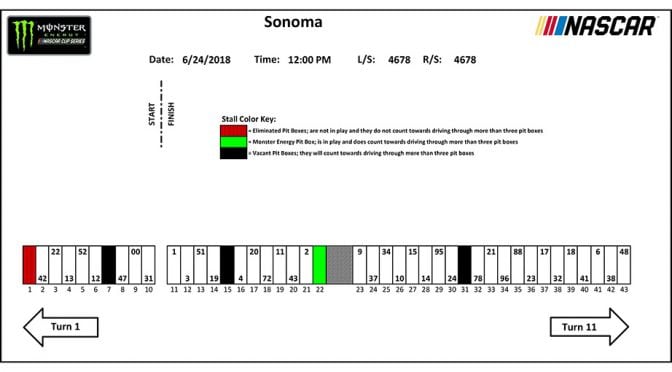
See where your favorite driver will pit at Sonoma Raceway on Sunday afternoon; the first road course race of the 2018 Monster Energy NASCAR Cup Series season (3 p.m. ET on FS1, PRN, SiriusXM NASCAR Radio).
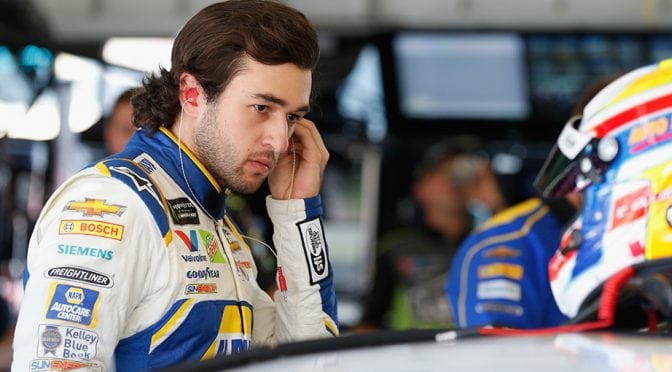
Kyle Larson won the Busch Pole Qualifying Award and will start in the top position in Sunday’s Toyota/Save Mart 350 (3 p.m. ET on FS1, PRN, SiriusXM NASCAR Radio) at Sonoma Raceway. After two practice sessions and qualifying, we’ve dissected the numbers and 10-lap averages to offer a suggested lineup worthy of your Fantasy Live consideration as you go to make roster decisions for the 16th Monster Energy NASCAR Cup Series race of 2018. Remember that the garage locks at the end of Stage 2.
RJ Kraft’s revised Fantasy Live lineup following practices and the lineup being set:
1: AJ Allmendinger
2: Jimmie Johnson
3: Jamie McMurray
4: Chase Elliott
5: Clint Bowyer
Garage: Kurt Busch
PLAY NOW: Set your Fantasy Live lineup | How the new Fantasy Live works
MORE: Fantasy analysis for Sonoma | Driver stats | Full lineup | 10-lap averages
Analysis: My main plan going into this weekend is to minimize my uses of the big names as best as possibility so I am leaving the big three of Kevin Harvick, Kyle Busch and Martin Truex Jr. on the sideline. Despite his spot on the pole, I am leaving Larson on the sideline as well — even though I have the uses to cover a play there. The thing with the California native is that qualifying at the road course has never been an issue, it’s been the end results with an average finish of 20.2. The other catch for me with Larson is I look at the summer stretch of Chicago, Kentucky, New Hampshire, Pocono and Michigan as great spots to get him in.
The only change from my original six-driver group is I am taking out Paul Menard in favor of Chase Elliott. The driver of the No. 9 Hendrick Motorsports Chevrolet qualified a surprising third and finished in the top 10 here last year. I would gladly take that again. The reason for Elliott over Larson is I feel comfortable with the No. 42 team for a number of races on the remaining schedule and I’m not sure how much I’d use Elliott moving forward. I gave some strong consideration to William Byron as well as I haven’t used him at all, but I just felt a little more comfortable with Elliott. I have only used Allmendinger, Johnson and McMurray a total of one time this season.
Bowyer and Kurt Busch did not qualify well — 19th and 23rd respectively but I trust in their Sonoma histories as they each have a win, seven top fives and nine top 10s here. They both led the two practice sessions as well. If all goes according to plan, I will only have one of them active and I’ll leave the other in the garage. Denny Hamlin falls in the same boat as he has had speed this weekend and has the most points in the past two Sonoma races. However, he qualified 21st and I’m a little lighter on uses with him so he stays off my roster. For my race winner pick, looking at someone out of the Bowyer-Hamlin-Harvick trio.
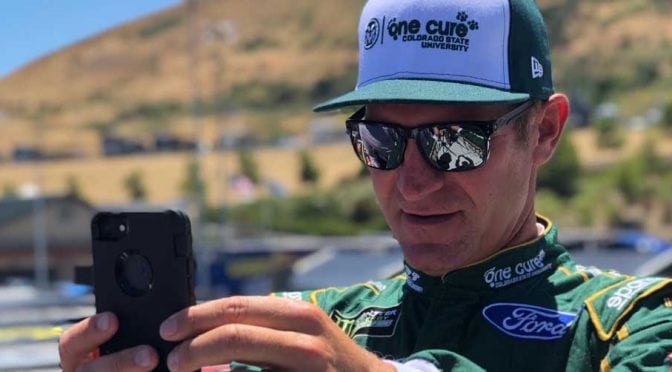
SONOMA, Calif. — Sometime between the festivities of his post-win celebration at Michigan and the trek out west to the vineyard-dotted hills of Wine Country, Clint Bowyer started daydreaming about Sonoma Raceway.
He thought about Turn 11 — “boy, are they going to dive-bomb there” — and Turn 7, where “a lot of action” happens.
At some point, maybe his mind wandered to winning at Sonoma Raceway — and what it would be like to put the No. 14 in Victory Lane for the third time this season following Sunday’s road-course event.
RACE DAY: Lineup | Keys to win
“This is one of my favorite tracks. I’ve won here before; I just have a lot of confidence here,” Bowyer told NASCAR.com after leading Friday’s opening practice at the Northern California track. “Statistically, it is one of my best tracks, so when you come here … you’re ready to go, your expectations are high and it was no different when we came here this year. We unloaded, the car’s fast, right up to the top of the board again and it’s been kind of business as usual so far from where we left off at Michigan.”
The Bowyer of 2018 is much different than the Bowyer NASCAR fans saw last season in his first year at Stewart-Haas Racing. The fun-loving, comical personality hasn’t wavered; but there’s a confidence that he and his team exude heading to the track every week.
Winning — and breaking a 190-race winless streak in the process — will do that to you.
“You can’t have confidence, you can’t have any of that, until you have success,” Bowyer said. “And everybody can say, ‘you’ve just got to change your attitude’ … it’s hard to be positive, damn it, when you don’t have that success to match it. All of a sudden, we put everything we learned (together) …
“Any time you start winning races, starting up front, collecting stage points — doing the things that we couldn’t do on a consistent basis last year — you start to exude that confidence and have that, not only from myself, but then you see it with our race team, everything else,” he said later. “Their swagger, their demeanor, their communication through a bad time. You struggle and it’s no longer (a) freak-out and panic and ruin the weekend. It’s ‘no big deal, we’ll get through it, we’re all in this.’ That’s the level of commitment and confidence that you have to have across the board of a race team and that’s what I see.”
FANTASY: Bowyer: Start or no start?
Bowyer also took the offseason to build up an important relationship; the one with crew chief Mike Bugarewicz. The pair took a hunting trip together and simply spent time with each other away from the track.
“That’s one thing that I regret not doing when I came to Stewart-Haas Racing is really getting to know Mike, and I think that was the thing starting right off at Daytona on the right foot,” Bowyer said. “We knew each other, we had fun and finally enjoyed each other away from the race track and once we got going to the race track, it helped so much more.
“And it’s not the easy times; when you’re having a good weekend, that’s easy. It’s when you start struggling. There’s been a couple times when we stubbed our toe in practices and things like that and just weren’t the best, but our communication and the vibe around the race team is so, so much better than it was last year and that’s been the difference.”
LINEUP: By paint scheme, with rosters
Bowyer and the No. 14 team will attempt to notch their second straight win of the season on Sunday at Sonoma, where he’s won once in 2012 and has earned nine top-10 finishes in 12 starts. With his recent surge, his name has floated around as a potential championship contender to join the “Big Three” of Martin Truex Jr., Kyle Busch and Bowyer’s Stewart-Haas Racing teammate Kevin Harvick.
Will a win at Sonoma solidify that? Maybe. Bowyer said there’s still some work to do.
“Are we running as good as my teammate Kevin Harvick or Kyle Busch on a consistent basis? No, I know that,” he said. “But what I see in our race team is progression almost every week; we keep knocking on the door more and more and more.
“If we continue to get a few more wins and get that points base established within the (Playoffs), I really feel like when we go back to the (tracks) for the second time, that we can be even better yet — and compete with those guys.”
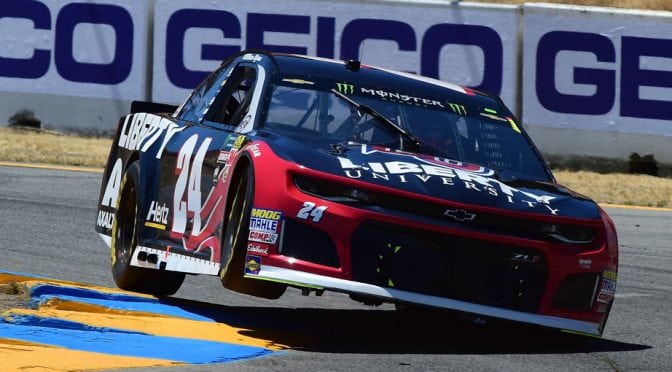
SONOMA, Calif. — Hendrick Motorsports driver William Byron, a Sunoco Rookie of the Year contender in the Monster Energy NASCAR Cup Series, has been sharpening his road-course racing skills under the tutelage of Max Papis.
Byron also worked with road-course expert Ron Fellows earlier in the week at Spring Mountain Motorsports Ranch in Pahrump, Nevada.
The work paid off on Saturday, when Byron qualified eighth for his first-road course race in the Monster Energy Series. It is Byron’s best starting spot of the season.
RELATED: Full Sonoma starting lineup
“Working with Ron a little bit and then working with Max Papis has helped me a ton in my career,” Byron said. “We work every week on a karting track trying to figure things out, so it’s been fun to get better.”
“Yesterday, I really started getting my rhythm of what I needed to do better and kind of put that all together today to try to get where we need to be. It was a lot of fun. I really enjoyed it.
“It was cool.”
Byron also got additional track time in qualifying and racing in the NASCAR K&N Pro Series West at Sonoma on Saturday.
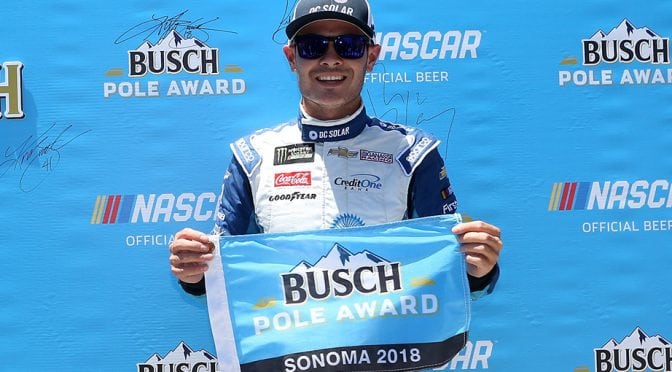
SONOMA, Calif. – Take the aerodynamic factor away and the new Chevrolets are just fine, as Kyle Larson proved Saturday in his pole-winning run at Sonoma Raceway.
Larson negotiated the 1.99-mile road course in 75.732 seconds (94.597 mph) – the fastest lap of the day – to earn the top starting spot in Sunday’s Toyota / Save Mart 350 (3 p.m. ET, FS1, PRN, SiriusXM NASCAR Radio). The Busch Pole Award was the California native’s second of the season, his second at Sonoma and the sixth of his career.
RELATED: Full lineup | Weekend schedule | Steve Letarte’s fantasy picks
Driving the No. 42 Chip Ganassi Racing Camaro ZL1, Larson edged reigning Monster Energy NASCAR Cup Series champion Martin Truex Jr. (94.227 mph) by .09 seconds. Truex will take the green flag from the front row for the fifth time in 16 races this season, having won three poles and having started first at Martinsville after a qualifying rainout.
Road course ace AJ Allmendinger was fastest in the first of two rounds at 94.477 mph (75.828 seconds), but Larson made a huge gain in the money round.
“It was a really good second lap there,” Larson acknowledged. “I figured I had run in the 75-second bracket. I just didn’t know how quickly, so when I saw the (75.732) pop up on my dash, I knew (it) would be a good lap, but I didn’t know if it was the pole or not.
“Once I knew I was ahead of the 78 (Truex), I figured the 47 (Allmendinger) was the only one that could beat me. I’m not sure where he messed up his lap, but he wasn’t able to get the pole (Allmendinger qualified fifth).
“It was cool to do it. We picked up a lot of time from the first round into the second round. The car had really good balance in the first round, so I don’t know what adjustments (the team made), if anything, but I was just able to attack the braking zones a little bit more and rush the throttle a little bit more on the exits, and it paid off.”
Chase Elliott qualified third, followed by Jamie McMurray, Larson’s Chip Ganassi Racing teammate, as Chevrolet drivers claimed six of the top eight starting positions. Truex had the fastest Toyota, and sixth-place qualifier Kevin Harvick the quickest Ford.
“It was a good lap,” Harvick said. “My Ford is a little better than me when it comes to this day. I was a little too conservative in a couple corners and gave up a little time, but it was a solid two rounds for us.
“The hardest thing to do is make it out of Round 1. After you do that, we went faster than we did in practice in Round 1 and faster again in Round 2. That’s always a good thing for me.”
MORE: Kurt Busch, Bowyer top practices | Best 10-lap averages
Hendrick Motorsports, which supplies the engines for Ganassi, placed three drivers in the top eight, with Elliott, Jimmie Johnson (seventh) and Sunoco rookie William Byron (eighth) all earning spots in the first four rows.
Johnson’s starting spot is his best of the season so far.
“The car since we unloaded has been very competitive and good,” said the seven-time series champion. “I got two clean laps. I can’t say that I really gave away any time out there, which is tough to do on a tight little road course like this. A top 10 starting spot – we will take it.”
Series leader Kyle Busch qualified ninth.
“Our qualifying run was okay,” Busch said. “For some reason, we’ve kind of been lacking here this weekend. We haven’t been able to find that fast lap. We keep trying to work on the car and on the driver and have certainly made improvements to both, just not enough of them.
“Qualified ninth, that’s OK. Certainly, we’d like to be more in the top five spots, but it’s kind of what we got, so it’s what we’ll have for tomorrow.”
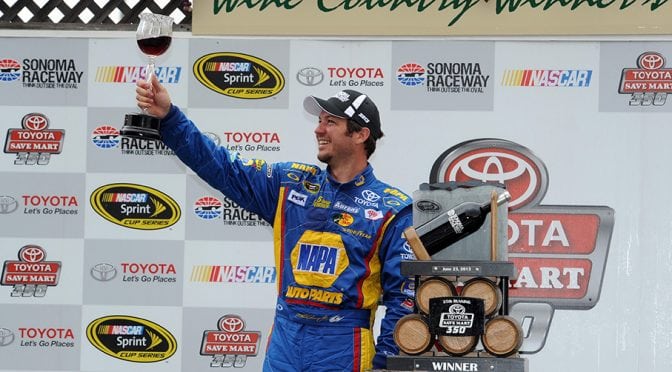
SONOMA, Calif. – Martin Truex Jr.’s 2013 victory at Sonoma Raceway holds a special place among the 17 wins the reigning Monster Energy NASCAR Cup Series champion has accumulated since his full-time debut in 2006.
Coming to California that year, Truex had been winless since his maiden Cup victory at Dover in 2007, a drought that had reached 218 races.
“A long time, very long – don’t remind me,” said Truex, a featured guest at a Sonoma Raceway luncheon on Thursday in San Francisco. “It was one of those weekends where everything just felt right. We had a good practice. We had, I felt like, a really good setup for the race.”
RELATED: Behind the scenes at Truex Jr.’s first pitch
Truex finished 8.133 seconds ahead of runner-up Jeff Gordon, exceeding the 7.355-second margin of victory in his inaugural win at Dover six years earlier. Gordon and third-through-sixth-place finishers Carl Edwards, Kurt Busch, Clint Bowyer and Kasey Kahne all have at least one Sonoma triumph on their respective resumes.
Obviously, Truex beat the best to score his second win.
RELATED: Every winner at Sonoma
“We ran third early on in the race for a while and had some pit strategy work out a little bit in our favor,” Truex said. “We were able to get the lead and then just managed the gap and the tires and really were able to drive away on long runs.
“That was awesome. We had a couple of late-race restarts where some guys that were really good there back then – (Juan Pablo) Montoya, I think, was running second for a while … but we were able to drive away and control the race.
“I remember how awesome it felt, how amazing it was, because it had been so long, and I’d been working so hard to try to get back to Victory Lane. Our team at that time (Michael Waltrip Racing) had been so close to winning so many times. It seemed like every time, somebody would just pull the rug out from under us.”
As it turned out, that victory represented the pinnacle of Truex’s career at MWR. He wouldn’t win again until 2015 at Pocono, after he had moved to Furniture Row Racing, the team he led to the 2017 title.
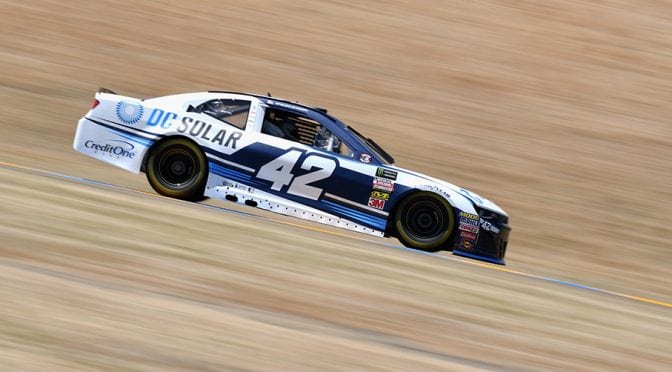
If the right attitude can translate into a break-through trophy then Kyle Larson should be ready to gulp his share of fine Northern California wine straight from the winner’s oversized chalice Sunday at Sonoma Raceway.
Larson has celebrated there before – dominating the 2014 NASCAR K&N Pro Series West race, leading every single lap in his first high profile NASCAR event at the scenic 11-turn road course. And he is the defending Busch Pole Award winner for Sunday’s Monster Energy NASCAR Cup Series’ Toyota/Save Mart 350 (3 p.m. ET, FS1, PRN, SiriusXM NASCAR Radio).
And while the versatile racer is as well-known for his dirt-track roots and prowess as his NASCAR rise to fame and popularity, the 25-year-old concedes he sure does love a road-course challenge, too. Especially when it’s essentially the Elk Grove, Californian’s “home track” – the very place he was famously photographed wearing a Jeff Gordon driver’s suit attending the summer NASCAR race as a young boy.
RELATED: Should you put Larson in your Fantasy Live lineup? | Full Sonoma schedule
“I think it’s a lot of fun,’’ Larson said of road-course racing. “It’s fun to get to do something totally different than what I ever grew up racing. A pavement oval is totally different than what I grew up doing, but a road course is way opposite.
“I enjoy it. I feel like I get better and better at it. To me, I feel like racing a stock car on a road course is more similar to a sprint car even because you can feel the suspension working more than you can on an oval. So, there are aspects of it that my background benefits to this more so than a normal oval race. I enjoy it. This is my home track so I get to see a lot of friends and family and hangout with people that I don’t get to see very often too.
“I enjoy this weekend a lot.”
It’s the first time in two years that Larson will be winless on the season as he arrives back home in Northern California. He visited Victory Lane twice last year before he arrived in Sonoma. But Larson has been a bright spot for his Chevrolet Camaro brand and is the highest ranking Chevy driver (10th) in the points standings right now.
He has four top-10 finishes in the last five races heading to Sonoma and he has three runner-up showings on the season (at Fontana, Calif., Bristol, Tenn. and Pocono, Pa.). Overall, he has nine top-10 efforts through the opening 15 races.
“I feel like our speed has been there all year really,’’ said Larson, who drivers the No. 42 Camaro for Chip Ganassi Racing.
“I feel like speed wise we have been about the same as we were last year. I think you can look at Stewart-Haas, (they are) quite a bit better than they were last year. I feel like compared to the Gibbs cars we are kind of right where we were to end the season with them last year, so we were pretty good there, so no, I don’t feel like our team is frustrated at all.
“I think we look at it as there is a lot of room to gain which is nice because I feel like we are already competitive and if we get any bit better we will be in a good spot. So, I think our team is definitely optimistic.”
Following his dramatic win in the K&N Pro Series West four years ago, Larson has been especially eager to triumph at the Cup level on Sonoma’s 1.90-mile course. He has never started the race from a position lower than fifth. And the pole position and nine laps led last year were a career highlight for him here. His four finishes, however, have been more disappointing. He’s had essentially twin bills – two times he’s been 15th and he bookended those with a finish of 28th in his first race and a 25th-place showing last summer.
“Always qualify well here,’’ Larson said, with a grin. “I think we have the track record maybe from ’14 or ’15, so that is pretty cool. The pole here last year was neat.
“I would like to race well here soon. I don’t know what it is about the race, but I always seem to struggle a little bit. Hopefully, this year is a little bit different and can do a good job and get our team up front.”
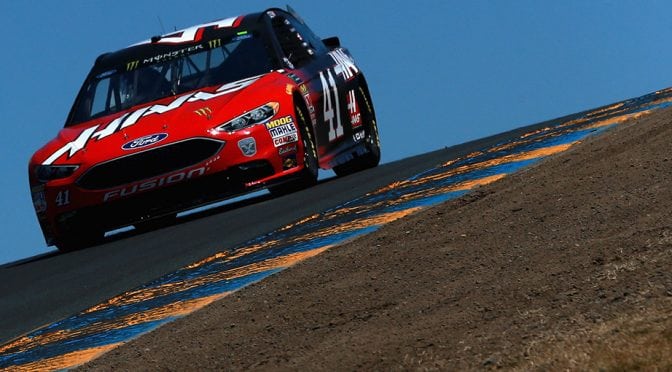
Kurt Busch led the way in Monster Energy NASCAR Cup Series final practice for Sunday’s Toyota/Save Mart 350 at Sonoma Raceway.
Busch got around the 1.99-mile road course at a clip of 94.061 miles per hour in the No. 41 Stewart-Haas Racing Ford. Busch has one victory at Sonoma, which came in 2011.
RELATED: Final practice results | Best 10-lap averages | Full Sonoma weekend schedule
Denny Hamlin was second-fastest in the No. 11 Joe Gibbs Racing Toyota, also eclipsing the 94-mph mark with a speed of 94.012 mph.
Martin Truex Jr. finished third with a lap of 93.718 mph in the No. 78 Furniture Row Racing Toyota, followed by Jamie McMurray in the No. 1 Chip Ganassi Racing Chevrolet (93.549 mph). Kevin Harvick provided a Stewart-Haas bookend to the top five with a lap of 93.441 mph in the No. 4 Ford.
Truex Jr. received significant damage to the front of his machine with roughly 10 minutes remaining, caving in the bumper of the No. 78 after running into the back of Bubba Wallace’s No. 43 Richard Petty Motorsports Chevrolet.
William Byron suffered an axle failure early in the final practice session, taking the No. 24 Hendrick Motorsports Chevrolet back to the garage while smoke billowed from the back of his Camaro.
Kyle Larson was also hit with mechanical trouble after light smoke puffed from the back of the No. 42 Chip Ganassi Racing Chevrolet while taking the esses portion of the 1.99-mile road course. The team confirmed the source of the smoke occurred after a transmission change between practice session. The crew changed a handful of hoses and o-rings, getting Larson back on track for the remainder of the session.
The next on-track action for the Monster Energy NASCAR Cup Series will be Busch Pole Award qualifying at 2:45 p.m. ET on FS1.
Practice 1
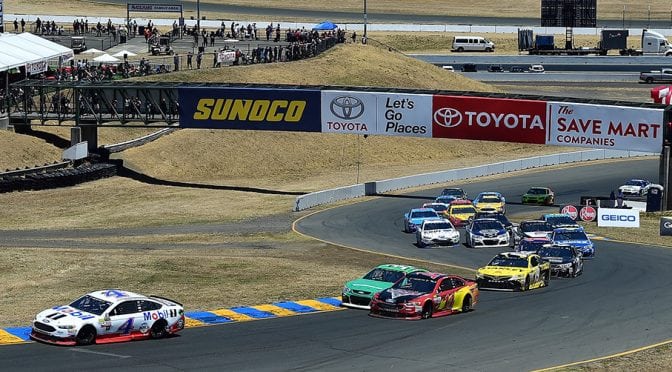
Monster Energy NASCAR Cup Series drivers shook down their race cars for the first time on a road course this season in preparation for Sunday’s Toyota/Save Mart 350 at Sonoma Raceway.
Fresh off his win at Michigan, Clint Bowyer led the way in the 75-minute session, rocketing to the top of the board early and staying there with a fast lap at 93.590 miles per hour around the 1.99-mile California road course in the No. 14 Stewart-Haas Racing Ford.
RELATED: Practice 1 results | Analyzing each turn at Sonoma
Ryan Blaney owned the second-fastest lap at a speed of 93.546 mph in the No. 12 Team Penske Ford, followed by teammate Joey Logano in third with a speed of 93.172 mph in the No. 22 Team Penske Ford.
Jamie McMurray in the No. 1 Chip Ganassi Racing Chevrolet (93.049 mph) and Daniel Suarez (92.746 mph) in the No. 19 Joe Gibbs Racing Toyota rounded out the top five.
Kasey Kahne lost control of his machine just 20 minutes into the session, spinning out the No. 95 Leavine Family Racing Chevrolet in Turn 2.
Paul Menard also received significant damage to the right-front fender of the No. 21 Wood Brothers Racing Ford, making impact with a tire stack in Turn 11. “I changed my line in Turn 11. I just got too close to the damn tire,” Menard said over the radio.
Four teams served practice holds at the end of this session for failing pre-race inspection at Michigan International Speedway. The No. 18 Joe Gibbs Racing team of Kyle Busch, No. 42 Chip Ganassi Racing team of Kyle Larson and No. 95 team of Kahne served 15-minute holds for failing pre-race inspection twice. The No. 38 Front Row Motorsports team of David Ragan served a 30-minute penalty for failing three times.
NASCAR announced this offseason that it will standardize at-track team rosters across all three national series in 2018, providing a structure for the number of personnel working on each vehicle during the course of a race weekend.
Official team rosters for Sunday’s Monster Energy NASCAR Cup Series race at Sonoma (3 p.m. ET on FS1, PRN, SiriusXM NASCAR Radio) have been released. Click the print icon above, or the link below.
ROSTERS: Sonoma race
RELATED: Overview of 2018 rules updates
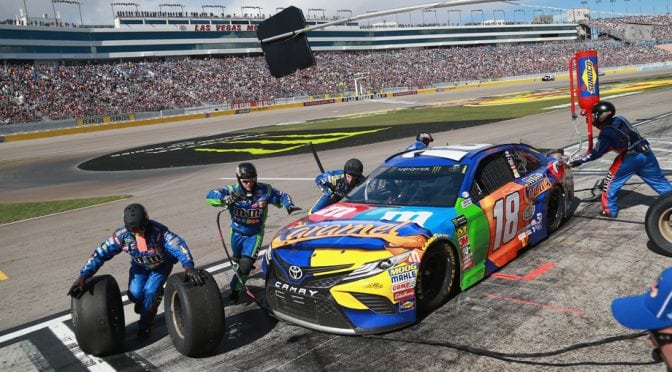
Ever been stranded on the side of the road with a flat tire? Can you change it yourself?
How about in less than 14 seconds? Now add a vehicle that has been going 200 mph, three more tires and the pressure of playoff points on the line.
MORE: NBC Sports debuts new ‘Peacock Pit Box’
Sound hard?
Pit crew members on any race team often face this type of enormous pressure. They can make or break a driver’s chance of winning a race off of pit road, and often may be the deciding factor of who ultimately takes the checkered flag.
And I had the opportunity to discover their challenges first-hand.
The No. 18 Joe Gibbs Racing pit crew is one that has dominated this year. They have fueled, changed and adjusted Kyle Busch’s Toyota Camry to four wins so far this season. Those victories helped “Rowdy” claim a career-long accomplishment of winning at every track on the Monster Energy NASCAR Cup Series circuit.
I had the pleasure of spending the day with these guys and seeing exactly what goes into simply “changing a tire.” The weight of the air gun is enough to make your arms sore for hours after. Then you have to aim it at five lug nuts on the center of a wheel in a rhythm that would make a musician happy.
These athletes make it look too easy.
Between practice and extensive workouts every day during the week, they travel with the team before performing on the biggest stage every Sunday. Most of them have an athletic backgrounds. Many have even suited up for Division I football teams around the country.
I gave it my best effort, as you can see in the video above. My skills need some work, and I doubt Kyle Busch will demand me on his team anytime soon. I did, however, get rewarded with unlimited M&M’s