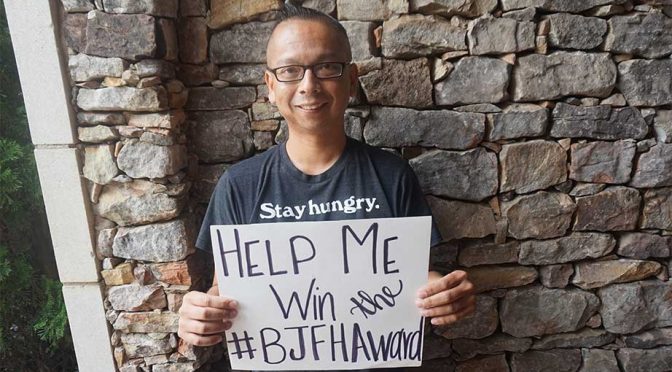
Editor’s note: This is the second in a series of four feature stories on this year’s Betty Jane France Humanitarian Award Presented by Nationwide finalists.

Julian Maha’s story is interesting and inspiring — and quite unique.

A Malaysian who became an Alabaman with an evolving affinity for NASCAR as part of the deal, Maha is one of four finalists for The NASCAR Foundation’s Betty Jane France Humanitarian Award Presented by Nationwide. The award honors NASCAR fans who are also accomplished volunteers working for children’s causes in their communities throughout the United States. It also honors the memory and the philanthropic legacy of the foundation’s late founder, Betty Jane France, who passed away last August.

On Thursday, Nov. 30, the award winner will be announced during the Monster Energy NASCAR Cup Series Awards at Wynn Las Vegas. The winner will be determined by online voting at NASCAR.com/Award; voting ends on Nov. 29 at 5 p.m. (ET). The NASCAR Foundation donates $100,000 to the charity the winner represents and $25,000 to the other finalists’ charities.

MORE FINALISTS
Tammy Richardon’s story

Maha’s charity is “KultureCity,” which he founded in 2013 with the mission to improve the lives of children with autism while also educating society about the inclusion of autistic individuals. Maha, an emergency room physician in Birmingham, Alabama — he lives in nearby Vestavia Hills — has a vested emotional interest in the mission. He has a non-verbal autistic son.

But let’s not get ahead of “the story.”

Maha came to Montgomery, Alabama as a teenager to live with his sister, who attended Auburn University on a tennis scholarship. Living near Talladega Superspeedway in true “NASCAR country,” he inevitably gravitated to NASCAR and now, at the age of 40, considers 2016 Daytona 500 winner Denny Hamlin his favorite driver.

“My initial exposure to the United States in Montgomery was pretty much in terms of through sports,” Maha says. “That was the biggest thing that helped me connect with my classmates. Coming to U.S. from Malaysia was a culture shock, everything was different. The unifying aspect for me was sports, and it was largely basketball and NASCAR.”

Maha left Alabama to attend the University of Calgary but would return and become immersed in his community. He also became committed to helping autistic children like his own son; in 2013 Maha founded KultureCity, which seeks to improve and save the lives of those with autism, while also educating society about inclusion.

Now serving as the volunteer president of KultureCity, Maha has led the development of the innovative Sensory Initiative, which addresses sensory inclusivity in locations such as arenas, stadiums and other public settings. The Sensory Initiative program has been utilized at the Birmingham Zoo and Quicken Loans Arena in Cleveland, and by 12 NBA teams and two NFL teams.

KultureCity also has developed the lifeBOKS program to help families monitor the movements of their children — autistic children can be prone to wandering — through GPS and Bluetooth tracking devices.

The Sensory Initiative and the lifeBOKS program — which would be the main beneficiaries if Maha wins the Betty Jane France Humanitarian Award — are high-profile achievements, but they rest on a platform of good, important work. Under Maha’s leadership, KultureCity estimates that it has impacted the lives of more than 50,000 autistic children.

This has been noticed. Maha is a past recipient of the Alabama Distinguished Citizen Award; he was named “Top Southerner” by Southern Living Magazine and was a Top 40 under 40 Influencer in 2016; and KultureCity has been named a Top-10 Non-Profit by Microsoft and the Top Non-Profit in Alabama.

Maha will be at Talladega Superspeedway this weekend, amid the excitement of Sunday’s Alabama 500, the crucial high-banked challenge that’s part of the Monster Energy Series’ playoffs. And he’ll be remembering the first time he visited the 2.66-mile track when he interviewed for the position of infield care center physician. The place was empty; the enormity of the facility blew him away.

“That was my ‘ah-ha’ moment for NASCAR,” he says.

There have been other moments that have collectively cemented his love of the sport.

“For me, the biggest thing about NASCAR, is that everyone gets together and they create what is almost a community over a race weekend,” he says. “It’s an amazing display of enjoyment of a singular event and an amazing display of unity. People from different backgrounds, different demographics. It’s everything that’s great about America.”
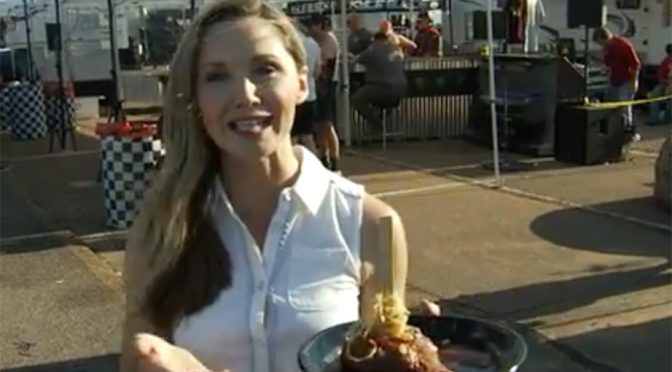
Talladega Superspeedway is known for its wild racing and entertaining infield.

Last year, Talladega gave new meaning to the term ‘Big One’ with the creation of its ‘Big One’ Meatball, which weighs about one pound. So, what else are we to do but see if the fans who hang out in the Talladega infield can handle such a delight?

Kim Coon and NASCARnivore decided to find out with a meatball eating contest. And as things normally do in Talladega, it got interesting between the contestants. In the end, victory was acquired in 3 minutes, 26 seconds.

However, unlike the winning drivers at Talladega there was no trophy to claim. Just a signed hat from Matt Kenseth.

Rankings below are based on a mixture of expected output and DraftKings’ NASCAR salaries for that day. The ordering is not based on highest projected fantasy totals, but rather by the value of each driver.

(FPPK = average fantasy points per $1,000 of salary.)

1. Ricky Stenhouse, Jr. ($8,000) – Believe it or not, Stenhouse is a favorite to win this weekend. He’s won the last two restrictor-plate races this season. Talladega is one of his best tracks. Stenhouse has finished 16th or better in seven of his eight races at Talladega. (4.0 FPPK)

2. Denny Hamlin ($9,500) – Everyone wrecks at plate tracks, but some drivers wreck less than others. Hamlin has made a name for himself by consistently finishing the plate races. His 12 top-20 finishes in the last 15 plate races (80%) lead NASCAR. (4.1 FPPK)

3. Joey Logano ($10,200) – If Logano wins this weekend, it will be his third win in a row at Talladega in the fall. Since 2015, Logano has six finishes of sixth or better in 11 plate races. What happened in the other races? Take a guess. Yes, he was involved in wrecks. (3.2 FPPK)

4. Kurt Busch ($8,300) – Winning the Daytona 500 definitely helps Kurt’s ranking. He’s finished 12th or better in the last six plate races. His 64% top-10 finish rate over the last 15 restrictor plate races is the best in NASCAR. (3.0 FPPK)

5. Clint Bowyer ($8,100) – Over the last 15 restrictor plate races, Bowyer has the best median finish (ninth). His nine top-10s over that span are the second most. He drives a Ford, and Ford has won 10 of the last 15 plate races. (3.5 FPPK)

6. Brad Keselowski ($9,800) – The Fords have excelled at plate tracks. They’re three for three this season. Last season, they won three of the four plate races. All three wins belonged to Team Penske. Keselowski won at Talladega and Daytona. He has five plate track wins. (4.2 FPPK)

7. Kyle Busch ($10,400) – Wrecking three times last weekend did not help the cause. Luckily for Busch, he has a trove of playoff points built up from the season. He’s sitting on a 13-point cushion, but he likely needs a top-10 finish this weekend to be safe heading into Kansas. (5.6 FPPK)

8. Austin Dillon ($7,400) – There is a skill to plate racing, but fortune also plays a large role. From 2014-2016, Dillon was one of the best plate racers with 11 top-15s in 12 races. Dillon is clearly skilled, but he’s wrecked in his last two plate races. (3.6 FPPK)

9. Kevin Harvick ($9,700) – In his last 15 Talladega races, Harvick has 11 top-15 finishes. He’s been even better of late. In his last seven Talladega races, he has six top-15s. He finished 23rd in the spring race, but he was on the lead lap. He could easily be seven for seven. (4.4 FPPK)

10. Kyle Larson ($9,400) – His career began with a handful of wrecks at plate tracks. Last year, he seemed to figure it out with five finishes of 12th or better at the plate tracks. Maybe he hasn’t quite figured it out yet, since he wrecked at Daytona. Then again, no one ever really figures it out. (5.7 FPPK)

11. Martin Truex Jr. ($10,100) – This race is almost meaningless for Truex. He’s already advanced to the next round. It’s safe to assume that Truex would rather finish the race in one piece than earn a couple measly stage points. Truex has wrecked in three of the last four plate races, so he likely just wants to finish. (6.6 FPPK)

12. Jimmie Johnson ($10,000) – Plate tracks are the great equalizer. Future Hall of Famers do not have much of an edge. Johnson has five top-10s in his last 15 plate track races. That ranks 10th, but a 33% top-10 rate is nothing to get excited about. (3.9 FPPK)

13. Paul Menard ($7,000) – How reliable are plate track stats? Menard has six top-10s in the last 15 plate races. His 40% top-10 rate ranks seventh. He’s on a roll at the plate tracks. His last four restrictor-plate finishes are third, ninth, fifth and 13th. The stats say you need to consider Menard. (3.9 FPPK)

14. Chase Elliott ($9,000) – The No. 24 car has 12 plate track wins. None of those wins were with Elliott behind the wheel. The car is still one of the best plate track rides in NASCAR, and Elliott has won three poles in that style of racing. If Elliott doesn’t wreck, then he should finish inside the top 10. (4.2 FPPK)

15. Dale Earnhardt, Jr. ($9,200) – Talladega is likely Junior’s last chance at a win. He’s still a 10-time plate track winner that’s not far removed from two plate wins in 2015. He was the pole-sitter at Daytona in July. Unfortunately, his best plate finish in the last two years is 21st. (2.8 FPPK)

16. Matt Kenseth ($8,800) – Statistically, Kenseth is not very good at plate tracks. His four top-20s over the last 15 plate races is just one better than the worst plate-track driver statistically. Kenseth has three plate wins; he’s just been unlucky. (3.6 FPPK)

17. Ryan Newman ($7,100) – It doesn’t matter if it’s a plate track, Newman is still Newman. His average finish of 20th seems uncharacteristically low, but compared to the field he has the 14th-best average finish. It’s only five spots worse than the best average finish. (4.1 FPPK)

18. AJ Allmendinger ($6,900) – A lot of middle-of-the-pack cars have decent finishes at plate tracks. A lot have top-10s, but Allmendinger has the most lately. The Dinger has a top-10 finish in three of the last four restrictor plate races. (3.8 FPPK)

19. Jamie McMurray ($7,800) – With wrecks and poor finishes being a certainty at plate tracks, it’s hard to trust a driver based on top-10 finishes. A win is still a win, and McMurray’s four plate track wins are the fourth most among active drivers. (3.6 FPPK)

20. Ryan Blaney ($8,700) – In the Daytona 500, Blaney finished second and scored the most fantasy points. For his encore, he wrecked in the next two plate races. That’s how it goes. At least he has more top-20s than wrecks over his last 11 plate races (six top-20s). (2.8 FPPK)

RELATED: NASCAR Whelen Euro Series coverage

Editor’s note: Correspondent Matt Crossman is in Belgium this weekend for coverage of the NASCAR Whelen Euro Series season finale at Circuit Zolder. Through his trip, he’ll share his experiences in a series of diary entries, all to document the European brand of stock-car racing.

Day 1: Alon Day offers a white-knuckle trip through Belgian streets

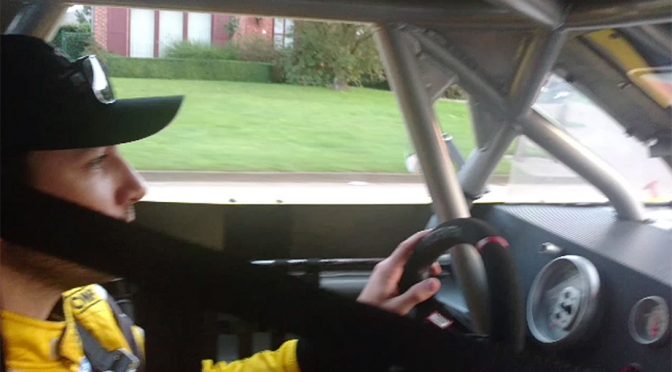
ZOLDER, Belgium — Alon Day was using his left hand to take cell phone video and his right hand to shift and that left no hands for the steering wheel. Ah well, the houses were set pretty far back from the road and we were not going that fast anyway.

I was riding shotgun as Day drove his No. 54 NASCAR Euro Whelen Series Chevrolet in a parade through Zolder, a small town in Belgium that is home to Circuit Zolder, site of the series’ season-ending races this weekend. The parade was meant to introduce drivers to fans, and I’m here to write about the growth and development of the series and its drivers. Day, a member of the 2016 NASCAR Next class and seen by many in the industry as a future star, is the points leader headed into the final two races (Saturday and Sunday).

We hadn’t gone half a mile when the parade of race cars ahead of us was gone. Drive nose to tail, organizers had said over and over again, so that drivers wouldn’t screw around. This being NASCAR, of course they did. Day also had to stop because a black van pulled out of a gas station in front of us, and by then there were five cars between us and the rest of the field.

We eventually caught back up, and Day said later that he didn’t want to drive too fast with me sitting next to him. Not only did I not have a seat belt, I did not, technically, have a seat. My butt rested on a pad, my legs were twisted to the left to avoid the battery and my back was against sheet metal.

Day is well known for adjusting to new racing situations — cars, tracks, weather, etc. — and he adapted to this one. He turned to me and said, “hold on to something.” I grabbed the roll cage just as he floored it. My butt sank into the pad and my back pressed against the sheet metal. Soon we were going way faster than I would ever tell the organizers. At least he was holding on to the wheel with both hands.


Day 2: Savoring cultural differences aplenty in Zolder

ZOLDER, Belgium — Members of the NASCAR community have a particular way of greeting each other. With square shoulders, they walk briskly toward each other, stop at arm’s length, and extend an arm for a handshake; occasionally a hug, or at least half of one, follows. It’s like long-lost friends who see each other all the time. The body language, a mixture of gravitas and familiarity, is so distinctive that I could spot it anywhere. I was surprised to see it in Belgium at Circuit Zolder, host of the NASCAR Whelen Euro Series races this weekend … and then even more surprised by the double-cheek kisses that often followed.

That’s a microcosm of NASCAR in Europe compared to NASCAR in America. It’s the same … and different. Take Friday’s drivers meeting. Drivers shuffled in. They sat down. Bored, they looked at their phones. Before the meeting began, it was just like every NASCAR drivers meeting I’ve ever been to. Then the meeting started, and the similarities ended.

Over and over again, series owner Jerome Galpin and race director Philippe Godet warned, cajoled, insisted, demanded and every other harsh word I can think of the drivers not run into each other. By comparison, NASCAR rules in America are presented as optional. Now, to be fair, this weekend will feature the last two races of the season, and Galpin and Godet did not want the championship decided by a wreck. But there’s also a cultural difference. In America, stock-car racing is a contact sport. Here, it isn’t … or at least not nearly as much.

One other way it’s the same and different: At the race track, the Euro NASCAR folks have made me feel more than welcome, which is exactly what it was like when I first started covering NASCAR in America.

I have been eating lunch and dinner with race officials, and in America, it’s common for me to be offered food in haulers. But that’s usually a hot dog and soda. Here, it’s like a potluck meets a picnic. Culturally, it’s French. We’ve had fish, chicken, salad, couscous, baguettes, bottles of wine and a cheese plate at the end of each meal (and also three courses of laughter). The cheese alone has made this trip worth it, to say nothing of the laughter.

RELATED: Talladega weekend schedule | Updated Playoff standings

It’s almost a guarantee that Sunday’s Monster Energy NASCAR Cup Series Playoff race at Talladega Superspeedway will be just what the title sponsor suggests — a monster.

It will be the first year that Talladega serves as the middle race in the Round of 12 instead of the second-round elimination race.

But that doesn’t mean the intensity will be any less. Actually, it might make it even greater.

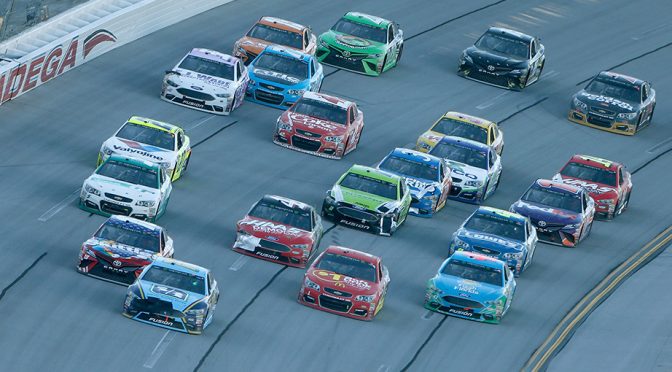
With the comfort in knowing next week’s cutoff race at Kansas offers a final chance if something goes haywire at unpredictable Talladega, drivers likely will be more inclined to take bigger risks to earn important stage points. That could transfer into three breathtaking sprints to the finish line at the 2.66-mile Alabama track.

We asked three past Talladega winners — Jamie McMurray, Ricky Stenhouse Jr. and Brad Keselowski — the keys to rolling into Victory Lane.

And just in case you need their credentials, Talladega is home to maiden Monster Energy Series victories for both Stenhouse (2017) and Keselowski (2009). Keselowski has gone on to earn three more wins, while McMurray has scored a pair of victories — in 2009 and 2013 — at the restrictor-plate track.

So, what does it take to win at ‘Dega? We’ll let the experts tell you.

SHOP: Stenhouse gear | Keselowski gear | McMurray gear

RELATED: Full schedule for Talladega | Last 10 winners at Talladega
SHOP: Keselowski playoff gear | Stenhouse playoff gear

“America! 1776! We are the champs! This validates what we did at Talladega!”

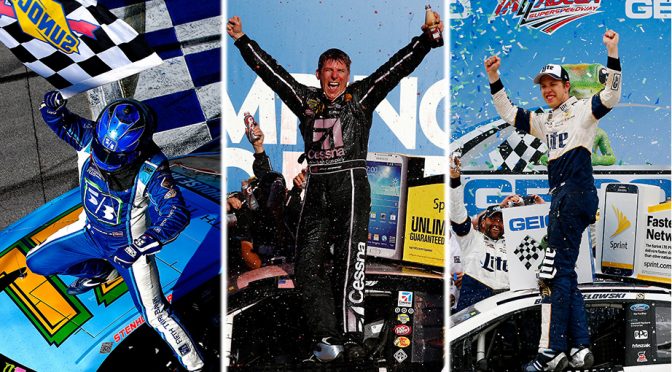
Those were the words of a jubilant Ricky Stenhouse Jr. after he won this summer at Daytona, backing up his win in May at Talladega and giving him two straight victories on restrictor-plate tracks in the 2017 Monster Energy NASCAR Cup Series season.

Can Ricky make it three in a row in Sunday’s Alabama 500 (2 p.m. ET, NBC, MRN, SiriusXM NASCAR Radio)? Or will Brad Keselowski come through at ‘Dega in the NASCAR Playoffs like he did before?

Or maybe it will be someone entirely different, like Dale Earnhardt Jr., who is the active leader at Talladega with six wins? NASCAR.com’s George Winkler and Allie Davison debate their top picks at Talladega:

Davison: It’s hard to argue that there is a better driver at restrictor-plate tracks than Ricky Stenhouse Jr. this year. He is 2-for-3 this year in restrictor-plate races (Talladega in May, Daytona in July) and the Talladega win marked his first ever Monster Energy Series victory. He currently sits at No. 12 in the playoff standings and will have his back against the wall on Sunday. However, he knows what it takes to get to Victory Lane at Talladega and you can’t dismiss experience.

RELATED: NASCAR Playoff standings

On the other hand, Brad Keselowski rose to the occasion in 2014 when he needed a win-or-be eliminated run at Talladega to advance in the NASCAR Playoffs. It’s been a quiet handful of races for the No. 2 driver, but that can only mean he is due for a win at any moment. What better way to make your presence known than by winning at the sport’s biggest track at 2.66-miles a lap? And he already has four wins at this particular superspeedway. I think it’s safe to take either Stenhouse Jr. or Keselowski on Sunday.

Winkler: Earnhardt Jr. has history on his side. Among active drivers, he’s No. 1 in wins (10), top fives (25) and laps led (1,562) on restrictor-plate tracks. Plus, he’s the sentimental choice in his last full-time appearance at a track where thousands will be cheering his name.

Junior hasn’t had the season fans hoped for, but winning the pole in the summer Daytona race — plus solid performances in the past two races — provide hope that this is his last best chance for a going-away-party win. And that would be sweet home Alabama, indeed.

TALLADEGA STATS: Stenhouse | Keselowski | Dale Jr. | Monster Energy Series drivers

RELATED: Updated Playoff standings | Hamlin: ‘Dega will be ‘exciting’

When the 2017 NASCAR schedule was released last spring, there was a lot of giddy buzz about the slight-but-crucial move of Talladega Superspeedway’s fall race in the playoff schedule.

And the overwhelming consensus was that moving it from a formidable second round “cut-off” race to its new middle-round “bring it on” position in the playoffs is a win-WIN situation.

The playoff drivers especially, will likely approach the race differently, no longer having to play it “safe” — an oxymoron anyway when it comes to restrictor-plate competition.

And the fans can count on even more drama, action and suspense at Talladega — which is hard to imagine.

“Talladega is indeed a wildcard race,” seven-time and reigning Cup champion Jimmie Johnson said. “I’m happy it’s not a cut-off for the Round of 8, but we really need to make it through the race and have a good finish. We don’t want to go to Kansas fighting to stay alive in the hunt for an eighth championship.”

SHOP: Jimmie Johnson playoffs gear

The right attitude about restrictor-plate racing is a rare treasure in the garage. Quite obviously, those boasting trophies from Talladega or the series’ other big track, Daytona International Speedway, seem to be more eager about this stop in the playoff schedule. Everyone, at least, considers a win a possibility.

“Yeah, I’ve done a lot of different things there and finished a lot of different ways,” Richard Childress Racing driver Austin Dillon said, essentially summing up the overall vibe.

Technique and mindset are invaluable here. And drivers will concede, yes, there is a certain skill set to mastering the tight pack of race cars.

Team Penske seems to have a good grip on the strategy and certainly holds the standard on recent winners at Talladega, with drivers Brad Keselowski (2012, 2014) and Joey Logano (2015, 2016) the only competitors with multiple wins in the last 10 races there. Keselowski scored his dramatic maiden Cup series victory at Talladega in 2009 and has a total of four career wins there — the most at any one track for him.

Dale Earnhardt Jr. has a famous five-victory score at Talladega — the most wins among active drivers — including a historic, not-likely-to-be-repeated four in a row between 2001-03. And the soon-to-retire driver is quite optimistic about making his final start on the speedway.

WATCH: Dale Earnhardt Jr. ‘Legacy’ video series

Ricky Stenhouse Jr. is making his first run at a Cup title thanks to his two restrictor-plate wins this year — at Talladega in May and at Daytona in July. In fact, Ford has won the last four straight at Talladega — a record streak for the blue oval on these high banks.

“I think there is something you can do,” Chevy driver and former Talladega pole-winner Chase Elliott said. “There are guys that have been consistently winning at those races over the past number of years. Anytime you see something consistently happen, there is obviously not just luck involved in it.

“We have to go there. It counts as much as the rest of them so I kind of look at it as an opportunity. The guys who have embraced it and have been willing to want to figure it out seem to excel and we would like to be among that group.”

Toyota carries a 2017 playoff sweep heading into Talladega, but it’s been seven races and three years (Denny Hamlin in May, 2014) since the manufacturer has won a race on this superspeedway.

Regular Season Champion and last week’s winner at Charlotte, Martin Truex Jr., may have been the happiest in the garage when Talladega’s position in the playoff round was moved. He won four races in 2016 and started on the pole in Talladega only to finish last (40th) with an engine failure and unable to advance to the next round of the playoffs despite being a huge championship favorite.

“We definitely want to perform (at Talladega), but I will say that it’s going to be pretty awesome going to Talladega and say, ‘Oh what the heck, let’s go race,’ ” said Truex, driver of the No. 78 Bass Pro Shops/TRACKER Boats Toyota. “Doesn’t matter if we crash. Talladega has just been a tough track for us to finish. I mean, last year we probably had the best car we’ve ever gone there with, and we ran (41) laps and blew up.

“There are so many unknowns at Talladega, and you can run up front all day long and finish 25th,” Truex added. “You can run up front and run 20 laps and get destroyed. You just never know. There is so much out of your control. To go there and not have to worry about all those things is definitely a good feeling.

“But we’ll go there and try to do everything just the way we did (at Charlotte). We want to be the best we can be, and we want to get those (playoff) bonus points and stop somebody else from getting them. But it will definitely be a little bit of a different feeling to go there and not have that pressure, not have to worry about if we go out early for something crazy.”

That kind of early playoff dominance combined with the new system of awarding stage points does create different strategies in very real and important ways.

RELATED: 2017 Stage points awarded

For drivers still needing to accumulate every point possible, there is real motivation to run up front and be there at the conclusion of each stage, instead of patiently waiting until the end of the race to make a move.

The massive scramble we’ve become accustomed to and holding our breath and watching wide-eyed in the closing laps of the race will now take place at least two additional times on Sunday afternoon to close out each stage — the intensity raised with playoff positions on the line.

“I think with the current points system, it’s better to stay up front and try to get as many points in each stage as you can throughout the day,” said Stewart-Haas Racing driver Kevin Harvick, who won at Talladega in April, 2010.

“Obviously, if you don’t qualify well, that makes it much more difficult but, with the new points system, I think you’re going to see a much different race.

“Guys aren’t going to be able to leave 20 potential points and playoff points on the table. They’re going to be racing for every point — that’s a good thing for the fans and should make it an exciting race.”

RELATED: Recap every Earnhardt win at Talladega

Racing fans know all too well when NASCAR’s most popular driver Dale Earnhardt Jr. takes the lead during a race.

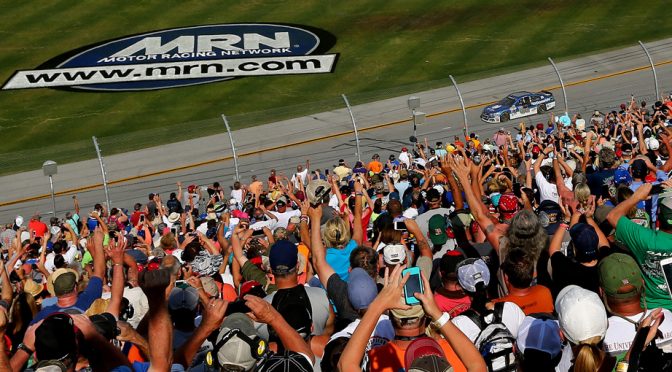
There’s the roar that suddenly arises through the grandstands, piercing the air over the already-loud sound of exhaust systems, and then often the standing ovation that unfolds like a choreographed routine.

This is especially true at Talladega Superspeedway — or as it’s often dubbed, Earnhardt Country. The place where both Junior and his father Dale Earnhardt have always been held in high esteem, holding a combined 16 wins at the Alabama oval.

RELATED: Previewing Junior’s last full-time start at ‘Dega

NASCAR’s favorite son often sees it, too.

“You can visually see a difference in the grandstands,” Earnhardt told NASCAR.com in June. “At Talladega, for example, when you take the lead. The difference visually between everybody sitting down and everybody standing up with their arms in the air is extremely easy to see.

“You come off of Turn 4, if you get the lead on the back straightaway and going into Turn 1 or something, the next time you come off Turn 4, you see everybody kind of waving their arms in the air and going crazy.”

RELATED: 88 things to love about Dale Jr.

It’s something that sticks with Earnhardt, giving him a bit of motivation while out front.

“It kind of makes that pass for the lead a lot more memorable and more fulfilling,” he said. “And it certainly motivates you to try as hard as you can to keep the lead and stay toward the front, keep fans excited and glued to what’s going on.”

So, Junior Nation: Stand up if Dale Jr. takes the lead in Sunday’s Alabama 500 at Talladega (2 p.m. ET, NBC, MRN, SiriusXM NASCAR Radio).

He’ll likely notice.

Editor’s note: This is the first in a series of four feature stories on this year’s Betty Jane France Humanitarian Award Presented by Nationwide finalists.

For the first time, The NASCAR Foundation’s Betty Jane France Humanitarian Award Presented by Nationwide has a hometown favorite.

Tammy Richardson, one of four finalists announced last week for the seventh annual award, is from Las Vegas. The award is presented during the Monster Energy NASCAR Cup Series Awards at Wynn Las Vegas. The award honors NASCAR fans who are also accomplished volunteers working for children’s causes in their communities throughout the United States. It also honors the memory and the philanthropic legacy of the foundation’s late founder, Betty Jane France, who passed away last August.

On Thursday, Nov. 30, the award winner will be announced. The winner will be determined by online voting at NASCAR.com/Award; voting ends on Nov. 29 at 5 p.m. (ET). The NASCAR Foundation donates $100,000 to the charity the winner represents and $25,000 to the other finalists’ charities.

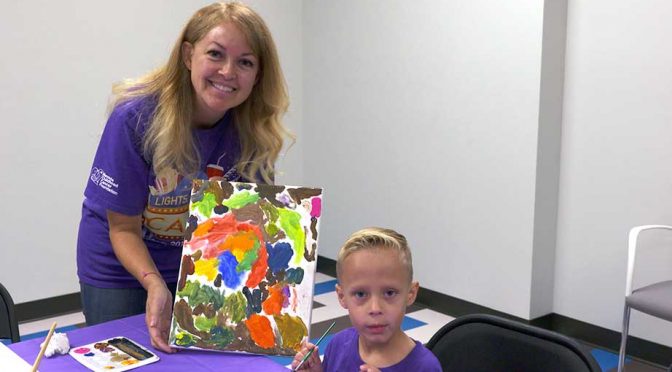
Richardson is representing the Nevada Childhood Cancer Foundation (NCCF), an organization that provides 25 pediatric programs and services to nearly 500 children. One of those programs is “Camp Cartwheel,” an outdoor camp experience designed to help children fighting cancer and other critical diseases. Richardson, a longtime volunteer and committee member at Camp Cartwheel, also operates the Camp Store, providing items and gifts for attendees. Funds received from the Betty Jane France Humanitarian Award would go toward the NCCF’s Emergency Funding Program that covers housing, travel, medical expenses and the cost of camp.

Richardson has imagined what it would be like to walk across the stage in her hometown, as the 2017 award winner.

“It would be amazing … it would be overwhelming but very humbling at the same time … it would be huge,” Richardson says. “Vegas is where I live, it’s where I’m from and it’s where our organization is located.”

Richardson volunteers 11 months annually at Camp Cartwheel, a commitment that has no end in sight. Richardson has special motivation driving that commitment.

The ultimate motivation, really.

Richardson, 52, lost her teenage daughter Stephanie to cancer in 2003. The experience was devastating, acerbated by the type of cancer and Stephanie’s rapid decline after the 2002 diagnosis of an inoperable brain tumor.

Suddenly, there was so little time. But there was still time for Stephanie to leave lasting memories. After her diagnosis she bravely announced her plan to personally meet every child in the state of Nevada who was also battling cancer. Fully aware that her own fight would not be won, she was committed to providing support to others.

Richardson became aware of Camp Cartwheel when her daughter became ill. In the years since her daughter passed away, Richardson has accelerated her volunteerism at the camp, striving to finish Stephanie’s unfinished task of meeting children with cancer throughout Nevada.

When Richardson describes the work being done at Camp Cartwheel, it’s clear she cherishes her involvement. She knows she’s honoring her daughter’s memory in the best way possible.

“A lot of these children at our camps do not get to do regular normal activities outside their home or outside a hospital environment,” Richardson said. “Some of these kids are critical and some of them are terminal.  get to help give them the most amazing time I can, to let them be okay for a while. So when they come to our camps, they get to be that normal child for four days.”

Richardson’s NASCAR connection is all about family — and the sport’s longstanding link to the U.S. military. Dale Earnhardt Jr.’s affinity for the military caught her eye — and her heart — some years back. Her husband Jim husband is an Army veteran and her son is currently serving the nation. Along the way, Earnhardt became Richardson’s favorite driver.

“My Dad was a Southern boy and I was raised in Las Vegas so the speedway was sort of right out the back door,” Richardson said. “It’s something I’d always done with my dad and now I do with my spouse. It’s a family thing and it’s a tie to America. And with NASCAR, it’s something where you can escape. You don’t have to worry about the real world.

“Kind of like our camp.”

When NASCAR fans think “Dale Earnhardt Jr.,” they think “legacy.”

Following in the footsteps of his seven-time NASCAR champion father, Dale Earnhardt, Junior burst onto the scene as the calendar turned the page on a new millennium. Nearly two decades later, NASCAR’s most popular driver is riding into the sunset, hanging up the fire suit full-time at season’s end.

Junior has always looked up to his father, bonding through racing — after all, it’s in his blood. He wanted his respect, his attention and to succeed in the larger-than-life shadow his dad cast, making “The Intimidator” proud in the process.

NASCAR.com has teamed up with John Deere to bring you the three-part series, Legacy: Dale Earnhardt Jr.

Watch Part 1, Born to Race, above, as Senior brings the next generation of Earnhardt to the Cup level, and Junior delivers.

PART 2

“We’ve lost Dale Earnhardt.”

When Dale Earnhardt Jr. lost his father in February 2001, NASCAR wept with him. Since that turning point, the sport has moved forward with Junior, who withstood the test of some of the most trying adversity to become the face of NASCAR.

Six months following the tragic death of Senior, a still-grieving Dale Jr. continued to move forward and build his own legacy in his father’s honor by winning in July at Daytona — the very same track that took his father’s life.

The “Dale Jr.” persona was cemented in time that night and has grown bigger and bigger ever since.

NASCAR.com has teamed up with John Deere to bring you the three-part series, Legacy: Dale Earnhardt Jr.

Watch Part 2, Driven to Succeed, below, as Junior overcomes tragedy to find glory in tribute to his father at Daytona.


PART 3

With the final weeks of Dale Earnhardt Jr.’s full-time racing career upon us, the legacy he leaves behind comes into focus.

Over the course of his two decades-plus in the sport, Junior has shown how the son of one of NASCAR’s greatest can grow up and mature in the face of tragedy, using his father’s life lessons to become the man he is today.

Often heralded as an “everyday guy,” Earnhardt has become one of the most important voices in the sport, a mentor to young drivers at his JR Motorsports organization and, starting next year, a broadcaster.

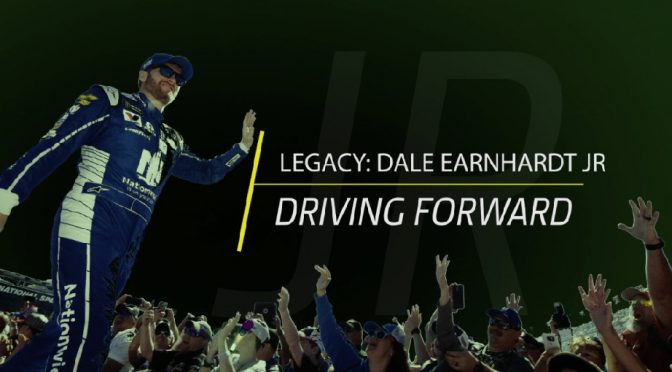
Watch the closing chapter of the Dale Earnhardt Jr. Legacy Series presented by John Deere in Part 3, Driving Forward, below.